💥UPSC 2026, 2027, 2028 UAP Mentorship (March Batch) + Access XFactor Notes & Microthemes PDF

Search results for: “”

  • Health Star Rating System of FSSAI for Packaged Food

    The “health star rating” system that the Food Safety Standards Authority of India (FSSAI) plans to adopt in order to help consumers reduce their intake of unhealthy foods has been opposed by close to a dozen consumer and health advocacy groups.

    What is the Health Star Rating System?

    • In February, the FSSAI decided to adopt the “health-star rating system”, which gives a product 1/2 a star to 5 stars, in its draft regulations for front of package labelling (FOPL).
    • The HSR format ranks a packaged food item based on salt, sugar, and fat content and the rating will be printed on the front of the package.
    • The underlying premise of the HSR is that positive ingredients such as fruits and nuts can offset negative nutrients such as calories, saturated fat, total sugar, sodium to calculate the number of stars ascribed to a product.
    • The decision was based on the recommendations of a study by the IIM-Ahmedabad the regulator had commissioned in September 2021.
    • In the same meeting, the regulator decided that FOPL implementation could be made voluntary for a period of four years.

    What is FoPL?

    • In India, packaged food has had back-of-package (BOP) nutrient information in detail but no FoPL.
    • Counter to this, FoPL can nudge people towards healthy consumption of packaged food.
    • It can also influence purchasing habits.
    • The study endorsed the HSR format, which speaks about the proportions of salt, sugar, and fat in food that is most suited for consumers.
    • Countries such as the UK, Mexico, Chile, Peru, Hungary, and Australia have implemented FoPL systems.

    What warranted the HSR rating in India?

    • Visual bluff: A lot of Indian consumers do not read the information available at the back of the packaged food item.
    • Burden of NCDs: Also, India has a huge burden of non-communicable diseases that contributes to around 5.87 million (60%) of all deaths in a year.
    • Healthy dietary choices: HSR will encourage people to make healthy choices and could bring a transformational change in the society.
    • Supreme Court order: A PIL seeking direction to the government to frame guidelines on HSR and impact assessment for food items and beverages was filed in the Supreme Court in June 2021.

    Which category of food item will have HSR?

    • All packaged food items or processed food will have the HSR label.
    • These will include chips, biscuits, namkeen, sweets and chocolates, meat nuggets, and cookies.
    • However, milk and its products such as chenna and ghee are EXEMPTED as per the FSSAI draft notified in 2019.

    Will there be pushback from food industry?

    • Negative warning: Some experts opposed the use of the HSR model in India, suggesting that consumers might tend to take this as an affirmation of the health benefits rather than as a negative warning of ill effects.
    • Lack of awareness: This is significant because there is lack of awareness on star ratings related to consumer products in India.
    • Impact on Sale: Certain organisations fear it might affect the sale of certain food products.

    Arguments against health star rating

    • Experts argue that “warning labels” instead have been most effective in various countries.
    • They said the HSR system adopted in countries like Australia and New Zealand has not resulted in any meaningful behavior change.
    • Even after eight years of their implementation, there is still no evidence of HSRs having a significant impact on the nutritional quality of people’s food and beverage purchases.
    • Also, the HSR system “misrepresents nutrition science”.
    • The algorithm of adding and subtracting nutrients does not fit with our understanding of biology.
    • For example, the presence of fruit in a fruit drink juice does not offset the impacts of added sugar in the body.


    UPSC 2022 countdown has begun! Get your personal guidance plan now! (Click here)

  • UPSC Mock Interview 2021: Paneled by former EC, Dy CAG, CEC, and Secretary level bureaucrats | On-demand session: book your slot

    UPSC Mock Interview 2021: Paneled by former EC, Dy CAG, CEC, and Secretary level bureaucrats | On-demand session: book your slot

    Book your slot for UPSC Mock interviews (paneled by ex UPSC members) and get a dedicated mentor, on-call DAF analysis, DAF-based personalized questionnaire, and Situational questionnaire (FREE)

    To give you a real feel of the panel that you will be facing in your real UPSC interview 2021, CD has brought together a mix of the most experienced and valued panelists for your mock interview.

    Panelists for Mock Interviews: 

    1. Shri Shankar Aggarwal, IAS (retd.), former Secretary
    2. Dr. Noor Mohammad, IAS (retd.), former EC
    3. Dr. P.K. Agrawal, IAS (Retd.), former Ch. Secy
    4. Shri T. N. Thakur, IAAS (retd.), former Dy CAG
    5. Shri V. P. Singh, IRPS
    6. Mrs.Aditi Gupta, Corporate Leadership Specialist
    7. Prof. U.M. Amin, Jamia Milia University
    8. Mr. S. D. Singh, IFoS (Retd.)
    9. Mr. Kunal Aggarwal, IRS
    10. Mr. Debraj Das, IPS

    Tentative: Shri S. Y. Quraishi (former CEC), Shri Harsh V. Pant (Observer Research Foundation), Shri SN Tripathi, IAS (Director IIPA), Shri Yogesh Narain (Retd. Defence Secretary), Shri Dipankar Gupta (Indian Sociologist), and others.

    Upcoming Mock interview and session

    This week’s mock interview dates have been fixed.

    • Mock interview this week 2nd May onwards – (Book your slot)   
    • Time: 10 a.m. – 7 p.m.  
    • Mode: Online/Offline 

    Do You Know That Civilsdaily Has a 75% Success Rate In UPSC Interview?

    Interview slots will be allocated on a first-come, first-served basis.

    This image has an empty alt attribute; its file name is WhatsApp-Image-2022-03-15-at-4.15.52-PM.jpeg

    Transcend Interview Guidance 2021: Program inclusion

    1. 2 Mock interviews, detailed analysis + feedback
    2. Most important issues coverage – current and structural
    3. Personalized mentorship
    4. DAF analysis and one-on-one sessions with in-service officers and panelists
    5. DAF based personalized questionnaire
    6. Situational and Roleplay questionnaire

    Do You Know That Civilsdaily Has a 75% Success Rate In UPSC Interviews?

    As a part of Transcend Interview Guidance Program for UPSC 2021 we’ve prepared and compiled a high-quality comprehensive questionnaire.

  • Why it took 5 attempts for me and the mistakes you should avoid | WEBINAR by Prabhat Gyanendra Singh, AIR 377, 2020 (JOINING LINK inside)

    Why it took 5 attempts for me and the mistakes you should avoid | WEBINAR by Prabhat Gyanendra Singh, AIR 377, 2020 (JOINING LINK inside)

    Prabhat Singh secured an AIR 377 in his 5th attempt. He’ll be available for a discussion and Ask Me Anything session for UPSC CSE. He will be focussing on choosing Optionals as well.

    Join Zoom Meeting

    https://us06web.zoom.us/j/84167109252?pwd=MWtaVXgxdWJkUk9DNWU2TG8zWTJEZz09

    Webinar Details

    A busy IRPS Officer like PRABHAT GYANENDRA SINGH  is free only on a Sunday. But he loves to dedicate his Sundays to mentoring upcoming civil servants. So join him and give your UPSC preparation a new Edge and direction! This webinar is absolutely free. All aspirants are heartily welcome to attend.

    Date: 1st May 2022 (Sunday)

    Time: 3 to 4 PM

    Join Zoom Meeting

    https://us06web.zoom.us/j/84167109252?pwd=MWtaVXgxdWJkUk9DNWU2TG8zWTJEZz09

    Infallible Tips to Learn in This Free Live Webinar by IRPS PRABHAT GYANENDRA SINGH

    • How can an aspirant’s academic and personal interests guide in choosing one’s optional?
    • How can an aspirant’s academic and personal interests guide in choosing one’s optional?
    • What is the Optional subject’s contribution to the General Studies curriculum?
    • In the recent past, Discussion on performance of various optional subject (past 5 years)
    • Effective Time Management for optional.
    • Various Benefits and Drawbacks of Humanity Optional
    • Why I will not follow the crowd. What are the difficulties it faces?
    • Discussion on Literature (optional) and its ramifications
    • Why should you be cautious before enrolling in Public Administration and Law?
    • Implications of selecting the incorrect optional on your preparation and result.
    UPSC Topper - Singh Prabhat Gyanendra, UPSC 2019, AIR 377 - Mock Interview  with Civilsdaily - YouTube

    About PRABHAT GYANENDRA SINGH 

    PRABHAT GYANENDRA SINGH was a B.sc Statistics from Gujarat University, M.G. Science college.  He completed his LL.B from Campus Law Centre, Delhi University LL.M. – I.P.S. Roorkee, UTU. On a personal level, he pursued further education, especially in public policy. In his attempt of CSE 2019 with Law as an optional secured All India Rank 377.

    Join Zoom Meeting

    https://us06web.zoom.us/j/84167109252?pwd=MWtaVXgxdWJkUk9DNWU2TG8zWTJEZz09

  • (Join webinar using this link)  How to choose an Optional for UPSC-CSE 2023| Webinar by PRABHAT GYANENDRA SINGH, IRPS

    (Join webinar using this link) How to choose an Optional for UPSC-CSE 2023| Webinar by PRABHAT GYANENDRA SINGH, IRPS

    Link: https://us06web.zoom.us/j/84167109252?pwd=MWtaVXgxdWJkUk9DNWU2TG8zWTJEZz09


    There is no dearth of advice floating around on the internet about ‘How to choose an optional subject for UPSC!’. Are those enough for an aspirant to make the right decision and score 350+ out of 500? 

    Some websites suggest ‘Hindi Literature’ for Hindi medium students and ‘Sociology’ for English medium. It’s extremely important to justify what are the exact principles that must be taken under scrutiny while selecting your optional subject. Because you have to choose 1 optional, not randomly and it will decide your rank for IAS.

    Is it only subjective interest that will work for you or should it be helpful to GS & essay papers too or highly scoring itself? 

    Attend the free live webinar conducted by Civilsdaily’s topper PRABHAT GYANENDRA SINGH to understand how to select the optional subject for UPSC to have an edge over the competition.

    Webinar Details

    A busy IRPS Officer like PRABHAT GYANENDRA SINGH  is free only on a Sunday. But he loves to dedicate his Sundays to mentoring upcoming civil servants. So join him and give your UPSC preparation a new Edge and direction! This webinar is absolutely free. All aspirants are heartily welcome to attend.

    Date: 1st May 2022 (Sunday)

    Time: 3 to 4 PM

    Link: https://us06web.zoom.us/j/84167109252?pwd=MWtaVXgxdWJkUk9DNWU2TG8zWTJEZz09

    Infallible Tips to Learn in This Free Live Webinar by IRPS PRABHAT GYANENDRA SINGH

    • How can aspirant’s academic and personal interests guide in choosing one’s optional?
    • What is the Optional subject’s contribution to the General Studies curriculum?
    • In the recent past, Discussion on performance of various optional subject (past 5 years)
    • Effective Time Management for optional.
    • Various Benefits and Drawbacks of Humanity Optional
    • Why I will not follow the crowd. What are the difficulties it faces?
    • Discussion on Literature (optional) and its ramifications
    • Why should you be cautious before enrolling in Public Administration and Law?
    • Implications of selecting the incorrect optional on your preparation and result.
    UPSC Topper - Singh Prabhat Gyanendra, UPSC 2019, AIR 377 - Mock Interview  with Civilsdaily - YouTube

    About PRABHAT GYANENDRA SINGH 

    PRABHAT GYANENDRA SINGH was a B.sc Statistics from Gujarat University, M.G. Science college.  He completed his LL.B from Campus Law Centre, Delhi University LL.M. – I.P.S. Roorkee, UTU. On a personal level, he pursued further education, especially in public policy. In his attempt of CSE 2019 with Law as an optional secured All India Rank 377.

    Link: https://us06web.zoom.us/j/84167109252?pwd=MWtaVXgxdWJkUk9DNWU2TG8zWTJEZz09

  • Death Penalty

    Context

    On April 22, a Bench of the Supreme Court of India, led by Justice U.U. Lalit, decided to critically examine the routine and abrupt way in which trial judges often impose the death penalty on convicts.

    Individualistic approach

    • The challenge before the Court in the instant case of Irfan vs State of Madhya Pradesh was to identify the mitigating circumstances and to ensure a convict-centric approach so that the imposition of capital punishment becomes rarer, fairer, and principled.
    • According to the Court, “a ‘one size fit for all’ approach while considering mitigating factors during sentencing should end”.
    • Mitigation expert: The Bench indicated the need for mitigation experts to assist trial courts in reaching a correct conclusion on whether one should be sent to the gallows or not.
    • The Court seemed to think that an individualistic approach that examines the social, economic, emotional, and genetic components that constituted the offender rather than the offence, would go a long way in evolving a just and judicious sentencing policy.
    • An analysis of the possible reasons to avert the death penalty is reflected in a series of recent verdicts such as Lochan Shrivas vs State of Chhattisgarh (2021) and Bhagchandra vs State of Madhya Pradesh (2021).
    • These reasons might include socio-economic backwardness, mental health, heredity, parenting, socialisation, education, etc.

    Background of the humane and reformist framework

    • The special reason: According to Section 354(3) in the Code of Criminal Procedure, while imposing the capital punishment, the judge should specify “the special reasons” for doing so.
    • It was in Bachan Singh vs State of Punjab (1980) that the Constitution Bench suggested a humane and reformist framework in the matter.
    • Bachan Singh requires the trial courts not only to examine the gravity of the offence but also the condition and the ‘reformability’ of the accused. 
    • Not unconstitutional: The Court, in Bachan Singh, refused to declare the death penalty as unconstitutional. 
    • It abundantly implied that no person is indubitably ‘irreformable’.
    • It had the effect of practically undoing the death penalty provision, if taken in its letter and spirit.
    • Person-centric approach: This person-centric approach, for its materialisation, needs a different judicial acumen that recognises the convict in her multitudes.

    Is the Bachan Singh doctrine followed?

    • The Bachan Singh principle was followed more in its breach than in compliance even by the Supreme Court.
    • In Ravji vs State of Rajasthan (1995), the Supreme Court said that it is the nature of the crime and not the criminal which is germane for deciding the punishment.
    • Several other cases also were decided by ignoring the Bachan Singh doctrine, as noted by the Supreme Court itself in Santhosh Kumar Satishbhushan Bariyar vs State of Maharashtra (2009) and Rajesh Kumar vs State (2011).
    • This egregious judicial error will have to be kept in mind while the Court revisits the issues related to mitigating factors and individual-centered sentencing policy in the Irfan case.
    • Shortcomings of Bachan Sing: Bachan Singh did not, in concrete terms, elaborate on the mitigating factors and the methods to gather them to avert the death penalty.
    • Nor did it explain the issues such as burden of proof and standard of proof in detail.

    Issue of misuse and overuse

    • Misuse of sedition provision: The Indian experience shows that whenever the Court tries to dilute the harshness of penal provisions by a balancing approach, instead of striking down the provision, the instrumentalities of the state (including the police, the prosecution and the court) continue to overuse or misuse the provisions.
    • The Supreme Court endorsed the validity of the sedition law (Section 124A of the Indian Penal Code) with a rider that it could be invoked only when there is an incitement to violence.
    • But the state seldom acts based on interpretation of the law. 
    •  Many were booked for the charge of sedition since then for mere words, innocent tweets or harmless jokes.

    Social implications

    • Disproportionate effect on the poor: In India, as elsewhere, the poor, rather than the rich, are sent to the gallows.
    • Ineffectiveness of legal assistance: In Williams vs Taylor (2000), the U.S. Supreme Court said that failure of the defence lawyer in highlighting the mitigating factors that could lead to avoidance of capital punishment makes the legal assistance ineffective. 
    • Therefore, it infringes constitutionally guaranteed rights.
    • In the Indian scenario, the legal assistance received by the poor facing serious charges is far from satisfactory.
    • Mitigating factors not placed: And in the matter of sentencing too, the mitigating factors are either not placed before the trial court or not persuaded adequately to convince the trial judge to avoid the death penalty.

    Way forward

    • Taking empirical lessons from the fate of Bachan Singh, the Supreme Court may have to now ask the more fundamental question posed and negatived in Bachan Singh — the question of the constitutional validity of death penalty.
    • Comprehensive report: The Court, in the instant case, will have to evolve a legal device for procurement of a comprehensive report dealing with the socio-economic and hereditary backgrounds of the accused from experts in the fields of social work, psychiatry, psychology, anthropology, etc.
    • Violation of Article 21: The Court may have to revisit Bachan Singh itself in so far as it refused to declare the death penalty as violative of the right to life envisaged under Article 21 of the Constitution.
    • Across the world, 108 nations have abolished death penalty in law and 144 countries have done so in law or practice, according to the Amnesty Report of 2021.
    • Judicial errors: In the Indian context, where judgmental error is quite frequent and the quality of adjudication is not ensured, what is required is a judicial abolition of death penalty. 

    Conclusion

    The present matter will have to be referred to a larger Bench, with a view to rectify the foundational omission in Bachan Singh — of not explicitly declaring capital punishment as unconstitutional.

    UPSC 2023 countdown has begun! Get your personal guidance plan now! (Click here)

  • [Burning Issue] China’s Debt Trap Diplomacy

    UPSC 2023 countdown has begun! Get your personal guidance plan now! (Click here)

    Context

    • Sri Lanka continues to grapple with its worst-ever economic crisis as it has defaulted on all of its external debt of about $51 billion – after running out of foreign exchange for imports, calling it the last resort.
    • So while domestic policies are largely being seen as reasons for Sri Lanka’s economic collapse, many also blame China for the unprecedented crisis in the island nation.
    • Defaults over China’s infrastructure loans to Sri Lanka, especially the financing of the Hambantota port are being cited as factors leading to the crisis.

    In this article, we will try and understand China’s lending model and the reasons it is coming under increasing criticism from low & middle-income countries against unsustainable debt.

    American statesman John Adams, who served as president from 1797 to 1801, famously said, “There are two ways to conquer and enslave a country: One is by the sword; the other is by debt.” China, choosing the second path, has embraced colonial-era practices and rapidly emerged as the world’s biggest official creditor.

    What is Debt Trap Diplomacy?

    • Loans to repay loans: The debt trap is a situation where one is forced to over consume loans to repay your existing debts.
    • Political leverage is exploited: Debt-trap diplomacy is a term in IR which describes a creditor country or institution extending debt to a borrowing nation partially, or solely, to increase the lender’s political leverage. The term was coined by an Indian academic Brahma Chellaney.
    • IMF and Chinese tools of coercion: Although the term is most commonly associated with China, it has also been applied to the International Monetary Fund (IMF); both allegations, however, are disputed.

    Features of such diplomacy

    • Lending is initially very indiscriminate
    • Terms of the loans are often not publicized
    • More conditional loans are offered to repay and restructure old debts
    • Such loans benefit the lender by undue exploitation of the borrower
    • Interest rates are hefty and unrealistic
    • It seeks sovereign guarantee and sovereign leases
    • Default leads to geo-strategic overtakes ex. PLA Navy being deployed at Hambantota Port

    Roots of such policy

    • There are many cases of countries in the 19th and early 20th century, the high-water mark of European colonialism and imperialism, using debt-funded infrastructure projects to embark on rapid modernisation.
    • For instance, the French-led design and construction of the Suez Canal.
    • It involved the issuing of £3.3 million’s worth of Egyptian bonds in 1863 on behalf of the Egyptian Khedive.
    • In return Egypt, committed to provide labour and a 99-year operational lease to France (much similar to the terms of Hambantota Port).
    • One of the earliest successes of China’s debt-trap diplomacy was in securing 1,158 square kilometers of strategic Pamir Mountains territory from Tajikistan in 2011 in exchange for debt forgiveness.

    Sri Lankan Case

    • Using its own brand of “strategic investments” China is now forcing smaller states to abide by its dictates.
    • Sri Lanka’s case is a text-book example of the Chinese modus operandi in pursuing its strategic interests.
    • In July 2017, the Sri Lankan government and CMPort (China Merchants Port Holdings Company), a state- owned Chinese company, signed an agreement.
    • It granted China a 99-year lease of the Hambantota harbour and 15,000 acres of land in exchange for $1.2 billion.

    How does China seek to achieve this?

    • Belt and Road Initiative (BRI): The BRI is a trillion-dollar initiative, which makes large-scale loans available to countries seeking to build infrastructure projects.
    • Ignorance to creditworthiness: Instead of first evaluating a borrower country’s creditworthiness, including whether new loans could saddle it with an onerous debt crisis, China is happy to lend.
    • Secrecy of negotiations: The China allegedly keep negotiations very secret and non-competitive pricing of projects.
    • Bidding is closed-door: Contracts go to Chinese state-owned or state-linked companies which charge significantly above-market prices.
    • Bribing of the govt: China also shows up with bribes to senior leaders in countries, in exchange for infrastructure projects.

    Worst outcomes

    • Sri Lanka: It was forced to hand over control of the Hambantota port project to China for 99 years, after it found itself under massive debt owed to Beijing.
    • Pakistan: It is literally sold to into the hands of the China over the development of China Pakistan Economic Corridor (CPEC).
    • Gulf region: Similarly, in exchange for relief, China constructed its first military base in Djibouti.
    • India: SL allowed China control over a key port positioned at the doorstep of its regional rival India, and a strategic foothold along a key commercial and military waterway.

    Chinese prophecy of its policy

    • Anti-China sentiments: Communist Party of China calls it a “meme” which became popular due to “human negativity bias” based on anxiety about the rise of China as a global superpower.
    • Obsession for China over the West: Many nations, Pakistan being the best example finds China as an attractive partner for their development.
    • Success of such loans: Most of the debtor countries voluntarily agreed to the loans and had positive experiences working with China.
    • Already existing debt distress: CCP conforms that Chinese loans are not currently a major contributor to the already existing debt distress in Africa.
    • Debt-Restructure Policy: China restructured or waived loan payments for 51 debtor nations (most of the BRI’s participants) without seizing state assets.
    • Case par excellence: Hambantota is an exception for China’s since the project was proposed by former Sri Lankan president Mahinda Rajapaksa, not Beijing.
    • Its borrowers who seek loans: China’s leverage in debt renegotiation is often exaggerated, and was realistically limited in power.
    • Waivers are considered: Considering the particular case of Pakistan, asset seizures are a very rare occurrence, and debt write-off is the most common outcome.

    Why do countries go for Chinese offers?

    • Distressed under-developed /developing countries: In retrospect, China’s designs might seem obvious. But the decision by many developing countries to accept Chinese loans was, in many ways, understandable.
    • Negligence by World Bank and IMF: Most developed nations got neglected by institutional investors, since they had major unmet infrastructure needs. Countries that don’t want to go the IMF for a bailout when they’re in trouble, they went to China instead.
    • Former colonists turned blind eyes: Most African and Asian countries turned troubled after de-colonization. Their finances were literally sucked up by colonists in post WW2 recovery.
    • China empathized when nobody else did: So when China showed up, promising benevolent investment and easy credit, they were all in.
    • Blaming Beijing is the easier option:  It became clear only later that China’s real objectives were commercial penetration and strategic leverage; by then, it was too late, and countries were trapped in a vicious cycle.

    Do you know?

    The State Bank of Pakistan (SBP), the central bank is no more a sovereign bank unlike the RBI. It has now become a commercial bank!

    Has India taken any loans from China?

    Ans. No. It’s the AIIB Loan.

    • India has not entered into any loan agreement directly with China.
    • However, it has been the top borrower of Asian Infrastructure Investment Bank (AIIB), a multilateral bank wherein China is the largest shareholder (26.6% voting rights) and India is the second (7.6% voting rights). 
    • China’s vote share allows it veto power over decisions requiring super-majority.
    • Loans provided to India could also pave the way for Chinese firms to enter and gain experience in the promising Indian infra market.

    Impact of Chinese policy on India

    • Almost all neighbours got lured: Most of India’s neighbours have fallen prey to China’s debt trap, and ceded to China’s $8 tn project – One Belt One Road Initiative (OBOR).
    • India’s sovereignty concerns disregarded: CPEC requires India to accept that the Kashmir-controlled Pakistan region, is Pakistan, because that’s where some of the projects are.
    • Perception change against traditional partners: China through OBOR can hence increase India’s political cost of dealing with its neighbours. Ex. Bangladesh now cherishes Chinese affinity more than its liberator.

    A critical assessment

    • Of course, extending loans for infrastructure projects is not inherently bad: The projects that China is supporting are often intended not to support the local economy, but to facilitate Chinese access to natural resources, or to open the market for its low-cost exports.
    • Several projects are now bleeding money: In a sense, it is even better for China that the projects don’t do well. After all, the heavier the debt burden on smaller countries, the greater China’s own leverage becomes.
    • Chinese morale are now high enough to prey its small neighbours: China has used its clout to push Cambodia, Laos, Myanmar, and Thailand to block a united ASEAN stand against China’s aggressive pursuit of its territorial claims in the South China Sea.
    • China is establishing its monopoly: In financially risky countries, China now demands majority ownership up front. For example, China clinched a deal with Nepal this month to build another largely Chinese-owned dam there, with its state-run China Three Gorges Corporation taking a 75% stake.
    • Debt for a debt has become crème de la crème: In exchange for rescheduling repayment, China is requiring countries to award it contracts for additional projects, thereby making their debt crises interminable.
    • China is becoming increasingly opportunistic and seizing assets: Countries that are not yet ensnared in China’s debt trap should take note – and take whatever steps they can to avoid it.
    • Deadly obligations are pre-conditions: China does obligate the borrower to exclude the Chinese debt from any multilateral restructuring process, such as the Paris Club of official bilateral creditors, and from any “comparable debt treatment.”
    • China has taken over exclusive development rights:  In small island nations, China has converted big loans into acquisition of entire islets through exclusive development rights. It took over a couple of islets in the Indian Ocean archipelago of the Maldives and one island in the South Pacific nation of the Solomon Islands.
    • Some developing economies are regretting their decision: Protests have erupted over widespread joblessness, purportedly caused by Chinese dumping of goods, which is killing off local manufacturing, and exacerbated by China’s import of workers for its own projects.
    • Rise of neo-imperialism: By integrating its foreign, economic, and security policies, China is advancing its goal of fashioning a hegemonic sphere through security links. If states are burdened with high levels of debt as a result, their financial woes only aid China’s neocolonial designs.

    Do you know?

    Yuan is now the official currency of Zimbabwe!

    Way forward

    • India needs to loop in: Getting ready to challenge China’s profile by enhancing its own regional role as an economic and security actor is the need of the hour for India.
    • Ring-fencing of its neighbours: India also needs to maintain its influence in the region and counter the growing debt-trap initiatives via cooperative strategies and humanitarian aid, a move aimed to ring-fence its strategic interests.
    • Countering China in maritime sphere: At a time when China is strangling India in the north with its attempts to change facts on the ground, it is imperative for India to strategically think of using the maritime sphere to break Beijing’s growing dominance in its periphery.
    • Alternatives for finances: India needs to push these small countries to improve its ties with the US and the West. The so called ‘assistance’ should be as per international standards or as per the interest rate imposed by the World Bank, the Asian Development Bank and others.

    Conclusion

    • Thus it is very much clear that- China often begins as an economic partner of a small, financial weak country and then gradually enlarges its footprint in that state to become its economic and political master. 
    • Atmanirbharta (Self-reliance) is the key to all such miseries.
  • Placing semicon diplomacy at the heart of India’s foreign policy

    Context

    The current decade presents a unique opportunity to India. . India must seize this opportunity and become an attractive alternative destination for semiconductor manufacturing.

    Importance of semiconductors

    • Semiconductor chips are the lifeblood of the modern information age.
    • The semiconductor is the cornerstone of all electronic products.
    • They enable electronic products to compute and control actions that simplify our lives.
    • These semiconductor chips are the drivers for ICT development and one of the key reasons for the current flattening of the world

    Global cooperation driven by semiconductors

    • The manufacturing cycle of a semiconductor chip from sand to a finished product, sees it change hands approximately 70 times across international borders.
    • Concentrated in few geographies: The semiconductor manufacturing capacities are concentrated in a few geographies.
    • Nearly all leading edge (sub 10nm) semiconductor manufacturing capacity is limited to Taiwan and South Korea, with nearly 92 per cent located in the former.
    • Further, 75 per cent of the semiconductor manufacturing capacity is concentrated in East Asia and China.

    Opportunity for India

    • Companies are looking to diversify their supply chain and for alternatives to their bases in China.
    • The chip shortages due to Covid-19 have hit automakers with a revenue loss of $110 bn in 2021.
    • The Russia-Ukraine conflict and its implications for raw material supplies for the semiconductor value chain has also poised chipmakers to invest in strengthening the semicon supply chain.
    • India must seize this opportunity and become an attractive alternative destination for semiconductor manufacturing.
    • The way ahead is conceptualising a semicon diplomacy action plan.
    • Placing semicon diplomacy at the heart of India’s foreign policy is essential both strategically and economically.
    • The multiplier effect on the economy: The establishment of the value chain for semiconductors would ensure a multiplier effect on the entire economy. 
    • National security implications: Semiconductors are used in critical infrastructures such as communication, power transmission etc., that have implications for national security. 
    • Reducing the BoP: Domestic production would be saving forex and reducing the balance of payments, especially vis a vis China.

    Way forward: Leveraging Semicon diplomacy

    • One of the ways of leveraging semicon diplomacy is increasing multilateral and bilateral cooperation.
    • Role of Quad: A key institution with immense potential in this regard is the Quad.
    • Australia, being rich in raw materials required for semiconductors, can be an important supplier to fill in India’s deficits.
    • The US and Japan can be leveraged for capacity building and their advanced semiconductor technology in logic and memory segments.
    • Pivot India’s Act East Policy: Considering that the semiconductor manufacturing and testing bases are heavily concentrated in East Asia, the Act East policy provides an opportunity to connect and strengthen ties with key players in the region.
    • Technological exchanges with ASEAN: Frequent technological exchanges between a regional bloc like ASEAN via tracks in forums like the East Asia Summit and the ASEAN regional forum will be beneficial.
    • Collective growth: Attaining self-sufficiency in semiconductor manufacturing can mean collective growth of the South Asian region.
    • India needs to harness its strengths, such as the strong presence of global EMS players, diaspora, world-class design ecosystem, demographic dividend, and use it as a pedestal for global partnerships and outreach.

    Conclusion

    India’s concept of self-reliance is not an individualistic endeavour but one that encourages growth and prosperity of all, in the spirit of Vasudhaiva Kutumbakam, meaning the entire world is one family. Similarly, we don’t have an option but to be self-reliant in semiconductors.

    UPSC 2023 countdown has begun! Get your personal guidance plan now! (Click here)

  • Mother Nature a ‘living being’ with legal entity: Madras HC

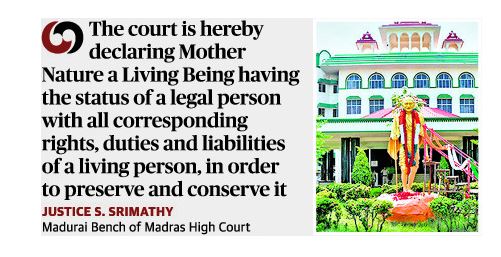
    Holding that it is the right time to confer juristic status to ‘Mother Nature’, Justice S. Srimathy of the Madurai Bench of Madras High Court invoked the ‘parens patriae jurisdiction’, and declared ‘Mother Nature’ as a ‘living being’ having the status of a legal entity.

    What is the news?

    • The Madras HC observed that ‘Mother Nature’ was accorded the rights akin to fundamental rights, legal rights, constitutional rights for its survival, safety, sustenance and resurgence in order to maintain its status and also to promote its health and well-being.

    Legal rights for nature: A backgrounder

    • The movement for legal personhood for the environment and animals began in the 1970s.
    • This concept was articulated by Christopher D. Stone in his thesis, Should Trees Have Standing.
    • In this compelling piece, the author makes an argument for the environment to have independent legal rights, much like what was granted by the judgment of the Uttarakhand High Court in 2017.
    • He highlights how the theory of rights has developed over the years and that many inanimate objects have both rights and legal duties. They can sue and be sued.

    What is the case for Madras HC’s personification of nature?

    • The Madras HC has made a personification of nature that focuses on the life-giving and nurturing aspects of nature by embodying it, in the form of the mother.
    • It observed that the court is hereby declaring ‘Mother Nature’ a ‘living being’ having the status of a legal person with all corresponding rights, duties and liabilities of a living person, in order to preserve and conserve it.
    • The State and Central governments are directed to protect ‘Mother Nature’ and take appropriate steps in this regard in all possible ways.

    A different course: Ecological Jurisprudence

    • The onset of climate change and the potential mass extinction of species is accompanied by the gradual closing window of opportunity to take meaningful action.
    • Activists around the world are calling for anthropocentric legal and governance systems to be replaced with ecocentric ones.
    • The last 15 years have seen a dramatic increase in the number of laws based on ecological jurisprudence.
    • Ecological jurisprudence is a philosophy that sees nature not as a set of objects to be exploited but as a community of subjects (humans and non-humans) who are connected through interdependent, reciprocal relationships.

    India’s typical case

    • In 2017, the Uttarakhand HC ruled (in two separate orders) that the Ganga, the Yamuna, their tributaries, and the glaciers and catchments feeding these rivers in Uttarakhand had rights as a “juristic/legal person/living entity”.
    • In 2018, the same HC ruled that the entire animal kingdom had rights similar to that of a living person (Narayan Dutt Bhatt vs Union of India).
    • In March 2020, the Punjab and Haryana High Court passed an order declaring the Sukhna Lake in Chandigarh city a living entity, with rights equivalent to that of a person.

    Beyond Rights

    • Law is a modern human construct. It not only talks in the language of rights and duties that only humans understand but also operationalizes them in a way that can further entrench human-centeredness.
    • In most cases where nature’s rights are recognized in law, they have done so by extending to it the concept of “personhood” in other words, akin to humans and, therefore, having human rights.
    • Hence, any such movement on recognizing the rights of the rest of nature must challenge the fundamental forms of injustices, including capitalism, stateism, anthropocentrism and patriarchy.

    Significance of such status

    • These rights-based laws granting legal personhood for nature aim to shift the legal status of the natural world from being human property to living entities in their own right and subjects of law.
    • This guarantees their right to exist, thrive, evolve and maintain their natural cycles.
    • These rights are not conferred by humans; it is a recognition that these rights have always existed.
    • It lays upon humans the duty to act as guardians for the more-than-human world.

    Issues of implementation

    • Assuming that these rights are recognised, nature or any of its entity cannot represent itself in a court of law.
    • Moreover there is the issue of custodianship.

    What would account for violations?

    • The Uttarakhand court order did not mention what amounted to violation of rights of rivers.
    • In order to be able to truly exercise the rights and implement appropriate redressal, there is a need for a comprehensive definition of the actions that amount to “violation of the rights”.
    • Say, the violation of the rights of rivers may be defined as “any obstruction or impediment that disables the entity from performing its essential ecological functions”.

    Restitution and compensation

    • The New Zealand law has an extensive section lending itself to restitutive, restorative and compensatory action.
    • It acknowledged the government’s decisions and actions for more than a century that resulted in the violation of the health of the Whanganui and the rights, culture and well-being of the indigenous people living along the river.
    • Several specific examples were given, including the dismantling of traditional structures for fishing and river use, a hydroelectric project and mining.
    • Such an acknowledgment is a necessary first step towards seeking appropriate restitutive and compensatory measures.

    Another question: Bioregional Governance

    • Recognizing river ecosystems or other entities of nature as having rights offers the possibility of managing and governing habitats based on the ecological realities of the region.
    • It brings out the bizarre fact that the human-drawn nation state, and political lines on maps in various parts of the world have created conflict situations or disrupted ancient cultural and ecological flows and relations.
    • We need to begin reimagining governance from a bioregional governance point of view.
    • This would also mean bridging the gap between the customary ways of decision making and the current legal frameworks.
    • There is a need for more imaginative lawyers, activists and judges to help move towards an eco-centric and diverse legal framework.

    Way forward

    • There is a need for a comprehensive system to implement and protect their rights.
    • The rights can be safeguarded using the principles of custodianship.
    • The Uttarakhand High Court order named several government functionaries and a couple of independent lawyers as “parents”.
    • An alternative solution is that custodianship or guardianship be given to a body of local communities associated with the river.
    • These communities have traditional or customary rights of the river such as fisherfolk, farmers along the riverbank, and people directly engaged in river-related services.


    UPSC 2023 countdown has begun! Get your personal guidance plan now! (Click here)
  • What are the rules for resignation and reinstatement of an IAS officer?

    A decorated Indian Administrative Service (IAS) officer and UPSC CSE topper from 2010, who resigned from the service in protest against the “unabated” killings in Kashmir in 2019, has been reinstated.

    What rules apply when an IAS officer chooses to resign?

    • A resignation is a formal intimation in writing by an officer of his/her intention or a proposal to leave the IAS, either immediately or at a specified date in the future.
    • Guidelines of the Department of Personnel, the cadre controlling department for the IAS, say that a resignation has to be clear and unconditional.
    • The resignation of an officer of any of the three All-India Services — IAS, the IPS and IFoS — is governed by Rules 5(1) and 5(1)(A) of the All India Services (Death-cum-Retirement Benefits) Rules, 1958.
    • There are similar rules for resignation of officers belonging to the other central services as well.
    • Resignation from service is entirely different from accepting the government’s Voluntary Retirement Scheme (VRS).

    To whom must the resignation of an IAS officer be submitted?

    • An officer serving in a cadre (state) must submit his/her resignation to the chief secretary of the state.
    • An officer who is on central deputation is required to submit his/her resignation to the secretary of the concerned Ministry or Department.
    • The Ministry/Department then forwards the officer’s resignation to the concerned state cadre, along with its comments or recommendations.

    What happens after the resignation is submitted?

    • The state checks to see if any dues are outstanding against the officer, as well as the vigilance status of the officer or whether any cases of corruption etc. are pending against him/her.
    • In case there is such a case, the resignation is normally rejected.
    • Before forwarding the resignation to the central government, the concerned state is supposed to send information on the issues of dues and vigilance status, along with its recommendation.
    • The resignation of the officer is considered by the competent authority, i.e., the central government, only after the recommendation of the concerned cadre has been received.
    • The competent authorities are: Minister of State at the DoPT in respect of the IAS, the MHA in respect of the IPS, and the MoEFCC in respect of the Forest Service.
    • Being the minister in charge of the DoPT, the Prime Minister himself takes decisions currently in respect of the IAS.

    Under what circumstances is a resignation accepted or rejected?

    • A circular issued by the DoPT on February 15, 1988 regarding resignation says that it is not in the interest of the government to retain an officer who is unwilling to serve.
    • The general rule, therefore, is that the resignation of an officer should be accepted — except in certain circumstances.
    • The references are made regarding the merit of the disciplinary case pending against the Government servant and whether it would be in the public interest to accept the resignation.
    • In some cases, resignations have been rejected because disciplinary cases were pending against officers.
    • In such cases, concurrence of the Central Vigilance Commission (CVC) is obtained.
    • The government also checks whether the concerned officer had executed any time-bond to serve the government.

    Is an officer allowed to withdraw a resignation that has already been submitted?

    • Rule 5(1A)(i) of the amended DCRB Rules says the central government may permit an officer to withdraw his/her resignation “in the public interest”.
    • An amendment in the Rules in 2011 states the member is allowed to resume duty as a result of permission to withdraw the resignation is not more than 90 days”.
    • The request for withdrawal of resignation shall NOT be accepted where a member of the Service resigns to be associated with any active politics/ political parties.

    And under what circumstances is the withdrawal of an officer’s resignation accepted?

    • The 2011 guidelines say that if a resigned officer resignation sends an intimation in writing withdrawing it before its acceptance by the competent authority, the resignation will be deemed to have been automatically withdrawn.
    • The officer under discussion had resigned on January 9, 2019, but his resignation was not processed.


    UPSC 2023 countdown has begun! Get your personal guidance plan now! (Click here)

  • What are Heatwaves?

    India is gripped in the wrath of a long spell of heatwaves that too in the early month of April.

    What is a Heatwave and when is it declared?

    • Heatwaves occur over India between March and June.
    • IMD declares a heatwave event when the maximum (day) temperature for a location in the plains crosses 40 degrees Celsius.
    • Over the hills, the threshold temperature is 30 degrees Celsius.

    How are they formed?

    • Heatwaves form when high pressure aloft (3,000–7,600 metres) strengthens and remains over a region for several days up to several weeks.
    • This is common in summer (in both Northern and Southern Hemispheres) as the jet stream ‘follows the sun’.
    • On the equator side of the jet stream, in the upper layers of the atmosphere, is the high pressure area.
    • Summertime weather patterns are generally slower to change than in winter. As a result, this upper level high pressure also moves slowly.
    • Under high pressure, the air subsides (sinks) toward the surface, warming and drying adiabatically, inhibiting convection and preventing the formation of clouds.
    • Reduction of clouds increases shortwave radiation reaching the surface.
    • A low pressure at the surface leads to surface wind from lower latitudes that brings warm air, enhancing the warming.
    • Alternatively, the surface winds could blow from the hot continental interior towards the coastal zone, leading to heat waves.

    Following criteria are used to declare heatwave:

    To declare heatwave, the below criteria should be met at least in 2 stations in a Meteorological subdivision for at least two consecutive days and it will be declared on the second day.

    1. a) Based on Departure from Normal
    • Heat Wave: Departure from normal is 4.5°C to 6.4°C
    • Severe Heat Wave: Departure from normal is >6.4°C
    1. b) Based on Actual Maximum Temperature (for plains only)
    • Heat Wave: When actual maximum temperature ≥ 45°C
    • Severe Heat Wave: When actual maximum temperature ≥47°C

    How long can a heatwave spell last?

    • A heatwave spell generally lasts for a minimum of four days. On some occasions, it can extend up to seven or ten days.
    • The longest recorded heatwave spell, in recent years, was between 18 and 31 May 2015.

    Impact of Heat Waves:

    Heat Strokes: The very high temperatures or humid conditions pose an elevated risk of heat stroke or heat exhaustion.

    Older people and people with chronic illness such as heart disease, respiratory disease, and diabetes are more susceptible to heatstroke, as the body’s ability to regulate heat deteriorates with age.

    Increased Healthcare Costs: Effects from extreme heat are also associated with increased hospitalisations and emergency room visits, increased deaths from cardio-respiratory and other diseases, mental health issues, adverse pregnancy and birth outcomes, etc.

    Lessens Workers’ Productivity: Extreme heat also lessens worker productivity, especially among the more than 1 billion workers who are exposed to high heat on a regular basis. These workers often report reduced work output due to heat stress.

    Risk of Wildfires: The heat domes act as fuel to wildfires, which destroys a lot of land area every year in countries like the US.

    Prevents Cloud Formation: The condition also prevents clouds from forming, allowing for more radiation from the sun to hit the ground.

    Effect on Vegetation: The trapping of heat can also damage crops, dry out vegetation and result in droughts.

    Increased Energy Demands: The sweltering heat wave also leads to rise in energy demand, especially electricity, leading to pushing up rates.

    Power Related Issues: Heat waves are often high mortality disasters.

    Avoiding heat-related disasters depends on the resilience of the electrical grid, which can fail if electricity demand due to air conditioning use exceeds supply.

    As a result, there is the double risk of infrastructure failure and health impacts.

    • Initiatives Taken:
      • Global:
        • Global forums dealing with climate change issues—such as the World Health Organization, World Economic Forum, First Global Forum on Heat and Health, and the Global Forum for Environment-OECD—also focus on heat waves by investing in research on health risks of extreme heat, climate and weather information, advice on surviving heat waves, partnerships and capacity building, and communications and outreach.
      • Indian:
        • The National Disaster Management Authority (NDMA) has issued guidelines on dealing with heatwaves.
          • However, India does not recognise heatwaves as a disasterunder its Disaster Management Act (2005).

    Way Forward

    • Adopting A More Sensitive Approach: The impact of such excessive heat needs to be understood from the point of view of common people — daily labourers; farmers; traders; fishermen etc.
      • Beyond numbers and graphs that capture the impact of the climate crisis, the human experience of living in oppressive heat needs to be understood by policymakers and measures should be taken accordingly.
    • Cooling Shelters: The government should come out with a policy to deal with the suffering and disability caused by heat extremes in different parts of the country.
      • Water kiosks, staggered outdoor work hours, cool roofs for buildings and homes are certain things that should be put in place immediately.
      • A number of emergency cooling shelters can be opened so that people without domestic air conditioning units can escape the heat.
        • Portable air-conditioning units, along with fans and even ice are also useful.
    • Passive Cooling to Reduce Urban Heat Islands: Passive cooling technology, a widely-used strategy to create naturally ventilated buildings, can be a vital alternative to address the urban heat island for residential and commercial buildings.
      • The IPCC report cites ancient Indian building designs that have used this technology, which could be adapted to modern facilities in the context of global warming.
    • Action Plans Similar to Ahmedabad: As per the IPCC Report, Ahmedabad has shown the way to combat heat extremes by heat-proofing buildings.
      • After the heat action plan was implemented in 2013 in Ahmedabad, heat-related mortality reduced by 30% to 40% over the years. Similar plans like that of Ahmedabad can be implemented in vulnerable regions.
    • Replacing Dark Roofs: A big reason that cities are so much hotter than rural areas is that they are covered by dark roofs, roads and parking lots that absorb and retain heat.
      • One of the long term solutions can be replacing the dark surfaces with lighter and more reflective materials; it will result in a comparatively cooler environment.


More posts