💥UPSC 2026, 2027, 2028 UAP Mentorship (March Batch) + Access XFactor Notes & Microthemes PDF

Search results for: “”

  • Do You Know Getting 1-1 Mentorship for UPSC-CSE Increases your Success Rate by 80%? || 41 out of 50 Smash 2021 Mains Aspirants Qualify for Interview|| Need a Personalised Revision Timetable for Prelims 2022?|| Want to Know the 30 Most Important Prelims Topics for Every Subject?|| Then, Register Yourself For Samanvaya Free 1-on-1 Mentorship

    Smash 2021 Mentorship Results

    As UPSC Mains results were announced last week, Sajal sir (Co-Founder of Civilsdaily and Mentor of Smash Mains 2021 Program) was flooded with calls by delighted aspirants who thanked him for his mentorship. Sajal Sir himself is the topper of GS 2017 Mains paper and mentor of 400 UPSC Toppers.
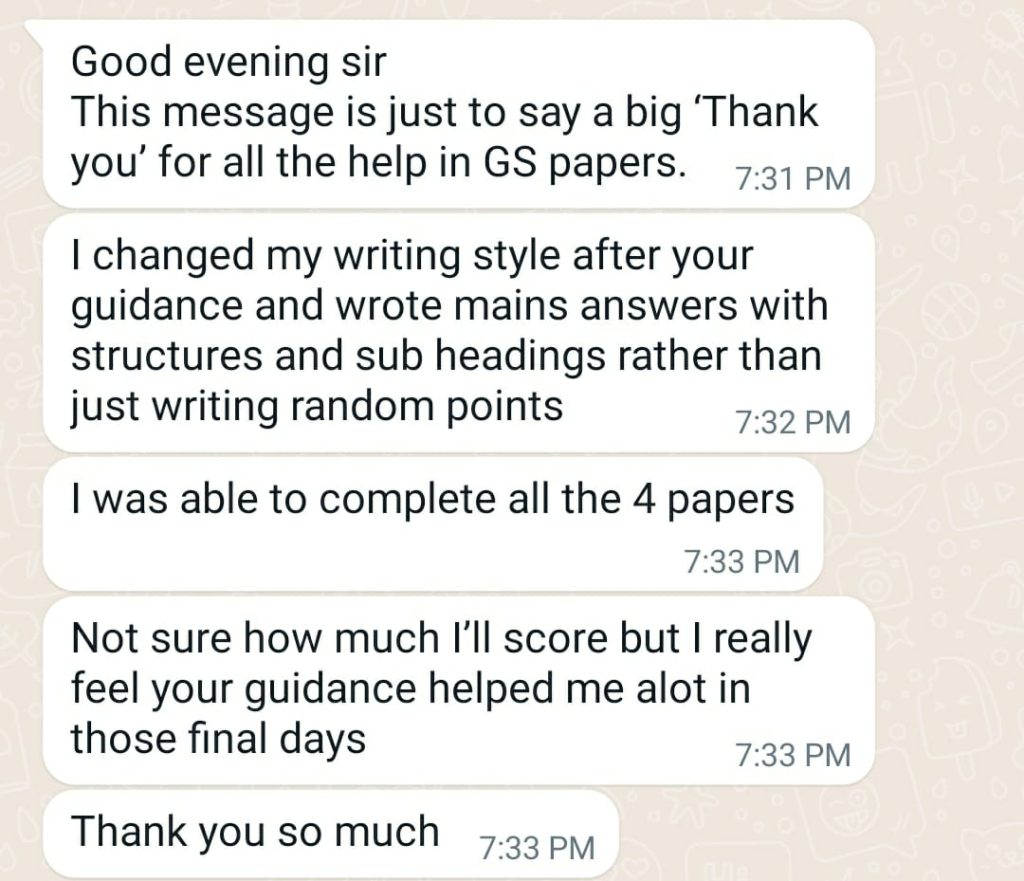
    After a quick check, we found out 41 Smash Mains students are qualified to attend the interview this year. As we are waiting for their interview results, we will not be announcing their names right now. However, we are sharing the testimonials of the qualified aspirants. We wish them all the very best!

    Prelims Must-Read Topics for Every Subject

    As prelims is round the corner, you would have already started your revision. The main purpose of the UPSC prelims exam is to test your conceptual clarity in basic topics and application of current affairs in subject-related questions.  Since the questions in prelims aren’t direct or straightforward, they appear to be outside the standard book and NCERTs.

    Based on our research, we have come up with nearly 30-35 important subject-wise topics for Prelims 2022. In this article, we will be highlighting only 3 topics per subject. Those aspirants interested to get the complete handbook of Must-Read Static+ Current Affairs Prelims Topics can register for our Free 1-on-1 Mentorship Session. Along With the Free Consultation+Handbook, aspirants will Get Free Personalised 60 Days Revision Timetable for Prelims 2022.

    Polity

    1. Important Supreme Court Judgements.

    Revise  important judgements passed by the Supreme Court in the year 2021 along with those mentioned in your polity standard books like Keshvananda Bharati case, Uman Rao Case and Minerva Mills Case. While reading up the reasoning behind the judgements, you will gain clarity of the constitutional provisions. 

    1. Fundamental Rights from Article 12-35

    Every year, a minimum of 2-3 questions mandatorily ask about the basic human rights guaranteed by the constitution, their significance and limitations. Sample these questions from Prelims 2021.

    1. Under the Indian constitution concentration of wealth violates

    (a) The Right to Equality

    (b) The Directive Principles of State Policy

    (c) The Right to Freedom

    (d) The Concept of Welfare

    2. A legislation which confers on the executive or administrative authority an unguided and uncontrolled discretionary power in the matter of the application of law violates which one of the following Articles of the Constitution of India?

    (a) Article 14

    (b) Article 28

    (c) Article 32

    (d) Article 44

    1. Non-constitutional Bodies

    Questions have been consistently asked about the recent developments in the quasi-judicial, statutory and regulatory bodies set up by the state legislatures. Examples include the National Human Rights Commission, National Green Tribunal and National Law Commission. One must be aware of the corresponding laws around which these bodies were established. 

    Economy

    1. Inflation

    Inflation has been a persistent issue that has affected Indians every year. Everytime, there is news on how the RBI plans to tackle the issue or how foreign crises result in inflation of goods in India. Aspirants are expected to understand types of inflation like demand-pull inflation, cost-push inflation and wholesale price inflation. Remedies for inflation can be found in the current affairs section. One can expect 2-3 questions in prelims from this section. The prelims questions would test the conceptual clarity in fiscal policy and inflation.

    1. Money market

    Aspirants are expected to have a general and not specialized knowledge on the financial instruments with high liquidity and short term maturities. The different kinds of credit that exist for different sections of the society needs to be read. 

    1. GDP Estimates

    Every year one question in prelims is about the GDP estimates of a particular year. While reading this topic, aspirants must note down the department that releases this report, the difference between GDP and GVA and the Index of Industrial Production (IIP).

    Environment 

    1. Environment Conventions from 1980s onwards

    Aspirants are expected to make micronotes from the standard books they are reading on the role of international institutions in combating environmental pollution through conventions, acts and policies. Examples of such conventions are Stockholm convention, Ramsar Convention, CITES etc. 

    1. Biogeochemical cycles

    Aspirants need to be familiar with the process of biogeochemical cycle, the types of biogeochemical cycle and the significance of the same. Questions around this are typically direct and straightforward. 

    1. Mapping of national parks, wildlife sanctuaries and wetlands

    Every year, aspirants definitely get 3-5 fact based questions on national parks. Some of these questions could be asked due to a recent development in a particular park. For example, the Chilika Lake wetland was recently in news in January due to migratory birds like the Mongolian Gull staying there. The Chilika Lake is the first wetland of international importance under Ramsar convention. Certain aspects the aspirants must note down are the areas where the particular national park or wetland is spread across, the major attractions, the economic and social significance of the place. 

    Social Issues and Government Schemes

    1. Reports and Indices

    Any report released by an international organisation on the performance of India against other countries under certain parameters must be revised. This includes The Global Hunger Index, World Happiness Report and Human Development Index.

    1. GOI schemes for 2021

    Ranging from agriculture, education, MSMEs, vulnerable sections and banking, aspirants need to have awareness on government initiatives in 2021. This will make it easier for them to solve indirect questions as well. 

    Science and Technology

    1. Electric Vehicles:
      India’s commitment towards electric vehicles and COP26 of Glasgow might be areas where prelims questions would be asked. Aspirants should understand the various measures to develop and promote the EV ecosystem in the country such as Faster Adoption and Manufacturing of Electric Vehicles (FAME II) scheme, Production-Linked Incentive (PLI) scheme for Advanced Chemistry Cell (ACC) and the recently launched PLI scheme for Auto and Automotive Components for manufacturers of electric vehicles.
    1. Dark Genome 

    This is a hot topic in DNA research and aspirants must understand why research in this area is essential for treatment of diseases. Questions on genetics can be expected from Prelims this time. 

    1. Emerging technologies (5G, AI, Machine learning)

    In recent years, a lot of questions have appeared about the latest developments in technology, their discoveries and the latest theories related to them. Few of these technologies are 5G, Quantum Key Distribution technology, hydrogen fuel cell etc. Aspirants must micronotes on these topics from prelims perspective. 

    Indian Geography

    1. Maps

    Aspirants must practice places in the Indian Map on a regular basis. Particularly, they must  focus on himalayan rivers like Ganga, Brahmaputra and Yamuna, peninsular rivers like Damodar, Mahanadi, Godavari, Krishna, Kaveri and Periyar. Not only rivers, but aspirants must know where exactly their tributaries are located. Apart from this, North to South Alignment of Mountains in Eastern ghat and Western Ghat, Andaman, Nicobar and Lakshadweep islands and Industrial Location and Ports need to be marked. 

    1. Climatic Regions in India

    Aspirants must learn about the onset and withdrawal of the Indian Monsoon system, tropical cyclones, different climatic zones, factors that cause shifts in climate and intertropical convergence zone. 

    1. Continental Shift Theory

    Present in the NCERT textbooks, this theory talks about the formation of different continents. Aspirants must keep an eye for one or two questions that might come from this topic in the Geography section. 

    Want to Know How a Free 1-on-1 Mentorship Looks Like? Watch This Video

    In this video, there is first an initial discussion of the test performance, which is then followed by the mentor discussing the questions which the aspirant had got wrong and then he will ask the aspirant, where did he study the topic and to share the notes he made on that topic. The mentor will find out the problem and suggest the correct method of studying the topics. After the session gets over, the aspirant has to study the topics where he couldn’t score high marks in polity. After this, the next day the mentor will conduct another test only on those topics. This way the aspirant gains an understanding on how to approach the whole subject of polity.

  • Criminal Procedure (Identification) Bill, 2022

    The bill that would allow the police and prison authorities to collect, store and analyse physical and biological samples, including retina and iris scans, was introduced in the Lok Sabha.

    Criminal Procedure (Identification) Bill

    • It authorises law enforcement agencies to collect, store and analyse physical and biological samples of convicts and other persons for the purposes of identification and investigation in criminal matters.
    • It seeks to repeal the Identification of Prisoners Act 1920 which provided for the collection of only fingerprints and footprints.
    • The said Act, in its present form, provides access to a limited category of persons whose body measurements can be taken.
    • As per the Bill, any state government OR Union Territory administration may notify an appropriate agency to collect, preserve and share the measurements of a person of interest in their respective jurisdictions.

    Why need such law?

    • The world has undergone technological and scientific changes, crime and its trend have increased.
    • Advanced countries across the globe are relying on new “measurement” techniques for reliable results.
    • It was felt necessary to expand the “ambit of persons” whose measurements can be taken as this will help investigating agencies gather sufficient legally admissible evidence and establish the crime of the accused person.
    • The Bill will not only help our investigation agencies but also increase prosecution.
    • There is also a chance of an increase in conviction rates in courts through this.

    Key features of the Bill

    The Bill seeks to:

    • Define “measurements”: To include finger impressions, palm-print and foot-print impressions, photographs, iris and retina scan, physical, biological samples and their analysis, etc.;
    • Empower the National Crime Records Bureau (NCRB): To collect, store and preserve the record of measurements and for sharing, dissemination, destruction and disposal of records;
    • Empower a Magistrate: To direct any person to give measurements; a Magistrate can also direct law enforcement officials to collect fingerprints, footprint impressions and photographs in the case of a specified category of convicted and non-convicted persons;
    • Empower police or prison officers: To take measurements of any person who resists or refuses to give measurements
    • Authorises police to record signatures, handwriting or other behavioural attributes: Referred to in section 53 or section 53A of the Code of Criminal Procedure, 1973, for the purposes of analysis.

    Notable feature: Maintenance of Record

    • The National Crime Records Bureau (NCRB) will be the repository of physical and biological samples, signature and handwriting data that can be preserved for at least 75 years.
    • The record of these measurements will be retained in digital or electronic form for a period of seventy-five years from the date of collection.
    • The court or Magistrate, for reasons to be recorded in writing, can direct agencies to maintain the records.
    • The records are to be destroyed in the case of any person who has not been previously convicted of an offence punishable under any law with imprisonment for any term.

    Refusal to Comply

    • Resistance to or refusal to allow the taking of measurements under this Act shall be deemed to be an offence under section 186 of the Indian Penal Code (IPC);
    • No suit or any other proceeding shall lie against any person for anything done, or intended to be done in good faith under this Act or any rule made thereunder;
    • Central government or state government may, by notification in the Official Gazette, make rules for carrying out the purposes of this Act;
    • Manner of collection, storing, preservation of measurements and sharing, dissemination, destruction and disposal of records under sub-section (1) of section 4;

    Issues with the Bill

    • Un-constitutionality: The proposed law will be debated against Article 20(3) of the Constitution, which is a fundamental right that guarantees the right against self-incrimination.
    • Violation of Article 21: The Bill also seeks to apply these provisions to persons held under any preventive detention law.
    • Legislative competence of Centre: The Bill was beyond the legislative competence of Parliament as it violated fundamental rights of citizens, including the right to privacy.
    • Contentious provisions: The Bill proposes to collect samples even from protesters engaged in political protests.
    • Lack of clarity: Several provisions are not defined in the Bill itself.. For instance, the statement of objects says it provides for collection of measurements for “convicts and other persons” but the expression “other persons” is not defined.
    • Other: While the jurisprudence around the right to be forgotten is still in an early stage in India, the Puttaswamy judgment discusses it as a facet of the fundamental right to privacy.


    UPSC 2022 countdown has begun! Get your personal guidance plan now! (Click here)

  • States can identify Minorities: Centre

    In an affidavit filed in the top court, the Union Ministry of Minority Affairs said “state governments can also declare a religious or linguistic community as a ‘minority community’ within the state”.

    Why in news?

    • The Centre was responding to a petition filed stating that the followers of Judaism, Baha’ism and Hinduism — who are the real minorities in Ladakh, Mizoram, Lakshadweep, Kashmir, Nagaland, Meghalaya, Arunachal Pradesh, Punjab and Manipur.
    • They however cannot establish and administer educational institutions of their choice.
    • The Centre said the allegation was “not correct”.
    • The government’s affidavit explained that Parliament and State legislatures have concurrent powers to enact laws to provide for the protection of minorities and their interests.

    Various states on Minorities

    • The Centre gave the example of how Maharashtra notified ‘Jews’ as a minority community within the State.
    • Again, Karnataka notified Urdu, Telugu, Tamil, Malayalam, Marathi, Tulu, Lambadi, Hindi, Konkani and Gujarati as minority languages within the State.

    Who are the Minorities?

    • Muslims, Sikhs, Christians, Buddhists, Jain and Zorastrians (Parsis) have been notified as minority communities under Section 2 (c) of the National Commission for Minorities Act, 1992.
    • As per the Census 2011, the percentage of minorities in the country is about 19.3% of the total population of the country.
    • The population of Muslims are 14.2%; Christians 2.3%; Sikhs 1.7%, Buddhists 0.7%, Jain 0.4% and Parsis 0.006%.
    • Minority Concentration Districts (MCD), Minority Concentration Blocks and Minority Concentration Towns, have been identified on the basis of both population data and backwardness parameters of Census 2001 of these areas.

    Defining Minorities

    • The Constitution recognizes Religious minorities in India and Linguistic minorities in India through Article 29 and Article 30.
    • But Minority is not defined in the Constitution.
    • Currently, the Linguistic minorities in India are identified on a state-wise basis thus determined by the state government whereas Religious minorities in India are determined by the Central Government.
    • The Parliament has the legislative powers and the Centre has the executive competence to notify a community as a minority under Section 2(c) of the National Commission for Minorities Act of 1992.

    Article 29: It provides that any section of the citizens residing in any part of India having a distinct language, script, or culture of its own, shall have the rights of minorities in India to conserve the same. Article 29 is applied to both minorities (religious minorities in India and Linguistic minorities in India) and also the majority. It also includes – rights of minorities in India to agitate for the protection of language.

    Article 30: All minorities shall have the rights of minorities in India to establish and administer educational institutions of their choice. Article 30 recognises only Religious minorities in India and Linguistic minorities in India (not the majority). It includes the rights of minorities in India to impart education to their children in their own language.

    Article 350-B: Originally, the Constitution of India did not make any provision with respect to the Special Officer for Linguistic minorities in India. However, the 7th Constitutional Amendment Act, 1956 inserted Article 350-B in the Constitution. It provides for a Special Officer for Linguistic Minorities appointed by the President of India. It would be the duty of the Special Officer to investigate all matters relating to the safeguards provided for linguistic minorities under the Constitution.


    UPSC 2022 countdown has begun! Get your personal guidance plan now! (Click here)

  • Detecting Microplastics in Human Blood

    A study by researchers from The Netherlands has found Microplastics in blood samples. About half of these were PET (polyethylene tertraphthalate) plastics, which is used to make food grade bottles.

    What are Microplastics?

    • Microplastics are tiny bits of various types of plastic found in the environment.
    • The name is used to differentiate them from “macroplastics” such as bottles and bags made of plastic.
    • There is no universal agreement on the size of microplastics. It defines microplastic as less than 5mm in length.
    • However, for the purposes of this study, since the authors were interested in measuring the quantities of plastic that can cross the membranes and diffuse into the body via the blood stream.
    • Hence they agreed on an upper limit on the size of the particles as 0.0007 millimetre.

    What were the plastics that the study looked for in the blood samples?

    • The study looked at the most commonly used plastic polymers.
    • These were polyethylene tetraphthalate (PET), polyethylene (used in making plastic carry bags), polymers of styrene (used in food packaging), poly (methyl methylacrylate) and poly propylene.
    • They found a presence of the first four types.

    Significance of the study

    • Making a human health risk assessment in relation to plastic particles is not easy, perhaps not even possible, due to the lack of data on exposure of people to plastics.
    • In this sense, it is important to have studies like this one.
    • The authors of the paper also remark that validated methods to detect the tiny (trace) amounts of extremely small-sized (less than 10 micrometre) plastic particles are lacking.
    • Hence this study, which builds up a methods to check the same, is important.

    Health hazard of microplastics

    • It is not yet clear if these microplastics can cross over from the blood stream to deposit in organs and cause diseases.
    • The report point out that the human placenta has shown to be permeable to tiny particles of polystyrene ( 50, 80 and 24 nanometre beads).
    • Experiments on rats where its lungs were exposed to polystryrene spheres (20 nanometre) led to translocation of the nanoparticles to the placental and foetal tissue.
    • Oral administration of microplastics in rats led to accumulation of these in the liver, kidney and gut.
    • Further studies have to be carried out to really assess the impact of plastics on humans.


    Try this PYQ:

    Q. Why is there a great concern about the ‘microbeads’ that are released into environment?

    (a) They are considered harmful to marine ecosystems.

    (b) They are considered to cause skin cancer in children.

    (c) They are small enough to be absorbed by crop plants in irrigated fields.

    (d) They are often found to be used as food adulterants.


    Post your answers here.


    UPSC 2022 countdown has begun! Get your personal guidance plan now! (Click here)

  • The phenomenon of Coral Bleaching

    The management authority of the world’s largest coral reef system, Australia’s Great Barrier Reef, confirmed on March 25 that the reef is experiencing a mass coral bleaching event.

    What are Coral Reefs?

    • Corals are marine invertebrates or animals not possessing a spine.
    • Each coral is called a polyp and thousands of such polyps live together to form a colony, which grows when polyps multiply to make copies of themselves.
    • Australia’s Great Barrier Reef is the world’s largest reef system stretching across 2,300 km.
    • It hosts 400 different types of coral, gives shelter to 1,500 species of fish and 4,000 types of mollusc.
    • Corals are of two types — hard coral and soft coral:
    1. Hard corals, also called hermatypic or ‘reef building’ corals extract calcium carbonate (also found in limestone) from the seawater to build hard, white coral exoskeletons.
    2. Soft coral polyps, however, borrow their appearance from plants, attach themselves to such skeletons and older skeletons built by their ancestors. Soft corals also add their own skeletons to the hard structure over the years and these growing multiplying structures gradually form coral reefs. They are the largest living structures on the planet.

    How do the feed themselves?

    • Corals share a symbiotic relationship with single-celled algae called zooxanthellae.
    • The algae provides the coral with food and nutrients, which they make through photosynthesis, using the sun’s light.
    • In turn, the corals give the algae a home and key nutrients.
    • The zooxanthellae also give corals their bright colour.

    What is Coral Bleaching?

    • Bleaching happens when corals experience stress in their environment due to changes in temperature, pollution or high levels of ocean acidity.
    • Under stressed conditions, the zooxanthellae or food-producing algae living inside coral polyps start producing reactive oxygen species, which are not beneficial to the corals.
    • So, the corals expel the colour-giving zooxanthellae from their polyps, which exposes their pale white exoskeleton, giving the corals a bleached appearance.
    • This also ends the symbiotic relationship that helps the corals to survive and grow.
    • Severe bleaching and prolonged heat stress in the external environment can lead to coral death.

    Impact of climate change

    • Over the last couple of decades, climate change and increased global warming owing to rising carbon emissions and other greenhouse gases have made seas warmer than usual.
    • Under all positive outlooks and projections in terms of cutting greenhouse gases, sea temperatures are predicted to increase by 1.5°C to 2°C by the time the century nears its end.
    • The first mass bleaching event had occurred in 1998 when the El Niño weather pattern caused sea surfaces in the pacific ocean to heat up; this event caused 8% of the world’s coral to die.
    • The second event took place in 2002.
    • In the past decade, however, mass bleaching occurrences have become more closely spaced in time, with the longest and most damaging bleaching event taking place from 2014 to 2017.

    Significance of Corals

    • Coral reefs support over 25% of marine biodiversity, including fish, turtles and lobsters; even as they only take up 1% of the seafloor.
    • The marine life supported by reefs further fuels global fishing industries. Even giant clams and whales depend on the reefs to live.
    • Besides, coral reef systems generate $2.7 trillion in annual economic value through goods and service trade and tourism.
    • In Australia, the Barrier Reef, in pre-COVID times, generated $4.6 billion annually through tourism and employed over 60,000 people including divers and guides.
    • Aside from adding economic value and being a support system for aquatic life, coral reefs also provide protection from storm waves.
    • Dead reefs can revive over time if there are enough fish species that can graze off the weeds that settle on dead corals, but it takes almost a decade for the reef to start setting up again.

    Current condition of the Great Barrier Reef

    • The United Nations Intergovernmental Panel on Climate Change (IPCC) released its report this month, which warned that the life of the Great Barrier is in grave danger.
    • The report said that if temperatures continue to rise, bleaching events may occur more often and a large proportion of the remaining reef cover in Australia could be lost.
    • Just a couple of weeks after this warning, the Barrier Reef Authority confirmed a mass bleaching phenomenon affecting all pockets of the reef system.

    Try this PYQ:

    Q. Consider the following statements:

    1. Most of the world’s coral reefs are in tropical waters.
    2. More than one third of the world’s coral reefs are located in the territories of Australia, Indonesia and Philippines.
    3. Coral reefs host far more number of animal phyla than those hosted by tropical rainforests.

    Which of the above statements is/are correct?

    (a) 1 and 2 only

    (b) 3 only

    (c) 1 and 3 only

    (d) 1 and 3 only


    Post your answers here.


    UPSC 2022 countdown has begun! Get your personal guidance plan now! (Click here)

  • What are Articulated All-Terrain Vehicles?

    The Indian Army has issued a Request For Information (RFI) for the supply of Articulated All-Terrain Vehicles to be deployed in Ladakh and Kutch.

    What are Articulated All-Terrain Vehicles?

    • Articulated ATV is a twin cabin, tracked, amphibious carrier for off road mobility.
    • The special design of this equipment exerts low ground pressure on the soil and a pull-push mode of locomotion between two cabins facilitates mobility over varied terrains like snow, desert and slush.
    • A ballistic protection in the cabin body ensures protection to troops travelling in it from small arms fire.
    • They can reach where wheeled vehicles cannot due to deep snow, slush or marshy terrain and can be very effective for patrolling and rapid deployment in operational situations.

    Utility of these vehicles

    • These vehicles are very useful to move troops or supplies in snow-bound terrains and in marshy/sandy environments.
    • The Indian Army wishes to use these vehicles in the snow-bound areas of Ladakh and in the marshy terrain of the Rann of Kutch.


    UPSC 2022 countdown has begun! Get your personal guidance plan now! (Click here)

  • Back in news: Malabar Rebellion

    The Indian Council for Historical Research (ICHR) has deferred its decision on a recommendation to remove the 1921 Malabar Rebellion martyrs, including Variamkunnaathu Kunhahamad Haji and Ali Musliyar, from the list of India’s freedom fighters.

    Malabar Rebellion

    • The Malabar Rebellion in 1921 started as resistance against the British colonial rule and the feudal system in southern Malabar but ended in communal violence between Hindus and Muslims.
    • There were a series of clashes between Mappila peasantry and their landlords, supported by the British, throughout the 19th and early 20th centuries.
    • It began as a reaction against a heavy-handed crackdown on the Khilafat Movement, a campaign in defence of the Ottoman Caliphate by the British authorities in the Eranad and Valluvanad taluks of Malabar.
    • The Mappilas attacked and took control of police stations, British government offices, courts and government treasuries.

    Who was Variyankunna Kunjahammed Haji?

    • He was one of the leaders of the Malabar Rebellion of 1921.
    • He raised 75000 natives, seized control of large territory from the British rule and set up a parallel government.
    • In January 1922, under the guise of a treaty, the British betrayed Haji through his close friend Unyan Musaliyar, arresting him from his hideout and producing him before a British judge.
    • He was sentenced to death along with his compatriots.

    Back2Basics: “Dictionary of Martyrs” Project

    • The project for compilation of “Dictionary of Martyrs” of India’s Freedom Struggle was commissioned by the Ministry of Culture, to the Indian Council of Historical Research (ICHR) to commemorate the 150th anniversary of uprising of 1857.
    • In this dictionary a martyr has been defined as a person who died or who was killed in action or in detention, or was awarded capital punishment while participating in the national movement for emancipation of India.
    • It includes ex-INA or ex-military personnel who died fighting the British.
    • Information of about 13,500 martyrs has been recorded in these volumes.

    Who are included?

    • It includes the martyrs of 1857 Uprising, Jallianwala Bagh Massacre (1919), Non-Cooperation Movement (1920-22), Civil Disobedience Movement (1930-34), Quit India Movement (1942-44), Revolutionary Movements (1915-34), Kissan Movements, Tribal Movements, Agitation for Responsible Government in the Princely States (Prajamandal), Indian National Army (INA, 1943-45), Royal Indian Navy Upsurge (RIN, 1946), etc.

    Five Volumes

    • Volume 1: In this volume, more than 4400 martyrs of Delhi, Haryana, Punjab and Himachal Pradesh have been listed.
    • Volume 2: In this volume more than 3500 martyrs of Uttar Pradesh, Uttarakhand, Madhya Pradesh, Chhattisgarh, Rajasthan and Jammu & Kashmir have been listed.
    • Volume 3: The number of martyrs covered in this volume is more than 1400. This volume covers the martyrs of Maharashtra, Gujarat and Sind.
    • Volume 4: The numbers of martyrs covered in this volume is more than 3300. This volume covers the martyrs of Bengal, Bihar, Jharkhand, Odisha, Assam, Arunachal Pradesh, Manipur, Meghalaya, Nagaland and Tripura.
    • Volume 5: The number of martyrs covered in this volume is more than 1450. This volume covers the martyrs of Andhra Pradesh, Telangana, Karnataka, Tamil Nadu and Kerala.

    Try this question from CSP 2020:

    Q. With reference to the history of India, “Ulgulan” or the Great Tumult is the description of which of the following event?

    (a) The Revolt of 1857

    (b) The Mappila Rebellion of 1921

    (c) The Indigo Revolt of 1859-60

    (d) Birsa Munda’s Revolt of 1899-1900


    Post your answers here.


    UPSC 2022 countdown has begun! Get your personal guidance plan now! (Click here)

  • 29th March 2022| Daily Answer Writing Enhancement(AWE)

    Topics for Today’s questions:

    GS-1         Modern Indian History

    GS-2         Governance, Transparency and Accountability

    GS-3         Environment Conservation, Sustainable development

    GS-4        Ethics and Human Interface

    Question 1)


    Q.1 Discuss the major changes introduced by the Government of India Act, 1919 and its significance as a historical landmark in the Indian freedom struggle. (15 Marks)


    Question 2)

    Q.2 How the use of technology can help in better policing? Also, examine the issues with the use of technology for policing? (10 Marks)

    Question 3)

    Q.3 What is green hydrogen? What are the incentives offered under the green hydrogen policy? Suggest the way forward. (10 Marks)

    Question 4)  

    Q.4 The mandatory nature of Corporate Social Responsibility goes against the notion of philanthropy. Discuss. (10 Marks)


    HOW TO ATTEMPT ANSWERS IN DAILY ANSWER WRITING ENHANCEMENT(AWE)?

    1. Daily 4 questions from General studies 1, 2, 3, and 4 will be provided to you.

    2. A Mentor’s Comment will be available for all answers. This can be used as a guidance tool but we encourage you to write original answers.

    3. You can write your answer on an A4 sheet and scan/click pictures of the same.

    4.  Upload the scanned answer in the comment section of the same question.

    5. Along with the scanned answer, please share your Razor payment ID, so that paid members are given priority.

    6. If you upload the answer on the same day like the answer of 11th  February is uploaded on 11th February then your answer will be checked within 72 hours. Also, reviews will be in the order of submission- First come first serve basis

    7. If you are writing answers late, for example, 11th February is uploaded on 13th February , then these answers will be evaluated as per the mentor’s schedule.

    8. We encourage you to write answers on the same day. However, if you are uploading an answer late then tag the mentor like @Staff so that the mentor is notified about your answer.

    *In case your answer is not reviewed, reply to your answer saying *NOT CHECKED*. 

    1. For the philosophy of AWE and payment: 

  • Prelims Spotlight: Mass Movements

    Dear Aspirants,

    This Spotlight is a part of our Mission Nikaalo Prelims-2022.

    You can check the broad timetable of Nikaalo Prelims here

    Session Details

    Morning 12 PM  – Prelims Spotlight Session

    Evening 06:30  PM  – TIKDAM/MCQs Session

    Noon 03:00 PM – CSAT Google Meet Session

    Evening 08 PM  – Tests on Alternate Days

    Join our Official telegram channel for Study material for GS and CSAT Here


    29th March 2022

    Mass Movements

    The Non-Cooperation Movement-  1920-22

    Following events acted as the catalysts which finally resulted in the launch of the Non-Cooperation Movement by Gandhiji on August 1, 1920.

    Backdrop

    • The Rowlatt Act (February 1919), the Jallianwala Bagh massacre (13 April 1919) and martial law in Punjab had belied all the generous wartime promises of the British.
    • The Montagu-Chelmsford Reforms satisfied few.
    • The treatment meted out to Turkey after the World War-I incensed had incensed the Indian Muslim, which led to the launch of Khilafat movement.

    What were the aspects of Non-Cooperation Movement?

    • The program of the non-cooperation included within its ambit-
      • Surrender of titles and honours.
      • Boycott of government-affiliated schools and colleges, law courts, foreign cloths and could be included to resignation from government service.
      • Mass civil disobedience.
      • Non-payment of taxes.
    • On the other hand, it also included-
      • Establishing national schools and colleges.
      • Establishing panchayats to settle the disputes.
      • Encouraging hand spinning and weaving.
      • Maintaining Hindu-Muslim unity.
      • Observing strict non-violence.
    • Several changes were made in Congress’ creed and organisation, which include-
      • The goal of the Congress was changed from attainment of self-government to attainment of Swaraj by peaceful and legitimate means.
      • The Congress was now to have Working Committee of fifteen members to look after its day-to-day affairs (the same proposal made by Tilak in 1916 was not accepted!).
      • The provincial Congress Committees were now to be organized on linguistic basis.
      • Congress was to use Hindi as far as possible.

    How the movement unfolded?

    • Gandhiji, along with Ali Brothers (who were the foremost Khilafat leaders) undertook nationwide tour during which he addressed hundreds of meetings and met a large number of students.
    • R. Das played a major role in promoting the movement and Subhas Bose became the principal of the National College in Calcutta.
    • The spirit of unrest and defiance of authority engendered by the Non-Cooperation Movement contributed to rise of many local movements in the different parts of the country.
    • In May 1921, the British Government tried through Gandhi-Reading talks to persuade Gandhiji to ask Ali brothers to withdraw from their speeches those passages that contained suggestions of violence.
      • This was an attempt to drive the wedge between the Khilafat leaders and Gandhiji.
    • By December 1921, the Government had changed the policy and started repression of the movement.
    • Public meeting and assemblies were banned, newspapers gagged, and midnight raids on Congress and Khilafat movement became common.
    • In response, Gandhiji declared mass civil disobedience movement would begin in Bardoli taluqa of Surat district.
    • But before the launch of the mass civil disobedience, the Chauri Chaura incident on February 5, 1922, resulted in the withdrawal of the movement by Gandhiji.


    The Civil Disobedience Movement 1930-31

    On 2 March 1930 Gandhiji addressed his historic letter to the Viceroy Irwin in which he first explained at great length why he regarded British rule as a curse. He then informed the Viceroy his plan of action. When Gandhiji reached the Dandi on 6 April 1930 by picking up a handful of salt he inaugurated the Civil Disobedience Movement.

    Backdrop

    • An announcement on 8 November 1927 of an all-White Simon Commission to recommend whether India was ready for further constitutional progress and on which lines.
    • The response in India was immediate. That no Indian should be thought fit to serve on a body that claimed the right to decide the political future of India was an insult no Indian of even the most moderate political opinion was willing to swallow.
    • The Congress resolved on the boycott of the commission at its annual session in Madras in December 1927.

    How the movement unfolded?

    • Once the way was cleared by Gandhiji’s ritual beginning at Dandi, the defiance of salt laws started all over the country.
    • The Government’s failure to arrest Gandhiji for breaking the salt law was used by the local level leaders to impress upon the people that ‘the Government is afraid of persons like ourselves’.
    • In Tamil Nadu, C. Rajagopalachari led a salt march from Trichinopoly to Vedaranniyam on the Tanjore coast.
    • On 23 April, the arrest of Congress leaders in the North-West Frontier Province led to the mass demonstration of unprecedented magnitude in Peshawar.
    • In Peshawar, the atmosphere created by the Khudai Khidmatgars contributed to the mass upsurge in Peshawar during which the city was virtually in the hands of non-violent revolutionaries.
    • It was increasingly becoming clear that the Government’s gamble of non-interference with the movement would result in its spending itself out.
    • On May 4, the Viceroy finally ordered Gandhiji’s arrest.
    • Gandhiji’s announcement that he would now proceed to continue his defiance of the salt laws by leading a raid on the Dharasana Salt Works had forced the Government to act.
    • Coming as it did at a high point in the movement, it only acted as a further spur to activity, and caused endless trouble for the government.
    • Dharsana Satyagraha carried out in the absence of Gandhiji with Sarojini Naidu in the lead, in which Satyagrahis were beaten with the lathis till they fell down.
    • This form of Satyagraha was adopted by the people who soon made it a mass affair.
    • But the salt Satyagraha was only the catalyst and the beginning, for a rich variety of forms of defiance that it brought in its wake.
    • Eastern India became the scene of a new kind of no-tax campaign-refusal to pay the chowkidara tax levied specifically on the villagers.
    • In Gujarat, in Kheda district, in Bardoli taluqa in Surat district, and Jambusar in Broach district a determined no-tax movement was in progress.
    • P. was setting up another kind of movement- a no-revenue no-rent campaign.
    • On January 5, 1931, the Viceroy announced the unconditional release of Gandhiji and all other members of the Congress working committee.
    • On March 5, 1931 the fortnight-long discussion culminated in Gandhi-Irwin Pact which was variously described as a truce and a provisional settlement and ended the Non-Cooperation Movement.

    The Quit India Movement

    ‘Quit India’, this powerful slogan launched the legendary struggle which also became famous by the name of the ‘August Revolution’.

    Backdrop

    • The failure of the Cripps Mission in April 1942 made it clear that Britain was unwilling to offer an honourable settlement and real constitutional advance during the war.
    • The empty gesture of the Cripps offer convinced even those Congressmen like Nehru and Gandhiji, who did not want to do anything to hamper the anti-fascist War efforts.
    • Other factors that made a struggle both inevitable and necessary were-
      • Popular discontent product of rising prices and war-time shortages.
      • The growing feeling of an eminent British collapse.
      • The manner in which British evacuated from Malaya and Burma leaving the people there to their fate

    How the movement unfolded?

    • A fortnight after Cripps’ departure Gandhiji drafted a resolution for the Congress Working Committee, calling for Britain’s withdrawal and the adoption of non-violent non-cooperation against any Japanese invasion.
    • Congress edged towards Quit India while Britain moved towards arming itself with special powers to meet the threat.
    • The historic August meeting at Gowalia Tank in Bombay marked the beginning of the movement. The meeting was unprecedented in the popular enthusiasm it generated.
    • The Government, however, was in no mood to either negotiate with the Congress or wait for the movement to be formally launched.
    • In the early hours of 9 August, in a single sweep, all the top leaders of the Congress were arrested and taken to an unknown destination.
    • The sudden attack by the government produced an instantaneous reaction among the people.
    • As soon as the news of the arrest spread lakhs of people flocked to Gowalia Tank where a mass meeting had been scheduled.
    • There were similar disturbances on 9 August in Ahmedabad and Poona.
    • On the 10th, Delhi and many towns in U.P. and Bihar, including Kanpur, Allahabad, Varanasi, and Patna followed the suit with hartals, public demonstrations and processions in defiance of the law.
    • Meanwhile, many provincial and local level leaders who had evaded arrest returned to their homes through devious routes set about organising resistance.
    • As the news spread in the rural areas, the villagers joined the townsmen in recording their protest.
    • For the first six or seven weeks after 9 August, there was a tremendous mass upsurge all over the country.
    • The brutal and all-out repression succeeded within a period of six or seven weeks in bringing about a cessation of the mass phase of the struggle.
    • But in the meantime, underground networks were being consolidated in various parts of the country.
    • This leadership saw the role of the underground movement as being that of keeping up the popular morale by continuing to provide the line of command and a source of guidance and leadership to the activists all over the country.

More posts
