💥UPSC 2027,2028 Mentorship (April Batch) + Access XFactor Notes & Microthemes PDF

Search results for: “”

  • Economically Weaker Sections (EWS): As defined by Govt Panel

    The government has accepted the report by a committee under the Ministry of Social Justice and Empowerment, which examined the income criteria for determining who are to be included among the EWS.

    EWS Quota: A Backgrounder

    • On July 29 last year, the Centre had issued a notification for implementing 10% reservation for EWS along with 27% for OBC within these courses.
    • Following the petitions, the Supreme Court has stayed counseling for admission until the matter is decided.
    • The NEET notification followed the same criteria for determining EWS as mentioned in a notification from the Department of Personnel and Training (DoPT).

    Inception of EWS Quota

    • EWS reservation was granted based on the recommendations of a commission headed by Major General (retd) S R Sinho.
    • The Commission for Economically Backward Classes was constituted by the then UPA government in 2005, and submitted its report in July 2010.
    • Based on this, the Cabinet in January 2019 decided to amend the Constitution (103rd Amendment) to provide reservation to EWS.

    Prime basis: Income criteria

    • The criteria include a Rs 8 lakh income ceiling for inclusion in EWS — which is the same as the criterion for deciding the “creamy layer” among the OBCs (those who are not in government).
    • The notification said income shall include income from all sources i.e. salary, agriculture, business, profession, etc for the financial year prior to the year of application.
    • Another criterion is that a person whose family owns or possesses 5 acres of agricultural land or more will be excluded from EWS.

    Why was the new committee constituted?

    • The committee aimed to revisit the criteria for determining the economically weaker sections in terms of the provisions of the explanation to Article 15 of the Constitution.
    • It followed the Supreme Court’s observation that the income criterion for determining EWS was “arbitrary”.
    • The Supreme Court is presently hearing a number of petitions, including a special leave petition filed by the Centre against a Madras HC order on EWS and OBC reservation in the all-India quota for NEET.

    Key recommendations

    • The report says that the “threshold of Rs 8 lakh of annual family income, in the current situation, seems reasonable for determining EWS”.
    • The committee has recommended that EWS may, however, exclude, irrespective of income, a person whose family has 5 acres of agricultural land and above.
    • The committee has removed the criteria that excluded some categories from EWS:
    1. Owners of residential properties of 1,000 sq ft and above
    2. Residential plots of 100 sq yards and above in notified municipalities
    3. Residential plots of 200 sq yards and above in areas other than the notified municipalities

    How does it address the questions raised by the Supreme Court?

    • The Supreme Court has earlier questioned the basis of Rs 8 lakh criteria and termed it arbitrary without any substantiation.
    • It asserted that this criteria is similar to that of Creamy Layer in OBCs.

    What did the committee say on Income Criteria?

    • The committee’s report now states the two sets of criteria are significantly different despite both using the Rs 8 lakh cut-off and that the criteria for the EWS.
    • EWS criteria are much more stringent than those for the OBC creamy layer.
    • The report justifies this income limit, stating that Rs 8 lakh cut off also has a link with the income tax exemption limit.
    • It would, therefore, be logical to use the income tax exemption limit to determine the threshold for EWS.

    Tap here to read more about:

    [Sansad TV] Perspective: Defining EWS


    UPSC 2022 countdown has begun! Get your personal guidance plan now! (Click here)

  • Draft Regional Plan 2041 for NCR

    Many environment analysts and activists has offered objections to the Draft Regional Plan-2041 for National Capital Region (NCR).

    Draft Regional Plan 2041

    • The National Capital Region Planning Board had sought objections and suggestions to the Draft RP-2041 from public.
    • Under the NCRPB plan, Delhi, two districts of Rajasthan, eight districts of Uttar Pradesh and 14 districts of Haryana are covered. In all, it covers an area of around 55,083 square kilometres.
    • The plan paves the way for a future-ready and slum-free NCR comprising of facilities like air ambulance, high-speed connectivity by means of rail, road, Heli taxis, and inland waterways.

    Key provisions

    • This plan puts special impetus on 30-minute connectivity by means of super-fast trains within major cities of NCR.
    • It also proposes to explore feasibility of 30-minute Mass Transit Rail System (MTRS) from boundaries of NCR to Delhi.
    • The plan seeks to make NCR a smart connected region by improving connectivity using bullet trains, smart roads, and helitaxi services.
    • It will evolve the region into an economically prosperous region comprising of citizen centric harmonious infrastructure.
    • It laid emphasis on circular economy of water & air quality improvements, improving environment conservation.

    Need for the plan

    • There was a need to ease out traffic congestions and create more integrated, accessible, user-centric and affordable transportation system.

    Various objections with the Plan


    • The plan excludes the terms “Aravalli” and “forest areas” from the Natural Conservation Zone (NCZ).
    • The Aravallis were an integral part of the NCZ in the current Regional Plan-2021.
    • This has left Aravallis open to unlimited real estate construction.
    • Similarly, the phrase “forest areas” has been deleted from the NCZ also. This will drastically reduce the forest cover that is eligible for NCZ zoning protection.

    Why Aravallis matters?


    • The Aravallis are home to over 400 species of native trees, shrubs and herbs, more than 200 native and migratory bird species, and wildlife that includes leopards, jackals, hyenas, mongoose and civet cats.
    • They are crucial to groundwater recharge, which is significant given the water scarcity the region faces during harsh summer months.
    • The thick forest cover helps to naturally purify air in a region plagued by high levels of vehicular and industrial pollution through the year.

    Back2Basics:  Aravali Range

    • The Aravali is a mountain range in Northwestern India, running approximately 670 km in a southwest direction, starting near Delhi, passing through southern Haryana and Rajasthan, and ending in Gujarat.
    • The highest peak is Guru Shikhar at 1,722 meters.
    • The Aravalli Range, an eroded stub of ancient mountains, is the oldest range of fold mountains in India.
    • The natural history of the Aravalli Range dates back to times when the Indian Plate was separated from the Eurasian Plate by an ocean.
    • Three major rivers and their tributaries flow from the Aravalli, namely Banas and Sahibi rivers which are tributaries of Yamuna, as well as Luni River which flows into the Rann of Kutch.


    UPSC 2022 countdown has begun! Get your personal guidance plan now! (Click here)

  • Veer Baal Diwas to be observed on December 26

    Prime Minister has declared that December 26 shall henceforth be marked as Veer Baal Diwas to pay homage to the courage of the Sahibzades, four sons of Guru Gobind Singh, the last Sikh guru.

    What is the legend of Sahibzades?

    • The word “Sahibzada” means “son” in Punjabi and is a term commonly used to refer to the 4 sons of Guru Gobind Singh, the tenth Sikh Guru.
    • The week of 21 to 27 December is celebrated as the Sacrificial Week in memory of the four Sahibzadas who made sacrifices for the protection of Sikhism and Hinduism.
    • Sahibzada Ajit Singh, Jujhar Singh, Zorawar Singh and Fateh Singh got martyrdom while saving their religious faiths against forceful conversion.

    Their martyrdom: A backgrounder story

    • After the establishment of the Khalsa Panth, Guru Gobind Singh left the fort of Sri Anandpur Sahib with his family on 20-21 December 1704 to fight the invasion by Aurgangzeb.
    • The elder sahibzade Ajit Singh, Jujhar Singh stayed with Guru ji, while the younger sons Zorawar Singh and Fateh Singh were with Mata Gujri ji.
    • Subedar Wazir Khan of Sirhind arrested the two Sahibzades subsequently and lured them for religious conversion.
    • In the end, it was announced to get them elected in the living walls.
    • The rest two sahibzades got assassinated in the battle of Chamkaur (1705).

    Implications of their martyrdom

    • When the news of this reached Guruji, he wrote a zafarnama (letter of victory) to Aurangzeb, in which he warned Aurangzeb that the Khalsa Panth was ready to destroy your empire.
    • Baba Banda Singh Bahadur took revenge for the martyrdom of Guruji’s Sahibzadas.
    • He punished Wazir Khan for his deeds in Sirhind and established Sikh hegemony over the entire area.
    • The result of this sacrifice was that later a large Sikh empire emerged under the leadership of Maharaja Ranjit Singh.

    A historic event in Indian History

    • This event is an important part of Indian history and the occasion of their martyrdom is remembered and commemorated both with great vigor and sorrow.
    • The names of Sahibzades are reverently preserved and are recalled every time Ardas (prayer) of supplication is recited at a congregation or privately by an individual.


    UPSC 2022 countdown has begun! Get your personal guidance plan now! (Click here)

  • Zebrafish study reveals how the brain makes its connections

    Recent work by researchers at the National Centre of Biological Sciences, Bengaluru, has thrown light on what stimulates the synapses (connection of nerve cells) to form.

    What are Synapses?

    • Neurons, or nerve cells, in the brain connect by means of junctions known as synapses through which they transmit signals.
    • There are two types of synapses – chemical and electrical:

    (1) Chemical Synapse

    • In this, there is a space of about 20 nanometres between two neurons, and the way they communicate is this: One neuron converts electrical signal into chemical signals.
    • This chemical is released into the synaptic space and the receiving neuron converts the chemical signal back into an electrical signal.

    (2) Electrical synapse

    • In these synapses, the two neurons have a physical connection and the conversion of electrical to chemical need not occur, and they communicate directly.
    • Electrical synapses are like a physical wire, communication is faster but they are also fewer in number.

    Observing these synapses

    • Researchers from TIFR-National Centre of Biological Sciences, Bengaluru, have chosen Zebrafish as a model organism to study this process.
    • Zebrafish are transparent and neuron development in larval zebrafish can be observed from day to day by injecting a dye or by engineering the fish to express fluorescent proteins.
    • It was observed that electrical synapses are formed before chemical synapses, they are like a blueprint in which neurons make a handshake. This results in the making of chemical synapses.
    • Research on organisms such as leeches showed that if you remove electrical synapses, the chemical synapses do not form.
    • However, the mechanism of how it happens in higher organisms such as vertebrates was not known.

    What induces these synapses?

    • The group observed that knocking out a particular protein known as the gap junction delta 2b (gjd2b) in the cerebellum of zebrafish affected levels of the enzyme CaMKII.
    • Levels of CaMKII were seen to increase in the Purkinje neurons in the cerebellum.
    • These neurons and the cerebellum itself control coordination of movements in the organism.

    Why study this?

    • In humans for example, excess abuse of alcohol leads to damage of these cells, which results in lack of coordination in movement.
    • The cerebellum shows an evolutionary continuity in all vertebrates, so, too, the Purkinje neurons.
    • Even though fish and humans diverged from a common ancestor about 500 million years ago, the cerebellum has been evolutionarily conserved.
    • While zebrafish have about 300-400 Purkinje neurons, humans have thousands of these.


    UPSC 2022 countdown has begun! Get your personal guidance plan now! (Click here)

  • Places in news: Orang National Park

    The Assam government has recently issued a preliminary notification for adding 200.32 sq. km to the 78.82 sq. km Orang National Park, the State’s oldest reserve, about 110 km northeast of Guwahati.

    The government had in September 21 dropped the ‘Rajiv Gandhi’ prefix to Orang given by the government in 1992.

    Orang National Park

    • Orang NP is located on the northern bank of the Brahmaputra River in the Darrang and Sonitpur districts of Assam.
    • It was established as a sanctuary in 1985 and declared a national park in 1999.
    • It has a rich flora and fauna, including great Indian rhinoceros, pygmy hog, Asian elephant, wild water buffalo and Bengal tiger.
    • Orang, on the northern bank of the river, is strategic to the Kaziranga Orang Riverine Landscape.
    • Tigers and rhinos are known to use the islands in this riverine landscape, about 180 km long, to hop between Orang and Kaziranga.

    Why in news?

    • The Assam government is pursuing a policy for the reintroduction of the gharial that became locally extinct more than six decades ago.
    • With better protection, the stretch of the Kaziranga-Orang landscape is ideal for sustaining the gharials.

    Back2Basics: National Park

    • Even before the Indian independence, sanctuaries had been created in the form of shooting blocks, game reserves or hunting reserves by the provisional governments or by the native rulers in their respective areas.
    • In 1936, the first National Park in India was created and named as the Hailey National Park, now called the Corbett National Park, in Uttaranchal.
    • The Wildlife Protection Act 1972 provides for the declaration of five types of protected areas viz. National Parks, Wildlife Sanctuaries, Community Reserves, Conservation Reserves and Tiger Reserves.
    • A National Park is defined by state government via notification under the WPA.
    • The state government can fix and alter boundaries of the National Parks with prior consultation and approval with National Board of Wildlife.
    • There is no need to pass an act for alternation of boundaries of National Parks.
    • No human activities are permitted in a National Park.


    UPSC 2022 countdown has begun! Get your personal guidance plan now! (Click here)

  • Free Live Session Today @ 7PM|| CSAT for Non-Maths Aspirants|| Shortcuts to Get Correct Answers in Quantitative Aptitude & Logical Reasioning|| Free Live Session with Civilsdaily Mentor Ravi Sir|| Limited Slots Available, Register Now

    Free Live Session Today @ 7PM|| CSAT for Non-Maths Aspirants|| Shortcuts to Get Correct Answers in Quantitative Aptitude & Logical Reasioning|| Free Live Session with Civilsdaily Mentor Ravi Sir|| Limited Slots Available, Register Now

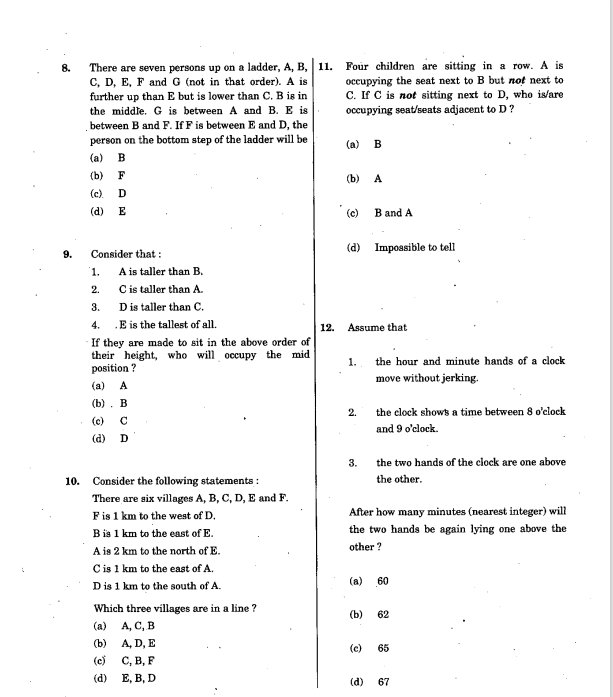
    Most of the aspirants don’t think about CSAT preparation until the fag end of UPSC Prelims only because it’s a qualifying paper. You have to get 33% of total marks i.e 66 marks to be clear Prelims. Failure to do so, will prevent you from writing Mains even if you have scored above 100+ marks in the GS Paper.

    Since the last two years, the English Comprehension passages are getting lengthier and the Mathematical questions trickier. Let’s take a look at the 2012 CSAT Paper and compare it with the 2021 CSAT paper.

    2014 CSAT Paper

    Here the questions are asked chapter by chapter and are basic-to-moderate. Questions are direct and straightforward without much combination numerals.

    2021 CSAT Paper

    There is no particular order of questions asked. Immediately after LR questions, we have a question on time and distance. Also the questions are moderate-to-advanced. One cannot find out the answer in first glance itself. There is no one-size fits for all approach or a uniform formula by which you can crack the sequential questions.

    Free Open to All CSAT Session by Civilsdaily Mentor Ravi Sir

    If you have to clear the paper, then you have to attempt atleast 50 questions out of 80. Out of these 50 questions, 27 need to be right. There is also negative marking of 1.5 marks for every wrong answer. Hence, for aspirants from a non-mathematics background the challenge lies in practising for CSAT without reducing time for GS Preparation.

    Do you want to know how you can complete both the lengthy comprehension passages and tricky mathematical questions within the stipulated time? Then it’s time you attended Civilsdaily Mentor Ravi sir’s webinar on Sunday.

    Ravi sir has cleared UPSC Prelims six times and attended the Interview round thrice. As a mentor, Ravi sir is a lifelong UPSC aspirant because he daily reads, checks and evaluates the right study materials for his students. On Monday, he will conduct a session on CSAT which is free for every aspirant to attend. All you have to do is register yourself for the session.

    Key Takeaways in the CSAT Session Conducted by Ravi Sir

    1. Topic-wise live demonstration on how to solve problems.

    2. Examples of easy, moderate and advanced questions to solve.

    3. Variety of questions under each topic.

    4. Previous year question paper analysis from 2013 onwards. How to be ready for the new paper pattern.

    5. Books one can refer for CSAT test series practice and to understand the concepts.

    6. How to practice CSAT without compromising on GS paper studies.

    7. Topic-wise weightage in Quantitative Aptitude.

    8. Ravi sir will solve your doubts in a Q&A discussion towards the end of the session.

    Webinar Details

    If you want to know the secrets of finishing the CSAT paper in 2 hours, then this webinar is for you! We hope this webinar will help all 2022 aspirants implement the suggestions of Ravi sir

    Date: 10 January 2022 (Monday)

    Time: 7 P.M.

More posts