💥Join UPSC 2027,2028 Mentorship (August Batch) + XFactor Notes & Microthemes PDF

Search results for: “”

  • DRDO tests Autonomous Flying Wing Technology Demonstrator

    The Defence Research and Development Organisation (DRDO) has successfully carried out the maiden test flight of a new Unmanned Aerial Vehicle (UAV), an autonomous Flying Wing Technology Demonstrator, from the Aeronautical Test Range, Chitradurga, Karnataka.

    About the Indigenous Drone

    • The Unmanned Aerial Vehicle (UAV) is powered by a small turbofan engine.
    • It is developed under unmanned combat aerial vehicle (UCAV) programme.
    • It is designed and developed by Aeronautical Development Establishment (ADE), Bengaluru, a premier research laboratory of DRDO.
    • The engine is Russian TRDD-50MT originally designed for cruise missiles.
    • A small turbo fan engine is being developed indigenously for meeting the requirement.

    Various initiatives by DRDO

    • DRDO is in the process of developing UAVs of different classes to met the requirements of the armed forces.
    • Rustom-2, the indigenous Medium Altitude Long Endurance (MALE) UAV under development, had crossed a milestone by reaching an altitude of 25,000 feet and an endurance of 10 hours.
    • It is now being designed to reach an altitude of 30,000 feet and 18 hours endurance.
    • An Unmanned Combat Aerial Vehicle is also on the drawing board.

    Significance of the development

    • Operating in a fully autonomous mode, the aircraft exhibited a perfect flight, including take-off, way point navigation and a smooth touchdown.
    • This flight marks a major milestone in terms of proving critical technologies towards the development of future unmanned aircraft.
    • This is a significant step towards self-reliance in strategic defence technologies.


    UPSC 2023 countdown has begun! Get your personal guidance plan now! (Click here)

  • [pib] Coalition for Disaster Resilient Infrastructure (CDRI)

    The Union Cabinet has approved the categorization of the Coalition for Disaster Resilient Infrastructure (CDRI) as an ‘International Organization’.

    What is the news?

    • The cabinet also signed as the Headquarters Agreement (HQA) with CDRI for granting it the exemptions, immunities and privileges as contemplated under the United Nations (Privileges & Immunities) Act, 1947.
    • This will provide CDRI an independent and international legal persona so that it can efficiently and effectively carry out its functions internationally.

    What is CDRI?

    • The CDRI is an international coalition of countries, UN agencies, multilateral development banks, the private sector, and academic institutions that aim to promote disaster-resilient infrastructure.
    • Its objective is to promote research and knowledge sharing in the fields of infrastructure risk management, standards, financing, and recovery mechanisms.
    • It was launched by the Indian PM Narendra Modi at the 2019 UN Climate Action Summit in September 2019.
    • CDRI’s initial focus is on developing disaster-resilience in ecological, social, and economic infrastructure.
    • It aims to achieve substantial changes in member countries’ policy frameworks and future infrastructure investments, along with a major decrease in the economic losses suffered due to disasters.

    Its inception

    • PM Modi’s experience in dealing with the aftermath of the 2001 Gujarat earthquake” as the chief minister led him to the idea.
    • The CDRI was later conceptualized in the first and second edition of the International Workshop on Disaster Resilient Infrastructure (IWDRI) in 2018-19.
    • It was organized by the National Disaster Management Authority (NDMA), in partnership with the UN Office for Disaster Risk Reduction (UNDRR), the UN Development Programme, the World Bank, and the Global Commission on Adaptation.

    Its diplomatic significance

    • The CDRI is the second major coalition launched by India outside of the UN, the first being the International Solar Alliance.
    • Both of them are seen as India’s attempts to obtain a global leadership role in climate change matters and were termed as part of India’s stronger branding.
    • India can use the CDRI to provide a safer alternative to China’s Belt and Road Initiative (BRI) as well.

    Why designated as International Organization?

    • Deputing experts to other countries
    • Deploying funds globally and receive contributions from member countries
    • Making available technical expertise to assist countries
    • Imparting assistance to countries in adopting appropriate risk governance arrangements and strategies for resilient infrastructure
    • Aligning with the Sustainable Development Goals (SDGs), the Paris Climate Agreement and the Sendai Framework for Disaster Risk Reduction
    • Leveraging international engagement to foster disaster-resilient infrastructure at home; and,
    • Providing Indian scientific and technical institution as well as infrastructure developers an opportunity to interact with global experts.

    Try this PYQ:

    Q.Consider the following statements:

    1. Climate and Clean Air Coalition (CCAC) to Reduce Short Lived Climate Pollutants is a unique initiative of G20 group of countries
    2. The CCAC focuses on methane, black carbon and hydrofluorocarbons.

    Which of the above statements is/are correct?

    (a) 1 only

    (b) 2 only

    (c) Both 1 and 2

    (d) Neither 1 nor 2


    [wpdiscuz-feedback id=”g1rfo9e6dp” question=”Please leave a feedback on this” opened=”1″]Post your answers here.[/wpdiscuz-feedback]


    UPSC 2023 countdown has begun! Get your personal guidance plan now! (Click here)

  • Festivals in news: Puri Rath Yatra

    Lakhs of devotees thronged the coastal town of Puri town to witness the annual Rath Yatra with three decorated chariots of sibling deities Lord Balabhadra, Lord Jagannath and Devi Subhadra towed in front of the 12th century Shree Jagannath Temple.

    About Jagannath Rath Yatra

    • Ratha Jatra, the Festival of Chariots of Lord Jagannatha is celebrated every year at Puri, the temple town in Orissa, on the east coast of India.
    • It involves a public procession with a chariot with deities Jagannath (Vishnu avatar), BalaBhadra (his brother), Subhadra (his sister) and Sudarshana Chakra (his weapon) on a ratha, a wooden deula-shaped chariot.
    • The huge, colourfully decorated chariots, are drawn by hundreds and thousands of devotees on the bada danda, the grand avenue to the Gundicha temple, some two miles away to the North.
    • It attracts over a million Hindu pilgrims who join the procession each year.

    Back2Basics: Puri Temple Architecture

    • Jagannath Temple is a very big temple and covers an area of 37000m2. The height of the outer wall is 6.1m.
    • It is surrounded by a high fortified wall 6.1 m high is known as Meghanada Pacheri.
    • The main portion of the temple is also surrounded by a wall known as Kurma Bheda.
    • The temple is built in Rekha Deula style and has four distinct sectional structures, namely –
    1. Deula, Vimana or Garba griha (Sanctum sanctorum) where the triad deities are lodged on the ratnavedi (Throne of Pearls)
    2. Mukhashala (Frontal porch)
    3. Nata mandir/Natamandapa, which is also known as the Jagamohan (Audience Hall/Dancing Hall), and
    4. Bhoga Mandapa (Offerings Hall)

    Try this question from CSP 2019:

    Q.Building ‘Kalyaana Mandapas’ was a notable feature in the temple construction in the kingdom of-

    (a) Chalukya (b) Chandela (c) Rashtrakuta (d) Vijayanagara


    [wpdiscuz-feedback id=”pdpfj71jer” question=”Please leave a feedback on this” opened=”1″]Post your answers here.[/wpdiscuz-feedback]


    UPSC 2023 countdown has begun! Get your personal guidance plan now! (Click here)

  • AIR-12, Yasharth is LIVE now:  join him (*Zoom link inside) 1-1 LIVE session with CD’s (UPSC-2021) Topper | Register free for their notes, resources, and Civilsdaily special Prelims package

    AIR-12, Yasharth is LIVE now: join him (*Zoom link inside) 1-1 LIVE session with CD’s (UPSC-2021) Topper | Register free for their notes, resources, and Civilsdaily special Prelims package


    Join Zoom Meeting: https://us06web.zoom.us/j/88925600359?pwd=Wk5HUm1iQ2dpdm1zVjNEZVpoVytVUT09

    Meeting ID: 889 2560 0359. Passcode: 771275


    Aspirants, this is huge. Mega sessions (1-1 talk), back to back with UPSC IAS Rankers. Register for FREE and get their notes + CivilsDaily’s special Prelims Packages


    👉And UPSC Mains Special 1-1 QnA Session with Sukanya Ma’am, Mains Head:- Details of strategy for the next 6 months…making schedules…how to plan Gs….making notes…how to write mains answer…basic structure.

    Timing: 5 P.M (2nd July, Saturday)

    Contact Email: sukanya@civilsdaily.com


    We are bringing our ‘Hall of Fame’ toppers who have taken multiple attempts, faced failures, changed strategies, applied, and executed to perfection. To achieve this feat there is a lot of hard work, perseverance, and turmoil which goes behind the making of these toppers and achievers. Due to their accomplishments, these toppers are a goldmine of UPSC prep wisdom.

    This is going to be a Mega session in which you will be talking 1-1 with these toppers. Asking them questions and doubts, getting them resolved. Moreover, these toppers will be sharing their notes, resources, and strategy with you.

    CivilsDaily has also made a special Prelims Package for you aspirants. On registration, you will be getting access to the package.

    AIR 12, UPSC 2021, Yasharth Shekhar will be coming to CivilsDaily’s Delhi Center – 2nd July 2022, 12 noon

    *You can participate via Zoom (online) as well in this session.

    AIR 06, UPSC 2021, Yaksh Choudhary will be Online for 1-1 session – on 1st July 2022

    Register for the Offline attendance, entry will be on the basis of first-come, first served.

    Address: 1 LGF, Apsara Arcade, Pusa Rd, Near Gate No.7 Karol Bagh, Metro station, Karol Bagh, New Delhi| Call or Whatsapp: 888291473

    About our Toppers

    Yaksh Choudhary, AIR 06, UPSC 2021

    Yaksh hails from Amroha, Uttar Pradesh and belongs to a family involved in agriculture. He is an IIT Guwahati alumnus and has been working as an assistant commandant in CRPF. This was Yaksh’s third attempt in UPSC CSE. His optional was Sociology and he had been a college level athlete. He believes trust in the process, studying with interest, understanding, and conceptual clarity are the keys to preparation.


    Yasharth Shekhar, AIR 12, UPSC 2021

    Yasharth Shekhar hails from Lucknow, Uttar Pradesh and becoming an IAS officer is his childhood dream. He is a St. Stephens graduate in Economics. This was his third attempt and his optional was Geography. Yasharth was not able to clear Prelims in his first attempt but he believes there is no shortcut to success and his hard work and dedication got him AIR 12.

    CivilsDaily has also made a special Prelims Package for you aspirants. On registration, you will be getting access to the package.

  • How to become an IAS officer

    Your presence over her echos your dream of an IAS officer. To become an IAS officer, Indian youths have to fulfill only 3 conditions:

    • Get a graduate degree
    • Clear the UPSC-CSE exam
    • Complete training successfully

    Passing the UPSC exam is not simple, many obstacles may be suffered during the process of the assessment. Even a serious aspirant without a hand-holding strategy, uncompromising attitude, and proper guidance may fail. 

    As we all know, the IAS examination is one of the toughest and most challenging tests among the other assessments. A UPSC student needs to be directed and determined towards their goal.  A prosperous competitor is not just a well-prepared one but also the one who can nourish their courage levels throughout the procedure.

    Important Links:

    UPSC IAS Exam Syllabus

    IAS Exam pattern

    Qualification

    Despite being one of the toughest exams in the country, the UPSC Civil Service IAS exam can sit with the simplest educational background. And the good news is that you can appear even before completing the minimum qualification. Okay, let’s see in detail:

    EDUCATIONAL QUALIFICATIONS REQUIRED
    • All candidates must have as a minimum one of the following educational qualifications:
    • A degree from a Central, State, or a Deemed university.
    • A degree received through correspondence or distance education.
    • A degree from an open university.
    • A qualification recognized by the Government of India as being equivalent to one of the above

    The following candidates are also eligible, but must submit proof of their eligibility from a competent authority at their institute/university at the time of the main examination, failing which they will not be allowed to attend the exam:

    • Candidates who have appeared in an examination, the passing of which would render them educationally qualified enough to satisfy one of the above points.
    • Candidates who have passed the final exam of the MBBS degree but have not yet completed an internship.
    • Candidates who have passed the final exam of ICAI, ICSI, and ICWAI.
    • A degree from a private university.
    • A degree from any foreign university recognized by the Association of Indian Universities

    AGE LIMIT

    • The candidate must be between the age of 21-32 years (for the General category candidate) on August 1 of the year of examination. However, age relaxations die to exist for SC, ST, OBC, and Physically Handicapped candidates.
    • For Other Backward Castes (OBC) the upper age limit is 35.
    • For Scheduled Castes (SC) and Scheduled Tribes (ST), the limit is 37 years.
    • The upper age limit is relaxed for certain candidates who are backward with respect to other factors and physically handicapped (PH) people.

    Personalized Education

    After knowing the syllabus of the exam, what is needed is your personalized education. For the most personalized learning, coaching is the only temple for both beginners and veterans. If you aren’t comfortable, at least get a personalized mentor for a seamless journey. To become an IAS, your preparation must be free from doubts. 

    Administrative attitude

    Besides smart preparation, an administrative attitude should be built up in you. The power of observing the social glitch, and finding the immediate solution is also virtual eligibility. So, pursue in such a way that education breeds morale. Morale breeds hope. Hope breeds calmness.

    Creation of smart content

    The focus ought to be on making yourself understand the requirement of the UPSC Mains Question, its elements, using information, and imparting answer writing skills for that.

    Self-confidence, healthy mind, clear-sightedness.

    Self-reliance maintains time management. Managing your time judiciously breeds a healthy mind. When you evolve ‘hardworking’, ‘enthusiast’, ‘social acumen, you will fall in love with the IAS career. Get power-packed living confidence, Become an IAS.

  • Free Entry: Limited Seats | Registrations open for Mega Seminar at Kale Auditorium, Gokhale Institute of Politics and Economics, Pune | UPSC + MPSC Preparation Strategy | Aspirants from Maharashtra are Invited |  Meet our Toppers from Maharashtra | Register Now

    Free Entry: Limited Seats | Registrations open for Mega Seminar at Kale Auditorium, Gokhale Institute of Politics and Economics, Pune | UPSC + MPSC Preparation Strategy | Aspirants from Maharashtra are Invited | Meet our Toppers from Maharashtra | Register Now

    Click and Register for a 1-1 meet and discussion with Rankers and Sajal sir


    UPSC 2021 results were released a few days back and it was a major validation of CivilsDaily’s student-centric approach, personalized mentorship, and commitment to your goal – cracking the UPSC IAS exam.

    ..amazing observation was the overwhelming number of rankers from Maharashtra.

    This was evident from 200+ rankers, including 30+ in the top 50 in the UPSC 2021 exam. Another amazing observation was the overwhelming number of rankers from Maharashtra. 

    Moreover, we have thousands of CivilsDaily students from the state.

    On the insistence of CivilsDaily’s alumni (ex-rankers) and our students from the state, we will be opening our first center in Maharashtra very soon, in Pune.

    How is Pune center going to help UPSC and Civil Services Aspirants from Maharashtra?

    Saves you from the trauma of relocation

    Aspirants have to leave their home state to Delhi, Karol Bagh for UPSC prep. It seriously dismantles their mental peace and continuity in preparation.

    Now you no longer have to leave your state and come to Delhi for UPSC preparation.

    Financially

    Financially, by saving huge expenditure incurred in Karol Bagh on renting and tuition fees.

    Now prepare for both: UPSC and MPSC

    Recently the notification for MPSC was released and since the pattern is similar to UPSC now, we will be helping you prepare for MPSC as well.

    Live lectures, Offline 1:1 Mentorship, Testing centre in Pune

    We will be providing the best classroom lectures; UPSC-relevant tests and study material; experienced mentors and dedicated faculty. 

    CivilsDaily will always remain committed to a personalized and student-centric approach and will live for its vision of making UPSC and government service exam preparation simpler, effective, result-oriented, and affordable to every aspiring student.

    Meet up in Pune Offline center: Sajal sir and UPSC Rankers from Maharashtra

    Get a golden chance to meet and discuss 1-1 with Rankers and Sajal sir at Pune center.

    Click and Register for a 1-1 meet and discussion with Rankers and Sajal sir

    Gokhale Institute of Politics and Economics, the alma mater of Sajal sir and some of the UPSC rankers from CivilsDaily has acknowledged the good work and has requested us to be hosted by the esteemed institute.

    You can meet Sajal sir and rankers.

    Venue:

    Kale Auditorium

    Gokhale Institute, Pune

    Date: 5th July
    Time: 3pm and 6pm

    Feel free to call/whatsapp for any clarification or details: +91 8668582260.


    We are all the more motivated now to churn out more and more rankers from Maharashtra.

  • Crack Prelims in 1st Attempt

    with carefully designed Smash Prelims Course

    85% of Smash Prelims 2022 students of Civilsdaily are writing Mains this year. Take the first step towards your UPSC dreams.

    Register for the Program

    [contact-form-7 id=”670186″ title=”Prelims Nov 2022″]

    To get up to 25% OFF on Course Fee

    More than a Crash Course for UPSC Prelims 2023

    Course completion (GS+Current Affairs) Lectures, Test Series (both GS and CSAT), 1-to-1 Mentorship, Previous Year Question analysis, and PDF Notes

    You don’t have time to read everything, nor do you have time to make notes.

    With just 5 months left for the exam Smash Prelims 2023: January Edition is what you need.

    Target 120+ marks in UPSC GS Prelims paper, 100+ in UPSC CSAT prelims with an overall accuracy of 90% with Smash Prelims program

    Mentorship by Santosh sir: Highly experienced and has an excellent record

    Beat the unpredictability of UPSC with 6 PILLARED APPROACH

    best test series for upsc prelims 2023

    Pillar-1: 60 Prelims test (GS + CSAT) Evidence-based UPSC patterned questions

    It is the best UPSC Prelims test series based on the Previous Year paper & PYQ trend analysis + the current pattern of UPSC Prelims

    • GS and Current Affairs Prelims Tests: 44 (14 Basic + 8 Advanced + 6 CA tests + 10 Full tests + 16 practice tests
    • 6 CSAT test papers to help you target 100+ marks in UPSC Prelims CSAT 2023 paper
    • Mandatory mentorship and doubt resolution call after every test

    Pillar-2: Syllabus completion – both GS and Current affairs for 1.5 yrs through LIVE Lectures (video available)

    • Most important and probable topics will be covered in a timely manner leaving ample time for multiple revisions.
    • Special classes on topics including Polity, History, Economics, Geography, Sessions to cover Environment innovatively, Science & Technology and more.
    • Previous year questions and paper trend analysis session
    • To be done through LIVE lectures, Notes will be shared.

    Pillar-3: Mentorship calls

    One-to-one mentorship by Santosh sir, core faculty and toppers

    • One to one Mentor calls after tests
    • Habitat/WhatsApp support from mentors
    • Frequent sessions with toppers for support and guidance.

    Pillar-4: Weekly zoom session by Santosh Gupta 

    Doubt clearance, strategy, and continuous improvement

    Tavishi failed thrice in the Prelims before but after joining Santosh sir’s mentorship cleared Prelim 2022 on her 4th attempt.

    Pillar-5: Learn Question-solvingImparting skills to attempt and solve Prelims paper

    • Targeting an accuracy rate of 90% and attempting maximum questions.
    • Strategic Live 1000 Questions solving with Santosh Gupta sir for Prelims-2023
    • Learn Art of Question-solving: Using Logical approach + Elimination techniques
    • Live Question solving of Previous year’s questions
    • Evolving your personal approach for attempting UPSC prelims paper

    Pillar-6: Study material, Current Affairs notes, listicles

    • Specifically made Current affairs notes + Live classes by core faculty for the entire two years for prelims.
    • Comprehensive and exhaustive notes covering everything that is important.

    What CivilsDaily’s Smash Prelims students have to say?

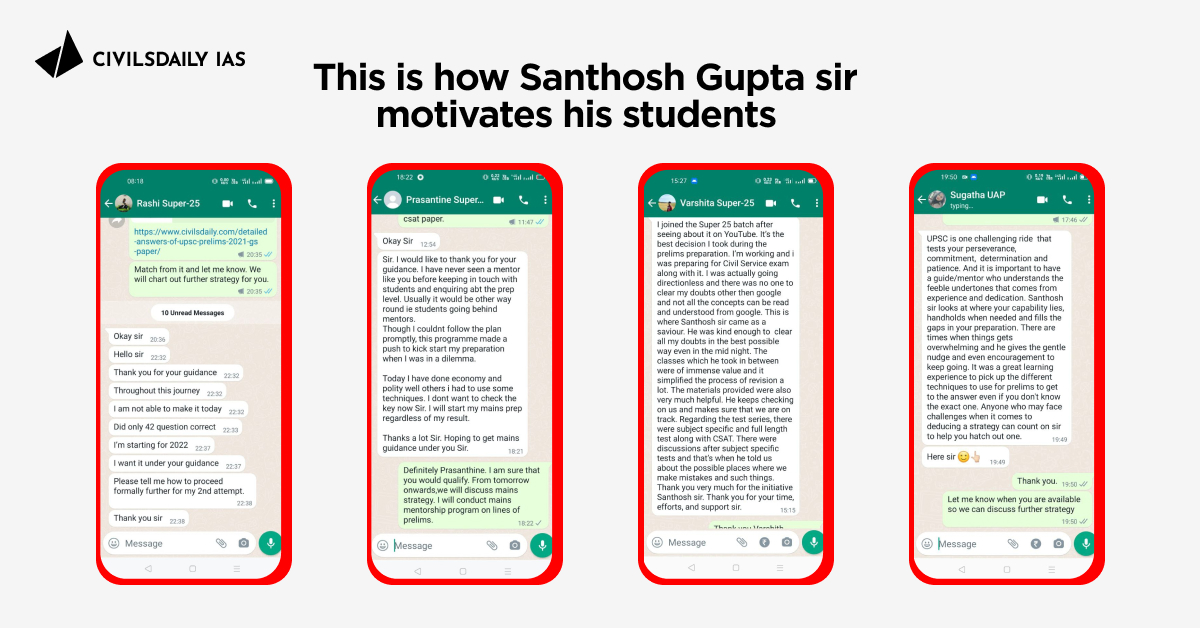
    Santosh sir’s guidance, a crucial part of the first prelims success for Rahul

    A miracle for Debarpita, Smash Prelims 2022 student

    Other messages showering gratitude for Santosh sir and Smash Prelims team

  • Do not weaken the anti-defection law

    Context

    The political developments in Maharashtra throw up troubling questions about how the political class is weakening the anti-defection law.

    Background of the anti-defection law

    •  It was enacted as the Tenth Schedule of the Constitution of India, in 1985, under Rajiv Gandhi’s premiership.
    • The law as it was enacted provided for the disqualification of a legislator belonging to a political party if he voluntarily gave up his membership of his party or if he defied the whip of his party by voting contrary to its directions in the legislative house.
    • Two exceptions: Initially, there were two exceptions provided in the schedule which would exempt a legislator from disqualification.
    • 1] Split: The first exception was a split in their original political party resulting in the formation of a group of legislators.
    • If the group consisted of one third of such legislators of that party, they were exempted from disqualification.
    • This exception was deleted from the schedule through a Constitution Amendment Act of 2003 because of frequent misuse.
    • 2] Merger: The second exception was ‘merger’ which can be invoked when the original political party of a legislator merges with another party and not less than two thirds of its legislators agree to such a merger.

    Interpretation of term ‘merger’ and issues with it

    • It is this second exception contained in paragraph four of the schedule which has been taken recourse to by a large number of legislators across States and even in Parliament to defect to the ruling party.
    • These legislators interpreted for themselves the term ‘merger’ to mean the merger of two thirds of legislators.
    • Now, the same is being repeated in Maharashtra.
    • But there is a little difference here.
    • It appears that the dissidents of Shiv Sena believed that if they get the two third number they can form a separate group and topple the government and then form a government with the help of the Bharatiya Janata Party.
    • The law imposes the condition of merger of the original political party.
    • However, a recent judgment of the Goa Bench of the Bombay High Court ( Girish Chodankar vs The Speaker, Goa State Legislative) that held that the merger of two thirds of Members of the Legislative Assembly is deemed to be the merger of the original party seems to have given them a ray of hope.
    • So, the legal position is if the dissidents do not merge with another party they will be disqualified now or later.

    Question of disqualification

    • Disqualification petitions have been filed by the Shiv Sena against 16 of the dissidents under paragraph 2(1)(a) on the ground that they have voluntarily given up the membership of the party.
    • The question of whether they have voluntarily given up the membership of the party is decided on the basis of the conduct of a member.
    • In Ravi S. Naik vs Union of India (1994), the Supreme Court had said “an inference can be drawn from the conduct of a member that he has voluntarily given up the membership of the party.

    Weakening the anti-defection law

    • Unprincipled defection: The ongoing developments in Maharashtra have once again brought before the country the reality of what the Supreme Court also described as the political evil of unprincipled defection.
    • But the order of the Supreme Court, on June 27, on petitions from the dissidents in the Shiv Sena, gives undue advantage to the dissident legislators.
    • The Court has granted them a longer time to submit replies than the rules mandate.
    • This order is going to set in motion certain political developments which will resurrect in a big way what the Supreme Court characterised as political evil.
    • The intervention by the Supreme Court too has thrown up some crucial question.
    • Kihoto Hollohan case: The first question is whether the Court can intervene at a stage prior to the decision by the Deputy Speaker.
    • A Constitution Bench of the Supreme Court had held in Kihoto Hollohan (1993) that judicial review cannot be available prior to the making of a decision by the Speaker nor at an interlocutory stage of the proceeding.
    •  The notice of no-confidence against the Deputy Speaker has added another piece to the jigsaw puzzle.
    • Nabam Rebia case: The Supreme Court had held in Nabam Rebia (2016) that the Speaker shall not decide the disqualification cases till the no-confidence motion against him is disposed of.
    • The House rules clearly say that the notice of no-confidence against the Speaker/Deputy Speaker needs to be admitted in the first place which is done only by the Speaker.
    • But it is the House which takes the final decision on the motion. If the notice of no-confidence does not contain specific charges, it can be disallowed by the Speaker. 
    • Further, the notice can be given only if the House is summoned.
    • When the notice was given, the Assembly was not convened. So, the notice against the Deputy Speaker can have no validity under the rules.

    Conclusion

    The law, though not perfect, is a serious attempt to strengthen the moral content of democracy. There will be shortcomings in this Bill but as we see and identify those shortcomings we should try to overcome them.

    UPSC 2023 countdown has begun! Get your personal guidance plan now! (Click here)

  • Is India really ahead of the West in terms of reproductive rights?

    Context

    Contrary to the grandstanding since the overturning of the landmark Roe V. Wade judgment, the truth is that India is not ahead of the West in terms of reproductive rights.

    Medical Termination of Pregnancy (MTP) Act

    • Abortion in India has been a legal right under various circumstances for the last 50 years with the introduction of Medical Termination of Pregnancy (MTP) Act in 1971.
    • The Act was amended in 2003 to enable women’s accessibility to safe and legal abortion services.
    • Abortion is covered 100% by the government’s public national health insurance funds, Ayushman Bharat and Employees’ State Insurance with the package rate for surgical abortion.

    The idea of terminating your pregnancy cannot originate by choice and is purely circumstantial. There are four situations under which a legal abortion is performed:

    1. If continuation of the pregnancy poses any risks to the life of the mother or mental health
    2. If the foetus has any severe abnormalities
    3. If pregnancy occurred as a result of failure of contraception (but this is only applicable to married women)
    4. If pregnancy is a result of sexual assault or rape

    These are the key changes that the Medical Termination of Pregnancy (Amendment) Act, 2021, has brought in:

    • The gestation limit for abortions has been raised from the earlier ceiling of 20 weeks to 24 weeks, but only for special categories of pregnant women such as rape or incest survivors. But this termination would need the approval of two registered doctors.
    • All pregnancies up to 20 weeks require one doctor’s approval. The earlier law, the MTP Act 1971, required one doctor’s approval for pregnancies upto 12 weeks and two doctors’ for pregnancies between 12 and 20 weeks.
    • Women can now terminate unwanted pregnancies caused by contraceptive failure, regardless of their marital status. Earlier the law specified that only a “married woman and her husband” could do this.
    • There is also no upper gestation limit for abortion in case of foetal disability if so decided by a medical board of specialist doctors, which state governments and union territories’ administrations would set up.

    Issues with legal provisions related to reproductive rights in India

    • Lack of rights based approach: The Medical Termination of Pregnancy (Amendment) Act 2021 is far from ideal and has been criticised for not taking a rights-based approach.
    • According to the Act, a pregnancy can be terminated on the following conditions: Grave danger to the physical/mental health of the pregnant woman; foetal abnormalities; rape/coercion; and contraceptive failure.
    • A woman’s right to choose to end the pregnancy even in the first few weeks is still not recognised in India.
    • Systemic barriers: It doesn’t give the pregnant person complete autonomy in ending the pregnancy, instead making them go through various systemic barriers.
    • The final decision falls not on the pregnant person, but on registered medical practitioners (RMP).
    • The constitution of a medical board, a requirement by the Act, is considered a barrier by the World Health Organisation.
    • Excludes transgenders and non-binary persons: Additionally, it uses the word “woman”, thereby leaving out pregnant transgender and non-binary persons who are biologically capable of bearing children.
    • It forces them to identify themselves in the gender-binary ignoring their gender identity.

    Social factors and lack of medical facilities

    • It is important to look through an intersectional lens, and factor in class and caste privilege.
    • Abortion facilities in private medical centres are expensive, available only for those who have the resources.
    • Lack of access: Not all public health centres, especially in rural India, provide abortion facilities.
    • Most unmarried women end up resorting to unsafe abortions in illegal clinics or at home.
    • According to the latest National Family Health Survey 2019-2021, 27 percent of the abortions were carried out by the woman herself at home.
    • According to United Nations’ Population Fund’s (UNFPA) State of the World Population Report 2022, around 8 women die each day in India due to unsafe abortions.
    • It also found that between 2007-2011, 67 percent of the abortions were classified as unsafe.
    • Unsafe abortion was one of the top three causes of maternal deaths.

    Discussion on reproductive rights in India are incomplete without mentioning surrogacy.

    Issues in the Surrogacy (Regulation) Act 2021

    • While well-intentioned, leaves much to be desired.
    • The plethora of regulations one must undergo is antithetical to a dignified standard of living.
    • Exclusionary in nature: Experts have pointed out that the Act is exclusionary in nature, disregards privacy, and also exploits women’s reproductive labour.
    • Only a heterosexual married couple (with certain preconditions) can be the intending parents.
    • It strips the reproductive autonomy of LGBTQ+ persons and single, divorced, and widowed intending parents. It can be seen as a violation to the fundamental right to equality.
    • Experts also believe that regulations, rather than a complete ban on commercial surrogacy, should have been the way forward.
    • Violates right to privacy: The Act requires the intending couple to declare their infertility and reveals the identity of the surrogate, both of which violate the right to privacy.
    • The landmark Puttaswamy judgment discusses bodily privacy – the right over one’s body and “the freedom of being able to prevent others from violating one’s body.”
    • The current reproductive rights regulatory framework falls short in guaranteeing bodily privacy.

    Conclusion

    The situation in India is far from perfect and we should take this moment to reflect and learn from progressive practices around the world. We should strive for inclusivity, complete bodily autonomy, and reproductive equity.

    UPSC 2023 countdown has begun! Get your personal guidance plan now! (Click here)
  • 1st July 2022| Daily Answer Writing Enhancement(AWE)

    Topics for Today’s questions:

    GS-1        Factors responsible for the location of primary, secondary and tertiary industries in various parts of the world including India

    GS-2        Parliament and State legislatures

    GS-3        Agriculture and related issues, e-technology in the aid of farmers

    GS-4       Case Studies

    Question 1)


    Q.1 What are the major factors that influence the location of the fertilizer industry in India? Explain with the help of suitable examples. (15 Marks)


    Question 2)

    Q.2 What are the various instruments available to the legislature to uphold the accountability of the executive in India? (10 Marks)

    Question 3)

    Q.3 Rapid adoption of agri-tech presents an important solution towards addressing the issues and inefficiencies plaguing the agriculture sector in India. Analyse. (10 Marks)

    Question 4)  

    Q.4 The proliferation of social media platforms have empowered the citizens and enabled them to freely share their views, including criticism of the government and its functionaries. However, it has also given rise to serious concerns such as spread of fake news, hate speech, revenge porn etc., which have grown manifold in recent years. Moreover, there are growing issues related to lack of transparency, accountability and rights of users of such social media platforms. In this context, what should be the underlying principles to regulate the social media platforms? Also, suggest a framework to address the associated issues and concerns and make such platforms a safe place for its diverse users. (20 Marks)


    HOW TO ATTEMPT ANSWERS IN DAILY ANSWER WRITING ENHANCEMENT(AWE)?

    1. Daily 4 questions from General studies 1, 2, 3, and 4 will be provided to you.

    2. A Mentor’s Comment will be available for all answers. This can be used as a guidance tool but we encourage you to write original answers.

    3. You can write your answer on an A4 sheet and scan/click pictures of the same.

    4.  Upload the scanned answer in the comment section of the same question.

    5. Along with the scanned answer, please share your Razor payment ID, so that paid members are given priority.

    6. If you upload the answer on the same day like the answer of 11th  February is uploaded on 11th February then your answer will be checked within 72 hours. Also, reviews will be in the order of submission- First come first serve basis

    7. If you are writing answers late, for example, 11th February is uploaded on 13th February , then these answers will be evaluated as per the mentor’s schedule.

    8. We encourage you to write answers on the same day. However, if you are uploading an answer late then tag the mentor like @Staff so that the mentor is notified about your answer.

    *In case your answer is not reviewed, reply to your answer saying *NOT CHECKED*. 

    1. For the philosophy of AWE and payment: