💥Mains Ready By December. Smash Mains & Smash PYQ Admissions Open

Search results for: “”

  • Reforms needed in the next stage of GST

    Context

    India has completed five years under the GST regime.

    How GST has performed so far

    • Before the GST, there were multiplicity of the Centre and state levies that masked the actual incidence of tax on products, the debilitating effects of the entry tax and the uncertainty of tax rates.
    • Today, in contrast, we have a single tax across the country combined with a stability in rates and a common technology platform in the form of a GSTN.
    • Record number of registrants: The ease of payments has improved over time with the technical glitches having been slowly sorted out, leading to a record number of GST registrants – increasing from 1.08 crore in April 2018 to 1.36 crore in 2022.
    •  The revenue gains have been significant.
    • If we factor in the three-percentage point decline in the incidence of GST duty from 14.8 to 11.8 per cent as suggested by the RBI, the actual proportion in 2021-2022 would have been 7.4 per cent of the GDP (according to a recent article by Arvind Subramanian and Josh Felman).

    What were the changes made to ensure the stricter compliance

    • The above improvement can be traced to stricter compliance flowing from three factors.
    • 1] Input credit only after supplier uploads invoice: Denial of input credit to the buyer without the supplier uploading the invoice.
    • 2] The introduction of e-invoicing.
    • 3] Third the introduction of e-waybills for transporters for value exceeding Rs 50,000 per consignment.
    • Greater coordination between CBIC and CBDT: Another factor is greater coordination between the Central Board of Excise and Customs (CBIC) and Central Board of Direct Taxes (CBDT) in compliance verification.

    Changes needed

    • 1] Provisions for unregistered GST suppliers: The micro, small and medium enterprises (MSME) sector has been affected by the GST reforms because the large units have been reluctant to buy from them in the absence of input duty credit.
    • An important measure here would be to amend the law to provide that all units buying from unregistered GST suppliers would have to pay duty on a reverse charge basis.
    • 2] Rate rationalisation: While the revenue gains have come through better compliance, the next surge in GST revenues will have to come from an increase in the average incidence of GST duties.
    • This will require a combination of measures — phasing out of exemptions, raising of the merit rate from the present level of 5 per cent and merging the 12 per cent rate with the standard rate, whether to 16 per cent or 18 per cent.
    • 3] Inclusion of fuels and real estate: Including natural gas/ATF under GST should be considered.
    • Further reforms in the factor markets — land, real estate and energy — would require their inclusion in the GST.
    • This is essential because while the economic reforms of the 1990s restructured the product market, the factor market reforms were incomplete.
    • 4] Creation of federal institution: We need to create another institution in the form of a GST state secretariat that can bring together senior officers from the Centre and states in an institutional forum registered under the Society Act.
    • This forum could also provide a common point of contact for trade and industry to redress the grievances on non-policy matters.

    Conclusion

    As GST enters its sixth year journey, the changes suggested above will fine tune it to propel India towards $5 trillion economy.

    UPSC 2023 countdown has begun! Get your personal guidance plan now! (Click here)


    Back2Basics: GST Input Tax Credit

    • Input Tax Credit means claiming the credit of the GST paid on purchase of Goods and Services which are used for the furtherance of business.
    • The Mechanism of Input Tax Credit is the backbone of GST and is one of the most important reasons for the introduction of GST.
  • A global order caught up in a swirl of chaos

    Context

    Adrift at the end of the 20th century, the world of the 21st century is proving to be highly chaotic.

    Lack of strong European leadership

    • Europe has been undergoing several major changes in recent months
    • Germany, which has steered European politics for almost two wdecades under Angela Merkel, now has a Chancellor (Olaf Scholz) who has hardly any foreign policy experience.
    • Without Germany’s steadying hand, Europe would be virtually adrift in troubled waters.
    • Emmanuel Macron may have been re-elected the President of France, but his wings have been clipped with the Opposition now gaining a majority in the French National Assembly.
    •  The United Kingdom is in deep trouble, if not disarray.
    • Consequently, at a time when actual and moral issues require both deft and firm handling, Europe appears rudderless.
    • Economic impact: Compounding this situation is the negative economic impact of the war in Ukraine.
    • What is evident already is that apart from the spiralling cost of energy, food and fertilizers, quite a few countries confront the spectre of food scarcity given that Ukraine and Russia were generally viewed as the granaries of the world.
    • Apart from this, nations do face several other problems as well, including, in some cases, a foreign exchange crisis.
    • The instruments employed by the West against Russia, such as sanctions, have not had the desired impact as far as the latter is concerned.

    Growing Russia-China closeness and its implications for Indo-Pacific

    • The situation in Europe is still to be decided, but what is also becoming obvious is that outside Europe, the conflict is beginning to take on a different dimension, leading to the emergence of new patchworks of relationships.
    • China’s growing influence in the Pacific region, including in the Indo-Pacific, and further strengthened by the entente with Russia, may hardly be a by-product of the Ukraine-Russia conflict, but it has induced fresh energy into a possible conflict between two rival power blocs.
    • Asia unwilling to take sides: Understanding the changing nature of relationships in Asia, and considering that most Asian nations appear unwilling to take sides in the event of a conflict, is important.
    • No unity of purpose: Unlike the unity and the strength displayed by European nations — there is no evidence of any such unity of purpose in the event that China was to launch a conflict with Taiwan.

    Challenges for India

    • India cannot ignore the situation created by the stronger bonds between Russia and China.
    • Uncertainty about Russia: India will need to determine whether Russia can be expected to play a role as a ‘trusted friend’ of India’s.
    • Again, it would be too much to hope that in dealing with China, India can expect the same kind of support it may need from the Quad.
    • China sidelining India: China, however, seems intent on establishing its dominance and also sidelining India in Asia, which New Delhi would have discerned in the course of the virtual BRICS Summit hosted by China in June.
    • Afghanistan challenge: Apart from China, India also urgently needs to come to terms with a Taliban Afghanistan.
    • Sri Lanka Challenge: At this time, the democratic upsurge in Sri Lanka presents India with a fresh set of problems.
    • In a situation where ‘rage’ and ‘anger’ are the dominant sentiments, there is every reason for concern that even governments that have maintained a ‘hands-off’ relationship could become targets of the new forces emerging in Sri Lanka.

    Major developments in West Asia

    • The Abraham Accords in 2020, which brought about the entente between the United Arab Emirates and Israel, has been the harbinger of certain new trends in the tangled web of relationships among countries of West Asia.
    • But even as the U.S.’s relations with Arab nations in West Asia appear to weaken, Russia and China are beginning to play key roles, with Iran as the fulcrum for establishing new relationships.
    • China continues to steadily build on its connections with the region, and with Iran in particular.
    • How India is dealing with the situation: India has been making steady progress in enlarging its contacts and influence in West Asia.
    •  While the India-Israel relationship dates back to the 1990s, the India-UAE relationship has blossomed in the past couple of years.
    • India-Iran relations, however, seem to have reached a stalemate of late.
    • Issues with I2U2: India has joined a U.S.-based group, the I2U2, comprising India, Israel the UAE and the U.S.
    • Details of the new arrangements are unclear, but it is evident that the target is Iran, as China is for the Quad, injecting yet another element of uncertainty into an already troubled region.

    Implications for nuclear deterrence

    • The argument being adduced is that a wide gap exists today in regard to China and India’s nuclear deterrent capabilities, and implicitly blames India for its voluntary ban on testing and its ‘no-first-use’ doctrine from making progress in this arena.
    • What is also implied is that India could overcome the lacuna by seeking the assistance of western nations which have such capabilities and knowledge.
    • Way forward for India: It is important for India to guard against such pernicious attempts at this time to undo its carefully negotiated and structured nuclear policy and doctrine, and be inveigled into any anti-China western move on this front.

    Conclusion

    Geopolitical experts in the West confine their findings at present solely to the impact of the Russia-Ukraine conflict, believing that this alone would determine not only war and peace but also other critical aspects as well. Significant developments are also taking place in many other regions of the globe, which will have equal if not more relevance to the future of the international governance system.

    UPSC 2022 countdown has begun! Get your personal guidance plan now! (Click here)

  • Indian MNCs are absent from discussions on digital policy

    Context

    Hyperactivity in the digital regulatory space in India in the form of policies, rules and guidelines signals the accelerated growth of the digital ecosystem which needs regulatory nurturing.

    Recent policy measures related to digital ecosystem

    • The Ministry of Electronics and Information Technology (MeitY) has announced the draft amendment to the IT Rules 2021 (June 2022).
    • The draft India Data Accessibility and Use Policy (February 2022),
    • National Data Governance Framework Policy (May 2022) and the new cyber security directions (April 2022).
    • Besides these, the most awaited and critical e-commerce policy and the Data Protection Bill, both of which have been in the making for at least a few years now, are likely to be announced soon.
    • This hyperactivity signals the accelerated growth of the digital ecosystem which needs regulatory nurturing.
    • The government has recently invited stakeholders to an open house discussion on the proposed changes to the IT Rules.

    Participation of Big Tech platforms  and other stakeholders in policy discussions

    • Various aspects of digital economy: Governments have been pushed to respond to myriad aspects of the digital economy — from financial sector regulation to anti-trust to data privacy.
    • With so much at stake, Big Tech platforms have upped their advocacy by hiring qualified professionals and funding empirical research, not only in India but also across the world.
    • Google, Amazon, Facebook, Twitter and the likes are all actively engaged in policy discussions, either directly or through third parties to put forth a point of view.
    • Similarly, start-ups, think tanks, civil society organisations and academics invested in the issues of the digital economy either as users or as observers contribute to the policy discourse.

    Who is missing?

    • Indian origin multinational corporations — the Tatas, Reliance, Aditya Birla Group, Godrej, ITC, Bajaj, and Hero — have collectively contributed to the country’s development.
    • While these may not be quintessential digital companies, except for Reliance Jio, many are working towards adopting digital technologies for manufacturing, distribution, and client service.
    • Many companies now have online distribution channels that retail through intermediary platforms or their own websites.
    • The Tatas have taken the plunge into e-commerce, first with Tata Cliq and recently with Neu.
    •  Despite this, these Indian MNCs are distant from conversations on these landmark policies that will determine the future of Indian commerce.

    Government relations and outreach functions of MNCs

    • Government relations and outreach functions have always been important to big businesses.
    • At what point and in what manner MNCs interact with the government will of course vary.
    • Using a sector-specific example, all telecom companies in India committedly participate in TRAI’s open houses, industry deliberations and written submissions so that they can nudge policymakers toward industry-friendly decision-making that sits well with overall growth objectives.
    • On general concerns such as infrastructure and the ease of doing business, intervention from the industry is much more indirect and often an ex-post phenomenon, that is, after the policy has been announced.
    • The practice of multi-stakeholderism in policy formulation is present in letter, if not always in spirit.

    Policy formulation in digital economy

    • The case of the digital economy is different.
    • There are multiple opportunities and avenues for participating in dialogue.
    • Striking balance between business viability and government objectives: The policy teams of Big Tech make the most use of these channels to present their point of view and hope for reconciliation on issues, with the final policy document attempting to strike a balance between business viability and government objectives.
    • Over the last few years of active debate on critical digital policies including those on data governance, privacy, anti-trust, and intermediary liability, there has been an overwhelming presence of the Big Tech Indian start-ups competing in this space, as well as their affiliated associations.
    • Indian MNCs, for reasons unclear, has been mostly absent.

    Conclusion

    Absence of Indian MNCs resulted in is a disproportionate policy focus on keeping Big Tech in check as against creating an enabling, secure and trusted digital ecosystem in India. As many issues highlighted by Big Tech are likely to be pain points for Indian businesses as well, participation of Indian MNCs could break the “us versus them” problem plaguing policy making in India today.

    UPSC 2023 countdown has begun! Get your personal guidance plan now! (Click here)

  • Why start IAS Prelims preparation RIGHT NOW? 7 steps to Smash Prelims 2023. Watch Video| Get Santosh sir’s notes (FREE)| Read success stories of three failures to 130+ in UPSC Prelims

    Only 30 seats left. Register now. | Smash Prelims 2023 under Santosh Gupta sir’s mentorship can increase your chances to clear Prelims by 85% | Read about Arsalanali and Tavishi’s success

    Click here for Smash Prelims 2023 details: Test series, 1-1 Mentorship, lectures and notes


    There is no doubt that UPSC Prelims could be the toughest stage. It is the great filter that weeds out the not-so-serious candidates but at times many serious ones too.

    Santosh sir here in this video gives explains why you should start preparing for UPSC 2023 right now. He touches upon five variables/factors that a student must consider at this moment: The Time factor, Priorities, Efforts, Guidance/Mentorship, and the most important of all- Right approach. Watch the video below.

    While there could be many reasons for failing in Prelims like insufficient syllabus coverage, mocks or test series not attempted, no proper planning, lack of conceptual understanding, etc but the major one is lack of guidance, preparation analysis, and course correction at regular intervals.

    To tackle all these Santosh sir, the mentor in chief for the CD Prelims program talks about 7 steps to smashing IAS Prelims incorporated under Smash Prelims 2023 program.

    1. Revising and covering syllabus through small measurable targets
    2. Make Short and smart notes of most important and relevant keywords/topics
    3. Attempting and analyzing past year UPSC Prelims papers (2000- 2022)
    4. Attempt Test:  Logical approach
    5. Analysis of the Mistakes: Fewer mistakes > Higher score through FCA/E approach 
    6. Revision of the topics where you made mistakes
    7. Analysis of the test, revision and discussion with Santosh sir
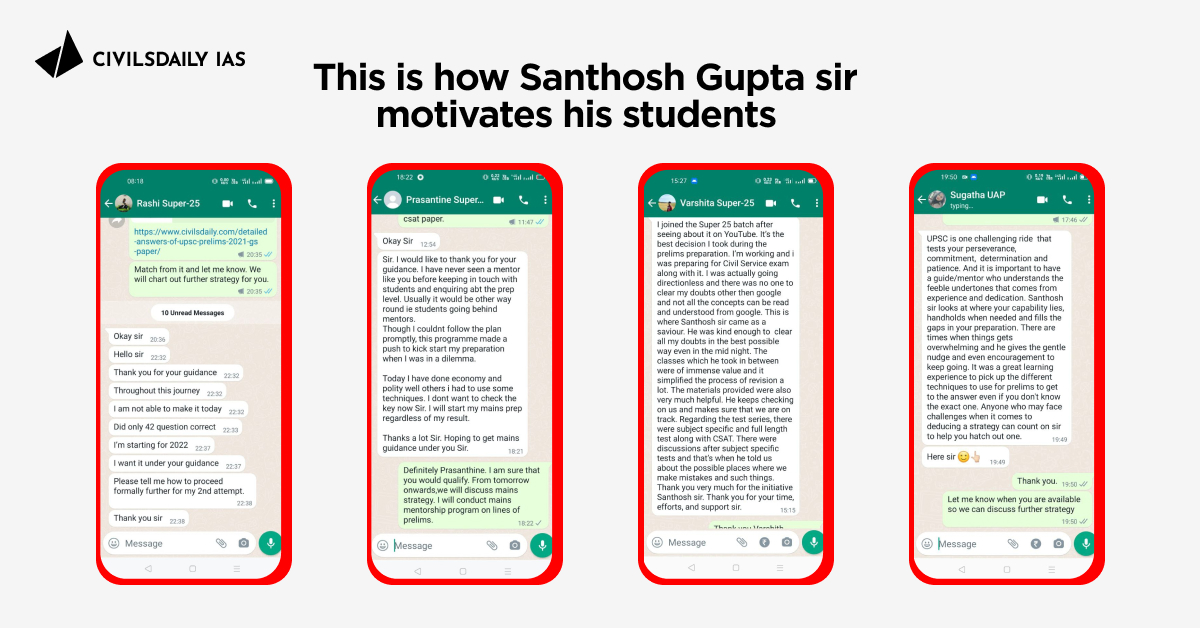
    Tavishi failed thrice in the Prelims before but after joining Santosh sir’s mentorship cleared Prelims 2022 in her 4th attempt. Schedule a call with Tavishi’s mentor
    You are 8 times more likely to clear Prelims 2023 with Santosh sir’s mentorship

    SMASH PRELIMS 2023: PERSONALIZED MENTORSHIP, TEST SERIES, LECTURES, NOTES

    Our Smash Prelims Program started as a pilot project last year with an aim to introduce step-wise improvement in our chosen 40 aspirants. Over a period of 2 months, Santhosh sir inculcated confidence in aspirants who were either newbies or gave too many attempts. This year, we achieved a remarkable 80% success ratio. This year, we have set our eyes on 100%. Yes, we are as ambitious and aspirational just like any other UPSC aspirant.


    About 6 pillared approach of Smash Prelims 2023

    Pillar-1: 44 Prelims test

    Prelims Tests: 44 (14 Basic + 8 Advanced + 6 CA tests + 10 Full tests + 6 CSAT tests)

    Pillar-2: Special Value Additions Notes and Classes by Santosh Gupta

    50 Special classes on topics including Polity, History, Economics, Geography, Sessions to cover Environment innovatively, Science & Technology and more.

    Pillar-3: Mentorship calls

    One-to-one mentorship by core faculty and toppers

    • One to one Mentor calls after tests
    • Habitat/WhatsApp support from mentors
    • Frequent sessions with toppers for support and guidance.
    You are 8 times more likely to clear Prelims 2023 with Santosh sir’s mentorship

    Pillar-4: Weekly zoom session by Santosh Gupta 

    Doubt clearance and continuous improvement

    Pillar-5: Learn Question-solving 

    • Strategic Live 1000 Questions solving with Santosh Gupta sir for Prelims-2023
    • Learn Art of Question-solving: Using Logical approach + Elimination techniques
    • Live Question solving of Previous year’s questions

    Pillar-6: Current Affairs

    Specifically made Current affairs notes + Live classes by core faculty for the entire two years for prelims.

    You are 8 times more likely to clear Prelims 2023 with Santosh sir’s mentorship under the Smash Prelims program
    Click and Enroll here

    About Santosh Gupta sir

    Santosh Gupta sir has scored above 140 twice in UPSC prelims and always 120 plus in all 6 attempts. He wrote all 6 mains and appeared for Interviews 3 times. He has qualified UPSC EPFO and BPSC 56-59th also. He has been teaching and mentoring UPSC aspirants for the last 5 years.

    What CivilsDaily’s Smash Prelims students have to say?

    Testimonial: Success Stories of Smash Prelims 2022

    From failing twice-thrice to clearing Prelims 2022
  • Latest guidelines on Arrests and Bail Orders

    On July 11, a division bench of the Supreme Court of India in Satender Kumar Antil vs CBI laid down fresh guidelines on arrests in order to have strict compliance with the provisions of Section 41 and 41A of the Code of Criminal Procedure, 1973.

    Why in news?

    • In recent times, there have been several controversies regarding the arrest and subsequent bail of accused persons.
    • On July 16, even the Chief Justice of India (CJI) cautioned against “hasty and indiscriminate arrests”.
    • He further commented on the delay in bails and the plight of undertrial prisoners.

    What are the guidelines?

    • In the case of Arnesh Kumar (2014), the apex Court had rightly observed that “arrest brings humiliation, curtails freedom and cast scars forever”.
    • With regard to the Satender Kumar Antil case, the Court has issued specific directions and has also called for a compliance report.
    • The Court said that the investigating agencies and their officers are duty-bound to comply with the mandate of Section 41 and 41A and the directions issued.

    How is a person arrested?

    • Arrest in its simplest form is defined as, “when one is taken and restrained from his liberty”.
    • The police has wide powers to arrest under the Code of Criminal Procedure, 1973.
    • In the Joginder Kumar (1994) verdict, the Court had stated that “arrest and detention in police lock-up of a person can cause incalculable harm to the reputation and self-esteem of a person”.

    What are Sections 41 and 41A of the Code of Criminal Procedure?

    • Section 41 provides for the circumstances in which arrest can be made by the police without a warrant and mandates for reasons to be recorded in writing for every arrest and non-arrest.
    • Section 41A provides for the requirement of a notice to be sent by the investigating agencies before making an arrest in certain conditions prescribed by the Code.

    What did the court comment regarding these articles?

    • The Court stated that any dereliction on the part of the agencies has to be brought to the notice of the higher authorities by the court followed by appropriate action.
    • The Bench further said that the courts will have to satisfy themselves on the compliance of Section 41 and 41A.
    • Any non-compliance would entitle the accused for a grant of bail.

    What are the guidelines with respect to bail?

    Regarding bail, the Court has made a specific observation in the form of an obiter that the:

    • GoI may consider the introduction of a separate enactment, i.e. a Bail Act, so as to streamline the grant of bails.
    • It is clearly stated that there need not be any insistence on a bail application while considering the application under Sections 88, 170, 204 and 209 of the Code.
    • The Court said that there needs to be a strict compliance of the mandate laid down in the judgment of this court in Siddharth” (Siddharth vs State of U.P., 2021).
    • It is a clear direction of the Court that bail applications ought to be disposed of within a period of two weeks except if the provisions mandate otherwise — the exception being an intervening application.
    • The Court also said that applications for anticipatory bail are expected to be disposed of within a period of six weeks with the exception of any intervening application.
    • The High Courts have been directed by the apex court to identify undertrial prisoners who cannot comply with bail conditions.

    Way forward

    • The State and Central governments will have to comply with the directions issued by the Court from time to time with respect to the constitution of special courts.
    • The High Court in consultation with the State governments will have to undertake an exercise on the need for special courts.
    • The vacancies should be filled up in the position of Presiding Officers of the special courts, expeditiously.
    • The CJI has also raised the issue of vacant positions and infrastructural requirements in the judiciary.


    UPSC 2023 countdown has begun! Get your personal guidance plan now! (Click here)

  • Private Sector Boost in India’s Space Industry

    Principal Scientific Adviser stated earlier this month that the government would soon come up with a new space policy that could initiate the rise of India’s own “SpaceX-like Ventures”.

    Prospects of the proposed Space Policy

    • The final version of the policy would soon be referred to the Empowered Technology Group for further examination.
    • The proposed move would increase private sector participation in the industry.
    • The policy document recognizes that India has not tapped into its complete potential in space sector.

    Why is development in the space sector important?

    Ans. Address wide range of problems

    (1) Climate Change

    • Satellites provide more accurate information on weather forecasts and assess (and record) long-term trends in the climate and habitability of a region.
    • By monitoring the long-term impact of climate change at regional, territorial, and national scales, governments would be able to devise more pragmatic and combative plans of action for farmers and dependent industries.
    • Additionally, they can also serve as real-time monitoring and early-warning solutions against natural disasters such as earthquakes, tsunamis, floods, wildfires, mining etc.
    • Real-time tracking can also serve multiple purposes in defence.

    (2)  Connectivity

    • In this light, it must be noted that satellite communications, which are used to facilitate telecommunication services, are among the major categories for investment in the space technology sector.
    • Satellite communication can reach more remote areas where conventional networks would require a heavy complimenting infrastructure.
    • Additionally, as to reliability, the World Economic Forum had stated that satellite communication can help connect 49% of the world’s unconnected population.
    • Other prominent categories include spacecraft and equipment manufacturing.
    • What essentially needs to be remembered is that the strategic space avenue is an integration of the aerospace, IT hardware and telecom sectors.

    Where does India stand in the global space market?

    • As per SpaceTech Analytics, India is the sixth-largest player in the industry internationally having 3.6% of the world’s space-tech companies (as of 2021).
    • US holds the leader’s spot housing 56.4% of all companies in the space-tech ecosystem.
    • Other major players include UK (6.5%), Canada (5.3%), China (4.7%) and Germany (4.1%).
    • The Indian Space Industry was valued at $7 billion in 2019 and aspires to grow to $50 billion by 2024.

    Why does India matter in the global space-tech market?

    • The country’s standout feature is its cost-effectiveness.
    • India holds the distinction of being the first country to have reached the Mars’ orbit in its first attempt and at $75 million — way cheaper than Western standards.

    Future prospects of India’s private ‘Space’

    Ans. India may lead in space junk management

    • Almost 60-odd start-ups had registered with the Indian Space Research Organisation (ISRO) this year.
    • A majority of them were dealing in projects related to space debris management.
    • As space becomes more congested with satellites, the technology would thus help in managing ‘space junk’ (debris of old spacecraft and satellites).

    Where does India lack?

    Ans. Undisputedly, it is the finances

    • The US and Canada were the highest receivers of space-related investment in 2021.
    • The US’s space budget was $41 billion in 2021, $23.3 billion of which was focused on NASA.
    • India’s total budgetary allocation for FY2022-23 towards the Department of Space was ₹13,700 crore ($172 million).
    • Further, as per Tracxn data, funding into the sector’s start-ups (in India) nearly tripled to $67.2 million on a year-over-year basis in 2021.

    How is the private sector’s involvement regulated in India?

    • In June 2020, the Union government announced reforms in the space sector enabling more private players to provide end-to-end services.
    • The central idea was to bring forth a predictable policy and regulatory environment for them and additionally provide access to ISRO facilities and assets to improve their capacities.

    (1) Establishment of IN-SPACe

    • An announcement for the establishment of the Indian National Space Promotion and Authorisation Centre (IN-SPACe) was made.
    • It was mandated the task of promoting, authorising and licensing private players to carry out space activities.
    • As an oversight and regulatory body, it is responsible for devising mechanisms to offer sharing of technology, expertise, and facilities free of cost to promote non-government private entities (NGPEs).
    • IN-SPACe’s Monitoring and Promotion Directorate oversees NGPE’s activities as per prescribed regulations and reports back in case any corrective actions or resolutions are required.
    • ISRO shares its expertise in matters pertaining to quality and reliability protocols, documentation, and testing procedure through IN-SPACe’s ‘interface mechanism’.

    (2) Establishment of NSIL

    • Additionally, constituted in March 2019, New Space India Ltd (NSIL), is mandated to transfer the matured technologies developed by the ISRO to Indian industries.
    • All of them are under the purview of the Ministry of Defence.
    • Private sector’s involvement in the long term, as with other commercial sectors, is believed to help spur investment and expertise in the realm which is capital-intensive and demands high technology.


    UPSC 2023 countdown has begun! Get your personal guidance plan now! (Click here)

  • Only 4 States adopt Model Tenancy Law

    More than a year since the Union Housing and Urban Affairs Ministry circulated the Model Tenancy Act (MTA), only four States had revised their tenancy laws to be in line with the MTA.

    What is the Model Tenancy Act?

    • MTA is aimed at opening up of the vacant housing stock for rental housing purposes and helping bridge the trust deficit that exists between tenants and landlords by clearly delineating their obligations.
    • The housing and urban affairs ministry had floated the draft model tenancy law in July 2019.

    Major provisions of MTA

    (1) Rent Court and Rent Tribunal:

    • To ensure speedy redressal of disputes, the Act calls for establishing a separate Rent Court and Rent Tribunal in every state/UTs to hear appeals for matters connected to rental housing.
    • Only the rent court and no civil court will have the jurisdiction to hear and decide the applications relating to disputes between landowner and tenant and matters connected with it.
    • It calls for the disposal of complaints and appeals by the Rent Court and Rent Tribunals within 60 days.

    (2) Tenancy Agreements:

    • It also seeks to establish an independent authority in every state and Union Territory for the registration of tenancy agreements.
    • Under the Act, unless otherwise agreed in the tenancy agreement, the landlord will be responsible for activities like structural repairs except those necessitated by damage caused by the tenant etc.
    • On his part, a tenant will be responsible for drain cleaning, switches and socket repairs, kitchen fixtures repairs, replacement of glass panels in windows, doors and maintenance of gardens and open spaces, among others.

    For residential and commercial properties

    • The Act will apply to premises let out for residential, commercial or educational use, but not for industrial use. It also won’t cover hotels, lodging houses, inns, etc.
    • This model law will be applied prospectively and will not affect existing tenancies.
    • It seeks to cover both urban as well as rural areas.
    • The Act says that a security deposit equal to a maximum of two month’s rent in the case of residential premises and a maximum of six month’s rent in the case of non-residential premises would have to be paid by the tenants.

    How will states implement it?

    • As per the MoU signed under PMAY-U, the states and union territories would legislate or amend the existing rental laws on the lines of the MTA.

    Why was a need felt to bring this on?

    (1) For a rental economy

    • Without a well-rounded rental policy and the proper implementation of the rental contracts, there was no sound mechanism to resolve tenant-landlord conflicts.
    • Property owners find it challenging to evict tenants if they misuse the property.
    • To steer clear of such complications, such property owners often chose to keep these homes vacant instead of renting them out.

    (2) Unattractive rental yield

    • In India, the rental yield for residential property is quite low, even in bigger cities. It is in the range of 1.5% to 3% of the capital values.
    • This has disincentivized people from investing in second or third homes which could be rented out.
    • Often, they also prefer to leave their properties vacant in case they return to India.
    • NRIs avoid leasing their residential properties for fear of squatters and dealing with the legalities of eviction.

    How will MTA help?

    (1) Unlocking homes

    • It will unlock vacant houses for rental purposes
    • It will enable the creation of adequate rental housing stock for all the income groups thereby addressing the issue of homelessness.

    (2) Helping migrants

    • Rental housing is a preferred option for students and migrants.
    • It will balance the rights of both landlords and tenants.

    (3) Effective negotiations

    • There is no monetary ceiling under MTA, which enables parties to negotiate and execute the agreement on mutually agreed terms.
    • It will give confidence to landlords to let out their vacant premises, the housing ministry said.
    • The Act also tries to address how a renter can legitimately increase the rent.

    (4) Control over encroachments

    • It has proposed limiting the advance security deposits to two months’ rent and has also suggested heavy penalties for tenants who decide to overstay.
    • Those who do may have to shell out double the rent for two months and even four months.

    (5) Rights of tenants

    • The landowner cannot cut power and water supplies in case of a dispute and would have to provide a 24-hour notice to tenants to carry out repair work.
    • Should the landlords wish to increase the rent, they will need to provide a three-months notice to the tenants.
    • These measures would go a long way in protecting the rights of a tenant as it regulates the rent hikes that tenants have had to face.

    Challenges ahead

    While the proposals of the Act have been widely welcomed, their implementation may not be very simple.

    (1) Not binding nature

    • The Act is not binding on the states as land and urban development remain state subjects.
    • Like in the case of RERA, the fear is that states may choose not to follow guidelines, diluting the essence of the Model Act.

    (2) Issues over paltry rents

    • Also, the Model Act is prospectively applicable and will not affect the existing tenancies.
    • The repeal of rent control Acts can be governed by political exigencies.
    • This may be a complicated process in cities like Mumbai, where tenants have occupied residential properties in prime areas for absurdly low rents.


    UPSC 2023 countdown has begun! Get your personal guidance plan now! (Click here)

  • 26th July 2022| Daily Answer Writing Enhancement(AWE)

    Topics for Today’s questions:

    GS-1          Population and associated issues

    GS-2         Bilateral, regional and global groupings and agreements involving India and/or affecting  India’s interests.

    GS-3        Science and Technology- developments and their applications and effects in everyday life.

    GS-4        Emotional intelligence-concepts, and their utilities and application in administration and governance.

    Question 1)


    Q.1 The window to realise India’s demographic potential is narrowing with time. Discuss in context of factors affecting the employability of Indian youth and their remedial measures. (10 Marks)


    Question 2)

    Q.2 “The combined financial firepower, human capital, and technology prowess available between the two countries would place the world on a safer and more stable plane. The India-US partnership is, in that sense, not a nicety but a necessity for the new multipolar world order.” Comment. (15 Marks)

    Question 3)

    Q.3 What are the reasons for discrimination or bias in the AI? How agreement reached at the UNESCO on AI governance could help deal with the issues with AI? (10 Marks)

    Question 4)  

    Q.4 What do you understand by conformity, compliance and obedience? Discuss their relevance in the context of civil services in India. (10 Marks)


    HOW TO ATTEMPT ANSWERS IN DAILY ANSWER WRITING ENHANCEMENT(AWE)?

    1. Daily 4 questions from General studies 1, 2, 3, and 4 will be provided to you.

    2. A Mentor’s Comment will be available for all answers. This can be used as a guidance tool but we encourage you to write original answers.

    3. You can write your answer on an A4 sheet and scan/click pictures of the same.

    4.  Upload the scanned answer in the comment section of the same question.

    5. Along with the scanned answer, please share your Razor payment ID, so that paid members are given priority.

    6. If you upload the answer on the same day like the answer of 11th  February is uploaded on 11th February then your answer will be checked within 72 hours. Also, reviews will be in the order of submission- First come first serve basis

    7. If you are writing answers late, for example, 11th February is uploaded on 13th February , then these answers will be evaluated as per the mentor’s schedule.

    8. We encourage you to write answers on the same day. However, if you are uploading an answer late then tag the mentor like @Staff so that the mentor is notified about your answer.

    *In case your answer is not reviewed, reply to your answer saying *NOT CHECKED*. 

    1. For the philosophy of AWE and payment: 

  • NITI Aayog’s plan for rollout of Digital Banks

    Last week, federal think tank NITI Aayog released a report on digital banks, offering a template for their licensing in India. It said India already has a technology stack to facilitate digital banks.

    What are the planned Digital Banks?

    • Digital Banks or DBs are full-scale banks to be licensed under the Banking Regulation Act.
    • Unlike traditional banks, which require brick-and-mortar infrastructure or physical access points, digital banks simply leverage technology to provide banking services through mobile applications and internet-based platforms.
    • DBs behave like any other scheduled commercial bank, accepting deposits, giving loans etc.
    • They will follow prudential and liquidity norms at par with the commercial banks.
    • Globally, terms like “digital banks”, “neobanks”, “challenger banks”, and “virtual banks” are often used interchangeably.

    What about digital banking units then?

    • The Union budget for FY23 proposed to establish digital banking units (DBUs) of scheduled commercial banks in 75 districts.
    • The objective is to ensure that the benefits of digital payments, banking and fintech innovations reach the grass-roots.
    • DBUs are treated as banking outlets, equivalent to a branch.
    • These units do not have a legal personality and are not licensed under the Banking Regulation Act.
    • Only existing commercial banks may establish DBUs. In contrast, digital banks will be licensed.
    • These banks are expected to ensure credit penetration to underserved MSMEs and retail customers.

    What purpose will digital banks serve?

    • Digital banks are expected to further innovation and support the underserved segments.
    • However, some believe that it will only cater to customers with some level of comfort with digital transactions.
    • According to them, RBI too is not comfortable with this model as the central bank believes that cash handling and credit decisions require physical branches.

    What does NITI Aayog suggest for DBs?

    • In the first phase, a restricted digital bank licence may be given, with limits in terms of volume/value of customers. In the second stage, the licensee will be put in a regulatory sandbox.
    • Finally, a ‘full-scale’ licence may be granted contingent on satisfactory performance.
    • A digital bank will be required to have initial capital of ₹20 crore while in the regulatory sandbox.
    • Upon progression from the sandbox, a full-stack digital business/consumer bank will be required to bring in ₹200 crore capital.

    What has been the global experience?

    • The UK has led the pack in terms of digital banks, with new entrants in the form of Monzo and Starling Bank.
    • Several jurisdictions in the South East Asian region have witnessed the rise of digital banks.
    • Hong Kong has issued separate licences for virtual banks.
    • As of May 2020, the Hong Kong Monetary Authority has licensed 8 entities out of 33 applications.
    • In South Korea, Kakao Bank and K Bank operate as internet banks licensed under the Banking Act.
    • The Philippines has approved six licenses for digital banks.


    UPSC 2023 countdown has begun! Get your personal guidance plan now! (Click here)

  • Who was Raja Ravi Varma?

    Ahead of the 175th birth anniversary fete of the legendary artist Raja Ravi Varma, erstwhile royal family of Kilimanoor has urged the Union government to posthumously confer the Bharat Ratna, the country’s highest civilian award, on him.

    Raja Ravi Varma

    • Raja Ravi Varma was born in April 1848 in Kilimanoor, Kerala, to a family which was very close to the royals of Travancore.
    • Often referred to as the father of modern Indian art, he is widely known for his realistic portrayal of Indian gods and goddesses.
    • While he majorly painted for the royalty, he is also credited for taking art to the masses with his prints and oleographs.
    • At a young age, he would draw animals and everyday scenes on the walls in indigenous colours made from natural materials such as leaves, flowers and soil.
    • His uncle, Raja Raja Varma, noticed this and encouraged his talent.
    • Patronised by Ayilyam Thirunal, the then ruler of Travancore, he learnt watercolour painting from the royal painter Ramaswamy Naidu, and later trained in oil painting from Dutch artist Theodore Jensen.

    How he become an artist of the royals?

    • Varma became a much sought-after artist for the aristocrats and was commissioned several portraits in late 19th century.
    • Arguably, at one point, he became so popular that the Kilimanoor Palace in Kerala opened a post office due to the sheer number of painting requests that would come in for him.
    • He travelled across India extensively, for work and inspiration.

    Fame as a notable painter

    • Following a portrait of Maharaja Sayajirao of Baroda, he has commissioned 14 Puranic paintings for the Durbar Hall of the new Lakshmi Vilas Palace at Baroda.
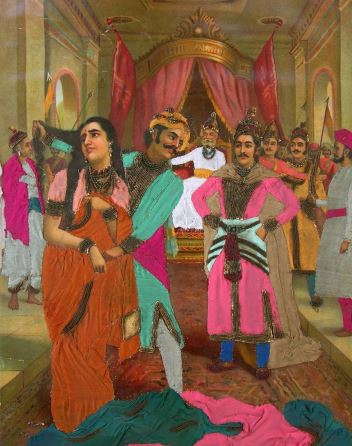
    • Depicting Indian culture, Varma borrowed from episodes of Mahabharata and Ramayana for the same.
    • He also received patronage from numerous other rulers, including the Maharaja of Mysore and Maharaja of Udaipur.
    • As his popularity soared, the artist won an award for an exhibition of his paintings at Vienna in 1873.
    • He was also awarded three gold medals at the World’s Columbian Exposition in Chicago in 1893.

    Nature of his artforms

    • Much of his celebrated art also borrows heavily from Indian mythology.
    • In fact, he is often credited with defining the images of Indian gods and goddesses through his relatable and more realistic portrayals often painted with humans as models.
    • The depictions include Lakshmi as the goddess of wealth, Saraswati as the goddess of knowledge and wisdom, and Lord Vishnu with his consorts, Maya and Lakshmi.

    How he took Indian art to the masses?

    • Raja Ravi Varma aspired to take his art to the masses and the intent led him to open a Lithographic Press in Bombay in 1894.
    • The idea, reportedly, came from Sir T Madhava Rao, former Dewan of Travancore and later Baroda, in a letter where he pointed out to Varma that since it was impossible for him to meet the large demand for his work, it would be ideal for him to send some of his select works to Europe and have them produced as oleographs.
    • Varma, instead, chose to establish a printing press of his own.
    • The first picture printed at Varma’s press was reportedly The Birth of Shakuntala, followed by numerous mythological figures and saints such as Adi Shankaracharya.

    Major works

    • It is believed that he had made around 7,000 paintings before his death at the age of 58.
    • But only one painting is now left in ‘Chithrashala,’ the artist’s studio at Kilimanoor Palace — an unfinished portrait of ‘Parsi lady’ which was his last work.
    • Some of his popular works include ‘Lady in the Moonlight’, ‘Nair Lady Adorning Her Hair’, ‘Malabar Lady with Violin’, ‘Lady with Swarbat’, and ‘Maharashtrian Lady with Fruits’.

    Try this PYQ:


    There are only two known examples of cave paintings of the Gupta period in ancient India. One of these is paintings of Ajanta caves. Where is the other surviving example of Gupta paintings?

    (a) Bagh caves

    (b) Ellora caves

    (c) Lomas Rishi cave

    (d) Nasik caves


    [wpdiscuz-feedback id=”6l9gnsan2c” question=”Please leave a feedback on this” opened=”1″]Post your answers here.[/wpdiscuz-feedback]


    Back2Basics: Bharat Ratna

    • Bharat Ratna – ‘Jewel of India’ is the highest civilian award of the country.
    • It is conferred for exceptional Service to the nation in various fields such as Science arts, literature and recognition of public service of the highest order.
    • The award can be granted posthumously and since its establishment, seven awards were granted posthumously.
    • The award was established by formal President of India Rajendra Prasad on 2nd January 1954.
    • The concept of awarding this award posthumously was not there in the original statute declared in January 1954.
    • Provision to award posthumously was finally added in January 1966 statute of this prestigious award.
    • The medallion is cast in Bronze.
    • The medallion is designed like the leaf of a pipal tree with a sunburst in the centre and Bharat Ratna is engraved underneath it.


    UPSC 2023 countdown has begun! Get your personal guidance plan now! (Click here)