Scientists have recorded four species of corals for the first time from Indian waters. These new species of azooxanthellate corals were found from the waters off the Andaman and Nicobar Islands.
What are Azooxanthellate Corals?
The azooxanthellate corals are a group of corals that do not contain zooxanthellae and derive nourishment not from the sun but from capturing different forms of planktons.
They are deep-sea representatives with the majority of species being reported from depths between 200 metres and 1,000 metres.
They are also reported from shallow waters unlike zooxanthellate corals that are restricted to shallow waters.
Which are the news species found?
Truncatoflabellum crassum, T. incrustatum, T. aculeatum, and T. irregulare under the family Flabellidae were previously found in Japan, the Philippines and Australian waters.
Only T. crassum was reported with the range of Indo-West Pacific distribution.
Significance of the discovery
Most studies of hard corals in India have been concentrated on reef-building corals while much is not known about non-reef-building corals.
These new species enhance our knowledge about non-reef-building solitary corals.
Back2Basics: Coral Reefs
Corals are marine invertebrates or animals not possessing a spine.
Each coral is called a polyp and thousands of such polyps live together to form a colony, which grows when polyps multiply to make copies of themselves.
Australia’s Great Barrier Reef is the world’s largest reef system stretching across 2,300 km.
It hosts 400 different types of coral, gives shelter to 1,500 species of fish and 4,000 types of mollusc.
Corals are of two types — hard coral and soft coral:
Hard corals, also called hermatypic or ‘reef building’ corals extract calcium carbonate (also found in limestone) from the seawater to build hard, white coral exoskeletons.
Soft coral polyps, however, borrow their appearance from plants, attach themselves to such skeletons and older skeletons built by their ancestors. Soft corals also add their own skeletons to the hard structure over the years and these growing multiplying structures gradually form coral reefs. They are the largest living structures on the planet.
How do they feed themselves?
Corals share a symbiotic relationship with single-celled algae called zooxanthellae.
The algae provides the coral with food and nutrients, which they make through photosynthesis, using the sun’s light.
In turn, the corals give the algae a home and key nutrients.
The zooxanthellae also give corals their bright colour.
Farmers in Kerala continue to protest across several high ranges of the state against the Supreme Court’s recent order to establish 1-km Eco-Sensitive Zones around all protected areas, wildlife sanctuaries, and national parks.
What are the Eco-sensitive Zones (ESZs)?
Eco-Sensitive Zones (ESZs) or Ecologically Fragile Areas (EFAs) are areas notified by the MoEFCC around Protected Areas, National Parks and Wildlife Sanctuaries.
The purpose of declaring ESZs is to create some kind of “shock absorbers” to the protected areas by regulating and managing the activities around such areas.
They also act as a transition zone from areas of high protection to areas involving lesser protection.
How are they demarcated?
The Environment (Protection) Act, 1986 does NOT mention the word “Eco-Sensitive Zones”.
However, Section 3(2)(v) of the Act, says that Central Government can restrict areas in which any industries, operations or processes or class of industries, operations or processes shall be carried out or shall not, subject to certain safeguards.
Besides Rule 5(1) of the Environment (Protection) Rules, 1986 states that central government can prohibit or restrict the location of industries and carrying on certain operations or processes on the basis of certain considerations.
The same criteria have been used by the government to declare No Development Zones (NDZs).
Defining its boundaries
An ESZ could go up to 10 kilometres around a protected area as provided in the Wildlife Conservation Strategy, 2002.
Moreover, in the case where sensitive corridors, connectivity and ecologically important patches, crucial for landscape linkage, are beyond 10 km width, these should be included in the ESZs.
Further, even in the context of a particular Protected Area, the distribution of an area of ESZ and the extent of regulation may not be uniform all around and it could be of variable width and extent.
Activities Permitted and Prohibited
Permitted: Ongoing agricultural or horticultural practices, rainwater harvesting, organic farming, use of renewable energy sources, and adoption of green technology for all activities.
Prohibited: Commercial mining, saw mills, industries causing pollution (air, water, soil, noise etc), the establishment of major hydroelectric projects (HEP), commercial use of wood, Tourism activities like hot-air balloons over the National Park, discharge of effluents or any solid waste or production of hazardous substances.
Under regulation: Felling of trees, the establishment of hotels and resorts, commercial use of natural water, erection of electrical cables, drastic change of agriculture system, e.g. adoption of heavy technology, pesticides etc, widening of roads.
What is the recent SC judgment that has caused an uproar in Kerala?
On June 3, a three-judge bench of the Supreme Court heard a PIL that sought to protect forest lands in the Nilgiris in Tamil Nadu, but was later expanded to cover the entire country.
In its judgment, the court while referring to the 2011 guidelines as “reasonable”, directed all states to have a mandatory 1-km ESZ from the demarcated boundaries of every protected area.
It also stated that no new permanent structure or mining will be permitted within the ESZ.
If the existing ESZ goes beyond 1-km buffer zone or if any statutory instrument prescribes a higher limit, then such extended boundary shall prevail, the court, as per the Live Law report, said.
Why are people protesting against it?
There is a high density of human population near the notified protected areas.
Farmer’s groups and political parties have been demanding that all human settlements be exempt from the ESZ ruling.
The total extent of the wildlife sanctuaries in Kerala is eight lakh acres.
If one-km of ESZ is demarcated from their boundaries, around 4 lakh acres of human settlements, including farmlands, would come within that purview.
Try this PYQ
With reference to ‘Eco-Sensitive Zones’, which of the following statements is/are correct?
Eco-Sensitive Zones are the areas that are declared under the Wildlife (Protection) Act, 1972
The purpose of the declaration of Eco-Sensitive Zones is to prohibit all kinds of human activities, in those zones except agriculture.
Select the correct answer using the code given below:
(a) 1 only
(b) 2 only
(c) Both 1 and 2
(d) Neither 1 nor 2
[wpdiscuz-feedback id=”u2c9ck8pr9″ question=”Please leave a feedback on this” opened=”1″]Post your answers here.[/wpdiscuz-feedback]
With the US Supreme Court’s overturning of abortion as a constitutionally guaranteed right, America has taken another step towards democratic backsliding.
Background of the Roe v Wade case
Bodily autonomy: Roe, the 1973 outcome of an unmarried woman’s crusade for bodily autonomy, had declared overbroad, and consequently unconstitutional, a provision of the Texas Penal Code which permitted only those abortions that were “procured or attempted by medical advice to save the life of the mother”.
Right to abortion: While locating the right of privacy within the guarantee of personal liberty enshrined in the fourteenth amendment of the American constitution, Roe embodies a supervening constitutional right to abortion emanating from this right of privacy.
The right to abort was held to be a constitutionally protected right within the right of privacy.
Recognition of states’ rights: The decision simultaneously recognised the state’s interest in protecting the life of the foetus as also the life of the mother.
Roe is not only relevant as a progressive trailblazer for reproductive rights in the United States but is also fundamental to constitutional jurisprudence globally for the interpretative tools it employed.
Overturning of Roe Vs Wade case
The US Supreme Court on June 24 overturned a half-century-old right to abortion, granted by a 1973 Supreme Court decision in the Roe vs Wade case.
No nationwide right to abortion: With a 5-4 majority, the court has said that American women have no nationwide right to abortion.
Rather, state legislatures should decide whether women can have that right in their respective states.
Concerns about the life of the unbors: In the court’s opinion, the right to privacy stemming from the 14th Amendment is not relevant, for abortion concerns not only the pregnant woman but also the life of the unborn.
Not mentioned in the 1787 constitution: Moreover, the court said, abortion is neither “enumerated” as a right in the original 1787 constitution nor is it consistent with American history and tradition.
Taking away the right once granted: In a democracy, can a right once granted be taken away?
As the world’s oldest surviving democracy, the United States has figured prominently in this debate.
With the overturning of Roe vs Wade, this debate has now become wider.
Was the right to abortion constitutionally justified?
Protection of liberty and privacy: The 1973 court decision allowing the right to abortion was based on the 14th Constitutional Amendment (1868).
Even though abortion was not mentioned in the 1787 US Constitution, abortion’s defence was derived from the 1868 Amendment
This Amendment, the court said, allowed protection of liberty and privacy, something the state could not impinge upon.
Not absolute right: The 1973 court also argued that this right was not absolute, limited as it would be by considerations of “protecting potential life”.
Issues with the overturning of Roe Vs. Wade case
1] No constitution can anticipate the evolution of rights: Abortion was not mentioned in the 1787 constitution, nor explicitly in the 1868 amendment.
That is because women were not autonomous political agents at that time.
Until they were given the right to vote in 1920, they were not a constitutional category in the US, as was true virtually everywhere in the world.
Women are autonomous agents today. Norms change; rights evolve.
2] Ignores rape and incest: As the court’s dissent note puts it, this majority decision ignore rape and incest.
If abortion as a right is dissolved, women can be forced to give such unwanted births.
The majority decision of the court is silent on this important matter.
3] Against the right to participate equally in economic and social life: Having a child is not simply a deeply moral obligation to the unborn.
It is also a decision that affects “the ability of women to participate equally in (the nation’s) economic and social life”.
These words are from a later decision, known as Casey (1992), when the US Supreme Court added the concept of “undue burdens” to support the idea of abortion.
4] Right over body ignored: Men don’t have to deal physically with pregnancy, whereas the foetus grows inside a woman’s body for nine months.
If men have the right over their bodies, which can’t be taken away by the government,then women should also have autonomy over their bodies as well.
Maternity must be a voluntary choice.
There is no going back to the notion of rights as they were viewed in the 18th century — unequal, unneutral, unbalanced.
Conclusion
Typically, as they evolve and deepen, democracies allow the arc of rights to broaden further, not retreat. After this judgment in the US, the stakes have become much higher and the democratic challenges bigger.
This article seeks to re-articulate a question pertaining to the composition of the Council of States.
Historical background and CAD over the issue of second chamber
Lokanath Misra led the charge against a federal second chamber in the Constituent Assembly stating that there was not need for the second chamber and also that it will not serve any useful purpose.
Shibban Lal Saksena, was equally emphatic: He said that as per their experience, the Upper House acts as a clog in the wheel of progress.
They were not the only ones who had concerns. Other members expressed them too in different contexts during the Constituent Assembly debate on draft Article 67.
Issues with the role of Rajya Sabha
Unable to protect the interest of the States: Article 1(1) of the Indian Constitution states “India, that is Bharat, shall be a Union of States.”
Therefore, the primary responsibility of a Council of States would be to protect the interests of the states vis a vis the Union.
There is hardly any empirical evidence that substantiates that the Rajya Sabha has measured upto the task ever since it came into existence on April 3r 1952.
No focus on states: From 1952 to 2003, at least there was a veneer of a state focus when it was mandatory that any citizen desirous of contesting a Rajya Sabha election had to be an elector from that particular state.
By amending Section 3(1) of the Representation of People’s Act 1952 and doing away with the domicile requirement, the Government removed this fig leaf also in 2003.
A five-judge bench did not uphold tha challenge to this judgement.
This amendment and the subsequent judgment buried the earlier practice of individuals entering the Rajya Sabha from anywhere based upon rather dodgy but still some form of domicile credentials.
All states do not have bicameral legislature: Twenty-four states have unicameral legislatures, that is, only one legislative body, and only six states are bicameral.
If the bulk of the states can make do with one House why not the Centre?
Rajya Sabha as continuous house argument: It is also argued that the Rajya Sabha is a continuous House as opposed to the Lok Sabha that gets mandatorily dissolved every five years if not sooner.
That can be fixed with a simple amendment to Article 83 (2) that should state that “Lok Sabha would remain in existence till the time its successor body/house is not constituted.
Article 83 (1) would stand deleted and consequential amendments can be carried out to other parts of the Constitution.
Conclusion
It would be instructive to keep in mind that the Basic Structure doctrine enunciated by the Supreme Court in Re: Kesvananda Bharti holds parliamentary democracy to be basic structure, not bicameralism.
At the invitation of Chinese President Xi Jinping, PM Modi is attending the 14th BRICS Summit hosted by China in virtual format.
Discussions during the summit are expected to cover intra-BRICS cooperation in areas such as counter-terrorism, trade, health, traditional medicine, environment, IT and innovation, agriculture, technical and vocational training, and MSMEs.
Why in news?
China is keen for the grouping to explore expansion and include new developing country members.
Under the “BRICS Plus” format, the forthcoming summit is also expected to be attended by leaders of invited emerging countries.
What is BRICS?
BRICS is an acronym for the grouping of the world’s leading emerging economies, namely Brazil, Russia, India, China and South Africa.
The BRICS Leaders’ Summit is convened annually. It does not exist in form of organization, but it is an annual summit between the supreme leaders of five nations.
Its inception
On November 30, 2001, Jim O’Neill, a British economist who was then chairman of Goldman Sachs Asset Management, coined the term ‘BRIC’ to describe the four emerging economies of Brazil, Russia, India, and China.
He made a case for BRIC on the basis of econometric analyses projecting that the four economies would individually and collectively occupy far greater economic space and become among the world’s largest economies in the next 50 years or so.
How it has formed?
The grouping was formalized during the first meeting of BRIC Foreign Ministers on the margins of the UNGA in New York in September 2006.
The first BRIC Summit took place in 2009 in the Russian Federation and focused on issues such as reform of the global financial architecture.
Who are the members?
South Africa was invited to join BRIC in December 2010, after which the group adopted the acronym BRICS. South Africa subsequently attended the Third BRICS Summit in Sanya, China, in March 2011.
The Chairmanship of the forum is rotated annually among the members, in accordance with the acronym B-R-I-C-S.
The importance of BRICS is self-evident: It represents 42% of the world’s population, 30% of the land area, 24% of global GDP and 16% of international trade.
The five BRICS countries are also members of G-20.
Salient features of BRICS
(1) New front against western dominance
The BRICS is group of countries having total population of approximately 3.6 billion which makes 40% of world population.
Also, the cumulative economy of the group members aggregate to around 17 trillion in nominal term which is 22% of world economy in current context.
(2) Future power centres of the world
India and China are today the fastest growing economies and they are considered as future super power of world.
The group also has Russia the former USSR as a member which was one of the two super power until 1991 when it was disintegrated for various political and economic reason but still retain the hegemony of western, US led military dominance.
(3) New global order
In subsequent summits since its inception the group has taken various initiatives which have changed the world economic order.
The group pledged a corpus of $75 billion to IMF on precondition of voting rights reform in June, 2012 which is not only the end of US hegemony in institution but also a start of more democratic world order.
(4) New Development Bank
During its fifth summit at Durban, South Africa in 2013, the member countries agreed to create a new global financial institution which finally came into existence as New Development Bank in 2015.
The bank is today considered as rival of World Bank and the bank’s primary focus is to lend for various development projects in member and other developing countries.
(5) Contingent Reserve Agreement
To save members from immediate economic shocks the group has also agreed to Contingent Reserve Agreement.
The agreement provide protection to member countries against global liquidity pressure as all the members are developing economies.
They are prone to increased economical volatility in current globalized scenario and is considered as rival of International Monetary Fund.
(6) A bridge between North and South
The grouping has gone through a reasonably productive journey. It strove to serve as a bridge between the Global North and Global South.
(7) Sustainable and inclusive growth and development
Structural imbalances caused by the global financial crisis of 2008 and new threats to the global economy posed by trade war and unilateral economic sanctions are yet to be resolved.
The growing contribution of the BRICS to the world economy and the rising importance of the economic relations between the BRICS and other Emerging Market and Developing Countries (EMDCs) create an opportunity for new initiatives.
Importance of BRICS for India
(1) Geo-Politics
Global geopolitics today represents the case of a tug of war and India finds itself in the middle of it.
This has made difficult for India to carve a middle path for balancing its strategic interests between the U.S and the Russia-China axis.
Therefore, BRICS platform provides an opportunity for India to balance Russia-China axis.
(2) Global Economic Order
BRICS countries shared a common objective of reforming the international financial and monetary system, with a strong desire to build a more just, and balanced international order.
To this end, BRICS community plays an important role in the G20, in shaping global economic policies and promoting financial stability.
(3) Voice of Developing Nations
As the western countries are raising challenges on issues ranging from World Trade Organization to climate change, the developing countries are crippling under the onslaught of these policies.
In recent period, BRICS has emerged as the voice of developing countries, or the global south and playing a significant role in protecting the rights of developing countries.
(4) Multilateral reforms
India is actively pursuing its membership for United Nation Security Council (UNSC) and Nuclear Supplier Group (NSG).
China forms the major roadblock in pursuing such goals.
Therefore, BRICS provides an opportunity to actively engage with China and resolve the mutual disputes. It also helps in garnering support of other partner countries.
What are the challenges with the BRICS?
(1) Heterogeneity
It is claimed by critics that heterogeneity (variable/diverse nature of countries) of the BRICS nations with its diverse interests possess a threat to the viability of the grouping.
(2) China Centric nature of the group
All the countries in BRICS grouping trade with China more than each other, therefore it is blamed that as a platform to promote China’s interest.
Balancing trade deficit with China is huge challenge for other partner nations.
(4) Regional model
Amidst, global slowdown, trade war and protectionism, the critical challenge for the BRICS consists in the development of a new global model of governance which should not be unipolar but inclusive and constructive.
The goal should be to avoid a negative scenario of unfolding globalization and to start a complicated merging of the global growing economies without distorting or breaking the single financial and economic continuum of the world.
(5) In-effective
The five-power combine has succeeded, albeit up to a point.
However, China’s economic rise has created a serious imbalance within BRICS.
Also the group has not done enough to assist the Global South to win their optimal support for their agenda.
(6) Hostile members
The future of the group seems little gloomy as the two biggest economy India and China of the group are having various contentious issues between them.
The two countries are often seen as rival on various global forums which degenerate the confidence between each other.
(7) Sanctions on Russia
In recent times the global slowdown, sanction on Russia since it annexed Crimea and political instability in Brazil has also added burden on BRICS economy.
Russian participation has been seen through lens of its recent invasion of Ukraine aslo.
Priorities/Immediate goals of BRICS
(1) Reform of multilateral institutions
The first is to pursue reform of multilateral institutions ranging from the United Nations, World Bank and the International Monetary Fund to the World Trade Organization and now even the World Health Organization.
This is not a new goal. BRICS has had very little success so far, although strengthening multilateralism serves as a strong bond as well as a beacon.
(2) Resolve to combat terrorism
Terrorism is an international phenomenon affecting Europe, Africa, Asia and other parts of the world.
Tragic developments concerning Afghanistan have helped to focus attention sharply on this overarching theme, stressing the need to bridge the gap between rhetoric and action.
China, for example, feels little hesitation in supporting clear-cut denunciations of terrorist groups, even as its backing of Pakistan, which is heavily enmeshed with a host of international terrorist groups, remains steadfast.
(3) Promoting technological and digital solutions for the Sustainable Development Goals
Digital tools have helped a world adversely hit by the pandemic, and India has been at the forefront of using new technological tools to improve governance.
(4) Expanding people-to-people cooperation
However, enhancing people-to-people cooperation will have to wait for international travel to revive.
Interactions through digital means are a poor substitute.
Way Forward
The BRICS needs to expand its agenda for increasing its relevance in the global order.
A close examination of India’s record in BRICS reveals that New Delhi has used its membership to make a substantial contribution to the global financial architecture.
India is not a free-rider in a system of global governance dominated by the West, and continues to provide a vision of global governance.
For BRICS to remain relevant over the next decade, each of its members must make a realistic assessment of the initiative’s opportunities and inherent limitations.
BRICS should promote comprehensive development of all states — both big and small — and enhanced mutually beneficial cooperation among them on the basis of shared interests.
Democratization of international issues i.e agreements on global agendas should be reached with the widest and equal participation of all stakeholders and be based on universally recognized legal norms.
The principle of respect for cultural and civilization diversity of the world should be a top priority.
BRICS nations should strive for peaceful and politico-diplomatic settlement of crisis and conflict in various regions of the world.
This week the Wall Street Journal and the New York Times both reported on India emerging as a major buyer of Russian oil.
Background of rising fuel prices due to Ukraine crisis
A significant fallout of Russia’s invasion of Ukraine has been the rising cost of petroleum.
In response to the invasion, Western countries, including the United States and Europe, have imposed an array of sanctions against Russia.
Reduced purchases from Russia: Europe and the United States have seen the price of oil steadily rise after they reduced their purchases from Russia.
For now, Russia has been able to mitigate the impact of sanctions by selling crude, oil and coal at reasonable prices in greater volumes to newer bulk buyers like India, to combat Europe trying to wean itself off Russian crude.
Why India increased purchase of Russian oil
India has chosen a different route.
Cope with rising fuel prices: We are the third-largest importer and consumer of oil in the world and have increased our purchase of Russian oil to cope with rising oil prices elsewhere.
We are also refining crude oil or turning it into products like jet fuel and diesel and selling it to Europe and other nations.
Curb inflation: Importing Russian crude also helps us curb inflation that has been made worse by rising fuel prices.
Halting the fall of the rupee: Procuring discounted Russian oil is an effort by the government to bring down prices and halt the decline in the value of the Indian rupee.
India’s behaviour is governed by our best interest, which is the most important element of any astute foreign and economic policy.
Issues with purchasing oil from Russia
The European Union has announced a ban against insuring ships carrying Russian oil, to commence this December.
Insurance ban: Countries like India, China and Turkey that are increasing their oil purchases from Russia have six months to find a work-around to the insurance ban by using non-European insurance companies.
European companies own most of the ships carrying Russian oil to India.
These insurance sanctions will impact the companies that own these ships as well.
Dependence for batteries: Apart from geopolitical changes in the world indicating the rise of China, there is a major change: Electric vehicles and electric batteries substituting for non-renewable resources like petroleum and diesel.
India cannot afford to be dependent on an unhindered supply of electric batteries from China, given geopolitical considerations and border disputes between the two nations.
Way forward
To weather the new electric era that will no doubt be dotted with territorial wars and national security concerns, India would do well to preempt shortages in the arena – by putting in place factories which will build the electric batteries that will power our futures.
What the invasion of Ukraine has taught us is that we need to be more self-reliant and have in-house energy sources.
Conclusion
India needs to factor in the implications of comprehensive western sanctions as it increases its purchase of discounted Russian oil.
The National Mobile Monitoring Software (NMMS) app seeks to improve citizen oversight and increase transparency in NREGA works. This causes significant difficulty for NREGA workers.
About NMMS app
National Mobile Monitoring Software (NMMS) App was launched by the Minister of Rural Development on May, 21 2021.
The National Mobile Monitoring App is applicable for the Mahatma Gandhi NREGA workers for all the States/ Union Territories.
This app is aimed at bringing more transparency and ensure proper monitoring of the schemes.
The main feature of the app is the real-time, photographed, geo-tagged attendance of every worker to be taken once in each half of the day.
The app helps in increasing citizen oversight of the programme.
Issues with the use of the app
While such an app may be useful in monitoring the attendance of workers who have fixed work timings, in most States, NREGA wages are calculated based on the amount of work done each day, and workers do not need to commit to fixed hours.
Disproportionately affects women: NREGA has historically had a higher proportion of women workers (54.7% in FY 2021-22) and has been pivotal in changing working conditions for women in rural areas.
Due to the traditional burden of household chores and care work on women, the app is likely to disproportionately affect women workers.
Lack of stable network: There are challenges of implementation with the NMMS as well.
A stable network is a must for real-time monitoring; unfortunately, it remains patchy in much of rural India.
NREGA Mates impacted: The app has adversely impacted NREGA Mates as well.
The role of a Mate was conceptualised as an opportunity to empower local women to manage attendance and work measurement in their panchayat.
To be a Mate, one needs to have a smartphone.
This new condition disqualifies thousands of women who do not own smartphones from becoming Mates.
Erosion of transparency: The app claims to “increase citizen oversight” by “bringing more transparency and ensuring proper monitoring of the schemes, besides potentially enabling processing payments faster”.
With no physical attendance records signed by workers anymore, workers have no proof of their attendance and work done.
No clarity provided on corruption: While ostensibly the NMMS’s focus on real-time, geo-tagged attendance could be one way of addressing this corruption, the MoRD has not provided much clarity on either the magnitude of this corruption or the manner in which the NMMS addresses it.
No parameters: There are no parameters established to assess the app’s performance, either on transparency, or on quicker processed payments.
Way forward
Social audits: Social audits are citizen-centric institutions, where the citizens of the panchayat have a direct role and say in how NREGA functions in their panchayat.
Audits have worked well in the past, allowing the local rights holders to be invested in decisions, and hold the administration accountable themselves.
Conclusion
The NMMS has very clear problems that will make it increasingly difficult for workers to continue working under NREGA, eroding the right to work that underwrites the NREGA Act.
So, Yasharth Shekhar, AIR 12 ranker will be LIVE on Saturday for a 1-1 session. He will be taking your questions and will personally resolve each one of your doubts. So, put up your question for Yasharth Shekhar below and set up a reminder for 5 pm coming Saturday.
How to write ‘Rule of answers’ what the question demands
And many other untold secrets that only a topper can explain
So, whether you’re a Working Junta or a full-time college fresher, preparing for IAS 2023/24 & made up your mind, a topper’s session can help you strategize and decipher the IAS exam and design a timetable that fits right in your hectic schedule. Besides he can help you pick the right books and craft a practical & personalstrategy.
A graduate in Economics from St. Stephen’s, Yasharth Shekhar secured AIR 12 in his third attempt. His optional was Geography. He wants to use his knowledge in developing better infrastructure for the country.
Register for the Open test, Mridul’s notes, and access to Telegram group
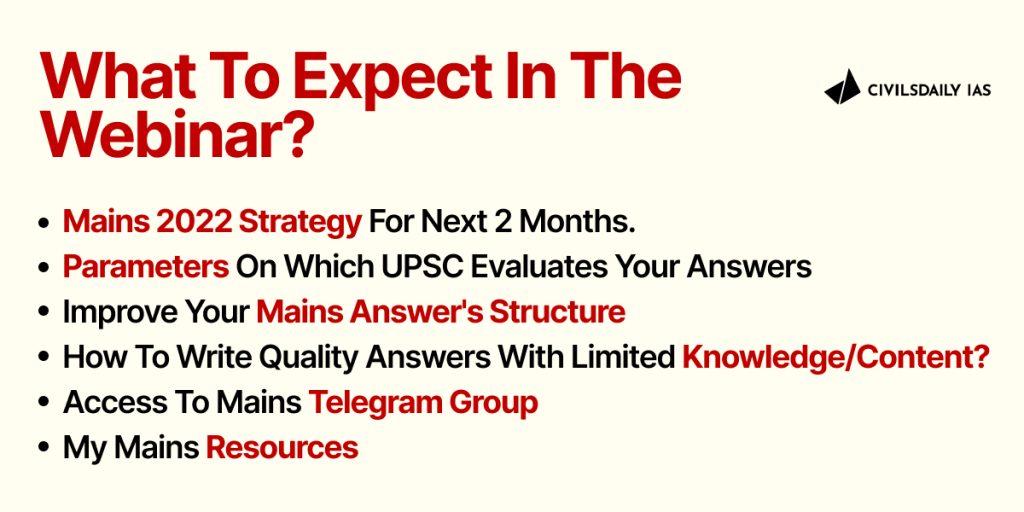
UPSC Mains 2022 is just ~80 days away. Get your Mains prep started with UPSC Ranker, Mridul. Register for CivilsDaily’s Bootcamp: 25th June 2022. This will be followed by an Open Mains Test on the same day. Details below
Haven’t started with mains prep? Feel nervous about Mains answer writing? Not able to write all 20 questions? Can’t make yourself sit and start answer writing?
Facing the same issues as mentioned above? This webinar cum UPSC Bootcamp is for you.
Mridul Shivhare, AIR 247 is a special ranker. He cleared UPSC in his first attempt at the young age of 22. His quality of answers is amazing. He has tricks to literally compel the examiner to give marks. By the way, a crazy fact- Mridul left around 170 marks worth of questions in his Mains and still was able to secure AIR 247 (yup, quality of answer matters).
In this special session, we will also be joined by Sukanya Rana, UPSC Mains head, CivilsDaily IAS. Sukanya has been able to guide successfully around 50 rankers in 2021 including AIR 28,32, 49, and more.
After Bootcamp, we will be having an Open Mains Test on 25th June only, at 6 pm. Top five scorers will get a Scholarship for Mains Mentorship Test Series and Program.
Register for the Bootcamp and we will email you the link for the Telegram group, Open test question paper, and other Mains resources.
About CivilsDaily’s Mains Programs
Mains Essential Program FLT EDITION 2022
Program Inclusion Details:
12 Full-length tests: After the prelims, it is time to go full gear. Practice 3 rounds of FLT based on 4 GS paper.
Quality Enrichment Program Notes: QEP is an intensive and holistic program for IAS Mains 2022 GS papers. We aim to cover up to 250 most relevant issues with a 360-degree view, covering all dimensions of each and every topic. Not only you’ll learn and analyze these issues but will also understand how to utilize them via Daily Answer Writing and Mains Test Series.
Personalized discussion in 1-to-1 mentorship: You doubt why you are scoring less or how you can improve your score for the next paper. No worries! Just schedule a call with our mentor to clear all your doubts and queries.
Civilsdaily’s handholding
Civilsdaily magazine: Your current affairs will be covered with access to our 1-year subscription.
12 Sectional tests: The whole syllabus will be divided into portions like history, economics, and geography. The test will be spread for a period of 8 months. This will ensure that your basic static preparation happens on a continuous basis alongside your mains answer writing program. Killing two birds with one stone!
12 Full-length tests: After the prelims, it is time to go full gear.
Personalized discussion: You doubt why you are scoring less or how you can improve your score for the next paper. No worries! Just schedule a call with our mentor to clear all your doubts and queries.
Civilsdaily’s handholding: You will be provided membership to Mains 2023 club on Habitat. There you can put up your doubts and queries. Also can be used to interact with peers on strategies to improve your mains writing. You can also contact mentors like Sajal sir, Sukanya ma’am, Sudhanshu sir and Poornima Ma’am. They all have interview-level experience, so utilize their experience to your benefit.
Civilsdaily magazine: Your current affairs will be covered with access to our 1-year subscription. (June 2022 to May 2023)
In a significant curtailment of women’s rights, the US Supreme Court overturned Roe v. Wade, a 1973 landmark decision giving women in America the right to have an abortion before the foetus is viable outside the womb — before the 24-28 week mark.
What is Roe vs. Wade Case: Upholding the Right to Abortion
Roe, short for Jane Roe, is the pseudonym for a Texas woman who in 1970 sought to have an abortion when she was five months pregnant.
Texas then had ban on abortions except to save a mother’s life. The case then went to the US Supreme Court (SCOTUS).
The 7-2 majority opinion of the SCOTUS written in 1973, paved the way for the recognition of abortion as a constitutional right in the US considering foetal viability.
[Foetal viability is the point at which a foetus can survive outside the womb, at the time considered to be around 28 weeks, but today is closer to 23 or 24 weeks owing to advances in medicine and technology.]
Right to Abortion Judgment: Key takeaways
Based on the Roe vs Wade case, the framework of regulations that applied towards the right to abortion:
Almost no limitations could be placed on that right;
Only limitations to abortion rights that were aimed at protecting a woman’s health were permitted; and in the third trimester,
State governments had greater leeway to limit the right to abortion except for cases in which the life and health of the mother were endangered.
What is the debate?
The abortion debate is the ongoing controversy surrounding the moral, legal, and religious status of induced abortion.
The sides involved in the debate are the self-described “pro-choice” and “pro-life” movements.
Pro-choice emphasizes the woman’s choice whether to terminate a pregnancy.
Pro-life position stresses the humanity of both the mother and foetus, arguing that a fetus is a human person deserving of legal protection.
Why is the judgement overturned?
Foetuses feel the pain: If the foetus is beyond 20 weeks of gestation, gynaecs assume that there will be pain caused to the foetus.
Biblical gospel: The Bible does not draw a distinction between foetuses and babies. By the time a baby is conceived, he or she is recognized by God.
Abortions cause psychological damage: Young adult women who undergo abortion may be at increased risk for subsequent depression.
Abortions reduce the number of adoptable babies: Instead of having the option to abort, women should give their unwanted babies to people who cannot conceive. Single parenthood is also gaining popularity in the US.
Cases of selective abortion: Such cases based on physical and genetic abnormalities (eugenic termination) is overt discrimination.
Abortion as a form of contraception: It is immoral to kill an unborn child for convenience. Many women are using abortion as a contraceptive method.
Morality put to question: If women become pregnant, they should accept the responsibility that comes with producing a child. People need to take responsibility for their actions and accept the consequences.
Abortion promotes throwaway culture: The legalization of abortion sends a message that human life has little value and promotes the throwaway culture.
Racial afflictions: Abortion disproportionately affects African American babies. In the US, black women are 3.3 times as likely as white women to have an abortion.
Arguments in favour for Abortion Rights
Upholding individual conscience and decision-making: The US Supreme Court has declared abortion to be a fundamental right guaranteed by the US Constitution.
Reproductive choice empowers women: The choice over when and whether to have children is central to a woman’s independence and ability to determine her future.
Foetal viability occurs post-birth: Personhood begins after a foetus becomes “viable” (able to survive outside the womb) or after birth, not at conception. Abortion is the termination of a pregnancy, not a baby.
No proof of foetal pain: Most neuroscientists believe that the cortex is necessary for pain perception. The cortex does not become functional until at least the 26th week of a foetus’ development.
Preventing illegal abortions: Access to legal, professionally-performed abortions reduces maternal injury and death caused by unsafe, illegal abortions.
Mother’s health: Modern abortion procedures are safe and do not cause lasting health issues such as cancer and infertility.
Child’s health: Abortion gives pregnant women the option to choose not to bring fetuses with profound abnormalities to full term.
Prevents women’s exclusion: Women who are denied abortions are more likely to become unemployed, to be on public welfare, to be below the poverty line, and to become victims of domestic violence.
Reproductive choice protects women from financial disadvantage: Many women who choose abortion don’t have the financial resources to support a child.
Justified means of population control: Many defends abortion as a way to curb overpopulation. Malnutrition, starvation, poverty, lack of medical and educational services, pollution, underdevelopment, and conflict over resources are all consequences of overpopulation.
Way forward
A search for the middle path perhaps the right of a woman to choose what to do with the foetus has to be balanced with the right of the foetus to survive.
It is only that a foetus does not have the ability to exercise an option while the person who carries it does.
Rather than banning abortion, lawmakers must focus on counselling, employment security, social welfare, and financial support to persuade pregnant women to give birth to their children.
We must achieve some degree of protection for the unborn by obtaining voluntary recognition of personal responsibility and respect for the personhood of the unborn.
Back2Basics: Medical Termination of Pregnancy (MTP) Act
Abortion in India has been a legal right under various circumstances for the last 50 years with the introduction of Medical Termination of Pregnancy (MTP) Act in 1971.
The Act was amended in 2003 to enable women’s accessibility to safe and legal abortion services.
Abortion is covered 100% by the government’s public national health insurance funds, Ayushman Bharat and Employees’ State Insurance with the package rate for surgical abortion.
The idea of terminating your pregnancy cannot originate by choice and is purely circumstantial. There are four situations under which a legal abortion is performed:
If continuation of the pregnancy poses any risks to the life of the motheror mental health
If the foetus has any severe abnormalities
If pregnancy occurred as a result of failure of contraception (but this is only applicable to married women)
If pregnancy is a result of sexual assault or rape
These are the key changes that the Medical Termination of Pregnancy (Amendment) Act, 2021, has brought in:
The gestation limit for abortions has been raised from the earlier ceiling of 20 weeks to 24 weeks, but only for special categories of pregnant women such as rape or incest survivors. But this termination would need the approval of two registered doctors.
All pregnancies up to 20 weeks require one doctor’s approval. The earlier law, the MTP Act 1971, required one doctor’s approval for pregnancies upto 12 weeks and two doctors’ for pregnancies between 12 and 20 weeks.
Women can now terminate unwanted pregnancies caused by contraceptive failure, regardless of their marital status. Earlier the law specified that only a “married woman and her husband” could do this.
There is also no upper gestation limit for abortion in case of foetal disability if so decided by a medical board of specialist doctors, which state governments and union territories’ administrations would set up.