The southwest monsoon is likely to be “normal” in 2022, though rainfall in August, the second rainiest month, will likely be subdued, according to the private weather company Skymet.
El Nino and La Nina
While El Niño (Spanish for ‘little boy’), the more common expression, is the abnormal surface warming observed along the eastern and central regions of the Pacific Ocean (the region between Peru and Papua New Guinea).
The La Niña (Spanish for ‘little girl’) is an abnormal cooling of these surface waters.
Together, the El Niño (Warm Phase) and La Niña (Cool Phase) phenomena are termed as El Niño Southern Oscillation (ENSO).
These are large-scale ocean phenomena which influence the global weather — winds, temperature and rainfall. They have the ability to trigger extreme weather events like droughts, floods, hot and cold conditions, globally.
Each cycle can last anywhere between 9 to 12 months, at times extendable to 18 months — and re-occur after every three to five years.
Meteorologists record the sea surface temperatures for four different regions, known as Niño regions, along this equatorial belt.
Depending on the temperatures, they forecast either as an El Niño, an ENSO neutral phase, or a La Niña.
Impact on India
El Nino during winter causes warm conditions over the Indian subcontinent and during summer, it leads to dry conditions and deficient monsoon.
Whereas La Nina results in better than normal monsoon in India.
It has been established that Indian summer monsoon is a fully coupled land-atmosphere-ocean system and that it is linked to ocean temperature variability.
In an agricultural country like India, the extreme departure from normal seasonal rainfall seriously affects the agricultural output and thus the economy of the country.
Try this PYQ:
Q. La Nina is suspected to have caused recent floods in Australia. How is La Nina different from El Nino?
La Nina is characterized by unusually cold ocean temperature in equatorial Indian Ocean whereas El Nino is characterized by unusually warm ocean temperature in the equatorial Pacific Ocean.
El Nino has an adverse effect on south-west monsoon of India, but La Nina has no effect on monsoon climate.
Which of the statements given above is/are correct?
(a) Only 1
(b) Only 2
(c) Both 1 and 2
(d) Neither 1 nor 2
[wpdiscuz-feedback id=”s79h0abm7h” question=”Please leave a feedback on this” opened=”1″]Post your answers here.[/wpdiscuz-feedback]
UPSC 2022 countdown has begun! Get your personal guidance plan now! (Click here)
As part of the Seema Darshan project, Union Home Minister inaugurated an Indo-Pakistan border viewing point in Nadabet in Gujarat, around 188 km from Ahmedabad.
Where is Nadabet?
Located in the Rann of Kutch region, Nadabet is also known as the ‘Wagah of Gujarat’.
It is connected by a narrow bitumen road cutting across mudflats that get inundated during high-tide.
The biggest attraction of the Seema Darshan Project is the access provided to civilians to view the fenced international border with Pakistan at ‘Zero Point’.
This is guarded round the clock by the Border Security Force (BSF) in Banaskantha district of Gujarat.
Pakistan is around 150 metres from the border pillar 960 at Nadabet.
Though the BSF conducts a parade similar to the one held at Attari-Wagah border in Punjab every evening during sunset, there won’t be anyone present across the border on the Pakistani side.
What is the Seema Darshan Project?
The Seema Darshan project is a joint initiative of the tourism department of the Gujarat state government and the BSF Gujarat Frontier.
The focus is to develop border-tourism in the region which has a sparse population and even sparser vegetation.
The project aims to boost tourism as well as restrict migration from the villages across the border to the Indian side.
Role of Nadabet in 1971 Indo-Pak War
Nadabet played a key role in the 1971 Indo-Pakistan War.
It was in this region that the BSF not only stalled the enemy trying to invade from the west, but also captured 15 enemy posts.
During the war, the BSF had captured 1,038 square km of Pakistan territory in Nagarparkar and Diplo areas.
The area was returned to Pakistan after the Shimla Agreement was signed.
Since its inception, UPSC-CSE has had toppers from various academic and socio-economic backgrounds who have cracked the exam with flying colours. It’s clear that one doesn’t have to go to Delhi or a coaching centre to crack UPSC-CSE.
If education, geographical and economic background doesn’t matter, then what does? Attitude, or precisely consistency. If you are persistent and adamant to clear UPSC- CSE and have given more than two attempts till now, then you must replace that with consistency. Because, being persistent might lead you to the door, but it’s consistency that unlocks it.
In last month’s Samanvaya 1-on-1 counselling sessions, our expert Civilsdaily mentors reached out to aspirants to address their concerns regarding UPSC-CSE preparation. These are the responses they often heard from them —
How do I start preparing after a gap of 3-4 months?
It’s easy for me to maintain consistency in GS Preparation but not Revision
I study daily, but can only remain focused for 2-3 hours. How do I improve?
My long working hours don’t allow me to study daily.
Why am I losing interest in completing a subject? It’ s easier to read a new subject everyday.
This week, we have decided to answer all these questions and take additional questions in our personalised & motivational counselling session.
Key-Takeaways from This Week’s Samanvaya, Free 1-on-1 Counselling Session?
If you want to experience the same mentorship as Rishab Sharma, then here’s the good news – your first UPSC mentorship is on us and is absolutely free! All you have to do is confirm your slot now.
This prompted us to reach out to one of our students who is currently an IPS officer, Rishabh Sharma. He cleared the exam in 2020 with AIR 454. After his first attempt, Rishabh had enrolled in Smash Mains program underSajal sir and also attended our free interview program. Cracking the mighty UPSC-CSE the second time, Rishabh explains what consistency means to him —
UPSC doesn’t just test your intellect. It tests your patience, mental strength, your emotions, the very character of yours . As far as the journey of CSE is concerned you might know when to start, but you never know when the journey will come to an end. So be consistent and enjoy the journey.
Every topper follows a plan, a method or strategy that makes it easier for them to study on a daily basis and complete the traget modules of the day. In this free live counselling session, we will explain the many ways you can do to avoid faltering on your preparation.
1. The difference between a consistent study pattern v/s an inconsistent one. How UPSC-CSE becomes easier over time with consistency?
2. Social media distraction. How to avoid spending long hours on social media?
3. Number of ideal breaks everyday. Why is it necessary to reward yourself with a short break from time to time?
4. Best way to plan your timetable in advance? Why daily timetable should not be rigid but yearly timetable should be well defined?
5. How to remain consistent when you are not opting for coaching?
6. What are the practical methods to maintain regularity in studies. Tips to sustain the fire and passion for studies.
7. Why using Public Libraries is a way to remain consistent in UPSC-CSE preparation?
8. What are the 4 factors that determine if you can remain consistent for a year? If not, then why should you work on them first before starting UPSC-CSE preparation?
Get Motivated to Maintain Overall Consistency for UPSC
It’s understandable we are humans and not programmable robots who can maintain the same level of interest everyday. However, maintaining an overall consistency throughout our preparation is neccessary to clear this competitive and vast exam.
Our philosophy behind MENTORSHIP is to get you out of this Snooze cycle. This ensures that you are the BEST VERSION of yourself in this journey. If you are under the impression that mentorship is weekly calls you attend, then you are mistaken, my friend. Trust us, your mentor will be your ‘FRIEND, PHILOSOPHER AND GUIDE’.
TO EACH THEIR OWN – Every aspirant is different. Their strengths and weaknesses are different. Their time availability is also different. Identifying this is important so you don’t end up making unrealistic targets and lose momentum. Your mentor will make sure you start slow but remain consistent to build your confidence. Making your schedule structured based on our experience of working with 2500+ students is our first priority.
TRACK YOUR PROGRESS – When you see yourself grow, it becomes easier to motivate yourself to push boundaries. Tracking your progress can happen in many ways like mentorship calls or chat sessions or by regular tests. The idea is to ensure that you don’t go off track in your preparation, and even if you do, we have your back.
EVOLUTION – A constant guidance is important to bring consistency to your UPSC preparation. Guidance is not about clearing your doubts or asking you to study when you don’t. It is also about the evolution of your preparation. This is where you and your mentor work as a team. A constant effort to PLAN AND BUILD UP YOUR ABILITY to learn in a faster and more efficient way.
TALK IT OUT – The biggest hurdle in achieving your highest level of consistency is the emotional part. Every now and then, you. surround yourself with negative thoughts, you feel scared and depressed. Instead of resolving these emotional issues, you avoid them as it seems like a waste of your precious time. You have to understand that ignoring emotional troubles does not solve them. What your doing is building an emotional time bomb that may burst a week before your mains or prelims! This is where your MENTOR AS A FRIEND comes in. All our mentors have been through this journey. We understand your fears and anxieties. So, TALK IT OUT.
Don’t let inconsistency keep you away from your dreams.
Fill up the SAMANVAYA form given below. Let us know your problems and we will find a solution to it, just like our students say ” TOGETHER WE CAN AND WE WILL”. BOOK YOUR SLOT FOR YOUR FREE 1-0N-1 COUNSELLING SESSION IN THE NEXT 24 HOURS
How has Civilsdaily Mentorship, helped Aspirants become Toppers?
The most difficult challenge faced by EVERY candidate is inconsistency. Be it inconsistency in studies, answer-writing practice, covering the syllabus, or revision, every candidate finds it difficult to cope with. Buthow do successful candidates manage to FIGHT Inconsistency so consistently?
In UPSC 2020, Civilsdaily helped 80+ students secure ranks in their exams. In the top 100, every 3rd ranker was a Civilsdaily student.
A very recent success story would be Vishwa Shah, student of Civilsdaily Mentor, Sukanya Ma’am. Vishwa has cleared the GPSC exam to become the Deputy Superintendent of Police in Gujarat. He has penned a thank-you note yesterday. Heartiest Congratulations to Vishwa!
One of our other Civilsdaily Student, Shubham Nagargojecleared the exams in 2020 to become an IPS Officer. Shubham was gracious enough to let us know how he felt about Civilsdaily Samanvaya Guidance under Parth sir.
To know how all of them cleared the exam with our mentorship, visit the UnherdPodcast.
Now that results are announced for UPSC 2021 Prelims, out of 15 out of 25 students of Santhosh Gupta sir have been recommended to Mains. One such student, Rahul expresses his gratitude and extends his appreciation.
Most of our Mentors like Sudhanshu sir, Sajal sir, Santhosh sir, Pravin sir, Parth Verma sir and Sukanya Ma’am were UPSC aspirants themselves and have attended UPSC Mains more than five times and UPSC Interview more than twice. Hence their mentorship is always a blend of the best test series, comprehensive notes and current affairs knowledge.
All of them dedicate their time weekly to give 1-on-1 mentorship to every student where they discuss last week’s performance and next week’s approach.
Be it Telegram, Whatsapp or Habitiat channels, they are always available and clear student’s doubts in a turnaround time of 24 Hours.
Why Civilsdaily Mentors are the GPS for Your UPSC-CSE Preparation
Remember there is always light at the end of the tunnel and if you want to get out of the tunnel you have to follow the direction of the light! Our mentors’ give you direction which is divided into daily modules. All you have to do is study and complete them on time.
As every year passes by, we don’t get confident by the previous years’ performance and become laidback. Instead, we become more hungry to convert all our students into toppers.REGISTER HERE TO SCHEDULE YOUR FIRST FREE SAMANVAYA COUNSELLING SESSION IN NEXT 24 HOURS
How are Current Civilsdaily Students Gearing up for UPSC-CSE 2022?
Initially, our Civilsdaily student Smriti wasn’t confident about Prelims when she began her preparation. Though she had joined Civilsdaily in 2020, she started studying for UPSC-CSE back in 2019. At that time, Smriti had enrolled in multiple institutes. Though, most of these institutes had promised a personal mentor, she was unable to get in touch with them on a daily basis. Also those mentors never scheduled test-series on a weekly basis. Hence, despite preparing for a year, Smriti had scored only 35 marks out of 200 in her first test series by Civilsdaily.
She then started writing 20-25 test series over the course of UAP 2021 and in her last test, her scores have drastically improved. She now scores in the range of 130-135 marks in prelims’ and 110+ in mains’ papers.
In Smriti’s own words she describes her Samanvaya Mentorship Experience to be —
“Our parents provide us financial and emotional support, friends provide us moral support and the right mentor gives you logistic and logical support for UPSC. There are days when I felt I won’t be able to compete against lakhs of aspirants. That’s when my mentor, Ravi sir reminded me of my improvement and encouraged me that I can crack it with the same consistency. We need someone, who tells us we are performing well especially when we cannot see that ourselves. The mentorship at Civilsdaily helped me become mentally stronger as a person. In other institutes, mentors are allotted only for doubt resolution. But at Civilsdaily, I am getting end-to-end mentorship via value added notes, classes, test series and detailed evaluation.”
Similarly our another Civilsdaily student, Ashishsums up his Samanvaya experience with Civilsdaily mentor,Pravin Sir, “Because of Pravin sir’s support, I am able to understand a topic in lesser time.”
This is how Pravin sir evaluates Ashish’s Mains Test Series every week. After every test series evaluation, Pravin sir schedules a 1 hour call to discuss how Ashish can improve his marks and the sources he can refer for key topics.
It’s Your Turn Get the Free 40 Min Counselling Session By a CD Mentor
Civilsdaily mentors are so dedicated, consistent and focused for your UPSC goal, that you will eventually become focused into turning your dreams to reality.
At the core of Civilsdaily UPSC mentorship, lies the fact that each one of you will have a unique journey while preparing for the exam. Some will get through on the first attempt without much effort while others will take both more time and more effort.
We want to understand you better to help you optimize your journey so you can focus on the right things and not waste time on the wrong ones. We are asking you to tap into the valuable experiences of mentors who underwent the same grind and realize the pitfalls and understand the shortcuts to make it.
In the first counselling session, we will understand your weaknesses. We then help you to stick to one plan or strategy throughout your preparation. We will then follow up with you on a daily basis to check if you are right on track. TALK TO OUR MENTORS & CLARIFY YOUR DOUBTS NOW
With Less than 60 days remaining for UPSC 2022 Prelims, your preparation must revolve around revision and attempting tests. At this stage, aspirants become more stressed and anxious than when they first started their preparation. Having a foolproof strategy for the last few days can work wonders — especially for those falling on the borderline, scoring between 80-90 marks in the mock test series. Now is the time to focus on improving your performance and boosting your scores.
While many of you, would have felt easier following a timetable for an entire year, you might not be sure how to revise every topic in the syllabus along with test series and current affairs of 1.5 years in last few days.
Open to all, Free Live Webinar by IPoS Officer Vikas Palwe (CSE 2020)
Vikas Palwe has a special command over UPSC Prelims. In all his 5 attempts, He scored 120+ marks consistently. Now, with prelims coming up in few days, he would be happy to share his mantras and techniques to scoring high in prelims with future aspirants.
If you are attempting this year’s prelims then do not miss this opportunity. Attend the webinar to gain topper’s insights on prelims and clear your personal queries with him.
Webinar Details
This Ask me Anything session is free for all aspirants to attend but is perfect for anyone looking for a refreshing break from their grueling studies. Only limited slots are available, so register ASAP.
Evening 09:00 PM – TIKDAM: Art of Elimination Session.
Download Habitat app from the Playstore Join our Official Civilsdaily Space for GS and CSATHere
13th Apr 2022
The monsoonal rainfall in India is concentrated only in four months and more than 50% of the net sown area is rainfed only. Irrigation is thus essential to overcome spatial and temporal variation of rainfall.
Archaeological and historical records show that from ancient times we have been constructing sophisticated hydraulic structures like dams built of stone rubble, reservoirs or lakes, embankments and canals for irrigation. Not surprisingly, we have continued this tradition in modern India by building dams in most of our river basins. Before we look at these methods of irrigation in detail, let’s have a look at some of the hydraulic structures used in ancient India!
Some Hydraulic Structures used in Ancient India:
In the first century BC, Sringaverapura near Allahabad had sophisticated water harvesting system channelling the flood water of the river Ganga.
During the time of Chandragupta Maurya, dams, lakes and irrigation systems were extensively built.
Evidences of sophisticated irrigation works have also been found in Kalinga (Orissa), Nagarjunakonda (Andhra Pradesh), Bennur (Karnataka), Kolhapur (Maharashtra), etc.
In the eleventh century, Bhopal Lake, one of the largest artificial lakes of its time was built.
In the 14th century, the tank in Hauz Khas, Delhi was constructed by Iltutmish for supplying water to the Siri Fort Area.
Coming back to irrigation in the present day India, let’s look at some important facts and figures before we move forward:
Some important facts and figures:
The net irrigated area = 66.1 million hectares.
Total/Gross Irrigated Area = 92.6 million hectares.
Irrigation Intensity in India = (Gross Irrigated Area ÷Gross Sown Area) * 100
= (92.6 ÷ 194.4) *100
= 47.6%
More than 50% of the country’s cropped area depends exclusively on rainfall, most of which is concentrated in a few months of the year. Even where the annual overall precipitation is high, the available moisture is not adequate to support multiple cropping.
Ultimate Irrigation Potential:
As seen in the above figures, only about 66mha i.e. 47.6% of the net sown area is estimated to be irrigated. There is a need to bring more cropped area under assured irrigation so as to increase agricultural productivity and production.
The total ultimate irrigation potential of the country has been estimated as 140mha, with about 76 mha from surface water sources and about 64mha from groundwater sources.
Irrigation – Sources and Methods
The main sources of irrigation in India are:
Canals
Wells (and tubewells)
Tanks
The relative importance of these has been changing from time to time. Let’s look at these in detail:
1. Canal Irrigation:
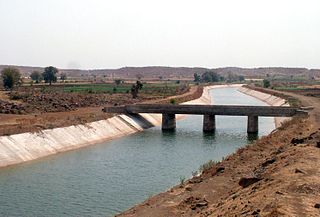
A canal is an artificial watercourse constructed for water supply and irrigation.
Inundation Canals – These are taken out from the rivers without any regulating system like weirs etc at their head. Such canals are useful only during the rainy season
Perennial Canals – These are those which are taken off from perennial rivers by constructing a barrage across the river. Most of the canals at present in India are perennial.
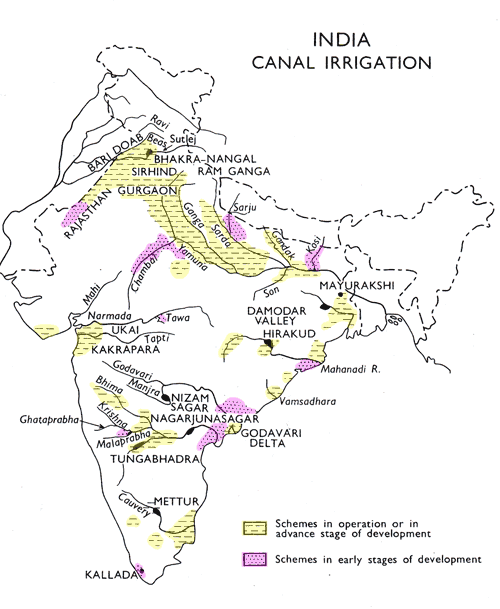
Canals can be an effective source of irrigation in areas of low relief, deep fertile soils, perennial source of water and an extensive command area. Therefore the main concentration of canal irrigation is in the northern plains.
The canals are practically absent from the peninsular plateau region because of rocky terrain. However, the coastal and the delta regions in South India have some canals for irrigation.
The percentage of canal irrigation area to total irrigated area in the country has fallen from about 40% in 1950-51 to less than 25% at present.
The states UP, Punjab, Haryana, Rajasthan and Bihar account for about 60% of the canal irrigated area in the country.
Merits of canal irrigation:
Perennial Source
Provides safety from droughts
Brings fertile sediments to the fields
Economical to serve a large area
Demerits:
Canal water soaks into the ground and leads to water logging, increases salinization, and leads to marshy conditions leading to malaria and flooding
Wastage of water.
2. Wells (and Tube Wells)
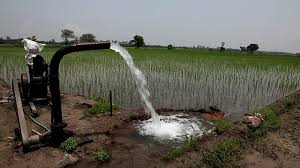
A well is a hole dug in the ground to obtain the subsoil water. An ordinary well is about 3-5 metres deep but deeper wells up to 15 metres are also dug.
This method of irrigation has been used in India from time immemorial. Various methods are used to lift the ground water from the well. Some of the widely used methods are the persian wheel, reht, charas or mot, and dhinghly (lever) etc.
A tube well is a deeper well (generally over 15 metres deep) from which water is lifted with the help of a pumping set operated by an electric motor or a diesel engine.
Well irrigation is gradually giving way to energized tube wells. But there are many wells still in use where electricity is not available or the farmers are too poor t0 afford diesel oil.
This method of irrigation is popular in those areas where sufficient sweet ground water is available.
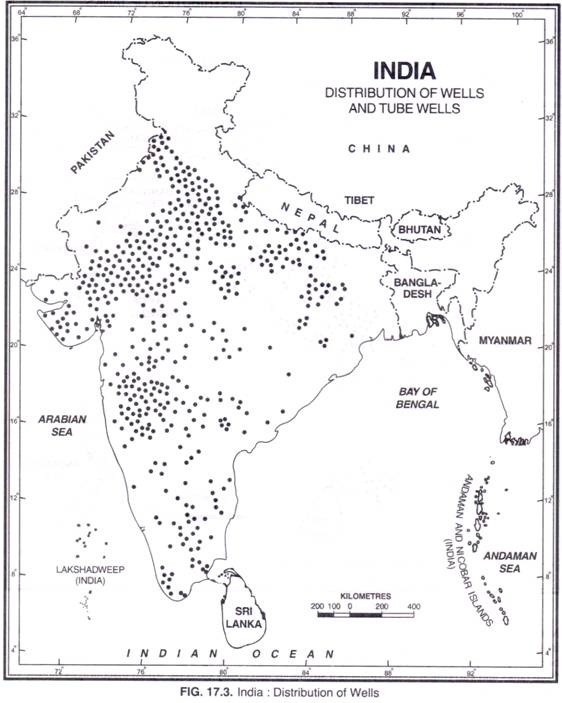
It is particularly suitable in areas with permeable rock structure which allows accumulation of ground water through percolation. Therefore wells are seen more in areas with alluvial soil, regur soil, etc. and less seen in rocky terrain or mountainous regions.
These areas include a large part of the great northern plains, the deltaic regions of the Mahanadi, the Godavari, the Krishna and the Cauvery, parts of the Narmada and the Tapi valleys and the weathered layers of the Deccan trap and crystalline rocks and the sedimentary zones of the peninsula
However, the greater part of peninsular India is not suitable for well irrigation due to rocky structure, uneven surface and lack of underground water.
Large dry tracts of Rajasthan, the adjoining parts of Punjab, Haryana and Gujarat and some parts of Up have brackish ground water which is not fit for irrigation and human consumption and hence unsuitable for well irrigation
At present irrigation from wells and tubewells accounts for more than 60% of the net irrigated area in the country.
UP has the largest area under well irrigation which accounts for 28% of the well irrigated area of the country. U.P., Rajasthan, Punjab, Madhya Pradesh, Gujarat, Bihar and Andhra Pradesh account for about three-fourths of the total well-irrigated area
Well is an independent source of irrigation and can be used as and when the necessity arises. Canal irrigation, on the other hand, is controlled by other agencies and cannot be used at will.
Some ground water salts are useful for crops
Does not lead to salinization and flooding problems
There is a limit to the extent of canal irrigation beyond the tail end of the canal while a well can be dug at any convenient place.
Demerits
Only limited area can be irrigated. Normally, a well can irrigate 1 to 8 hectares of land.
Not suitable for dry regions
Overuse may lead to lowering of water table
3. Tank irrigation
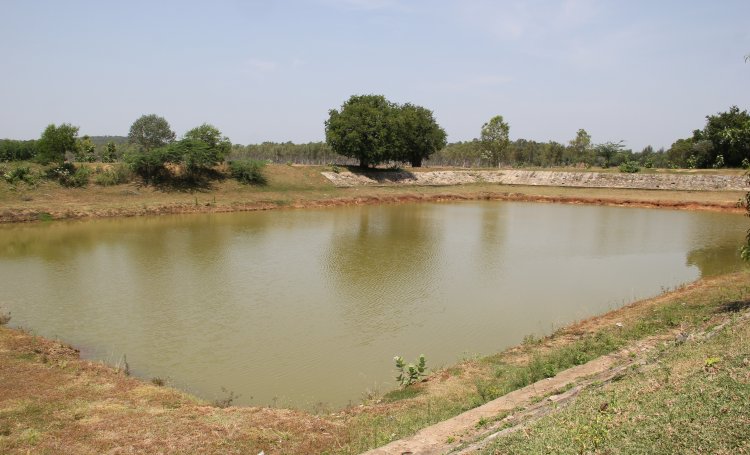
A tank is a reservoir for irrigation, a small lake or pool made by damming the valley of a stream to retain the monsoon rain for later use.
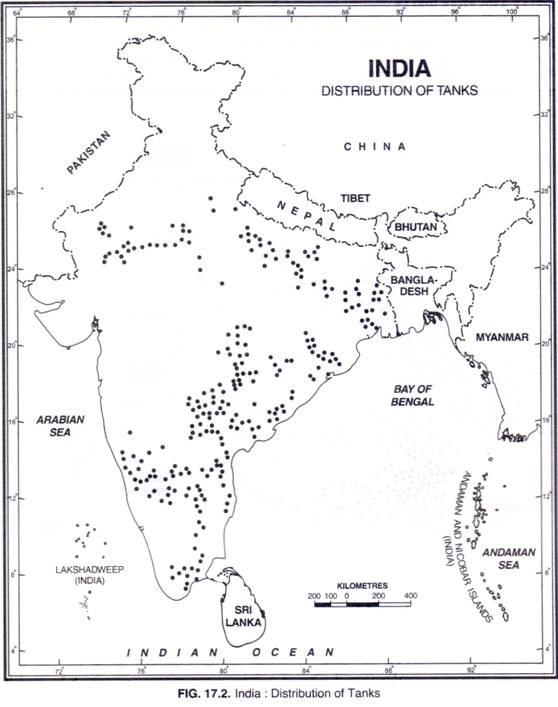
It is practised mainly in the peninsular region due to the following reasons:
The undulating relief and hard rocks make it difficult to dig canals and wells
There is little percolation of water due to hard rock structure and ground water is not available in large quantities.
Most of the rivers are seasonal; there are many streams which become torrential during the rainy season – so the only way to use this water is to impound it by constructing bunds and building tanks. Also, it is easy to collect rainwater in natural or artificial pits because of impermeable rocks.
Scattered nature of agricultural fields
Merits
Most of the tanks are natural and do not involve cost for their construction
Independent source for an individual farmer or a small group of farmers
longer life span
can be used for fishing also
Demerits
Depends on rain and these tanks may dry up during the dry season
Silting of their beds
Require large areas
Evaporation losses
Sometimes there might be a need to lift the water to take it to the field
Irrigation water is generally applied to crops by:
Flooding on the field surface
Applying beneath the soil surface
Spraying under pressure
Applying in drops in the crop root zone
The application method must ensure a uniform distribution of water along the cropped field as well as in the root zone of the crop with high application efficiency. The ratio of water stored in the root zone to that delivered to the field should be maximum. There should be minimum or no wastage of water either through surface run-off or deep percolation below the root zone of a crop.
Several water application methods are practised to suit different soil types, water supply and its quantity, the topography of the land, crops to be irrigated and costs.
Surface Application Methods:
In this method, water is applied to the crop by flooding it on the soil surface.
This method requires proper land grading for the flow of water over the land surface.
More than 95% of the irrigated area in India is under surface irrigation.
Merits:
It is simple in layout and operation.
The amount of manual labour required is minimum.
It does not obstruct the use of machinery for land preparation, cultivation, harvesting, etc.
Demerits:
The overall irrigation efficiency is low. The worldwide average irrigation in canal command areas shows an overall efficiency of as low as 28%.
It may result in water=logging and soil salinization besides the huge amount of water losses.
Surface Irrigation methods may be broadly classified as:
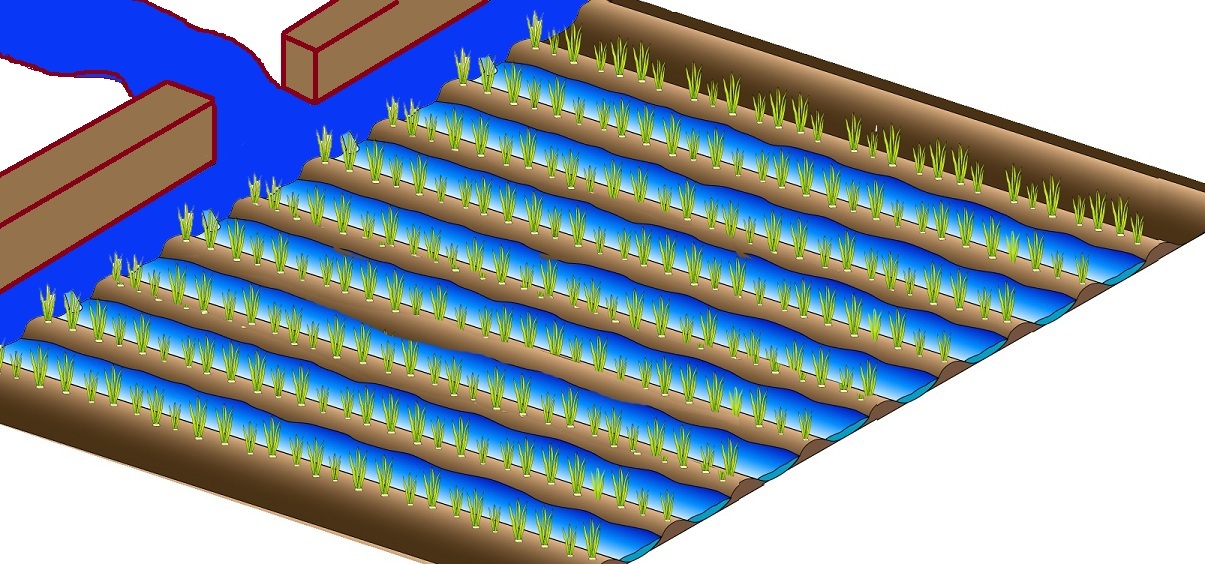
Border Method:
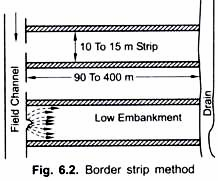
Borders are formed by dividing the field into a number of strips which are separated by ridges.
The strips are generally levelled along the width but may or may not have slope along the length.
An irrigation channel runs along the upper end of the borders.
The water is diverted from the channel into the strips. The water flows slowly towards the lower end, wetting the soil as it advances. Extra water is generally removed from the strip by means of a collecting drain. It is provided at the other end.
This method is suitable in the fields where the soil is sufficiently capable of absorbing the water.
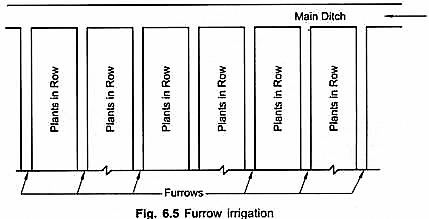
Furrow irrigation is adaptable to a great variation in slope, crops and topography.
When the crops are grown and planted in rows this method is the best suited. In this method, unlike flooding, only a part of the field is wetted. The area wetted varies from 1/2 to 1/5 of total area over which crops are grown.
Close growing crops, on slopes and soils that develop crust after being wet, may be irrigated with small furrows which are called corrugations or rills.
Furrow spacing should be such that the lateral water movement of the moisture wets the ridges by the time irrigation is complete. The lateral movement from the furrows depends on the soil type.
Furrow spacing is determined by agronomic requirements of row-to-row spacing and machinery to be used for planting and cultivation.
Furrow length: Longer furrows = more percolation and less run-off
Benefits of this method:
In this method plants in their early tender age are not damaged by the flow of water.
The land between the rows of plants is utilised to construct furrows, therefore useful irrigable land is not wasted.
As the area wetted is just 1/2 to 1/5 of the cropped area of the field, puddling and crusting of the soil is minimum.
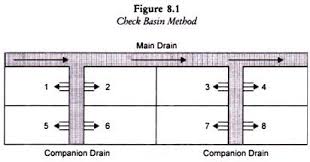
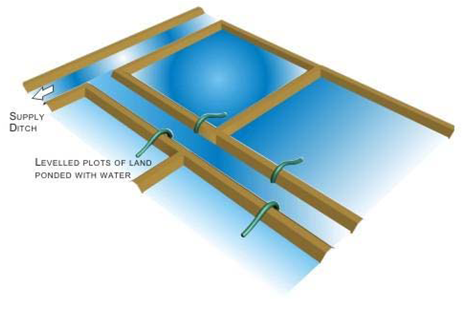
Check basin:
It consists of running water into relatively level plots surrounded by small ridges.
The length of the plot is generally less than 3 times the width.
The main and lateral channels irrigate The main channel is aligned along the upper end of the field and checks are made on the either side of the lateral channels.
The check basins are especially suitable for heavy soils with low infiltration rate or highly permeable sandy soils.
The key to attaining high irrigation efficiency in the design of the check basin is to spread water over the entire basin as rapidly as possible.
Therefore, the use of large inflow stream reduces water spread time over the basin.
Sprinkler and Micro-Sprinkler Application:
Sprinklers:
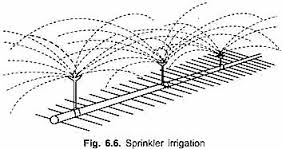
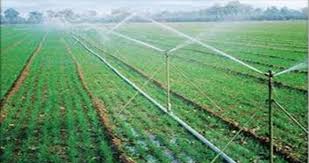
This system sprinkles water in a manner similar to rainfall so that run-off and deep percolation losses are avoided and the uniformity of application is quite high.
The system consists of sprinkler heads or nozzles, which are mounted on risers in lateral lines taken from the main line, which is further connected to a pumping unit.
The soil is too porous for good distribution by surface irrigation.
The fields have an uneven surface.
The soil is easily erodable.
The water supply is just sufficient for crop growth.
Merits:
Sprinklers can be used on all soil types of any topography.
It entails increased irrigation frequency which has a positive effect on crop yield.
In this method, a water saving of 30% to 50% is reported in comparison to the surface method of irrigation
Thus by introducing sprinklers, an additional area ~ up to 50% can be brought under irrigation besides increased crop yields
The overall efficiency of the system is above 80% and no land is wasted on making bunds and channels, and about 40-50% of saving in labour as compared to surface irrigation.
Only 2 to 5% water is lost through evaporation.
Demerits:
Expensive
Requires continuous maintenance and skill for installation and operation
The high energy requirement for operation as sprinklers operate at water pressure ranging from 1 to 10 kg/sq cm.
Wind interferes with the distribution pattern. It reduces the spreading rate and in turn the efficiency. Under high temperatures and strong winds heavy evaporation loss takes place thereby offsetting the saving in water.
Micro-sprinklers:
It sprinkles around the root zone with small sprinklers that work under low pressure.
In this method, water is applied only to the root zone area unlike to the entire field as in the case of sprinkler irrigation method.
This method is highly suitable for orchard crops and vegetable crops.
Drip Application
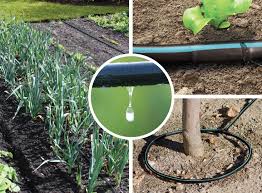
In this method, the application of water is precise but slow as discrete drops, continuous drops, tiny streams or miniature sprays through mechanical devices, called emitters or applicators located at selected points along water delivery lines.
This is useful in areas with water scarcity and salt problems.
Drip irrigation system consists of main pipe, sub-mains, lateral valves, drippers or emitters, a riser valve, vacuum breakers, pressure gauges, water metres, filters, fertiliser tanks etc.
These are designed to supply water at desired rates (1 to 10 litres/hour) directly to the soil.
Low pressures ranging from 0.35 to kg/sq cm are sufficient for drip system