💥Mains Ready By December. Smash Mains & Smash PYQ Admissions Open

Search results for: “”

  • Need for one common language

    Last week, Home Minister Amit Shah suggested that states should communicate with each other in Hindi rather than English, while stressing that Hindi should not be an alternative to local languages.

    This again sparked the debate of “Hindi imposition”.

    How widely is Hindi spoken in India?

    • The 2011 linguistic census accounts for 121 mother tongues, including 22 languages listed in the 8th Schedule of the Constitution.
    • Hindi is the most widely spoken, with 52.8 crore individuals, or 43.6% of the population, declaring it as their mother tongue.
    • The next highest is Bengali, mother tongue for 97 lakh (8%) — less than one-fifth of Hindi’s count (Chart 2).
    • In terms of the number of people who know Hindi, the count crosses more than half the country.
    • Nearly 13.9 crore (over 11%) reported Hindi as their second language, which makes it either the mother tongue or second language for nearly 55% of the population.

    Has it always been this widespread?

    • Hindi has been India’s predominant mother tongue over the decades, its share in the population rising in every succeeding census.
    • In 1971, 37% Indians had reported Hindi as their mother tongue, a share that has grown over the next four censuses to 38.7%, 39.2%, 41% and 43.6% at last count (Chart 1).
    • This begs the question as to which mother tongues have declined as Hindi’s share has risen.
    • A number of mother tongues other than Hindi have faced a decline in terms of share, although the dip has been marginal in many cases.
    • For example, Bengali’s share in the population declined by just 0.14 percentage points from 1971 (8.17%) to 2011 (8.03%).
    • In comparison, Malayalam (1.12 percentage points) and Urdu (1.03 points) had higher declines among the mother tongues with at least 1 crore speakers in 2011.
    • Punjabi’s share, on the other hand, rose from 2.57% to 2.74%.
    • At the other end of the scale (among the 22 languages listed in the 8th Schedule of the Constitution) were Malayalam, whose numbers rose by under 59% in four decades, and Assamese, rising just over 71% (Chart 3).

    What explains Hindi’s high numbers?

    • One obvious explanation is that Hindi is the predominant language in some of India’s most populous states, including Uttar Pradesh, Madhya Pradesh and Bihar.
    • Another reason is that a number of languages are bracketed under Hindi by census enumerators.
    • In 2011, there were 1,383 mother tongues reported by people, and hundreds were knocked out.
    • These mother tongues were then grouped into languages.
    • You will find that under Hindi, they have listed nearly 65 mother tongues.
    • Among them is Bhojpuri, and 5 crore people have reported Bhojpuri as their mother tongue, but the census has decided that Bhojpuri is Hindi.
    • If one were to knock out the other languages merged with Hindi, the total figure goes down to 38 crore.

    And how widely is English spoken?

    • Although English, alongside Hindi, is one of the two official languages of the central government, it is not among the 22 languages in the 8th Schedule; it is one of the 99 non-scheduled languages.
    • In terms of mother tongue, India had just 2.6 lakh English speakers in 2011 — a tiny fraction of the 121 crore people counted in that census.
    • That does not reflect the extent to which English is spoken.
    • It was the second language of 8.3 crore respondents in 2011, second only to Hindi’s 13.9 crore.
    • If third language is added, then English was spoken — as mother tongue, second language or third language — by over 10% of the population in 2011, behind only Hindi’s 57%.
    • It is still not a scheduled language in India, when it should be.

    Where is English most prevalent?

    • As mother tongue, Maharashtra accounted for over 1 lakh of the 2.6 lakh English speakers.
    • As second language, English is preferred over Hindi in parts of the Northeast.
    • Among the 17.6 lakh with Manipuri (an 8th Schedule language) as their mother tongue in 2011, 4.8 lakh declared their second language as English, compared to 1.8 lakh for Hindi.
    • Among the non-scheduled languages spoken in the Northeast, Khasi, predominant in Meghalaya, was the mother tongue of 14.3 lakh, of whom 2.4 lakh declared their second language as English, and 54,000 as Hindi.
    • The trends were similar for Mizo, and for various languages spoken in Nagaland, including Ao, Angami and Rengma.
    • Beyond the Northeastern languages, among 68 lakh with Kashmiri as their mother tongue, 2.8 lakh declared their second language as English, compared to 2.2 lakh who declared Hindi.

    Back2Basics: Eighth Schedule to the Indian Constitution

    • The Eighth Schedule lists the official languages of the Republic of India.
    • At the time when the Constitution was enacted, inclusion in this list meant that the language was entitled to representation on the Official Languages Commission.
    • This language would be one of the bases that would be drawn upon to enrich Hindi and English, the official languages of the Union.
    • The list has since, however, acquired further significance.
    • In addition, a candidate appearing in an examination conducted for public service is entitled to use any of these languages as the medium in which he or she answers the paper.
    • As per Articles 344(1) and 351 of the Indian Constitution, the eighth schedule includes the recognition of the 22 languages.

    ‘Classical’ languages in India

    Currently, six languages enjoy the ‘Classical’ status: Tamil (declared in 2004), Sanskrit (2005), Kannada (2008), Telugu (2008), Malayalam (2013), and Odia (2014).

    How are they classified?

    According to information provided by the Ministry of Culture in the Rajya Sabha in February 2014, the guidelines for declaring a language as ‘Classical’ are:

    • High antiquity of its early texts/recorded history over a period of 1500-2000 years;
    • A body of ancient literature/texts, which is considered a valuable heritage by generations of speakers;
    • The literary tradition be original and not borrowed from another speech community;
    • The classical language and literature being distinct from modern, there may also be a discontinuity between the classical language and its later forms o

    UPSC 2022 countdown has begun! Get your personal guidance plan now! (Click here)

  • NITI Aayog publishes Energy and Climate Index List

    Gujarat has topped the list for larger States in the NITI Aayog’s State Energy and Climate Index–Round 1 that has ranked States and Union Territories (UTs) on certain parameters.

    State Energy and Climate Index

    • The States have been categorized based on size and geographical differences as larger and smaller States and UTs.
    • The index is based on 2019-20 data.
    • It ranks the states’ performance on 6 parameters, namely
    1. DISCOM’s Performance
    2. Access, Affordability and Reliability of Energy
    3. Clean Energy Initiatives
    4. Energy Efficiency
    5. Environmental Sustainability; and
    6. New Initiatives
    • The parameters are further divided into 27 indicators. Based on the composite SECI Round I score.
    • The states and UTs are categorized into three groups: Front Runners, Achievers, and Aspirants.

    Performance by the states

    • Gujarat, Kerala and Punjab have been ranked as the top three performers in the category of larger States, while Jharkhand, Madhya Pradesh and Chhattisgarh were the bottom three States.
    • Goa emerged as the top performer in the smaller States category followed by Tripura and Manipur.
    • Among UTs, Chandigarh, Delhi and Daman & Diu/Dadra & Nagar Haveli are the top performers.
    • Punjab was the best performer in discom performance, while Kerala topped in access, affordability and reliability category.
    • Haryana was the best performer in clean energy initiative among larger States and Tamil Nadu in the energy efficiency category.


    UPSC 2022 countdown has begun! Get your personal guidance plan now! (Click here)


  • How ancient megalithic jars connect Assam with Laos and Indonesia

    The discovery of a number of megalithic stone jars in Assam’s Dima Hasao district has brought to focus possible links between India’s Northeast and Southeast Asia, dating back to the second millennium BC.

    What is the news?

    • According to a study in Asian Archaeology, the jars are a “unique archaeological phenomenon”.
    • It calls for more research to understand the “likely cultural relationship” between Assam and Laos and Indonesia, the only two other sites where similar jars have been found.

    About the Megalithic Jars

    • The jars of Assam were first sighted in 1929 by British civil servants James Philip Mills and John Henry Hutton.
    • They recorded their presence in six sites in Dima Hasao: Derebore (now Hojai Dobongling), Kobak, Kartong, Molongpa (now Melangpeuram), Ndunglo and Bolasan (now Nuchubunglo).
    • More such sites were later discovered in 2016 and 2020.
    • Researchers documented three distinct jar shapes (bulbous top with conical end; biconcial; cylindrical) on spurs, hill slopes and ridge lines.

    Their significance

    • While the jars are yet to be scientifically dated, the researchers said links could be drawn with the stone jars found in Laos and Indonesia.
    • There are typological and morphological similarities between the jars found at all three sites.
    • Dating done at the Laos site suggests that jars were positioned at the sites as early as the late second millennium BC.
    • The other takeaway is the link to mortuary practices with human skeletal remains found inside and buried around the jars.
    • In Indonesia, the function of the jars remains unconfirmed, although some scholars suggest a similar mortuary role.

    Back2Basics: Megalithic Burials in India

    • Megaliths were constructed either as burial sites or commemorative (non-sepulchral) memorials.
    • The former are sites with actual burial remains, such as dolmenoid cists (box-shaped stone burial chambers), cairn circles (stone circles with defined peripheries) and capstones (distinctive mushroom-shaped burial chambers found mainly in Kerala).
    • The urn or the sarcophagus containing the mortal remains was usually made of terracotta.
    • Non-sepulchral megaliths include memorial sites such as menhirs. (The line separating the two is a bit blurry, since remains have been discovered underneath otherwise non-sepulchral sites, and vice versa.)
    • Taken together, these monuments lend these disparate peoples the common traits of what we know as megalithic culture, one which lasted from the Neolithic Stone Age to the early Historical Period (2500 BC to AD 200) across the world.
    • In India, archaeologists trace the majority of the megaliths to the Iron Age (1500 BC to 500 BC), though some sites precede the Iron Age, extending up to 2000 BC.


    UPSC 2022 countdown has begun! Get your personal guidance plan now! (Click here)


  • What are the 5 Methods to Maintain Daily Consistency in Current Affairs, Optional & GS Preparation?|| What are the 4 Factors you Need to Work on if you can’t Study Regularly?|| Register for Free 1-on-1 Mentorship if You are Yet to Restart Your UPSC Preparation

    Since its inception, UPSC-CSE has had toppers from various academic and socio-economic backgrounds who have cracked the exam with flying colours. It’s clear that one doesn’t have to go to Delhi or a coaching centre to crack UPSC-CSE.

    If education, geographical and economic background doesn’t matter, then what does? Attitude, or precisely consistency. If you are persistent and adamant to clear UPSC- CSE and have given more than two attempts till now, then you must replace that with consistency. Because, being persistent might lead you to the door, but it’s consistency that unlocks it.

    In last month’s Samanvaya 1-on-1 counselling sessions, our expert Civilsdaily mentors reached out to aspirants to address their concerns regarding UPSC-CSE preparation. These are the responses they often heard from them —

    How do I start preparing after a gap of 3-4 months?

    It’s easy for me to maintain consistency in GS Preparation but not Revision

    I study daily, but can only remain focused for 2-3 hours. How do I improve?

    My long working hours don’t allow me to study daily.

    Why am I losing interest in completing a subject? It’ s easier to read a new subject everyday.

    This week, we have decided to answer all these questions and take additional questions in our personalised & motivational counselling session.

    Key-Takeaways from This Week’s Samanvaya, Free 1-on-1 Counselling Session?

    If you want to experience the same mentorship as Rishab Sharma, then here’s the good news – your first UPSC mentorship is on us and is absolutely free! All you have to do is confirm your slot now.

    This prompted us to reach out to one of our students who is currently an IPS officer, Rishabh Sharma. He cleared the exam in 2020 with AIR 454. After his first attempt, Rishabh had enrolled in Smash Mains program under Sajal sir and also attended our free interview program. Cracking the mighty UPSC-CSE the second time, Rishabh explains what consistency means to him —

    UPSC doesn’t just test your intellect. It tests your patience, mental strength, your emotions, the very character of yours . As far as the journey of CSE is concerned you might know when to start, but you never know when the journey will come to an end. So be consistent and enjoy the journey.

    Every topper follows a plan, a method or strategy that makes it easier for them to study on a daily basis and complete the traget modules of the day. In this free live counselling session, we will explain the many ways you can do to avoid faltering on your preparation.

    1. The difference between a consistent study pattern v/s an inconsistent one. How UPSC-CSE becomes easier over time with consistency?

    2. Social media distraction. How to avoid spending long hours on social media? 

    3. Number of ideal breaks everyday. Why is it necessary to reward yourself with a short break from time to time?

    4. Best way to plan your timetable in advance? Why daily timetable should not be rigid but yearly timetable should be well defined? 

    5. How to remain consistent when you are not opting for coaching? 

    6. What are the practical methods to maintain regularity in studies. Tips to sustain the fire and passion for studies.

    7. Why using Public Libraries is a way to remain consistent in UPSC-CSE preparation? 

    8. What are the 4 factors that determine if you can remain consistent for a year? If not, then why should you work on them first before starting UPSC-CSE preparation?

    Get Motivated to Maintain Overall Consistency for UPSC

    It’s understandable we are humans and not programmable robots who can maintain the same level of interest everyday. However, maintaining an overall consistency throughout our preparation is neccessary to clear this competitive and vast exam. 

    Our philosophy behind MENTORSHIP is to get you out of this Snooze cycle. This ensures that you are the BEST VERSION of yourself in this journey. If you are under the impression that mentorship is weekly calls you attend, then you are mistaken, my friend. Trust us, your mentor will be your ‘FRIEND, PHILOSOPHER AND GUIDE’.

    TO EACH THEIR OWN – Every aspirant is different. Their strengths and weaknesses are different. Their time availability is also different. Identifying this is important so you don’t end up making unrealistic targets and lose momentum. Your mentor will make sure you start slow but remain consistent to build your confidence. Making your schedule structured based on our experience of working with 2500+ students is our first priority. 

    This image has an empty alt attribute; its file name is WhatsApp-Image-2021-05-05-at-10.14.09-AM.jpeg

    TRACK YOUR PROGRESS – When you see yourself grow, it becomes easier to motivate yourself to push boundaries. Tracking your progress can happen in many ways like mentorship calls or chat sessions or by regular tests. The idea is to ensure that you don’t go off track in your preparation, and even if you do, we have your back.

    This image has an empty alt attribute; its file name is WhatsApp-Image-2021-05-05-at-10.14.09-AM-4-576x1024.jpeg

    EVOLUTION – A constant guidance is important to bring consistency to your UPSC preparation. Guidance is not about clearing your doubts or asking you to study when you don’t. It is also about the evolution of your preparation. This is where you and your mentor work as a team. A constant effort to PLAN AND BUILD UP YOUR ABILITY to learn in a faster and more efficient way.

    This image has an empty alt attribute; its file name is WhatsApp-Image-2021-05-05-at-10.14.09-AM-6.jpeg

    TALK IT OUT – The biggest hurdle in achieving your highest level of consistency is the emotional part. Every now and then, you. surround yourself with negative thoughts, you feel scared and depressed. Instead of resolving these emotional issues, you avoid them as it seems like a waste of your precious time. You have to understand that ignoring emotional troubles does not solve them. What your doing is building an emotional time bomb that may burst a week before your mains or prelims! This is where your MENTOR AS A FRIEND comes in. All our mentors have been through this journey. We understand your fears and anxieties. So, TALK IT OUT.

    This image has an empty alt attribute; its file name is WhatsApp-Image-2021-05-05-at-10.14.09-AM-3.jpeg

    Don’t let inconsistency keep you away from your dreams.

    Fill up the SAMANVAYA form given below. Let us know your problems and we will find a solution to it, just like our students say ” TOGETHER WE CAN AND WE WILL”. BOOK YOUR SLOT FOR YOUR FREE 1-0N-1 COUNSELLING SESSION IN THE NEXT 24 HOURS

    How has Civilsdaily Mentorship, helped Aspirants become Toppers?

    The most difficult challenge faced by EVERY candidate is inconsistency. Be it inconsistency in studies, answer-writing practice, covering the syllabus, or revision, every candidate finds it difficult to cope with. But how do successful candidates manage to FIGHT Inconsistency so consistently?

    This image has an empty alt attribute; its file name is hall-of-fame.jpg

    In UPSC 2020, Civilsdaily helped 80+ students secure ranks in their exams. In the top 100, every 3rd ranker was a Civilsdaily student.

     A very recent success story would be Vishwa Shah, student of Civilsdaily Mentor, Sukanya Ma’am. Vishwa has cleared the GPSC exam to become the Deputy Superintendent of Police in Gujarat. He has penned a thank-you note yesterday. Heartiest Congratulations to Vishwa!

    This image has an empty alt attribute; its file name is WhatsApp-Image-2021-12-27-at-18.49.53-727x1024.jpeg

    One of our other Civilsdaily Student, Shubham Nagargoje cleared the exams in 2020 to become an IPS Officer. Shubham was gracious enough to let us know how he felt about Civilsdaily Samanvaya Guidance under Parth sir.

    This image has an empty alt attribute; its file name is image-1.png
    This image has an empty alt attribute; its file name is WhatsApp-Image-2022-01-11-at-19.37.54-461x1024.jpeg

    To know how all of them cleared the exam with our mentorship, visit the Unherd Podcast.

    Now that results are announced for UPSC 2021 Prelims, out of 15 out of 25 students of Santhosh Gupta sir have been recommended to Mains. One such student, Rahul expresses his gratitude and extends his appreciation.

    Most of our Mentors like Sudhanshu sir, Sajal sir, Santhosh sir, Pravin sir, Parth Verma sir and Sukanya Ma’am were UPSC aspirants themselves and have attended UPSC Mains more than five times and UPSC Interview more than twice. Hence their mentorship is always a blend of the best test series, comprehensive notes and current affairs knowledge.

    This image has an empty alt attribute; its file name is 29d33a91-62aa-45e9-a906-327fbaad5180-1024x814.jpg
    This image has an empty alt attribute; its file name is 50f70a4d-c239-44a5-b49b-9b93617a378f-461x1024.jpg

    All of them dedicate their time weekly to give 1-on-1 mentorship to every student where they discuss last week’s performance and next week’s approach.

    Be it Telegram, Whatsapp or Habitiat channels, they are always available and clear student’s doubts in a turnaround time of 24 Hours.

    This image has an empty alt attribute; its file name is image-9-6.jpg
    This image has an empty alt attribute; its file name is WhatsApp-Image-2021-12-18-at-13.22.45-576x1024.jpeg
    This image has an empty alt attribute; its file name is WhatsApp-Image-2021-12-18-at-13.22.45-1-576x1024.jpeg
    This image has an empty alt attribute; its file name is WhatsApp-Image-2021-12-18-at-13.22.46-576x1024.jpeg
    This image has an empty alt attribute; its file name is WhatsApp-Image-2021-12-18-at-13.22.46-1-576x1024.jpeg
    This image has an empty alt attribute; its file name is WhatsApp-Image-2021-12-18-at-13.22.46-2-576x1024.jpeg
    This image has an empty alt attribute; its file name is WhatsApp-Image-2021-12-18-at-13.22.47-576x1024.jpeg
    This image has an empty alt attribute; its file name is image-9-5.jpg
    This image has an empty alt attribute; its file name is image-8.png

    Why Civilsdaily Mentors are the GPS for Your UPSC-CSE Preparation

    Remember there is always light at the end of the tunnel and if you want to get out of the tunnel you have to follow the direction of the light! Our mentors’ give you direction which is divided into daily modules. All you have to do is study and complete them on time.

    This image has an empty alt attribute; its file name is WhatsApp-Image-2021-11-29-at-21.47.49-1024x527.jpeg
    This image has an empty alt attribute; its file name is IMG-20211030-WA0003-461x1024.jpg
    This image has an empty alt attribute; its file name is IMG-20211029-WA0002-1-461x1024.jpg
    This image has an empty alt attribute; its file name is IMG-20211029-WA0001-1-461x1024.jpg
    This image has an empty alt attribute; its file name is IMG-20211029-WA0019-461x1024.jpg
    This image has an empty alt attribute; its file name is IMG-20211029-WA0018-461x1024.jpg
    This image has an empty alt attribute; its file name is WhatsApp-Image-2021-05-19-at-6.12.52-PM-576x1024.jpeg
    This image has an empty alt attribute; its file name is WhatsApp-Image-2021-05-05-at-10.14.09-AM-3.jpeg
    See the source image
    This image has an empty alt attribute; its file name is WhatsApp-Image-2021-05-19-at-6.12.52-PM-1.jpeg

    As every year passes by, we don’t get confident by the previous years’ performance and become laidback. Instead, we become more hungry to convert all our students into toppers.REGISTER HERE TO SCHEDULE YOUR FIRST FREE SAMANVAYA COUNSELLING SESSION IN NEXT 24 HOURS

    How are Current Civilsdaily Students Gearing up for UPSC-CSE 2022?

    This image has an empty alt attribute; its file name is 5_6161088602806683010.jpg

    Initially, our Civilsdaily student Smriti wasn’t confident about Prelims when she began her preparation. Though she had joined Civilsdaily in 2020, she started studying for UPSC-CSE back in 2019. At that time, Smriti had enrolled in multiple institutes. Though, most of these institutes had promised a personal mentor, she was unable to get in touch with them on a daily basis. Also those mentors never scheduled test-series on a weekly basis. Hence, despite preparing for a year, Smriti had scored only 35 marks out of 200 in her first test series by Civilsdaily.

    She then started writing 20-25 test series over the course of UAP 2021 and in her last test, her scores have drastically improved. She now scores in the range of 130-135 marks in prelims’ and 110+ in mains’ papers.

    In Smriti’s own words she describes her Samanvaya Mentorship Experience to be —

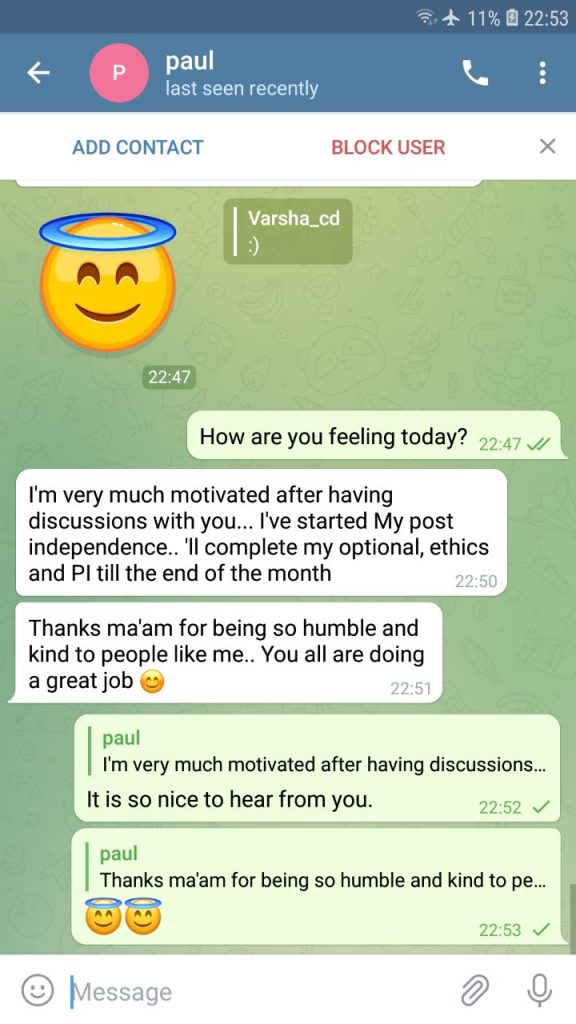
    “Our parents provide us financial and emotional support, friends provide us moral support and the right mentor gives you logistic and logical support for UPSC. There are days when I felt I won’t be able to compete against lakhs of aspirants. That’s when my mentor, Ravi sir reminded me of my improvement and encouraged me that I can crack it with the same consistency. We need someone, who tells us we are performing well especially when we cannot see that ourselves. The mentorship at Civilsdaily helped me become mentally stronger as a person. In other institutes, mentors are allotted only for doubt resolution. But at Civilsdaily, I am getting end-to-end mentorship via value added notes, classes, test series and detailed evaluation.”

    Similarly our another Civilsdaily student, Ashish sums up his Samanvaya experience with Civilsdaily mentor, Pravin Sir, “Because of Pravin sir’s support, I am able to understand a topic in lesser time.”

    This image has an empty alt attribute; its file name is ashish-anand-testimonial-1-461x1024.jpg
    This image has an empty alt attribute; its file name is 69f7a70f-c53d-44b4-8e59-f297401650b5-1-461x1024.jpg
    This image has an empty alt attribute; its file name is ashish.jpg

    This is how Pravin sir evaluates Ashish’s Mains Test Series every week. After every test series evaluation, Pravin sir schedules a 1 hour call to discuss how Ashish can improve his marks and the sources he can refer for key topics.

    This image has an empty alt attribute; its file name is test-461x1024.jpg

    It’s Your Turn Get the Free 40 Min Counselling Session By a CD Mentor

    Civilsdaily mentors are so dedicated, consistent and focused for your UPSC goal, that you will eventually become focused into turning your dreams to reality.

    This image has an empty alt attribute; its file name is a2d57403-4c49-462b-8459-b15e690ea928-1-461x1024.jpg

    At the core of Civilsdaily UPSC mentorship, lies the fact that each one of you will have a unique journey while preparing for the exam. Some will get through on the first attempt without much effort while others will take both more time and more effort.

    We want to understand you better to help you optimize your journey so you can focus on the right things and not waste time on the wrong ones. We are asking you to tap into the valuable experiences of mentors who underwent the same grind and realize the pitfalls and understand the shortcuts to make it.

    In the first counselling session, we will understand your weaknesses. We then help you to stick to one plan or strategy throughout your preparation. We will then follow up with you on a daily basis to check if you are right on track. TALK TO OUR MENTORS & CLARIFY YOUR DOUBTS NOW

    This image has an empty alt attribute; its file name is photo1627364370-1024x1024.jpeg
    This image has an empty alt attribute; its file name is AAJ-.jpeg

  • Prelims Spotlight: Major Rivers in India

    Now Free Tikdam Sessions on our Space

    Dear Aspirants,

    This Spotlight is a part of our Mission Nikaalo Prelims-2022

    JOIN THE SPECIAL SESSIONS ON OUR OFFICIAL SPACE

    Morning 12:00 PM  – Prelims Spotlight Session

    Evening 06:30  PM  – MCQs Session

    Noon 04:00 PM – Special Session by Shubham Sir

    Evening 08:00 PM  – Tests on Alternate Days

    Evening 09:00 PM – TIKDAM: Art of Elimination Session.

    Download Habitat app from the Playstore Join our Official Civilsdaily Space for GS and CSAT Here

    12th Apr, 2022

    Clueless about 2023 Preparation?

    Fill up this form to schedule a free on-call discussion with senior mentor from Civilsdaily. Once submitted we will call you within 24 hours.
    Fill the Form HERE

  • [Burning Issue] India-Nepal Relations

    UPSC 2022 countdown has begun! Get your personal guidance plan now! (Click here)

    Context

    The Prime Minister of Nepal made his first bilateral visit abroad to India since taking his oath in July 2021. The visit was a success in terms of launching connectivity projects and signing Memorandums of Understanding (MoUs). Bilateral dialogues, strengthened economic connections and more sensitization towards the people of Nepal is what India needs to pursue to fulfil the objectives of its ‘neighborhood first policy’.

    Historical Background

    • Ancient ties: The relationship between India and Nepal goes back to the times of the rule of the Sakya clan and Gautama Buddha.
      • Initially, Nepal was under tribal rule and only with the coming of Licchavi rule in Nepal did its feudal era truly begin.
    • Cultural relations: From 750 to 1750 AD period saw a shift from Buddhism to Hinduism in Nepal and witnessed widespread cultural diffusion.
      • India and Nepal share similar ties in terms of Hinduism and Buddhism with Buddha’s birthplace Lumbini located in present-day Nepal.
    • India-Nepal Treaty of Peace and Friendship of 1950 forms the bedrock of the special relations that exist between India and Nepal.
    • Nepal is an important neighbor of India and occupies a special significance in its foreign policy because of the geographic, historical, cultural and economic linkages/ties that span centuries.
    • In recent years, India’s relations with Nepal have witnessed some ‘lows’. 
      • The relationship between the two took a nosedive in 2015, with India first getting blamed for interfering in the Constitution drafting process and then for an “unofficial blockade” that generated widespread resentment against India.

    Highlights of the recent visit

    • Important Projects in discussion:
      • The operationalization of the 35 kilometre cross-border rail link from Jayanagar (Bihar) to Kurtha (Nepal) will be further extended to Bijalpura and Bardibas.
      • The 90 km long 132 kV double circuit transmission line connecting Tila (Solukhumbu) to Mirchaiya (Siraha) is close to the Indian border.
    • Agreements signed:
      • Agreements providing technical cooperation in the railway sector, 
      • Nepal’s induction into the International Solar Alliance,  becoming the 105th country to become a signatory to the Framework Agreement of the ISA.
      • Between Indian Oil Corporation and Nepal Oil Corporation ensuring regular supplies of petroleum products were also signed.
    • India called for taking full advantage of opportunities in the power sector, including through joint development of power generation projects in Nepal and the development of cross-border transmission infrastructure.
    • Launch of Indian RuPay card in Nepal: This would open new vistas for cooperation in financial connectivity, and is expected to facilitate bilateral tourist flows as well as further strengthen people-to-people linkages between India and Nepal.

    Various facets of India-Nepal ties

    1. Cultural ties

    • While enjoying their own peculiarities, both India and Nepal share a common culture and ways of life.
    • Religion is perhaps the most important factor and plays a predominant role in shaping the cultural relations between these two countries, marked by a cross country pilgrimage on Char Dham Yatra, Pashupatinath Temple and some Buddhist sites.
    • A considerable section of Nepalese comprises of Madhesi population which has familial & ethnic ties with states of Bihar, UP.

    2. Strategic ties

    • Nepal is a buffer state between India and China.
    • Several Nepali Citizens are also deployed in Indian defence forces as well.

    3. Political ties

    • Constitutional turmoil is not new in Nepal. India has played a vital role in the democratic transition in Nepal against the monarch King Gyanendra.
    • Nepali Congress (NC) is one of the country’s oldest parties which supports relations with India, but the communist parties show a tilt towards China.

    4. Economic ties

    • Nepal is an important export market for India. India is Nepal’s largest trading partner.
    • Himalayan rivers flowing through Nepal can be used for Hydroelectric power projects which will benefit border states of UP, Bihar and other adjacent areas.
    • There are three major water deals between Nepal and India, namely the Kosi Agreement, the Gandak Treaty and the Mahakali Treaty. India also exports Power to Nepal.
    • Also, Nepal is the largest borrower of Indian Currency in South Asia.
    • Nepal has escalating trade deficit with India. Nepal and India have concluded bilateral Treaty of Transit, Treaty of Trade and the Agreement of Cooperation to Control Unauthorized Trade.

    5. Connectivity

    • The 1950 Treaty of Peace and Friendship was sought by the Nepali authorities in 1949 to provide for an open border and for Nepali nationals to have the right to work in India.
    • The BBIN Motor Vehicles Agreement (MVA) in which Nepal is a partner will permit the member states to ply their vehicles in each other’s territory for transportation of cargo and passengers.

    6. Multilateral and Regional Fora

    • Both Nepal and India work in tandem in the United Nations, Non-aligned Movement and other international fora on most of the important international issues.
    • Both the countries have been deeply engaged in the regional and sub-regional frameworks of SAARC, BIMSTEC and BBIN for enhancing cooperation for greater economic integration.

    China’s role in Nepal – a matter of concern

    • Once considered a buffer state between India and China, Nepal is now showing an inclination towards Beijing. China is trying to stimulate and tempt Nepal with multiple aids, economic growth and acquisition.
    • China is pursuing a more assertive foreign policy and considers Nepal as an important element in its growing South Asian footprint and being a key partner in its Belt and Road Initiative (BRI).
    • In 2016, Nepal negotiated an Agreement on Transit Transportation with China and in 2017, China provided a military grant of $32 million to Nepal.
    • In 2019, a Protocol was concluded with China providing access to four seaports and three land ports to Nepal. China is also engaged with airport expansion projects at Pokhara and Lumbini.
    • China has overtaken India as the largest source of foreign direct investment with the annual development assistance being worth $120 million.
    • Recently, the ratification of the Pancheshwar Multipurpose project saw street protests and big-time social media campaigns supported by China.

    Indo-Nepal Border Disputes

    India and Nepal share about an 1800 Km long border. There are 2 major border or territorial disputes:

    1) Kalapani

    • The Kali River in the Kalapani region demarcates the border between India and Nepal.
    • The Treaty of Sugauli signed by the Kingdom of Nepal and British India (after the Anglo-Nepalese War) in 1816 located the Kali River as Nepal’s western boundary with India.
    • The discrepancy in locating the source of the Kali River led to boundary disputes between India and Nepal, with each country producing maps supporting their own claims.
    • However, India has control of Kalapani since the 1962 Indo-Sina War.
      • Kalapani is a valley that is administered by India as a part of the Pithoragarh district of Uttarakhand. It is situated on the Kailash Mansarovar route.

    Why is Lipulekh important for India?

    • For India, the Lipulekh pass has security implications.
    • After its disastrous 1962 border war with China, it was concerned about a possible Chinese intrusion through the pass and has been keen to hold on to the strategic Himalayan route to guard against any future incursions.
    • The link road via Lipulekh Himalayan Pass is also considered one of the shortest and most feasible trade routes between India and China.

    2) Susta Region

    • It is about 140 sq. km of land in Uttar Pradesh at the Nepal border in the Terai area. India has control of the territory. Nepal claims this territory.
    • The change of course by the Gandak river is the main reason for disputes in the Susta area.
    • Susta is located on the bank of the Gandak river.
    • It is called the Narayani river in Nepal.
    • It joins Ganga near Patna, Bihar.

    Issue of Simultaneous floods in Bihar and Nepal

    • Some of Nepal’s biggest river systems originate in the Himalayan glaciers which then flow into India through Bihar.
    • During the monsoons, these river systems flood causing many problems for Bihar.
    • It is a necessity that there is process-driven coordination between the Centre and the Government of Bihar to handle the flooding in Nepal’s Terai and North Bihar (largely the Mithilanchal region).

    Which are those flooding rivers?

    • Nepal’s three biggest river systems—Kosi, Gandaki and Karnali—originate in the high mountain glaciers, flow through the country and then enter India through the state of Bihar.
    • During the monsoon season, these river systems often get flooded due to heavy rains/landslides in Nepal which create floods in India’s most flood-prone state—Bihar.

    Why Nepal is Important to India?

    1. It acts as a strategic buffer against the aggression of China.
    2. The Pakistan factor: peddling of FICN, drugs and terrorism through the Indo-Nepal border. It makes the cooperation of Nepal important.
    3. India and Nepal share common culture: There are huge Nepali communities in Darjeeling and Sikkim. Many marital relations across the border exist.
    4. National Security: There is a lot of interdependence. Gurkha Regiment in Indian Army is known for its valiance.
      • Nepal could play in the hands of China which could be detrimental to Indian interests. Hence they need to be kept as close as possible.
    5. Ministry of External Affairs term India-Nepal Relation as “Roti-Beti ka Rishta” (Relation of food and marriage)
    6. Energy Security: Nepal has the potential of 80 GW of hydroelectricity. But only 600 MW potential is realized so far.
      • Nepal’s lack of cooperation in this regard has hindered development. The surplus could be used for Indian border states.

    Major Irritants in bilateral ties

    1) Nepali nationalism and Anti-India sentiments

    • Anti-India Sentiment in Nepal is largely politically motivated as it is wrongly perceived as India’s backing to Monarchy.
    • The widening gap in understanding each other’s concerns has helped feed Nepali nationalism and create a dense cloud of distrust and suspicion between the two countries.
    • The gap widened after India chose to impose an economic blockade in response to Nepal’s sovereign decision to promulgate a democratic constitution.

    2) China factor

    • Increasing Chinese presence in Nepal is one of the major concerns for India. China’s move to extend the rail link to its border with Nepal can reduce its dependence on India.
    • Fundamentally these Chinese agencies are building up anti-India sentiments in Nepal.
    • Nepal’s assent for the ‘One Belt One Region’ (OBOR) initiative of China is viewed by India with suspicion.
    • Nepal has been slowly fallen prey to China’s inroad debt trap policy.

    3) India has ignored the changing political narrative for long

    • The reality is that India has ignored the changing political narrative in Nepal for far too long.
    • For too long India has invoked a “special relationship”, based on shared culture, language and religion, to anchor its ties with Nepal.
    • The 1950 Treaty of Peace and Friendship which was sought by the Nepali authorities in 1949 is viewed as a sign of an unequal relationship, and an Indian imposition.

    4) Open borders

    • The issue of open borders has also been a point of debate in Nepal in recent years- Nepalese people argue that India is benefiting more from it than Nepal.
    • It has an open border with India which leads to problems such as illegal migrants, counterfeit currency entry, drug and human trafficking.

    5) Madhesis Issue

    • Madhesis share extensive cross-border ethnic and linguistic links with India. India’s involvement in Nepali politics and the upsurge in Madhesi have deep roots in history and unless resolved.
    • Madhesis protest and India’s blockade soured the relations for the worst.

    Way Forward

    1) Dialogues for Territorial Disputes

    • In the best spirit of friendship, Nepal and India should restart the water dialogue and come up with policies to safeguard the interests of all those who have been affected on both sides of the border.
    • India needs to be a sensitive and generous partner for the neighbourhood first policy to take root.
    • The dispute shall be negotiated diplomatically under the aegis of International law on Trans-boundary Water Disputes.

    2) Sensitising Towards Nepal

    • The onus is on India to rethink on a long-term basis how to recalibrate its relationship with Nepal provided Nepal should not ignore its relations with India.
    • It should maintain the policy of keeping away from the internal affairs of Nepal, meanwhile, in the spirit of friendship, India should guide the nation towards more inclusive rhetoric.

    3) Strengthening Economic Ties

    • The power trade agreement needs to be such that India can build trust in Nepal. Despite more renewable energy projects (solar) coming up in India, hydropower is the only source that can manage peak demand in India.
    • For India, buying power from Nepal would mean managing peak demand and also saving the billions of dollars of investments that would have to be invested in building new power plants, many of which would cause pollution.

    4) Investments from India

    • The Bilateral Investment Promotion and Protection Agreement (BIPPA) signed between India and Nepal needs more attention from Nepal’s side.
    • The private sector in Nepal, especially the cartels in the garb of trade associations, are fighting tooth and nail against foreign investments.
    • It is important that Nepal conveys this message that it welcomes Indian investments.

    UPSC 2022 countdown has begun! Get your personal guidance plan now! (Click here)

  • Personalized DAF questionnaire we prepared for AIR 16 and 17 UPSC 2020 (inside), get yours now!| Schedule your FREE Mock + DAF questionnaire | Limited seats

    Personalized DAF questionnaire we prepared for AIR 16 and 17 UPSC 2020 (inside), get yours now!| Schedule your FREE Mock + DAF questionnaire | Limited seats

    Book your slot for UPSC Mock interviews (paneled by ex UPSC members) and get a dedicated mentor, on-call DAF analysis, DAF-based personalized questionnaire, and Situational questionnaire (FREE)

    Detailed Application Form (DAF) is one of the most important documents that you might have filled for UPSC interviews. A major part of the interview will revolve around the information and details provided in the DAF. It is more than your CV.

    Your ability to defend your DAF before the panel is going to decide your success. Anticipating and preparing for the questions based on your DAF is an essential part of the interview preparation.

    As a part of Transcend Interview Guidance Program for UPSC 2021 we’ve prepared and compiled a high-quality comprehensive questionnaire.

    upsc mock interview 2021

    Upcoming Mock interview and session

    This week’s mock interview dates have been fixed.

    • Mock interview this week 12th April onwards – (Book your slot)   
    • Time: 10 a.m. – 7 p.m.  
    • Mode: Online/Offline 

    Do You Know That Civilsdaily Has a 75% Success Rate In UPSC Interview?

    Interview slots will be allocated on a first-come, first-served basis.

    Panelists for Mock Interviews: 

    1. Shri Shankar Aggarwal, IAS (retd.)
    2. Dr. Noor Mohammad, IAS (retd.)
    3. Dr. P.K. Agrawal, IAS (Retd.)
    4. Shri T. N. Thakur, IAAS (retd.)
    5. Shri V. P. Singh, IRPS
    6. Mrs.Aditi Gupta, Corporate Leadership Specialist
    7. Prof. U.M. Amin, Jamia Milia University
    8. Mr. S. D. Singh, IFoS (Retd.)
    9. Mr. Kunal Aggarwal, IRS
    10. Mr. Debraj Das, IPS

    Tentative: Shri Harsh V. Pant (Observer Research Foundation), Shri SN Tripathi, IAS (Director IIPA), Shri Yogesh Narain (Retd. Defence Secretary), Shri Dipankar Gupta (Indian Sociologist), and others.

    This image has an empty alt attribute; its file name is WhatsApp-Image-2022-03-15-at-4.15.52-PM.jpeg

    Transcend Interview Guidance 2021: Program inclusion

    1. Mock interview and detailed analysis + feedback
    2. Most important issues coverage – current and structural
    3. DAF 2 curation
    4. Personalized mentorship
    5. DAF analysis and one-on-one sessions with mentors
    6. DAF based personalized questionnaire
    7. Situational and Roleplay questionnaire

    Do You Know That Civilsdaily Has a 75% Success Rate In UPSC Interview?

  • WHAT IS KARISHMA’s (AIR 14 UPSC 2020) SECRET TO SUCCESS?

    WHAT IS KARISHMA’s (AIR 14 UPSC 2020) SECRET TO SUCCESS?

    It is always a proud moment for us when our students succeed, and we feel humbled when they thank us for our guidance. Karishma Nair (AIR 14, 2020) wrote a personal note to Sajal sir and Civilsdaily after securing AIR 14 and in the letter she explained how our mentorship helped her succeed!

    Under the guidance of Sajal sir, Karishma Nair received regular detailed feedback. Each and every answer was analysed and every mistake removed. She says in the letter that the feedback helped her improve every day.

    Not only that, her mentor was always available to guide her. She received a structured approach to the UPSC syllabus and answer-writing along with help and motivation throughout her preparation. With time, she was able to improve her performance and was able to secure AIR 14 in UPSC 2020. You can read her letter below:

    Civilsdaily’s personal guidance and mentorship program helped 80 aspirants like Karishma crack UPSC exam. You could be next! Just fill the form below to speak personally with Karishma’s mentor, now!

  • Care economy

    Context

    The importance of care work is now widely acknowledged and covered in various international commitments such as the SDGs. However, the investment in the care economy has not matched the pace.

    Significance of care work

    • Care work encompasses direct activities such as feeding a baby or nursing an ill partner, and indirect care activities such as cooking and cleaning’.
    • Whether paid or unpaid, direct or indirect, care work is vital for human well-being and economies.
    • Unpaid care work is linked to labour market inequalities, yet it has yet to receive adequate attention in policy formulation.
    • Paid care workers, such as domestic workers and anganwadis in India, also struggle to access rights and entitlements as workers.
    • Greater investment in care services can create an additional 300 million jobs globally, many of which will be for women.
    • In turn this will help increase female labour force participation and advance Sustainable Development Goal (SDG) 8.
    • This year, to commemorate International Women’s Day, the ILO brought out its new report titled, ‘Care at work: Investing in care leave and services for a more gender-equal world of work’.
    • The report highlights the importance of maternity, paternity, and special care leave, which help balance women’s and men’s work and family responsibilities throughout their lives.

    Gaps in the current policies

    • Bridging the gaps in current policies and service provisions to nurture childcare and elderly care services will deliver the benefits of child development, aging in dignity and independent living as the population grows older and also generate more and better employment opportunities, especially for women.
    • Maternity leave: Maternity leave is a universal human and labour right.
    • Yet, it remains unfulfilled across countries, leaving millions of workers with family responsibilities without adequate protection and support. India fares better than its peers in offering 26 weeks of maternity leave, against the ILO’s standard mandate of 14 weeks that exists in 120 countries.
    • However, this coverage extends to only a tiny proportion of women workers in formal employment in India, where 89% of employed women are in informal employment (as given by ILOSTAT, or the ILO’s central portal to labour statistics).
    • While paternity leave is recognised as an enabler for both mothers and fathers to better balance work and family responsibilities, it is not provided in many countries, including India.
    • Access to quality and affordable care services such as childcare, elderly care and care for people with disabilities is a challenge workers with family responsibilities face globally.
    • Limited implementation: While India has a long history of mandating the provision of crèches in factories and establishments, there is limited information on its actual implementation.
    • Domestic workers, on whom Indian households are heavily reliant, also face challenges in accessing decent work.
    • According to the Government’s 2019 estimates, 26 lakh of the 39 lakh domestic workers in India are female.
    • Ensure decent work for domestic workers: While important developments have extended formal coverage to domestic workers in India, such as the Sexual Harassment of Women at Workplace (Prevention, Prohibition and Redressal) Act and the minimum wage schedule in many States, more efforts are required to ensure decent work for them.

    Way forward

    • Increase spending: India spends less than 1% of its GDP on the care economy; increasing this percentage would unfurl a plethora of benefits for workers and the overall economy.
    • Strategy: In consultation with employers’ and workers’ organisations and the relevant stakeholders, the Government needs to conceptualise a strategy and action plan for improved care policies, care service provisions and decent working conditions for care workers.
    • 5R Framework: The ILO proposes a 5R framework for decent care work centred around achieving gender equality. The framework urges the Recognition, Reduction, and Redistribution of unpaid care work, promotes Rewarding care workers with more and decent work, and enables their Representation in social dialogue and collective bargaining.

    Conclusion

    A human-centred and inclusive recovery from the COVID-19 pandemic that benefits workers, employers, and the government, requires a more significant investment in and commitment to supporting the care economy, which cares for the society at large.

    UPSC 2022 countdown has begun! Get your personal guidance plan now! (Click here)

  • Tackle communally charged questions in UPSC Interviews: Watch how Ravi Kumar answered | Schedule your Mock + DAF questionnaire | Limited seats

    Tackle communally charged questions in UPSC Interviews: Watch how Ravi Kumar answered | Schedule your Mock + DAF questionnaire | Limited seats

    Book your slot for UPSC Mock interviews (paneled by ex UPSC members) and get a dedicated mentor, on-call DAF analysis, DAF-based personalized questionnaire, and Situational questionnaire (FREE)

    UPSC panelists are going to ask unsettling communal/community-based questions. You need to be prepared for such questions. How Ravi Kumar, AIR 84, UPSC 2020 tackled a bouncer of a question, watch the video.

    As a part of Transcend Interview Guidance Program for UPSC 2021 we’ve prepared and compiled a high-quality comprehensive questionnaire.

    upsc mock interview 2021

    Upcoming Mock interview and session

    This week’s mock interview dates have been fixed.

    • Mock interview this week 12th April onwards – (Book your slot)   
    • Time: 10 a.m. – 7 p.m.  
    • Mode: Online/Offline 

    Do You Know That Civilsdaily Has a 75% Success Rate In UPSC Interview?

    Interview slots will be allocated on a first-come, first-served basis.

    Panelists for Mock Interviews: 

    1. Shri Shankar Aggarwal, IAS (retd.)
    2. Dr. Noor Mohammad, IAS (retd.)
    3. Dr. P.K. Agrawal, IAS (Retd.)
    4. Shri T. N. Thakur, IAAS (retd.)
    5. Shri V. P. Singh, IRPS
    6. Mrs.Aditi Gupta, Corporate Leadership Specialist
    7. Prof. U.M. Amin, Jamia Milia University
    8. Mr. S. D. Singh, IFoS (Retd.)
    9. Mr. Kunal Aggarwal, IRS
    10. Mr. Debraj Das, IPS

    Tentative: Shri Harsh V. Pant (Observer Research Foundation), Shri SN Tripathi, IAS (Director IIPA), Shri Yogesh Narain (Retd. Defence Secretary), Shri Dipankar Gupta (Indian Sociologist), and others.

    This image has an empty alt attribute; its file name is WhatsApp-Image-2022-03-15-at-4.15.52-PM.jpeg

    Transcend Interview Guidance 2021: Program inclusion

    1. Mock interview and detailed analysis + feedback
    2. Most important issues coverage – current and structural
    3. DAF 2 curation
    4. Personalized mentorship
    5. DAF analysis and one-on-one sessions with mentors
    6. DAF based personalized questionnaire
    7. Situational and Roleplay questionnaire

    Do You Know That Civilsdaily Has a 75% Success Rate In UPSC Interview?