💥UPSC 2027,2028 Mentorship (May Batch) + Access XFactor Notes & Microthemes PDF

Search results for: “”

  • Tribes in news: Changpa Tribe

    The Chinese Army’s intrusion in Chumur and Demchok has left Ladakh’s nomadic herding Changpa community cut off from large parts of summer pastures.

    Pashmina shawl is a landmark product of the Kashmir Valley. But make a note here. It carries only a BIS certification and not a Geographical Indicator.

    Also try this PYQ from CSP 2014:

    Q. With reference to ‘Changpa’ community of India, consider the following statement:

    1. They live mainly in the State of Uttarakhand.
    2. They rear the Pashmina goats that yield fine wool.
    3. They are kept in the category of Scheduled Tribes.
    Which of the statements given above is/are correct?

    a) 1 only
    b) 2 and 3 only
    c) 3 only
    d) 1, 2 and 3

    Changpa Tribes

    • The Changpa of Ladakh is high altitude pastoralists, raising mainly yaks and goats.
    • Among the Ladakh Changpa, those who are still nomadic are known as Phalpa, and they take their herds from in the Hanley Valley to the village of Lato.
    • Hanley is home to six isolated settlements, where the sedentary Changpa, the Fangpa reside.
    • Despite their different lifestyles, both these groups intermarry.
    • The Changpa speak Changskhat, a dialect of Tibetan, and practice Tibetan Buddhism.

    What is the issue?

    • The Chinese Army has taken over 16 kanals (two acres) of cultivable land in Chumur and advanced around 15 km inside Demchok, taking over traditional grazing pastures and cultivable lowlands.
    • In a cascading effect, this has resulted in a sharp rise in deaths of young Pashmina goats this year in the Korzok-Chumur belt of Changthang plateau in Ladakh.
    • This incursion has destabilized the annual seasonal migration of livestocks, including yaks and Pashmina goats.

    Back2Basics: Pashmina

    • The Changthangi or Ladakh Pashmina is a breed of Cashmere goat native to the high plateau of Ladakh.
    • The much-valued wool from the Ladakh herds is essential for the prized Pashmina shawls woven in Kashmir and famous for their intricate handwork.
    • They survive on the grass in Ladakh, where temperatures plunge to as low as −20 °C.
    • These goats provide the wool for Kashmir’s famous pashmina shawls. Shawls made from Pashmina wool are considered very fine and are exported worldwide.
    • Bureau of Indian Standards (BIS) has recently published an Indian Standard for identification, marking and labelling of Pashmina products to certify its purity.
  • Depsang Plain near LAC

    Reports of a heavy Chinese presence at Depsang, an area at a crucial dip (called the Bulge) on the Line of Actual Control (LAC) have increased the recent tensions between Indian and Chinese troops.

    For the Depsang Plain, a prelim based question is hardly possible. However one must know all the fronts of border disputes from mains perspective.

    Depsang Plain

    • The “Depsang Plain” is one of the few places in the Western Sector where light armour (vehicles) would have ease of manoeuvre, so any Chinese buildup there is a cause for concern.
    • India controls the western portion of the plains as part of Ladakh, whereas the eastern portion is part of the Aksai Chin region, which is controlled by China and claimed by India.
    • The buildup invokes memories of both the 1962 war, when Chinese troops had occupied all of the Depsang plains.
    • More recently in April 2013, the PLA crossed the LAC and pitched tents on the Indian side for three weeks, before they agreed to pull out.

    Also read:

    [Burning Issue] India-China Skirmish in Ladakh

  • The Deccan Queen Express

    The historic Deccan Queen train between Mumbai and Pune completed 90 years on June 1.

    Take the opportunity to revise some of reformative measure in the Indian Railways taken through these years.  Click here to read more .

    The Deccan Queen

    • The Deccan Queen was introduced between Mumbai and Pune on June 1, 1930 by the Great Indian Peninsula Railway (GIPR), the forerunner of the Central Railway.
    • This was the first deluxe train introduced to serve the two important cities of the region, and was named after Pune – also known as the “Queen of Deccan”.
    • It is among the rare Indian trains that have never been hauled using steam traction and were always electric-powered; on rare instances running on diesel.
    • The GIPR in the 1940s would run Race Special trains for Mumbai’s horse racing enthusiasts who would come to Pune on weekends and race days.
    • This train holds many a record, including that of being India’s first superfast train, first long-distance electric-hauled train, first vestibuled train, the first train to have a ‘women-only’ car, and the first train to feature a dining car.

    Back2Basics: Railways in India

    • Indian Railways started its service 164 years ago on 16 April 1853.
    • The first railway proposals for India were made in Madras in 1832.
    • The first train was run over a stretch of 33 kilometres from Mumbai to Thane and was hauled by three steam locomotives named Sahib, Sindh and Sultan.
    • Indian Railway now has the 4th largest rail network in the world after the United States of America, China and Russia.
  • Fortifying the African outreach: Contrast in the approach adopted by China and India

    As both India and China try and vie for increasing the influence in the African continent, the difference in the approach they adopted become evident. Both countries have been providing assistance in Africa amid the COVID pandemic. This article analyses the difference in the approach of the two countries.

    Impact of covid pandemic in Africa

    • Although African countries moved quickly to curb the initial spread, they are still woefully ill-equipped to cope with a public health emergency.
    • They are facing shortages of masks, ventilators, and even basic necessities such as soap and water.
    • Such conditions have meant that Africa’s cycle of chronic external aid dependence continues.
    • Africa needs medical protective equipment and gear to support its front line public health workers.
    • India and China have increased their outreach to Africa through medical assistance.
    • Their efforts are directed to fill a part of the growing African need at a time when not many others have stepped in to help.

    China’s donation diplomacy in Africa

    • China, being Africa’s largest trading partner, was quick to signal its intent to help Africa cope with the pandemic.
    • It despatched medical protective equipment, testing kits, ventilators, and medical masks to several African countries.
    • The primary motive of such donations has been to raise Beijing’s profile as a leading provider of humanitarian assistance and “public goods” in the global public health sector.
    • China’s billionaire philanthropy was also in full display when tech founder Jack Ma donated three rounds of anti-coronavirus supplies.
    • Chinese embassies across Africa have taken the lead by coordinating both public and private donations to local stakeholders.
    • However, the sub-optimal quality of China’s medical supplies and its deputing of medical experts have been a major cause for concern.

    Let’s understand the objectives of China’s donation diplomacy

    • Beijing’s ‘donation diplomacy’ in Africa aims to achieve three immediate objectives:
    • 1) Shift the focus away from talking about the origins of the virus in Wuhan.
    • 2) Build goodwill overseas.
    • 3) Establish an image makeover.
    • For the most part, it succeeded in achieving these ends until China faced widespread backlash over the ill-treatment of African nationals in Guangzhou city.
    • The issue quickly grew into a full-blown political crisis for Beijing.

    Let’s analyse the depth of China’s political influence in Africa

    • For the most part, China has been successful in controlling the Guangzhou narrative due to the depth of its political influence in Africa.
    • It is no secret that China relies heavily on diplomatic support and cooperation from African countries on key issues in multilateral fora.
    • For example, Beijing used African support for securing a win for Chinese candidates as the head of Food and Agriculture Organization (FAO) and in the World Health Organization (WHO).
    • On Africa’s part, the problem lies in the deep disjuncture and credibility gap between Africa’s governing class, the people, the media and civil society.
    • Even when criticisms have been levelled against Chinese indiscretions, it has hardly ever surfaced at the elite level.
    • Overall, China’s donation diplomacy towards Africa during COVID-19 has received mixed reactions, but Beijing’s advantage lies in its economic heft and political influence in Africa.

    Understanding India’s diplomacy in Africa: Responsible and reliable global stakeholder

    • For India, the pandemic presents an opportunity to demonstrate its willingness and capacity to shoulder more responsibility.
    • The fact that even with limited resources, India can fight the virus at home while reaching out to developing countries in need is testament to India’s status as a responsible and reliable global stakeholder.
    • Nowhere has India’s developmental outreach been more evident than in Africa with the continent occupying a central place in Indian government’s foreign and economic policy in the last six years.
    • Africa has been the focus of India’s development assistance and also diplomatic outreach, as evident in plans to open 18 new embassies.
    • These efforts have been supplemented by an improved record of Indian project implementation in Africa.

    Trade ties and cooperation amid pandemic

    • India’s role as ‘the pharmacy of the world’, as the supplier of low-cost, generic medicines is widely acknowledged.
    • Pharmaceutical products along with refined petroleum products account for 40% of India’s total exports to African markets.
    • India is sending consignments of essential medicines, including hydroxychloroquine (HCQ) and paracetamol, to 25 African countries in addition to doctors and paramedics at a total cost of around ₹600 million ($7.9 million) on a commercial and grant basis.
    • The initial beneficiaries were the African Indian Ocean island nations of Mauritius, the Seychelles, Comoros, and Madagascar under India’s ‘Mission Sagar’.
    • While transportation and logistics remain a concern, most of the consignments have already reached various African states.
    • A timely initiative has been the e-ITEC COVID-19 management strategies training webinars exclusively aimed at training health-care professionals from Africa and the SAARC nations and sharing of best practices by Indian health experts.
    • Nigeria, Kenya, Mauritius, and Namibia have been beneficiaries.
    • Across Africa, there is a keen interest to understand the developments and best practices in India because the two share similar socioeconomic and developmental challenges.
    • There is also growing interest in research and development in drugs and vaccines.
    • A few African countries such as Mauritius are pushing for health-care partnerships in traditional medicines and Ayurveda for boosting immunity.
    • The Indian community, especially in East African countries, has also been playing a crucial role in helping spread awareness.
    • Prominent Indian businessmen and companies in Nigeria and Kenya have donated money to the respective national emergency response funds.
    • Country-specific chapters of gurdwaras and temples have fed thousands of families by setting up community kitchens, helplines for seniors and distributing disinfectants and sanitisers.

    The contrast between approaches adopted by India and China

    • Both India and China, through their respective health and donation diplomacy, are vying to carve a space and position for themselves as reliable partners of Africa in its time of need.
    • Burnishing their credentials as humanitarian champions is the name of the game.
    • But there are significant differences in the approaches.
    • For China, three aspects are critical:
    • 1) Money, political influence and elite level wealth creation.
    • 2) Strong state-to-state relations as opposed to people-to-people ties.
    • 3) Hard-infrastructure projects and resource extraction.
    • India’s approach, on the other hand, is one that focuses on building local capacities and an equal partnership with Africans and not merely with African elites concerned.

    Consider the question “Both India and China have been playing an active role in the African continent and vying for the outreach there. But there is a fundamental difference in their approach. Comment.”

    Conclusion

    As these two powers rise in Africa, their two distinct models will come under even greater scrutiny. And both New Delhi and Beijing might find that they need to adapt to the rising aspirations of the African continent.

  • Problem of interest rate differential in India

    Do you remember Operation Twist by the RBI? what was being twisted there? It was the yield curve that was sought to be twisted. It had been aimed at reducing the gap between long term interest rates and short term policy rates. This article explains the impact such gap could have on the economy.

    Why long term loans come with a higher interest rate?

    • Long term loans equate to long repayment periods.
    • More uncertainty during these long periods can translate to higher risks.
    • And to compensate for the high risks involved, banks quote higher interest rates when corporates borrow from them to build and operate stuff.
    • However, when banks borrow from the RBI they are borrowing over short intervals.
    • And so they get charged lower interest rates.

    So, why banks are keeping interest rates high despite borrowing at low rates from the RBI?

    • Ever so often, the RBI cuts rates in the hopes of making loans more accessible to banks.
    • They are hoping banks will also extend this benevolence to their customers by cutting long term interest rates.
    • But right now, banks are scared.
    • They don’t think the corporates can pay back.
    • So they are keeping long term rates at elevated levels despite borrowing at consistently low rates from the RBI.

    What happens when gap between long-term and short term interest rates widen?

    •  Capital wasn’t cheap to begin with for corporate borrowers, and it’s getting more expensive.
    • This comes just as migrant rural workers have been driven out of urban production centers because of shuttered factories.
    • Even if this labor is safely put back on, say, road construction, concessionaires [think private road contractors] might still go bankrupt before completing any projects.
    • That’s because their annuity payments from the government are linked to falling short-term policy rates, whereas their long-term borrowing costs are both high and sticky

    To understand the issue of annuity payment and its relation with interest rates, let’s dig deeper into 3 types of models-

    1. Build-Operate-Transfer (BOT) Model

    • So, NHAI is the National Highways Authority of India and is largely responsible for building and maintaining roads.
    • Its preferred method to get the job done is to deploy what is called the BOT model.
    • The Build-Operate-Transfer (BOT) model, as the name suggests is a way for NHAI to offload its responsibilities of road building to private contractors.
    • Under BOT model, private contractors build the road, operate it, make money off of collecting toll, and after about 10–15 years, they hand over the road back to NHAI.
    • There aren’t enough private contractors willing to bid for such projects because — hey, maintaining and operating a road is a pain.
    • Why pain?  You have to wait 15 years to recoup all the money you had to pour in to build the damn thing. That’s the pain.

    2. Engineering, procurement and Construction (EPC) model

    • Under the EPC (Engineering, Procurement & Construction) model, NHAI pays private contractors first, so that they can help NHAI build the road.
    • The contractor does not operate or collect tolls here.
    • Instead, it can walk away scot-free with money in its coffers once it’s done building the road.
    • But it’s hard for the government to shore up all the resources required upfront.

    3. Hybrid Annuity Model (HAM)- The middle path

    •  It’s a nice little mix of both EPC and BOT.
    • Under it, NHAI pays some money upfront in fixed installments usually, 40% of the project cost.
    • And the private contractor does his bit by putting up the rest and finishing the project.
    • However, once the construction is complete, the contractor does not make money off of collecting toll.
    • Instead, he transfers the assets over to NHAI.
    • So its incumbent on the government to pay the rest of the money once the project takes off.
    • And the payments are dependent on the asset created, the performance of the developer, and a few other things.
    • However, since the payouts usually last 15–20 years we need to find a way to determine what kind of money the government pays the contractor every 6 months.
    • And here’s the best way to think about this — So when the government pays the 40% upfront, it’s promising to pay the 60% sometime in the future.
    • It’s money they owe the contractor.

    And, here is the crux of the matter

    • So when the repayments, are made, they’ll have to pay the principal and the interest.
    • The interest involves a fixed component (3%) and a variable component.
    • What is varible component? The variable component is effectively the short term policy rates.
    • So if the RBI keeps cutting these short term rates, private contractors get less money per instalment even if their roads are all nice and shiny.
    • And this can’t bode well for them because they probably put up the 60% back in the day by borrowing from another bank.
    • A bank that’s charging them long term interest rates that refuse to come down.

    Conclusion

    The widening gap between the short term policy rates and long term interest could easily spell the disaster for the entrepreneurs and in turn for the economy as a whole. The government should consider a special package for such entities given the unprecedented situations we found ourselves in.

  • Time to revisit the special relationship with Nepal

    A new map released by Nepal delivered a blow to the India-Nepal relations. But this is hardly the first time this has happened. The article clears some cobwebs about Nepal’s foreign policy. First, it throws light on the past trend set by Nepal. And drawing on the past experience, it suggests the changes India should adopt in new framework to deal with Nepal.

    Nepal’s new map: Yet another knock on India-Nepal relations

    • As the parliament in Nepal gets ready to approve a new map that will include parts of Indian territory in Uttarakhand, Delhi is bracing for yet another knock to a bilateral relationship.
    • Many in the Indian strategic community believe that the train wreck was avoidable.
    • But others view the collision between Delhi and Kathmandu as both inevitable and imminent.
    • Even if the territorial issue had been finessed, something else would have triggered the breakdown.

    Bigger fissures in relation

    • A closer look suggests that the territorial dispute is merely a symptom of the structural changes.
    • These structural changes are unfolding in the external and internal context of the bilateral relationship.
    • The question, then, is not what Delhi could have done to prevent the current crisis.
    • It should be about looking ahead to build more sustainable ties with Kathmandu.

    2 factors India must consider and depart from

    • Any new framework for engaging Kathmandu must involve two important departures from the past in Delhi.
    • 1) First is coming to terms with Nepal’s natural politics of balance.
    • 2) The other is the recognition that Delhi’s much-vaunted “special relationship” with Kathmandu is part of the problem.

    Let’s look at the history of Nepal’s geopolitics

    • The founder of the modern Nepali state, Prithvi Narayan Shah, described Nepal as a “yam between two rocks”.
    • He was pointing to the essence of Nepal’s geographic condition between the dominant power in the Gangetic plains on the one hand and Tibet and the Qing empire on the other.
    • Contrary to the conventional wisdom in India, China has long been part of Kathmandu’s international relations.
    • As the East India Company gained ground at the turn of the 19th century, Nepal’s rulers made continuous offers to Beijing to act as China’s frontline against Calcutta’s expansion into the Himalayas.
    • Kathmandu also sought to build a coalition of Indian princes to counter the Company.
    • Even after it lost the first Anglo-Nepal war in 1816, Kathmandu kept up a continuous play between Calcutta and Beijing.
    • As the scales tilted in the Company’s favour after the First Opium War (1839-42), Nepal’s rulers warmed up to Calcutta.
    • When the 1857 Mutiny shook the Company, Kathmandu backed it and regained some of the territories it lost when the Raj replaced the Company.
    • As the fortunes of the Raj rose, Kathmandu rulers enjoyed the benefits of being Calcutta’s protectorate.
    • India inherited this framework but has found it impossible to sustain.

    Why the Treaty of Peace and Friendship (1950) lost its appeal?

    • The 1950 Treaty of Peace and Friendship gave the illusion of continuity in Nepal’s protectorate relationship with the Raj and its successor, independent India.
    • That illusion was continuously chipped away amid the rise of mass politics in Nepal, growing Nepali nationalism, and Kathmandu’s acquisition of an international personality.
    • The 1950 Treaty, which proclaims an “everlasting friendship” between the two nations, has become the symbol of Indian hegemony in Nepal.
    • In a paradox, its security value for India has long been hollowed out.
    • It is a political millstone around India’s neck that Delhi is unwilling to shed for the fear of losing the “special relationship”.
    • Delhi has been trapped into a perennial political play among Kathmandu’s different factions and responding to Nepal’s China card.

    Weakening of “special relationship”: Essence of Nepal’s foreign policy

    • Once the Chinese Communist Party consolidated its power in Tibet and offered assurances to Nepal, Kathmandu’s balancing impulses were back in play.
    • At the risk of oversimplification, Nepal’s foreign policy since the 1950s has, in essence, been about weakening the “special relationship” with India and building more cooperation with China.
    • Kathmandu has used different labels to package its desire for greater room for manoeuvre between its two giant neighbours — non-alignment, diversification, “zone of peace”, equidistance, and a Himalayan bridge between India and China.
    • The stronger China has become, the wider have Kathmandu’s options with India become.

    Way forward

    • It makes no sense for Delhi to hanker after a “special relationship” that a large section of Kathmandu does not want.
    • If Delhi wants a normal and good neighbourly relationship with Kathmandu, it should put all major bilateral issues on the table for renegotiation.
    • Such issues should include the 1950 treaty, national treatment to Nepali citizens in India, trade and transit arrangements, the open border and visa-free travel.
    • Delhi should make it a priority to begin talks with Nepal on revising, replacing, or simply discarding the 1950 treaty.
    • It should negotiate a new set of mutually satisfactory arrangements.
    • India had conducted a similar exercise with Bhutan to replace the 1949 treaty during 2006-07.
    • The issues and political context are certainly more complicated in the case of Nepal.
    • It is better that Delhi bites the bullet and makes a fresh beginning with Kathmandu rather than let the relationship deteriorate.
    • No bilateral relationship between nations can be built on sentiment — whether it is based on faith, ideology or inheritance.
    • Only those rooted in shared interests will endure.
    • Rather than object to Kathmandu’s China ties, Delhi must focus on how to advance India’s relations with Nepal.
    • It should bet that the logic of Nepal’s economic geography, its pursuit of enlightened self-interest, and Kathmandu’s natural balancing politics, will continue to provide a strong framework for India’s future engagement with Nepal.

    Conclusion

    Discarding the appearances of the “special relationship” might, in fact, make it easier for Delhi to construct a more durable and interest-based partnership with Kathmandu that is rooted in realism and has strong popular support on both sides.

  • Clear Prelims 2021 with Prime Prelims TS 2021 | Starting 13th June 2020

    Click here to enroll

    Click here for Prime Prelims 2021 Time Table (Download PDF for better visibility)

    Dear students,

    We are delighted to launch Prime Prelims Test Series 2021 for IAS 2021. It will start from 13th June 2020.

    Prime Prelims TS, is our flagship programme for a complete Prelims preparation. Our oldest & most loved offering, it takes a giant leap this year with 6 key differentiators and 3 ‘exclusive’ features.


    IAS UPSC Prelims 2021 Civilsdaily Best test series38 Tests (8 Basic, 8 Advanced,  10 Current Affairs, 8 Full Length, 4 CSAT) 


    It aims to build your core competencies in a graded manner; from basic, advanced and then to UPSC+ level. Focus is on conceptual clarity, coverage of syllabus and developing a personalized strategy to attempt a UPSC Prelims paper.

    Click here to enroll for Prime Prelims TS 2021

    A Test Series is more than just a set of 100 questions and solutions at the end.

    Our philosophy – Mastering Prelims by guided yet Flexible Goal Setting

    1. Evidence-based question making: UPSC level mocks

    The 3600 questions you face in our mocks have their relevance established via UPSC’s trend analysis. We focus on themes that are important as per UPSC so that we maximize your chances of questions overlap with the actual UPSC Prelims.

    2. Civilsdaily’s Innovation: Tagging

    Tagging helps us to ensure balanced coverage of static and current affairs, setting optimum difficulty level, keeping the paper relevance to UPSC syllabus and pattern, and cover all important themes. It’ll help you to analyse and understand the expectation of the UPSC in a better way.

    Subject/Sub-subject tagging ensures that a balanced paper is presented to you with an emphasis on important themes. It helps you discover your subject-specific blindspots and rectify them. We disclose our coverage. 

    Question Type Tags: Helps you understand the mix of questions and equip yourself in multifaceted question forming. Learn about question types here.

    Difficulty Level Tags, Conceptual/Factual Tags: These tags don’t leave you guessing about your weaknesses. If you miss a difficult factual question, it’s absolutely fine. In fact, it’s desirable as you don’t score a negative.

    3. Tikdams for mastering the art of intelligent guesstimates:

    Tikdam techniques is a very important skill which can boost your score by 30+ marks. It will prepare you and enhance your ability to perform under pressure (& lack of information). 

    We not only impart but make you practice these skills in our Test Series.

    Click to watch this video to know more about Tikdams

    4. Civilsdaily’s Handholding and Habitat:

    You’ll be assigned to an exclusive group on Civilsdaily’s Habitat, it’s headed by Sajal sir, Ajay sir, Ravi sir, Zeeshan sir and rankers like Dr Vipin Garg (AIR 20), Swapnil Pawar (AIR 525) and others.

    Habitat is where everything comes together: learning, doubt clearing, notes, references, mentors, and a focussed community. You’re going to learn and discuss like never before.

    What is there on Habitat?

      • #DDS sessions – Dedicated sessions every day to resolve doubts in real-time. Never keep a doubt to yourself.
      • An ecosystem for co-learning and active learning.
      • A highly motivated community to bring flexibility and consistency to your preparation.
      • Daily news analysis and Op-ed discussion sessions on Habitat. 
      • Other activities like revisions, quizzes, test discussion, CSAT, etc. are also planned.

        Samachar Manthan Civilsdaily IAS Current Affairs UPSCCivilsdaily’s Habitat – Desktop and Mobile view


    Click here to enroll for Prime Prelims TS 2021

    5. Value Added Material: 

    Tests are not just about assessment. They should be accompanied by learning. Following crucial & independent modules are a part of this package.

    Advanced Lecture Series is yet another nifty way of revisiting the tricky, factual and sometimes technical aspects of the static syllabus. 60+ hours of videos – most helpful when you advance to the L2 & L3 tests and very rewarding for senior UPSC students.

    CD’s Monthly Magazines: We walk the extra mile with Monthly Magazine Combo (12 months of all good content at CD). These magazines are a brand in themselves and have been a preference of Toppers for years. Click here for CD magazines.

    Program inclusion:

      • 38 Tests
          • 8 Basic tests
          • 8 Advanced tests
          • 10 Current Affairs
          • 8 Full-Length Tests
          • 4 CSAT tests
      • Advanced Lecture Series
      • Civilsdaily’s Monthly Magazine Combo
      • Civilsdaily’s Handholding
      • Admission to the exclusive group on Civilsdaily’s Habitat.

    This is what our students have to say about our mock tests..

    Feedback for 2020 Prelims Mocks
    Feedback for 2020 Prelims Mocks

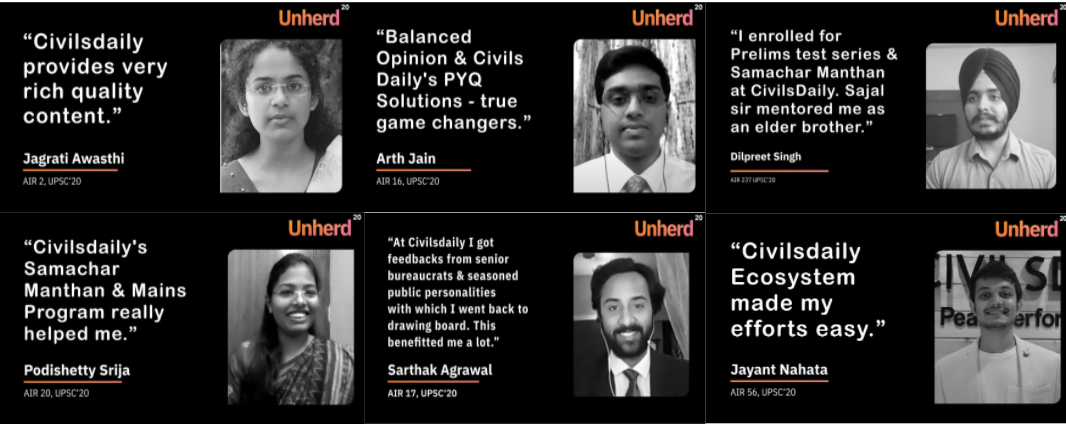
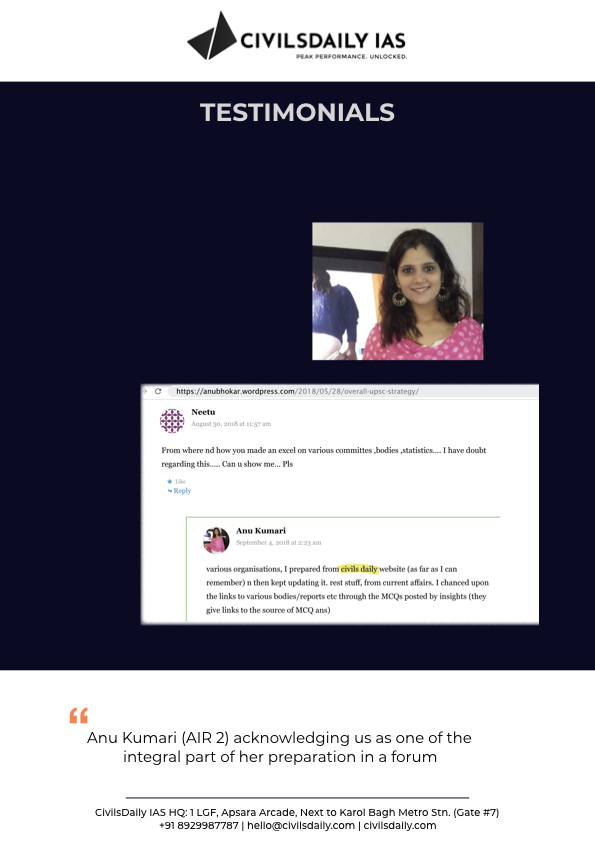
    Civilsdaily’s community: Testimonials

    Click here to enroll for Prime Prelims TS 2021

    Should you have any query, or want to discuss more about Prime Prelims TS call us at +91 89299 87787 or email at hello@civilsdaily.com.

    Let’s clear Prelims 2021.

  • What are Social Stock Exchanges?

    A working group constituted by the Securities and Exchange Board of India (SEBI) on Social Stock Exchanges (SSEs) has recommended allowing non-profit organisations to directly list on such platforms.

    Practice questions for mains:

    Q. What are Social Stock Exchanges? Discuss how it will help finance social enterprises in India.

    What are Social Stock Exchanges (SSEs)?

    • An SSE is a platform which allows investors to buy shares in social enterprises vetted by an official exchange.
    • The Union Budget 2019 proposed setting up of first of its kind SSE in India.
    • The SSE will function as a common platform where social enterprises can raise funds from the public.
    • It will function on the lines of major stock exchanges like BSE and NSE. However, the purpose of the Social Stock Exchange will be different – not profit, but social welfare.
    • Under the regulatory ambit of SEBI, a listing of social enterprises and voluntary organizations will be undertaken so that they can raise capital as equity, debt or as units like a mutual fund.

    Why SSEs?

    • India needs massive investments in the coming years to be able to meet the human development goals identified by global bodies like the UN.
    • This can’t be done through government expenditure alone. Private enterprises working in the social sector also need to step up their activities.
    • Currently, social enterprises are very active in India. However, they face challenges in raising funds.
    • One of the biggest hurdles they face is, apparently, the lack of trust from common investors.

    Benefits

    • There is a great opportunity to unlock funds from donors, philanthropic foundations and CSR spenders, in the form of zero-coupon zero principal bonds. These bonds will be listed on the SSE.
    • At first, the SSE could become a repository of social enterprises and impact investors.
    • The registration could be done through a standard process.
    • The SEs could be categorized into different stages such as- Idea, growth stage and likewise, investors can also be grouped based on the type of investment.

More posts