The Supreme Court has told Tamil Nadu and Kerala that it was not there to “administer the dam” when a supervisory committee was already in place to examine the issue of safety of the Mullaperiyar Dam and the management of its water level.
Do you know?
The Mullaperiyar dam is located in Kerala on the river Periyar but is operated and maintained by the neighbouring state of Tamil Nadu.
John Pennycuick (the architect of this dam) sold his family property in England to mobilize money to fund the project! People of the region fondly name their children under his name a remark of reverence.
Mullaperiyar Dam
It is a masonry gravity dam on the Periyar River in Kerala.
It is located on the Cardamom Hills of the Western Ghats in Thekkady, Idukki District.
It was constructed between 1887 and 1895 by John Pennycuick (who was born in Pune) and also reached in an agreement to divert water eastwards to the Madras Presidency area.
It has a height of 53.6 m (176 ft) from the foundation, and a length of 365.7 m (1,200 ft).
Operational issue
The dam is located in Kerala but is operated and maintained by Tamil Nadu.
The catchment area of the Mullaperiyar Dam itself lies entirely in Kerala and thus not an inter-State river.
In November 2014, the water level hit 142 feet for first time in 35 years.
The reservoir again hit the maximum limit of 142 feet in August 2018, following incessant rains in the state of Kerala.
Indeed, the tendency to store water to almost the full level of reservoirs is becoming a norm among water managers across States.
The dispute: Control and safety of the dam
Supreme court judgment came in February 2006, has allowed Tamil Nadu to raise the level of the dam to 152 ft (46 m) after strengthening it.
Responding to it, the Mullaperiyar dam was declared an ‘endangered’ scheduled dam by the Kerala Government under the disputed Kerala Irrigation and Water Conservation (Amendment) Act, 2006.
For Tamil Nadu, the Mullaperiyar dam and the diverted Periyar waters act as a lifeline for Theni, Madurai, Sivaganga, Dindigul and Ramnad districts.
Tamil Nadu has insisted on exercising the unfettered colonial rights to control the dam and its waters, based on the 1886 lease agreement.
Rule of Curve issue
A rule curve or rule level specifies the storage or empty space to be maintained in a reservoir during different times of the year.
It decides the fluctuating storage levels in a reservoir.
The gate opening schedule of a dam is based on the rule curve. It is part of the “core safety” mechanism in a dam.
The TN government often blames Kerala for delaying the finalization of the rule curve.
Back2Basics: Periyar River
The Periyar is the longest river in the state of Kerala with a length of 244 km.
It is also known as ‘Lifeline of Kerala’ as it is one of the few perennial rivers in the state.
It originates from Sivagiri hills of Western Ghats and flows through the Periyar National Park.
The main tributaries of Periyar are Muthirapuzha, Mullayar, Cheruthoni, Perinjankutti.
India now ranks at 83rd position in the Henley Passport Index, climbing seven places from 90th rank last year.
Henley Passport Index
The Henley & Partners publishes the ranking and the Index of the world’s passports according to the number of destinations their holders can access without a prior visa.
It was launched in 2005.
The ranking is based on data from the IATA (International Air Transport Association), a trade association of some 290 airlines, including all major carriers.
The index includes 199 different passports and 227 different travel destinations.
The data are updated in real time as and when visa policy changes come into effect.
India’s performance this year
India is ranked at 83rd position and shares the rank with Sao Tome and Principe in Central Africa, behind Rwanda and Uganda.
It now has visa-free access to 60 destinations worldwide with Oman and Armenia being the latest additions.
It has added 35 more destinations since 2006.
Global performance
Japan and Singapore has topped the list.
The US and the UK passports regained some of their previous strength after falling all the way to eighth place in 2020.
The passport of the Maldives is the most powerful in South Asia (58th) enabling visa-free entry to 88 countries.
In South Asia, Bangladesh (103rd) is ahead of Pakistan (108th) and Nepal (105th).
Ever since the UNDP took up computation of the HDI in 1990, there have been adjustments such as inequality-adjusted HDI. The environment is one such issue now considered to be an essential component to be factored in to measure human development.
Planetary pressure-adjusted Human Development Index
The purpose of the planetary pressure adjusted HDI, or PHDI, is to communicate to the larger society the risk involved in continuing with existing practices in our resource use and environmental management, and the retarding effect that environmental stress can perpetuate on development.
When planetary pressure is adjusted, the world average of HDI in 2019 came down from 0.737 to 0.683.
PHDI of India: In the case of India, the PHDI is 0.626 against an HDI of 0.645 with an average per capita CO2 emission (production) and material footprints of 2.0 tonnes and 4.6 tonnes, respectively.
India gained in global rankings by eight points (131st rank under HDI and 123rd rank under PHDI), and its per capita carbon emission (production) and material footprint are well below the global average.
India’s twin challenge
India faces the twin challenges of poverty alleviation and environmental safeguarding.
India’s natural resource use is far from efficient, environmental problems are growing, and the onslaught on nature goes on unabated with little concern about its fallout.
At the same time, India has 27.9% people under the Multidimensional Poverty Index ranging from 1.10% in Kerala to 52.50% in Bihar, and a sizable section of them directly depend on natural resources for their sustenance.
India’s performance on SDGs
The SDGs have acquired high priority in the context of the issue of climate change and its impact on society.
The Sixth Assessment Report (AR6) of IPCC 2021 laid stress on limiting global temperature rise at the 1.5° C level and strengthening the global response to the threat of climate change, sustainable development, and efforts to eradicate poverty.
‘No poverty’ and ‘Zero hunger’ are the first and second SDGs.
According to NITI Aayog (2020-21), out of 100 points set for the grade of Achiever, India scored 60 (Performer grade, score 50-64) for no poverty and 47 (Aspirant grade, score 0-49) for zero hunger, with wide State-level variations.
India’s score in the SDGs of 8, 9, and 12 (‘Decent work and economic growth’; ‘Industry, Innovation and Infrastructure’ and ‘Responsible Consumption and Production’, respectively) — considered for working out planetary pressure — are 61 (performer), 55 (performer) and 74 (front runner), respectively.
Way forward
Nature-based solutions: It is now well established that there are interdependencies of earth system processes including social processes, and their relationships are non-linear and dialectic.
Therefore, the central challenge is to nest human development including social and economic systems into the ecosystem, and biosphere building on a systematic approach to nature-based solutions that put people at the core.
Integrated perspective and local level involvement: Social and environmental problems cannot be addressed in isolation anymore; an integrated perspective is necessary.
This can be conceived and addressed at the local level, for which India has constitutional provisions in the form of the 73rd and 74th Amendments.
Conclusion
An integrated perspective is necessary as social and environmental problems cannot be addressed in isolation anymore.
Everything that has a value in life is a product of consistency — Health, Fitness, Wealth, Relationships and Your UPSC Aspiration as well. Choosing consistency is better than chasing perfection. Nobody can be perfect, but everyone can stay consistent.
Choosing to be a UPSC Aspirant means you have signed up for a roller-coaster of emotions for a period of 1-2 years. Not all days are going to be the same, that is for sure. Some days you’re extremely motivated and positive, and on other days, you might find yourself questioning EVERYTHING about your preparation! It is absolutely normal. This is something extremely inevitable. Even the best of the toppers can have the worst days during the preparation phase simply because it is an extremely long and often a lonely process.
It’s fine to be inconsistent for a short while. Maybe a day or two in the initial phase. But don’t make it a habit. Regular inconsistency won’t fetch you the desired result. But what exactly is inconsistency?
What did Aspirants say made them Inconsistent 1-on-1 Free Counselling Session?
Last month, we had counselled about 4000 aspirants and found out the major reasons why are in inconsistent in their UPSC preparation. Here are few of the responses we received (we have withheld names to respect their privacy) —
1. “I am inconsistent because my thoughts don’t line up with my actions. I like the idea of being an IAS officer, but I am unable to study for it.”
2. “There are days when I brood about the competition and think do I really stand a chance? That’s what keeps me studying for many days together.”, shared another
3. “I am a working professional and I am unable to find time to study for weeks together.”
4. “I am unable to make a timetable that can do justice to both my pace and the vast syllabus of UPSC”
5. “This is my third attempt. The thought of repeating the same cycle of studies and reading those dreary books once again keeps me from staying consistent.”
6. “I feel burnt out. There are days I put in so much effort studying for UPSC that I won’t feel like the next day.”
7. “Social Media. I get distracted often.”
8. “The preparation makes me feel lonely. Sometimes I wish I had a well-wisher who could pull me out of my inconsistent ways.”
What we could understand from this is that self-doubt kills enthusiasm to prepare for UPSC. And fear of failure stops you from staying consistent. It’s important to inculcate consistency as a UPSC aspirant as consistency leads to habits. Habits lead to action and action makes you successful.
Inconsistency is the frenemy of every UPSC aspirant — they look like your friend at first, but they are your enemy in disguise. It doesn’t even let you achieve 10% of your actual potential. You know that you are capable of so many things if you stopped being inconsistent.
Keeping this in mind, we have launched our mentorship program this week. The highlight of our free 1-on-1 sessions would be to suggest ways that can help you stay focused during your long preparation journey for UPSC.
How does 1-on-1 Mentorship fights inconsistency in UPSC Preparation?
Our philosophy behind MENTORSHIP is to get you out of this Snooze cycle. This ensures that you are the BEST VERSION of yourself in this journey. If you are under the impression that mentorship is weekly calls you attend, then you are mistaken, my friend. Trust us, your mentor will be your ‘FRIEND, PHILOSOPHER AND GUIDE’.
TO EACH THEIR OWN – Every aspirant is different. Their strengths and weaknesses are different. Their time availability is also different. Identifying this is important so you don’t end up making unrealistic targets and lose momentum. Your mentor will make sure you start slow but remain consistent to build your confidence. Making your schedule structured based on our experience of working with 2500+ students is our first priority.
TRACK YOUR PROGRESS – When you see yourself grow, it becomes easier to motivate yourself to push boundaries. Tracking your progress can happen in many ways like mentorship calls or chat sessions or by regular tests. The idea is to ensure that you don’t go off track in your preparation, and even if you do, we have your back.
EVOLUTION – A constant guidance is important to bring consistency to your UPSC preparation. Guidance is not about clearing your doubts or asking you to study when you don’t. It is also about the evolution of your preparation. This is where you and your mentor work as a team. A constant effort to PLAN AND BUILD UP YOUR ABILITY to learn in a faster and more efficient way.RECEIVE PERSONAL GUIDANCE FOR UPSC (REGISTER HERE)
TALK IT OUT – The biggest hurdle in achieving your highest level of consistency is the emotional part. Every now and then, you. surround yourself with negative thoughts, you feel scared and depressed. Instead of resolving these emotional issues, you avoid them as it seems like a waste of your precious time. You have to understand that ignoring emotional troubles does not solve them. What your doing is building an emotional time bomb that may burst a week before your mains or prelims! This is where your MENTOR AS A FRIEND comes in. All our mentors have been through this journey. We understand your fears and anxieties. So, TALK IT OUT.
Don’t let inconsistency keep you away from your dreams.
Fill up the SAMANVAYA form given below. Let us know your problems and we will find a solution to it, just like our students say ” TOGETHER WE CAN AND WE WILL”.
How has Civilsdaily Mentorship, helped Aspirants become Toppers?
The most difficult challenge faced by EVERY candidate is inconsistency. Be it inconsistency in studies, answer-writing practice, covering the syllabus, or revision, every candidate finds it difficult to cope with. Buthow do successful candidates manage to FIGHT Inconsistency so consistently?
In UPSC 2020, Civilsdaily helped 80+ students secure ranks in their exams. In the top 100, every 3rd ranker was a Civilsdaily student.
A very recent success story would be Vishwa Shah, student of Civilsdaily Mentor, Sukanya Ma’am. Vishwa has cleared the GPSC exam to become the Deputy Superintendent of Police in Gujarat. He has penned a thank-you note yesterday. Heartiest Congratulations to Vishwa!
One of our other Civilsdaily Student, Shubham Nagargojecleared the exams in 2020 to become an IPS Officer. Shubham was gracious enough to let us know how he felt about Civilsdaily Samanvaya Guidance under Parth sir.
To know how all of them cleared the exam with our mentorship, visit the UnherdPodcast.
Now that results are announced for UPSC 2021 Prelims, out of 15 out of 25 students of Santhosh Gupta sir have been recommended to Mains. One such student, Rahul expresses his gratitude and extends his appreciation.
Most of our Mentors like Sudhanshu sir, Sajal sir, Santhosh sir, Pravin sir, Parth Verma sir and Sukanya Ma’am were UPSC aspirants themselves and have attended UPSC Mains more than five times and UPSC Interview more than twice. Hence their mentorship is always a blend of the best test series, comprehensive notes and current affairs knowledge.
All of them dedicate their time weekly to give 1-on-1 mentorship to every student where they discuss last week’s performance and next week’s approach.
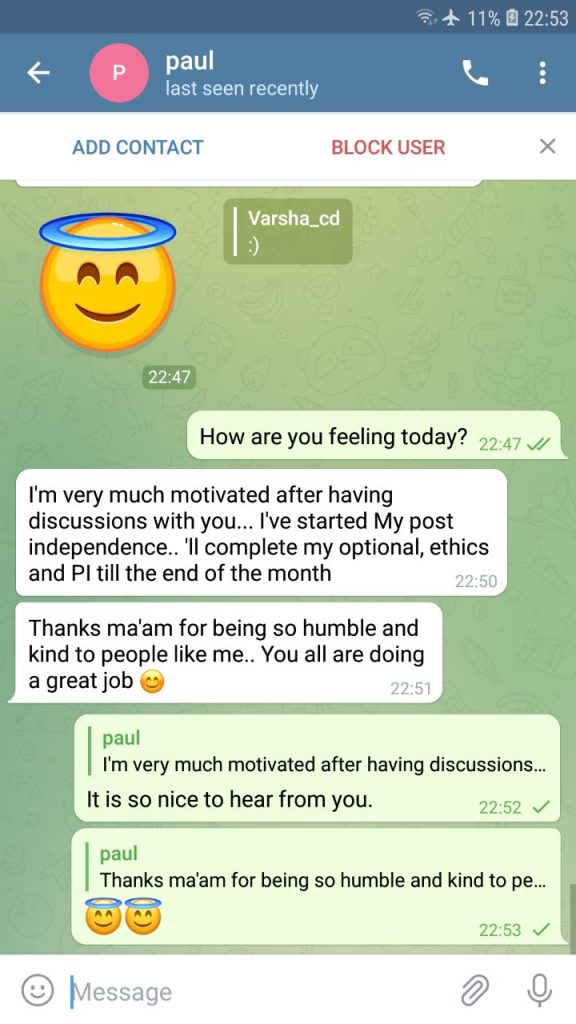
Be it Telegram, Whatsapp or Habitiat channels, they are always available and clear student’s doubts in a turnaround time of 24 Hours.
Why Civilsdaily Mentors are the GPS for Your UPSC-CSE Preparation
Remember there is always light at the end of the tunnel and if you want to get out of the tunnel you have to follow the direction of the light! Our mentors’ give you direction which is divided into daily modules. All you have to do is study and complete them on time.
As every year passes by, we don’t get confident by the previous years’ performance and become laidback. Instead, we become more hungry to convert all our students into toppers.
How are Current Civilsdaily Students Gearing up for UPSC-CSE 2022?
Initially, our Civilsdaily student Smriti wasn’t confident about Prelims when she began her preparation. Though she had joined Civilsdaily in 2020, she started studying for UPSC-CSE back in 2019. At that time, Smriti had enrolled in multiple institutes. Though, most of these institutes had promised a personal mentor, she was unable to get in touch with them on a daily basis. Also those mentors never scheduled test-series on a weekly basis. Hence, despite preparing for a year, Smriti had scored only 35 marks out of 200 in her first test series by Civilsdaily.
She then started writing 20-25 test series over the course of UAP 2021 and in her last test, her scores have drastically improved. She now scores in the range of 130-135 marks in prelims’ and 110+ in mains’ papers.
In Smriti’s own words she describes her Samanvaya Mentorship Experience to be —
“Our parents provide us financial and emotional support, friends provide us moral support and the right mentor gives you logistic and logical support for UPSC. There are days when I felt I won’t be able to compete against lakhs of aspirants. That’s when my mentor, Ravi sir reminded me of my improvement and encouraged me that I can crack it with the same consistency. We need someone, who tells us we are performing well especially when we cannot see that ourselves. The mentorship at Civilsdaily helped me become mentally stronger as a person. In other institutes, mentors are allotted only for doubt resolution. But at Civilsdaily, I am getting end-to-end mentorship via value added notes, classes, test series and detailed evaluation.”
Similarly our another Civilsdaily student, Ashishsums up his Samanvaya experience with Civilsdaily mentor,Pravin Sir, “Because of Pravin sir’s support, I am able to understand a topic in lesser time.”
This is how Pravin sir evaluates Ashish’s Mains Test Series every week. After every test series evaluation, Pravin sir schedules a 1 hour call to discuss how Ashish can improve his marks and the sources he can refer for key topics.
It’s Your Turn Get the Free 40 Min Counselling Session By a CD Mentor
Civilsdaily mentors are so dedicated, consistent and focused for your UPSC goal, that you will eventually become focused into turning your dreams to reality.
At the core of Civilsdaily UPSC mentorship, lies the fact that each one of you will have a unique journey while preparing for the exam. Some will get through on the first attempt without much effort while others will take both more time and more effort.
We want to understand you better to help you optimize your journey so you can focus on the right things and not waste time on the wrong ones. We are asking you to tap into the valuable experiences of mentors who underwent the same grind and realize the pitfalls and understand the shortcuts to make it.
In the first counselling session, we will understand your weaknesses. We then help you to stick to one plan or strategy throughout your preparation. We will then follow up with you on a daily basis to check if you are right on track. To get an idea of how your 1st 1-on-1 mentorship will look like, watch this sample video —
In 2020-21, the compensation payment episode plunged the Union-State relationship to a new low, creating humongous mistrust.
Background of the compensation to the States
To allay the fears of States of possible revenue loss by implementing GST in the short term, the Union government promised to pay compensation for any loss of revenue in the evolutionary phase of five years.
This was estimated by taking the revenue from the merged taxes in 2015-16 as the base and applying the growth rate of 14% every year.
To finance the compensation requirements, a GST compensation cess was levied on certain items such as tobacco products, automobiles.
Period of five years: The agreement to pay compensation for the loss of revenue was for a period of five years which will come to an end by June 2022.
Mistrust between Centre and the State: In 2020-21, due to the most severe lockdown following the novel coronavirus pandemic, the loss of revenue to States was estimated at ₹3 lakh-crore of which ₹65,000 crore was expected to accrue from the compensation cess.
Of the remaining ₹2.35 lakh-crore, the Union government decided to pay ₹1.1 lakh-crore by borrowing from the Reserve Bank of India.
The entire compensation payment episode plunged the Union-State relationship to a new low, creating humongous mistrust.
GST reform is still in transition
Misuse of input tax credit: The technology platform could not be firmed up for a long time due to which the initially planned returns could not be filed.
This led to large-scale misuse of input tax credit using fake invoices.
Revenue uncertainty faced by the States: This is the only major source of revenue for the States.
Considering their increased spending commitments to protect the lives and livelihoods of people, they would like to mitigate revenue uncertainty to the extent they can.
They have no means to cushion this uncertainty for the Finance Commission which is supposed to take into account the States’ capacities and needs in its recommendations has already submitted its recommendations.
Changes needed: More importantly, the structure of GST needs significant changes and the cooperation of States is necessary to carry out the required reforms.
Changes needed in GST structure
Reducing exemption items: Almost 50% of the consumption items included in the consumer price index are in the exemption list; broadening the base of the tax requires significant pruning of these items.
Bringing petroleum products, real estate etc under GST: Sooner or later, it is necessary to bring petroleum products,real estate, alcohol for human consumption and electricity into the GST fold.
Single rate: The present structure is far too complicated with four main rates (5%, 12%, 18% and 28%).
This is in addition to special rates on precious and semi-precious stones and metals and cess on ‘demerit’ and luxury items at rates varying from 15% to 96% of the tax rate applicable which have complicated the tax enormously.
Multiple rates complicate the tax system, cause administrative and compliance problems, create inverted duty structure and lead to classification disputes.
Way forward
Extending the compensation period: Reforming the structure to unify the rates is imperative and this cannot be done without the cooperation of States.
Thus, extending the compensation payment for the next five years is necessary not only because the transition to GST is still underway but also to provide comfort to States to partake in the reform.
Reforming the structure is important not only to enhance the buoyancy of the tax in the medium term but also to reduce administrative and compliance costs to improve ease of doing business and minimise distortions.
New rate of compensation: It has been pointed out by many including the Fifteenth Finance Commission that the compensation scheme of applying 14% growth on the base year revenue provided for the first five years was far too generous.
The issue can be revisited and the rate of growth of reference revenue for calculating compensation can be linked to the growth of GSDP in States.
Conclusion
The transition to GST is still in progress and an extension will provide comfort to States to help roll out crucial changes.
The growing incidence of hate speeches, especially those targeting minorities, in combination with the judicial ambiguity has provided an opportunity to chart legislative reforms.
Current legal provisions to deal with hate speech
Not defined in legal framework: Hate speech is neither defined in the Indian legal framework nor can it be easily reduced to a standard definition due to the myriad forms it can take.
The Supreme Court, in Pravasi Bhalai Sangathan v. Union of India (2014), described hate speech as “an effort to marginalise individuals based on their membership in a group” and one that “seeks to delegitimise group members in the eyes of the majority, reducing their social standing and acceptance within society.”
The Indian Penal Code illegalises speeches that are intended to promote enmity or prejudice the maintenance of harmony between different classes.
Specifically, sections of the IPC, such as 153A, which penalises promotion of enmity between different groups;
153B, which punishes imputations, assertions prejudicial to national integration;
505, which punishes rumours and news intended to promote communal enmity, and
295A, which criminalises insults to the religious beliefs of a class by words with deliberate or malicious intention.
Summing up various legal principles, in Amish Devgan v. Union of India (2020), the Supreme Court held that “hate speech has no redeeming or legitimate purpose other than hatred towards a particular group”.
Lack of established legal standard:Divergent decisions from constitutional courts expose the lack of established legal standards in defining hate speech, especially those propagated via the digital medium.
Suggestions
The Law Commission of India, in its 267th report, recommended the insertion of two new provisions to criminalise and punish the propagation of hate speech.
The 189th Report of the Parliamentary Standing Committee on Home Affairs, in 2015, recommended the incorporation of separate and specific provisions in the Information Technology Act to deal with online hate speech.
Specialised legislation for social media: Much of the existing penal provisions deal with hate speech belong to the pre-Internet era.
The need of the hour is specialised legislation that will govern hate speech propagated via the Internet and, especially, social media.
Recognise hate speech as reasonable restriction to free speech: Taking cue from best international standards, it is important that specific and durable legislative provisions that combat hate speech, especially that which is propagated online and through social media.
Ultimately, this would be possible only when hate speech is recognised as a reasonable restriction to free speech.
Consider the question “What is hate speech? What are the challenges in dealing with hate speech? Suggest a way forward.”
Conclusion
It is important that specific and durable legislative provisions be enacted to combat hate speech.
Everything that has a value in life is a product of consistency — Health, Fitness, Wealth, Relationships and Your UPSC Aspiration as well. Choosing consistency is better than chasing perfection. Nobody can be perfect, but everyone can stay consistent.
Choosing to be a UPSC Aspirant means you have signed up for a roller-coaster of emotions for a period of 1-2 years. Not all days are going to be the same, that is for sure. Some days you’re extremely motivated and positive, and on other days, you might find yourself questioning EVERYTHING about your preparation! It is absolutely normal. This is something extremely inevitable. Even the best of the toppers can have the worst days during the preparation phase simply because it is an extremely long and often a lonely process.
It’s fine to be inconsistent for a short while. Maybe a day or two in the initial phase. But don’t make it a habit. Regular inconsistency won’t fetch you the desired result. But what exactly is inconsistency?
What did Aspirants say made them Inconsistent 1-on-1 Free Counselling Session?
Last month, we had counselled about 4000 aspirants and found out the major reasons why are in inconsistent in their UPSC preparation. Here are few of the responses we received (we have withheld names to respect their privacy) —
1. “I am inconsistent because my thoughts don’t line up with my actions. I like the idea of being an IAS officer, but I am unable to study for it.”
2. “There are days when I brood about the competition and think do I really stand a chance? That’s what keeps me studying for many days together.”, shared another
3. “I am a working professional and I am unable to find time to study for weeks together.”
4. “I am unable to make a timetable that can do justice to both my pace and the vast syllabus of UPSC”
5. “This is my third attempt. The thought of repeating the same cycle of studies and reading those dreary books once again keeps me from staying consistent.”
6. “I feel burnt out. There are days I put in so much effort studying for UPSC that I won’t feel like the next day.”
7. “Social Media. I get distracted often.”
8. “The preparation makes me feel lonely. Sometimes I wish I had a well-wisher who could pull me out of my inconsistent ways.”
What we could understand from this is that self-doubt kills enthusiasm to prepare for UPSC. And fear of failure stops you from staying consistent. It’s important to inculcate consistency as a UPSC aspirant as consistency leads to habits. Habits lead to action and action makes you successful.
Inconsistency is the frenemy of every UPSC aspirant — they look like your friend at first, but they are your enemy in disguise. It doesn’t even let you achieve 10% of your actual potential. You know that you are capable of so many things if you stopped being inconsistent.
Keeping this in mind, we have launched our mentorship program this week. The highlight of our free 1-on-1 sessions would be to suggest ways that can help you stay focused during your long preparation journey for UPSC.
How does 1-on-1 Mentorship fights inconsistency in UPSC Preparation?
Our philosophy behind MENTORSHIP is to get you out of this Snooze cycle. This ensures that you are the BEST VERSION of yourself in this journey. If you are under the impression that mentorship is weekly calls you attend, then you are mistaken, my friend. Trust us, your mentor will be your ‘FRIEND, PHILOSOPHER AND GUIDE’.
TO EACH THEIR OWN – Every aspirant is different. Their strengths and weaknesses are different. Their time availability is also different. Identifying this is important so you don’t end up making unrealistic targets and lose momentum. Your mentor will make sure you start slow but remain consistent to build your confidence. Making your schedule structured based on our experience of working with 2500+ students is our first priority.
TRACK YOUR PROGRESS – When you see yourself grow, it becomes easier to motivate yourself to push boundaries. Tracking your progress can happen in many ways like mentorship calls or chat sessions or by regular tests. The idea is to ensure that you don’t go off track in your preparation, and even if you do, we have your back.
EVOLUTION – A constant guidance is important to bring consistency to your UPSC preparation. Guidance is not about clearing your doubts or asking you to study when you don’t. It is also about the evolution of your preparation. This is where you and your mentor work as a team. A constant effort to PLAN AND BUILD UP YOUR ABILITY to learn in a faster and more efficient way.RECEIVE PERSONAL GUIDANCE FOR UPSC (REGISTER HERE)
TALK IT OUT – The biggest hurdle in achieving your highest level of consistency is the emotional part. Every now and then, you. surround yourself with negative thoughts, you feel scared and depressed. Instead of resolving these emotional issues, you avoid them as it seems like a waste of your precious time. You have to understand that ignoring emotional troubles does not solve them. What your doing is building an emotional time bomb that may burst a week before your mains or prelims! This is where your MENTOR AS A FRIEND comes in. All our mentors have been through this journey. We understand your fears and anxieties. So, TALK IT OUT.
Don’t let inconsistency keep you away from your dreams.
Fill up the SAMANVAYA form given below. Let us know your problems and we will find a solution to it, just like our students say ” TOGETHER WE CAN AND WE WILL”.
How has Civilsdaily Mentorship, helped Aspirants become Toppers?
The most difficult challenge faced by EVERY candidate is inconsistency. Be it inconsistency in studies, answer-writing practice, covering the syllabus, or revision, every candidate finds it difficult to cope with. Buthow do successful candidates manage to FIGHT Inconsistency so consistently?
In UPSC 2020, Civilsdaily helped 80+ students secure ranks in their exams. In the top 100, every 3rd ranker was a Civilsdaily student.
A very recent success story would be Vishwa Shah, student of Civilsdaily Mentor, Sukanya Ma’am. Vishwa has cleared the GPSC exam to become the Deputy Superintendent of Police in Gujarat. He has penned a thank-you note yesterday. Heartiest Congratulations to Vishwa!
One of our other Civilsdaily Student, Shubham Nagargojecleared the exams in 2020 to become an IPS Officer. Shubham was gracious enough to let us know how he felt about Civilsdaily Samanvaya Guidance under Parth sir.
To know how all of them cleared the exam with our mentorship, visit the UnherdPodcast.
Now that results are announced for UPSC 2021 Prelims, out of 15 out of 25 students of Santhosh Gupta sir have been recommended to Mains. One such student, Rahul expresses his gratitude and extends his appreciation.
Most of our Mentors like Sudhanshu sir, Sajal sir, Santhosh sir, Pravin sir, Parth Verma sir and Sukanya Ma’am were UPSC aspirants themselves and have attended UPSC Mains more than five times and UPSC Interview more than twice. Hence their mentorship is always a blend of the best test series, comprehensive notes and current affairs knowledge.
All of them dedicate their time weekly to give 1-on-1 mentorship to every student where they discuss last week’s performance and next week’s approach.
Be it Telegram, Whatsapp or Habitiat channels, they are always available and clear student’s doubts in a turnaround time of 24 Hours.
Why Civilsdaily Mentors are the GPS for Your UPSC-CSE Preparation
Remember there is always light at the end of the tunnel and if you want to get out of the tunnel you have to follow the direction of the light! Our mentors’ give you direction which is divided into daily modules. All you have to do is study and complete them on time.
As every year passes by, we don’t get confident by the previous years’ performance and become laidback. Instead, we become more hungry to convert all our students into toppers.
How are Current Civilsdaily Students Gearing up for UPSC-CSE 2022?
Initially, our Civilsdaily student Smriti wasn’t confident about Prelims when she began her preparation. Though she had joined Civilsdaily in 2020, she started studying for UPSC-CSE back in 2019. At that time, Smriti had enrolled in multiple institutes. Though, most of these institutes had promised a personal mentor, she was unable to get in touch with them on a daily basis. Also those mentors never scheduled test-series on a weekly basis. Hence, despite preparing for a year, Smriti had scored only 35 marks out of 200 in her first test series by Civilsdaily.
She then started writing 20-25 test series over the course of UAP 2021 and in her last test, her scores have drastically improved. She now scores in the range of 130-135 marks in prelims’ and 110+ in mains’ papers.
In Smriti’s own words she describes her Samanvaya Mentorship Experience to be —
“Our parents provide us financial and emotional support, friends provide us moral support and the right mentor gives you logistic and logical support for UPSC. There are days when I felt I won’t be able to compete against lakhs of aspirants. That’s when my mentor, Ravi sir reminded me of my improvement and encouraged me that I can crack it with the same consistency. We need someone, who tells us we are performing well especially when we cannot see that ourselves. The mentorship at Civilsdaily helped me become mentally stronger as a person. In other institutes, mentors are allotted only for doubt resolution. But at Civilsdaily, I am getting end-to-end mentorship via value added notes, classes, test series and detailed evaluation.”
Similarly our another Civilsdaily student, Ashishsums up his Samanvaya experience with Civilsdaily mentor,Pravin Sir, “Because of Pravin sir’s support, I am able to understand a topic in lesser time.”
This is how Pravin sir evaluates Ashish’s Mains Test Series every week. After every test series evaluation, Pravin sir schedules a 1 hour call to discuss how Ashish can improve his marks and the sources he can refer for key topics.
It’s Your Turn Get the Free 40 Min Counselling Session By a CD Mentor
Civilsdaily mentors are so dedicated, consistent and focused for your UPSC goal, that you will eventually become focused into turning your dreams to reality.
At the core of Civilsdaily UPSC mentorship, lies the fact that each one of you will have a unique journey while preparing for the exam. Some will get through on the first attempt without much effort while others will take both more time and more effort.
We want to understand you better to help you optimize your journey so you can focus on the right things and not waste time on the wrong ones. We are asking you to tap into the valuable experiences of mentors who underwent the same grind and realize the pitfalls and understand the shortcuts to make it.
In the first counselling session, we will understand your weaknesses. We then help you to stick to one plan or strategy throughout your preparation. We will then follow up with you on a daily basis to check if you are right on track. To get an idea of how your 1st 1-on-1 mentorship will look like, watch this sample video —
HOW TO ATTEMPT ANSWERS IN DAILY ANSWER WRITING ENHANCEMENT(AWE)?
Daily 4 questions from General studies 1, 2, 3, and 4 will be provided to you.
A Mentor’s Comment will be available for all answers. This can be used as a guidance tool but we encourage you to write original answers.
You can write your answer on an A4 sheet and scan/click pictures of the same.
Upload the scanned answer in the comment section of the same question.
Along with the scanned answer, please share your Razor payment ID, so that paid members are given priority.
If you upload the answer on the same day like the answer of 11th October is uploaded on 11th October then your answer will be checked within 72 hours. Also, reviews will be in the order of submission- First come first serve basis
If you are writing answers late, for example, 11th October is uploaded on 13th October, then these answers will be evaluated as per the mentor’s schedule.
We encourage you to write answers on the same day. However, if you are uploading an answer late then tag the mentor like @Staff so that the mentor is notified about your answer.
*In case your answer is not reviewed, reply to your answer saying *NOT CHECKED*.
Everything that has a value in life is a product of consistency — Health, Fitness, Wealth, Relationships and Your UPSC Aspiration as well. Choosing consistency is better than chasing perfection. Nobody can be perfect, but everyone can stay consistent.
Choosing to be a UPSC Aspirant means you have signed up for a roller-coaster of emotions for a period of 1-2 years. Not all days are going to be the same, that is for sure. Some days you’re extremely motivated and positive, and on other days, you might find yourself questioning EVERYTHING about your preparation! It is absolutely normal. This is something extremely inevitable. Even the best of the toppers can have the worst days during the preparation phase simply because it is an extremely long and often a lonely process.
It’s fine to be inconsistent for a short while. Maybe a day or two in the initial phase. But don’t make it a habit. Regular inconsistency won’t fetch you the desired result. But what exactly is inconsistency?
What did Aspirants say made them Inconsistent 1-on-1 Free Counselling Session?
Last month, we had counselled about 4000 aspirants and found out the major reasons why are in inconsistent in their UPSC preparation. Here are few of the responses we received (we have withheld names to respect their privacy) —
1. “I am inconsistent because my thoughts don’t line up with my actions. I like the idea of being an IAS officer, but I am unable to study for it.”
2. “There are days when I brood about the competition and think do I really stand a chance? That’s what keeps me studying for many days together.”, shared another
3. “I am a working professional and I am unable to find time to study for weeks together.”
4. “I am unable to make a timetable that can do justice to both my pace and the vast syllabus of UPSC”
5. “This is my third attempt. The thought of repeating the same cycle of studies and reading those dreary books once again keeps me from staying consistent.”
6. “I feel burnt out. There are days I put in so much effort studying for UPSC that I won’t feel like the next day.”
7. “Social Media. I get distracted often.”
8. “The preparation makes me feel lonely. Sometimes I wish I had a well-wisher who could pull me out of my inconsistent ways.”
What we could understand from this is that self-doubt kills enthusiasm to prepare for UPSC. And fear of failure stops you from staying consistent. It’s important to inculcate consistency as a UPSC aspirant as consistency leads to habits. Habits lead to action and action makes you successful.
Inconsistency is the frenemy of every UPSC aspirant — they look like your friend at first, but they are your enemy in disguise. It doesn’t even let you achieve 10% of your actual potential. You know that you are capable of so many things if you stopped being inconsistent.
Keeping this in mind, we have launched our mentorship program this week. The highlight of our free 1-on-1 sessions would be to suggest ways that can help you stay focused during your long preparation journey for UPSC.
How does 1-on-1 Mentorship fights inconsistency in UPSC Preparation?
Our philosophy behind MENTORSHIP is to get you out of this Snooze cycle. This ensures that you are the BEST VERSION of yourself in this journey. If you are under the impression that mentorship is weekly calls you attend, then you are mistaken, my friend. Trust us, your mentor will be your ‘FRIEND, PHILOSOPHER AND GUIDE’.
TO EACH THEIR OWN – Every aspirant is different. Their strengths and weaknesses are different. Their time availability is also different. Identifying this is important so you don’t end up making unrealistic targets and lose momentum. Your mentor will make sure you start slow but remain consistent to build your confidence. Making your schedule structured based on our experience of working with 2500+ students is our first priority.
TRACK YOUR PROGRESS – When you see yourself grow, it becomes easier to motivate yourself to push boundaries. Tracking your progress can happen in many ways like mentorship calls or chat sessions or by regular tests. The idea is to ensure that you don’t go off track in your preparation, and even if you do, we have your back.
EVOLUTION – A constant guidance is important to bring consistency to your UPSC preparation. Guidance is not about clearing your doubts or asking you to study when you don’t. It is also about the evolution of your preparation. This is where you and your mentor work as a team. A constant effort to PLAN AND BUILD UP YOUR ABILITY to learn in a faster and more efficient way.RECEIVE PERSONAL GUIDANCE FOR UPSC (REGISTER HERE)
TALK IT OUT – The biggest hurdle in achieving your highest level of consistency is the emotional part. Every now and then, you. surround yourself with negative thoughts, you feel scared and depressed. Instead of resolving these emotional issues, you avoid them as it seems like a waste of your precious time. You have to understand that ignoring emotional troubles does not solve them. What your doing is building an emotional time bomb that may burst a week before your mains or prelims! This is where your MENTOR AS A FRIEND comes in. All our mentors have been through this journey. We understand your fears and anxieties. So, TALK IT OUT.
Don’t let inconsistency keep you away from your dreams.
Fill up the SAMANVAYA form given below. Let us know your problems and we will find a solution to it, just like our students say ” TOGETHER WE CAN AND WE WILL”.
How has Civilsdaily Mentorship, helped Aspirants become Toppers?
The most difficult challenge faced by EVERY candidate is inconsistency. Be it inconsistency in studies, answer-writing practice, covering the syllabus, or revision, every candidate finds it difficult to cope with. Buthow do successful candidates manage to FIGHT Inconsistency so consistently?
In UPSC 2020, Civilsdaily helped 80+ students secure ranks in their exams. In the top 100, every 3rd ranker was a Civilsdaily student.
A very recent success story would be Vishwa Shah, student of Civilsdaily Mentor, Sukanya Ma’am. Vishwa has cleared the GPSC exam to become the Deputy Superintendent of Police in Gujarat. He has penned a thank-you note yesterday. Heartiest Congratulations to Vishwa!
One of our other Civilsdaily Student, Shubham Nagargojecleared the exams in 2020 to become an IPS Officer. Shubham was gracious enough to let us know how he felt about Civilsdaily Samanvaya Guidance under Parth sir.
To know how all of them cleared the exam with our mentorship, visit the UnherdPodcast.
Now that results are announced for UPSC 2021 Prelims, out of 15 out of 25 students of Santhosh Gupta sir have been recommended to Mains. One such student, Rahul expresses his gratitude and extends his appreciation.
Most of our Mentors like Sudhanshu sir, Sajal sir, Santhosh sir, Pravin sir, Parth Verma sir and Sukanya Ma’am were UPSC aspirants themselves and have attended UPSC Mains more than five times and UPSC Interview more than twice. Hence their mentorship is always a blend of the best test series, comprehensive notes and current affairs knowledge.
All of them dedicate their time weekly to give 1-on-1 mentorship to every student where they discuss last week’s performance and next week’s approach.
Be it Telegram, Whatsapp or Habitiat channels, they are always available and clear student’s doubts in a turnaround time of 24 Hours.
Why Civilsdaily Mentors are the GPS for Your UPSC-CSE Preparation
Remember there is always light at the end of the tunnel and if you want to get out of the tunnel you have to follow the direction of the light! Our mentors’ give you direction which is divided into daily modules. All you have to do is study and complete them on time.
As every year passes by, we don’t get confident by the previous years’ performance and become laidback. Instead, we become more hungry to convert all our students into toppers.
How are Current Civilsdaily Students Gearing up for UPSC-CSE 2022?
Initially, our Civilsdaily student Smriti wasn’t confident about Prelims when she began her preparation. Though she had joined Civilsdaily in 2020, she started studying for UPSC-CSE back in 2019. At that time, Smriti had enrolled in multiple institutes. Though, most of these institutes had promised a personal mentor, she was unable to get in touch with them on a daily basis. Also those mentors never scheduled test-series on a weekly basis. Hence, despite preparing for a year, Smriti had scored only 35 marks out of 200 in her first test series by Civilsdaily.
She then started writing 20-25 test series over the course of UAP 2021 and in her last test, her scores have drastically improved. She now scores in the range of 130-135 marks in prelims’ and 110+ in mains’ papers.
In Smriti’s own words she describes her Samanvaya Mentorship Experience to be —
“Our parents provide us financial and emotional support, friends provide us moral support and the right mentor gives you logistic and logical support for UPSC. There are days when I felt I won’t be able to compete against lakhs of aspirants. That’s when my mentor, Ravi sir reminded me of my improvement and encouraged me that I can crack it with the same consistency. We need someone, who tells us we are performing well especially when we cannot see that ourselves. The mentorship at Civilsdaily helped me become mentally stronger as a person. In other institutes, mentors are allotted only for doubt resolution. But at Civilsdaily, I am getting end-to-end mentorship via value added notes, classes, test series and detailed evaluation.”
Similarly our another Civilsdaily student, Ashishsums up his Samanvaya experience with Civilsdaily mentor,Pravin Sir, “Because of Pravin sir’s support, I am able to understand a topic in lesser time.”
This is how Pravin sir evaluates Ashish’s Mains Test Series every week. After every test series evaluation, Pravin sir schedules a 1 hour call to discuss how Ashish can improve his marks and the sources he can refer for key topics.
It’s Your Turn Get the Free 40 Min Counselling Session By a CD Mentor
Civilsdaily mentors are so dedicated, consistent and focused for your UPSC goal, that you will eventually become focused into turning your dreams to reality.
At the core of Civilsdaily UPSC mentorship, lies the fact that each one of you will have a unique journey while preparing for the exam. Some will get through on the first attempt without much effort while others will take both more time and more effort.
We want to understand you better to help you optimize your journey so you can focus on the right things and not waste time on the wrong ones. We are asking you to tap into the valuable experiences of mentors who underwent the same grind and realize the pitfalls and understand the shortcuts to make it.
In the first counselling session, we will understand your weaknesses. We then help you to stick to one plan or strategy throughout your preparation. We will then follow up with you on a daily basis to check if you are right on track. To get an idea of how your 1st 1-on-1 mentorship will look like, watch this sample video —
There are three major reasons why the GDP data, and hence any narrative of economic recovery based on it, are questionable.
Background
The NSO released the current GDP series in 2015, using 2011-12 as its base year.
Some have argued that the problem in the new series is the real growth rate. This is debatable.
Scholars have pointed to measurement problems, both in the nominal and real GDP growth rates.
Three issues with the GDP data, and narrative of economic recovery based on it
[1] Double deflation problem
The new series entailed a shift from a volume-based measurement system to one based on nominal values, thereby making the deflator problem more critical.
Simply put, the NSO calculates real GDP by gathering nominal GDP data in rupees and then deflating this data using various price indices.
The nominal data needs to be deflated twice: Once for outputs and once for inputs.
But the NSO — almost uniquely amongst G20 countries — deflates the nominal data only once.
It does not deflate the value of inputs.
To see why this is a problem, consider what happens when the price of imported oil goes down.
In that case, input costs will fall and the profits recorded by Indian firms will rise.
This increase in profits is merely the result of a fall in input prices, so it needs to be deflated away.
But the NSO doesn’t deflate away the increase in profits.
Since the cost of inputs is measured by the WPI (wholesale price index), a crude measure of the overestimation caused by the absence of “double deflation” is given by the gap between the WPI and the CPI (consumer price index).
In the 2014-2017 period, oil prices plunged, causing the WPI to fall sharply relative to the CPI.
This meant that real growth was probably overstated.
In the last few months, the exact opposite has been happening. WPI inflation is soaring.
The rapid increase in the WPI relative to the CPI is imparting an upward bias to the deflator.
[2] Sectoral weight not updated
When it calculates GDP, it takes a sample of activity in each sector, then aggregates the figures by using sectoral weights.
To make sure that the weights are reasonably accurate, the NSO normally updates them once a decade.
It has now been more than 10 years since the weights were changed, and there are no signs of a base year revision.
As a result, the sectoral weights are still based on the structure of the economy in 2010-11, when in particular the information technology sector was much smaller.
[3] Measurement of unorganised sector
Measurement of the unorganised sector has always been difficult in India.
Once in a while, the NSO undertakes a survey to measure the size of the sector.
In the meantime, it simply assumes that the sector has been growing at the same rate as the organised sector.
However, starting in 2016 the unorganised sector has been disproportionately impacted by a series of shocks.
In 2018, the NBFC sector reported serious problems, which in turn impacted unorganised sector firms since they were heavily dependent on NBFCs for funds.
From 2020 onwards, the pandemic has impacted the unorganised sector more than the organised sector enterprises.
Despite these shocks, the NSO does not seem to have made any adjustments to its methodology for estimating the growth of the unorganised sector.
Consider the question “Elaborate the issues with India’s GDP data. Suggest the way forward.”
Conclusion
There are serious problems with India’s GDP data. Any analysis of recovery or growth forecast based on this data must be taken with a handful of salt.