China’s status as a ‘developing country’ at the World Trade Organization (WTO) has become a contentious issue with a number of countries raising concerns.
Defining a country’s ‘Development’
There are no WTO definitions of “developed” or “developing” countries.
Developing countries in the WTO are designated on the basis of self-selection although this is not necessarily automatically accepted in all WTO bodies.
The WTO however recognizes as least-developed countries (LDCs) those countries which have been designated as such by the United Nations.
Benefits of ‘Developing Country’ tag
Special and differential treatment: Certain WTO agreements give developing countries special rights through ‘special and differential treatment’ (S&DT) provisions.
Preferential treatment: The classification also allows other countries to offer preferential treatment.
Longer timeframe for pacts: WTO can grant developing countries longer timeframes to implement the agreements and even commitments to raise trading opportunities for such countries.
Issues with Chinese ‘Developing Country’ status
China has become an upper-middle-income country according to the World Bank.
It involves in unfair trade practices such as preferential treatment for state enterprises, data restrictions and inadequate enforcement of intellectual property rights.
How has China responded?
China has consistently maintained that it is the “world’s largest developing economy”.
It has recently indicated that it may be willing to forego many benefits of being a developing country.
What are the benefits of LDC classification?
The WTO recognizes LDCs relying on a classification by the UN based on criteria that is reviewed every three years. LDCs are often exempted from certain provisions of WTO pacts.
Bangladesh, currently classified as an LDC, receives zero duty, zero quota access for almost all exports to the EU.
It is, however, set to graduate from the LDC status in 2026 as its per capita GDP has risen sharply surpassing that of India in FY21.
Try this question from CS Mains 2018:
Q.What are the key areas of reform if the WTO has to survive in the present context of ‘Trade War’, especially keeping in mind the interest of India?
The Ministry of Home Affairs (MHA) has sought another extension from parliamentary committees to frame the rules of the Citizenship (Amendment) Act (CAA), 2019.
What is Citizenship Amendment Act (CAA), 2019?
The act is sought toamend the Citizenship Act, 1955 to make Hindu, Sikh, Buddhist, Jain, Parsi, and Christian illegal migrants from Afghanistan, Bangladesh, and Pakistan, eligible for citizenship of India.
In other words, it intends to make it easier for non-Muslim immigrants from India’s three Muslim-majority neighbours to become citizens of India.
Under The Citizenship Act, 1955, one of the requirements for citizenship by naturalization is that the applicant must have resided in India during the last 12 months, as well as for 11 of the previous 14 years.
The amendment relaxes the second requirement from 11 years to 6 years as a specific condition for applicants belonging to these six religions, and the aforementioned three countries.
It exempts the members of the six communities from any criminal case under the Foreigners Act, 1946 and the Passport Act, 1920 if they entered India before December 31, 2014.
Key feature: Defining illegal migrants
Illegal migrants cannot become Indian citizens in accordance with the present laws.
Under the CAA, an illegal migrant is a foreigner who: (i) enters the country without valid travel documents like a passport and visa, or (ii) enters with valid documents, but stays beyond the permitted time period.
Illegal migrants may be put in jail or deported under the Foreigners Act, 1946 and The Passport (Entry into India) Act, 1920.
Exceptions
The Bill provides that illegal migrants who fulfil four conditions will not be treated as illegal migrants under the Act. The conditions are:
they are Hindus, Sikhs, Buddhists, Jains, Parsis or Christians;
they are from Afghanistan, Bangladesh or Pakistan;
they entered India on or before December 31, 2014;
they are not in certain tribal areas of Assam, Meghalaya, Mizoram, or Tripura included in the Sixth Schedule to the Constitution, or areas under the “Inner Line” permit, i.e., Arunachal Pradesh, Mizoram, and Nagaland.
Controversy with the Act
Country of Origin: The Act classifies migrants based on their country of origin to include only Afghanistan, Pakistan and Bangladesh.
Other religious minorities ignored: It is unclear why illegal migrants from only six specified religious minorities have been included in the Act.
Defiance of purpose: India shares a border with Myanmar, which has had a history of persecution of a religious minority, the Rohingya Muslims.
Date of Entry: It is also unclear why there is a differential treatment of migrants based on their date of entry into India, i.e., whether they entered India before or after December 31, 2014.
Way forward
India is a constitutional democracy with a basic structure that assures a secure and spacious home for all Indians.
Being partitioned on religious grounds, India has to undertake a balancing act for protecting the religious minorities in its neighbourhood.
These minorities are under constant threat of persecution and vandalism.
India needs to balance the civilization duties to protect those who are prosecuted in the neighbourhood.
Turkmenistan President has ordered experts to find a way to extinguish a fire in a huge natural gas crater, the Darvaza gas crater also known as the ‘Gateway to Hell’.
Darvaza Gas Crater
Located in the Karakum desert, 260 kilometres away from Turkmenistan’s capital, Ashgabat, the crater has been burning for the last 50 years.
The crater is 69 metres wide and 30 metres deep.
While the details of the origin of the crater are contested but it has been said that the crater was created in 1971 during a Soviet drilling operation.
In 1971, Soviet geologists were drilling for oil in the Karakum desert when they hit a pocket of natural gas by mistake, which caused the earth to collapse and ended up forming three huge sinkholes.
Why is it flamed?
This pocket of natural gas contained methane, hence to stop that methane from leaking into the atmosphere, the scientists lit it with fire, assuming the gas present in the pit would burn out within a few weeks.
The scientists seemed to have misjudged the amount of gas present in the pit, because the crater has been on fire for five decades now.
A popular tourist attraction
The crater has become a significant tourist attraction in Turkmenistan.
In 2018, the country’s president officially renamed it as the “Shining of Karakum”.
Why did Turkmenistan order to extinguish it?
Calling it a human-made crater, it has negative effects on both environment and the health of the people living nearby.
It also ends up losing valuable natural resources for which could fetch significant profits.
How harmful are methane leaks?
Methane is the primary contributor to the formation of ground-level ozone, a hazardous air pollutant and greenhouse gas, exposure to which causes 1 million premature deaths every year.
Methane is also a powerful greenhouse gas. Over a 20-year period, it is 80 times more potent at warming than carbon dioxide.
Back2Basics: TAPI Gas Pipeline
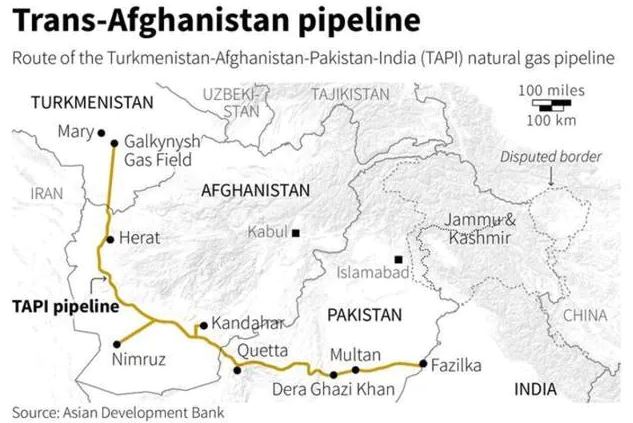
The Turkmenistan–Afghanistan–Pakistan–India (TAPI) Pipeline is a natural gas pipeline being developed with the participation of the Asian Development Bank.
It will be a 1,814km trans-country natural gas pipeline running across four countries.
It will transport natural gas from the Galkynysh Gas Field in Turkmenistan through Afghanistan into Pakistan and then to India.
The plan for the TAPI project was originally conceived in the 1990s to generate revenue from Turkmenistan’s gas reserves by exporting natural gas via Afghanistan to Pakistan and India.
Construction on the project started in Turkmenistan on 13 December 2015, work on the Afghan section began in February 2018, and work on the Pakistani section was planned to commence in December 2018.
Presently, the construction work has been stalled due to terror activities of Taliban in Afghanistan since few years.
Red Sanders (Red Sandalwood) has fallen back into the ‘endangered’ category in the International Union for Conservation of Nature’s (IUCN) Red List.
A recently released and trending Telugu movie plot provides a fictional account of red sandal smuggling.
About Red Sanders
The species, Pterocarpus santalinus, is an Indian endemic tree species, with a restricted geographical range in the Eastern Ghats.
It is endemic to a distinct tract of forests in Andhra Pradesh.
It is mainly found in Chittoor, Kadapa, Nandhyal, Nellore, Prakasam districts of Andhra Pradesh.
It was classified as ‘near threatened’ in 2018 and has now joined the ‘endangered’ list once again in 2021.
It is listed under Appendix II of CITES and is banned from international trade.
Status of legal protection in India
The Union Environment Ministry had decided to keep Red Sanders (red sandalwood) OUT of the Schedule VI of Wild Life Protection Act, 1972, arguing that this would discourage the cultivation of the rare plant species.
Schedule VI regulates and restricts the cultivation, possession, and sale of a rare plant species.
Significance of listing
It was a moment of celebration when the species was lifted off from the endangered category for the first time since 1997.
Over the last three generations, the species has experienced a population decline of 50-80 percent.
It is also scheduled in appendix II of the CITES and Wildlife Protection Act.
Threats to this species
Red Sanders are known for their rich hue and therapeutic properties, are high in demand across Asia, particularly in China and Japan.
They are used in cosmetics and medicinal products as well as for making furniture, woodcraft and musical instruments.
Its popularity can be gauged from the fact that a tonne of Red Sanders costs anything between Rs 50 lakh to Rs 1 crore in the international market.
Try this question from CSP 2016:
Q.With reference to ‘Red Sanders’, sometimes seen in the news, consider the following statements:
It is a tree species found in a part of South India.
It is one of the most important trees in the tropical rain forest areas of South India.
Which of the above statements is/are correct?
(a) 1 only
(b) 2 only
(c) Both 1 and 2
(d) Neither 1 nor 2
[wpdiscuz-feedback id=”wtga11jsfj” question=”Please leave a feedback on this” opened=”1″]Post your answers here.[/wpdiscuz-feedback]
Back2Basics: Red List Categories of IUCN
Species are classified by the IUCN Red List into nine groups specified through criteria such as rate of decline, population size, area of geographic distribution, and degree of population and distribution fragmentation. They are:
Extinct (EX) – beyond reasonable doubt that the species is no longer extant.
Extinct in the wild (EW) – survives only in captivity, cultivation and/or outside native range, as presumed after exhaustive surveys.
Critically endangered (CR) – in a particularly and extremely critical state.
Endangered (EN) – very high risk of extinction in the wild, meets any of criteria A to E for Endangered.
Vulnerable (VU) – meets one of the 5 red list criteria and thus considered to be at high risk of unnatural (human-caused) extinction without further human intervention.
Near threatened (NT) – close to being at high risk of extinction in the near future.
Least concern (LC) – unlikely to become extinct in the near future.
Delhi and most of the other non-attainment cities under the National Clean Air Programme (NCAP) have shown only a marginal improvement, said a new analysis released.
About NCAP
The NCAP was implemented across India in 2019 to reduce particulate matter levels in 132 cities by 20-30% in 2024.
Cities are declared non-attainment if they consistently fail to meet the National Ambient Air Quality Standards (NAAQS) over a five-year period.
What are NAAQ standards?
The mandate provided to the Central Pollution Control Board (CPCB) under the Air (Prevention and Control of Pollution) Act empowers it to set standards for the quality of air.
Hence the current National Ambient Air Quality Standards were notified in November 2009 by the CPCB.
Prior to this, India had set Air Quality standards in 1994, and this was later revised in 1998.
The 2009 standards further lowered the maximum permissible limits for pollutants and made the standards uniform across the nation.
Earlier, less stringent standards were prescribed for industrial zones as compared to residential areas.
Pollutants covered:
Sulphur Dioxide (SO2)
Nitrogen Dioxide (NO2),
Particulate Matter (size less than 10 µm) or PM 10
Particulate Matter (size less than 2.5 µm) or PM2.5
Around four lakh more acres have been brought under the Crop Insurance Scheme for the Samba Cultivation season of 2021-22 in Tamil Nadu.
What is Samba Cultivation?
It is a Tamil name for paddy cultivation season.
Other paddy seasons in Tamil Nadu include:
Kuruvai: June-July
Samba: August
Late Samba / Thaladi: September- October
Navarai: December- January
Back2Basics: Major crop seasons
(1) Kharif Crop
Kharif crops, monsoon crops, or autumn crops are cultivated and harvested in the monsoon season.
The farmers sow seeds at the beginning of the monsoon season and harvest them at the end of the season. i.e., between September and October.
Kharif crops need a lot of water and hot weather for proper growth.
Examples: Rice, Maize, Millet, Soybean, Arhar, Cotton. etc.
(2) Rabi Crop
Rabi means spring in Arabic. Crops grown in the winter season [October to December] and harvested in the spring season [Aril-May] are called Rabi crops.
These crops require a warm climate for germination and maturation of seeds and need a cold environment for their growth.
Rain in winter spoils the Rabi crop but is good for the Kharif crop.
Examples: Wheat, Gram, Barley, Peas, Oats, Chickpea, Linseed, Mustard, etc.
(3) Zaid Crop
Zaid crops are grown between Kharif and Rabi Seasons, i.e., between March to June.
They require warm, dry weather as a vital growth period and longer day length for flowering.
Zaid crop is significant for farmers as it gives fast cash to the farmers and is also known as gap-filler between two chief crops, Kharif and Rabi.
Everything that has a value in life is a product of consistency — Health, Fitness, Wealth, Relationships and Your UPSC Aspiration as well. Choosing consistency is better than chasing perfection. Nobody can be perfect, but everyone can stay consistent.
Choosing to be a UPSC Aspirant means you have signed up for a roller-coaster of emotions for a period of 1-2 years. Not all days are going to be the same, that is for sure. Some days you’re extremely motivated and positive, and on other days, you might find yourself questioning EVERYTHING about your preparation! It is absolutely normal. This is something extremely inevitable. Even the best of the toppers can have the worst days during the preparation phase simply because it is an extremely long and often a lonely process.
It’s fine to be inconsistent for a short while. Maybe a day or two in the initial phase. But don’t make it a habit. Regular inconsistency won’t fetch you the desired result. But what exactly is inconsistency?
What did Aspirants say made them Inconsistent 1-on-1 Free Counselling Session?
Last month, we had counselled about 4000 aspirants and found out the major reasons why are in inconsistent in their UPSC preparation. Here are few of the responses we received (we have withheld names to respect their privacy) —
1. “I am inconsistent because my thoughts don’t line up with my actions. I like the idea of being an IAS officer, but I am unable to study for it.”
2. “There are days when I brood about the competition and think do I really stand a chance? That’s what keeps me studying for many days together.”, shared another
3. “I am a working professional and I am unable to find time to study for weeks together.”
4. “I am unable to make a timetable that can do justice to both my pace and the vast syllabus of UPSC”
5. “This is my third attempt. The thought of repeating the same cycle of studies and reading those dreary books once again keeps me from staying consistent.”
6. “I feel burnt out. There are days I put in so much effort studying for UPSC that I won’t feel like the next day.”
7. “Social Media. I get distracted often.”
8. “The preparation makes me feel lonely. Sometimes I wish I had a well-wisher who could pull me out of my inconsistent ways.”
What we could understand from this is that self-doubt kills enthusiasm to prepare for UPSC. And fear of failure stops you from staying consistent. It’s important to inculcate consistency as a UPSC aspirant as consistency leads to habits. Habits lead to action and action makes you successful.
Inconsistency is the frenemy of every UPSC aspirant — they look like your friend at first, but they are your enemy in disguise. It doesn’t even let you achieve 10% of your actual potential. You know that you are capable of so many things if you stopped being inconsistent.
Keeping this in mind, we have launched our mentorship program this week. The highlight of our free 1-on-1 sessions would be to suggest ways that can help you stay focused during your long preparation journey for UPSC.
How does 1-on-1 Mentorship fights inconsistency in UPSC Preparation?
Our philosophy behind MENTORSHIP is to get you out of this Snooze cycle. This ensures that you are the BEST VERSION of yourself in this journey. If you are under the impression that mentorship is weekly calls you attend, then you are mistaken, my friend. Trust us, your mentor will be your ‘FRIEND, PHILOSOPHER AND GUIDE’.
TO EACH THEIR OWN – Every aspirant is different. Their strengths and weaknesses are different. Their time availability is also different. Identifying this is important so you don’t end up making unrealistic targets and lose momentum. Your mentor will make sure you start slow but remain consistent to build your confidence. Making your schedule structured based on our experience of working with 2500+ students is our first priority.
TRACK YOUR PROGRESS – When you see yourself grow, it becomes easier to motivate yourself to push boundaries. Tracking your progress can happen in many ways like mentorship calls or chat sessions or by regular tests. The idea is to ensure that you don’t go off track in your preparation, and even if you do, we have your back.
EVOLUTION – A constant guidance is important to bring consistency to your UPSC preparation. Guidance is not about clearing your doubts or asking you to study when you don’t. It is also about the evolution of your preparation. This is where you and your mentor work as a team. A constant effort to PLAN AND BUILD UP YOUR ABILITY to learn in a faster and more efficient way.RECEIVE PERSONAL GUIDANCE FOR UPSC (REGISTER HERE)
TALK IT OUT – The biggest hurdle in achieving your highest level of consistency is the emotional part. Every now and then, you. surround yourself with negative thoughts, you feel scared and depressed. Instead of resolving these emotional issues, you avoid them as it seems like a waste of your precious time. You have to understand that ignoring emotional troubles does not solve them. What your doing is building an emotional time bomb that may burst a week before your mains or prelims! This is where your MENTOR AS A FRIEND comes in. All our mentors have been through this journey. We understand your fears and anxieties. So, TALK IT OUT.
Don’t let inconsistency keep you away from your dreams.
Fill up the SAMANVAYA form given below. Let us know your problems and we will find a solution to it, just like our students say ” TOGETHER WE CAN AND WE WILL”.
How has Civilsdaily Mentorship, helped Aspirants become Toppers?
The most difficult challenge faced by EVERY candidate is inconsistency. Be it inconsistency in studies, answer-writing practice, covering the syllabus, or revision, every candidate finds it difficult to cope with. Buthow do successful candidates manage to FIGHT Inconsistency so consistently?
In UPSC 2020, Civilsdaily helped 80+ students secure ranks in their exams. In the top 100, every 3rd ranker was a Civilsdaily student.
A very recent success story would be Vishwa Shah, student of Civilsdaily Mentor, Sukanya Ma’am. Vishwa has cleared the GPSC exam to become the Deputy Superintendent of Police in Gujarat. He has penned a thank-you note yesterday. Heartiest Congratulations to Vishwa!
One of our other Civilsdaily Student, Shubham Nagargojecleared the exams in 2020 to become an IPS Officer. Shubham was gracious enough to let us know how he felt about Civilsdaily Samanvaya Guidance under Parth sir.
To know how all of them cleared the exam with our mentorship, visit the UnherdPodcast.
Now that results are announced for UPSC 2021 Prelims, out of 15 out of 25 students of Santhosh Gupta sir have been recommended to Mains. One such student, Rahul expresses his gratitude and extends his appreciation.
Most of our Mentors like Sudhanshu sir, Sajal sir, Santhosh sir, Pravin sir, Parth Verma sir and Sukanya Ma’am were UPSC aspirants themselves and have attended UPSC Mains more than five times and UPSC Interview more than twice. Hence their mentorship is always a blend of the best test series, comprehensive notes and current affairs knowledge.
All of them dedicate their time weekly to give 1-on-1 mentorship to every student where they discuss last week’s performance and next week’s approach.
Be it Telegram, Whatsapp or Habitiat channels, they are always available and clear student’s doubts in a turnaround time of 24 Hours.
Why Civilsdaily Mentors are the GPS for Your UPSC-CSE Preparation
Remember there is always light at the end of the tunnel and if you want to get out of the tunnel you have to follow the direction of the light! Our mentors’ give you direction which is divided into daily modules. All you have to do is study and complete them on time.
As every year passes by, we don’t get confident by the previous years’ performance and become laidback. Instead, we become more hungry to convert all our students into toppers.
How are Current Civilsdaily Students Gearing up for UPSC-CSE 2022?
Initially, our Civilsdaily student Smriti wasn’t confident about Prelims when she began her preparation. Though she had joined Civilsdaily in 2020, she started studying for UPSC-CSE back in 2019. At that time, Smriti had enrolled in multiple institutes. Though, most of these institutes had promised a personal mentor, she was unable to get in touch with them on a daily basis. Also those mentors never scheduled test-series on a weekly basis. Hence, despite preparing for a year, Smriti had scored only 35 marks out of 200 in her first test series by Civilsdaily.
She then started writing 20-25 test series over the course of UAP 2021 and in her last test, her scores have drastically improved. She now scores in the range of 130-135 marks in prelims’ and 110+ in mains’ papers.
In Smriti’s own words she describes her Samanvaya Mentorship Experience to be —
“Our parents provide us financial and emotional support, friends provide us moral support and the right mentor gives you logistic and logical support for UPSC. There are days when I felt I won’t be able to compete against lakhs of aspirants. That’s when my mentor, Ravi sir reminded me of my improvement and encouraged me that I can crack it with the same consistency. We need someone, who tells us we are performing well especially when we cannot see that ourselves. The mentorship at Civilsdaily helped me become mentally stronger as a person. In other institutes, mentors are allotted only for doubt resolution. But at Civilsdaily, I am getting end-to-end mentorship via value added notes, classes, test series and detailed evaluation.”
Similarly our another Civilsdaily student, Ashishsums up his Samanvaya experience with Civilsdaily mentor,Pravin Sir, “Because of Pravin sir’s support, I am able to understand a topic in lesser time.”
This is how Pravin sir evaluates Ashish’s Mains Test Series every week. After every test series evaluation, Pravin sir schedules a 1 hour call to discuss how Ashish can improve his marks and the sources he can refer for key topics.
It’s Your Turn Get the Free 40 Min Counselling Session By a CD Mentor
Civilsdaily mentors are so dedicated, consistent and focused for your UPSC goal, that you will eventually become focused into turning your dreams to reality.
At the core of Civilsdaily UPSC mentorship, lies the fact that each one of you will have a unique journey while preparing for the exam. Some will get through on the first attempt without much effort while others will take both more time and more effort.
We want to understand you better to help you optimize your journey so you can focus on the right things and not waste time on the wrong ones. We are asking you to tap into the valuable experiences of mentors who underwent the same grind and realize the pitfalls and understand the shortcuts to make it.
In the first counselling session, we will understand your weaknesses. We then help you to stick to one plan or strategy throughout your preparation. We will then follow up with you on a daily basis to check if you are right on track. To get an idea of how your 1st 1-on-1 mentorship will look like, watch this sample video —
The surge in demand for gig workers, particularly in the shared services and logistics segments, in the aftermath of the Covid-19 pandemic led to mushrooming of job discovery platforms.
What is the gig economy?
In a gig economy, temporary, flexible jobs are commonplace and companies tend toward hiring independent contractors and freelancers instead of full-time employees.
A gig economy undermines the traditional economy of full-time workers who rarely change positions and instead focus on a lifetime career. e.g Employee models of Uber, Ola, Swiggy etc
In this economy, tech-enabled platforms connect the consumer to the gig worker to hire services on a short-term basis. Gig workers include self-employed, freelancers, independent contributors and part-time workers.
This project-based gig economy allows the service adopter to cut overhead costs, and the gig worker to get paid for a specific task performed instead of receiving a fixed salary.
The gig economy can benefit workers, businesses, and consumers by making work more adaptable to the needs of the moment and demand for flexible lifestyles.
At the same time, the gig economy can have downsides due to the erosion of traditional economic relationships between workers, businesses, and clients.
Sectors such as media, real estate, legal, hospitality, technology-help, management, medicine, allied and education are already operating in gig culture.
Is Gig economy a new concept?
The ‘Gig concept’ is very common in advanced countries like the US, Europe, who hire part time workers.
With freelancing evolving into the Gig Economy, the concept is attracting a lot of people in India as well.
Gig economy is remunerative and gives a wide range of choices but it also leads to casualization of the labor.
Trends in Gig Economy
The digital gig economy generated a gross volume of approximately $204 bn from worldwide customers in 2018. Transportation-based services contributed to over 50% of this value.
The size of the gig economy is projected to grow by a 17% CAGR and generate a gross volume of ~$455 bn by 2023.
Digital platforms have emerged as enablers for employment creation with the power to easily discover job seekers and job providers in the absence of middlemen.
Due to the rapid developments in technology, the transaction cost for outsourcing non-core activities is reducing and facilitating an increase in the number of tasks which can be performed by each worker.
Thus, firms are shrinking in size and we are witnessing a rise in start-ups which are outsourcing many activities to expert service providers on a contractual basis.
While the gig economy is popular amongst the blue-collar workers in India, there is now huge potential for the white-collar workers as well, due to increasing demand in industries – project-specific consultants, logo/content design, web design etc.
The gig economy is expanding from less skilled services to more skilled jobs.
Gig Economy in India
The COVID-19 pandemic-induced remote working has blurred the age-old skepticism over the efficiency and dependability of contractual or part-time employees, with companies increasingly looking to hire gig workers.
As per a report by ASSOCHAM, India’s gig sector is expected to increase to US$455 billion at a CAGR of 17% by 2024 and has the potential to expand at least 2x the pre-pandemic estimates.
India has emerged as the 5th largest country for flexi-staffing after US, China, Brazil and Japan.
Haryana, Madhya Pradesh, Andhra Pradesh, Gujarat and Telangana have most opportunities in terms of growth for the flexi-workers.
In another estimate, India is likely to have 350 million gig jobs by 2025, presenting a huge opportunity for job seekers to capitalize and adapt to the changing work dynamics.
At present, India has a pool of ~15 million freelance workers staffed in projects across IT, HR and designing. In addition, India’s workforce is growing by ~4 million people annually.
And as most of them are young millennials, they are showing an increasing preference for gig contracts. This trend is expected to significantly impact gig economy in the near future.
Key Drivers for Gig Economy
(1) Unconventional work approach by millennials
Hectic lifestyles of employees in private sectors have created a negative perception of full-time employment among millennials.
Factors such as growth opportunities, flexibility, better work-life balance and option to not acquire a college degree are encouraging millennials to opt for freelancing opportunities as opposed to corporate work culture.
(2) Emergence of a start-up culture
The start-up ecosystem in India has been developing rapidly. For start-ups, hiring full-time employees leads to high fixed costs and therefore, contractual freelancers are hired for non-core activities.
Start-ups are also looking at hiring skilled technology freelancers (on a per project basis) in areas such as engineering, product, data science and ML to bolster their tech platforms.
(3) MNCs are hiring contractual employees
MNCs are adopting flexi-hiring options, especially for niche projects, to reduce operational expenses after the pandemic. This trend is significantly contributing to the gig culture in India.
(4) Rise in freelancing platforms
Rise in freelancing platforms has also aided in the development of the gig economy. Many home-grown platforms such as Upwork, Truelancer and Guru provide access to high-skilled freelancers.
The number of freelancing platforms has significantly increased—from 80 in 2009 to 330 in 2021. These platforms boast of a clientele comprising not only start-ups, but also Fortune 500 companies.
(5) Business Models
Gig employees work on various compensation models such as fixed-fee (decided during contract initiation), time & effort, actual unit of work delivered and quality of outcome.
The fixed-fee model is the most prevalent; however, time & effort model comes a close second.
(6) Impact of Covid-19
According to the survey, India stands to lose ~135 million jobs because of the pandemic and this is likely to push the full-time workforce towards the gig economy.
Moreover, many laid-off employees are focusing on developing skills to avail freelance job opportunities and become a part of this burgeoning economy.
Why is Gig Economy preferred by workers?
One can work on freelancing as well as work full-time somewhere else. Hence it is profitable to the worker as he can hit two targets together and multitask.
It is very beneficial for women who work on this concept when they cannot continue their work or take a break from career due to marriage or child birth.
Retired people can stay active after retirement as this will keep them engaged away from loneliness and depression and can earn as well on their own rather than depending on their children or pensions.
It offers flexibility and diversity to the workers. It offers flexibility when workers can work according to their convenience and schedule rather than routine like in full-time jobs.
The travel costs and energy to travel to the workplace is reduced.
Why is Gig Economy preferred by Employers?
The efficiency, efficacy and productivity of workers in gig economy are much more than that of a stable full-time job.
More Economical for employers – When employment givers can’t afford to hire full-time workers, they hire people for specific projects and pay them.
Start-up companies and entrepreneurs – who do not have big financial space – can grow only if they can leverage the services of contract employees or freelancers.
In a gig economy, businesses save resources in terms of benefits, office space and training. (Reference – Whatis)
Competition and efficiency among workers improved.
Challenges faced in Gig economy
There are no labour welfare emoluments like pension, gratuity, etc. for the workers.
Gig workers may face unfair termination. They may also attain minimum wages and less paid leave.
Workers do not have the bargaining power to negotiate a fair deal with their employers.
Unionization of workers will be difficult.
Confidentiality of documents etc of the workplace is not guaranteed
The gig economy is not accessible for people in many rural areas where internet connectivity and electricity is unavailable.
The social welfare objectives can be neglected if business and profitable avenues of freelancing are prioritized.
What are the major impacts of the gig economy?
Gig economy companies had introduced innovative systems and methods to the labour market. These methods are offering workers flexibility and the freedom to choose how and when they work.
But this chaotic and amoebic environment has helped create an environment of exploitation where workers get minimal protection and low wages.
A government study in the UK recently established that a quarter of the people working in the country’s gig economy are being paid below the national minimum wage.
As most of the gig economy companies act as an aggregator and digital companies, their interaction with the labourers and customers is minimal.
Gig Economy and the women empowerment
The women are considerably placed in a victimised position in the workplace. The flexibility that the gig economy offers women help to come out of the shackles of the male domination.
The financial independence is often considered as the first step towards the women empowerment. The labour of the women will be valued and paid worth for.
Rise and participation of the women in the job market would help in improving the indicators where women participation is considered the least and they will occupy roles as the decision makers.
But women due to lack of certain options are forced to perform the dual responsibility of work and home.
Dual exploitation faced as they are sandwiched between the familial and professional responsibilities where they have to forego their professional lives.
Code on Social Security 2019
To aid gig workers, the govt passed the ‘Code on Social Security’, which will provide workers with life and disability cover, accidental insurance, health & maternity benefits old age protection and others.
Under this code, the central and state governments will primarily fund social security measures, with a nominal contribution (1-2% of their annual turnover) by the aggregator.
Also, the contribution made by the aggregator/platform will not exceed 5% of the amount payable to gig and platform workers.
In addition, the code proposed to establish a ‘National Social Security Board’, which will supervise and formulate schemes for the well-being of gig and platform workers.
Way Forward
The gig economy has been on the rise and is expected to beat the pre-pandemic estimates due the expected influx of gig workers transitioning from full-time employment.
While the government has taken the initial steps to ensure social security of gig workers, the ‘Code on Social Security’ needs to be fine-tuned.
Further, all platform workers should be offered mandatory coverage under the Bharat Pradhan Mantri Jan Arogya Yojana, Pradhan Mantri Suraksha Bima Yojana and Pradhan Mantri Jeevan Jyoti Bima Yojana.
This can be facilitated through the employer companies and will ensure employee protection; thus, guaranteeing a sustainable gig economy.
There should be revamped of employee policy assessments and evaluations. An effective evaluation process is required to ensure consistent and quality work, where customized assessment procedures need to be developed.
India should learn from developed countries like the US and basic training and courses on freelancing, etc. should be provided to people.
Career Avenues, choices, counselling should be available to students and workers on gig economy.
Companies will also need a human resource department that can manage a diverse workforce and imbue the company’s culture into gig workers.
The report of the Standing Committee on External Affairs on ‘India and bilateral investment treaties (BITs)’ was presented to Parliament last month.
Factor’s that necessitated the review of India’s BITs
Investor’s started suing India frequently: Since 2011, when India lost its first investment treaty claim in White Industries v. India, foreign investors have sued India around 20 times for alleged BIT breaches.
This made India the 10th most frequent respondent-state globally in terms of investor-state dispute settlement (ISDS) claims from 1987 to 2019 (UNCTAD).
Adoption of new Model BIT: India adopted a new Model BIT in 2016, which marked a significant departure from its previous treaty practice.
Negotiating new BITs: India is in the process of negotiating new investment deals (separately or as part of free trade agreements) with important countries such as Australia and the U.K.
Recommendations of the Committee
1] Speed of the existing negotiations: India has signed very few investment treaties after the adoption of the Model BIT.
It recommends that India expedite the existing negotiations and conclude the agreements at the earliest because a delay might adversely impact foreign investment.
2] Sign more BIT’s in core sector: The committee recommends that India should sign more BITs in core or priority sectors to attract FDI.
Generally, BITs are not signed for specific sectors.
It will require an overhauling of India’s extant treaty practice that focuses on safeguarding certain kinds of regulatory measures from ISDS claims rather than limiting BITs to specific sectors.
3] Fine-tune Model BIT: Model BIT gives precedence to the state’s regulatory interests over the rights of foreign investors.
The Model BIT should be recalibrated keeping two factors in mind:
a) tightening the language of the existing provisions to circumscribe the discretion of ISDS arbitral tribunals.
b) striking a balance between the goals of investment protection and the state’s right to adopt bonafide regulatory measures for public welfare.
4] Improve the capacity of government officials: The committee recommends bolstering the capacity of government officials in the area of investment treaty arbitration.
While the government has taken some steps in this direction through a few training workshops, more needs to be done.
What is needed is an institutionalised mechanism for capacity-building through the involvement of public and private universities.
The government should also consider establishing chairs in universities to foster research and teaching activities in international investment law.
Need to improve poor governance
A very large proportion of ISDS claims against India is due to poor governance.
This includes changing laws retroactively which led to Vodafone and Cairn suing India.
Annulling agreement in the wake of imagined scam which resulted in taking away S-band satellite spectrum from Devas.
The judiciary’s fragility in getting its act together (sitting on the White Industries case for enforcement of its commercial award for years).
Suggestions
The Committee could have emphasised on greater regulatory coherence, policy stability, and robust governance structures to avoid ISDS claims.
The government should promptly assemble an expert team to review the Model BIT.
Consider the question “India is one of the most frequent respondent-state globally in terms of investor-state dispute settlement (ISDS) claims. In context of this, examine the reasons for such frequent disputes and suggest the way forward.”
Conclusion
The committee’s report on India’s BITs have novel suggestions, but it is lacking in several aspects.
Investor-state dispute settlement (ISDS) is a mechanism in a free trade agreement (FTA) or investment treaty that provides foreign investors, with the right to access an international tribunal to resolve investment disputes.
ISDS promotes investor confidence and can protect against sovereign or political risk.
If a country does not uphold its investment obligations, an investor can have their claim determined by an independent arbitral tribunal, usually comprising three arbitrators.
When Prime Minister Narendra Modi hosts the five Central Asia leaders at the Republic Day Parade on January 26, it will send a strong signal — of the new prominence of the Central Asian region in India’s security calculations.
Why India needs effective continental policy
Factors intensifying geopolitical competition: China’s assertive rise, withdrawal of forces of the United States/North Atlantic Treaty Organization (NATO) from Afghanistan, the rise of Islamic fundamentalist forces, the changing dynamics of the historic stabilising role of Russia (most recently in Kazakhstan) and related multilateral mechanisms — the Shanghai Cooperation Organization (SCO), the Collective Security Treaty Organisation, and the Eurasian Economic Union — have all set the stage for a sharpening of the geopolitical competition on the Eurasian landmass.
Progress in ties: India’s continental strategy, in which the Central Asian region is an indispensable link, has progressed intermittently over the past two decades — promoting connectivity, incipient defence and security cooperation, enhancing India’s soft power and boosting trade and investment.
It is laudable, but as is now apparent, it is insufficient to address the broader geopolitical challenges engulfing the region.
To meet this challenge, evolving an effective continental strategy for India will be a complex and long-term exercise.
Leveraging maritime power
India’s maritime vision and ambitions have grown dramatically during the past decade, symbolised by its National Maritime Strategy, the Security and Growth for All in the Region (SAGAR) and major initiatives relating to the Indo-Pacific and the Quad, in which maritime security figures prominently.
It was also a response to the dramatic rise of China as a military power.
Importance: Maritime security is important to keeping sea lanes open for trade, commerce and freedom of navigation, resisting Chinese territorial aggrandisement in the South China Sea and elsewhere, and helping littoral states resist Chinese bullying tactics in interstate relations.
However, maritime security and associated dimensions of naval power are not sufficient instruments of statecraft as India seeks diplomatic and security constructs to strengthen deterrence against Chinese unilateral actions and the emergence of a unipolar Asia.
Bulwarks against Chinese maritime expansionist gains are relatively easier to build and its gains easier to reverse than the long-term strategic gains that China hopes to secure on continental Eurasia.
Centrality of Central Asia: Like Association of Southeast Asian Nations (ASEAN) centrality is key to the Indo-Pacific, centrality of the Central Asian states should be key for Eurasia.
Challenges for India
1] Connectivity challenge
Connectivity means nothing when access is denied through persistent neighbouring state hostility contrary to the canons of international law.
India has been subject for over five decades to a land embargo by Pakistan that has few parallels in relations between two states that are technically not at war.
Lack of alternative route: Difficulties have arisen in operationalising an alternative route — the International North-South Transport Corridor on account of the U.S.’s hostile attitude towards Iran.
With the recent Afghan developments, India’s physical connectivity challenges with Eurasia have only become harder.
The marginalisation of India on the Eurasian continent in terms of connectivity must be reversed.
2] India must be aware of the limitations of the US
The ongoing U.S.-Russia confrontation relating to Ukraine, Russian opposition to future NATO expansion and the broader questions of European security including on the issue of new deployment of intermediate-range missiles, following the demise of the Intermediate-Range Nuclear Forces (INF) treaty will have profound consequences for Eurasian security.
The U.S. would be severely stretched if it wanted to simultaneously increase its force levels in Europe and the Indo-Pacific.
A major conflict — if it erupts in Central Europe, pitting Russia, Ukraine and some European states — will stall any hopes of a substantial U.S. military pivot to the Indo-Pacific.
India should be cognisant of the limitations of geography, obvious gaps between strategic ambition and capacity but also the inherently different standpoints of how major maritime powers view critical questions of continental security.
India is unique as no other peer country has the same severity of challenges on both the continental and maritime dimensions.
Way forward for India
India would need to acquire strategic vision and deploy the necessary resources to pursue our continental interests without ignoring our interests in the maritime domain.
This will require a more assertive push for our continental rights — namely that of transit and access, working with our partners in Central Asia, with Iran and Russia, and a more proactive engagement with economic and security agendas ranging from the SCO, Eurasian Economic Union (EAEU) and the Collective Security Treaty Organization (CSTO).
Striking the right balance between continental and maritime security would be the best guarantor of our long-term security interests.
Conclusion
India will need to define its own parameters of continental and maritime security consistent with its own interests. In doing so, at a time of major geopolitical change, maintaining our capacity for independent thought and action will help our diplomacy and statecraft navigate the difficult landscape and the choppy waters that lie ahead.