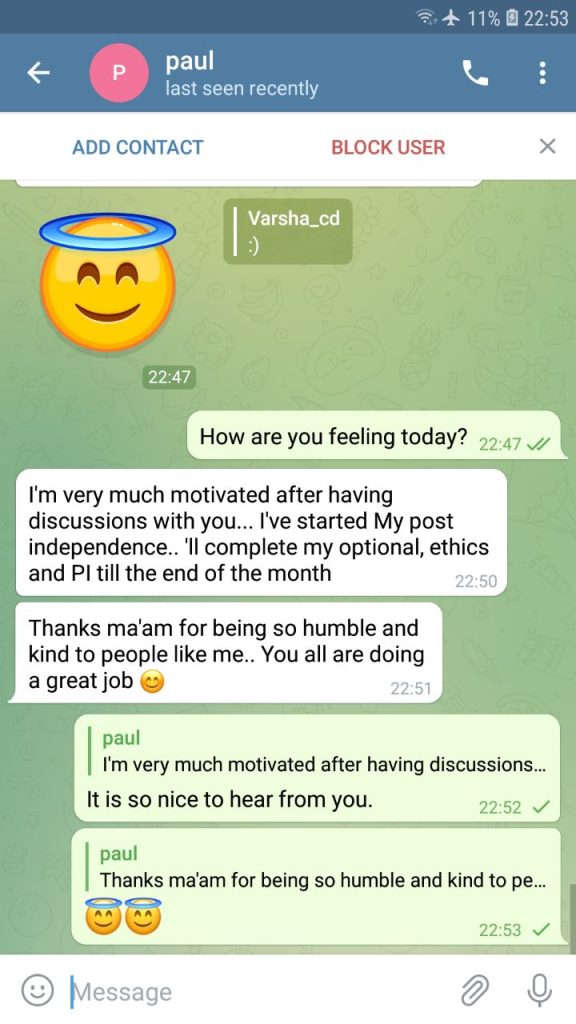
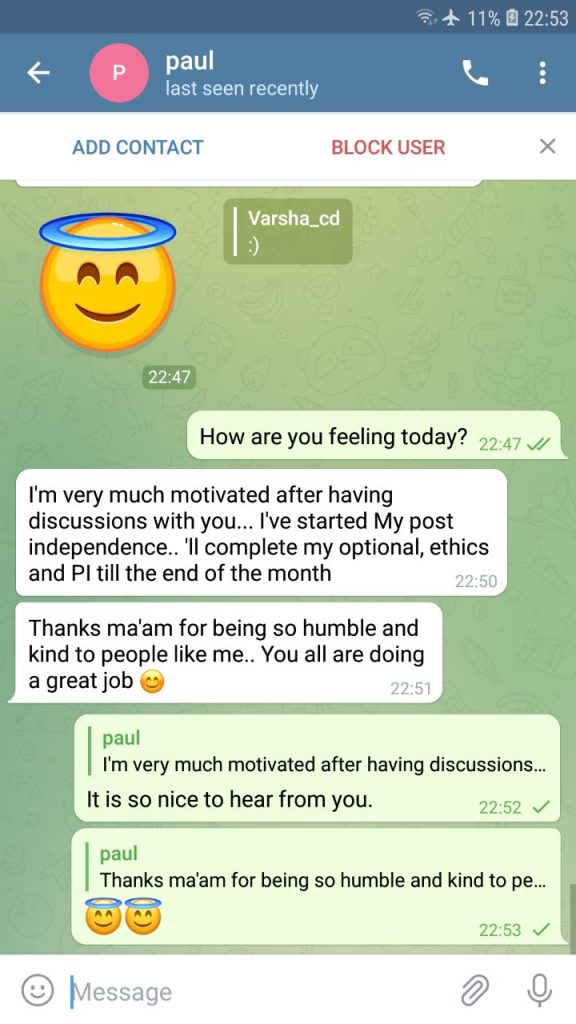
Group Studies for UPSC-CSE has it’s pros and cons. At it’s best, you are exposed to highly competitive and helpful aspirants who will share their knowledge and resources with you. You also get to discuss and debate on important current affairs issues with like-minded peers. When everyone transparently shares their marks, you get motivated to perform better. You will also understand easy ways to complete your preparation from another person.
But, many a times this ideal is not achieved and group studies initiatives fail. This is because there is no one to lead the group and provide a structured agenda for everyone to follow. Every aspirant is busy, wrapped up in their own schedule that they don’t meet up often.
At Civilsdaily, we are bridging this gap and turning the ideal to reality. Our mentors lead the telegram channels and give a direction for all aspirants to contribute. Doubts are resolved, notes are shared, timetable is laid out for everyone to complete.
Are you finding Current Affairs for UPSC-CSE to be a time-consuming affair? Do you either spend the entire day reading only current affairs or skip reading it for many days? Is there a lack of clarity while answering current affairs questions? Do you want to know the right approach to prepare for UPSC-CSE Current affairs without wasting time on trial and error? Then it’s time you filled the Samanvaya form for free 1-on-1 counselling session with an experienced faculty from Civilsdaily!
Current Affairs for UPSC-CSE doesn’t only test an aspirant’s basic understanding, but their ability to critically analyze and remember certain very important details. It requires you to do match the following — you need to match the topic in your UPSC syllabus with the current affairs as you read. For example, India has placed an anti-dumping duty recently on China to protect it’s local manufacturers from cheap imports. This news is related to GS 3 Economics and comes under Foreign Trade topic.
But that’s not all. Current Affairs is the key component that you cannot do without in all the 3 stages of your UPSC-CSE preparation — Prelims, Mains and Interview. And the way you are supposed to prepare for current affairs under each stage varies. You have to remember facts for Prelims, understand the background, challenges and the solutions of current events for Mains and for Interview you should be able to drive meaningful discussions with your current affairs knowledge. Hence, simply reading a newspaper cannot help you ace current affairs for UPSC-CSE.
Unlike popular notion, importance of current affairs isn’t decreasing in UPSC-CSE papers. Rather, it’s become a part and parcel of every topic in the Core Subjects like Economy, Polity, Science and Environment. Let’s understand this with a question asked in UPSC-CSE Mains 2020 —
Which steps are required for constitutionalization of a commission? Do you think imparting constitutionality to the National Commission for Women would ensure greater gender justice and empowerment in India? Give reasons.
This question needs you to have current knowledge on government policies/interventions, constitutional and non-constitutional bodies, constitutional provisions and issues related to developmental and management of social sectors. That’s totally 4 topics for one answer!
Remembering current affairs indices for Prelims MCQs & using them to substantiate answers in Mains is crucial to get marks above cut-off.
Why Samanvaya for UPSC-CSE Current Affairs Preparation?
In UPSC 2020, Civilsdaily helped 80+ students secure ranks in their exams. In the top 100, every 3rd ranker was a Civilsdaily student.
A very recent success story would be Vishwa Shah, student of Civilsdaily Mentor, Sukanya Ma’am. Vishwa has cleared the GPSC exam to become the Deputy Superintendent of Police in Gujarat. He has penned a thank-you note yesterday. Heartiest Congratulations to Vishwa!
One of our other Civilsdaily Student, Shubham Nagargojecleared the exams in 2020 to become an IPS Officer. Shubham was gracious enough to let us know how he felt about Civilsdaily Samanvaya Guidance under Parth sir.
To know how all of them cleared the exam with our mentorship, visit the UnherdPodcast.
Now that results are announced for UPSC 2021 Prelims, out of 15 out of 25 students of Santhosh Gupta sir have been recommended to Mains. One such student, Rahul expresses his gratitude and extends his appreciation.
Most of our Mentors like Sudhanshu sir, Sajal sir, Santhosh sir, Pravin sir, Parth Verma sir and Sukanya Ma’am were UPSC aspirants themselves and have attended UPSC Mains more than five times and UPSC Interview more than twice. Hence their mentorship is always a blend of the best test series, comprehensive notes and current affairs knowledge.
All of them dedicate their time weekly to give 1-on-1 mentorship to every student where they discuss last week’s performance and next week’s approach.
Be it Telegram, Whatsapp or Habitiat channels, they are always available and clear student’s doubts in a turnaround time of 24 Hours.
Why Civilsdaily Mentors are the GPS for Your UPSC-CSE Preparation
Remember there is always light at the end of the tunnel and if you want to get out of the tunnel you have to follow the direction of the light! Our mentors’ give you direction which is divided into daily modules. All you have to do is study and complete them on time.
As every year passes by, we don’t get confident by the previous years’ performance and become laidback. Instead, we become more hungry to convert all our students into toppers.
How are Current Civilsdaily Students Gearing up for UPSC-CSE 2022?
Initially, our Civilsdaily student Smriti wasn’t confident about Prelims when she began her preparation. Though she had joined Civilsdaily in 2020, she started studying for UPSC-CSE back in 2019. At that time, Smriti had enrolled in multiple institutes. Though, most of these institutes had promised a personal mentor, she was unable to get in touch with them on a daily basis. Also those mentors never scheduled test-series on a weekly basis. Hence, despite preparing for a year, Smriti had scored only 35 marks out of 200 in her first test series by Civilsdaily.
She then started writing 20-25 test series over the course of UAP 2021 and in her last test, her scores have drastically improved. She now scores in the range of 130-135 marks in prelims’ and 110+ in mains’ papers.
In Smriti’s own words she describes her Samanvaya Mentorship Experience to be —
“Our parents provide us financial and emotional support, friends provide us moral support and the right mentor gives you logistic and logical support for UPSC. There are days when I felt I won’t be able to compete against lakhs of aspirants. That’s when my mentor, Ravi sir reminded me of my improvement and encouraged me that I can crack it with the same consistency. We need someone, who tells us we are performing well especially when we cannot see that ourselves. The mentorship at Civilsdaily helped me become mentally stronger as a person. In other institutes, mentors are allotted only for doubt resolution. But at Civilsdaily, I am getting end-to-end mentorship via value added notes, classes, test series and detailed evaluation.”
Similarly our another Civilsdaily student, Ashishsums up his Samanvaya experience with Civilsdaily mentor,Pravin Sir, “Because of Pravin sir’s support, I am able to understand a topic in lesser time.”
This is how Pravin sir evaluates Ashish’s Mains Test Series every week. After every test series evaluation, Pravin sir schedules a 1 hour call to discuss how Ashish can improve his marks and the sources he can refer for key topics.
It’s Your Turn Get the Free 40 Min Counselling Session By a CD Mentor
At the core of Samanvaya lies the fact that each one of you will have a unique journey while preparing for the exam. Some will get through on the first attempt without much effort while others will take both more time and more effort.
We want to understand you better to help you optimize your journey so you can focus on the right things and not waste time on the wrong ones. We are asking you to tap into the valuable experiences of mentors who underwent the same grind and realize the pitfalls and understand the shortcuts to make it.
In the first counselling session, we will understand your weaknesses. Over 80% of students who claimed to have revised NCERTs twice were unable to answer basic questions. Many were not comfortable with at least 1 GS subject and Optional. Many struggled with ‘What went wrong’ after 2-3 years of hard work. Our mentors will provide free preliminary assignments so that we can assess your preparedness and suggest accurate strategies. We then help you to stick to one plan or strategy throughout your preparation.
Are you finding Current Affairs for UPSC-CSE to be a time-consuming affair? Do you either spend the entire day reading only current affairs or skip reading it for many days? Is there a lack of clarity while answering current affairs questions? Do you want to know the right approach to prepare for UPSC-CSE Current affairs without wasting time on trial and error? Then it’s time you filled the Samanvaya form for free 1-on-1 counselling session with an experienced faculty from Civilsdaily!
Current Affairs for UPSC-CSE doesn’t only test an aspirant’s basic understanding, but their ability to critically analyze and remember certain very important details. It requires you to do match the following — you need to match the topic in your UPSC syllabus with the current affairs as you read. For example, India has placed an anti-dumping duty recently on China to protect it’s local manufacturers from cheap imports. This news is related to GS 3 Economics and comes under Foreign Trade topic.
But that’s not all. Current Affairs is the key component that you cannot do without in all the 3 stages of your UPSC-CSE preparation — Prelims, Mains and Interview. And the way you are supposed to prepare for current affairs under each stage varies. You have to remember facts for Prelims, understand the background, challenges and the solutions of current events for Mains and for Interview you should be able to drive meaningful discussions with your current affairs knowledge. Hence, simply reading a newspaper cannot help you ace current affairs for UPSC-CSE.
Unlike popular notion, importance of current affairs isn’t decreasing in UPSC-CSE papers. Rather, it’s become a part and parcel of every topic in the Core Subjects like Economy, Polity, Science and Environment. Let’s understand this with a question asked in UPSC-CSE Mains 2020 —
Which steps are required for constitutionalization of a commission? Do you think imparting constitutionality to the National Commission for Women would ensure greater gender justice and empowerment in India? Give reasons.
This question needs you to have current knowledge on government policies/interventions, constitutional and non-constitutional bodies, constitutional provisions and issues related to developmental and management of social sectors. That’s totally 4 topics for one answer!
Remembering current affairs indices for Prelims MCQs & using them to substantiate answers in Mains is crucial to get marks above cut-off.
Why Samanvaya for UPSC-CSE Current Affairs Preparation?
In UPSC 2020, Civilsdaily helped 80+ students secure ranks in their exams. In the top 100, every 3rd ranker was a Civilsdaily student.
A very recent success story would be Vishwa Shah, student of Civilsdaily Mentor, Sukanya Ma’am. Vishwa has cleared the GPSC exam to become the Deputy Superintendent of Police in Gujarat. He has penned a thank-you note yesterday. Heartiest Congratulations to Vishwa!
One of our other Civilsdaily Student, Shubham Nagargojecleared the exams in 2020 to become an IPS Officer. Shubham was gracious enough to let us know how he felt about Civilsdaily Samanvaya Guidance under Parth sir.
To know how all of them cleared the exam with our mentorship, visit the UnherdPodcast.
Now that results are announced for UPSC 2021 Prelims, out of 15 out of 25 students of Santhosh Gupta sir have been recommended to Mains. One such student, Rahul expresses his gratitude and extends his appreciation.
Most of our Mentors like Sudhanshu sir, Sajal sir, Santhosh sir, Pravin sir, Parth Verma sir and Sukanya Ma’am were UPSC aspirants themselves and have attended UPSC Mains more than five times and UPSC Interview more than twice. Hence their mentorship is always a blend of the best test series, comprehensive notes and current affairs knowledge.
All of them dedicate their time weekly to give 1-on-1 mentorship to every student where they discuss last week’s performance and next week’s approach.
Be it Telegram, Whatsapp or Habitiat channels, they are always available and clear student’s doubts in a turnaround time of 24 Hours.
Why Civilsdaily Mentors are the GPS for Your UPSC-CSE Preparation
Remember there is always light at the end of the tunnel and if you want to get out of the tunnel you have to follow the direction of the light! Our mentors’ give you direction which is divided into daily modules. All you have to do is study and complete them on time.
As every year passes by, we don’t get confident by the previous years’ performance and become laidback. Instead, we become more hungry to convert all our students into toppers.
How are Current Civilsdaily Students Gearing up for UPSC-CSE 2022?
Initially, our Civilsdaily student Smriti wasn’t confident about Prelims when she began her preparation. Though she had joined Civilsdaily in 2020, she started studying for UPSC-CSE back in 2019. At that time, Smriti had enrolled in multiple institutes. Though, most of these institutes had promised a personal mentor, she was unable to get in touch with them on a daily basis. Also those mentors never scheduled test-series on a weekly basis. Hence, despite preparing for a year, Smriti had scored only 35 marks out of 200 in her first test series by Civilsdaily.
She then started writing 20-25 test series over the course of UAP 2021 and in her last test, her scores have drastically improved. She now scores in the range of 130-135 marks in prelims’ and 110+ in mains’ papers.
In Smriti’s own words she describes her Samanvaya Mentorship Experience to be —
“Our parents provide us financial and emotional support, friends provide us moral support and the right mentor gives you logistic and logical support for UPSC. There are days when I felt I won’t be able to compete against lakhs of aspirants. That’s when my mentor, Ravi sir reminded me of my improvement and encouraged me that I can crack it with the same consistency. We need someone, who tells us we are performing well especially when we cannot see that ourselves. The mentorship at Civilsdaily helped me become mentally stronger as a person. In other institutes, mentors are allotted only for doubt resolution. But at Civilsdaily, I am getting end-to-end mentorship via value added notes, classes, test series and detailed evaluation.”
Similarly our another Civilsdaily student, Ashishsums up his Samanvaya experience with Civilsdaily mentor,Pravin Sir, “Because of Pravin sir’s support, I am able to understand a topic in lesser time.”
This is how Pravin sir evaluates Ashish’s Mains Test Series every week. After every test series evaluation, Pravin sir schedules a 1 hour call to discuss how Ashish can improve his marks and the sources he can refer for key topics.
It’s Your Turn Get the Free 40 Min Counselling Session By a CD Mentor
At the core of Samanvaya lies the fact that each one of you will have a unique journey while preparing for the exam. Some will get through on the first attempt without much effort while others will take both more time and more effort.
We want to understand you better to help you optimize your journey so you can focus on the right things and not waste time on the wrong ones. We are asking you to tap into the valuable experiences of mentors who underwent the same grind and realize the pitfalls and understand the shortcuts to make it.
In the first counselling session, we will understand your weaknesses. Over 80% of students who claimed to have revised NCERTs twice were unable to answer basic questions. Many were not comfortable with at least 1 GS subject and Optional. Many struggled with ‘What went wrong’ after 2-3 years of hard work. Our mentors will provide free preliminary assignments so that we can assess your preparedness and suggest accurate strategies. We then help you to stick to one plan or strategy throughout your preparation.
China’s Ministry of Civil Affairs has issued standardized names for 15 places in the Indian State of Arunachal Pradesh, to be used henceforth on official Chinese maps.
MEA clarification
The Ministry of External Affairs has dismissed the Chinese “invention”.
Arunachal Pradesh has always been, and will always be, an integral part of India, said MEA.
Why is China giving names to places that are in India?
China claims some 90,000 sq km of Arunachal Pradesh as its territory.
It calls the area “Zangnan” in the Chinese language and makes repeated references to “South Tibet”.
Chinese maps show Arunachal Pradesh as part of China, and sometimes parenthetically refer to it as “so-called Arunachal Pradesh”.
China makes periodic efforts to underline this unilateral claim to Indian territory.
Giving Chinese names to places in Arunachal Pradesh is part of that effort.
Earlier unilateral renamings
This is the second lot of “standardized” names of places in Arunachal Pradesh that China has announced.
Earlier in 2017, it had issued “official” Chinese names for six places spanning the breadth of Arunachal Pradesh
What is China’s argument for claiming these areas?
The PRC disputes the legal status of the McMahon Line, the official boundary under the ‘Convention Between Great Britain, China, and Tibet’ — of 1914 (Simla Convention).
China was represented at the Simla Convention by a plenipotentiary of the Republic of China, which had been declared in 1912 after the Qing dynasty was overthrown.
The present communist government came to power only in 1949, when the People’s Republic was proclaimed.
The Chinese representative did not consent to the Simla Convention, saying Tibet had no independent authority to enter into international agreements.
What is the McMohan Line?
The McMohan Line, named after Henry McMahon, the chief British negotiator at Shimla, was drawn from the eastern border of Bhutan to the Isu Razi pass on the China-Myanmar border.
China claims territory to the south of the McMahon Line, lying in Arunachal Pradesh.
China also bases its claims on the historical ties that have existed between the monasteries in Tawang and Lhasa.
Intention behind these renamings
This renaming is a part of the Chinese strategy to assert its territorial claims over Indian territory.
As part of this strategy, China routinely issues statements of outrage whenever an Indian dignitary visits Arunachal Pradesh.
Beijing keeps harping on its “consistent” and “clear” position that the Indian possession of Arunachal Pradesh.
These claims have been firmly established and recognized by the world, as “illegal”.
Arunachal not all-alone
Laying aggressive claims to territories on the basis of alleged historical injustices done to China is a part of Beijing’s foreign policy playbook.
The claim on Taiwan is one such example, as are the consistent efforts to change the “facts on the ground” in several disputed islands in the South China Sea.
The aggression is at all times backed in overt and covert ways by the use of China’s economic and military muscle.
Hours before the new GST rate was to take effect, the GST Council has decided to temporarily roll back the increase in tax rate for the textiles sector.
What was the proposal?
The GST Council had recommended making certain rate changes for footwear and textiles to correct the inverted duty structure.
What is Inverted Duty Structure?
An inverted duty structure arises when the taxes on output or final product is lower than the taxes on inputs.
This creates an inverse accumulation of input tax credit which in most cases has to be refunded.
A loss for the govt
Inverted duty structure has implied a stream of revenue outflow for the government prompting the government to relook the duty structure.
For footwear, the government refunds around Rs 2,000 crore in a year.
What is the present rate of GST on textiles?
At present, tax rate on manmade fibre, yarn and fabrics is 18%, 12% and 5%, respectively.
Apparel and clothing up to Rs 1,000 per piece currently attracts 5% GST.
Issues with the tax increase
This decision has created a negative impact resulting in drop in demand and recession.
The new rate structure would cause closure of around 1 lakh textile units and losses of 15 lakh jobs nationally.
Ladakh’s Chisumle-Demchok Road, when it crosses the Umling Pass, is now the world’s highest motorable road.
Chisumle- Demchok Road
The project to build the road through the pass — a part of Border Roads Organization (BRO) Project Himank — had been completed in 2017, after which vehicles had started playing on the route.
The road is in south Ladakh. It passes through Umling La Pass, which is at a height of over 19,000 feet.
The height of the pass makes it the highest motorable road in the world, and was recently recognized as such by Guinness World Records.
The 52-km road ‘black-top’ tarmac road from Chisumle to Demchok betters the previous record of a road in Bolivia, which connects the volcano Uturuncu at 18,953 feet.
The road was built under extremely challenging conditions, as temperatures in the region can fall to below minus 40 degrees Celsius, and oxygen levels go down to 50 per cent below normal.
Top of the world
At the pass, the road is higher than both the base camps for the climb to Mount Everest, the world’s highest mountain.
The South Base Camp in Nepal is at a height of 17,598 ft, while North Base Camp in Tibet is at 16,900 ft.
The Chisumle-Demchok road is also higher than the Siachen Glacier, which is situated at 17,700 feet.
Khardung La in Leh, which at one time was among the highest roads in the world, is at an altitude of 17,582 feet.
Military significance of the road
This road provides a direct route from Chisumle, which lies on the major road coming from Leh, Karu and Nyoma.
All of these stations have important military stations which are close to the Line of Actual Control.
Demchok has been an India-China flashpoint earlier, the site of a standoff between the two armies in 2016.
In the current standoff in eastern Ladakh, which began in May 2020, Demchok has come up as a point of contention.
Other benefits offered
The new axis will be helpful for the armed forces, making it easier to mobilize troops and equipment, including rations.
The road will not only enable faster movement of armed forces to the region but will also boost tourism and improve the socio-economic condition of the local people in the region.
Certain limitations
Since the road goes through such a high pass, road transport will be unfeasible during the winter, when the armed forces rely on air support.
After Twitter CEO Parag Agrawal, now another Indian origin is in the headline is Jagdeep Singh, CEO and founder of a US battery startup. The reason for his recent buzz for his breakthrough battery technology.
About QuantumScape
QuantumScape Corp is a battery startup backed by Volkswagen AG.
Its solid-state battery — lithium metal with a solid electrolyte separating the two electrodes — is seen as an exceptionally bright prospect in E-Vehicle industry.
What are Solid-state batteries?
A solid-state battery is a battery technology that uses solid electrodes and a solid electrolyte, instead of the liquid or polymer gel electrolytes found in lithium-ion or lithium polymer batteries.
Such batteries can provide potential solutions for many problems of liquid Li-ion battery, such as flammability, limited voltage, unstable solid-electrolyte interphase formation, poor cycling performance and strength.
What are Li-ion Batteries?
Lithium-ion batteries use aqueous electrolyte solutions, where ions transfer to and fro between the anode (negative electrode generally made of graphite) and cathode (positive electrode made of lithium), triggering the recharge and discharge of electrons.
The energy density of lithium-ion cells used in today’s mobile phones and electric vehicles is nearly four times higher than that of older-generation nickel-cadmium batteries.
Its limitations
Low energy density: Despite improvements in technology over the last decade, issues such as long charging times and weak energy density persist.
Small appliances: While lithium-ion batteries are seen as sufficiently efficient for phones and laptops, they still lack the range that would make EVs a viable alternative.
Extreme reactivity: One major problem is that lithium metal is extremely reactive.
Corrosion of cells: The main form of lithium corrosion is dendrites (branched lithium structures) that grow out from the electrode and can potentially pierce the separator short-circuiting the cell.
Fire hazard: In current lithium-ion batteries, in which the electrolyte is a flammable liquid, dendrite formation can trigger a fire.
What is the breakthrough?
QuantumScape claims to prevent dendrites formation.
It uses a solid-state separator technology that eliminates the side reaction between the liquid electrolyte and the carbon/graphite in the anode of conventional lithium-ion cells.
The replacement of the separator enables the use of a lithium-metal anode in place of the traditional
The lithium metal anode is more energy-dense than conventional anodes, which allows the battery to store more energy in the same volume, according to the company.
Key advantages of QuantumScape Battery
The advantages of the solid-state battery technology include higher cell energy density (by eliminating the carbon anode), lower charge time (by eliminating the need to have lithium diffuse into the carbon particles in conventional lithium-ion cells).
It has the ability to undertake more charging cycles and thereby a longer life, and improved safety.
Lower cost could be a game-changer, given that at 30 per cent of the total cost, battery expenses are a key driver of the vehicle costs.
India’s battery push
The centre is working on a blueprint for a project of around 4,000 MWh of grid-scale battery storage system at the regional load dispatch centres that control the country’s power grid, primarily to balance the vagaries of renewable generation.
Reliance Industries Ltd has announced plans to set up an Energy Storage Giga factory; state-owned NTPC Ltd has floated a global tender for a grid-scale battery storage project.
The Ministry of Heavy Industries issued a request for proposal for setting up manufacturing facilities for Advanced Chemistry Cell (ACC) battery storage in India.
Are you finding Current Affairs for UPSC-CSE to be a time-consuming affair? Do you either spend the entire day reading only current affairs or skip reading it for many days? Is there a lack of clarity while answering current affairs questions? Do you want to know the right approach to prepare for UPSC-CSE Current affairs without wasting time on trial and error? Then it’s time you filled the Samanvaya form for free 1-on-1 counselling session with an experienced faculty from Civilsdaily!
Current Affairs for UPSC-CSE doesn’t only test an aspirant’s basic understanding, but their ability to critically analyze and remember certain very important details. It requires you to do match the following — you need to match the topic in your UPSC syllabus with the current affairs as you read. For example, India has placed an anti-dumping duty recently on China to protect it’s local manufacturers from cheap imports. This news is related to GS 3 Economics and comes under Foreign Trade topic.
But that’s not all. Current Affairs is the key component that you cannot do without in all the 3 stages of your UPSC-CSE preparation — Prelims, Mains and Interview. And the way you are supposed to prepare for current affairs under each stage varies. You have to remember facts for Prelims, understand the background, challenges and the solutions of current events for Mains and for Interview you should be able to drive meaningful discussions with your current affairs knowledge. Hence, simply reading a newspaper cannot help you ace current affairs for UPSC-CSE.
Unlike popular notion, importance of current affairs isn’t decreasing in UPSC-CSE papers. Rather, it’s become a part and parcel of every topic in the Core Subjects like Economy, Polity, Science and Environment. Let’s understand this with a question asked in UPSC-CSE Mains 2020 —
Which steps are required for constitutionalization of a commission? Do you think imparting constitutionality to the National Commission for Women would ensure greater gender justice and empowerment in India? Give reasons.
This question needs you to have current knowledge on government policies/interventions, constitutional and non-constitutional bodies, constitutional provisions and issues related to developmental and management of social sectors. That’s totally 4 topics for one answer!
Remembering current affairs indices for Prelims MCQs & using them to substantiate answers in Mains is crucial to get marks above cut-off.
Why Samanvaya for UPSC-CSE Current Affairs Preparation?
In UPSC 2020, Civilsdaily helped 80+ students secure ranks in their exams. In the top 100, every 3rd ranker was a Civilsdaily student.
A very recent success story would be Vishwa Shah, student of Civilsdaily Mentor, Sukanya Ma’am. Vishwa has cleared the GPSC exam to become the Deputy Superintendent of Police in Gujarat. He has penned a thank-you note yesterday. Heartiest Congratulations to Vishwa!
One of our other Civilsdaily Student, Shubham Nagargojecleared the exams in 2020 to become an IPS Officer. Shubham was gracious enough to let us know how he felt about Civilsdaily Samanvaya Guidance under Parth sir.
To know how all of them cleared the exam with our mentorship, visit the UnherdPodcast.
Now that results are announced for UPSC 2021 Prelims, out of 15 out of 25 students of Santhosh Gupta sir have been recommended to Mains. One such student, Rahul expresses his gratitude and extends his appreciation.
Most of our Mentors like Sudhanshu sir, Sajal sir, Santhosh sir, Pravin sir, Parth Verma sir and Sukanya Ma’am were UPSC aspirants themselves and have attended UPSC Mains more than five times and UPSC Interview more than twice. Hence their mentorship is always a blend of the best test series, comprehensive notes and current affairs knowledge.
All of them dedicate their time weekly to give 1-on-1 mentorship to every student where they discuss last week’s performance and next week’s approach.
Be it Telegram, Whatsapp or Habitiat channels, they are always available and clear student’s doubts in a turnaround time of 24 Hours.
Why Civilsdaily Mentors are the GPS for Your UPSC-CSE Preparation
Remember there is always light at the end of the tunnel and if you want to get out of the tunnel you have to follow the direction of the light! Our mentors’ give you direction which is divided into daily modules. All you have to do is study and complete them on time.
As every year passes by, we don’t get confident by the previous years’ performance and become laidback. Instead, we become more hungry to convert all our students into toppers.
How are Current Civilsdaily Students Gearing up for UPSC-CSE 2022?
Initially, our Civilsdaily student Smriti wasn’t confident about Prelims when she began her preparation. Though she had joined Civilsdaily in 2020, she started studying for UPSC-CSE back in 2019. At that time, Smriti had enrolled in multiple institutes. Though, most of these institutes had promised a personal mentor, she was unable to get in touch with them on a daily basis. Also those mentors never scheduled test-series on a weekly basis. Hence, despite preparing for a year, Smriti had scored only 35 marks out of 200 in her first test series by Civilsdaily.
She then started writing 20-25 test series over the course of UAP 2021 and in her last test, her scores have drastically improved. She now scores in the range of 130-135 marks in prelims’ and 110+ in mains’ papers.
In Smriti’s own words she describes her Samanvaya Mentorship Experience to be —
“Our parents provide us financial and emotional support, friends provide us moral support and the right mentor gives you logistic and logical support for UPSC. There are days when I felt I won’t be able to compete against lakhs of aspirants. That’s when my mentor, Ravi sir reminded me of my improvement and encouraged me that I can crack it with the same consistency. We need someone, who tells us we are performing well especially when we cannot see that ourselves. The mentorship at Civilsdaily helped me become mentally stronger as a person. In other institutes, mentors are allotted only for doubt resolution. But at Civilsdaily, I am getting end-to-end mentorship via value added notes, classes, test series and detailed evaluation.”
Similarly our another Civilsdaily student, Ashishsums up his Samanvaya experience with Civilsdaily mentor,Pravin Sir, “Because of Pravin sir’s support, I am able to understand a topic in lesser time.”
This is how Pravin sir evaluates Ashish’s Mains Test Series every week. After every test series evaluation, Pravin sir schedules a 1 hour call to discuss how Ashish can improve his marks and the sources he can refer for key topics.
It’s Your Turn Get the Free 40 Min Counselling Session By a CD Mentor
At the core of Samanvaya lies the fact that each one of you will have a unique journey while preparing for the exam. Some will get through on the first attempt without much effort while others will take both more time and more effort.
We want to understand you better to help you optimize your journey so you can focus on the right things and not waste time on the wrong ones. We are asking you to tap into the valuable experiences of mentors who underwent the same grind and realize the pitfalls and understand the shortcuts to make it.
In the first counselling session, we will understand your weaknesses. Over 80% of students who claimed to have revised NCERTs twice were unable to answer basic questions. Many were not comfortable with at least 1 GS subject and Optional. Many struggled with ‘What went wrong’ after 2-3 years of hard work. Our mentors will provide free preliminary assignments so that we can assess your preparedness and suggest accurate strategies. We then help you to stick to one plan or strategy throughout your preparation.
The Internet of Things (IoT) can become a game-changer that India needs as this concept is set to disrupt almost every sector in India from smart cities and telecom to manufacturing and mobility. The rapid development in the IoT leads to the starting of the next digital revolution. However, the Internet of Things throws up many challenges like data safety and privacy. So India needs to push ahead with this concept to kick-start the radical development process with the proper regulatory framework in place to govern IoT.
What is the Internet of Things?
IoT is the network of devices, vehicles, and home appliances that contain electronics, software, actuators, and connectivity which allows these things to connect, interact and exchange data.
IoT involves extending Internet connectivity beyond standard devices, such as desktops, laptops, smartphones, and tablets to everyday objects.
These objects may be anything from cell phones, coffee makers, washing machines, headphones, lamps, wearable devices.
It can also be components of machines, for example, a jet engine of an airplane or the drill of an oil rig.
Embedded with technology, these devices can communicate and interact over the Internet, and they can be remotely monitored and controlled.
Thus, it is all about connecting devices over the internet and letting them ‘talk’ to us, applications, and each other.
However, the Internet of Things doesn’t necessarily have to be connected to the internet; it can also be a network of things.
Advantages of IoT
Monitor Data: It helps us know the precise quantity of supplies or the air quality in home, it can also provide more data that could not have previously been possible to collect easily. For instance, monitoring the expiration of products will improve safety.
Ease of Access: Right now, one can easily gain the required information in real-time, from almost any location. It only takes a smart device and an internet connection. Example using Google Maps to see our location, instead of asking a person in real life.
Speedy Operation: All this data pouring in enables us to complete multiple tasks with amazing speed. For example, IoT makes automation effortless. Smart industries automate repetitive tasks, thus allowing employees to invest their time and effort into more challenging things.
Adapting to New Standards: As IoT is an ever-changing topic, its changes are minimal compared to the other techs of the high-tech world. Without IoT, it would be complicated for us to keep track of all the latest things.
Better Time Management: IoT is a clever time-saving tool. We can look up the latest news on our phones during our daily commute, or check a blog about our favourite pastime, purchase an item in an online shop, we can do almost all the things from the palm of our hands.
Automation and Control: Without human interference, the machines are communicating with each other providing faster and timely output.
Saving Money: Another main advantage of IoT is saving money. If the cost of the tagging and monitoring machines are less compared with the amount of money saved, this is the reason for the Internet of Things being very widely adopted.
Allowing the data to be communicated and shared between devices and then translating it into our required way, makes our systems efficient.
Applications of Internet of Things
(1) Daily Lives
There can be several IoT examples in our day-to-day lives.
For instance, a person returning home after his office hours can call his coffee-maker to make the coffee ready when he reaches home.
IoT can be used to water the plants of the garden whenever the moisture level falls below a certain limit.
We can utilize IoT to convert a normal home into a smart home. It can be used in energy efficiency in homes and office places.
(2) Industry
IoT’s effects may vary from industry to industry based on its utilization.
In the manufacturing sector, IoT can be utilized to enhance performance, minimize human-induced errors and consequently improve the overall quality of the manufactured products.
In the IT sector, utilization of IoT can result in improvement in services, development of more advanced software and digital services, etc.
(3) Agriculture
IoT can be utilized to collect data about rainfall, soil moisture, soil nutrients, pest infestation, etc.
It can assist in making informed decisions to increase agricultural production as well as reducing the risks of crop failures etc.
It can help make agriculture profitable with better price-discovery for farmers through smart techniques.
(4) Healthcare
Medical practitioners and doctors can use IoT to remotely monitor the patient’s health.
Smart beds can detect when the patient is trying to get up, his abnormal activities, etc.
Specialized sensors for senior citizens can be developed with the help of IoT.
Wearable heart monitors can help monitor the heartbeats, blood pressure of patients, etc.
It can revolutionize telemedicine applications.
(5) Media
Corporate media houses can utilize IoT to monitor consumer habits for the purpose of behavior targeting = display consumer-specific advertisements. They can utilize Big Data and Data Mining for this purpose.
(6) Transportation
IoT can be used in driverless cars and improve intra-vehicular communication to reduce accidents and traffic jams etc.
We can use it for electronic toll collections, smart parking, smart traffic management, etc.
IoT can be useful in logistics, fleet management, safety assistance, etc.
(7) Smart cities
IoT can be utilized in solid waste management systems to improve the cleanliness of the city.
Smart meters and power grids can improve energy efficiency and reduce transmission loss.
IoT can be used to track the air pollution levels in the cities and give a warning when it breaches the prescribed safety levels.
IoT can also be used to develop smart transportation systems to minimize congestion in the cities.
(8) Smart Retail
IoT provides an opportunity to retailers to connect with the customers to enhance the in-store experience. Interacting through Smartphones and using Beacon technology can help retailers serve their consumers better.
They can also track consumers’ paths through a store and improve store layout and place premium products in high traffic areas.
(9) Energy Engagement
Power grids of the future will not only be smart enough but also highly reliable.
The basic idea behind the smart grids is to collect data in an automated fashion and analyze the behavior or electricity consumers and suppliers for improving efficiency as well as the economics of electricity use.
Smart Grids will also be able to detect sources of power outages more quickly and at individual household levels like a nearby solar panels, making possible distributed energy systems.
What is the case with India?
IoT is the natural evolution of the internet and has many benefits including boosting global economies, improving public utilities, and increasing efficiencies.
Many of our global counterparts have already begun reaping the rewards of investing in IoT-based infrastructure.
The Indian government outlined a plan to leverage IoT as part of the Digital India mission.
The Indian IoT market is expected to reach $15 billion by 2020 and constitute 5% of the global market.
Investing in IoT will boost our economy on par with global leaders and it will also bring in investments, create jobs and improve Indian public infrastructure
What are the measures taken by the government to promote IoT?
The central government launched a plan to utilize IoT as part of the Digital India mission.
The government came up with the National Digital Communications Policy 2018 to satisfy the modern realities of the telecom such as 5G technology, IoT, Machine to Machine (M2M) communication, etc.
The government also allowed 100% FDI in the telecom sector. This will help in the development and growth of the IoT.
Department of Electronics and Information Technology (DeITY) has published a draft policy for IoT. The target is to establish an IoT market of USD 15 billion by 2020 and having a share of 5-6% in the global IoT industry.
Challenges with the IoT
Data Breach: Having access to data is excellent. Unfortunately, our personal data is more exposed.
Dependence on Technology: IoT is mainly dependent on the internet connection. When there is none, it can’t be used.
Complexity in Operation: IoT may seem to be managing tasks with ease, a lot of complex operations are done behind it. If by mistake the software makes a wrong calculation, this will affect the rest of the process.
Our Safety: As all the household appliances, industrial machinery, public sector services and many other devices all are connected to the Internet, a lot of information is available on it. This information is prone to attack by hackers. It would be very disastrous if private and confidential information is accessed by unauthorized intruders.
Inter Compatibility: As devices from various manufacturers will be interconnected to each other, the issue of compatibility in tagging and monitoring increases. This disadvantage can be overcome if manufacturers make a common standard, but there is still a possibility that the technical problems may still persist.
Lesser Employment of Menial Staff: The uneducated workers and helpers may lose their jobs as an effect of automation of daily activities. This can lead to unemployment in the society.
Technology Takes Control of Life: Our lives are increasingly controlled by technology and will be dependent on it. The younger generation is already addicted to technology for every little work to be done.
How is IoT impacting the digital transformation of education?
Tracking movement: Integrated systems of IoT, which automatically transmit information about the child boarding the bus, the bus reaching the school, and the child entering the school premises, can be available to both parents and teachers via an app and automated messages.
Attendance system: Teachers and faculty members need not waste time on roll call. Instead, the student’s identity card automatically communicates with the sensors in the classroom and marks attendance.
Automatic sharing: Taking notes and marking critical points is an integral part of a student’s class activity. But, with IoT, all the contents on the black/whiteboard is automatically converted into a portable document and shared over email.
Session capture: An IoT environment automatically captures a classroom session (audio and video) and puts it on a shareable drive. This can be accessed by those students who missed the class. This way learning becomes both inclusive and accessible.
Ensuring security: With COVID-19 still doing the rounds, an IoT-based system integrated with CCTVs can scan the campus and spot people who are not wearing masks. The coordinates can be sent as an SMS and an email to the administrative authority for further action.
Read and translate: IoT can also be used to quickly scan editable text from books, papers, and other documents directly into a phone, tablet or computer and translate into more than 40 languages.
Way forward
IoT makes life easier at the cost of privacy and hence Data Protection Bill can do a lot well in ensuring the privacy of an individual.
Policy-makers, regulators, device manufacturers, supporting industries, and service providers will all have to join hands in creating a safer space online.
In India, the NDCP (National Digital Communications Policy) brought alignment from critical stakeholders to advance India’s infrastructure and security around digital communications.
The draft IoT policy seeks to establish committees to govern and drive IoT-specific initiatives. It is not yet clear how much access to personal data these committees get and how their actions will be monitored.
The Justice Srikrishna Committee had recommended some provisions for personal data protection including a consumer’s right to information, consent, and right to request companies to erase their data if preferred.
2021 surely sped by quickly for UPSC aspirants and now there’s only two more days left to welcome the new year. Every new year brings us new hopes, and every UPSC aspirant wishes that that they clear the exam that very year.
If you are appearing for UPSC-CSE 2022 exams, you might have completed your entire prelims and mains syllabus right now. So what are you going to be doing January onwards? How are you going to switch to a prelims focused approach till June?
Are you feeling low that you are unable to get the required cut-off marks in your test series. Worry not, for about 65% of the UPSC toppers have said that they scored below cut-off marks till December. But by June, they were able to boost their marks to get through the prelims hurdle. How did they do this?
Free Open to All Webinar by Civilsdaily Mentor Ranadheer Ravula
Our Civilsdaily mentor, Ranadheer sir will be providing a fool proof time-table on how to devote your time for the upcoming prelims exams from January onwards. This will include a month-by-month outlook as well.
Preparing ahead will help you stay focused, determined and consistent in your UPSC preparation as opposed to deciding impulsively. It takes a lot of efforts to plan the right schedule for the upcoming prelims exams. Sometimes, you will be second guessing and wondering what others are upto. Ranadheer sir will use his expertise to break down your preparation into phases.
Additionally he will speak about the 6 ways to find the right optional for you. The right optional is always subjective, however the process of finding out an optional that’s easy to understand (for you) and is a scoring subject (by UPSC standards) is objective.
Want to know how is the January month timetable? Then fill the form & register below
Key Takeaways of Free Live Webinar with Ranadheer Sir
1. How to revise 2 years of Prelims Current Affairs in the last 6 months?
2. How to go a day without studying yet take frequent breaks in a day?
3. Is it advisable to increase the number of study hours as the exam nears?
4. How to speed read all the books once again?
5. How many test series should one take before exams?
6. What are the 6 things to keep in mind before choosing an Optional that can change your fortunes?
7. What are the additional sources and books that can help you score above cut-off marks?
Webinar Details
Don’t miss the chance to get value addition inputs to score better in the examination! This webinar is absolutely free. All aspirants are welcome to attend.
Date – 31 December 2021 (Friday)
Time – 6:00 P.M.
Limited slots are available. Please register immediately.