NASA has launched a new mission named Imaging X-ray Polarimetry Explorer or IXPE.
About IXPE
IXPE observatory is a joint effort of NASA and the Italian Space Agency.
The mission will study “the most extreme and mysterious objects in the universe – supernova remnants, supermassive black holes, and dozens of other high-energy objects.”
The mission’s primary length is two years and the observatory will be at 600 kilometers altitude, orbiting around Earth’s equator.
IXPE is expected to study about 40 celestial objects in its first year in space.
What are the instruments onboard?
IXPE carries three state-of-the-art space telescopes.
Each of the three identical telescopes hosts one light-weight X-ray mirror and one detector unit.
These will help observe polarized X-rays from neutron stars and supermassive black holes.
By measuring the polarization of these X-rays, we can study where the light came from and understand the geometry and inner workings of the light source.
This new mission will complement other X-ray telescopes such as the Chandra X-ray Observatory and the European Space Agency’s X-ray observatory, XMM-Newton.
Why is it important?
The mission will help scientists answer questions such as:
How do black holes spin?
Was the black hole at the center of the Milky Way actively feeding on surrounding material in the past?
How do pulsars shine so brightly in X-rays?
What powers the jets of energetic particles that are ejected from the region around the supermassive black holes at the centers of galaxies?
PM will inaugurate the Saryu Nahar National Project.
Saryu Nahar National Project
The Project involves the interlinking of five rivers – Ghaghara, Saryu, Rapti, Banganga and Rohini to ensure optimum usage of water resources of the region.
It will benefit nine districts of Eastern Uttar Pradesh namely – Bahraich, Shravasti, Balrampur, Gonda, Siddharthnagar, Basti, Sant Kabir Nagar, Gorakhpur and Maharajganj.
The sub canals with a length of 6,600km have been linked to the 318km main canal.
The work on the project started in 1978 but due to lack of continuity, it got delayed and was not completed even after nearly four decades.
Benefits offered
The project will provide assured water for irrigation of over 14 lakh hectares of land and benefit about 29 lakh farmers of over 6200 villages.
The farmers of the region, who were the worst sufferers of the inordinate delay in the project, will now immensely benefit from the upgraded irrigation potential.
They will now be able to grow crops on a larger scale and maximize the agri-potential of the region.
Back2Basics: Sarayu River
The Sarayu is a river that originates at a ridge south of Nanda Kot mountain in Bageshwar district in Uttarakhand.
It flows through Kapkot, Bageshwar, and Seraghat towns before discharging into the Sharda River at Pancheshwar at the India—Nepal border.
Lower Ghaghara is also popularly known as Sarayu in India.
Especially while it flows through the city of Ayodhya, the birthplace of legendary Rama.
Nilesh Gaikwad has a come a long way, just like his UPSC preparation.
He started in the year 2015 and fulfilled his dream in 2020. This however does not mean he is not academically inclined. Nilesh cleared the tough IIT-JEE examinations in his first attempt and graduated from IIT Bombay. After working for a year at a private firm, Nilesh quit to follow his UPSC-CSE dream. Why did he want to prepare for UPSC-CSE just when he had achieved the ‘middle-class’ settled life?
As a college student, Nilesh was never interested in UPSC-CSE. However, as an employee in an IT firm, Nilesh looked upto his boss. He wondered what motivated his boss to wake up everyday and navigate through the rigors of work. He understood that his boss had found the purpose of his life in his job.
That’s when Nilesh realized he was unable to fulfill his purpose or express his passion in a private job. “Owning a car, buying fancy gadgets and earning in lakhs — this did not drive me. Unfortunately, a private job just gives you that and nothing more.”, Nilesh said. Hailing from a small town, Nilesh wanted to go back to roots and do something for many such small towns in India. After a quick research, the idea of UPSC-CSE struck him.
He left his fulltime job to prepare for UPSC-CSE and gave nearly 4 attempts. In his 3rd attempt, he got selected for Indian Defence Accounts Service post. While undergoing training, Nilesh prepared once again under the guidance of Civilsdaily mentor Pravin Sir and finally became an IPS Officer.
Open to All, Free to Attend Ask me Anything Session with Nilesh Gaikwad
This Sunday, Nilesh will be enlightening all Civilsdaily aspirants in an Ask me Anything Webinar. This webinar is absolutely free for all to attend and everyone can air their questions to Nilesh Gaikwad IPS.
But since there is only a limited slot of one hour, invitation for the webinar is by registration only. Confirm your presence by filling the form below.
1. How to develop perseverance and self-confidence while preparing for UPSC CSE?
2. How to work on weaknesses and overcome them?
3. The right approach for Mains.
4. What to study in last 25 days for Mains 2021?
5. How to score good marks in the Personality Test (Interview)
6. Tips for beginners.
7. Importance of ‘right guidance with right direction’ to sail through the exam.
Webinar Details
If you are studying hard but are unsure that you are studying right, then its time to get some assurance from the topper himself! Register for thisfree webinar by IPS officer Nilesh Gaikwad.
The recent killing of civilians by security forces in a case of alleged mistaken identity in Nagaland has once again rekindled the debate over the Armed Forces Special Powers Act (AFSPA).
Six civilians said to be workers in a coal mine were killed by security forces in an area between Tiru and Oting village in Nagaland’s Mon district. The incident triggered violence in the area in which eight more civilians were killed after security forces allegedly opened fire.
The killing of civilians has been condemned by local civil society organizations, Naga outfits, national political parties, and the state government itself. The Government has promised an inquiry by a Special Investigation Team.
What can be the impact of the killings?
Retard the peace process: It can stall the ongoing Naga peace process and has the potential to revive the narrative of India versus the Naga people.
Threat to internal security: The incident can be used by the insurgent groups to recruit and even strengthen the positions.
Resentment among groups:
NSCN(I-M), the key Naga group negotiating with the Centre, has already declared the incident as a “black day” for all Nagas.
While, Naga National Political Group (NNPG) has blamed the continued implementation of the Armed Forces Special Powers Act (AFSPA), 1958 for such incidents.
Demand for repeal of AFSPA: There have been mounting demands for repeal of AFSPA in the Nagaland region.
Multiple views of the incident
Opportunity for Naga separatists to push their demands: For those sympathetic to the rebel Nagas, this is an opportunity to tarnish the image of the Army, demand its withdrawal from the area, and push their agenda to demand a separate Constitution and a separate flag for the Naga separatists.
Difficult task for security forces amidst insurgencies: It must be remembered that the security forces are performing an extremely difficult and complicated task in the midst of multiple insurgencies in the Northeast.
Counterinsurgency operations are full of uncertainties and in such a situation, mistakes and blunders happen.
Political failure: In fact, they are paying the price for our political mis-management and blunders since the mid-fifties when trouble erupted in the Naga Hills.
Other international examples of such mishaps: In Iraq, on March 1, 2017, during a strike on ISIS near Mosul, there was an unintentional death of 14 civilians because the blast set off a secondary explosion.
Recently, on August 30, a drone strike by the US forces killed 10 civilians near the Kabul International Airport.
Proper enquiry is must: However, it cannot be denied that the incident was negligible, but it needs to be carefully investigated, and if there was any malafide or excessive use of force, the guilty must be punished.
Let us learn about the Armed Forces Special Powers Act (AFSPA), 1958 in detail.
AFSPA: A Backgrounder
The AFSPA, 1958 came into force in the context of insurgency in the North-eastern States decades ago.
It provides “special power” to the Armed Forces applies to the Army, the Air Force and the Central Paramilitary forces etc.
It has been long contested debate whether the “special powers” granted under AFSPA gives total immunity to the armed forces for any action taken by them.
Armed Forces (Special Powers) Act, 1958
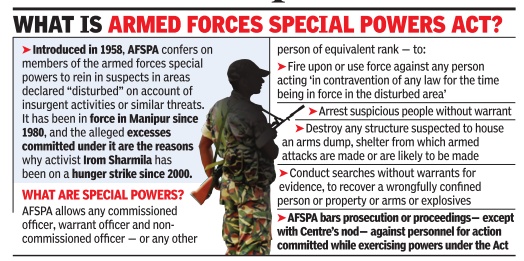
Armed Forces Special Powers Act, to put it simply, gives armed forces the power to maintain public order in “disturbed areas.”
AFSPA gives armed forces the authority use force or even open fire after giving due warning if they feel a person is in contravention of the law.
The Act further provides that if “reasonable suspicion exists”, the armed forces can also arrest a person without warrant; enter or search premises without a warrant; and ban the possession of firearms.
What are the Special Powers?
The ‘special powers’ which are spelt out under Section 4 provide that:
(a) Power to use force, including opening fire, even to the extent of causing death if prohibitory orders banning assembly of five or more persons or carrying arms and weapons, etc are in force in the disturbed area;
(b) Power to destroy structures used as hide-outs, training camps, or as a place from which attacks are or likely to be launched, etc;
(c) Power to arrest without warrant and to use force for the purpose;
(d) Power to enter and search premises without a warrant to make arrest or recovery of hostages, arms and ammunition and stolen property, etc.
What are the Disturbed Areas?
A disturbed area is one that is declared by notification under Section 3 of the AFSPA.
As per Section 3, it can be invoked in places where “the use of armed forces in aid of the civil power is necessary”.
Who can declare/notify such areas?
The Central Government or the Governor of the State or administrator of the Union Territory can declare the whole or part of the State or Union Territory as a disturbed area.
A suitable notification would have to be made in the Official Gazette.
Presently ‘Disturbed Areas’
AFSPA is currently in force in Assam, Nagaland, Manipur, 3 districts of Arunachal Pradesh, and areas falling within the jurisdiction of 8 police stations in Arunachal Pradesh bordering Assam.
In Jammu and Kashmir, a separate law Armed Forces (Jammu and Kashmir) Special Powers Act, 1990 has been in force.
AFSPA: Is it a License to Kill?
While the operation of the Section has been controversial in itself, it has attracted much criticism when actions have resulted in the death of civilians.
Power to kill: Section 4 of the Act granted officers the authority to “take any action” even to the extent to cause the death.
Protection against prosecution: This power is further bolstered by Section 6 which provides that legal can be instituted against the officer, except with the previous sanction of the Central Government.
The case for repeal of AFSPA
The repeal of AFSPA is necessary not just for restoring constitutional sanity, but also as a way of acknowledging dark history of our conduct in Nagaland.
If the moral case for repealing AFSPA is strong, the political case points in the same direction as well.
Need for ensuring individual dignity: The political incorporation of Nagaland (and all other areas where this law applies) will be set back if the guarantees of individual dignity of the Indian Constitution are not extended.
Not state of exception: We often describe AFSPA in terms of a “state of exception”.
But this theoretical term is misleading. How can a law that has been in virtually continuous existence since 1958 be described as an “exception”.
Why AFSPA is counterproductive to Army
Distortion of choice: First, giving wide immunity to the forces can distort the choice of strategy in counter insurgency operations.
Reduce professionalism: Second, wider immunity can often reduce rather than increase the professionalism of the forces.
Against federalism: Third, we are constantly in the vicious circle that leads to central dominance in a way that undermines both Indian federalism and operational efficiency.
Powers and limits under AFSPA
The Act grants extraordinarily sweeping powers to the armed forces of search, seizure, arrest, the right to shoot to kill.
No blanket immunity: It is true that AFSPA does not grant blanket immunity.
The SC guidelines: The Supreme Court laid down guidelines for the use of AFSPA in 1997; and in principle, unprofessional conduct, crimes and atrocities can still be prosecuted.
But this will run into two difficulties.
Lack of accountability mechanism: As the Jeevan Reddy Committee that advocated the repeal of AFSPA pointed out, the accountability mechanisms internal to AFSPA have not worked.
In 2017, the Supreme Court ordered a probe into 1,528 extra-judicial killings in Manipur.
At the least, this order seemed to suggest the problems with AFSPA were systemic.
But there have apparently been no hearings in this case for three years.
Lack of human empathy: At the heart of AFSPA is a profound mutilation of human empathy.
Our discourse is a rather abstract one, balancing concepts of human rights and national security.
Supreme Court’s Observations over AFSPA
These extra-judicial killings became the attention of the Supreme Court in 2016.
It clarified that the bar under Section 6 would not grant “total immunity” to the officers against any probe into their alleged excesses.
The judgment noted that if any death was unjustified, there is no blanket immunity available to the perpetrator(s) of the offense.
The Court further noted that if an offense is committed even by Army personnel, there is no concept of absolute immunity from trial by the criminal court constituted under the CrPC.
Constitutionality of AFSPA
Attempts have been made to examine the constitutionality of the Act on the grounds that it is contravention to the:
Right to Life and Personal Liberty (Article 21) and
Federal structure of the Constitution since law and order is a State subject
Recommendations to repeal AFSPA
(1) Justice B.P. Jeevan Reddy Commission
The 2004 Committee headed by Justice B.P. Jeevan Reddy, the content of which has never officially been revealed by the Government, recommended that AFSPA be repealed.
Additionally, it recommended that appropriate provisions be inserted in the Unlawful Activities Prevention Act, 1967 (UAPA) instead.
It also recommended that the UAPA be modified to clearly specify the powers of the armed forces and paramilitary forces and grievance cells should be set up in each district where the armed forces are deployed.
(2) ARC II
The Administrative Reforms Commission in its 5th Report on ‘Public Order’ had also recommended that AFSPA be repealed.
It recommended adding a new chapter to be added to the Unlawful Activities Prevention Act, 1967.
However, the recommendation was considered first and then rejected.
Other issues with AFSPA
(1) Sexual Misconduct by Armed Forces
The issue of violation of human rights by actions of armed forces came under the consideration of the Committee on Amendments to Criminal Law (popularly known as Justice Verma Committee) set up in 2012.
It observed that- in conflict zones, legal protection for women was neglected.
(2) Autocracy
The reality is that there is no evidence of any action being taken against any officer of the armed forces or paramilitary forces for their excesses.
The caution given by the Supreme Court
A July 2016 judgment authored by Justice Madan B. Lokur in Extra Judicial Execution Victim Families Association quoted the “Ten Commandments” issued by the Chief of the Army Staff for operations in disturbed areas:
Definite circumstances: The “power to cause death is relatable to maintenance of public order in a disturbed area and is to be exercised under definite circumstances”.
Declaration preconditions: These preconditions include a declaration by a high-level authority that an area is “disturbed”.
Due warning: The officer concerned decides to use deadly force on the opinion that it is “necessary” to maintain public order. But he has to give “due warning” first.
No arbitrary action: The persons against whom the action was taken by the armed forces should have been “acting in contravention of any law or order for the time being in force in the disturbed area”.
Minimal use of force: The armed forces must use only the “minimal force required for effective action against the person/persons acting in contravention of the prohibitory order.”
Empathy with perpetrators: The court said that: the people you are dealing with are your own countrymen. All your conduct must be dictated by this one significant consideration.
People friendliness: The court underscored how the Commandments insist that “operations must be people-friendly, using minimum force and avoiding collateral damage – restrain must be the key”.
Good intelligence: It added that “good intelligence is the key to success”.
Compassion: It exhorted personnel to “be compassionate, help the people and win their hearts and minds. Employ all resources under your command to improve their living conditions”.
Upholding Dharma (Duty): The judgment ended with the final Commandment to “uphold Dharma and take pride in your country and the Army”.
Conclusion
Despite demands by civil society groups and human rights activities, none of the recommendations have not been implemented to date.
It is high time that all parties come together to repeal AFSPA. It will also be in the fitness of things if all parties got together to acknowledge the trauma in Nagaland and elsewhere.
This will strengthen, not weaken, the comatose Indian constitutional project.
Try this question for mains:
Q. Evaluate the need for AFSPA in disturbed areas. Discuss in the context of the recent Nagaland incident.
Nilesh Gaikwad has a come a long way, just like his UPSC preparation.
He started in the year 2015 and fulfilled his dream in 2020. This however does not mean he is not academically inclined. Nilesh cleared the tough IIT-JEE examinations in his first attempt and graduated from IIT Bombay. After working for a year at a private firm, Nilesh quit to follow his UPSC-CSE dream. Why did he want to prepare for UPSC-CSE just when he had achieved the ‘middle-class’ settled life?
As a college student, Nilesh was never interested in UPSC-CSE. However, as an employee in an IT firm, Nilesh looked upto his boss. He wondered what motivated his boss to wake up everyday and navigate through the rigors of work. He understood that his boss had found the purpose of his life in his job.
That’s when Nilesh realized he was unable to fulfill his purpose or express his passion in a private job. “Owning a car, buying fancy gadgets and earning in lakhs — this did not drive me. Unfortunately, a private job just gives you that and nothing more.”, Nilesh said. Hailing from a small town, Nilesh wanted to go back to roots and do something for many such small towns in India. After a quick research, the idea of UPSC-CSE struck him.
He left his fulltime job to prepare for UPSC-CSE and gave nearly 4 attempts. In his 3rd attempt, he got selected for Indian Defence Accounts Service post. While undergoing training, Nilesh prepared once again under the guidance of Civilsdaily mentor Pravin Sir and finally became an IPS Officer.
Open to All, Free to Attend Ask me Anything Session with Nilesh Gaikwad
This Sunday, Nilesh will be enlightening all Civilsdaily aspirants in an Ask me Anything Webinar. This webinar is absolutely free for all to attend and everyone can air their questions to Nilesh Gaikwad IPS.
But since there is only a limited slot of one hour, invitation for the webinar is by registration only. Confirm your presence by filling the form below.
1. How to develop perseverance and self-confidence while preparing for UPSC CSE?
2. How to work on weaknesses and overcome them?
3. The right approach for Mains.
4. What to study in last 25 days for Mains 2021?
5. How to score good marks in the Personality Test (Interview)
6. Tips for beginners.
7. Importance of ‘right guidance with right direction’ to sail through the exam.
Webinar Details
If you are studying hard but are unsure that you are studying right, then its time to get some assurance from the topper himself! Register for thisfree webinar by IPS officer Nilesh Gaikwad.
The death of civilians in Nagaland in a security operation has revived the debate about AFSPA.
Demand for repeal of AFSPA
Some years ago, all the northeastern states had come together to demand the annulment of this Act.
That remained in the realm of yet another “demand”.
In 1997, after Nagaland’s most enduring insurgent outfit, the National Socialist Council of Nagalim (NSCN), led by Isak Swu and T H Muivah, first decided to talk peace with the Indian government, the Naga Peoples’ Movement for Human Rights (NPMHR) had approached the Supreme Court for revocation of the Act.
Enabling legislation: The apex court had then upheld its constitutionality and said it was an enabling legislation that confers minimum powers on the army to operate in situations of widespread internal disorder.
Way forward
Talk to the other groups: Many are wondering if the peace talks between the NSCN (IM) and the government of India now lie in tatters.
The media has focussed exclusively on the NSCN (IM) and ignored the other Naga National Political Groups (NNPGs), who have been brought on board because they are Nagaland-based and speak exclusively for Nagaland.
The NNPGs and the Gaon Bura Association of Nagaland doubt NSCN(IM)’s ability to bring lasting peace in Nagaland.
Since 2015, the Nagaland Gaon Bura Association, the apex body of Nagas which includes all the 16 recognised tribes and the NNPGs barring the NSCN (IM), have sent several memorandums to the government.
These representatives of the Naga people do not demand a separate flag or constitution because they understand these are tenuous demands.
These groups have also never raised the sovereignty issue.
The working committee of the seven NNPGs, roped in to join the peace talks, are also opposed to the idea of changing interlocutors as and when the NSCN (IM) decides.
Reconsider use of AFSPA: There is a need to reconsider the use of the army and AFSPA when killings have reduced considerably.
The apex body has specifically mentioned that they want to be delivered from the gun culture.
Check the misuse of FMR: Countering insurgency in the Northeast is fraught also because of the Free Movement Regime (FMR) between India and Myanmar.
Conclusion
The government need to reconsider the use of AFSPA and also focus on other measures to ensure peace and stability in these regions.
Twelve members of the Rajya Sabha were suspended for their alleged involvement in the grave disorder in the House on the last day of the previous session.
What do Rajya Sabha’s rules of procedure say about the suspension of a member?
Rule 256 of Rajya Sabha’s rules of procedure provides for the suspension of a member who disregards the authority of the chair or abuses the rules of the council by persistently and willfully obstructing the business of the House.
Persistent and willful obstruction of the business of the House is the crux of the offence.
What is the maximum period of suspension? Suspension can be for a period not exceeding the remainder of the session.
This would mean that if the member is suspended on the last day of the session, the period of suspension will be only a day.
So, even if a government would like to suspend such a member for a longer period. it would not be possible under the present rule.
Unless the House itself revokes the suspension nothing can be done about it.
The decision of the House is final.
Every legislature has the power to suspend its members if they cause disorder and obstruct the business of the House.
But the rule of suspension is rarely invoked in parliaments in mature democracies.
Whether the existing rules permit such a course of action?
Rule 256 says that the chairman may, if he deems it necessary, name a member who either disregards the authority of the chair or abuses the rules of the House by persistently and willfully obstructing the business of the House.
Sub Rule 2 of this rule is of very great importance in the context of the main question, namely, whether a member can be suspended in the next session for creating disorder in the previous session.
No adjournment is allowed: It clearly says no adjournment is allowed, which means the matter of suspension cannot be adjourned to a later period.
It needs to be decided then and there.
A member who abuses the rules of the House by persistently and willfully obstructing its business needs to be punished swiftly.
No adjournment is allowed at all.
The powers of the House to regulate its internal matters
It can be said that the rule under which the members were suspended does not actually permit it.
Absolute power to interpret rule: The House is supreme in these matters and the chair has absolute powers to interpret the rules.
The judiciary has time and again clarified that the House has absolute powers to regulate its internal matters.
Suspension of a member is such a matter.
The judiciary will intervene only when a patently unconstitutional act is done by the House.
Conclusion
The solution to disruptions does not lie in suspension. That is the lesson we should learn from past experience.
Nilesh Gaikwad has a come a long way, just like his UPSC preparation.
He started in the year 2015 and fulfilled his dream in 2020. This however does not mean he is not academically inclined. Nilesh cleared the tough IIT-JEE examinations in his first attempt and graduated from IIT Bombay. After working for a year at a private firm, Nilesh quit to follow his UPSC-CSE dream. Why did he want to prepare for UPSC-CSE just when he had achieved the ‘middle-class’ settled life?
As a college student, Nilesh was never interested in UPSC-CSE. However, as an employee in an IT firm, Nilesh looked upto his boss. He wondered what motivated his boss to wake up everyday and navigate through the rigors of work. He understood that his boss had found the purpose of his life in his job.
That’s when Nilesh realized he was unable to fulfill his purpose or express his passion in a private job. “Owning a car, buying fancy gadgets and earning in lakhs — this did not drive me. Unfortunately, a private job just gives you that and nothing more.”, Nilesh said. Hailing from a small town, Nilesh wanted to go back to roots and do something for many such small towns in India. After a quick research, the idea of UPSC-CSE struck him.
He left his fulltime job to prepare for UPSC-CSE and gave nearly 4 attempts. In his 3rd attempt, he got selected for Indian Defence Accounts Service post. While undergoing training, Nilesh prepared once again under the guidance of Civilsdaily mentor Pravin Sir and finally became an IPS Officer.
Open to All, Free to Attend Ask me Anything Session with Nilesh Gaikwad
This Sunday, Nilesh will be enlightening all Civilsdaily aspirants in an Ask me Anything Webinar. This webinar is absolutely free for all to attend and everyone can air their questions to Nilesh Gaikwad IPS.
But since there is only a limited slot of one hour, invitation for the webinar is by registration only. Confirm your presence by filling the form below.
1. How to develop perseverance and self-confidence while preparing for UPSC CSE?
2. How to work on weaknesses and overcome them?
3. The right approach for Mains.
4. What to study in last 25 days for Mains 2021?
5. How to score good marks in the Personality Test (Interview)
6. Tips for beginners.
7. Importance of ‘right guidance with right direction’ to sail through the exam.
Webinar Details
If you are studying hard but are unsure that you are studying right, then its time to get some assurance from the topper himself! Register for thisfree webinar by IPS officer Nilesh Gaikwad.
GS-1 Important Geophysical phenomena such as earthquakes, Tsunami, Volcanic activity, cyclone etc, geographical features and their location-changes in critical geographical features (including water-bodies and ice-caps) and in flora and fauna and the effects of such changes
GS-2 Government policies and interventions for development in various sectors and issues arising out of their design and implementation; Constitution of India
GS-3 Indian Economy
GS-4 Ethics and Human Interface: Essence, determinants and consequences of ethics in human actions; dimensions of ethics; ethics in private and public relationships
HOW TO ATTEMPT ANSWERS IN DAILY ANSWER WRITING ENHANCEMENT(AWE)?
Daily 4 questions from General studies 1, 2, 3, and 4 will be provided to you.
A Mentor’s Comment will be available for all answers. This can be used as a guidance tool but we encourage you to write original answers.
You can write your answer on an A4 sheet and scan/click pictures of the same.
Upload the scanned answer in the comment section of the same question.
Along with the scanned answer, please share your Razor payment ID, so that paid members are given priority.
If you upload the answer on the same day like the answer of 11th October is uploaded on 11th October then your answer will be checked within 72 hours. Also, reviews will be in the order of submission- First come first serve basis
If you are writing answers late, for example, 11th October is uploaded on 13th October, then these answers will be evaluated as per the mentor’s schedule.
We encourage you to write answers on the same day. However, if you are uploading an answer late then tag the mentor like @Staff so that the mentor is notified about your answer.
*In case your answer is not reviewed, reply to your answer saying *NOT CHECKED*.