💥UPSC 2026, 2027, 2028 UAP Mentorship (March Batch) + Access XFactor Notes & Microthemes PDF

Search results for: “”

  • CD Prelims TS 2018- FLT 7 (Older schemes/acts/policies of 2014-16) discussion

    All aspirants who are giving tomorrow’s test should discuss all there doubts/queries about any question on this thread and not in the comments section of the test

    Around 20 questions of the test can be solved using Tikdam method

    Tikdams explanations in those selected questions are given in the explanation column itself

    By closely observing those questions after every test you will gradually learn the art of Tikdams which will assist you in clearing the UPSC prelims

    Highlights of tomorrow’s test:


    Q.1) Consider the following statements regarding Rashtriya Krishi Vikas Yojana (RKVY)

    1. It incentives states to enhance investments in Agriculture and Allied sectors to achieve 4% growth rate.

    2. Various Sub-schemes include Bringing Green Revolution to Eastern India (BGREI), Saffrom Mission, Bee Keeping etc.

    Which of the above statement/s is/are correct?

    a) Only 1

    b) Only 2

    c) Both 1 & 2

    d) None of the above


    Q.2)  Consider the following statements regarding Deen Dayal Antyodaya Yojana- NRLM

    1. It aims at creating efficient and effective institutional platforms of the rural poor, enabling them to increase household income through sustainable livelihood enhancements and improved access to financial services

    2. The Scheme is assisted by funds from World Bank.

    Which of the above statements are correct?

    a) Only 1

    b) only 2

    c) Both 1 & 2

    d) None of the above


    Q.3)  Consider the following statements regarding Pradhan Mantri Awas Yojana Gramin

    1. It replaces Indira Awas Yojana (IAY)

    2. Beneficiaries of the rural houses would be chosen according to data taken from the Socio Economic Caste Census of 2011

    3. PMAY-G aims at providing a pucca house, with basic amenities, to all houseless householder and those households living in kutcha and dilapidated house, by 2020

    Which of the above statements are correct?

    a) Only 1 and 2

    b) Only 2 and 3

    c) Only 1 and 3

    d) All of the above


    Q.4)  DIKSHA, an initiative by the government, aims to

    a) assist below poverty line (BPL) households in forming functional Self Help Groups (SHGs)

    b) assist teachers by equipping them with advanced digital infrastructure.

    c) assist exporters by providing a single window clearance facility for product certification.

    d) assist non-governmental organisations by allowing them access to government infrastructure

    Best of luck!
  • [Prelims Spotlight] Ashgabat Agreement, G20

    As a part of revision for Prelims 2018, Here’s a Factoid to brush up your concepts

    Name : Ashgabat Agreement

    Brief Intro : 1.Ashgabat Agreement, is an international transport and transit corridor facilitating transportation of goods between Central Asia and the Persian Gulf. 2.The transit agreement provides for a transit corridor across Central Asia and the Middle East through the continuous landmass between Kazakhstan, Uzbekistan, Turkmenistan and Iran before reaching the Persian Gulf and into Oman.

    Objective : The objective of this agreement is to enhance connectivity within Eurasian region and synchronize it with other transport corridors within that region including the International North–South Transport Corridor (INSTC).

    Type : Declaration

    Category : Connectivity

    Year : 2011

    Importance (wr. Prelims) : High

    Place : Ashgabat

    Name : G-20

    Brief Intro : 1.It was started in 1999 as a meeting of Finance Ministers and Central Bank Governors in the aftermath of the Southeast Asian (Tiger economies) financial crisis. 2.The Group of Twenty (G20) is the premier forum for its members’ international economic cooperation and decision-making. It is deliberating forum for the governments and central bank governors from 20 major economies on economic issues and other important development challenges. 3.In 2008, the first G20 Leaders’ Summit was held in Washington DC, US. The group had played a key role in responding to the global financial crisis. It comprises total 19 countries plus the European Union (EU), representing 85% of global GDP, 80% of international trade, 65% of world’s population. Its members include Australia, Argentina, Brazil, Canada, China, India, France, Germany, Indonesia, Italy, Japan, South Korea, Mexico, Saudi Arabia, Russia, Turkey, South Africa, UK, US and EU. 4.The 2016 summit was held in Hangzhou China.

    Objective : It was established for studying, reviewing, and promoting high-level discussion of policy issues pertaining to the promotion of international financial stability.

    Type : Summit/ Conference

    Category : Economy

    Year : 2008

    Importance (wr. Prelims) : High

  • [open SIP] Test 42- Misc. Test 18 Link + discussion

    Link for the test: Click2Attempt  (Let us know your score in comments)

    We have started our Open SIP program in conjunction with our PAID program (Click2Know all details of the program)

    We will be running this special FREE initiative on daily basis providing students with revision questions for static subjects as well as current affairs starting from June 2017

    Test 42 as per schedule (Click2View) is Misc. Test 18


    Liked the test? You can join our FLT program containing more such high-level questions. The module contains 11 FLTs (8 paper 1 TS + 3 CSAT)

    Know all details about the program and join here: Click2Join

    Want to do quick revision for Prelims? Join our SIP Comprehensive or SIP Mini modules giving you Static & Dynamic subjects coverage through video lectures

    SIP Comprehensive- Samanvaya + Lectures + Notes + FLTs + CA Tests: Click2Join

    SIP Mini- Samanvaya + Lectures + Notes: Click2Join

  • [open SIP] Test 41- Misc. Test 17 (February + March CA ) Link + discussion

    Link for the test: Click2Attempt  (Let us know your score in comments)

    We have started our Open SIP program in conjunction with our PAID program (Click2Know all details of the program)

    We will be running this special FREE initiative on daily basis providing students with revision questions for static subjects as well as current affairs starting from June 2017

    Test 41 as per schedule (Click2View) is Misc. Test 17 (February + March CA ) 


    Liked the test? You can join our FLT program containing more such high-level questions. The module contains 11 FLTs (8 paper 1 TS + 3 CSAT)

    Know all details about the program and join here: Click2Join

    Want to do quick revision for Prelims? Join our SIP Comprehensive or SIP Mini modules giving you Static & Dynamic subjects coverage through video lectures

    SIP Comprehensive- Samanvaya + Lectures + Notes + FLTs + CA Tests: Click2Join

    SIP Mini- Samanvaya + Lectures + Notes: Click2Join

  • [Prelims Spotlight] Gomastha, Ibadat Khana

    As a part of revision for Prelims 2018, Here’s a Factoid to brush up your concepts

    Key words related to History : Gomastha

    Dynasty/era : Mughal period

    Meaning : 1.Gomastha described an Indian agent of the British East India Company employed in the Company’s colonies, to sign bonds, usually compellingly, by local weavers and artisans to deliver goods to the Company. The prices of the goods were fixed by the gomasthas. 2.The goods were exported by the Company to Europe and America.Gomastha may also be described as ‘a paid manager of the private trader’s concerns’, who claimed ‘hardly any share in the profit and loss of his employer’s business’


    Key words related to History : Ibadat Khana

    Dynasty/era : Mughal period

    Meaning : The Ibādat Khāna was a meeting house built in 1575 CE by the Mughal Emperor Akbar at Fatehpur Sikri to gather spiritual leaders of different religious grounds so as to conduct a discussion on the teachings of the respective religious leaders

  • [open SIP] Test 40- Misc. Test 16(December + January CA ) Link + discussion

    Link for the test: Click2Attempt  (Let us know your score in comments)

    We have started our Open SIP program in conjunction with our PAID program (Click2Know all details of the program)

    We will be running this special FREE initiative on daily basis providing students with revision questions for static subjects as well as current affairs starting from June 2017

    Test 40 as per schedule (Click2View) is Misc. Test 16(December + January CA )


    Liked the test? You can join our FLT program containing more such high-level questions. The module contains 11 FLTs (8 paper 1 TS + 3 CSAT)

    Know all details about the program and join here: Click2Join

    Want to do quick revision for Prelims? Join our SIP Comprehensive or SIP Mini modules giving you Static & Dynamic subjects coverage through video lectures

    SIP Comprehensive- Samanvaya + Lectures + Notes + FLTs + CA Tests: Click2Join

    SIP Mini- Samanvaya + Lectures + Notes: Click2Join

  • [Prelims Spotlight] GOLD and ICON Mission, Transiting Exoplanet Survey Satellite (TESS)

    As a part of revision for Prelims 2018, Here’s a Factoid to brush up your concepts

    Name : GOLD and ICON Mission

    Details : To explore the earth’s ionosphere.

    Agency : NASA


    Name : Transiting Exoplanet Survey Satellite (TESS)

    Details : designed to search for exoplanets using the transit method

    Agency : NASA

  • [open SIP] Test 39- Misc. Test 15(October + November CA ) Link + discussion

    Link for the test: Click2Attempt  (Let us know your score in comments)

    We have started our Open SIP program in conjunction with our PAID program (Click2Know all details of the program)

    We will be running this special FREE initiative on daily basis providing students with revision questions for static subjects as well as current affairs starting from June 2017

    Test 39 as per schedule (Click2View) is Misc. Test 15(October + November CA )


    Liked the test? You can join our FLT program containing more such high-level questions. The module contains 11 FLTs (8 paper 1 TS + 3 CSAT)

    Know all details about the program and join here: Click2Join

    Want to do quick revision for Prelims? Join our SIP Comprehensive or SIP Mini modules giving you Static & Dynamic subjects coverage through video lectures

    SIP Comprehensive- Samanvaya + Lectures + Notes + FLTs + CA Tests: Click2Join

    SIP Mini- Samanvaya + Lectures + Notes: Click2Join

  • [Static Revision] Drainage System | Part 5


    The Peninsular Drainage:

    The Peninsular drainage system is older than the Himalayan one. This is evident from the broad, largely-graded shallow valleys, and the maturity of the rivers.

    Evolution: Three major geological events in the distant past have shaped the present drainage systems of Peninsular India:

    • Subsidence of the western flank of the Peninsula leading to its submergence below the sea during the early tertiary period. Generally, it has disturbed the symmetrical plan of the river on either side of the original watershed and left just the upper parts of west flowing rivers above the sea level.
    • Upheaval of the Himalayas when the northern flank of the Peninsular block was subjected to subsidence and the consequent trough faulting. The Narmada and The Tapi flow in trough faults and fill the original cracks with their detritus materials. Hence, there is a lack of alluvial and deltaic deposits in these rivers.
    • Slight tilting of the Peninsular block from north-west to the southeastern direction gave orientation to the entire drainage system towards the Bay of Bengal during the same period.

    River-Systems:

    The peninsular river system can be categorised into the following sections:

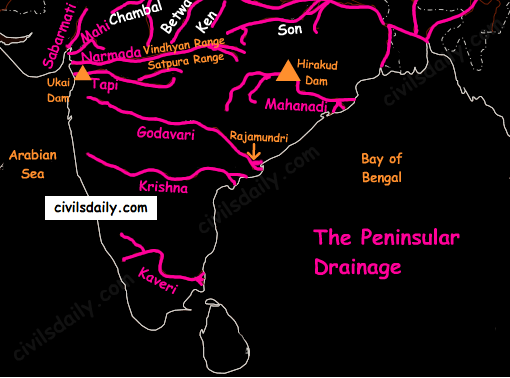
    • The East flowing rivers – the Mahanadi, the Godavari, the Krishna and the Cauvery flow eastwards and drain into the Bay of Bengal. These rivers make deltas at their mouths.
    • The West flowing rivers:
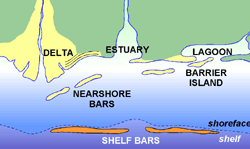
      • Narmada and Tapi along with other small rivers originating from the Western Ghats and falling in the Arabian Sea form estuaries in place of deltas. This is due to the fact that these rivers, especially Narmada and Tapi, flow through hard rocks and are not able to form distributaries before they enter the sea.
      • Although these west flowing rivers of Sahyadri form only about 3% of the areal extent of basins of India, they contain about 18% of the country’s water resources.

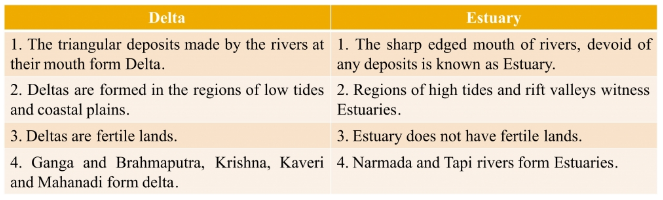
    Wondering what is the difference between a delta and an estuary? Let’s see:

    Source


    Source
    • The Western Ghats running close to the western coast act as a water divide between the major Peninsular Rivers discharging their water in the Bay of Bengal and the small rivulets joining the Arabian Sea.
    • The Chambal, the Sind, the Betwa, the Ken, the Son, originating in the northern part of the Peninsula belong to the Ganga river system.
    • The Peninsular rivers are characterized by fixed courses, absence of meanders and non-perennial flow of water. The Narmada and the Tapi which flow through the rift valley are, however, exceptions.
    The Peninsular Drainage

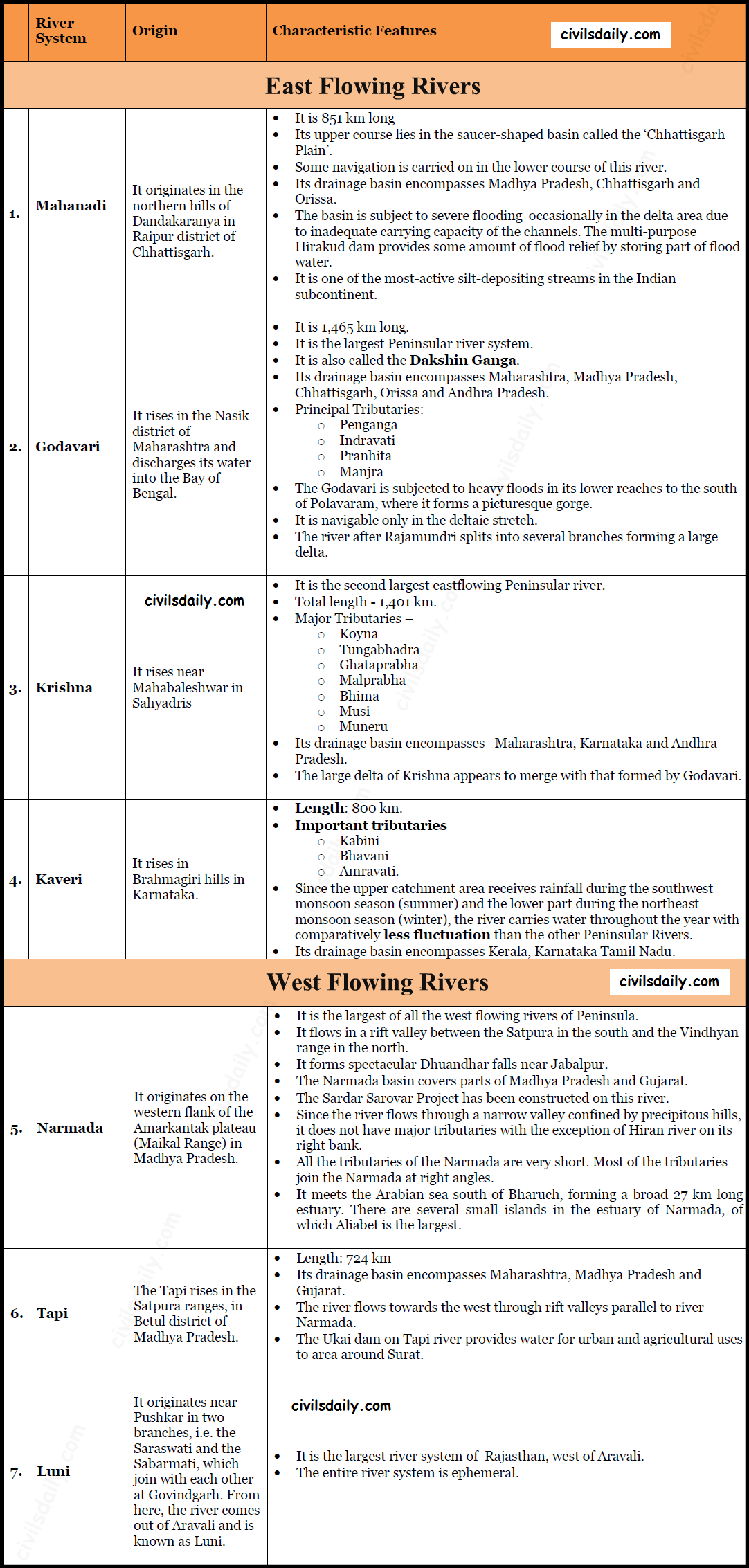
    A brief account of the major Peninsular river systems is given below:

    Major Peninsular River Systems

    Smaller rivers flowing Towards the West:

    The rivers flowing towards the Arabian Sea have short courses ( Because their origins lie closer to the sea, and the Western Ghats act as a water divide). Several of these small rivers are important for the production of hydroelectricity because of steep slopes and waterfalls.

    Gujarat:

    • The Shetruniji – It rises near Dalkahwa in Amreli district.
    • The Bhadra – It originates near Aniali village in Rajkot district.
    • The Dhadhar rises near Ghantar village in Panchmahal district.
    • Sabarmati
    • Mahi

    Maharashtra:

    • The Vaitarna rises from the Trimbak hills in Nasik district
    • The Kalinadi rises from Belgaum district and falls in the Karwar Bay.
    • The source of Bedti river lies in Hubli Dharwar and traverses a course of 161 km.
    • The Sharavati is another important river in Karnataka flowing towards the west. The Sharavati originates in Shimoga district of Karnataka and drains a catchment area of 2,209 sq. km. The famous Jog or Gersoppa Falls (289m) made by Sharavati river are the highest untiered waterfalls in India.

    Goa:

    • Mandovi
    • Juari

    Kerala:

    • Bharathapuzha – It is the largest river of Kerala. It is also known as Ponnani. It originates from Annamalai hills and flows into the Arabian Sea at a place called Ponnani.
    • The Periyar – It is the longest and the second largest river of Kerala. [Largeness of a river is related to its basin size and the volume of water flowing in the river. At the same time when we say that a river is the longest, it means that we are referring to its geographical length]
    • The Pamba river – It falls in the Vembanad lake.

    Small Rivers Flowing towards the East:

    There are small rivers which join the Bay of Bengal, though small, these are important in their own right.

    • The Subarnrekha
    • the Baitarni
    • the Brahmani
    • the Vamsadhara
    • the Penner
    • the Palar
    • the Vaigai
  • [Prelims Spotlight] Block-III version of Brahmos cruise missile, Agni III

    As a part of revision for Prelims 2018, Here’s a Factoid to brush up your concepts

    #1. Name : Block-III version of Brahmos cruise missile

    Defence Forces : Army

    Module Type : Missiles

    Brief Intro : Block III had advanced guidance and upgraded software, incorporating high manoeuvres at multiple points and steep dive from high altitude. The steep dive capability of the Block III enables it to hit targets hidden behind a mountain range. It will be deployed in Arunachal Pradesh. It can engage ground targets from an altitude as low as 10 meters for surgical strikes with out any collateral damage. It is capable of being launched from multiple platforms like submarines, ships, aircraft and land based Mobile Autonomous Launchers (MAL). Range: 450 Km (to be upgraded to 600 Km)


    #2. Name : Agni III

    Defence Forces : Army

    Module Type : Missiles

    Brief Intro : Agni-III is an intermediate-range ballistic missile developed by India as the successor to Agni-II. It has a range of 3,500 km- 5,000 km, and is capable of engaging targets deep inside neighbouring countries. The missile’s Circular error probable (CEP) is within 40 meters range, which makes it the most sophisticated and accurate ballistic missile of its range class in the world.

More posts