💥UPSC 2026, 2027, 2028 UAP Mentorship (March Batch) + Access XFactor Notes & Microthemes PDF

Search results for: “”

  • Medical Education Governance in India

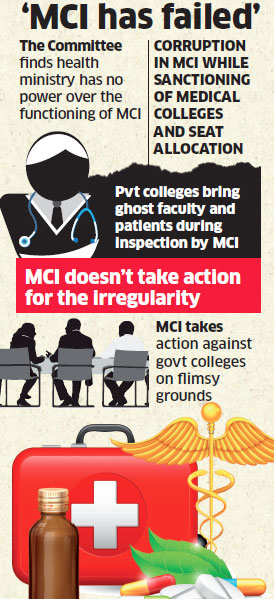
    The MCI has been in the news for the wrong reasons as the Parliamentary Standing Committee on Health in its 92nd report came down heavily on various aspects of the functioning of MCI. British medical Journal also had suggested radical revamp of the MCI. This articles focuses on the medical education governance in India.
    source

    Let’s understand the issues under the following heads:

    • Context
    • Background
    • Weaknesses Highlighted by Parliamentary panel
    • What are the major reforms needed in MCI?
    • Measures needed to overhaul and revamp MCI
    • Mandate of Lodha committee
    • Way forward

    Context:

    • MCI has been criticised for being a ‘biased’ organisation, acting ‘against larger public health goals’ and an ‘exclusive club’ of medical doctors from corporate hospitals and private practice. The British Medical Journal (BMJ) and the Parliamentary Standing Committee in their recent report have called for a ‘radical prescription’ to reform the Medical Council of India (MCI) in order to eliminate corruption and lack of ethics in healthcare.
    • SC appointed a three-member committee headed by former Chief Justice of India R M Lodha to oversee MCI.

    Background

    • The MCI was established under the Indian Medical Council Act 1933 and given responsibility for maintaining standards of medical education, providing ethical oversight, maintaining the medical register, and, through amendments in 1993, sanctioning medical colleges has failed to deliver quality and integrity in the health services across India.
    • The Medical Council of India (MCI) is a statutory body entrusted with the responsibility of establishing and maintaining high standards of medical education in India.

    Weaknesses Highlighted by Parliamentary panel

    In its scathing report, the standing committee felt that the MCI has repeatedly failed on all its mandates over the years. The committee noted the following as some of the prominent failures of MCI.

    • Failure to create a curriculum that produces doctors suited to working in Indian context especially in the rural health services and poor urban areas. The committee felt that this has created disconnect between medical education system and health system.
    • Failure to maintain uniform standards of medical education, both at the undergraduate and post-graduate levels.
    • Devaluation of merit in admission, particularly in private medical institutions due to prevalence of capitation fees, which make medical education available only to the rich and not necessarily to the most deserving.
    • Non-involvement of the MCI in any standardized summative evaluation of the medical graduates and post-graduates.
    • Failure to put in place a robust quality assurance mechanism.
    • Very little oversight of PG medical education leading to huge variation in standards.
    • Failure to create a transparent system of medical college inspections and grant of recognition or de-recognition.
    • Failure to oversee and guide the Continuing Medical Education in the country, leaving this important task in the hands of the commercial private industry.
    • Failure to instill respect for a professional code of ethics in the medical professionals and take disciplinary action against doctors found violating the code of Ethics.

    What are the major reforms needed in MCI?

    1. There is a need to restructure the MCI. It should not be an elected body dominated by vested interest but should represent all stakeholders through nomination. The MCI, as presently elected, neither represents professional excellence nor its ethos. The current composition of the Council reflects that more than half of the members are either from 21 corporate hospitals or in private practice.
    2. The MCI currently sets standards for recognition, inspects and licenses medical colleges; overseas Registration and Ethical Conduct of Doctors. It now proposes to undertake accreditation as well. Such concentration of powers creates a serious conflict of interest and provides a fertile ground for misuse of authority. So there is a need to create a transparent system of licensing of medical colleges.
    3. There should be bifurcation of the functions of MCI and recommends that different structures be created for discharging different functions.
    4. There is a need to revisit ICT tools and revisit minimum standards which are required under the act to establish medical colleges.
    5. A code of ethics which is in line with the international standards needs to be developed for the medical professionals to reduce the corrupt practices.
    6. It needs to see a balance between the number of seats available for medical courses at undergraduate and postgraduate level.

    Measures needed to overhaul and revamp MCI

    1. The Parliamentary committee made a number of recommendations to overhaul the system. Some of the important recommendations of the committee are the following,
    2. Doctor – Population ratio in India is 1:1674 as against the WHO norm of 1:1000, hence the government should immediately spell out policy stance in great detail to augment the capacity of production of doctors including specialists and super-specialists at the scale and speed required to meet India’s health needs.
    3. The regulatory framework of medical education and practice should be comprised of professionals of the highest standards of repute and integrity, appointed through a rigorous and independent selection process.
    4. Urgent measures have to be taken to restructure the composition of MCI to encourage diversity so that it does not become an exclusive club of doctors.
    5. Physical infrastructure requirement should be pruned down in such a way that it should have just about 30 to 40 percent standing value in the total assessment of a medical college.
    6. Support to convert district hospitals into medical colleges. If a district hospital is converted into a medical college, it will not only be equipped with specialists of all disciplines, providing the healthcare services across the whole spectrum but will also produce some doctors in its area of operation and will thus help reduce geographical mal-distribution of doctors.
    7. The PG entrance exam should be held immediately after the final MBBS examination so that the graduate doctor could concentrate on practical skills during his internship.
    8. Ethics should be made one of the cornerstones of the syllabus of medical education.
    9. Introduction of Common Medical Entrance Test (CMET) should be done across the nation barring those States who wish to remain outside the ambit of the CMET. A common exit test should be introduced for MBBS doctors.

    Mandate of the Lodha committee

    1. Lodha Committee would have complete authority to oversee all statutory functions under the MCI Act.
    2. All policy decisions of the MCI will need approvals from the Committee. It will also be free to issue remedial directions.
    3. The Committee will function for 1 year, unless a suitable mechanism is brought in earlier by it.
    4. Initially the panel will function for a year, unless suitable mechanism is brought in place earlier which will substitute the said committee.

    Way forward

    • The abysmal doctor-patient ratios in India’s rural areas and poorer districts, the sanctioning of new medical colleges without ensuring trained medical faculty, the failure to produce adequate specialist doctors, and corruption in the conduct of inspections and in granting sanctions to medical colleges have wrecked the MCI’s credibility.So, there is a need to bring back the integrity which MCI has lost over the years.
    • Whether Lodha Committee manages to inculcate the changes needed in MCI or ends up being one of the numerous other attempts at cleaning up the medical education scene remains to be seen.

    References:

  • Learn from your mistakes BUT don’t slack off while you attempt

    Every year, we try to read the UPSC examiner’s mind to position our preparation on the right track and more often than not, the said examiners do allow us a window to take a detour through their mind and marvel at the beauty of the art of crafting questions by them. And the beauty lies not in making the question which no one has ever heard of but ensuring that some questions are such that you can attempt them even if you just devoted 2 minutes of your long tea break in discussing what others had been studying.

    Here are few such question which only need a calm look at the question and common sense and you can’t mark them wrong even if you mark them while half asleep:

    BUT if you got these incorrect then you need to start studying from this moment itself.

    This blog is specifically for the junta who joined the final 4 FLTs with us. If you have joined and haven’t attempted the FLT #2, please do so. Click here.

    Here’s the list from the FLT #2:


    Q.3) India successfully tested the Reusable Launch Vehicle technology demonstrator recently.

    What are the benefits of developing a reusable launch vehicle?

    1. It shall cut down on the cost of satellite launches.
    2. It shall be a step forward for manned space missions in future.

    Select the correct alternative using the codes given below.

    1. a) 1 only
    2. b) 2 only
    3. c) Both 1 and 2
    4. d) Neither 1 nor 2

    Q.4) In recent times, few places have been in news due to local movements centred around ecological/environmental issues. In this context consider the following pairs:

    1. Mithi Virdi : Maharashtra
    2. Niyamgiri Hills : Odisha
    3. Plachimada : Tamil Nadu

    Which of the above pairs is/are correctly matched?

    1. a) 2 only
    2. b) 1 and 2 only
    3. c) 1 and 3 only
    4. d) 1, 2 and 3

    Q.6) After Gujarat and Arunachal Pradesh, which of the following pairs represents the western most and eastern most states of India?

    1. a) Rajasthan and Nagaland
    2. b) Jammu & Kashmir and Manipur
    3. c) Rajasthan and Manipur
    4. d) Jammu & Kashmir and Nagaland

    Q.13) Which of the following is/are the pollutants released into the air by combustion of fossil fuels?

    1. Oxides of carbon
    2. Oxides of sulphur
    3. Oxides of hydrogen
    4. Oxides of nitrogen

    Select the correct alternative using the codes given below.

    1. a) 1 and 2 only
    2. b) 1, 2 and 3 only
    3. c) 1, 2 and 4 only
    4. d) 1, 2, 3 and 4


    Q.14) Which one of the following conventions/protocols is associated with prohibition of trade in wildlife and plants that can threaten their survival?

    1. a) Nagoya Protocol
    2. b) CBD
    3. c) Cartagena Protocol
    4. d) CITES

    Q.20) Consider the following rivers:

    1. Alaknanda
    2. Ramganga
    3. Pindar

    Which of the above rivers flow through Uttarakhand?

    1. a) 1 and 2 only
    2. b) 1 only
    3. c) 2 and 3 only
    4. d) 1, 2 and 3

    Q.22) A joint sitting of the two houses of the Parliament may be called upon by

    1. a) the Prime Minister
    2. b) the Rajya Sabha Secretariat
    3. c) the President
    4. d) the Leader of the house in Lok Sabha

    Q.24) With respect to the Indian freedom struggle, a violent incident at Chauri Chaura led to the withdrawal of which one of the following movements?

    1. a) Civil Disobedience Movement
    2. b) Quit India Movement
    3. c) Non-Cooperation Movement
    4. d) Swadeshi Movement

    There are 6 more questions in this paper (FLT #2) which everyone should have got correct. But we won’t prick you more.

    Hope you are writing your Full Length Mocks seriously. Learn from the explanations but do not go easy on them when you are attempting the tests. There will be many among you who will score an ace on subjects they did not even study properly, but could make an educated guess on.

    Make sure you are one of them!


    The FLTs are being held at prelims.civilsdaily.com

  • Polity conundrum !!

    How do I deal with constitutional and non constitutional bodies?
    I just lack everything after panchayati raj,should I have to cover Laxmikanth,cover to cover?
    Any tips Dr.V?

  • The Making of the Indian Constitution

    Pretty amazing stuff by Google Cultural Institute. Have a look.

    https://www.google.com/culturalinstitute/beta/exhibit/gQ516SIa

  • UPSC Prelims Modern History Trend Analysis: Part 5

    Pre 2009

    1. One of the following began with the Dandi March?

    1. Home Rule Movement     
    2. Non – Cooperation Movement
    3. Civil Disobedience Movement
    4. Quit India Movement

    Dandi march is very very imp. for prelims and mains. Even last year question on dandi march in south India was asked

    Learning – Poorna Swareaj resolution and Dandi march, Choice of salt law

    2. With which one of the following movements is the slogan ”Do or Die” associated?

    1. Swadeshi Movement     
    2. Non – Cooperation Movement
    3. Civil Disobedience Movement
    4. Quit India Movement

    QIM has been asked so many times. Almost every year there is one question on QIM.

    Learning – Phases of QIM, Contrast QIM with other Gandhian movements, Karnataka method

    3. Who of the following founded the Ahmedabad Textile Labour Association?

    1. Mahatma Gandhi     
    2. Sardar Vallabhbhai Patel
    3. N. M. Joshi     
    4. J. B. Kripalani
    • Gandhiji first three satyagrahas very important
    • One of them was Ahmedabad textile mill workers strike <this association went on strike>
    • There he would find this association
    • In this movement  Ambalal Sarabhai’s sister, Anasuya Behn, was one of the main lieutenants of Gandhiji.

    4. In the context of the Indian freedom struggle 16th October 1905 is well known for which one of the following reasons?

    1. The formal proclamation of Swadeshi Movement was made in Calcutta town hall
    2. I Partition of Bengal took effect
    3. Dadabhai Naoroji declared that the goal of Indian National Congress was Swaraj
    4. Lolananya Tilak started Swadeshi Movement in Poon
    • Questions from one of the most imp. topic <learn everything about it, sequence of events, when was partition 1st announced, when it took effect etc.>
    • there could be confusion b/w 1 and 2
    • The formal proclamation of the Swadeshi movement was made on August 7, 1905 at a meeting held at the Calcutta Town hall.
    • At the August 7 meeting, the famous Boycott resolution was passed.
    • Boycott was first suggested by Krishan Kumar Mitra in Sanjivani in 1905.

    5. In the ”Individual Satyagraha”, Vinoba Bhave was chosen as the first Satyagrahi. Who was the second?

    1. Dr. Rajendra Prasad     
    2. Pandit Jawaharlal Nehru
    3. C. Rajagopalachari     
    4. Sardar Vallabhbhai Patel
    • J.L.Nehru. idea was to court arrest by breaking a law individually <which law did he break?>
    • Third was Brahma Datt, one of the inmates of the Gandhi’s Ashram
    • It’s important to remember that the Individual Satyagraha was not to seek independence but to affirm the right of speech <Gandhiji did not want t embarass Britain during 2nd world war, hence was not in favour of mass movement>

    Learning – CDM v/s Individual civil Disobedience movement, Gandhi v/s Subhash debate

    1.  Consider the following statements:

    The Cripps Proposals include the provision for

    1. Full independence for India
    2. Creation of Constitution making body.

    Which of the statements given above is are correct?

    1. 1 only     
    2. 2 only
    3. Both 1 and 2     
    4. Neither 1 nor 2
    • 1 is wrong. It provided for dominion and that’s one of the reason why congress rejected the Cripps proposal <India would be a dominion associated with the United kingdom – Cripps propsal>
    • It provided for constitution making body and for the 1st time England conceded that constitution making would be sole responsibility of Indians
    • This was the one such propsal which was rejeected by all including Congress, League Hindu Mahasabha, Sikh, Dali

    Learning -:Cripps proposals, Wavell plan, timeline of events from 2nd word war to independence

    7. During the freedom struggle, Aruna Asaf AIi was a major woman organizer of underground activity in :

    1. Civil Disobedience Movement
    2. Non-Cooperation Movement
    3. Quit India Movement     
    4. Swadeshi Movement

    Underground activity was the 3rd phase of quit India movement, so obviously Aruna Asaf Ali would have organised that during that movement only.

    Learning – three phases of quit India movement

    8. In collaboration with David Hare and Alexander Duff, who of the following established Hindu College at Calcutta?

    1. Henry Louis Vivian Derozio     
    2. Ishwar Chandra Vidyasagar
    3. Keshab Chandra Sen     
    4. Raja Rammohan Roy

    That Everything about Raja Ram Mohan Roy is important, I have repeated ad nauseum

    9.Who of the following Prime Ministers sent Cripps Mission to India?

    1. James Ramsay MacDonald     
    2. Stanley Baldwin
    3. Neville Chamberlain     
    4. Winston Churchill
    • Cripps mission came to India in 1942.
    • World war 2 was going on then
    • You all know Winston Churchill was war time PM. Answer is clear now

    Learning – mcdonald, communal award and Poona pact

    10. During the Indian Freedom Struggle, why did Rowlatt Act arouse popular indignation?

    1. It curtailed the freedom of religion
    2. It suppressed the Indian traditional education
    3. It authorized the government to imprison people without trial
    4. It curbed the trade union activities
    • Repeat
    • Imprisonment without trial. For how many months?

    11. Consider the following statements:

    1. The first telegraph line in India was laid between Kolkata (formerly Calcutta) and Diamond Harbour.
    2. The first Export Processing Zone in India was set up in Kandla.

    Which of the statements given above is/ are correct?

    1. 1 only     
    2. 2 only
    3. Both 1 and 2     
    4. Neither 1 nor 2
    • 1st telegraph line in 1850 <who was the governor general?>
    • 1st EPZ in 1956

    12. Consider the following statements:

    1. The discussions in the Third Round Table Conference eventually led to the passing of the Government of India Act of 1935.
    2. The Government of India Act of 1935 provided for the establishment of an All India Federation to be based on a Union of the provinces of British India and the Princely States.

    Which of the above statements is/ are correct?

    1. 1 only     
    2. 2 only
    3. Both 1 and 2     
    4. Neither 1 nor 2
    • GOI act 1935 very important
    • 2nd statement is true. It provided for an all India federation
    • RTCs were held to discuss further constitutional advance of India in 1930s so obviously 1st us also true

    Learning – GOI Act 1935, round table conferences and Gandhi Irwin pact

    A few difficult questions from CAPF 2015

    1. Which one of the following statements about the Gandhi-Irwin Pact is NOT correct?

    1. Gandhi wrote a letter seeking an interview with the Viceroy
    2. Civil Disobedience movement was to be discontinued
    3. The imprisoned freedom fighters were to be released
    4. All the lands that had been confiscated were to be returned to the original owners

    Only the land that had not been sold was to be returned

    2. Which one of the following was NOT the feature of the Home Rule movement in India?

    1. Boycott and Picketing
    2. Two separate Home-Rule Leagues rather than one All-India Home-Rule Organisation
    3. Setting up of discussion groups and reading rooms
    4. Sale and circulation of pamphlets
    • Boycott and picketing was done in Swadeshi movement and Gandhian movements
    • Home rule league was more of an intellectual sort of movement which mainly attracted educated people in urban areas

    3. Which of the following represents the main phases of the Quit India Movement ?

    1. Strikes, boycotts, and picketing in urban centres
    2. Widespread attacks in rural areas on the many symbols and means of colonial rule and authority, e.g. railways, telegraph lines, and Government buildings
    3. Formation of Home Rule leagues
    4. The ‘Karnataka method’

    Select the correct answer using the code given below :

    1. 1 and 2 only
    2. 2, 3 and 4
    3. 1, 2 and 4
    4. 1 and 4 only
    • Phases of QIM very important
    • There was formation of parallel govts not home rule leagues
    • Home rule leagues were formed in Home rule movement

    P.S. This completes the analysis of history. Do solve last yaer questions of history of various UPSC papers and from 2000 to 2008 CSE prelims history portion

    P.P.S. – Analysis of geography or art and culture/ancient/ medieval India will be done from tomorrow.

  • 🙁

    Is it necessary to read 2nd ARC recommendations as well?

  • Open Discussion for Full Length Mock #3

    What’s this?

    Discussion blog page for those who just attempted FL#3. Discussion is open for any question which you had a doubt about, brainstorming on ways to arrive at a particular answer, any other interesting tit bit that you may share etc.

    Where are the prelims mocks held?

    Go to the link and start attempting the mocks. Click here. 100 Questions – True to UPSC pattern.

    When will the detailed explanations be uploaded?

    The detailed explanations will be provided to subscribers only. You can find the explanation pdf uploaded on the Document centre within the portal on the coming Sunday.

  • Polity

    If govt loses confidence, will the ministers from Rajya Sabha or from Leg. Council lose their membership or only ministry..

  • World geography

    Give some info about world straits,countries around different seas,mountains of the world

More posts