💥UPSC 2026, 2027, 2028 UAP Mentorship (March Batch) + Access XFactor Notes & Microthemes PDF

Search results for: “”

  • Day 2: IAS Mains 2015 General Studies Paper 1

    The IAS Mains 2015 General Studies Paper 1 is done with. Here are the 20 questions which formed the part of the 3 hour paper.

    Instructions: Answer the following questions in not more than 200 words each. Contents of the answers are more important than their length. All questions carry equal marks.

    Note: Each question carries 12.5 Marks (12.5×20 = 250 Marks ). All are compulsory.


    1. The ancient civilization in Indian sub continent differed from those of Egypt, Mesopotamia and Greece in that its culture and traditions have been preserved without breakdown to the present day. Comment (12.5M)

    2. Mesolithic rock cut architecture of India not only reflects the cultural life of the times but also a fine aesthetic sense comparable to modern painting. Critically evaluate this comment. (12.5M)

    3. How difficult would have been the achievement of Indian independence without Mahatma Gandhi? Discuss. (12.5M)

    4. Mahatma Gandhi and Dr. B R Ambedkar, despite having divergent approaches and strategies, had a common goal of amelioration of the downtrodden. Elucidate. (12.5M)

    5. It would have been difficult for the Constituent Assembly to complete its historic task of drafting the Constitution for Independent India in just three years, but its experience gained with the Government of India Act, 1935 .Discuss.(12.5M)

    6. Why did the industrial revolution first occur in England? Discuss the quality of life of the people there during the industrialization. How does it compare with that in India at present times? (12.5M)

    7. To what extend can Germany be held responsible for causing the two World Wars? Discuss critically. (12.5M)

    8. Describe any four cultural elements of diversity in India and rate their relative significance in building a national identity. (12.5M)

    9. Critically examine whether growing population is the cause of poverty OR poverty is the mains cause of population increase in India. (12.5M)

    10. How do you explain the statistics that show that the sex ratio in Tribes in India is more favourable to women than the sex ratio among Scheduled Castes? (12.5M)

    11. Discuss the changes in the trends of labour migration within and outside India in the last four decades. (12.5M)

    12. Discuss the positive and negative effects of globalization on women in India? (12.5M)

    13. Debate the issue whether and how contemporary movements for assertion of Dalit identity work towards annihilation of caste. (12.5M)

    14. Explain the factors responsible for the origin of ocean currents. How do they influence regional climates, fishing and navigation? (12.5M)

    15. Mumbai, Delhi and Kolkata are the three Mega cities of the country but the air pollution is much more serious problem in Delhi as compared to the other two. Why is this so? (12.5M)

    16. India is well endowed with fresh water resources. Critically examine why it still suffers from water scarcity. (12.5M)

    17. The states of Jammu and Kashmir, Himachal Pradesh and Uttarakhand are reaching the limits of ecological carrying capacity due to tourism. Critically evaluate. (12.5M)

    18. How far do you agree that the behaviour of the Indian monsoon has been changing due to humanizing landscape? Discuss. (12.5M)

    19. Smart cities in India cannot sustain without smart vilages. Discuss this statement in the backdrop of rural urban integration. (12.5M)

    20. What are the economic significances of discovery of oil in Arctic Sea and its possible environmental consequences? (12.5M)


    PS: To know the syllabus of GS Paper 1, click here to view our earlier post.

  • China-Pakistan Equation: Is it India’s Dilemma?

    In April, China struck 51 agreements with all-weather ally Pakistan, including the multibillion dollar economic corridor through the PoK that will expand the communist giant’s influence in India’s neighbourhood.

    Before we deep dive, let’s first know historical background

    Kashmir_region_2004
    India claims the entire erstwhile princely state of Jammu and Kashmir based on an instrument of accession signed in 1947. Pakistan claims Jammu and Kashmir based on its majority Muslim population, whereas China claims the Shaksam Valley and Aksai Chin.

    • The origin of the Sino-Pak equation could be traced in China–Pakistan Economic Corridor (CPEC), finds root to the Border Agreement of 1963, considered a milestone in China-Pakistan relations.
    • The agreement ceded the 5000 plus square mile Trans Karakorum Tract to China and served as a precursor to the Karakoram Highway, conceived later as a strategic link defining China and Pakistan’s ‘all-weather friendship’.
    • The then Defence Minister of India, Krishna Menon, elaborately enunciated India’s position on the issue at the UN, condemning the agreement as illegitimate.
    • Besides, India lodged an “emphatic protest” to China and conveyed its concerns in a letter of protest.
    • Decades down the line, while India’s policy orientation and broader claim on Gilgit Baltistan remains unchanged, its stance on Chinese investments in the Karakoram Highway, and Chinese efforts to leverage this territorial link to build a strategic corridor, is perceived to be weakening over time.

    What is the China–Pakistan Economic Corridor (CPEC) project?

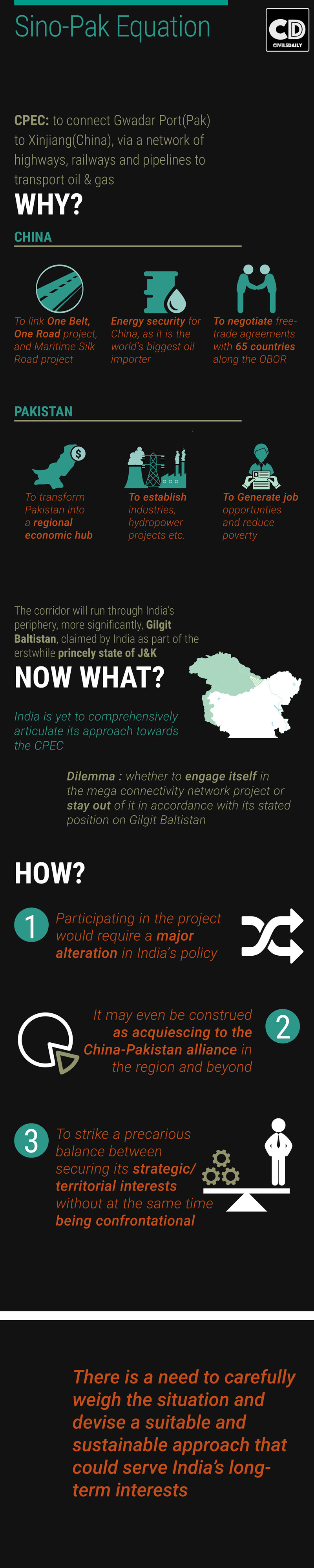
    • The China–Pakistan Economic Corridor (CPEC) is biggest connectivity project aims to connect Gwadar Port in southwestern Pakistan to China’s northwestern autonomous region of Xinjiang, via a network of highways, railways and pipelines to transport oil and gas.
    • The economic corridor is considered central to China–Pakistan relations and will run about 3,000 km from Gwadar to Kashgar.
    • The Corridor is an extension of China’s proposed 21st century Silk Road initiative.
    • According to a Firstpost report, this is the biggest overseas investment by China announced yet and the corridor is expected to be operational within 3 years.

    Why Gwadar Port is strategically so important to China?

    • Gwadar forms the crux of the CPEC project, as it is envisaged to be the link between China’s ambitious One Belt, One Road (OBOR) in Maritime Silk Road project.
    • In total, more than $1 billion worth of projects are to be developed around the port of Gwadar by December 2017.

    But, what are the geopolitical reasons to China’s OBOR project?


    • There are compelling geopolitical reasons, such as energy security, for China to push forward with its One Belt, One Road plans at a time when its trading partners are potentially excluding it from strategic agreements.
    • Trans-Pacific Partnership (TPP) countries, the Transatlantic Trade and Investment Partnership (TTIP) and the EU-Japan agreement show comprehensive liberalisation agendas, but do not include China and have the potential to increase trading costs.
    • In response, China plans to negotiate free-trade agreements with 65 countries along the OBOR.
    • Until now China has signed 12 free-trade agreements including Singapore, Pakistan, Chile, Peru, Costa Rica, Iceland, Switzerland, Hong Kong and Taiwan.
    • Further 8 are under negotiation with Japan, Korea, Australia, Sri Lanka, Norway, the Regional Comprehensive Economic Partnership, Asean and the Gulf Cooperation Council (GCC).

    How will CPEC benefits to Pakistan ? Is it a Game changer for Pak?

    • China and Pakistan hope the massive investment plan will transform Pakistan into a regional economic hub as well as further boost the growing ties between Pakistan and China.
    • The CPEC is considered a significant project that seeks to cement Sino-Pakistan bilateral ties and further consolidate their strategic ties.
    • According to The Guardian, “The Chinese are not just offering to build much-needed infrastructure but also make Pakistan a key partner in its grand economic and strategic ambitions.”

    What’s the claim from India in CPEC?

    • The corridor will run through India’s periphery, more significantly, Gilgit Baltistan, claimed by India as part of the erstwhile princely state of J&K.
    • In due course, this geographical reality of the CPEC could potentially impinge upon India’s geopolitical calculations and pose a strategic challenge.

    How does China look at CPEC?

    • In December 2014, the Chinese state-run Xinhua published a statement announcing the closure of the strategic Khunjerab Pass and in the process referred to Gilgit Baltistan as part of Pakistan.
    • Until then, China had maintained that J&K was a bilateral problem/dispute between India and Pakistan.
    • Whether terming Gilgit Baltistan as part of Pakistan reflected a possible shift in the Chinese position on the J&K— a change from its previously held neutral position – was debated in the Indian media for a while.
    • In the Gilgit Baltistan segment, the CPEC project design includes a major expansion of the Karakoram Highway, establishing industrial parks in special economic zones, constructing hydropower projects, railway line and road building.
    • The project also entails building hydropower projects and motorways/highways in the so-called Azad Jammu and Kashmir (AJK).

    What’s the India’s claim and response to it?

    • India’s High Commissioner to Pakistan, noted: “India has no worry over the construction of Pakistan-China Economic Corridor as an economically strong Pakistan would bring stability in the region.”
    • India is yet to comprehensively articulate its approach towards the CPEC despite the fact that the corridor bodes strategic implications for India.
    • The corridor will pass through the Gilgit Baltistan region where China has invested in the past in infrastructure and hydropower projects.
    • India has occasionally raised objections to Chinese infrastructure investment in the region.
    • New Delhi’s move to raise objections to Pakistan’s plan of holding an election in Pakistan-occupied Kashmir’s Gilgit-Baltistan region may appear to be an afterthought.
    • In fact, the belated assertion of a simple principle: In a dispute, express your maximal position, rather than the one you will compromise on.

    Is it India’s Dilemma?

    • Is it because of a realization that in a changed strategic landscape, the options for India vis-a-vis a project like CPEC are limited and complicated?
    • Is India conflicted about whether to engage itself in the mega connectivity network project or stay out of it in accordance with its stated position on Gilgit Baltistan and the so-called AJK?


    How does it pose a policy challenge to India?

    • Participating in the project would require a major alteration in India’s policy.
    • Overlooking the territorial dimension could be interpreted as a massive climb-down from its stated position.
    • It may even be construed as acquiescing to the China-Pakistan alliance in the region and beyond.
    • Thus, the CPEC poses a policy challenge to India on how best to strike a precarious balance between securing its strategic/territorial interests without at the same time being confrontational.
    • Charting a policy course is essential since China has, of late, through stray remarks extended an invitation for India to participate in the Silk Route ‘one route one belt’ project.

    How will CPEC get materialised despite scepticism?

    • Ironically, in Pakistan itself, there is growing cynicism about the CPEC’s prospects and feasibility because of security-related concerns and inter-provincial political discord on route preferences.
    • Nevertheless, given the Chinese determination to find a route to oil-rich West Asia through Pakistan, and the Pakistani desperation to provide every possible assurance to China about safeguarding its investments, the project is likely to be implemented, even if its scope may be limited.
    • One has to remember that China and Pakistan have weathered geographical and logistical extremes in the past to build the highest metalled road on one of the toughest terrain, i.e. the Karakoram Highway.
    • Moreover, the Pakistani decision to raise a special security division to protect Chinese workers and interests in Pakistan, indicates its resolve to implement the project in all earnestness.

    The Way forward

    • While India’s overall stance on PoK remains understated, the commencement of the CPEC warrants more serious attention than what has been accorded so far.
    • There is a need to carefully weigh the situation and devise a suitable and sustainable approach that could serve India’s long-term interests.
    • It is imperative that some of the explicit strategic concerns regarding the CPEC figure in the bilateral round of talks during the Indian Prime Minister’s forthcoming visit to Pakistan.

    What do you think on such a big triangular geostrategic politics? How will it resolved from Sino-India relations? Let us know!


    Published with inputs from Arun | Image: Wikipedia
  • Day1: IAS Mains 2015 Essay Paper

    Instructions: Write two essays, choosing one from each of the following Section A & B, in about 1000-1200 words.

    #1. Section ‘A’

    1. Lending hands to someone is better than giving a dole.
    2. Quick but steady wins the race
    3. Character of an institution is reflected in its leader.
    4. Education without values, as useful as it is, seems rather to make a man more clever devil.

    #2. Section ‘B’

    1. Technology cannot replace manpower.
    2. Crisis faced in India – moral or economic.
    3. Dreams which should not let India sleep.
    4. Can capitalism bring inclusive growth?

    What should an average aspirant do with these 8 topics?

    You read the 8 topics which formed the part of IAS Mains 2015 essay paper. Our best advice would be to try and look back on the events from late 2014 to mid 2015 and see how heavily these topics formed a part of daily news. If you can help find events, themes, newsbytes in the last year which can connect the dots on these topics, nothing like it!

    Think in broad topics – political, economical, world etc. and try to drive home the different incidents and point of views and connect them with the essay theme at hand.

  • Indian Polity | Speaker of the Lok Sabha

    The office of the Speaker is more than merely a presiding officer of the LS. One thing you will notice is that you will not find an exhaustive list of rules and procedures for the Officers of Lok Sabha and Rajya Sabha. That’s because these are offices of trust. We take for granted that when a Member is appointed a speaker, he/she keeps his party allegiance aside and acts in an impartial manner.

    Powers of the Speaker

    The Office of the Speaker is a very powerful one. He derives his powers from three sources – a. The Constitution, b. The Rules of Procedures and Conduct of Business of Lok Sabha and c. The Parliamentary Convention(residuary powers that are unwritten or unspecified).

    1. He is the sole authority to decide whether a Bill is a Money Bill or not. This decision of his cannot be challenged.

    The present Parliament is the best example to demonstrate how important this power can be. The Govt. enjoys a majority in the LS but not in the RS. Hence they are unable to get a lot of Bills passed. Our FM remarked that certifying the Bills as Money Bills are the only way to get them passed.

    *The Speaker has to consult Article 110 to mark a Bill as Money Bill. So it’s not entirely his discretion.

    1. He presides over the joint setting of the two houses. This privilege doesn’t belong to the Chairman of the RS. If the Speaker is absent, it goes to the Dy. Speaker of the LS. If the Dy. Speaker is absent, it goes to the Vice Chairman of the RS.
    2. The Speaker enjoys a special relationship with the Parliamentary Committees. All the Joint Parliamentary Committees are appointed by the Speaker and they report to him directly. Further, the Speaker nominates various members to these committees. If the Speaker himself is a Member, he becomes the ex-officio Chairman.
    3. The Office of the Speaker is retained till the 1st meeting of the next LS. All other Members cease to be in office once the LS dissolves.
    4. Special Role in Anti-Defection law. The Speaker has to accept the resignation of any Member of the House. This is to ensure that the resignation is voluntary. This decision is final but is open to Judicial Review. Ref: PRS India
  • IAS Mains answer writing – Explained via a model answer

    Update: Participate in the FREE Target Mains initiative going over at CD – Click Here


    Let’s take the case of a question on TAPI to see how one can approach answer writing.

    #1. Discuss the strategic significance of the TAPI pipeline and the potential challenges faced by it.

    TAPI (Turkmenistan-Afghanistan-Pakistan-India) pipeline recently made headway and shall bring gas from the Galkynysh gas field at India’s doorsteps in Punjab.

    The pipeline is not just a insurance against the energy challenges of the participant countries but reopening a historic route connecting South Asia to Central Asia. India shall find a particularly attractive proposition in the project given the proximity and abundance of Turkmenistan’s reserves.

    The pipeline is expected to play a major role in securing India’s interest in Central Asia especially in the backdrop of the energy-guzzling China securing half of its energy needs from the region. TAPI might be a game changer for the geopolitical stability for the region ensuring that India, Pakistan and Afghanistan get more strategically fused.

    However, the project might get encumbered with several challenges and needs to be insulated against the terrorism, securing it from Taliban across the Durand Line and from the militant groups in Pakistan.

    The project’s success shall also depend upon the TAPI countries disallowing any bilateral disputes from holding the pipeline to ransom and burying the history of doubt and skepticism to enable it to emerge as the pivot of a connected, cooperative, peaceful and prosperous region.

    Dissection:

    Given above is just an outline for an answer where you know some facts and use some names-dropping to make a decent enough answer.

    Facts like Galkynysh field, Durand Line, Chinese interest.

    Name calling like geo-political stability, strategically fused, pivot.

    Now let’s get some basic things right, now that we are set to write mains. Have it from me that there shall be many questions to which you shall only have a fleeting idea. And even in those questions where you have a fair idea of answers, it all gets messed up given the stress.

    So, first thing first, yes you are going to write probably the toughest exam in the country but don’t let it get the better of you as it would get the worse out of you in the paper.

    As I said before, before you start writing, pick up the central theme of the question and ensure you conjure up enough theme related words to be put in the answer. For example, a question on strategic importance shall appear empty without words like geo-politics. Little names-dropping you see.

    Even though the paper setter might have used an acronym in the question, you must expand it when you use it first time in your answer. Later you can use the acronym. Also, when you use an acronym expand it first time, write the abridged form in bracket and then use it. Expand USA as United States of America when you use it first time.

    In the examination hall, don’t look for the ‘best’ answer. There has never been and there shall never be one. At the end of the day, it all boils down to how well you used your information, how connected you remained to the question and, most importantly, how pleased the examiner was after reading your answer (because UPSC claims that they don’t give any model answers to the examiners. Sound a white lie to me).

    Ok? So Best of Luck once again and do well.

  • Social Security Scheme for Farmers : Ministry of Agriculture

    The Government is implementing a number of schemes to help the farmers in increasing their productivity by reducing cost of cultivation, achieving higher yield per unit and by realizing remunerative prices. 

    Let’s know about important new initiatives in this context!

    Soil Health Card (SHC) scheme

    Soil health cards scheme by Dept of Agriculture and Cooperation
    Soil health cards scheme by Dept of Agriculture and Cooperation


    • By SHC, the farmers can know the major and minor nutrients available in their soils.
    • It will ensure judicious use of fertiliser application and thus save money of farmers.
    • The balanced use of fertiliser will also enhance productivity and ensure higher returns to the farmers.

    What is the Neem Coated Urea ?

    • Neem Coated Urea is being promoted to regulate urea use, enhance its availability to the crop and reduce cost of fertilizers application.
    • The entire quantity of domestically manufactured urea is now neem coated.

    Paramparagat Krishi Vikas Yojana (PKVY)

    Paramparagat Krishi Vikas Yojana, a Cluster based programme by Ministry of Agriculture
    Paramparagat Krishi Vikas Yojana, a Cluster based programme by Ministry of Agriculture


    • It is being implemented with a view to promoting organic farming in the country.
    • This will improve soil health and organic matter content and increase net income of the farmer so as to realise premium prices.
    • The PMKSY is being implemented to expand cultivated area with assured irrigation, reduce wastage of water and improve water use efficiency.

    Centrally Sponsored Schemes (CSS) by Government –

    • National Food Security Mission (NFSM)
    • Mission for Integrated Development of Horticulture (MIDH)
    • National Mission on Oilseeds & Oil palm (NMOOP)
    • National Mission for Sustainable Agriculture (NMSA)
    • National Mission on Agricultural Extension & Technology (NMAET)
    • National Crop Insurance Programme (NCIP)
    • Unified National Agriculture Markets
    • Rashtriya Krishi Vikas Yojana (RKVY)

    But, What are the Centrally Sponsored Schemes?

    Centrally Sponsored Schemes (CSS) are schemes that are implemented by State governments of India but are largely funded by the Central Government with a defined State Government share.

    Let’s know about Market Intervention Scheme (MIS)?

    • MIS is for procurement of agricultural and horticultural commodities not covered under the Minimum Price Support (MPS) Scheme on the request of State/UT Government.
    • The MIS is implemented in order to protect the growers of these commodities from making distress sale in the event of bumper crop when the prices tend to fall below the economic level/cost of production.
    • Losses, if any, incurred by the procuring agencies are shared by the Central Government and the concerned State Government on 50:50 basis (75:25 in case of North-Eastern States).
    • Profit, if any, earned by the procuring agencies is retained by them.

    National Crop Insurance Scheme

    • It will protect the interest of farmers with a broader coverage towards crop losses and other such natural calamities. This is an intervention to cover the risks involved in farming.
    • Ministry of Food Processing Industries (MOFPI), through its various schemes, has been providing assistance to various agriculture related industries.

    But, What should be the priority of government for citizens?

    • To work towards enabling social security protection for citizens, especially from the economically weaker and vulnerable sections.
    • In accordance with this priority, the Pradhan Mantri Jeevan Jyoti Bima Yojana (PMJJBY), the Pradhan Mantri Suraksha Bima Yojna (PMSBY) and Atal Pension Yojana (APY) were recently launched to address the areas of life and accident risk, and old age income security.

    Do you know any other important schemes in this context?
    Then, Let us know!


    Source - Ministry of Agriculture | Pic - Soil Health Card

More posts