💥UPSC 2026, 2027, 2028 UAP Mentorship (March Batch) + Access XFactor Notes & Microthemes PDF

Search results for: “”

  • The Bahubali of a Devaluation!

    Dear Reader,

    The Chinese Yuan was devalued so suddenly, it was almost filmy in its implementation. Here’s my filmy take on a “Bahubali of a Devaluation” that appeared in the Hindu Business Line today under my column “Tweakonomics.” You can also read the column directly at http://www.thehindubusinessline.com/opinion/yuan-a-lens-eye-view/article7583325.ece

    Enjoy!

    ——————————————————————————————————-

    It’s official. So impressed is the film fraternity with the filmi way in which the Chinese Yuan was suddenly devalued, that film makers all over the world now want to re-create famous movies in China.

    Cast of the sci-fi movie “Honey, I shrunk the kids” was found in China last week, trying to create “Honey, I devalued the Yuan.” Instead of a mad scientist, the movie will show a mad economist, trying to gain entry into the IMF inner circle. The mad economist makes a desperate appeal to the IMF to let the Yuan be one of the 4 currencies that can be part of the Special Drawing Rights. But the IMF refuses to consider it and then the mad economist goes back to China and creates a machine that can shrink the Yuan to miniscule sizes.

    In the meanwhile, disavowed IMF agent Raghuram Rajan comes to India on Mission Impossible. His mission, if he is to accept it, is to prevent the Chinese devaluation from affecting Indian markets. He is given a team of the best to assist him in this mission. An FM who can make statements to calm the markets and Sundar Pichai as IT support. The services of Amma or Didi can also be availed to create the charm of the femme fatale, but he correctly refuses. As he fights with the havoc created by the Rogue Nation, he uses the FOREX to control the Rupee from going into free fall. Indian FOREX reserves fall a bit, but he says in style “Desperate times, desperate measures.”

    Karan Johar has also reached China to re-make “Kabhi Renminbi Kabhi Yuan”. In Johar’s film, Shah Rukh Khan, who is Bachchan’s son and lives in a palace that looks suspiciously like the NY Federal Reserve, is called Dollar. In the meanwhile, there’s Renminbi, played by Kajol, who lives in abject poverty off the Great Wall of China. Dollar and Remnimbi exchange rate their vows and enter parity. The marriage enters troubled waters. Reason? Kajol has become fat and has slowed down. Bas! Aur nahiiii! Renminbi decides to devalue and break parity. Kajol, wearing a 10-feet long black pallu depresses currency, derivative and stock markets through the globe. But she emerges looking leaner and meaner and with re-newed fundamentals, re-enters a new, more flexible relationship vis-a-vis Dollar. Shava shava!

    Karan Johar also wanted to re-make “Currency of the Year” in China; but the Chinese Government expressed serious reservations about allowing Alia Bhat to play a central role in any movie made on Yuan dynamics.

    Finally, much to the consternation of the Chinese, the entire star cast of Bahubali reached Shanghai, the new Mahishmati. Chinese economists were rounded up for a compulsory viewing of the first part. The poor economists could only watch in stunned silence as the towering matriarch with the curled lip gave crazy orders holding two babies in one hand, while Orcs from another movie suddenly entered the scene to pass lewd comments. Her spite and command reminded many of the good old Mao days. After the ordeal was over, wiping tears of disbelief and relief, the Chinese Premier asked the only question, which has been ticking in the mind of crores of Indians. “WHY, oh WHY did Katappa cut-uppa Bahubali? Tell me the answer and I’ll do anything you want. I’ll stop the Yuan from devaluing further.” Bahubali Junior removed his helmet. It was PM Modi. “Place a call to Dr. Rajan and tell him it’s all over. Mission Accomplished. There’s no need for competitive depreciations and FOREX reductions. All it needed was a Hindi movie.”


  • Targeting Mains

    Prelims is over and I am sure many of you who are reading this will clear that stage. Don’t be too happy about it. it is just one small step towards a bigger goal. The goal to contribute towards society. The goal to bring positive change in people’s lives (Mind you, your goal is not just to become an IAS). The next stage is more fierce, more competitive and more demanding. It can make you realize your limitations but at the same time, it gives you a chance to learn and know about what is happening about you. It will sanitize you about social milieu you live in and about the ways you can contribute towards the society.


    Often, prelims and mains are different ball game. While prelims is very diverse and requires certain skill sets, mains is more about focus, analysis and have an in-depth understanding of a subject. Off late,  UPSC is asking questions based not just on the facts but based on your understanding and perspective. There might not be right or wrong answers to many of the questions asked in UPSC.


    Now the task is not that simple. You can’t just read, memorize and reproduce in the exam. You have to understand the topic which you read, understand multiple perspectives about each topic and come up with your own perspective. In such a scenario, debates and discussions among your peers, with parents, and with mentors would come handy.


    Writing practice has its own advantages, but you would write only those things which you know. So knowing becomes more paramount. Try to build up a perspective. Try to read multiple resources. Don’t just stick to one paper. Try to include 2 or 3 papers to understand various points of view. Talk to you seniors often about the subjects which are socially relevant. Try to put yourself in that situation (as an administrator) and think about the solution from multiple perspectives.


    To know the facts is the bare minimum which all the 16000 candidates writing mains will be doing. To crack it with flying colors, you need to walk on extra mile, you need to be original in your thought and should be able to communicate well through your writing. I hope you get an idea of how to proceed with your preparation for mains.

  • [UPSC Mains 101] Don’t Just Read News – Understand the Theme

    Down through the ages, a new form has evolved for the preparation for the UPSC Mains examination. The aspirants are invited to come up with a ~200 odd words answer to a set of questions put on a daily basis. The peers & mentors are invited to assess the answers and plug up leakages in terms of logic and facts.


    We at Civilsdaily intended to respect that tradition but then we realised that this way of approaching news might be myopic in the long run.

    Why so?


    • A simple question-answer test series works wonderful for static subjects. There is no news – there is no evolution. Babur is not going to fight another war of panipat because it’s awesome to fight in an open terrain enroute to delhi & Indus Valley folks do not have more surprises for you other than the meticulously planned towns and cities!
    • But the game changes when you are understanding Current Affairs. You are not just playing with Information – You are dealing with News in Themes.
    • This may sound cliché but just look around the papers and see how beautifully UPSC integrates the current affairs in the paper under every section apart from, probably, History.

    Phailin found its way in the paper with “How cyclones are named”, Shale gas found its way under “Distribution of shale gas”, Section 66A of the IT act made its presence felt in the paper, Green Corridors, String of Pearls all were there.

    • So, while it makes sense to have an answer writing practice – It is better that you let a news develop and then put your thoughts to shape!
    • When you are reading a topic, just ponder over it for a while and see how it connects with the other topics of the syllabus.

    UPSC has this uncanny habits of joining multiple topics in a single question like connecting border management to internal security, makes sense?

    Enough Gyaanbaazi – What do we propose?

    Ready?

    1. The first topic is out – We want you to tell us everything you know about the Special category status for states and how the events shaped up. Discuss 14th FC – Discuss Neeti Ayog – Discuss Articles of constitution and what not!
    2. We will follow this up with a summary of important terms every alternate day or so – so keep coming back!
  • Will the US raise interest rates in September?

    No.

    Based on the volatility we’ve been witnessing in the global markets, it seems unlikely that the Fed will hike interest rates in the September review.

    One of the external factors that the RBI has been watching closely for taking a call on its own interest rate stance is the behaviour of the US interest rate. Since Jan 2015, increasing number of Fed members, policy analysts and traders have opined that an interest rate hike in the US is a question of when, rather than of.

    The markets were largely expecting that the Fed would raise its interest rates in the September review. The RBI, which did not slash rates in last month’s policy review, also seemed to be waiting for some kind of a cue coming in from the Fed, before it could give a reduction on rates.

    Pre-volatility, why were the markets expecting the Fed to hike rates?

    The basic argument was that the jobs data from the Labor Bureau has been very good in the run-up to August. Unemployment rate in the US seems to be around 5.5% (see chart below). Now, the Federal Reserve believes that the “Natural Rate of Unemployment” for the US stands between 5% and 6%. This is the unemployment rate faced by the US when the labor resource is almost fully employed. Thus, any further reduction in the unemployment to say, 5%, would eventually spark off wage inflation and feed into an overall price hike.

    image001

    Has the inflation in the US been very high?

    Actually, no. But since monetary policy is as much about managing inflationary expectations as it is about curbing the actual inflation, the Fed was taking a view that the current jobs data seemed to show a trend of future potential inflation. It would be necessary to curb this potential overheating by hiking interest rates.

    image001

    How has the dollar been moving vis-a-vis other currencies in the past one year?

    Now this is one trend which is really interesting. If we observe the US Dollar Index (which is 6 currencies weighted against the dollar), we find that the dollar has pretty much strengthened against a basket of currencies since September 2014. The aggregate strengthening of the dollar over the past one year works out to a hefty 14%. So for a year now, the dollar has been getting stronger, which has been hurting the exports movement from the US.

    image001

    So what has changed now?

    Many things.

    • Since the Emerging Market economies have all witnessed considerable depreciations in this week, the dollar will emerge even stronger once the dust starts settling down. This by itself, should help the economic system to move from overheat to a more calm economy.
    • Add to this the fact that cheaper exports and cheaper oil should take the inflation southwards. Since the Chinese growth rate is expected to be soft in the coming fiscal, the biggest buyer of commodities will be showing low demands. This will cause commodities to remain low for a while, helping inflation to be controlled for all economies including the US.
    • Finally add to this the fact that the Chinese Central Bank PBOC has reduced its interest rates in an attempt to excite the real sector fundamentals into growth. Even with the US interest rates untouched, it really creates a differential between the US interest rates and the Chinese interest rates, which effectively helps in controlling overheat and dampening inflation in the US.
    • One last point before I wind up. Interest rates are changed in order to give critical direction to the economy. By that I mean, that interest rates are used as an instrument to change values in the real sector of the economy. However, that they have an impact on financial markets is also a given. When markets are already jittery and on tenterhooks, it would be pointless to rattle them some more by hiking the rates at this point.

    There seems to be no case left for a September hike anymore.

  • Special Category Status and States

    • What is ‘Special Category’ status?
      What benefits do states having ‘Special Category’ status enjoy?
    • Who accords the category status to state and how?
    • Which states held Special category status?
    • Lacunas in the working of Special Category status
    • Why the status has been removed?
    • Way ahead now

    What is ‘Special Category’ status?

    • ‘Special category’ status is a classification given by Centre to assist in development of those states that face geographical & socio-economic disadvantages like hilly terrains, strategic international borders, economic & infrastructural backwardness and non-viable state finances.
    • The classification came into existence in 1969 as per the suggestion given by the Fifth Finance Commission, set up to devise a formula for sharing the funds of Central govt. among all states.

    What benefits do states having ‘Special Category’ status enjoy?

    • Significant concession in excise & customs duties, income tax and corporate tax
    • 30 percent of planned expenditure (central budget) goes to ‘special category’ states
    • Special Category states are benefited because of Normal Central Assistance which was skewed in favour of these states. These states get more funds in terms of NCA and most part of these funds was in the form of grants rather than loans.
    • Special Central Assistance given to SCS is also an additional amount which can be used by the concerned state for economic development.
    • Centre bears 90% of the state expenditure (given as grant) on all centrally-sponsored schemes and external aid while rest 10% is given as loan to state. For general category, the respective grant to loan ratio is 30:70 where as external aid is passed on in the same ratio as received at the centre.
    • Unspent money does not lapse and gets carry forward.

    Hence, special-category status catalyses the inflow of private investments and generates employment and additional revenue to state. Since centre bears 90% of state expenditure on all centrally-sponsored schemes, state can take more welfare-based schemes from the new savings.

    Further, more grants from centre helps in building state infrastructure and social sector projects. As a result, special-category state gets to bridge its development deficit.

    Who accords the category status to state and how?

    Special Category’ status had been granted in the past by the Union government to States having certain characteristics based on the recommendations of the National Development Council.

    These include

    i) hilly terrain;

    ii) low population density and/or sizeable share of tribal population;

    iii) strategic location along borders with neighbouring countries;

    iv) economic and infrastructure backwardness; and

    v) non-viable nature of State finances.

    Special Category States

    source

    Which states held Special category status?

    11 states used to have ‘special category’ status, namely, Arunachal Pradesh, Assam, Manipur, Meghalaya, Mizoram, Nagaland, Sikkim, Tripura, Jammu & Kashmir, Himachal Pradesh, and Uttarakhand.

    Lacunas in the working of Special Category status

    • Firstly, the way Special Category Status were assigned to a state has been a matter of debate. Various committees used different parameters to classify a state in Special Category status.
    • Some states lobby central government to classify them in special category. This was to be corrected and the consent of majority of state must be taken before granting a special category status to any state.
    • Moreover there should have been a general consensus among states related to principle used for granting the SCS.
    • Secondly, data reveals that even after awarding Special category status not much economic progress has been noticed among states. This may mean that for economic development it’s important to follow sound economic policy. Benefit of SCS may act as a stimulus but rest depends on the individual state policy.
    • Third, the amount of proceeds that states receive has increased after 14th finance commission. So the structure does not seem to have any specific relevance in present context.

    Why has the status been removed now?

    The Finance Ministry’s reasoning for withdrawing the status is that the higher 42% devolution takes into account all needs of states.

    Way ahead?

    Following the demand for Special Status by Bihar, a committee was appointed under Dr. Raghuram Rajan in 2013. This committee suggested that States classified as ‘Special Category States’ and those seeking inclusion in that category, would find that their need for funds and special attention more than adequately met by a basic allocation to each State and the categorisation of some as ‘least developed’.

    Considering special status to any new State will result in demands from other States and dilute the benefits further. It is also not economically beneficial for States to seek special status as the benefits under the current dispensation are minimal. States facing special problems will be better off seeking a special package.


    References:

  • Prelims Over – What Next?


    Hello Everyone!

    Well it is three days past the ‘bloodbath’ and I am sure that after the customary UPSC-bashing and verifying the responses from various sources most of you should be very clear about where you stand.

    Many of you might have embraced the “truth” that you are not going to make it and must still be reeling under the cloud of the Pre disaster. For them a simple message is, ‘What if you make it to the next round, by chance, by luck or by fluke, by anything for that matter? In that case will you be able to complete all the 7 papers in one and a half months time (assuming Pre result shall be out by mid-Oct)? If no, start preparing for mains. Right away.’

    At this moment even the UPSC does not know the cut-off so don’t be disheartened. And for those who are sure that they will clear Prelims and are still celebrating, the message is, ‘About 100 days, 6 papers (not even counting the Essay). This is the time to pull out all stops. A day wasted by you is like giving a lead of 24 hours to your fellow competitors.


    Ok now let’s shift the gear to the central idea of writing this blog. The Mains, the main battle. Clearing Prelims affords you a chance to enter the ring. Mains is where the punches are. Whether you shall make it to the list of finally selected candidates depends largely upon how you defend yourself from these punches.

    All of you are well versed with the three pronged strategy of read-revise-write. If you read and don’t revise, you won’t be able to recall. If you read and revise but don’t practice writing, again useless. It is a daunting task to write 8000-10000 words across two papers in a single day if you are not in the habit of writing.

    Depend on it, you may know the answers but after initial 7-8 answers the thumb shall start aching and you would only end up littering on the answer sheet.

    Practice answer writing is the central idea.

    Now coming to the questions themselves.

    Over the years a well planned strategy of the coaching malls had been to impregnate a simple idea in the mind of the candidates and that is that UPSC can ask anything under the sun. It has resulted in some sort of fear psychosis where UPSC is being seen as an enemy to be vanquished.

    The biggest myth and the most potent propaganda. If they had to ask anything under the sun why would they even waste time in printing a notification that runs into tens of pages, most of it listing the syllabus? To be fair to UPSC, we should accept that they ask question from the syllabus. Yes they do expect you to go a little further and probe all the current happening or background of a listed topic but that is it.

    And ‘itna to haq banta hai unka’. After all they are picking up the ones who shall practically run the country. So they need the brains that go a little further and are certainly not oblivious to their surroundings.

    For example, all of us have read about the thaw in the relations of US and Cuba. Every other day there was some news items. But shall not a general “educated” person (the ones that UPSC claims to be looking for) probe about the very first thing that crosses our mind when we think of Cuba. Castro? Yes. Cigar? Yes. But what about “Cuban Missile Crisis”? Shall we really blame an examiner who expects examinees to have done a background search on Cuban Missile Crisis?

    Somehow question in mains, especially in GS Paper II and Paper III, can be traced back to some prominent current event, until and unless coaching malls decided to run commentaries on it and UPSC decided to give it a skip and save it for future.

    Remember, the Nagaland and Ministry of Oil confrontation and a direct question in UPSC or the Mid Day Meal mishaps and question in mains or AIIB formation and the mains question? Examples abound.

    So what is the bottom-line? Read the syllabus, again. Have a well chalked-out plan and execute it. Read the newspapers and focus on items with direct correlation to the topics in the syllabus. Frame a question and practice writing the answer. And, in case you are hard-pressed for time, which you shall be for sure, leave the work to us.

    We can and we will hold your hand to success. The Mains strategy should be out by tomorrow. Let’s get cracking!

  • The Art of Reading Newspaper & How Civilsdaily Got it Right


    We started thinking about Civilsdaily sometime in early January. We were talking to a friend of ours who was appearing for the civil services examination this year and among other things, he was complaining about how hard it was to connect the news items together and understand a story in full.

    A lot is lost among the clamour of opinions, open letters, discussion forums and what not and news starts becoming overwhelming! And that’s how we realised that the news is broken today.

    We started by hand curating bits and pieces of important news items which were most relevant news for IAS Prep. Preparing current affairs for IAS Prep is no mean task.

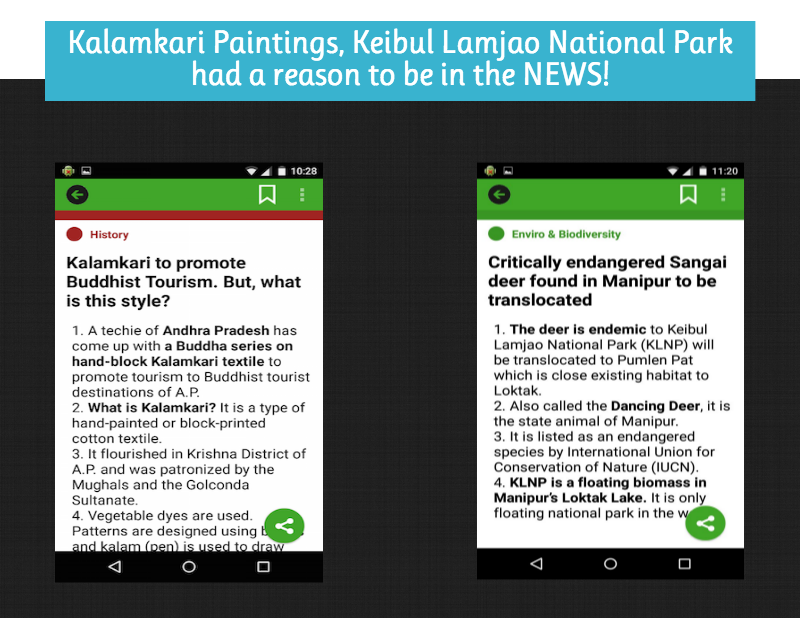
    We aggregated the best news dailies from India and abroad and pushed them in a simple, clutter free interface – The Civilsdaily Android App!


    Look familiar? We bet they do! These and many more formed the part of the current affairs questions at the UPSC 2015 Paper I this year. We are not saying that a sincere student won’t be able to ace them all (given enough time and coverage), but imagine having them all in one place – handy for a quick revision while you wait in long queues or sleep through those boring lectures, wait for your code to compile in the office or that customary chai-sutta break!


    What next?

    If you are preparing for UPSC 2016 & beyond  There is no reason why you should miss even a single day @civilsdaily. While we understand that it’s not easy to remember all the news items, we do firmly believe that key point summaries + regular revisions will go a long way in making current affairs for IAS Prep easy for you!


    For those looking forward to this year’s mains – Try and read all the News Stories that we have been making all this while.

    1. Working behind the scenes, all this while, we have been linking these Newscards into News Stories.
    2. It’s not good enough to read news daily – what is expected is build up a well grounded understanding of events & issues at hand. What do we mean?
    3. Think of the Yemen Crisis and imagine being able to link up Arab Spring – Shia/ Sunni conflict – US/ Iran deal and then India’s changing diplomacy in one single story @ Yemen Crisis. Sounds good, right?

    All right then, it’s time to end this blog lest it becomes too didactic! Share your experiences – if you have been a seasoned exam taker, let us know your experiences.

    Share this post! Let it reach as many students as it should. A community is only as strong as its members and we would love to break the UPSC Mains’ code as well!


    PS: We have started bringing in independent mentors, guests and rankers at the CD Hub. The idea is to make concepts lucid and understanding easy!

    PPS: If you have benefitted from our endeavours, please take some time and rate us at the Playstore. If you have already done that, won’t you be nicer still and tell us about civilsdaily at this question @Quora!

    See you around!


More posts