💥Mains Ready By December. Smash Mains & Smash PYQ Admissions Open

Search results for: “”

  • What is African Swine Fever (ASF)?

    • Amid the coronavirus pandemic, another disease outbreak is affecting thousands of animals in Assam.
    • Since February, over 2,900 pigs have died in the state due to African Swine Fever (ASF), which does not affect humans but can be catastrophic for pigs.
    • This is the first time that an ASF outbreak has been reported in India.

    As Flu is nowadays a lot in news, keep a tab on them for prelims. Be it the Swine Flue, African Swine Fever or even H5N1.

    African Swine Fever (ASF)

    • ASF is a severe viral disease that affects wild and domestic pigs typically resulting in an acute hemorrhagic fever.
    • The disease has a case fatality rate (CFR) of about 100 per cent.
    • Its routes of transmission include direct contact with an infected or wild pig (alive or dead), indirect contact through ingestion of contaminated material such as food waste, feed or garbage or through biological vectors such as ticks.
    • The disease is characterized by the sudden deaths of pigs.
    • Other manifestations of the disease include high fever, depression, anorexia, loss of appetite, hemorrhages in the skin, vomiting and diarrhoea among others.

    How did the current outbreak start?

    • As per the latest update issued by FAO, the current outbreak of ASF has affected China, Mongolia, Vietnam, Cambodia, Myanmar, the Philippines, Republic of Korea and Indonesia among others.
    • In China, the first ASF outbreak was confirmed in August 2018 and since then more than 1 million pigs have been culled in the country.
    • ASF came into India through Tibet into Arunachal Pradesh and then into Assam, the state with the highest population of pigs in the country.

    How is ASF different from swine flu?

    • Swine influenza or swine flu is a respiratory disease of pigs, which is caused by type A influenza virus that regularly causes outbreaks of influenza in pig populations.
    • While the swine flu causing virus leads to a high number of infections in pig herds, the disease is not as fatal and causes few deaths. Specific swine influenza vaccines are available for pigs.
    • The swine flu viruses are spread among pigs through close contact and through contaminated objects moving between infected and uninfected pigs.
    • Symptoms include fever, depression, coughing, discharge from the nose and eyes, eye redness or inflammation.

    Vaccines availability

    • As of now, there is no approved vaccine, which is also a reason why animals are culled to prevent the spread of infection.
    • It is important that determination of ASF is made through laboratory testing and it is differentiated from Classical Swine Fever (CSF), whose signs may be similar to ASF, but is caused by a different virus for which a vaccine exists.
    • Even so, while ASF is lethal, it is less infectious than other animal diseases such as foot-and-mouth disease.

    What is the impact ASF will have on pig farmers?

    • Pig farmers in Assam describe the outbreak as a “double whammy” since the COVID-19 lockdown was already impacting sales negatively.
    • The outbreak has ruined the prospect of the Northeastern states as a hub for the export of pork products.
  • Luhman 16A: A binary brown-dwarf system

    A group of international astrophysicists have identified cloud bands on the surface of Luhman 16A, one of a pair of binary brown dwarfs in the Vela constellation.

    Space terminology has gained importance in prelims. The Luhman 16A coupled with few more examples of space concepts like binary star and dwarf star are discussed in this newscard.

    Luhman 16A

    • Luhman 16 is a binary star system, the third closest system to the Sun after Alpha Centauri and Barnard’s star.
    • At a distance of about 6.5 light-years from the Sun, this pair of brown dwarfs referred to as Luhman 16A and Luhman 16B orbit each other, casting a dim light.
    • Brown dwarfs are also called failed stars because their masses are intermediate to the largest planets and the smallest main sequence stars.
    • Their masses being too small, they are unable to sustain fusion of their hydrogen to produce energy.
    • It is believed that some of the more massive brown dwarfs fuse deuterium or lithium and glow faintly.

    The cloud band over Luhman

    • The group, by using the Very Large Telescope at European Southern Observatory, Chile, found that Luhman 16A had band-like clouds in its atmosphere, whereas the same was not true of Luhman 16B.
    • Many astronomers detected polarization of brown dwarfs.
    • But what is special in the newest study of Luhman 16 is that the researchers have found the actual structure of the clouds — that they form bands over one of the pair.
    • Understanding the cloud system over a brown dwarf can shed light on the pressure, temperature and climate on the surface of the celestial body.

    Why it has made into a headline?

    • The researchers have used an idea put forth nearly two decades ago by Indian astrophysicist Sujan Sengupta, who works at the Indian Institute of Astrophysics, Bengaluru.
    • Sengupta had propounded the light emitted by a cloudy brown dwarf, or reflected off an extrasolar planet, will be polarized.
    • He then suggested that a polarimetric technique could serve as a potential tool to probe the environment of these objects.

    Back2Basics: Binary Star System

    • A binary star is a star system consisting of two stars orbiting around their common barycenter.
    • Systems of two or more stars are called multiple star systems.
    • These systems, especially when more distant, often appear to the unaided eye as a single point of light, and are then revealed as multiple by other means.
    • Binary star systems are very important in astrophysics because calculations of their orbits allow the masses of their component stars to be directly determined.
  • [pib] Seasonal rapid advancement of Surging Glaciers in Karakoram Range

    Indian researchers have found a seasonal advancement in 220 surge-type glaciers in the Karakoram Range of Ladakh.

    Points to note:

    1) Open you map and revise the glaciers of Himalayan region.

    2) Glacial landforms as Geographic phenomenon.

    What are Glacial Surges?

    Click here to see the animated view

    • Glacial surges are short-lived events where a glacier can advance substantially, moving at velocities up to 100 times faster than normal.
    • Until recently, most glaciologists believed that a glacier’s physical characteristics, such as its thickness and shape, and the properties of the terrain it sits on determining whether it can surge.
    • Now, it is proved to believe an external factor also plays a major role: water from precipitation and melting.
    • Pooling on the surface, it can infiltrate the glacier through crevasses and reach its base, warming, lubricating, and, ultimately, releasing the ice.

    Why surging in the Karakoram is a concern?

    • The behaviour of these glaciers, which represent 40% of the total glaciated area of the Karakoram, goes against the normal trend.
    • Surging of glaciers is potentially catastrophic as it can lead to the destruction of villages, roads and bridges.
    • It can also advance across a river valley and form the ice-dammed lake.
    • These lakes can form catastrophic outburst floods.
    • Therefore, monitoring of glacier surges, ice-dammed lake formation, and drainage is of paramount importance.

    Which are these glaciers?

    • The scientists focused on the Shispare and Muchuhar glaciers, former tributaries of the once larger Hasanabad Glacier situated in Hunza Valley, Gilgit-Baltistan.

    Significance of the study

    • The Surge-type glaciers oscillate between brief (months to years) rapid flow and lengthy (tens to hundreds of years) slow flow or stagnation, which are called the ‘active’ (or ‘surge’) and ‘quiescent’ phases, respectively.
    • This unsteady glacier flow makes it difficult to accurately assess individual glacier mass balances using in-situ observations.
    • The study will help to understand the diversity of glacial behaviour and help make accurate assessments of individual glacier mass balances for disaster planning and management.
  • [pib] Data on Energy Savings

    The Union Ministry of Power has released a Report on “Impact of energy efficiency measures for the year 2018-19”.

    Things to note:

    1) UJALA Scheme

    2) PAT Scheme

    3) Standards & Labeling Programme

    Possible mains question:

    Q. Discuss the role of Bureau of Energy Efficiency (BEE) in “institutionalizing” energy efficiency services in India.

    About the report

    • This report was prepared by an Expert agency PWC Ltd, who was engaged by the Bureau of Energy Efficiency (BEE).
    • The objective of this study is to evaluate the performance and impact of all the key energy efficiency programmes in India, in terms of total energy saved and the related reduction in CO2 emissions.

    Data on energy savings

    • With our energy efficiency initiatives, we have already reduced the energy intensity of our economy by 20% compared to 2005 levels. This includes both the Supply Side and Demand Side sectors of the economy.
    • The implementation of various energy efficiency schemes has led to total electricity savings to the tune of 113.16 Billion Units in 2018-19, which is 9.39% of the net electricity consumption.
    • Energy savings (electrical + thermal), achieved in the energy-consuming sectors is to the tune of 16.54 Mtoe, which is 2.84% of the net total energy consumption in 2018-19.
    • Overall this has translated into savings worth INR 89,122 crores against last year’s savings of INR 53,627 crore.
    • These efforts have also contributed to reducing 151.74 Million Tonnes of CO2 emissions, whereas last year this number was 108 MTCO2.

    (Note: Mtoe= million Tonne of Oil Equivalent)

    What led to this significant savings?

    • The study has identified the following major programmes, viz. Perform, Achieve and Trade Scheme, Standards &Labelling Programme, UJALA Programme, Municipal Demand Side Management Programme, etc.
    • There is huge capacity still for bringing efficiencies especially in MSME sector and a Housing sector that has now been taken up.

    About the Bureau of Energy Efficiency (BEE)

    • The Bureau of Energy Efficiency is an agency under the Ministry of Power created in March 2002 under the provisions of the nation’s 2001 Energy Conservation Act.
    • Its function is to develop programs which will increase the conservation and efficient use of energy in India.
    • The mission of BEE is to “institutionalize” energy efficiency services, enable delivery mechanisms in the country and provide leadership to energy efficiency in all sectors of the country.

    Back2Basics

    1) PAT Scheme

    • Perform Achieve and Trade (PAT) scheme is a flagship programme of the Bureau of Energy Efficiency under the National Mission for Enhanced Energy Efficiency (NMEEE).
    • NMEEE is one of the eight national missions under the National Action Plan on Climate Change (NAPCC) launched in the year 2008.
    • The scheme aims to reduce specific energy consumption in energy-intensive industries through certification of excess energy saving which can be traded.
    • It refers to the calculation of Specific Energy Consumption (SEC) in the baseline year and projected SEC in the target year covering different forms of net energy going into the boundary of the designated consumers’ plant and the products leaving it over a particular cycle.
    • Those eight Energy Intensive Sectors included are Chlor-alkali, Pulp & Paper, Textile, Aluminum, and Thermal Power plants, Fertilizer, Iron & Steel and Cement.

    2) Standards & Labeling Programme

    • It is one of the major thrust areas of BEE.
    • A key objective of this scheme is to provide the consumer with an informed choice about the energy-saving and thereby the cost-saving potential of the relevant marketed product.
    • The scheme targets display of energy performance labels on high energy end-use equipment & appliances and lay down minimum energy performance standards.

    3) UJALA Scheme

    • Launched in 2015, the Unnat Jyoti by Affordable LEDs for All (UJALA), in a short span of time, has emerged as the world’s largest domestic lighting programme.
    • The main objective is to promote efficient lighting, enhance awareness on using efficient equipment which reduces electricity bills and helps preserve the environment.
    • The Electricity Distribution Company and Energy Efficiency Services Limited (EESL) a public sector body of the Ministry of Power is implementing the programme.
  • [pib] Energy-efficient Photodetector for Security Application

    Indian scientists have fabricated an economical and energy-efficient wafer-scale photodetector using gold – silicon interface, for security applications.

    A basic question on the working principle of Photodetectors can be asked in the Prelims.

    What are Photodetectors?

    • Photodetectors, also called photosensors, are sensors of light or other electromagnetic radiation.
    • A photodetector has a p–n (positive-negative) junction that converts light photons into the current.
    • The absorbed photons make electron-hole pairs in the depletion region.
    • Photodiodes and phototransistors are a few examples of photodetectors. Solar cells convert some of the light energy absorbed into electrical energy.
    • The material cost and the intricate fabrication processes involved in realizing high-performance detectors make them unaffordable for day to day applications.

    Applications

    • Photodetectors are the heart of any optoelectronic circuit that can detect light.
    • They are employed for a wide variety of applications ranging from controlling automatic lighting in supermarkets to detecting radiation from the outer galaxy as well as security-related applications.
    • They range from simple devices that automatically open supermarket doors, to receivers on the TV remote controls.

    What did Indian researchers achieve?

    • The scientists have fabricated gold (Au) – silicon (Si) interface, which showed high sensitivity towards light demonstrating the photodetection action.
    • The Au–Si interface was brought about by galvanic deposition, a technique for electroplating of metals, wherein water-based solutions (electrolytes) are used, which contain the metals to be deposited as ions.
    • In addition, a nanostructured Au film also was deposited on top of p-type silicide (having an excess of positive charges), which acts as a charge collector.

    Benefits

    • Being a solution-based technique, the method is highly economical and enabled large-area fabrication without compromising the detector response.
    • The process is quick, taking only minutes to fabricate a detector of any arbitrary area and exhibited a rapid response of 40 microseconds.
    • This photodetector displayed long-term environmental stability.
    • The Indian invention provides a simple and cost-effective solution-based fabrication method for high-performance photodetector.
    • It could help detect weak scattered light as an indication of unwanted activity.
  • Get ready for upcoming 6th Full Length Prelims Test (Full Syllabus) on 9th May – sample questions highlighting our methodology

    Click here to enrol for the Prime Prelims TS

    Dear students,

    31st May 2020 is the D-day for all civil service aspirants.

    “Give me six hours to chop down a tree and I will spend the first four sharpening the axe.”

    This quote by Abraham Lincoln sums up how one should prepare for that day. So before entering the battlefield alone should have enough practice. Our Prime Prelims Test series which shall enrich you to acquaint yourself with the pattern of CSE-2020, assess your abilities, rectify your mistakes and make you confident to appear on the examination day.

    Our Prime Prelims Test Series follows the same approach as that adopted by UPSC. Our team of experts is quite enriched with the UPSC pattern and focal point of the questions and hence creates more chances for the aspirants to crack civil service examination by appearing our Test Series.

    This is the time where you must have done most of your revision and are ready to face the UPSC CSP with all the josh. Thus, what better exercise would you need than the full syllabus Mock Test. This is the 1st among the four Full-Length Tests covering the whole syllabus and we have curated it as per the trend of previous 5 years of UPSC CSP.  You see, since 2015, this has been the general weightage of various subjects in UPSC CSP:


    Subjects Question Distribution in the year 2019 Question Distribution in the year 2018 Question Distribution in the year 2017 Question Distribution in the year 2016 Question Distribution in the year 2015
    Economy 14 16 8   8 13
    Current Affair

    (including IR)

    22 28 34   27 29
    History, Modern India, Indian National Movements, Art and Culture 17 15 14   15 14
    Geography 14 8 7   7 14
    Polity 15 13 22   7 13
    Science & Technology 7 7   4   8 7
    Environment 11 13   11   18 10

    This is reflected in our mock test as well.

    History, Art & Culture: 16

    Polity and Governance: 15

    Economics: 12

    Geography: 15

    Environment: 14

    Science and Tech: 10

    International Organizations, Maps and Current Affairs: 18

    The key philosophy of our prelims TS is Evidence-based question making: The 3600 questions you face in our mocks have their relevance established in UPSC’s trend analysis. We focus on themes that are important as per UPSC so that we maximize your chances of questions overlap with the actual UPSC Prelims.

    Nothing speaks more than the facts itself rather than a mere jargon. Here is a list of 5 sample questions from the upcoming test which will help you in identifying the standards and approach we follow. (you can skip this if you want to attempt these directly in the test). 

    Noone but only you can assess how it will help you in being the top percentile of aspirants. You have to practice ruthlessly and civils Daily provides you with a platform to hone your skills.

    Q1. With regard to the Charter Act of 1833, consider the following statements:

    1. After the Charter Act of 1833, the East India Company ceased to be a commercial agency in India.

    2. The Charter Act of 1833 debarred those Indians from entering the public services who had not been educated in England.

    Chose the correct statements from the codes given below:

    a. 1 only

    b. 2 only

    c. Both of them

    d. Neither of them


    Q2. Which of the following rivers does have their origin in the Aravallis?

    1. Banas

    2. Sakhi

    3. Mahi

    4. Luni

    Which of the following statements are correct?

    a. 1, 2 and 3 only

    b. 1, 2 and 4 only

    c. 3 and 4 only

    d. 1 and 3 only


    Q3. Consider the following statements about Low Earth Orbit (LEO).

    1. It is an Earth-centered orbit with an altitude of 2,000 km or less.

    2. The International Space Station conducts operations in LEO.

    3. A major disadvantage of low Earth orbit is that it requires a high amount of energy for satellite placement.

    Which of the above statements is/are correct?

    a. 1 and 2 only

    b. 2 and 3 only

    c. 1 and 3 only

    d. All of them


    Q4. Which of the following provisions are enshrined the constitution of India for protection of the rights of linguistic minorities?

    1. A person can submit a representation for redressal of grievances to any authority of the state in any language used in the state.

    2. Any citizen having a distinct language or script has the right to conserve it.

    3. Instruction in the mother tongue at the primary stage of education.

    Select the correct answer using the code given below.

    a. 1 and 2 only

    b. 2 and 3 only

    c. 1 and 3 only

    d. All of them


    Q5. With reference to Statutory Grants under Article 275 of the Indian Constitution, consider the following statements:

    1. It empowers the Parliament to make grants to each and every state of India.

    2. It is given to states on the recommendation of Finance Commission.

    Which of the statements given above is/are correct?

    a. 1 only

    b. 2 only

    c. Both 1 and 2

    d. Neither of them

  • [Prelims Spotlight] The Northern and Northeastern Mountains with Important Passes

    Prelims Spotlight is a part of “Nikaalo Prelims 2020” module. This open crash course for Prelims 2020 has a private telegram group where PDFs and DDS (Daily Doubt Sessions) are being held. Please click here to register.

    The Northern and Northeastern Mountains with Important Passes


    08 May 2020

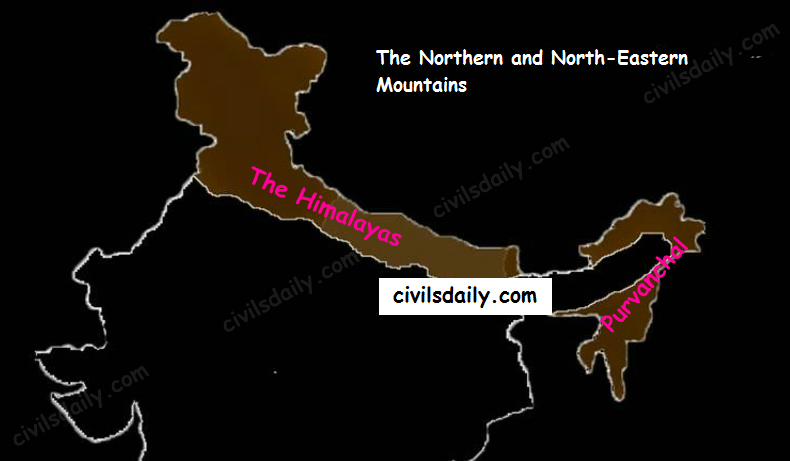
    Let’s begin with the first physiographic division. It consists of:

    • The Himalayas, and
    • The Northeastern hills (Purvanchal).
    The Physiographic Divisions of India | The Northern and Northeastern Mountains

    A) The Himalayas:

    The name “Himalaya” means “the abode or house of snow” in Sanskrit (i.e. hima “snow”, and ālaya “abode or house”). The Himalayas are the highest and longest of all young fold mountains of the world. The Pamir, known as the roof of the world, connects the Himalayas with the high ranges of Central Asia.

    Let’s begin by understanding how the Himalayas came into being:

    Origin and development:

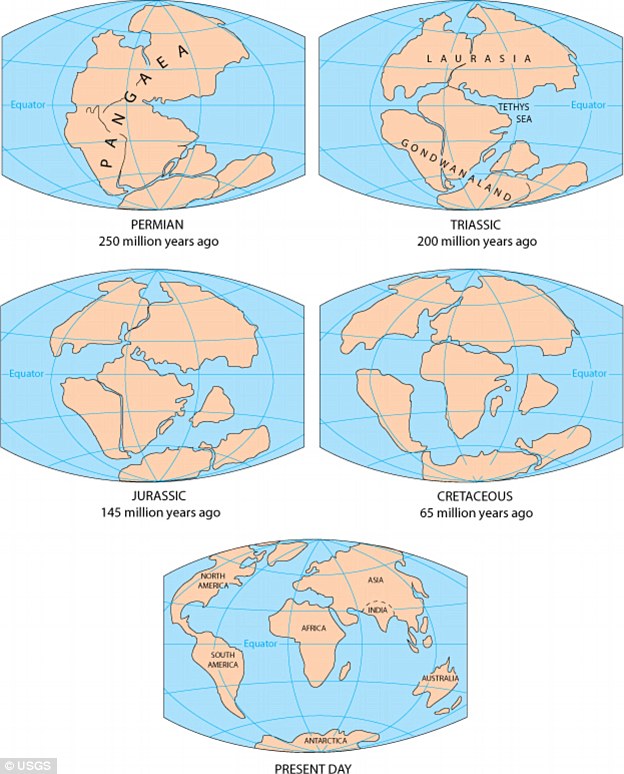
    According to the theory of Continental Drift, the world was made up of a single continent through most of the geologic time. That continent eventually separated and drifted apart; forming the seven continents we have today.

    continental-drift
    Source

    About 200 million years ago: Pangaea broke apart leading to the formation of two landmasses – “Laurasia in North” and “Gondwanaland in South”. Both the landmasses were separated by a shallow sea called “Tethys Sea”. The size of Tethys sea kept on decreasing due to movement of landmasses towards each other

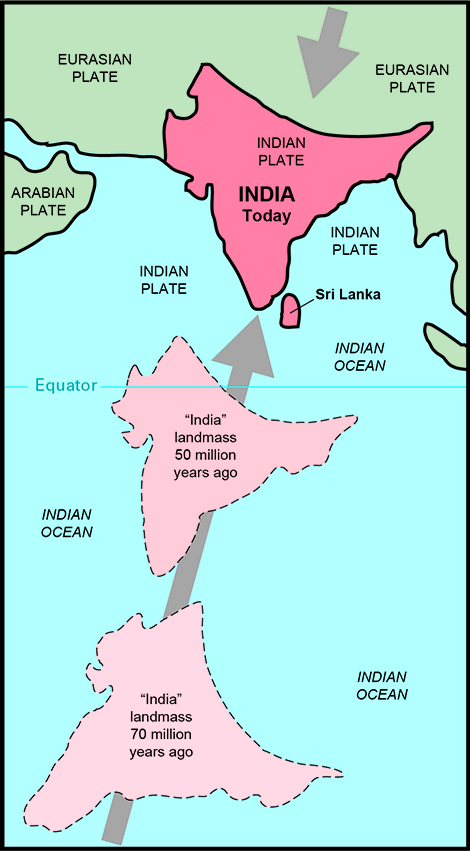
    About 40 to 50 million years ago: The two large landmasses, India and Eurasia, driven by plate movement, collided. As a result, the sediments accumulated in Tethys Sea (brought by rivers) were compressed, squeezed and series of folds were formed, one behind the other, giving birth to folded mountains of the Himalayas.

    India moving copy-2
    Source

    Recent studies show that India is still moving northwards at the rate of 5cm/year and crashing into the rest of Asia, thereby constantly increasing the height of Himalayas.

    Evidence to prove that the Himalayas are still rising:

    1. Fossil formation found in Shivalik hills:

    Similar fossils have also been found in the Tibet Plateau. This indicates that in the past, Tibetan plateau and Shivalik hills shared a common location, similar level and thus similar vegetation, life etc.; then Tibetan plateau got uplifted.

    2. Desiccation of lakes of Tibet:

    In the Tibet plateau, we find deposits which are generally found in lakes. This indicates that lakes once existed in Tibet but because of upliftment the water got discharged and deposits remained.

    3. Frequent Earthquakes

    4. Youthful nature of rivers (High erosion, v-shaped valleys etc.)

    The North-South Division of the Himalayas

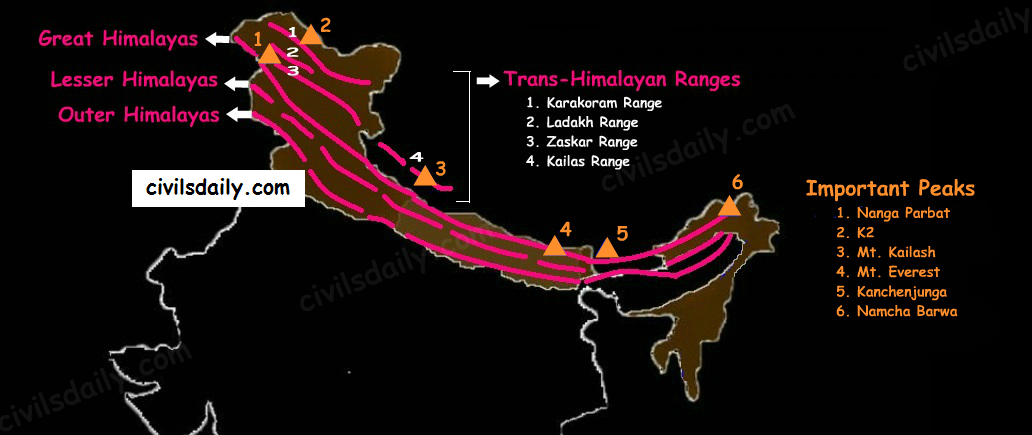
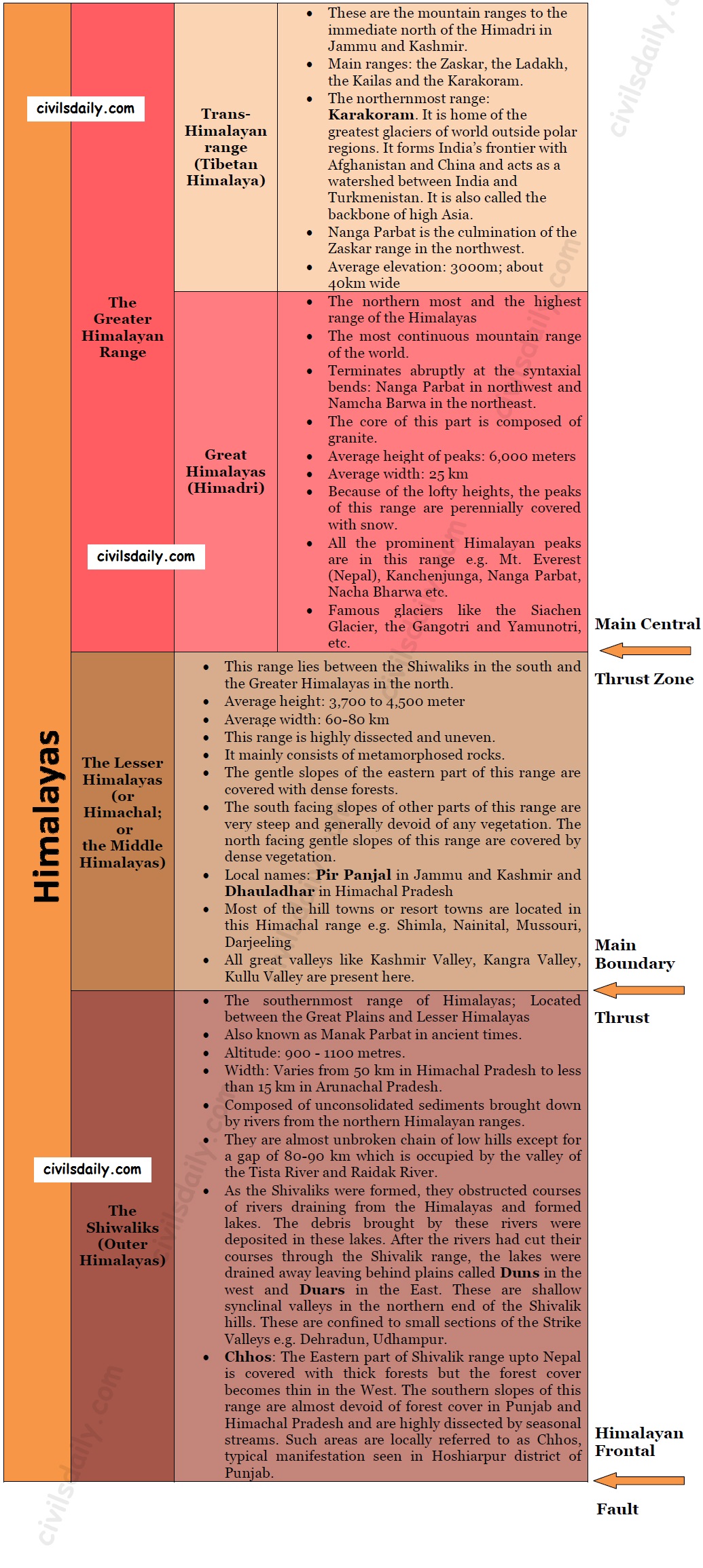
    The Himalayas consist of a series of parallel mountain ranges:

    1. The Greater Himalayan range, which includes:
      • The Great Himalayas(Himadri), and
      • The Trans-Himalayan range
    2. The Lesser Himalayas (or Himachal), and
    3. The Outer Himalayas (or Shiwalik).
    The Himalayan Ranges and Important Peaks
    • Formation of these ranges: The Himadri and Himachal ranges of the Himalayas have been formed much before the formation of Siwalik range. The rivers rising in the Himadri and Himachal ranges brought gravel, sand and mud along with them, which was deposited in the rapidly shrinking Tethys Sea. In course of time, the earth movements caused folding of these relatively fresh deposits of sediments, giving rise to the least consolidated Shiwalik range.
    • Characteristic Features:
      • Notice in the map shown above that the Himalayas form an arcuate curve which is convex to the southThis curved shape of the Himalayas is attributed to the maximum push offered at the two ends on the Indian peninsula during its northward drift. In the north-west, it was done by Aravalis and in the Northeast by the Assam ranges.
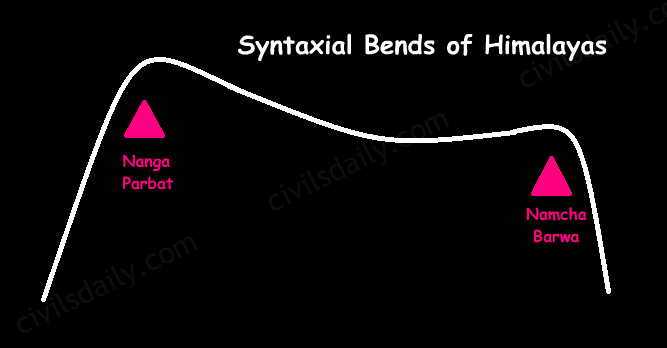
      • Syntaxis/ Syntaxial bends: The gently arching ranges of the Himalayan mountains on their Western and Eastern extremities are sharply bent southward in deep Knee-bend flexures that are called syntaxial bends. On both the ends, the great mountains appear to bend around a pivotal point. The western point is situated south of the Pamir where the Karakoram meets the Hindu Kush. A similar sharp, almost hairpin bend occurs on the eastern limit of Arunachal Pradesh where the strike of the mountain changes sharply from the Easterly to Southerly trend. Besides these two major bends, there are a number of minor syntaxial bends in other parts of Himalayas.

        Syntaxial Bends of Himalayas

      • The Himalayas are wider in the west than in the east. The width varies from 400 km in Kashmir to 150 km in Arunachal Pradesh.The main reason behind this difference is that the compressive force was more in the east than in the west. That is why high mountain peaks like Mount Everest and Kanchenjunga are present in the Eastern Himalayas.
      • The ranges are separated by deep valleys creating a highly dissected topography.
      • The southern slopes of the Himalayas facing India are steeper and those facing the Tibetan side are generally gentler.
    • Let’s take up these Himalayan mountain ranges one by one:

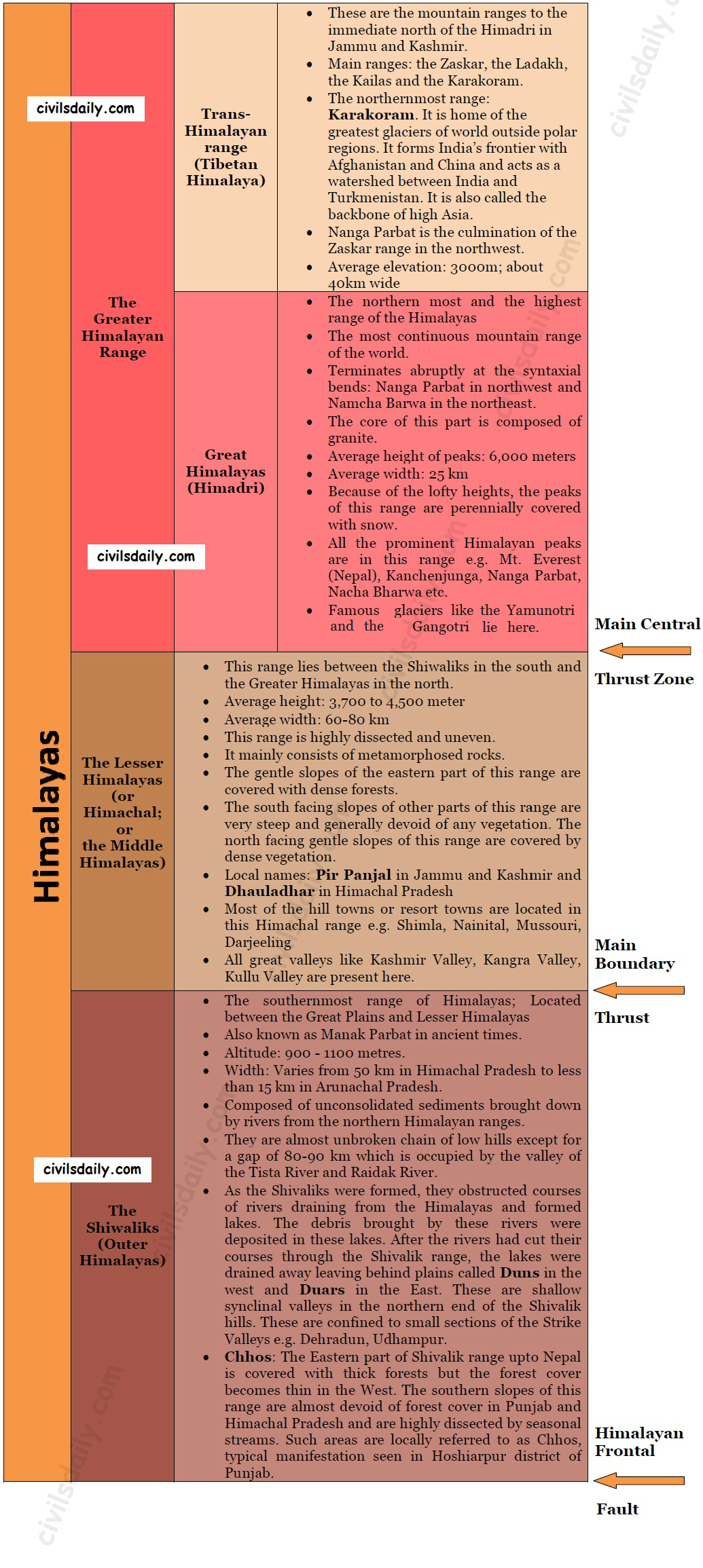
      The Himalayan Ranges | the Greater Himalayan Range, the Lesser Himalayas, the Shivaliks

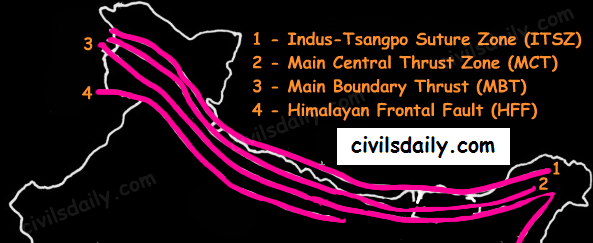
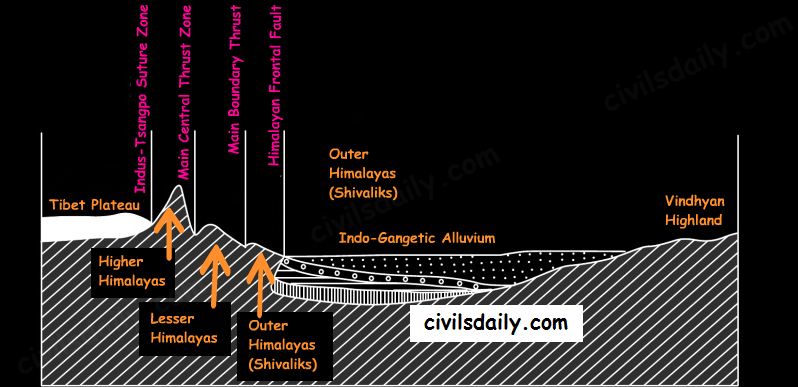
      Indus-Tsangpo Suture Zone: It represents a belt of tectonic compression caused by the underthrusting of the Indian shield/ plate against the Tibetan mass. It marks the boundary between Indian and Eurasian plates. The suture zone stretches from the North Western Himalayan syntaxis bordering the Nanga Parbat to the East as far as the Namche Barwa Mountain. Tha Karakoram range and the Ladakh plateau lie to the north of ITSZ and originally formed a part of the European plate.Main Central Thrust Zone: This separates the Higher Himalayas in the north from lesser Himalayas in the south. It has played an important role in the tectonic history of these mountains.Main Boundary Thrust: It is a reverse fault of great dimensions which extends all the way from Assam to Punjab and serves to separate the outer Himalayas from the lesser Himalayas.Himalayan Frontal Fault: It is a series of reverse faults that demarcates the boundary of the Shivalik from of the Himalayan province from the alluvial expanse of the Indo-Gangetic plains.

    Major Faults of the Himalayas – ITSZ, MCT, MBT, HFF
    The Himalayan Complex: A Cross-sectional View

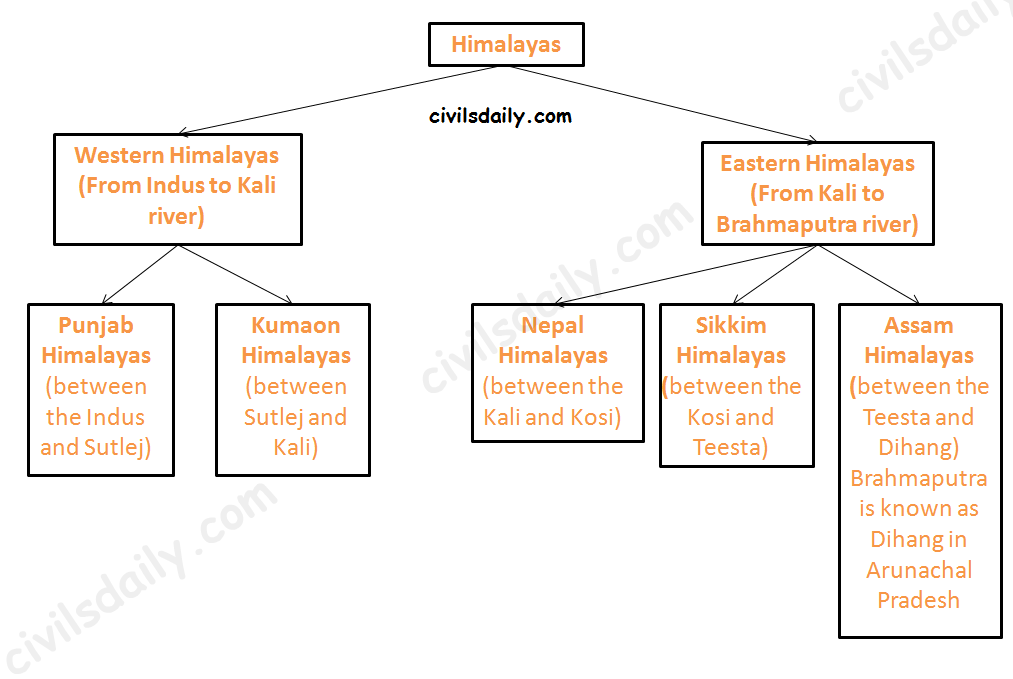
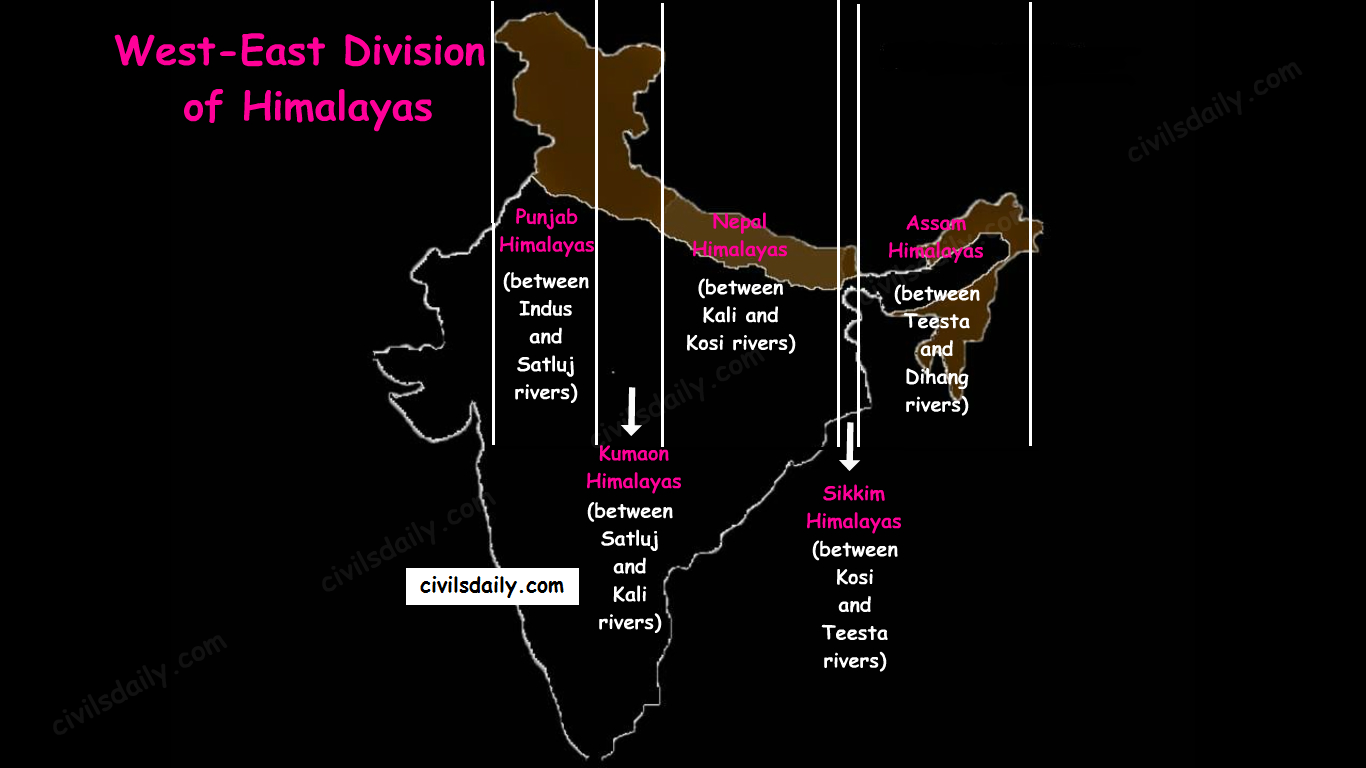
    Besides the longitudinal divisions, the Himalayas have been divided on the basis of regions from west to east:

    These divisions have been demarcated by river valleys:

    The Regional Divisions of Himalayas – the Western and Eastern Himalayas.
    1. Punjab Himalayas:
      • A large portion of Punjab Himalayas is in Jammu and Kashmir and Himachal Pradesh. Hence they are also called the Kashmir and Himachal Himalaya.
      • Major ranges: Karakoram, Ladakh, Pir Panjal, Zaskar and Dhaola Dhar.
      • The general elevation falls westwards.
      • The Kashmir Himalayas are also famous for Karewa formations.
        • ‘Karewas’ in Kashmiri language refer to the lake deposits, found in the flat-topped terraces of the Kashmir valley and on the flanks of the Pir Panjal range.
        • These deposits consist of clays, silts and sands, these deposits also show evidence of glaciation.
        • The occurrence of tilted beds of Karewas at the altitudes of 1500-1800m on the flanks of the Pir Panjal strongly suggests that the Himalayas were in process of uplift as late as Pliocene and Pleistocene (1.8mya to 10kyears ago)
        • Karewas are famous for the cultivation of Zafran, a local variety of saffron.
    2. Kumaon Himalayas
    3. Nepal Himalayas:
      • Tallest section of Himalayas
    4. Sikkim Himalayas:
      • Teesta river originates near Kanchenjunga
      • Jelep la pass- tri-junction of India- China-Bhutan
    5. Assam Himalayas:
      • Himalayas are narrower in this region and Lesser Himalayas lie close to Great Himalayas.
      • Peaks: Namcha Barwa, Kula Kangri
      • Bengal ‘Duars’
      • Diphu pass- tri-junction of India- China-Myanmar
      • The Assam Himalayas show a marked dominance of fluvial erosion due to heavy rainfall.
    The West-East Division of Himalayas

    Glaciers and Snowline:

    Snowline: The lower limit of perpetual snow is called the ‘snowline’. The snowline in the Himalayas has different heights in different parts, depending on latitude, altitude, amount of precipitation, moisture, slope and local topography.

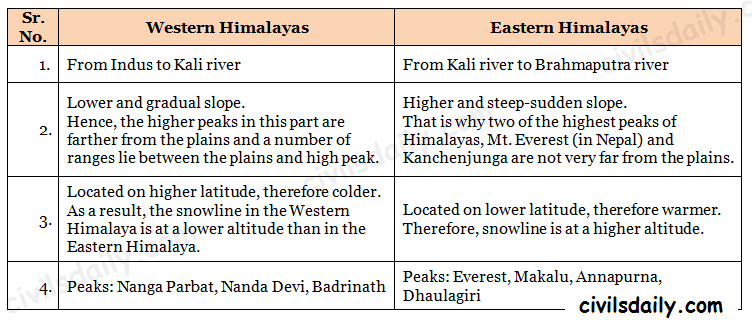
    1. The snowline in the Western Himalaya is at a lower altitude than in the Eastern Himalaya. E.g. while the glaciers of the Kanchenjunga in the Sikkim portion hardly move below 4000m, and those of Kumaon and Lahul to 3600m, the glaciers of the Kashmir Himalayas may descend to 2500m above the sea level.

    • It is because of the increase in latitude from 28°N in Kanchenjunga to 36°N in the Karakoram (Lower latitude —> warmer temperatures —> higher snowline).
    • Also, the Eastern Himalayas rise abruptly from the planes without the intervention of High ranges.
    • Though the total precipitation is much less in the western Himalayas, it all takes place in the form of snow.

    2. In the Great Himalayan ranges, the snowline is at a lower elevation on the southern slopes than on the northern slopes. This is because the southern slopes are steeper and receive more precipitation as compared to the northern slopes.

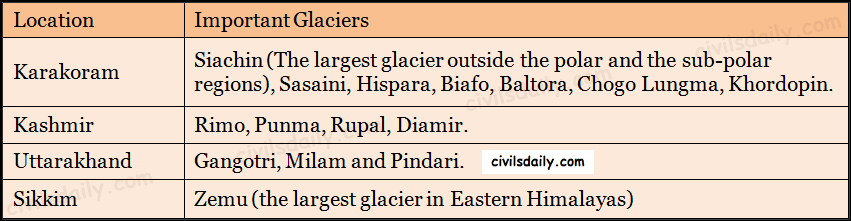
    Glaciers: The main glaciers are found in the Great Himalayas and the Trans-Himalayan ranges (Karakoram, Ladakh and Zaskar). The Lesser Himalayas have small glaciers, though traces of large glaciers are found in the Pir Panjal and Dhauladhar ranges. Some of the important glaciers are:

    Important Glaciers and their Locations

    Key differences between the Eastern and Western Himalayas:

    Key Difference between the Western and Eastern Himalayas.

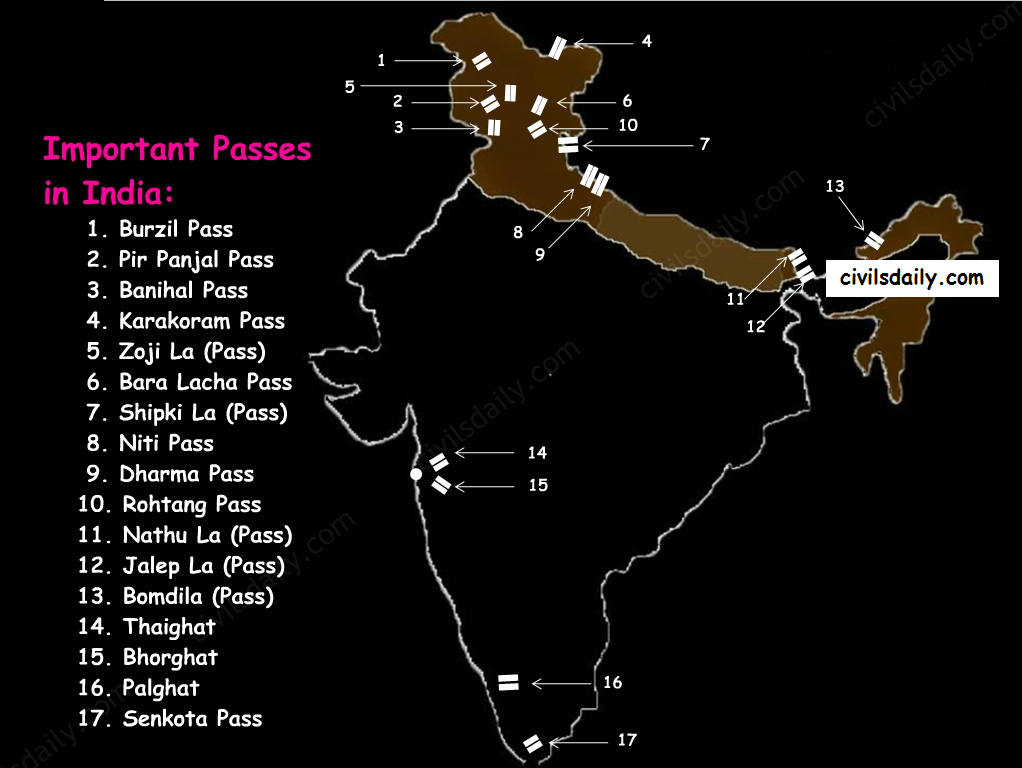
    Important Passes in India:

    A pass is a narrow gap in a mountain range which provides a passageway through the barrier.

    Important Passes in India
    1. Pir Panjal Pass – It provides the shortest and the easiest metal road between Jammu and the Kashmir Valley. But this route had to be closed down as a result of partition of the subcontinent.
    2. Banihal Pass – It is in Jammu and Kashmir. The road from Jammu to Srinagar transversed Banihal Pass until 1956 when Jawahar Tunnel was constructed under the pass. The road now passes through the tunnel and the Banihal Pass is no longer used for road transport.
    3. Zoji La (Pass) – It is in the Zaskar range of Jammu and Kashmir. The land route from Srinagar to Leh goes through this pass.
    4. Shipki La (Pass) – It is in Himachal Pradesh. The road from Shimla to Tibet goes through this pass. The Satluj river flows through this pass.
    5. Bara Lacha Pass – It is also in Himachal Pradesh. It links Mandi and Leh by road.
    6. Rohtang Pass – It is also in Himachal Pradesh. It cuts through the Pir Panjal range. It links Manali and Leh by road.
    7. Niti Pass – It is in Uttarakhand. The road to the Kailash and the Manasarovar passes through it.
    8. Nathu La (Pass) – It is in Sikkim. It gives way to Tibet from Darjeeling and Chumbi valley. The Chumbi river flows through this pass.
    9. Jalep La (Pass) – At the tri-junction of India- China-Bhutan. The Teesta river has created this pass.

    B) The North-Eastern Hills and Mountains

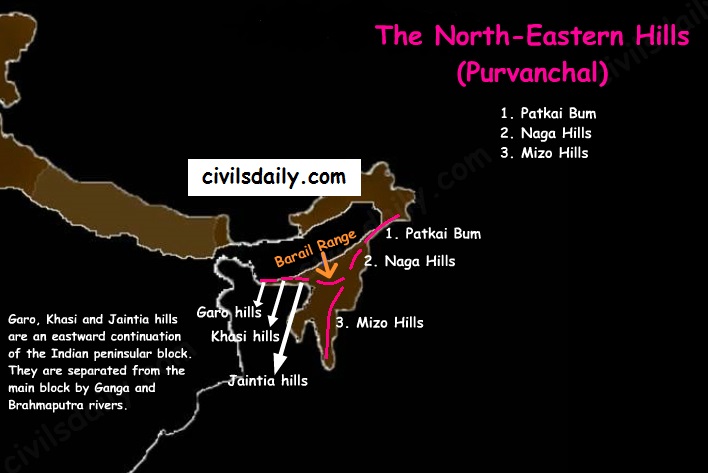
    The North-Eastern Hills (Purvanchal): Patkai Bum, Naga Hills, Mizo Hills

    The Brahmaputra marks the eastern border of Himalayas. Beyond the Dihang gorge, the Himalayas bend sharply towards south and form the Eastern hills or Purvanchal.

    • These hills run through the northeastern states of India.
    • These hills differ in scale and relief but stem from the Himalayan orogeny.
    • They are mostly composed of sandstones (i.e. Sedimentary rocks).
    • These hills are covered with dense forests.
    • Their elevation decreases from north to south. Although comparatively low, these hill ranges are rather forbidding because of the rough terrain, dense forests and swift streams.
    • Purvanchal hills are convex to the west.
    • These hills are composed of:
      • Patkai Bum – Border between Arunachal Pradesh and Myanmar
      • Naga Hills
      • Manipuri Hills – Border between Manipur and Myanmar
      • Mizo Hills.
    • Patkai Bum and Naga Hills form the watershed between India and Myanmar.
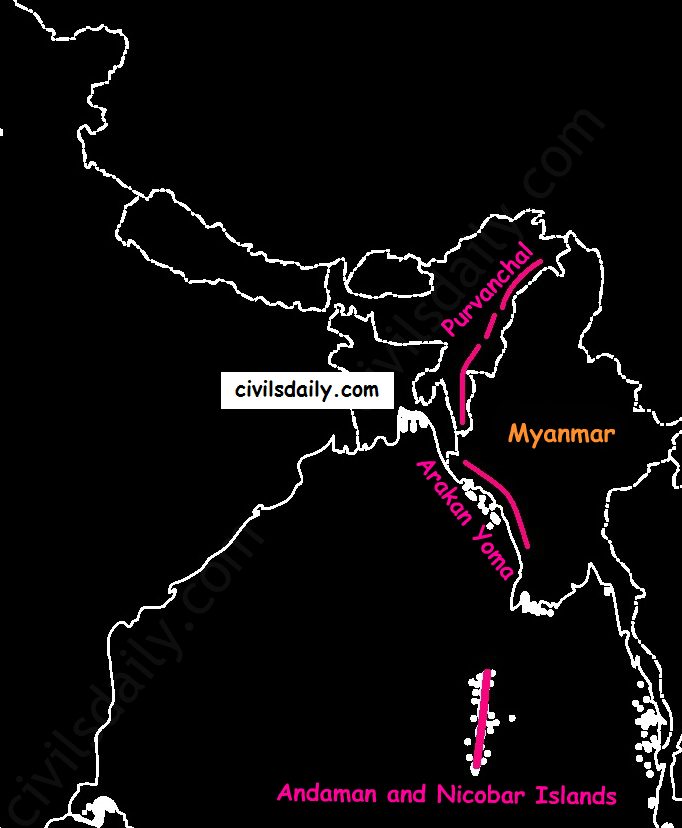
    • Extension of Purvanchal continues in Myanmar as Arakan Yoma –then Andaman and Nicobar Islands.
    Arakan Yoma – An Extension of Purvanchal in Myanmar
  • Global crisis and opportunities for India

    Multilateralism has been on the decline for some time now.  The corona pandemic has acted like a catalyst to heightene this crisis. China’s role in weaponising the interdependence of multilateralism would have far-reaching consequences to the world as we know it. Yet, the crisis presents India with some unique opportunities. What are these opportunities? How can we save multilateralism? or do we even need to? These questions and such other issues are discussed in the article.

    The basic Idea

    • Multilateralism has its benefits like to reduce the further spread of the virus, to develop effective medical treatments, and to curtail the worst effects of the inevitable recession- cooperation among nations will be necessary.
    • But the very foundation of multilateralism is shaking today. Hence, the need of the hour is a meaningful fix.
    • The US faces multiple internal challenges like the divisive Presidential election in November and China is facing a global crisis of credibility.
    • Thus, India is uniquely positioned to help resuscitate multilateralism.
    • New Delhi can assume leadership in strengthening constructive transnational cooperation.
    • India may also help China: Through mediation to temper what is increasingly seen as Beijing’s unilateralist revisionism; revive the promise of the gradual socialisation of China into the international system; and its acceptance of the norms and rules that regulate the principal multilateral institutions.

    So, when did the crisis of multilateralism start?

    • The malaise that afflicts multilateralism is not new.
    • 1) The paralysis of all three functions of the World Trade Organization (WTO) — negotiation, dispute settlement, and transparency — was one sign of that deep-rooted malaise.
    • 2) The severely dented credibility of the World Health Organization (WHO) is just another more recent indicator.
    • The pandemic has heightened the crisis of multilateralism, not created it.
    • Pandemic has highlighted the misuse of international institutions (like WHO) and multilateralism is incapable of dealing with it.

    Weaponisation of the global supply chain by China

    • Post-war multilateral system was based on the idea of peace and prosperity.
    • It was expected that economic inter-mingling among various countries would lead to peace.
    • Most of the countries of were democratic and countries with a different system of governance were not part of this system.
    • Our multinational institutions were not designed to handle the situation in which one country starts misusing its dominant position in interdependence (ex. global supply chains).
    • The misuse of existing loopholes within the existing rules by China to gain an unfair advantage in trade relations was already attracting critique in the last years.
    • China has been accused of forced technology requirements, intellectual property rights violations, and subsidies.
    • But the pandemic has provided us with some even more alarming illustrations of how damaging the weaponisation of global supply chains can be.

    Examples of China weaponising interdependence

    • When India complained that test kits imported from China were faulty, China slammed it for “irresponsible” behaviour.
    • When Australia indicated that it would conduct an independent investigation of China’s early handling of the epidemic, China threatened it with economic consequences.
    • Several actors, including the EU and India, were alarmed at the prospects of predatory takeovers of their companies by China.

    Against this background, repeated calls by heads of governments and international organisations urging countries to remain committed to multilateralism ring hollow.

    So, what are remedies to save multilateralism?

    • 1. Policies with renewed commitment
    • There is the need for reassurance and policies that reflect a renewed commitment to the raison d’étre of multilateralism.
    • A “retreating” United States must demonstrate that it remains committed to strengthening global supply chains.
    • Global supply chains must be based on the promise of ensuring global stability and the attendant promise of peace and prosperity.
    • 2. Strategic separation of value chains
    • There is an urgent need for some strategic decoupling, handled smartly in cooperation with other like-minded countries.
    • It will undoubtedly cause considerable disruption to existing global value chains.
    • We will be less prosperous. But we will also be more secure.
    • 3. Closer integration with some distancing from others
    • A multilateralism that recognises the need for decoupling will necessitate closer cooperation with some and distancing from others.
    • Membership of such renewed multilateral institutions would not be universal.
    • Rather, one would limit deep integration to countries with which one shares values — such as pluralism, democracy, liberalism, animal welfare rights, and more.

    Opportunities for India

    • India is a country whose pluralism, democracy and liberalism have often been underestimated by the West.
    • As some constituencies in the West seek a gradual decoupling from China, they would be well served to look toward India.
    • To make use of the opportunities, for itself and for the provision of certain global public goods, India’s cooperation with like-minded actors will be key.
    • India could work closely with the Alliance for Multilateralism, an initiative launched by Germany and France, to shape both the alliance itself and the reform agenda at large.
    • Working together with a group of countries from the developed and developing countries could further amplify India’s voice.
    • China may recover faster than most economically, and its military might remains intact, its image as a reliable partner has suffered a huge dent.
    • India could lead a coalition to bridge the deficit of trust between China and the rest of the world.

    Consider the following question “Covid pandemic has been acting as a catalyst in precipitating the fall of global order and multilateralism. At the same time, we are well aware of the utility of the multilateralism. Examine the opportunities that falling global order provides for India in restoring it in the new form.”

    Conclusion

    The disruption in the global order provides India with a unique opportunity. One the one hand it has to steer the gradual decoupling with China and on the other hand, it has the opportunity to lead the coalition to bridge trust deficit with China. India should not squander these opportunities.


  • Is the perpetual bond a suitable option to raise money?

    The government is exploring ways to raise money to deal with the destruction caused by COVID pandemic. One of the suggestion is the monetisation of fiscal deficit. But this article looks into an alternative approach of issuing bonds based on the idea of Consol bond issued by the British government during WW 2. So, how much amount needs to be raised? and why a perpetual bond like Consol bond is a suitable option for India? Read to know!

    A gathering financial storm

    • India projected a deficit of ₹7.96-lakh crore in the Budget before the pandemic.
    • Adding to the above concern: 1) Off-balance sheet borrowings of 1% of GDP. 2) The overly excessive target of ₹2.1 lakh crore through disinvestments.
    • Thus, financial deficit number is set to grow by a wide margin owing to corona crisis.
    • There will be revenue shrinkage from the coming depression that will most certainly be accompanied by a lack of appetite for disinvestment.

    Need for stimulus package and measures taken by the RBI

    • In addition to the expenditure that was planned, the government has to spend anywhere between ₹5-lakh crore and ₹6-lakh crore as a stimulus package.
    • The stimulus provided by the government so far and recent announcements by the Reserve Bank of India (RBI) achieved little.
    • All the RBI’s schemes are contingent on the availability of risk capital, the market for which has completely collapsed.
    • The government and the RBI have tried several times to increase lending to below investment grade micro, small and medium enterprises, but have come up short each time.
    • Furthermore, while the 60% increase in ways and means limits for States is a welcome move, many States have already asked for doubling the limits due to the shortages in indirect taxation collections from Goods and Services Tax, fuel and liquor.
    • The government and the central bank need to understand that half measures will do more harm than good.

    What is the Consol Bond?

    • Consol bond is a form of British government bond that has no maturity and that pays a fixed coupon.
    • Consols are basically rare examples of actual perpetual bonds.
    • The bonds were issued in 1917 as the government sought to raise more money to finance the ongoing cost of the First World War.

    So, why bond like Consol Bonds is a good option for India?

    • There is no denying the fact that the traditional option of monetising the deficit by having the central bank buy government bonds is one worth pursuing.
    • Citizens’ active participation is ensured in Consol Bond type alternative.
    • Furthermore, with the fall of real estate and given the lack of safe havens outside of gold, the bond would offer a dual benefit as a risk-free investment for retail investors.
    • When instrumented, it would be issued by the central government on a perpetual basis with a right to call it back when it seems fit.
    • An attractive coupon rate for the bond or tax rebates could also be an incentive for investors.
    • The government can consider a phased redemption of these bonds after the economy is put back on a path of high growth.

    The solution of bond offered here could be a valuable addition in points to the answer to the question which asks about the ways to raise money. Consider the question, “Economic devastation caused by the COVID pandemic has forced the government to explore the various ways to raise the money. Discuss the options available with the government and issues associated with the options.”

    Conclusion

    Politicians and epidemiologists across the world have used the word “war” to describe the situation the world is currently in. So, to raise the money to fight this war against Covid-19, we can take the cue from past and issue bond based on the Consol bond.


    Back2Basics: What is fiscal deficit?

    • A fiscal deficit is a shortfall in a government’s income compared with its spending.
    • The government that has a fiscal deficit is spending beyond its means.
    • A fiscal deficit is calculated as a percentage of gross domestic product (GDP).
    • There can be different types of deficit in a budget depending upon the types of receipts and expenditure we take into consideration. Accordingly, there are three concepts of the deficit, namely-
    • Revenue deficit = Total revenue expenditure – Total revenue receipts.
    • Fiscal deficit = Total expenditure – Total receipts excluding borrowings.
    • Primary deficit = Fiscal deficit-Interest payments.
    • Primary deficit shows how much government borrowing is going to meet expenses other than interest payments.
    • Thus, zero primary deficits mean that the government has to resort to borrowing only to make interest payments.
    • To know the amount of borrowing on account of current expenditure over revenue, we need to calculate the primary deficit.
    • Thus, the primary deficit is equal to fiscal deficit less interest payments.

    Perpetual Bonds

    • A perpetual bond, also known as a “consol bond” or “prep,” is fixed income security with no maturity date.
    • This type of bond is often considered a type of equity, rather than debt. One major drawback to these types of bonds is that they are not redeemable.
    • However, the major benefit of them is that they pay a steady stream of interest payments forever.
    • Perpetual bonds exist within a small niche of the bond market.
    • This is mainly due to the fact that there are very few entities that are safe enough for investors to invest in a bond where the principal will never be repaid.
    • AT-1 bonds which were recently in news due to YES bank failure is an example of a perpetual bond.


  • [Prelims Spotlight] Important Schemes regarding Agriculture & Allied Sectors

    Prelims Spotlight is a part of “Nikaalo Prelims 2020” module. This open crash course for Prelims 2020 has a private telegram group where PDFs and DDS (Daily Doubt Sessions) are being held. Please click here to register.

    Important Schemes regarding Agriculture & Allied Sectors


    06 May 2020

    1.1 Pradhan Mantri Krishi Sinchayee Yojana

    Objective

    ● To achieve convergence of investments in irrigation at the field level.
    ● To enhance the recharge of aquifers and introduce sustainable water conservation practices.
    ● To explore the feasibility of reusing treated municipal wastewater for peri-urban agriculture.
    ● To attract greater private investments in irrigation.
    ● To promote extension activities relating to water harvesting, water management and crop alignment for farmers and grass root level field
    functionaries.

    Salient features

    ● Decentralized State level planning and projectized execution’ structure, in order to allow States to draw up a District Irrigation Plan (DIP) and a State Irrigation Plan (SIP). These plans need to be prepared in order to access
    the PMKSY fund.
    ● It will be supervised and monitored by the Inter-Ministerial National Steering Committee (NSC) under PM with Union Ministers of all concerned Ministries. A National Executive Committee (NEC) is to be constituted under the Chairmanship of the Vice Chairman, NITI Aayog to oversee programme implementation.
    ● PMKSY has been formulated amalgamation ongoing schemes viz. Accelerated Irrigation Benefit Programme (AIBP); Integrated
    Watershed Management Programme (IWMP); and On-Farm Water Management (OFWM) component of National Mission on Sustainable
    Agriculture (NMSA).
    ● Water budgeting is done for all sectors namely, household, agriculture and industries.
    ● Investments will happen at farm level. So, farmers know what is happening and can provide valuable feedback.
    ● Recently, the Long Term Irrigation Fund has been instituted under PMKSY in NABARD for funding and fast-tracking the implementation
    of incomplete major and medium irrigation projects.

    1.2 RASHTRIYA KRISHI VIKAS YOJANA – RAFTAAR (RKVY-RAFTAAR)

    Objective

    ● To make farming a remunerative economic activity through strengthening the farmer’s efforts, risk mitigation and promoting
    agribusiness entrepreneurship.
    ● To attend national priorities through several sub-schemes.
    ● To empower youth through skill development, innovation and agri entrepreneurship based business models.

    Salient features 

    ● RKVY, initiated in 2007 as an umbrella scheme for holistic development of agriculture and allied sectors, has been recently revamped as
    RKVY-RAFTAAR – Remunerative Approaches for Agriculture and Allied sector Rejuvenation for 2017-19 and 2019-20.
    ● It provided states with considerable flexibility and autonomy for planning and executing Programs.
    ● The decentralised planning for agriculture and allied sectors is initiated by the states through District Agriculture Plan and State Agriculture
    Plan based on agro-climatic conditions, availability of appropriate technology and natural priorities.
    ● It will incentivize states to increase allocations for agriculture and allied sectors and help in creation of post-harvest infrastructure and
    promotion of private investment in the farm sector across the country.
    ● Fund Allocation – 60:40 grants between Centre
    and States in states and 90:10 for North Eastern States and Himalayan States through following streams – o Infrastructure & Assets and Production Growth o RKVY-RAFTAAR special sub-schemes of National Priorities o Innovation
    and agri-entrepreneur development.

    Sub-schemes include

    ● Bringing Green Revolution to Eastern India
    ● Crop Diversification Program – It is being implemented in the Original Green Revolution States of Punjab, Haryana and Western Uttar Pradesh to diversify area from water-guzzling crop
    ● Reclamation of Problem Soil ● Foot & Mouth Disease – Control Program
    (FMD-CP)
    ● Saffron Mission
    ● Accelerated Fodder Development Programme (AFDP)

    1.3 NATIONAL FOOD SECURITY MISSION

    Objective

    Increasing production of rice, wheat, pulses, coarse cereals and commercial crops through area expansion and productivity enhancement
    in a sustainable manner.
    ● Restore soil fertility and productivity at the individual farm level.
    ● Enhancing farm level economy.

    Salient features

    ● It is a Centrally Sponsored Scheme which was launched in 2007.
    ● The approach of the scheme is to bridge the yield gap in respect of these crops through dissemination of improved technologies and farm management practices while focusing on districts which have high potential but relatively low level of productivity at present.
    ● Major Components – National Food Security Mission – Rice, National Food Security Mission – Wheat, National Food Security Mission – Pulses,
    National Food Security Mission – Coarse Cereals and National Food Security Mission –Commercial Crops.

    1.4 National Horticulture Mission

    1. To provide holistic growth of the horticulture sector through an area based regionally differentiated strategies, to enhance horticulture production, improve nutritional security and income support to farm households
    2. To establish convergence and synergy among multiple ongoing and planned programmes for horticulture development
    3. To promote, develop and disseminate technologies, through a seamless blend of traditional wisdom and modern scientific knowledge
    4. To create opportunities for employment generation for skilled and unskilled persons, especially unemployed youth.

    Scheme:

    A National Horticulture Mission was launched in 2005-06 as a Centrally Sponsored Scheme to promote holistic growth of the horticulture sector
    through an area based regionally differentiated strategies. The scheme has been subsumed as a part of Mission for Integration Development of
    Horticulture (MIDH) during 2014-15.

    What is the National Horticulture Mission?

    The National Horticulture Mission is a government mission to support horticultural production in the country. NHM is a Centrally Sponsored Scheme in which the Government of India contributes 85%, and 15% is met by the State Governments.

    Factual Information:

    ● India ranks second in the global production of fruits and vegetables next to China.
    ● Started in 2005-06.

    1.5 SOIL HEALTH CARD SCHEME

    Objective

    ● To issue soil health cards every 3 years, to all farmers of the country, so as to provide a basis to address nutrient deficiencies in fertilization practices.
    ● To strengthen the functioning of Soil Testing Laboratories (STLs) through capacity building, the involvement of agriculture students and
    effective linkage with Indian Council of Agricultural Research (ICAR) / State Agricultural Universities (SAUs).
    ● To diagnose soil fertility related constraints with standardized procedures for sampling uniformly across states.
    ● To build capacities of district and state level staff and of progressive farmers for promotion of nutrient management practices.

    Salient features

    ● It is a centrally sponsored scheme launched by the Government of India in 2015.
    ● It is being implemented through the Department of Agriculture of all the State and Union Territory Governments.
    ● Assistance is provided to the State Government to issue Soil Health Card and also develop a database to improve service delivery.
    ● Soil Health Card issued to farmers carry crop-wise recommendations of nutrients and fertilizers required for the individual farms.
    ● The experts will analyze the strength and weaknesses (micronutrients deficiency) of the soil collected from farms and suggest measures
    to deal with it.
    ● It will contain the status of his soil with respect to 12 parameters, namely N,P,K (Macronutrients); S (Secondary nutrient); Zn, Fe, Cu, Mn, Bo (Micro – nutrients); and pH, EC, OC (Physical parameters).

    1.6 PM FASAL BIMA YOJANA

    Objective

    ● To provide insurance coverage and financial support to the farmers in the event of natural calamities, pests & diseases.
    ● To stabilise the income of farmers to ensure
    their continuance in farming. ● To encourage farmers to adopt innovative and
    modern agricultural practices.
    ● To ensure flow of credit to the agriculture sector.
    Intended beneficiary.
    ● All farmers including sharecroppers and tenant farmers growing notified crops in a notified area during the season who have insurable interest in the crop are eligible.

    Salient features

    ● It replaced all other existing insurance schemes except the Restructured Weather-Based Crop Insurance Scheme (uses weather parameters as
    proxy for crop yield in compensating the cultivators for deemed crop loses) .
    ● A uniform premium of only 2% to be paid by farmers for all Kharif crops and 1.5% for all Rabi crops.
    ● In case of annual commercial and horticultural crops, the premium to be paid by farmers will be only 5%.
    ● There is no upper limit on Government subsidy so farmers will get claim against full sum insured without any reduction.
    ● The difference between the premium paid by farmers and the actuarial premium charged was paid by the Centre and state government in
    the ratio of 50:50.
    ● It is compulsory for loanee farmers availing crop loans for notified crops in notified areas and voluntary for non-loanee farmers.
    ● Yield Losses: due to non-preventable risks, such as Natural Fire and Lightning, Storm, Hailstorm, Cyclone, Typhoon, Tempest, Hurricane, Tornado.
    Risks due to Flood, Inundation and Landslide, Drought, Dry spells, Pests/ Diseases also will be covered.
    ● Post-harvest losses are also covered.
    ● Mandatory use of technology: Smart phones, drones etc., will be used to capture and upload data of crop cutting to reduce the delays in claim payment to farmers. Remote sensing will be used to reduce the number of crop cutting
    experiments.
    ● The Scheme shall be implemented on an ‘Area Approach basis’. Defined Area (i.e., unit area of insurance) is Village or above. It can be a
    Geo-Fenced/Geo-mapped region having homogenous Risk Profile for the notified crop.
    ● Presently, 5 public sector insurers (Agriculture
    Insurance Company of India, United India Insurance Company etc.) and 13 private insurance companies are empanelled for implementation of the scheme.
    ● Recently, states have been allowed to set up their own insurance companies for implementing the scheme.

    1.7 National Mission for Sustainable Agriculture

    National Mission for Sustainable Agriculture (NMSA) has been formulated for enhancing agricultural productivity especially in rainfed areas focusing on integrated farming, water use efficiency, soil health management and
    synergizing resource conservation.

    Objectives

    ● To make agriculture more productive, sustainable, remunerative and climate resilient by promoting location specific Integrated/Composite Farming Systems
    ● To conserve natural resources through appropriate soil and moisture conservation measures
    ● To adopt comprehensive soil health management practices based on soil fertility maps, soil test based application of macro & micro nutrients, judicious use of fertilizers etc.
    ● To optimize utilization of water resources through efficient water management to expand coverage for achieving ‘more crop per drop’.
    ● To develop capacity of farmers & stakeholders, in conjunction with other on going missions e.g. National Mission on Agriculture Extension &
    Technology, National Food Security Mission, National Initiative for Climate Resilient Agriculture (NICRA) etc., in the domain of
    climate change adaptation and mitigation measures.
    ● To pilot models in select blocks for improving  productivity of rainfed farming by mainstreaming rainfed technologies refined through NICRA and by leveraging resources  from other schemes/Missions like Mahatma
    Gandhi National Rural Employment Guarantee Scheme (MGNREGS), Integrated Watershed Management Programme (IWMP), RKVY etc.;
    and
    ● To establish an effective inter and intra Departmental/Ministerial coordination for accomplishing key deliverables of National Mission for Sustainable Agriculture under the aegis of National Action Plan on Climate
    Change (NAPCC).

    1.8 PARAMPARAGAT KRISHI VIKAS YOJANA

    Objective

    ● Promotion of commercial organic production through certified organic farming.
    ● pesticide residue free produce and improved health of consumer
    ● Raise farmer’s income and create potential markets for traders.
    ● Motivate the farmers for natural resource mobilization for input production.
    ● Increase domestic production and certification of organic produce by involving farmers.

    Intended beneficiary
    ● Farmers doing organic farming
    ● Farmers from NE India such as Sikkim
    ● Food processing industries
    ● Organic foods – export industry

    Salient features
    ● “Paramparagat Krishi Vikas Yojana” is an elaborated component of Soil Health Management (SHM) under National Mission of Sustainable Agriculture (NMSA).
    ● Cluster Approach: Fifty or more farmers form a cluster having 50 acre land to take organic farming. Each farmer will be provided Rs. 20000
    per acre in three years for seed to harvesting crops and to transport them to market.
    ● Government plans to form around 10 thousand clusters in three years and cover an area of 5 Lakh hectares under organic farming.

    Components
    ● Participatory Guarantee System (PGS) certification through cluster approach – mobilization of farmers, form clusters, identification of land resources and training on organic farming and PGS Certification and
    quality control.
    ● Adoption of organic village for manure management and biological nitrogen harvesting through cluster approach –action plan for Organic Farming, Integrated Manure Management, Packing, Labelling and Branding
    of organic products of cluster.

    1.9 NATIONAL AGRICULTURAL MARKET
    (NAM)

    Objective

    ● To promote genuine price discovery
    ● Increases farmers’ options for sale and access to markets
    ● Liberal licensing of traders / buyers and commission agents. One license for a trader valid across all markets in the State
    ● Harmonisation of quality standards of agricultural produce
    ● Single point levy of market fees, i.e on the first wholesale purchase from the farmer.
    ● Provision of Soil Testing Laboratories in/ or near the selected mandi to facilitate visiting farmers to access this facility in the mandi itself

    Intended beneficiary 

    ● 585 regulated wholesale markets in states/union territories (UTs).
    ● Farmers
    ● Local traders
    ● Bulk buyers, processors
    ● Farm produce exporters
    ● Overall economy of the nation

    Salient features
    ● NAM is a pan-India electronic trading portal which seeks to network the existing APMCs and other market yards to create a unified national
    market for agricultural commodities.
    ● Small Farmers Agribusiness Consortium (SFAC) has been selected as the lead agency to implement it.
    ● Central government will provide the software free of cost to the states and in addition, a grant of up to Rs. 30 lakhs per mandi or market or
    private mandis will be given for related equipment and infrastructure requirements.
    ● New Features added to the scheme such as E-NAM Mobile App, BHIM Payment facility, MIS dashboard for better analysis and insights,
    grievance redressal mechanism for Mandi Secretaries and integration with Farmer Database to ease the registration and identification process will further strengthen e-NAM.
    ● Fund Allocation – The Scheme is being funded through AgriTech Infrastructure Fund (AITF).

    1.10 KRISHI VIGYAN KENDRAS

    Objective
    ● To be a frontline extension in agriculture, and to serve as a single window mechanism for addressing the technology needs of farmers
    ● To demonstrate location specific technologies and build capacity of farmers
    ● To serve as links between research and extension and also with farmers
    Intended beneficiary
    ● Rural youth, farm women and Farmers (skill development training)
    Salient features
    ● Indian Council of Agricultural Research (ICAR)has created a network of 645 Krishi Vigyan Kendras (KVKs) in the country and 106 more
    KVKs will be established.
    ● Directorate of Extension in State Agriculture Universities also helps KVKs in its activities.
    ● KVKs lay strong emphasis on skill development training of rural youth, farm women and farmers
    ● Provide latest technological inputs like seeds,planting materials and bio-products.
    ● Advise farmers on timely crop/enterprise related recommendations, including climate resilient technologies.
    ● Diagnose and solve problems emerging from district agro-ecosystems and lead in adoption of innovations.

    1.11 MERA GAON-MERA GAURAV

    Objective

    ● To promote direct interface of scientists withthe farmers and hasten the land to lab process.
    ● To imbibe a sense of ownership among the agricultural scientists
    ● To provide farmers with required information, knowledge and advisories on regular basis by adopting villages.

    Intended beneficiary

    ● Scientists with ground level experience
    ● Farmers

    Salient features
    ● This scheme involves scientists of the Indian Council of Agriculture Research (ICAR) and state agricultural universities.
    ● Groups of four multidisciplinary scientists each will be constituted at these institutes and universities. Each group will “adopt” five villages within a radius of maximum 100 km.

    1.12 Price Stabilization Fund

    Objective: to safeguard the interest of the growers and provide them financial relief when prices fall below a specified level.

    Scheme:
    ● Central Sector Scheme.
    ● To support market interventions for price control of perishable agri-horticultural commodities.
    ● PSF will be used to advance interest free loan to State Governments and Central agencies to support their working capital and other expenses on procurement and distribution interventions for such commodities.
    ● Procurement of the commodities will be undertaken directly from farmers or farmers’ organizations at farm gate/mandi and made available at a more reasonable price to the consumers.
    ● Initially the fund is proposed to be used for onion and potato only. Losses incurred, if any, in the operations will be shared between the Centre and the States.

    Framework and Funding:

    ● States will set up a revolving fund to which theCentre and State will contribute equally, i.e. 50:50.
    ● The ratio of Centre-State contribution to the State-level corpus in respect of Northeast States will, however, be 75:25.

    1.13 Mission Fingerling

    ● It is a programme to enable holistic development and management of the fisheries sector in India.
    ● The mission aims to achieve the target to enhance fisheries production from 10.79 mmt (2014-15) to 15 mmt by 2020-21 under the Blue Revolution.

    Programme:

    ● Government has identified 20 States based ontheir potential and other relevant factors to strengthen the Fish Fingerling production and Fish Seed infrastructure in the country.
    ● This program will facilitate the establishment of Fingerling rearing pond and hatcheries.
    ● This will converge in the production of 20 lakh tonnes of fish annually, which will in turn benefit about 4 million families.
    ● The implementation of this program will supplement the requirement of stocking materials in the country up to a large extent, which is a much needed input to achieve the enhanced fish production.

    1.14 Umbrella Scheme Green Revolution — Krishonnati Yojana

    AIM

    These schemes look to develop the agriculture and allied sector in a holistic and scientific manner to increase the income of farmers by enhancing
    production, productivity and better returns on produce.

    The Schemes that are part of the Umbrella Schemes are :-

    i. Mission for Integrated Development of Horticulture (MIDH)
    ii. National Food Security Mission (NFSM)
    iii. National Mission for Sustainable Agriculture (NMSA)
    iv. Submission on Agriculture Extension (SMAE)
    v. Sub-Mission on Seeds and Planting Material (SMSP)
    vi. Sub-Mission on Agricultural Mechanisation (SMAM)
    vii. Sub Mission on Plant Protection and Plan Quarantine (SMPPQ)
    viii. Integrated Scheme on Agriculture Census, Economics and Statistics (ISACES)
    ix. Integrated Scheme on Agricultural Cooperation (ISAC)
    x. Integrated Scheme on Agricultural Marketing (ISAM)
    xi. National e-Governance Plan (NeGP-A) The Schemes/Missions focus on
    creating/strengthening of infrastructure of production, reducing production cost and marketing of agriculture and allied produce.

    1.15 Pradhan Mantri Annadata Aay SanraksHan Abhiyan (PM-AASHA)

    1. The Scheme is aimed at ensuring remunerative prices to the farmers for their produce as announced in the Union Budget for 2018.
    2. It is expected that the increase in MSP will be translated to farmers’ income by way of robust procurement mechanism in coordination with
    the State Governments.
    The three schemes that are part of AASHA are:
    1. the Price Support Scheme (PSS)
    2. the Price Deficiency Payment Scheme (PDPS)
    3. the Pilot of Private Procurement and Stockist Scheme (PPPS)
    ● These three components will complement the existing schemes of the Department of Food and Public Distribution.
    ● They relate to paddy, wheat and other cereals and coarse grains where procurement is at MSP now.
    ● PSS – Under the PSS, physical procurement of pulses, oilseeds and copra will be done by Central Nodal Agencies.
    ● Besides, NAFED and Food Corporation of India will also take up procurement of crops under PSS.
    ● The expenditure and losses due to procurement will be borne by the Centre.
    ● PDPS – Under the PDPS, the Centre proposes to cover all oilseeds.
    ● The difference between the MSP and actual selling/modal price will be directly paid into the farmer’s bank account.
    ● Farmers who sell their crops in recognised mandis within the notified period can benefit from it.
    ● PPSS – In the case of oilseeds, States will have the option to roll out PPSS in select districts.
    ● Under this, a private player can procure crops at MSP when market prices drop below MSP.
    ● The private player will then be compensated through a service charge up to a maximum of 15% of the MSP.

    1.16 Pradhan Mantri Kisan Samman Nidhi (PM-KISAN)

    What is the news: The Central Government notified a decision to extend the benefit of ₹6,000 per year under the Pradhan Mantri Kisan Samman Nidhi
    scheme to all 14.5 crore farmers in the country, irrespective of the size of their landholding.
    ● Central sector scheme

    Objective

    ○ To provide income support to all farmer families having cultivable land.
    ○ To supplement the financial needs of the farmers in procuring various inputs to ensure proper crop health and appropriate yields, commensurate with the anticipated farm income.

    Salient Features:

    ● The revised Scheme is expected to coveraround 2 crore more farmers, increasing the coverage of PM-KISAN to around 14.5 crore
    beneficiaries.
    ● Responsibility of identifying the landholder farmer family eligible for benefit under the scheme shall be of the State/UT Government.
    ● The lists of eligible beneficiaries would be published at the village level to ensure transparency.
    ● Exclusions: Certain categories of beneficiaries of higher economic status such as institutional landholders, former and present holder of constitutional posts, persons who paid income tax in the last assessment year etc. shall not be eligible for benefit under the scheme.
    ■ Professionals like doctors, engineers and lawyers as well as retired pensioners with a monthly pension of over ₹10,000 and those who paid income tax in the last assessment year are also not eligible for the benefits.
    ■ For the purpose of exclusion State/UT Government can certify the eligibility of the beneficiary based on self-declaration by the beneficiaries.
    ● A dedicated PM Kisan Portal will be launched for the implementation of the scheme.
    ● This is a Central Sector Scheme and will be funded fully by the Government of India