💥UPSC 2026, 2027, 2028 UAP Mentorship (March Batch) + Access XFactor Notes & Microthemes PDF

Search results for: “”

  • Pay Commission 007: Bond’s Spectre pales before India’s Spectre!

    It’s back! In a richer, more generous, more fiery, more flashy avatar. With more goodies for everyone. No, not James Bond. Pay Commission 007. And it has left the Indian Administrative Services shaken as well as stirred.

    Decadal corrections have come in, and how! “What took you so long, 007?” Even as the average salaries of central government employees go up by 23 per cent, this Desi 007 has created a storm by bringing the tricky question of pay parity between IAS and other services to the fore. IAS officers enjoy higher pay than their counterparts in other services by way of earning additional increments at 3 per cent of their basic pay.

    The weeks prior to the release of the recommendations of Pay Commission 007 saw hectic activity and a flurry of letters from IAS officers to Secretary, department of personnel and training. It’s very difficult to understand what most IAS officers write in their letters. For the most part it does seem to be in English, but for mere mortals (read non-IAS) to understand what the brightest and the best are saying is to expect a child to fathom The Wasteland by TS Eliot.

    Had we had the honour of hosting Sir Humphrey, the Permanent Secretary to Hon’ble Jim Hacker (of Yes, Minister! fame) in the IAS, he would have recorded his “profound opposition to the newly instituted practice which imposes severe and intolerable restrictions upon the ingress and egress of senior members of the hierarchy and which will, in all probability, should the current deplorable innovation be perpetuated, precipitate a constriction of the channels of communication, and culminate in a condition of organisational atrophy and administrative paralysis, which will render effectively impossible the coherent and co-ordinated discharge of the function of government within India”. Whew! That is Sarkari 007 to cut the Sanskaari Bond to size. To put it in English, “We are simply the best and hence deserve more”. It’s simply the “writing on the wall”, Bond would have claimed.

    Bond heads to Mexico City with a lead from M and has his brush with Spectre, the organisation driven by IT intelligence systems, and exists simply everywhere. The Indian Pay Commission 007 is also headed by our own M, Justice AK Mathur, and now is up against the Indian Administrative Spectre, the organisation driven by Bureaucracy intelligence (?) systems and exists simply everywhere, or as an afterthought, at least in the highest levels of government.

    Fathom this. Of the total 91 Secretary posts in the current system, there are 73 IAS officers and a sprinkling of other services just to keep the situation under control and maintain an atmosphere of bonhomie with the police, forests, scientists, etc. However, at the Joint Secretary level, they don’t even pretend to be interested in “What will the other Services think” . Joint Secretaries are IAS officers. Period. Having secured the joints, the IAS cadre then “adds on” muscle power. Additional Secretaries obviously have to be IAS officers; what with all these Secretaries and Joint Secretaries and Additional Secretaries, you have quite an adhesive Bond of the Indian AdministrativeSpectre.If Bond’s Spectre is autocratic, the Indian Spectre is bureaucratic. If Spectre works with sinister one-liners, the IAS works with meaningless realms of paper in different coloured ink filed meticulously since 1947. Pay Commission 007 is up against a formidable force. In the Indian version of Spectre, M has raised the Q. The real Q is, is there an A?

  • G20: The Antalya Summit 2015 – Everything that you should know

    This article gives you an overview of G20, since its formation to latest key achievements in 2015 Summit. Stay tuned to India and G20 as we capture the antalya summit 2015 in detail.


    G20 in a quick fast track glance

    Together, the G20 economies account for –

    • 85% of the global economic output
    • 80% of world trade, and
    • 65% of the global population.

    Which of the 20 members make promise of inclusive and robust growth in 2015?

    Argentina, Australia, Brazil, Canada, China, France, Germany, India, Indonesia, Italy, Japan, the Republic of Korea, Mexico, Russia, Saudi Arabia, South Africa, Turkey, the United Kingdom, the United States of America, and the European Union.

    Let’s take a Historical dive on G20

    • The G20 was formally established on 26 September, 1999, at the Finance Ministers’ meeting of G7 (Canada, France, Germany, Italy, Japan, the United Kingdom and the United States) in the aftermath of the Asian Financial Crisis.
    • The G20 convened for the first time at the leaders’ level in Washington, D.C. on November 14-15, 2008, to respond collectively to the 2008-09 crisis.
    • In order to restore global growth, strengthen the global financial system, and reform international financial institutions.
    • The G20 played a key role in supporting the first stages of economic recovery and continues to promote measures to reform international financial institutions, improve financial regulation, and strengthen the global economy through an increasingly comprehensive agenda.
    • This year, Turkish G20 Presidency’s theme is “Collective Action for Inclusive and Robust Growth”.

    Okay, how’s the structure of G20?

    • The G-20 operates without a permanent secretariat or staff. (Take a Note of it, it may form a prelims’ question)
    • The group’s chair is part of a revolving three-member management group of past, present and future chairs, referred to as the “Troika”.
    • The role of the Troika is to ensure continuity in the G-20’s work and management across host years.
    • Turkey will host the 2015 summit in Antalya, while China will host the 2016 summit in Hangzhou.

    Then, what is the role of Asian countries?

    • A 2011 report released by the Asian Development Bank (ADB) predicted that large Asian economies such as China and India would play a more important role in global economic governance in future.
    • The report claimed that the rise of emerging market economies heralded a new world order, in which the G-20 would become the global economic steering committee.
    • The ADB furthermore noted that Asian countries had led the global recovery following the late-2000s recession.
    • It predicted that the region would have a greater presence on the global stage, shaping the G-20’s agenda for balanced and sustainable growth through strengthening intraregional trade and stimulating domestic demand.

    G20-info


    What are the significant outcomes of Turkey’s G20 presidency in 2015?

    #1. Framework for Strong, Sustainable and Balanced Growth

    • Antalya Action Plan including national and global steps for strong, sustainable and balanced growth.
    • Adjusted Growth Strategies, including policies towards inclusiveness, in line with recent economic developments.

    #2. Investment and Infrastructure

    • G20 Investment Strategies and G20/OECD Report on G20 Investment Strategies.
    • PPP Guidelines: World Bank Group Infrastructure Deliverables.

    #3. International financial Architecture

    • Strong emphasis on the importance of the full implementation of the 2010 IMF Quota and Governance Reform.
    • Leaders provided a strong momentum to completion of the SDR basket review so as the basket continues to reflect the role of currencies in the global trading and financial system.

    #4. International Tax

    Base Erosion and Profit Shifting (BEPS) Action Plan finalised.

    #5. Climate Change Finance

    Leaders committed to work together to for a successful outcome of the COP21 and a fair, balanced, ambitious, durable and dynamic agreement.

    #6. Development

    G20 and Low Income Developing Countries (LIDC) Framework
    G20 Food Security Action Plan

    #7. Trade

    • Statement of a strong support for a successful WTO Nairobi Ministers Conference with balanced outcomes on Doha Development agenda issues and guidance for post-Nairobi.
    • Report on better integration of SME and LIDC’s into the Global Value Chains.

    What are the India’s concerns and reform agenda?

    • Prime Minister Modi had expressed hope earlier, that the US would ratify the quota reforms of the International Monitoring Fund, a key demand of the developing countries.
    • Optimistic news came about that, G20 communique backed India on the issue of IMF quota reforms and called for early reforms, and expressed disappointment with the delay.

    Why is there need of IMF Quota review reform?

    • The IMF quota reforms are aimed at giving more voice and voting power to the emerging economies with regard to the functioning of the multilateral body.
    • Once the review takes effect, India’s share will increase from the current 2.44 per cent to 2.75 per cent, following which the country will become the eighth largest quota holder at the IMF, up from the 11th position.

    Does G20 would helped to resolve syrian crisis?

    • The Guardian reports that Obama and Putin at G20, agreed that the United Nations will negotiate a peace deal between the Syrian government and the rebel groups.
    • Putin also thanked David Cameron for sharing intelligence suggesting IS had taken down a Russian plane. Whether this means President Assad’s time is up is unclear.
    • We’re a long way from a proper strategy to bring peace to Syria. However, Russia and the West talking is still a big step forwards.
    • It also may mean countries will begin working more closely together to combat IS. May be!

    Published with inputs from Arun
  • Techniques for reading ‘The Hindu’

    Hi friends,

    Most of my students have had this question “How to read the Hindu ? What notes to make ?”
    Yes,’ The Hindu ‘ is the preferred newspaper for IAS aspirants, because most of the questions are triggered from there .

    Before you learn how to read the newspaper, here are some points I shall suggest

    #1. Always have the syllabus infront of you .

    #2. Have the past question papers with you and keep referring to them,to understand how questions are asked .

    #3. Understand the issue rather than just reading word by word. After identifying the issue ,take down notes topic wise and not date wise.

    #4. Use the following websites, if you need more points .

    http://pib.nic.in/newsite/mainpage.aspx

    #5. Do not spend more than 1 hour on the newspaper.Few students end up spending 3-4 hours merely on the newspaper. It does not help.

    Let’s take a look at the newspapers and relevant articles for the exam.

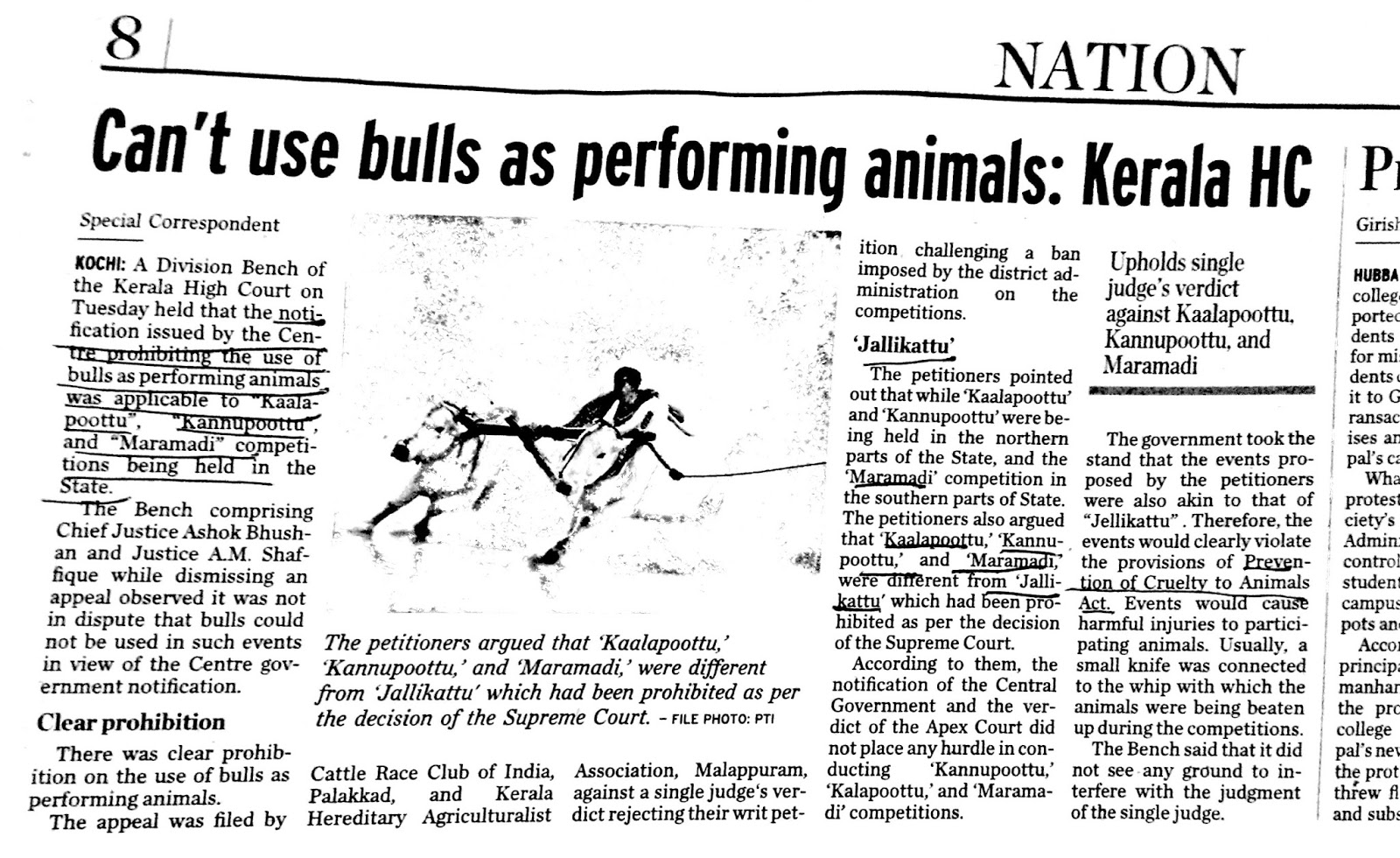
    1. Any judgement/ruling /remark by Supreme Court/High Court is important. While you note down the judgement ,also understand its relevance in your syllabus.Relate it to Geography /History /Economics/Polity.


    2. Identify social issues /challenges facing the society as such .Understand its pros and cons and also note down the recent incidents .You can quote them to substantiate your point .Example -caste riots ,moral policing ,restriction on freedom of speech,etc.

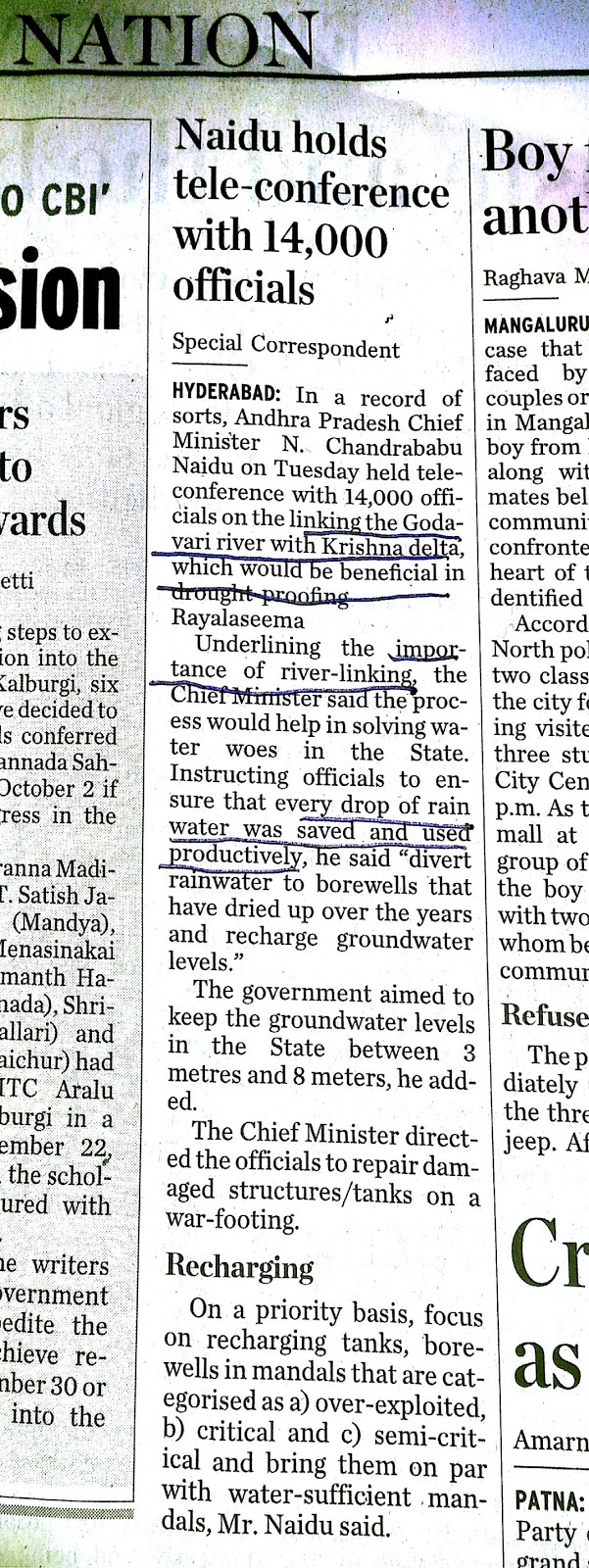
    3. Note down any issue being discussed in the Government departments/ministries. Note down the pros and cons of the issue .example -Linking rivers ,water conservation ,etc.
    4. Identify schemes/policies/ initiatives of the government. For the prelims ,you will have to know
    • Objectives of the policy
    • Under which ministry /department / it operates.
    • Any special feature of the policy.
    • Who are the members (If its an organisation .eg.Inter State council)
    • Any constitutional provisions related to it .
    For the mains,
    • you will have to understand the issue relating to the policy/scheme and make notes on pros and cons.


    Here,you will have to know about CISF and cyber crime in detail.
    5. While reading the editorial , identify the issue first. Then find out points in favour and against it. Please understand the the editorials have a bias towards one opinion. So,it is your duty to identify points, both for the topic and against the topic.
    5.

    Here, the issue is on the powers of AFSPA. A judgement has triggered this debate.

    Hope you find the article helpful in reading the newspaper .
    Happy reading .

  • What’s next on The First Firangis?

    Here’s a sneak-peek of what’s to be expected next on The First Firangis series.

    The Anglo-Mysore wars


    And here’s how you can help

    Tell us what intrigued you about these 4 wars? Tell us if you wish to know about anything in particular – any trivia, any weird fact, a tact or diplomatic maneuver which made you curious to know more. Enlighten us & help us in a way to shape the next comic.

    We are preparing a loooooong post and your contribution will help us shape the way we cover these 4 wars.

  • Why should you join Civil Services (IAS, IPS, IFS, IRS or like) in India?

    The bureaucrat returns with an emphatic answer as to why should you JOIN civil services.


    There are several benefits in the civil services, which you can’t get in any other profession. It is upto you to focus your attention to the positive side of the civil services or at the negative side. There are still numerous reasons to join civil services in India despite all the liberalization and globalization. Let me narrate a few of those.

    1:  Prestige

    Imagine that you are passing on a road of a city like Delhi, Mumbai, Chennai or any major city of India and you see several vehicles passing by. There are expensive vehicles like Mercedes, BMW, or Jaguar and there is a Government vehicle of average type with red/blue light on its top with the name plate of the office/officer. Which vehicle people look at?

    I am sure that most people look at the vehicle with red light. The traffic constables become alert on duty and may give a crisp salute to the officer sitting in the vehicle. A government vehicle is a sign of authority, which immediately attracts the attention of people. Similarly, a government officer immediately gets attention in big galaxies of important people.

    Contrary to popular perception in urban India and media, the civil servants are highly respected by the people of India. It is because they serve people like no one else. Further, their selection process has always been transparent and fair. UPSC had always been above board for selection of candidates for top services.  A PM/CM can make anyone a Cabinet Minister, Supreme Court Collegium can make anyone a High Court or Supreme Court Judge; and anyone can be made the CEO/CMD of a company but nobody can make you an IAS, IPS or IRS officer except your own merit. Hence, people of India never doubt the ability of a civil servant. When you become part of any function of an organization, its prestige goes up and you become the central point of the function and get all the attention.

    2: Power

    A civil servant is the epitome of state power. You are not a government servant but the government itself. The laws may be passed by the Parliament, but are executed only through civil servants. We as IRS officers sign so many documents on behalf of President of India. Please remember that you exercise the power of the Government in India pertaining to your department. You have the authority to decide cases worth hundreds of crores and conduct search, seizure of arrest of the people who are breaking the law of the land. No wonder, the law breakers don’t want to mess with you and the law abiders look at you for taking on the law breakers. You have the original powers to implement the rule of law in this country. Only when you fail, others come into picture.

    3. Job Security and Political Interference

    If you are in a private sector job, you can be removed with one day notice. You are always at the mercy of the company and its top bosses. The service conditions of civil servants are determined by the Parliament and can’t be changed to his disadvantage. Their service is protected by Article 311 of the Indian Constitution according to which, he can’t be dismissed from service without an enquiry where he would be given opportunity to defend himself. He also has the option to approach the Courts, in case he has been treated unfairly. The promotion of a civil servant is not in the hands of politician, which is either time bound manner or based on seniority. The promotion committees are headed by UPSC Member/Chairman and hence you can expect utmost objectivity in promotion.  You don’t have to fear anyone, if you are on the right side of the law.

    Fortunately the central services like IRS are fully insulated from political interference. I have never got any call from any politician in my 25 years of my career and there has been no political interference directly or indirectly ever. The reason can be attributed to the ‘Transfer Policy’ in our department. The postings upto the rank of Additional Commissioner are made by the Chief Commissioner (Within his Zone/State) or by the Central Board of Excise and Customs (All over India) manned by all IRS officials. Even for Commissioner and Chief Commissioner, it is the Placement Committee (PC) headed by The Chairman CBEC or CBDT proposes the names for the approval of FM. If a name is not proposed by PC, no order can be made.

    Similarly for posting in sensitive intelligence/investigation originations like DRI and DGCEI, the names have to be proposed by the Director General for being considered for posting. Thus the CBEC/CBDT has a sort of veto power over transfer and postings of IRS officers. If you find it unbelievable, please read the policy yourself by visiting the link Page on cbec.gov.in

    Unfortunately the situation is not same in States and the IAS/IPS/IFoS officers are posted usually by CM directly. I was told by one of my IPS colleagues that in his State, an SP can’t even transfer a constable without the approval of the Minister In-charge of the district. I hope that good sense will prevail and some day they will adopt the best practices of Government of India.

    4: Decent Salaries and Excellent Perks

    The salaries of the government officers have become very decent in recent years. When I joined IRS in 1991, my salary was around Rs 3500 pm only. Today in 2015 my salary is around Rs 1,50,000 pm viz. 43 times time more in less than 25 years . In addition, you also get free house, car, phone, medical, Leave Travel Concession, Children Education Allowance and pension. Most of the allowances are tax free.  You require at least Rs 50 lakhs of CTC to enjoy the same lifestyle in corporate.  Sometime, the rental value of your government accommodation itself may be much more than the CTC of several big corporate CEOs. Who can afford to stay in Lutyens Delhi bungalows on rent?

    5: Work Life Balance

    While it is common to hear the ply of the civil servants that they don’t have a good personal life, it is not absolutely true. Every government department has different types of postings. Some posts (like DM, SP) require long hours of work while several posts are such where you have to find work. The salaries in both the cases are exactly the same.

    Hence, if you give priority to personal life, you can always request the government to give you such assignments, where you can have more free time for yourself and the family. I have, on several occasion, requested the government for such peaceful assignments as I wanted to devote some time to teach my children and I was always given such light assignements. You also get 2/3 years of fully paid study leave, using which I did my PhD on E-Governance from IIITM Gwalior while in service. You can choose to study abroad in top university of the world and the government may finance most of the expenses.

    A female government officer gets additional 2 years of fully paid Child Care Leave to take care of their children, in addition to the maternity leave. Each government officer is also entitled to upto 5 years of Extra Ordinary Leave (Unpaid) for taking care of personals needs in addition to the 20 days of Half Pay Leave and 30 days of Earned leave every year besides 5 day a week work-schedule and numerous gazetted holidays. You have lots of flexibility to choose the postings according to your needs and temperament.

    6: Job Satisfaction

    You must remember that civil services is not an ordinary job where you work for an organization or for a person. You work for the country and its people. The revenue collected by an IRS officer is used for the benefit of the poorest and needy and for development of infrastructure and nation.

    As a police officer, you control crime in the country and hence create an atmosphere for security, growth and prosperity.

    As an IAS officer, you make and implement the developmental schemes for the growth of the nation. Your job is in the nature of social service. Many billionaires like Bill Gates, Azim Premji spend billions from their own pocket to get the satisfaction of doing the social work. You have the opportunity to do so while in service and you are even paid for it decently.

    7: Freedom to Work

    It may not be believable, but it is a fact that you have tremendous freedom to do your work as a government officer.  Each post in a government (SP, DM or Commissioner) is created and empowered by Parliament. Hence as far as you are on that chair, you have the full freedom to decide the things according to your judgment and discretion.

    For example, as a revenue officer, if I get information of tax evasion and I am empowered by law to conduct search, seizure or arrest; no one can give me any direction to act or not to act. No senior officer or Minister can change the decisions taken by the appropriate legal authority without following the procedures provided by the law. For example if the order of Commissioner is wrong, you have to approach the Tribunal, High Court or Supreme Court to reverse the order. These agencies have tremendous freedom and they decide the legality of the action independently without any intervention from the government.

    Even though media mostly highlights the conflicts between politicians and civil servants, in reality they work with each other without much problem. It is because the goal of civil servants and politician is one and the same. Politicians need good IAS and IPS officers who can help the state grow and become free from crime. When there is a problem, often both sides are responsible. You don’t even hear any conflict in states like MP, Chhattisgarh, Orissa, Rajasthan and even in Bihar (in Nitish Kumar regime). Most of the states have no conflict at all between officers and politicians. Good politicians and good bureaucrats always work together harmoniously and help each other. The problem between them is more personal than professional, though it is always highlighted as professional problem and politicians are blamed for the mess.

    8: Diversity of Jobs

    The civil services provide tremendous diversity of jobs. If you are in IAS, you can virtually head any organization in India. As secretary, you can head different ministries of the government and also different public sector undertaking, educational and research institutions.

    As an IRS (C&CE) officer you work in Customs, Excise, Service Tax, Narcotics, Training, Systems etc. You even work as advocate, when you are posted in Tribunals. You also work in intelligence agencies like DRI, DGCEI, CEIB, IB or RAW. All officers may get posting in Ministries and State/Central Government and work in the policy formation.

    You can get posted to international organizations like WCO, UN, WHO, World Bank IMF etc.  You can take lien and become a professor or join an NGO or even start an NGO in public interest. You can write books, make films and do several other activities with the permission of government.

    9: Widest Networking

    The networks of civil servants are the widest in the country. As an IRS officer, my collogues are posted all over the country. We also have officers posted in several part of the world. I can call anyone and request them for any help or protocol. When you join a service, you join a family. You are like the new born baby, who is looked after by every elder of the family. You have to just request and your wishes may be fulfilled. As you grow older in service, your role is reversed and you take care of the young officers like your children.

    There is also a brotherhood between all officers. I just have to pick up the phone and request my colleagues in IAS, IPS or others, and they will usually extend all types of help. Through your friends, you can approach anyone in the country, in case you need their help. The businessman, actors, leaders are all interested in networking with you, because you are always in positive to help others. It is you who have to restrict your network due to time constraints and due to its effect on performing your job professionally and impartially. Even when you retire, the network is not broken since your juniors remain in the service till almost the end of your life.

    10: Post Retirement Jobs

    A civil servant get the experience of the government as no one else can. It is often said in movies that an IAS (or IPS, IRS) officer can always choose to become a Minister but a Minister can’t become a civil servant. There is a great demand of such experience in the corporate, who have to deal several government departments, but they have no experience of dealing them. The retiree officers usually get very good job officers by corporate, if they choose to work later. Many of my colleagues, who have left IRS after 10-15 years of service to join corporate are getting salaries in Crores. You can even start your own consultancy firm and earn good money.  Since you learn how to run the government, you can also choose to join politics and become an effective Minister or even Chief Minister (Arvind Kejriwal, Ajit Jogi) or Prime Minister (Morarji Desai). You can also become Governor, CIC, CVC, CEC or UPSC/CAT/Tax Tribunal Member/Chairman after retirement.

    Conclusion

    It may be a good idea to join civil services like IAS,IPS, IFS,IRS or like, if you appreciate the value of the good things that government services have to offer. However, there is no free lunch in this world. Hence there is a price to be paid for getting the good things.

    Remember the old Hindi Song “Kabhi kisi ko mukammal jahan nahi milta, Kabhi zamin to kabhi asman nahi milta” (No body gets a perfect world, sometime you don’t get the earth and sometime you don’t get the sky).

    If you are willing to pay the price, civil services is still one of the best options to join in India.


    This article was written by Awdhesh Singh, an IRS officer with the GOI. Ref: Quora

  • Pay Commission Updates

    The 7th Central Pay Commission Report

    The Seventh Pay Commission, headed by Justice A K Mathur, submitted its report to the Centre in November, recommending 23.55% overall hike in pay, allowances and pensions of government employees from January 1, 2016. This means the Centre’s salary bill will go up by Rs 1,02,100 crore in 2016-17.

    The terms of reference of 7th CPC

    1. To review the principles that should govern the emoluments structure including pay, allowances and other benefits, in respect of the following categories of employees:-
      • Central Govt employees (industrial and non-industrial)
      • Personnel of the All India Services
      • Personnel of the UTs
      • Officers and employees of the Indian Audit and Accounts Dept
      • Members of regulatory bodies (excluding the RBI) set up under Acts of Parliament
      • Officers and employees of the Supreme Court
    2. To review the principles that should govern emoluments, concessions and benefits, as well as retirement benefits of Defence Forces
    3. To work out a framework for an emoluments structure to attract the most suitable talent to Govt service, promote efficiency, accountability and responsibility in the work culture
    4. To examine the existing schemes of payment of bonus and recommend general principles for an appropriate incentive scheme to reward excellence in productivity, performance and integrity
    5. To review the existing allowances available to employees and suggest their rationalization and simplification
    6. To examine the principles that govern the structure of pension and other retirement benefits
    7. To recommend the date of effect of its recommendations on all the above

    The recommendations should consider the following criteria:

    • Economic conditions in India and the need for fiscal prudence
    • Need to ensure that adequate resources are available for developmental expenditures and welfare measures
    • Likely impact of the recommendations on the finances of the States, which usually adopt the recommendations with modifications
    • Prevailing emolument structure and retirement benefits available to employees of Central PSUs
    • Best global practices and their adaptability and relevance in Indian conditions

    The above information may be helpful during prelims, though it has little relevance for mains

    Now, let’s take a look at the key recommendations

    It has recommended overall hike of 23.55% in pay, allowances and pensions of central govt. employees with effect from January 1, 2016

    • The minimum pay in govt to be set at ₹18,000 per month
    • The  system of pay bands and grade pay has been dispensed with and a new pay matrix has been designed
    • The Military Service Pay will be admissible only to the Defence forces personnel. <It is a compensation for the various aspects of military service>
    • Introduce a health insurance scheme for central govt employees and pensioners
    • The force personnel of CAPFs should be accorded martyr status in case of death in the line of duty. <Currently, it is accorded only to defence forces personnel>
    • Fair and equitable treatment must be given to all services; or it will widen the gap between the IAS and other services
    • A screening committee should be set up to decide on the allocation of officers on deputation to the centre on the basis of domain knowledge
    • Introduce Performance Related Pay for all categories of central govt employees
    • Take steps to improve the functioning of NPS and establishment of a strong grievance redressal mechanism

    Now, let’s analyse various issues pertaining to personnel in govt. sector.

    It is a long-pending debate that there are huge disparities between private sector and govt. employees in terms of salaries.

    Let’s analyse the difference in salaries of private and govt. employees

    • Compensation to Group C and D employees in govt. is greater than the private sector.< More than 90% of the workforce employed by govt. lies here>
    • For Group B employees, it is similar to private sector <Govt. workforce includes approx 5% group B employees>
    • However, for Group A employees, it is lower than private sector <Govt. workforce includes less than 5% group B employees>

    Govt. job offers added benefits, which are not available in private sector

    Pay Commission on Performance Related pay (PRP)

    What is it : Paying salaries or wages based on performance

    Rationale: Human beings respond to incentives. Recognition for good effort and achievement through an incentive is expected to energize and motivate officers to perform even better

    What’s the problem in implementing such a scheme?

    1. How to measure performance of an organization when targets are more in the nature of social and public goods which may not even be tangible?
    2. How to distribute credit among various departments for such larger public good?
    3. How to separate individuals from collective?
    4. How to prevent PRP degenerating into routine entitlements?

    The Commission notes it may be easier to implement such schemes in profit-driven private organizations where targets based on quantitative criteria make performance appraisal easier.

    Pay flexibility reforms are not a silver bullet, and involve trade-offs and risks. A study of the literature on the subject reveals that employee motivation and performance are not exclusively linked to Performance Related Pay (PRP) which may only enforce temporary compliance.

    Yet evidence from many countries indicates that pay flexibility contributes to management improvements, promotes an atmosphere of dialogue, rewards teamwork and is helpful in efficient task allocation.

    Two important aspects to be kept in mind before evolving such a scheme:

    1. Evolve proper criteria to measure performance along with setting a context where individual and organizational goals are clearly aligned
    2. Devise a performance appraisal system in which the objectives of the appraisal system match with that of the reward system

    Recommendation

    1. Results Framework Document (RFD) can be used as the primary assessment tool for linking the targets of the organization with that of the individuals
    2. Suitable changes in the Annual Performance Appraisal Report (APAR) can provide the necessary link between targets of the appraisal system with those of the RFD document

    Let’s see some of the critical observations of 7th CPC

    • The core of govt. employees (excluding security and commercial department) is very small
    • Pay, allowances and pension as a proportion of govt. expenditure has been declining sharply. <In 1998-99, it was 38% of revenue expenditure, which has reduced to 18% in 2015-16>
    • Pay and allowances in the central govt. have remained stable since 2010-11 at around 1.8%-2% of GDP
    • Impact of the pay hike will be .65% of the GDP. However, some increase in the salary comes back to govt. as taxes, reducing the net impact

    Often, it is argued that Indian govt. employs less people in proportion to its population. Let’s take a look at it.

    Why govt. should hire more?

    • Indian govt. employs less than 1.5% of its population with respect to China which employs 3% of its population
    • The number of personnel per lakh population is 139 for India, against  668 for the US
    • 7th CPC notes there is overall vacancy of around 18% of sanctioned strength
    • It has also observed that sanctioned strength is not adequate to deliver adequate governance

    Recent Developments

    • The Union finance ministry has set up an implementation cell for processing and implementing accepted recommendations of the 7th Pay Commission
    • Recently, several States have approached the Union govt. seeking more time in implementation of the Commission’s report.

    India should implement the recommendations of 7th CPC and II ARC together, reflecting the new mindset. Govt. should be ready to pay its public officials well, increase their strength and invest in building competence.

    It’s time for some questions:

    1. Pay commissions are relics of an age when India was a closed economy and govt. was the major employer. This archaic model has no role in today’s economy and it’s high time India scrapped the system of setting up pay commissions. Comment.
    2. Private organizations are generally thought to be more efficient than government organizations. What could be the possible reasons for this? How can we make our government system more efficient?
    3. Salary hikes are generally linked to performance. This truism of management is totally lost in the public sector, where duration of employment is linked to salary hikes. Keeping in view of the recommendations of 7th Pay commission, discuss the pros and cons of performance related pay.
    Published with inputs from Pushpendra 
  • Why you should not join Civil Services (IAS, IPS, IFS, IRS or like) in India?


    Most people join IAS, IPS, IFS, IRS or other civil services in India without knowing the full facts. You already know why you should join civil services. Yet most of you may not be aware of the negative sides of the civil services, which you will realize soon after you join. It is only fair that you should have the complete picture before you take a decision about your career.

    Let me explain now why you should not join Civil Services in India.

    1: No Recognition for Excellence

    All civil servants get their promotions based on their seniority. Your destiny is fixed by your UPSC rank and what you do in next 30-38 years is hardly of any consequence as far as your career is concerned. Initially, when brilliant students join civil services, they work very hard to deliver results and change the system. However, soon they realize that there are several colleagues, who don’t work even half and get all the (legal) benefits as them. They also realize that the more you work, the more chances of you committing a mistake and more chances of punishment. Hence gradually they too become slow and practical.  I quote following lines which are quite popular among civil servants.

    Bane Raho Pagla, Kam Karega Agla

    Raho Hamesha Cool, Salary Paoge Full

    Mat Lo Tension, Nahi to Family payegi Pension

    (English translation)

    (Pretend to be fool, your successor shall do the work

    Always Remain Cool, You get full salary

    Don’t take tension, Else your family will get pension)

    2: Corruption

    It is a fact that many people are attracted towards civil services due to the tales of corruption. They know some officers or they have heard about some officers who have made millions. They join the civil services to make lot of money illegally thinking that it is easy to do so. When they join these services, they discover that no money is available for the post. They have to do some illegal activity or allow the illegal things to go on to make money. When you do any illegal act, there is always a risk of getting caught even after you have demitted the office. Your reputation is 100% spoiled even if you are not caught. Even when you have somehow made a lot of illegal money, you don’t know how you use that money for you. You can’t build any asset or buy new cars and live the life of luxury, because you may face vigilance action or face CBI or Income Tax raid at your house, which can spoil your career forever. You may even end up in jail. Every year, dozens of top civil servants are arrested and put behind the bar. Hence, you can’t sleep properly once you have accumulated lots of ill-gotten money. You may also suffer many illnesses due to the mental tensions. Once you start doing illegal activities, you can never go back to your honest life because you will always be blackmailed by your superiors and juniors who know where you committed the illegal acts. Corruption is one way traffic, with no U-turn.

    3: Frequent Transfers

    People join civil services to occupy the prominent positions like DM, SP or Commissioners. They get all their recognition, perks and privileges (legal as well as illegal) only on these posts. However, they don’t know how long they can continue in these postings. I was posted on election duty in Paudi (Garhwal) in 2007. Among the other election observers was a lady IAS officer, whose husband was also an IAS officer of the same batch. Presently both husband and wife were in central deputation in Delhi. She told me that in last 14-15 years, she and her husband were never posted in the same station. They used to meet only when a meeting is called by the Commissioner or CM. Only when they came to Central Deputation, they are staying together. In Paudi I found that the DM and Commissioner were staying alone in their big-bungalows and their families were in Dehradun. Even SP and SDM were staying alone since their spouses were in IAS/IPS and they were posted in different stations. You must be ready to live alone, if you choose All India Services.

    4: Frustration of Joining Central Services

    I have already explained the problems of IAS and IPS. So you may be thinking that why not join IFS, IRS or other Central Services where you don’t have these problems of transfer/posting. You are right. Central services provide you best family lives but they don’t satisfy most people. Most people write civil services again and again to join IAS. I know a few people who got into IAS after 4-6 years of working in their other jobs as IPS, IRS etc. It is because, the type of recognition an IAS or IPS gets at such young age is unparallel in other services. They get the big bungalows, red-light cars and uniformed guards which are not available to other services. But once you join IAS, IPS, you face different types of problems.

    5: Political Interference

    Who does not know about political interference in India, particularly in IAS and IPS? Most of these officers have to have political godfathers. The politicians use them to get their work done and the officers use them to get their postings and also protect them in case of any problems.  Often you have to do illegal things to keep the bosses and politicians happy and thus you get trapped forever in their clutches. You can neither leave them nor live with them. There may not be much political interference in Central Services, but then they are also not helped by politicians when they need them.

    6: Promotion or Demotion

    While in other jobs, you gain importance as you get more and more experience. Unfortunately, it is just opposite in IAS, IPS. You are the most important person when you are SP or DM. Even the CM is directly in touch with you. This happens within just 3-5 years of your joining the cadre after training. However, as you get promoted to DIG, IG or Commissioner/Secretary, your importance declines. There are several dozen IG, ADG and even DG sitting in the state capital, and no one knows them. The IAS officers also become just a glorified babu when they become secretaries after promotion. Most people don’t even know that such posts exist in their cadre. The situation is different in Central Services where your importance rises with every promotion. But then central service officer don’t ever have that level of social adulation.

    7: Poor Salaries

    While the starting salaries of a civil servant are decent (around Rs 50,000), his growth of salary is just @ 3% per annum (plus the Dearness Allowance). The salary of the Chief Secretary is hardly Rs 1,80,000 pm (or Rs 1,35,000 after tax). The ratio of the peak salary to staring salary of an IAS officer is just four times. However, the story is quite different in corporate. For example, the Infosys CEO Vishal Sikka has been given an annual salary of USD5.08 million (over Rs. 30 crore) and USD2 million in stock options. Since the entry level salary of Infosys is around 3 lakhs per annum, the top man is paid more than 1000 times more salary than the entry level employee. In most of the corporate, the ratio is more than 100 times.

     No honest civil servant can ever afford to buy a decent house in a good locality in any Metropolitan city. The low salaries were earlier compensated by the liberal pension given by the Government which used to be revised after every pay commission. However, once the pension benefit is stopped, you don’t have  a back-up support after your retirement.

    8: Long and Hard Preparation

    While most people think that they can get into their choice service in their first attempt, the reality is quite different. The average age of IAS and other service is around 27-28 years. This means that an average entrant of a CSE spend around 6-7 years after his graduation to get into civil services. Still only 1 in 500 is able to get into Civil Services and 1 in 5000 gets into IAS (proper). Even most people, who are in IAS, fail to get the cadre of choice and 25% end up in cadres which they hate to go.

    9: Poor Family Life

    While the family life of central service officers like IRS may be normal, the life of IAS and IPS are quite challenging in the initial years when you are heading a district. Most of the districts in India are quite backwards with hardly a decent school for your children. You are working 12 hours a day and hardly have any time for family. You also make so many enemies, if you an honest officer and you family is always fearing about your safety and of their own.

    10: Diminishing Social Relevance

    In the pre-liberalized era, government officers were looked as the Mai-Baap for a common citizen of India. Their salaries were comparable with private sectors but their perks were far superior. They were playing leading roles in social development. Today, most of the space is filled with private sectors. Our Honorable PM Shri Narendra Modi once said, “I believe government has no business to do business. The focus should be on Minimum Government but Maximum Governance.”  Today a company like Infosys or TCS provides around 40000-50000 jobs each year while UPSC and PSC put together don’t appoint as many people.  The personal wealth of Mukesh Ambani is $20.8 billion (Rs 137280 Crores) which is more than the total tax collection of several states in a year. The value of top 10 companies in India is more than the total revenue of the Government of India and all State Governments put together. The Tata group alone has market capitalization of Rs 7,00,000 crores. It is also a fact that most Indians don’t like civil servants, who are perceived to be inefficient and corrupt. They are seen as hindrance to the growth of India rather than an instrument of growth.

    PS: The purpose of this article is not to discourage to join Civil Services but to have the full picture of the civil services by highlighting the negative side of civil services which are hardly known to most of the entrants.

    Want to read more?


    This article was written by Awdhesh Singh, an IRS officer with the GOI. Ref: Quora

  • Vienna Conference to end Syria’s endless agony

    This article gives you an understanding of how perplex and deepened Syria Crisis is , and solutions from Global Interests in it. Stay tuned to Syria Crisis and World.


    What’s the Vienna conference ?

    • The conference at Vienna on October 30, bringing together 17 states (China, Egypt, France, Germany, Iran, Iraq, Italy, Jordan, Lebanon, Oman, Qatar, Russia, Saudi Arabia, Turkey, United Arab Emirates, the UK, and the US), ended with a nine-point joint communique.
    • The United Nations (UN) and European Union (EU) were also represented at the conference.
    • This is the third such attempt to hold talks to find a way to bring to an end Syria’s complicated issues.

    Historical Background

    Previous two attempts, Geneva 1 (June 2012) and Geneva 2 (February 2014), can be correctly characterised as insincere and cynical theatre, for 4 reasons:

    • Iran, an important stakeholder, willing and able to frustrate any search for a political solution that excludes it, was not invited.
    • With the US-supported rebels given undue weightage, not all the opposition parties in Syria were invited.
    • Principal initiators, the US and Russia, more intent on scoring points over each other.
    • By inviting warring Syrian parties, including the Bashar al-Assad regime, their external supporters found it difficult to talk frankly among themselves.
    • The exclusion of Syria this time in Vienna is a wise step.

    The highlights of the communique

    • Syria’s unity, independence, territorial integrity, and secular character are fundamental, and imperative to promote all efforts to end the war.
    • The Islamic State (IS) and other terrorist groups, as designated by the UNSC, must be defeated.
    • The UN is invited to convene a conference of representatives of the Syrian Government and the Opposition to start a political process leading to credible, inclusive, non-sectarian governance followed by a new constitution, and an election under the UN supervision.
    • In parallel with political process, participants along with UN will explore modalities for a nationwide ceasefire to be effective.

    What’s the principal bone of contention? Is it about Assad’s position?

    • Probably, it is the US, Saudi Arabia, and their allies who have given in.
    • Till now, they have been repeating that Assad is not part of the solution and that the political process cannot start without his leaving office.
    • After the Russian military intervention, Assad’s position, from a military point of view at least, has improved.
    • The changed US position is that Assad has to go, but not on day one the political process starts. The US has wisely changed its position.
    • It is rather naïve to say that if Assad steps down, Syria will rapidly see the end of the civil wars.

    vienna-infograph


    What has been discussed in Vienna ?

    • The participants at the conference were not willing to put the ceasefire as an immediate goal.
    • It should be noted that the US announced its plans to send Special Forces to Syria the day the conference started.
    • Further, the Saudi decision to send more and better weapons to rebels supported by it remains unchanged.
    • In short, it was far from a gathering of powers with common goals keen to work together to find solutions.

    What about the Islamic State (IS) ?

    • It will not be invited to be part of the political process. Nor is it likely to agree to be part of the process even if invited.
    • Is it the intention of some of the participants, if not all, to reconcile Assad and all the non-IS rebels and thereafter put together a grand coalition against the IS?
    • How long will it take to put together such a coalition assuming that an attempt will be made?

    Is there a shift in the US policy ?

    • For Obama, it was a painful decision to send Special Forces, “less than fifty”, to Syria.
    • Their mission is to “help coordinate local ground forces and coalition efforts”.
    • In other words, the Special Forces will not assist forces fighting Assad’s regime.
    • Obama has found it difficult to answer cogently his critics at home who fault him with a weak and incoherent policy on Syria.

    Are there any concerns from Russia’s side ?

    • Surely, Russia has raised concerns about a ‘proxy war’ and urged closer consultations with the US to take care of deconfliction.
    • Looking ahead, if there is no settlement before the US presidential election due in a year’s time, Obama’s successor might step up the military involvement taking the US closer to a ‘proxy war’ with Russia.

    Then, has Vienna reached to a conclusion?

    • In conclusion, the Vienna Conference could lead over time to a ceasefire between Assad and the non-IS rebels, but it is too soon to say that it will.
    • The key powers adding fuel to the fire of the multiple civil wars raging in Syria have yet to reach the conclusion that it is in their interest to stop doing that.
    • The conference might not have been held but for the Russian bombing campaign and the inundation of Europe by refugees.
    • The US policy towards Syria is slowly changing and it is difficult to say whether it will be dragged deeper into the quagmire that Syria is.

    What is painfully clear is that we all are going to witness more killing, more refugees, and more talking, Isn’t it ? It is difficult, not to recall the Roman poet Ovid’s lines penned twenty centuries ago:

    Video meliora, proboque; deteriora sequor
    (I see better things and approve; I follow the worse)


    Published with inputs from Arun

More posts