💥UPSC 2026, 2027, 2028 UAP Mentorship (March Batch) + Access XFactor Notes & Microthemes PDF

Search results for: “”

  • PJ Nayak Committee for Governance reforms [Comic strip]

    A week back or so, we fiddled with the idea of introducing flashcards of basic theoretical terms which bug early stage aspirants when they read daily news. Here’s the post on that.

    This time, we are going in a step further. And what better way to deal with complex concepts, than with a comic strip interspersed with conversations and questions! Sounds fun? Here we go.

    The rules of this initiative. Only 2, not much! 

    1. We will introduce a module from static or current affairs in the most interesting way that we can conjure up.
    2. We will poke holes in the committee reports, suggestions, policy changes, historical blunders etc etc so that we all pitch in with clarifications and help each other understand the basics of things.

      Over to the topic at hand then…

    P J Nayak was entrusted (by none other than Raghuram Rajan) to head an RBI committee on banking governance and present a report, which he did in style:


    Do you know why banks were nationalised way back in Indira Gandhi’s time?

    And why it might still be a good idea (according to government) to keep control over them?


    For newly enthused aspirants, it might be a good idea to go figure the pros and cons of such heavy oversight of FinMin – RBI – CAG – CVC over public sector companies in general (banks or otherwise).


    If you were to represent government’s interest here, what would your rebuttal be? Take a hint from the its seven-pronged strategy called ‘Indradhanush’ to revamp public-sector banks. P J Nayak wasn’t very happy with that!

  • Roadmap For Paris Climate Talks: Part III


    This is the 3rd explainer in the series of articles on Paris Climate Talks and the underlying issues.

    Previous articles, here: Part 1 & Part 2

    In this article, we will explore the newly emerged concept of INDCs, which will shape the Paris climate change negotiations.

    What is an INDC?

    INDCs, known as Intended Nationally Determined Contributions.

    INDCs are bottom-up commitments from nations defining the extent of their emissions reduction contribution towards this global goal.

    INDCs showcase a paradigm shift from top-down approach to bottom-up system, in deciding the commitments towards climate change.

    Countries have agreed to publicly outline what post-2020 climate actions they intend to take under a new international agreement, known as their INDCs.

    Why are INDCs important for climate change?

    These INDCs will form the basis for the most awaited Paris Climate Change agreement by the end of this year, which will put in place a new protocol from 2020.

    It will largely determine whether the world achieves an ambitious 2015 agreement and is put on a path toward a low-carbon, climate-resilient future.

    Ambitious, equitable and transparent INDCs can provide the world a fighting chance to tackle climate change.

    How does the process work?

    The process for INDCs pairs national policy-setting in which countries determine their contributions in the context of their national priorities, circumstances and capabilities.

    It will be accompanied with a global framework where each country drives the collective action towards a low-carbon, climate-resilient future.

    INDCs are the primary means for govts to communicate internationally the steps they will take to address climate change in their own countries.


    What do India’s INDC look like?

    Indian INDCs are inspired by Mahatma Gandhi’s famous quote, “Earth provides enough to satisfy every man’s needs, but not every man’s greed.

    • India has promised to reduce the emissions intensity of its GDP by 33-35% by 2030 from 2005 levels. < The GHG emission intensity means the ratio between a country’s gross emissions to its gross domestic product at a particular point. >
    • To increase the share of non-fossil fuel sources in it’s energy portfolio to about 40% by 2030.
    • To create an additional carbon sink of 2.5 to 3 billion tonnes of CO2 equivalent through additional forest and tree cover by 2030.

    These emission intensity-reduction targets and adaptation to climate change will require about $2.5 trillion

    How will India mobilise funds to fulfill its INDC commitment?

    INDC data estimates spending of atleast $2.5 trillion between 2015-30 to meets its ambitious INDC target.

    India is banking on fiscal measures including fuel subsidy cuts and increased taxes on fossil fuels including diesel and petrol.

    The coal cess forms the corpus for the National Clean Environment Fund, which is used for financing clean energy, technologies, and projects related to it.


    Published with inputs from Pushpendra
  • IAS Prelims 2016 Corner #7

    While attempting Prelims 2015, many of you might have had this feeling of deja vu because there were some questions that were picked up word by word or were inspired by questions from previous examinations. Why no tropical cyclones in a particular region, national park with varied climate, Babur, Buddha, floating park.. all had been there in previous tests. So, I had requested them to provide me copy of previous years tests conducted by them and today I am picking up question from them. Enjoy the ride to the past, The Glorious Past!

    #1. In which one of the following regions are the hurricanes apparently absent?

    (a) Coast of Texas

    (b) Gulf of Mexico

    (c) South-eastern coast of USA

    (d) South-eastern coast of Pacific

    #2. Consider the following statements:

    1. The continental shelves of Lakshadweep originated due to coral reefs.

    2. The continental shelves of western coast are due to faulting and submergence.

    Which of the above statements is/are correct?

    (a) 1 only

    (b) 2 only

    (c) Both 1 and 2

    (d) Neither 1 nor 2

    #3. The Dogger Bank, the main fishing area of Europe lies in

    (a) Baltic Sea

    (b) English Channel

    (c) North Sea

    (d) Norwegian Sea

    #4. Consider the following statements:

    1. Nokrek Biosphere Reserve contains tropical wet evergreen forest type of vegetation.

    2. The River Pindar flows through Nandadevi Biosphere Reserve.

    Which of the above statements is/are correct?

    (a) 1 only

    (b) 2 only

    (c) Both 1 and 2

    (d) Neither 1 nor 2

    #5. Which one of the following pairs of cities have the largest annual average rainfall difference as compared to the other three pairs?

    (a) Jabalpur and Nagpur

    (b) Mumbai and Pune

    (c) Kolkata and Bhubaneshwar

    (d) Guwahati and Shillong

    #6. Which one of the following is not required for the formation of photochemical smog?

    (a) Oxygen

    (b) Oxide of Nitrogen

    (c) Carbon monoxide

    (d) Sunlight

    #7. On the banks of which river is the city of Kathmandu located?

    (a) Arun

    (b) Saptakosi

    (c) Bagmati

    (d) Sunkosi

    Answer Key:

    #1. (d)

    #2. (c)

    #3. (c)

    #4. (c)

    #5. (b)

    #6. (c)

    #7. (c)


  • New Initiative: Back 2 Basics – Static Syllabus Through Dynamic News


    For the last 8 months or so, we have been continuously providing daily current affairs in form of Newscards over our awesomely clutter free android app.

    And every now and then a good product needs to reinvent itself and think of how to best serve its audience, AND THAT IS YOU!

    YES, YOU! You right now sitting across the computer or a tiny miny mobile device, trying to make sense of the sudden onslaught of CAPSLOCK AND SENTENCES MAKING NO PRACTICAL sense. Kidding! Okay. Digression ends.


    What is awesome?

    Current affairs from the best sources in ONE SINGLE APP.

    What is awesomer still?

    The ability to revise static portion of GS syllabus while reading the current affairs. In the same APP!


    This is what we were experimenting in the past few days. We believe that it is always good for an aspirant (new and old) to keep in touch with the basics. 

    • You know about a scheme on congestion tax being thought by the delhi government – Good. You get to revisit the basic of congestion tax – Great!
    • Government launches a scheme for financial turnaround of Power Distribution Companies – Good. You get to revisit the reasons why these companies are usually so stressed? – Great!
    • Scientist develop a 3D printing method to produce embryonic stem cells? Good. But what is this 3D printing stuff? What else can I get to know in 2-3 points? That’s what we call going back 2 basics!

    Let us know what you guys think? It is heartening to see that you guys are pitching in with relevant points and helping each other out with sincere questions/ answers.

    A community is only as strong as its members and you guys make us wanna innovate more and more and more on content!

    Keep the spirit going and yes, do do do RATE THE APP!


  • Ethical Dilemma of a Lieutenant in a Military Organisation

    Picking up an important question from our last pop quiz on Ethics – GS Paper4. Since no one attempted this question, I would like you to give it another chance.

    I wish to bring forth an interesting set of dilemma and theory on the Paper 4 via this question. Do give it a shot.


    #2. You are first lieutenant in a military organisation. You report to captain who in turn reports to Major. You share positive working relation with both.

    In your office there arises vacancy of a supervisor. In this regard both of your officers encourage you to appoint a particular person from other department. However you are not impressed with that person and found that person unsuitable for the post. In-spite of this you decided to trust your seniors and appoint him.

    After one month it is clear to you that your judgement was correct that this person is not competitive enough. Although given time he can improve and develop his skills.

    However very soon situation has become very complicated New supervisor has developed misunderstanding with the Captain and now the Major and the Captain are sending conflicting signals. Captain suggests that you immediately transfer supervisor during his probation period while Major urged you to write an early highly positive evaluation for him even before prescribed three months.

    Q1. Examine the major issues involved.

    Q2. Trace your course of action.

  • IAS Prelims 2016 Corner #6

    While we renew our pitch to join  NSG, the crash in Sinai exposes the vulnerabilities that we have to live with! Here is set 6 for you to brush up on current affairs with a little bit of geography thrown in.

    #1. Despite substantial thorium reserves, Indian Nuclear Programme is largely uranium-centric because

    (a) thorium cannot sustain a chain reaction on its own unlike uranium

    (b) India wants to preserve its thorium reserves for future exigencies

    (c) energy efficiency in thorium based reactors is much less compared to uranium based reactors

    (d) thorium based reactors are known to be more prone to meltdown compared to uranium based reactors

    #2. Nuclear Suppliers Group (NSG) is a multinational body concerned with reducing nuclear proliferation. Which of the following is/are among the member countries of NSG?

    1. Ireland

    2. Mongolia

    3. Japan

    4. Norway

    Select the correct alternative using the codes given below.

    (a) 2, 3 and 4 only

    (b) 1 and 2 only

    (c) 1, 3 and 4 only

    (d) 1, 2, 3 and 4

    #3. In case of India, the monetary policy of the country is decided by the

    (a) the chief of the central bank in consultation with a committee headed by a government representative

    (b) the Central government in consultation with the central bank

    (c) the chief of the central bank advised by a technical committee

    (d) the Central government in consultation with State Finance Ministries

    #4. Consider the following statements:

    1. The first Indi-Africa Forum Summit (IAFS) was held in Addis Ababa.

    2. The theme of the recently concluded IAFS was ‘Partnering the Resourceful Africa’.

    Which of the above statements is/are correct?

    (a) 1 only

    (b) 2 only

    (c) Both 1 and 2

    (d) Neither 1 nor 2

    #5. Sinai Peninsula, recently in news, is a region in

    (a) Southern Africa

    (b) North-Western Africa

    (c) Central Africa

    (d) North-Eastern Africa

    #6. Wassenaar Arrangement is a term generally used in connection with

    (a) bilateral trade agreements between regional groupings

    (b) control of use of chemical agents in war-torn regions

    (c) arresting the trade in parts of endangered wildlife

    (d) export control for conventional arms and dual-use goods and technologies

    #7. Which of the following pairs is/are not correctly matched?

    1. Garhjat Hills : Western India

    2. Mikir Hills : North-Eastern India

    3.  Mahadeo Hills : Central India

    4. Satmala Hills : Eastern India

    Select the correct alternative using the codes given below.

    (a) 2 and 3 only

    (b) 1 and 2 only

    (c) 1 and 4 only

    (d) 3 and 4 only

    Answer Key:

    #1. (a)

    #2. (c)

    #3. (c)

    #4. (d)

    #5. (d)

    #6. (d)

    #7. (c)


  • Roadmap For Paris Climate Talks: Part II


    This is 2nd explainer in the series of articles on Paris Climate Talks and the underlying issues.

    In this article, we will explore the principles that figure during climate change discussions, which could have serious implications during Paris climate change negotiations.

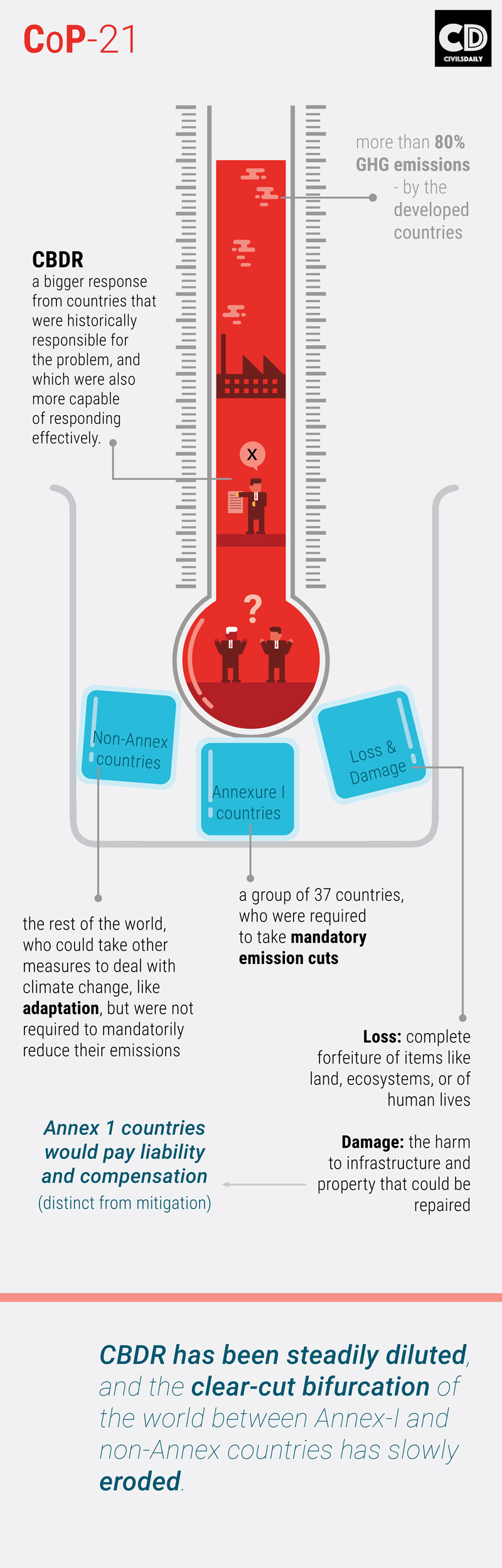
    Since more than 80% GHG emissions present in the atmosphere today have been emitted by the developed countries which underwent Industrial Revolution in last 150 years.

    Therefore, UN Framework Convention, 1994 placed the burden of mitigating climate change primarily on these countries.


    What is the principle of Common But Differentiated Responsibilities and Respective Capabilities (CBDR-RC)

    This principle demands a bigger response from countries that were historically responsible for the problem, and which were also more capable of responding effectively.

    Most of the rich and technologically advanced countries of the west fitted both criteria.

    The Convention divided the world in two clear groups:

    Annexure I countries: It was a group of 37 countries, who were required to take mandatory emission cuts.

    Non-Annex countries: It comprises the rest of the world, who could take other measures to deal with climate change, like adaptation, but were not required to mandatorily reduce their emissions.

    Where does the problem lie?

    CBDR is at the heart of the Kyoto Protocol, the existing global arrangement for fighting climate change that came into being at CoP-3 in Kyoto, and gave quantified emission cut targets to every Annex-I country.

    However, owing to persistent efforts of the rich and developed world, CBDR has been steadily diluted, and the clear-cut bifurcation of the world between Annex-I and non-Annex countries has slowly eroded.

    What is the principle of Loss and Damage ?

    It essentially tries to capture the inability of communities/countries to cope with the effects of global warming.

    At the Conference of Parties (COP19) of the UNFCCC, held in Warsaw in 2013, all parties agreed to set up a new mechanism on L&D.

    Loss: It generally refers to the complete forfeiture of items like land, ecosystems, or of human lives. The term includes both economic and non-economic losses.

    Damage: It refers to the harm to infrastructure and property that could be repaired.

    What makes Loss and Damage important and different from other mechanism?

    It is important because even after GHG emissions are reduced and communities adapt to climate change, there would still be loss and damage to people, livelihoods and infrastructure as a result of their inability to cope with climate change.

    This is distinct from mitigation, or reducing greenhouse gas emissions, and adaptation, or finding ways to live in a warmer world.

    How L&D will figure in Paris Climate Conference?

    The implementation of L&D principle would mean that Annex 1 countries would pay liability and compensation, as they are responsible for bulk of emissions.

    Recently, the Like Minded Developing Countries held a meeting in Delhi for the issues to be discussed in Paris COP and they have included Loss & Damage in their agenda.

    Published with inputs from Pushpendra
  • Contention over South China Sea

    • Why in news?
    • Background
    • Importance of South China Sea
    • What is the case about?
    • Are Chinese claims valid?
    • What next?
    • India’s involvement in issue
    • Further role by India

    Why in news?

    • The Permanent Court of Arbitration at Hague has declared that China cannot claim any historic rights over islands in the South China sea. The tribunal also ruled that China has violated Philippines’s sovereign rights.
    • The dispute had been raised by Philippines in 2013. However, China had refused to participate in the tribunal proceedings, questioning jurisdiction among other things.
    • After the tribunal announced the verdict, China has officially announced it has neither accepted nor recognised the award of the tribunal.
    • This award had been looked forward to by many countries including India and USA, both of which have strategic maritime as well as economic interests in the region.

    source

    Background

    • The South China Sea is located at the western edge of the Pacific Ocean, to Asia’s southeast.
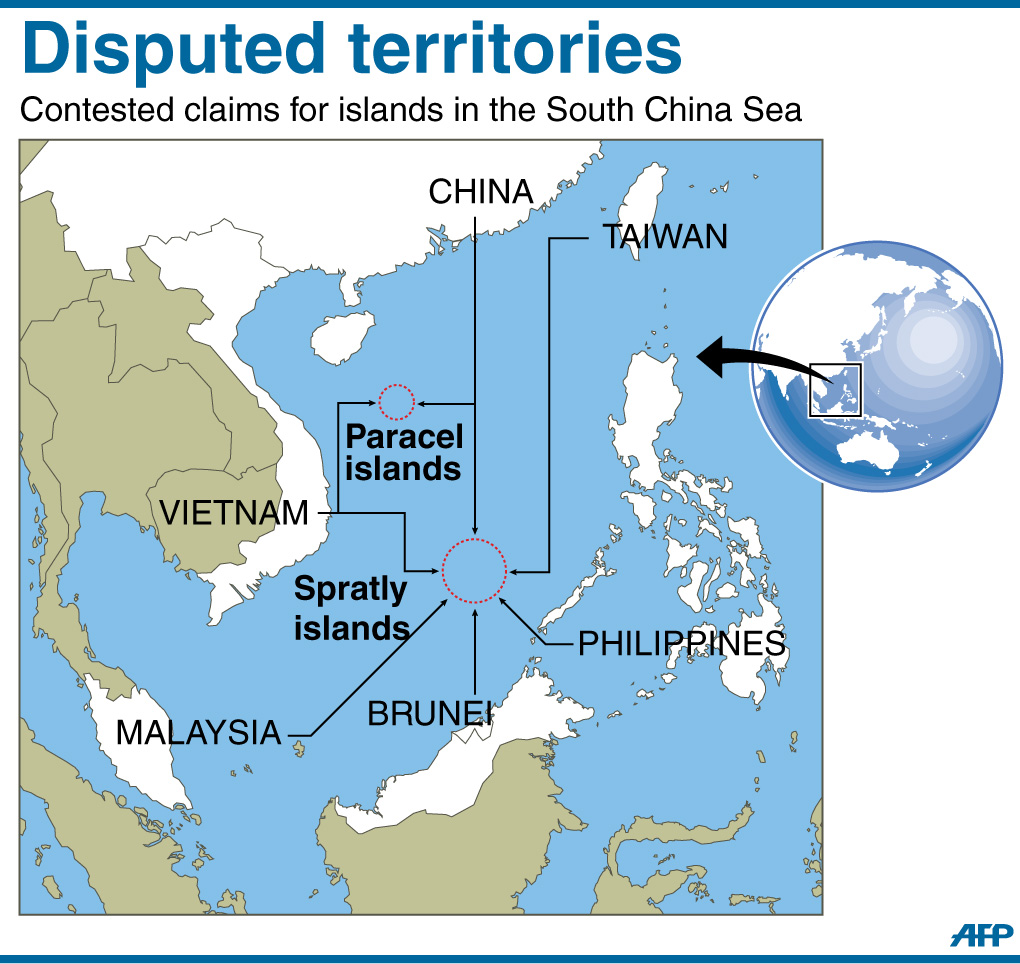
    • It encompasses an area of about 1.4 million square miles and contains a collection of reefs, islands and atolls, including the Spratly Islands,Paracel Islands and Scarborough Shoal.
    • China has been claiming the historic control of over 85% of South China Sea, while countries like Philippines, Malaysia, Vietnam, Taiwan and Brunei also have been making competing claims.

    Importance of South China Sea

    • It is a 3.5m sq km waterway.
    • One of the world’s most strategically vital maritime spaces.
    • More oil passes through here than the Suez Canal.
    • More than $5 trillion in trade flows through its waters each year. That is a third of all global maritime commerce.
    • The Strait of Malacca that links Indian and Pacific Oceans handles four times as much oil as Suez Canal.

     What is the case about?

    • Philippines brought its dispute with China to international arbitration in January 2013, despite Beijing’s warnings of a diplomatic and economic backlash.
    • The Philippines asked a tribunal of five arbitrators to declare as invalid China’s vast claims, known as nine-dash lines for the dashes that demarcate virtually all of the South China Sea as Chinese territory, under the United Nation Convention on the Law of the Seas, or UNCLOS.
    • The Philippines also asked the tribunal to classify whether a number of disputed areas are islands, low-tide coral outcrops or submerged banks to determine the stretch of territorial waters they are entitled to under the convention.
    • It also wants China to be declared in violation of the convention for carrying out fishing and construction activities that breached the Philippines’ maritime rights.

    Are Chinese claims valid?

    • China had joined UNCLOS long before and has accepted international jurisdictions.
    • However, their current discourse is that China was not the party to the rule making and hence, China has some hesitation in fully following the UNCLOS provisions.
    • The Chinese proposal is that SCS is a territorial sea which means that freedom of navigation would be problematic, although they clarified that they are not obstructing the freedom of navigation or have obstructed before.

    What next?

    • The award can’t be enforced as Chinese have rejected it.
    • What is going to be instructive is how China will respond as PCA doesn’t have any enforcement mechanism.
    • UNCLOS has made it very clear that if a country has equivalent of manmade islands, which is what is at dispute here, the country does not have a maritime entitlement.
    • There is a claim which says that China’s territorial water goes up to 2000 kms!! which is quite untenable.
    • Thus, Chinese response is going to be very critical. However, the first sign of foreign office statement from Beijing has been very categorical. They have used ‘null and void’ to answer the verdict, which is very strong.

    India’s involvement in issue

    From India’s perspective, the freedom of navigation and overflight is critical for two reasons:

    • Lot of India’s trade passes through SCS. Therefore, India cannot accept the situation where India is dependent on the goodwill of Chinese for transit.
    • If China manages to establish its sovereignty over these islands and waters, then it becomes a very important base for its power projection in the Indian Ocean. This is what concerns India.

    India is at present, not taking sides between the contestants in the dispute. So, the Indian position is balanced. At this stage, when it is talked about geopolitical dimension, India should continue this stand.

    Further role by India

    • The role India could play while awaiting China’s response is to engage in a chat with Beijing and cite the India-Bangladesh example that there is a case of principles and that India is taking no position on territoriality but is talking about the way in which maritime practice and law must be respected because that has bearing on the larger issues of global order.
    • India can try to deal with each of the major stakeholders in its own way as it has in the past.

    References:

More posts