- Why in news?
- Background
- Importance of South China Sea
- What is the case about?
- Are Chinese claims valid?
- What next?
- India’s involvement in issue
- Further role by India
Why in news?
- The Permanent Court of Arbitration at Hague has declared that China cannot claim any historic rights over islands in the South China sea. The tribunal also ruled that China has violated Philippines’s sovereign rights.
- The dispute had been raised by Philippines in 2013. However, China had refused to participate in the tribunal proceedings, questioning jurisdiction among other things.
- After the tribunal announced the verdict, China has officially announced it has neither accepted nor recognised the award of the tribunal.
- This award had been looked forward to by many countries including India and USA, both of which have strategic maritime as well as economic interests in the region.
source
Background
- The South China Sea is located at the western edge of the Pacific Ocean, to Asia’s southeast.
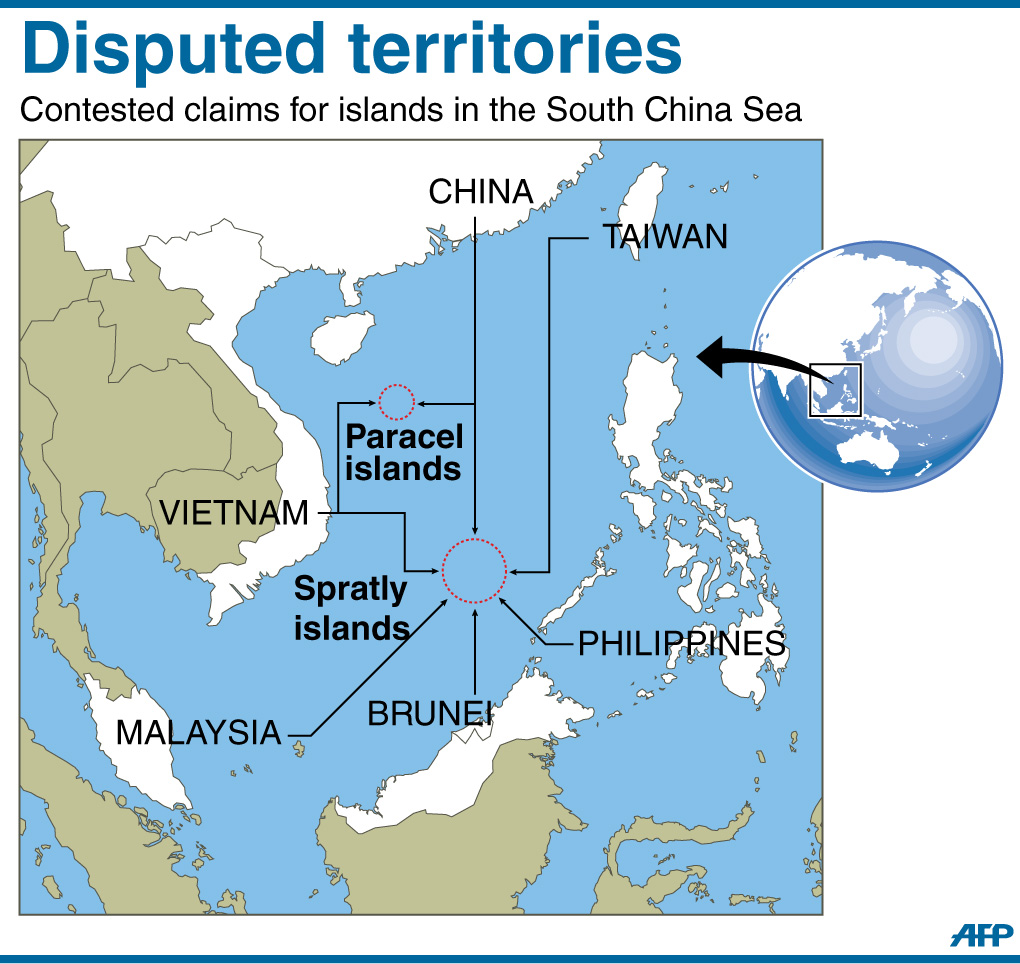
- It encompasses an area of about 1.4 million square miles and contains a collection of reefs, islands and atolls, including the Spratly Islands,Paracel Islands and Scarborough Shoal.
- China has been claiming the historic control of over 85% of South China Sea, while countries like Philippines, Malaysia, Vietnam, Taiwan and Brunei also have been making competing claims.
Importance of South China Sea
- It is a 3.5m sq km waterway.
- One of the world’s most strategically vital maritime spaces.
- More oil passes through here than the Suez Canal.
- More than $5 trillion in trade flows through its waters each year. That is a third of all global maritime commerce.
- The Strait of Malacca that links Indian and Pacific Oceans handles four times as much oil as Suez Canal.
What is the case about?
- Philippines brought its dispute with China to international arbitration in January 2013, despite Beijing’s warnings of a diplomatic and economic backlash.
- The Philippines asked a tribunal of five arbitrators to declare as invalid China’s vast claims, known as nine-dash lines for the dashes that demarcate virtually all of the South China Sea as Chinese territory, under the United Nation Convention on the Law of the Seas, or UNCLOS.
- The Philippines also asked the tribunal to classify whether a number of disputed areas are islands, low-tide coral outcrops or submerged banks to determine the stretch of territorial waters they are entitled to under the convention.
- It also wants China to be declared in violation of the convention for carrying out fishing and construction activities that breached the Philippines’ maritime rights.
Are Chinese claims valid?
- China had joined UNCLOS long before and has accepted international jurisdictions.
- However, their current discourse is that China was not the party to the rule making and hence, China has some hesitation in fully following the UNCLOS provisions.
- The Chinese proposal is that SCS is a territorial sea which means that freedom of navigation would be problematic, although they clarified that they are not obstructing the freedom of navigation or have obstructed before.
What next?
- The award can’t be enforced as Chinese have rejected it.
- What is going to be instructive is how China will respond as PCA doesn’t have any enforcement mechanism.
- UNCLOS has made it very clear that if a country has equivalent of manmade islands, which is what is at dispute here, the country does not have a maritime entitlement.
- There is a claim which says that China’s territorial water goes up to 2000 kms!! which is quite untenable.
- Thus, Chinese response is going to be very critical. However, the first sign of foreign office statement from Beijing has been very categorical. They have used ‘null and void’ to answer the verdict, which is very strong.
India’s involvement in issue
From India’s perspective, the freedom of navigation and overflight is critical for two reasons:
- Lot of India’s trade passes through SCS. Therefore, India cannot accept the situation where India is dependent on the goodwill of Chinese for transit.
- If China manages to establish its sovereignty over these islands and waters, then it becomes a very important base for its power projection in the Indian Ocean. This is what concerns India.
India is at present, not taking sides between the contestants in the dispute. So, the Indian position is balanced. At this stage, when it is talked about geopolitical dimension, India should continue this stand.
Further role by India
- The role India could play while awaiting China’s response is to engage in a chat with Beijing and cite the India-Bangladesh example that there is a case of principles and that India is taking no position on territoriality but is talking about the way in which maritime practice and law must be respected because that has bearing on the larger issues of global order.
- India can try to deal with each of the major stakeholders in its own way as it has in the past.
References:
Comments
10 responses to “Contention over South China Sea”