💥Mains Ready By December. Smash Mains & Smash PYQ Admissions Open

Search results for: “”

  • [Burning Issue] Increasing Influence Of China In Indian Ocean And Its Impact In India

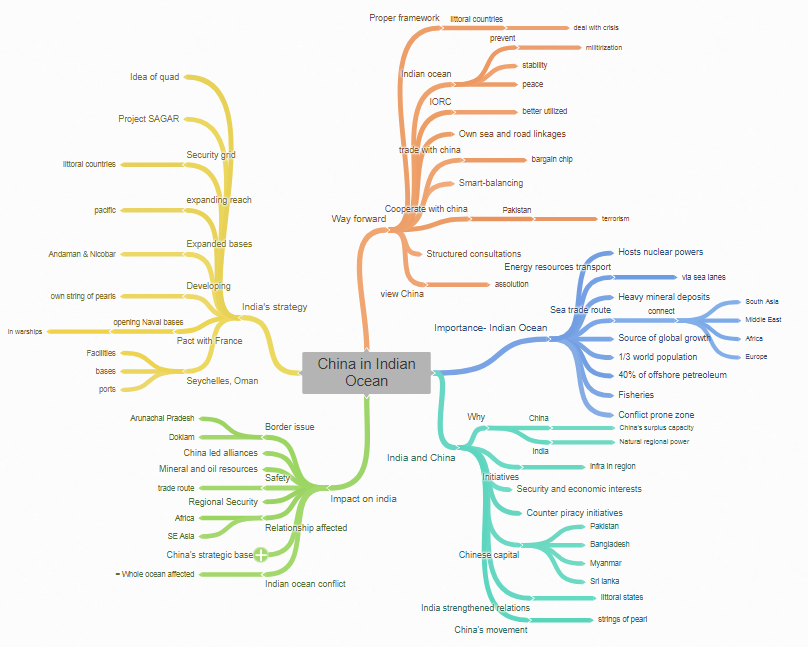
    The Indian Ocean is the world’s third largest body of water and has become a growing area of competition between China and India. Escalated activities such as port development and military exercises and rhetoric could endanger stability in a critical region for global trade flows.

    India has treated the Indian Ocean as an ocean of peace and stability. Now that China has decided that it is going to become one of the major player in the region, India has reasons to worry because China will come to India’s immediate neighbourhood.

    Importance of the Indian Ocean

    • The Indian Ocean littoral has the potential to become the leading source of new global growth over the next 20 years.
    • One-third of the world population lives in the region, including one-quarter of the UN members.
    • It provides critical sea trade routes that connect the Middle East, Africa, and South Asia with the broader Asian continent to the east and Europe to the west.
    • A number of the world’s most important strategic choke points are found in the Indian Ocean.
    • Indian Ocean channels carry 2/3rd of the world’s oil shipments, 1/3rd of the bulk cargo and half of all container traffic.
    • Nearly 40 per cent of the world’s offshore petroleum is produced in the Indian Ocean.
    • The Indian Ocean hosts heavy mineral deposits, and fisheries are increasingly important for both exports and domestic consumption.
    • China and India are dependent on energy resources transported via the secure sealanes in the Indian Ocean to fuel their economies.
    • India imports nearly 80 percent of its energy, mostly oil from the Middle East.
    • For New Delhi’s press to maintain economic growth, its dependency on the safe transport of resources will likely intensify.
    • The region is home to some of the most intense conflict-prone areas and hosts various nuclear powers of the world.

    India and China In Indian Ocean

    • China’s growing global influence and India’s rapid economic rise have heightened the ocean’s strategic value.
    • Both countries have developed initiatives to bolster infrastructure and other connections in the region.
    • Each country is seeking to strengthen ties with smaller regional states to secure their respective security and economic interests.
    • Since launching counter-piracy operations in 2009, Beijing has become increasingly active in the region.
    • Beijing’s regional vision outlines its One Belt, One Road plan.
    • China’s ties with regional states have deepened, including the influx of Chinese capital into construction projects in Bangladesh, Myanmar, Pakistan, and Sri Lanka.
    • Beijing’s forays into the Indian Ocean are driven by China’s excess capacity challenges, incentivizing Chinese firms to compete in and open new markets abroad.
    • India sees itself as the natural preeminent regional power.
    • India has doubled-down on maintaining stronger diplomatic, economic, and security ties with IOR maritime states.
    • It is meant to strengthen India’s economy, establish its role a driver of regional growth, and simultaneously diminish China’s growing appeal.
    • It is India’s neighbourhood that holds the key to its emergence as a regional and global power.
    • China’s movements in the region have been described by the “string of pearls” metaphor, which holds that China is taking on economic and investment projects with Indian Ocean states to secure ports or places for its military stations.

    Impact of Chinese Influence on India

    • The Indian Ocean is the only ocean which has been named after one of the countries. So, this indicates the important presence of India in this zone.
    • About 7000 km of India’s coastal land borders around the Indian Ocean. Most of its trade through sea-route occurs through this Ocean and some of the islands belonging to the Indian territory lie in this Ocean, whose safety is also a primary responsibility of India.
    • China’s increased presence can mean a great harm to this position.
    • Chinese are increasing their trading posts all around the Indian Ocean and also exploring mineral and oil resources in these areas.
    • India has a competitive and cooperative relationship in many countries of Africa and Southeast Asia which might get affected due to Chinese presence.
    • China has become the first or second major trading country with all these countries in the Indian Ocean region and Australia as well.
    • There could possibly be China-led alliances, Chinese client states and the establishment of Chinese spheres of influence, affecting India’s clout in the region.
    • With China, stepping up its political and economic footprint in the region, revisionist claims in the land and oceanic space could be brought up again like the issue of Doklam and Arunachal Pradesh.
    • With the presence of Chinese strategic bases, there will be constriction of the Indian strategic manoeuvre space within its own geographical area.
    • India has legitimate strategic concerns because any conflict in the Indian Ocean will have ramification in the whole region.
    • It may hamper regional security situation and in such case, India’s relationship with IOR countries may get disrupted.
    • There is global maritime security interest involved in the region and many nations want India to balance the assertive and rising China and like it to get involved in the dispute to maintain peace and security in the region.

    India’s current strategy in the Indian Ocean

    • India is moving to shore up its position against a more assertive Chinese presence by developing its own ‘string of pearls’.
    • New Delhi recently signed a strategic pact with France, with each opening their naval bases to the other’s warships across the Indian Ocean.
    • That gives the Indian navy access to strategically important French ports including one in Djibouti that offers easy access to key oil supply and trade routes.
    • Prime Minister Modi finalised an agreement for a new base in Seychelles and negotiated military access to facilities at Oman’s port and airfields.
    • India signed an agreement with Singapore and Indonesia for naval cooperation.
    • India has expanded its bases on Andaman and Nicobar Islands.
    • India has realised that it needs to match China’s assertiveness, and that includes expanding its reach into the Pacific.
    • India is creating a security grid with the littoral countries so that militarization of the Indian Ocean can be prevented.
    • For Delhi, having a counter power-projection capability in the South China Sea is now seen as critical to its strategic deterrence against Beijing.
    • India has also stepped up aid to littorals through its Project SAGAR (Security and Growth for All in the Region), which is designed to revive India’s ancient trade routes and cultural linkages around the Indian Ocean. It is a counter-move to China’s maritime silk road.
    • India is seemingly increasing its alliance with the US to deal with Beijing; most recently the Quad.

    What More India Should Do

    • The idea of selling the illusion of China as a villain in Asia may not work beyond a point.
    • Instead, view China as part of the solution to the region’s challenges.
    • A mutual ‘complex interdependence’ in economic, security and other domains should be strengthened by initiating structured consultations. E.g. the current India-China joint anti-piracy missions in the Gulf of Aden.
    • India should certainly focus on the Indo-Pacific and consider cooperating with China, even while being part of the Quad.
    • India also needs to strategize a plan to nudge China towards playing a role so as to ensure a stable regional security order.
    • This is particularly in the context of its role in Pakistan, where China has to balance trade and terrorism.
    • Despite this strategy of mutual trust, the role of military strength in guaranteeing national security cannot be underestimated.
    • Thus, India would be better served by adopting a more nuanced strategy of ‘smart-balancing’ China.
    • It is suggested that India should use its $70 billion-strong trading relationship with China as a bargaining chip to check Chinese behaviour.
    • India needs to plan its own sea and road linkages with its neighbouring countries.
    • Indian Ocean RIM Association should be a force multiplier for India’s interests and for this, bilateral relations with all countries in this region has to be revived.
    • Maintaining peace and stability of the Indian ocean is very important.
    • The militarization of Indian ocean must be prevented.
    • A proper framework must be developed by the littoral countries to deal with any type of crisis be it natural or any other.
  • 1 October 2018 | Prelims Daily with Previous Year Questions

    Q.1) With reference to the Model Code of Conduct during elections, consider the following statements:

    1. MCC is a set of guidelines issued by the Election Commission of India for conduct of political parties and candidates during elections.
    2. It is mainly regulated with respect to speeches, polling day, polling booths, election manifestos, processions and general conduct.

    Which of the given statements is/are correct?

    a) All of the above

    b) Only 1

    c) Only 2

    d) None of the above

    Inspired by: MCC to kick in right after premature dissolution of Assembly: EC

    https://www.civilsdaily.com/news/mcc-to-kick-in-right-after-premature-dissolution-of-assembly-ec/

    Q.2) Gandhi Trail was recently in news is a –

    a) Circuit of Places associated with M. Gandhi’s Satyagraha

    b) Villages in transit of Dandi March

    c) Gandhi’s ashram in Transvaal

    d) Ashrams associated Swachh Bharat in Gujarat

    Inspired by: [pib] Mahatma Gandhi International Sanitation Convention

    https://www.civilsdaily.com/news/pib-mahatma-gandhi-international-sanitation-convention/

    Q.3) With reference to the Corporate Social Responsibility Framework of India, consider the following statements:

    1. It is applicable to all Indian and foreign companies registered in India only.
    2. All the CSR activities are not necessarily to be carried out in India.

    Which of the given statements is/are correct?

    a) 1 only

    b) 2 only

    c) Both 1 and 2

    d) All are incorrect.

    Inspired by: Govt forms committee on Corporate Social Responsibility

    https://www.civilsdaily.com/news/govt-forms-committee-on-corporate-social-responsibility/

    Q.4) Recently the United States and Morocco launched the Global Counter-Terrorism Forum’s (GCTF) Terrorist Travel Initiative. Which of the following statements about GCTF is/are correct?

    1. The Global Counter-terrorism Forum is a body under the United Nations Security Council.
    2. Both India and Pakistan are founding members of this forum.

    Select the correct code:

    a) Both 1 and 2

    b) Only 1

    c) Only 2

    d) All are incorrect.

    Inspired by: Initiative to stop terrorist travel launched on UNGA sidelines

    https://www.civilsdaily.com/news/initiative-to-stop-terrorist-travel-launched-on-unga-sidelines/

    Q.5) The report “Reinvigorating Trade and Inclusive Growth” is released by-

    a) IMF

    b) WTO

    c) World Bank

    d) All of these.

    Inspired by: WTO, IMF, World Bank seek ‘urgent’ international trade reforms

    https://www.civilsdaily.com/news/wto-imf-world-bank-seek-urgent-international-trade-reforms/

    For Solutions – Click Here

    Prelims Daily Archive – Click here

  • 02 October 2018 | High Relevance vs Low Relevance News

    Reading News for UPSC is utmost important and rising number of questions year on year in UPSC Prelims is a testimony of this

    We are starting a daily series where we will analyze news covered in The Hindu, Indian Express and other newspapers which are important from exam perspective and which are not

    Important news would have been covered in our daily news coverage in form of newscards.

    Unimportant ones will be mentioned here and a short description regarding why it is not relevant for the exam

    Click on news headlines to read the full news

    High Relevance News

    Odisha to launch State Food Security Scheme

    https://www.civilsdaily.com/news/odisha-to-launch-state-food-security-scheme/

    Read about provisions of NFSA. Can be asked in Prelims.

    59 plant species in IUCN threat categories

    https://www.civilsdaily.com/news/59-plant-species-in-iucn-threat-categories/

    Read about categorisation criteria for IUCN red list. Important for Prelims.

    [op-ed snap] Up in the air — on stubble burning

    https://www.civilsdaily.com/news/op-ed-snap-up-in-the-air-on-stubble-burning/

    The editorial discusses reasons behind Delhi’s air pollution and how it can be controlled. Important for Mains.

    Low Relevance News

    India dispatches relief material to tsunami-hit Indonesia

    After India’s offer of assistance to tsunami-hit Indonesia, Indian Air Force (IAF) and Navy launched Humanitarian Assistance and Disaster Relief (HADR) efforts on Tuesday to deliver relief material to the South East Asian country

    No important points in the news from the exam perspective

  • GS Paper 4 – UPSC Civil Services Mains Examination – 2018

    Section A

    1. 

    (a) State the three basic values, universal in nature, in the context of civil services and bring out their importance. (150 words)

    (b) Distinguish between “Code of ethics” and “Code of conduct” with suitable examples.
    (150 words)

    2.

    (a) What is mean by public interest? What are the principles and procedures to be followed by the civil servants in public interest? (150 words)

    (b) “The Right to Information Act is not all about citizens’ empowerment alone, it essentially redefines the concept of accountability. Discuss. (150 words)

    3.

    (a) What is mean by conflict of interest? Illustrate with examples, the difference between the actual and potential conflicts of interest. (150 words)

    (b) “In looking for people to hire, you look for three qualities: integrity, intelligence and energy. And if they do not have the first, the other two will kill you.” – Warren Buffett

    What do you understand by this statement in the present-day scenario? Explain. (150 words)

    4.

    (a) “In doing a good thing, everything is permitted which is not prohibited expressly or by clear implication”. Examine the statement with suitable examples in the context of a public servant discharging his/her duties. (150 words)

    (b) With regard to the morality of actions, one view is that means is of paramount importance and the other view is that the ends justify the means. Which view do you think is more appropriate? Justify your answer. (150 words)

    5.

    (a) Suppose the Government of India is thinking of constructing a dam in a mountain valley bond by forests and inhabited by ethnic communities. What rational policy should it resort to in dealing with unforeseen contingencies (150 words)

    (b) Explain the process of resolving ethical dilemmas in Public Administration. (150 words)

    6.

    What do each of the following quotations mean to you in the present context?

    (a) “The true rule, in determining to embrace, or reject anything, is not whether it has any evil in it; but whether it has more evil than good. There are few things wholly evil or wholly good. Almost everything, especially of governmental policy, is an inseparable compound of the two; so that our best judgement of the preponderance between them is continually demanded. ” -Abraham Lincoln ( 150 words)
    (b) “Anger and intolerance are the enemies of correct understanding. “ – Mahatma Gandhi (150 words)

    (c) “Falsehood takes the place of truth when it results in unblemished common good.” -Tirukkural (150 words)


    Section B

     7. Rakesh is a responsible district level officer, who enjoys the trust of his higher officials. Knowing his honesty, the government entrusted him with the responsibility of identifying the beneficiaries under a health care scheme meant for senior citizens.

    The criteria to be a beneficiary are the following:
    (a) 60 years of age or above.
    (b) Belonging to a reserved community.
    (c) Family income of less than 1 Lakh rupees per annum.
    (d) Post-treatment prognosis is likely to be high to make a positive difference to the quality of life of the beneficiary.

    One day, an old couple visited Rakesh’s office with their application. They have been the residents of a village in his district since their birth. The old man is diagnosed with a rare condition that causes obstruction in the large intestine. As a consequence, he has severe abdominal pain frequently that prevents him from doing any physical labour. The couple has no children to support them. The expert surgeon whom they contacted is willing to do the surgery without charging any fee. However, the couple will have to bear the cost of incidental charges, such as medicines, hospitalization, etc., to the tune of rupees one lakh. The couple fulfils all the criteria except criterion ‘b’. However, any financial aid would certainly make a significant difference in their quality of life.

    How should Rakesh respond to the situation? (250 words)


     8. As a senior officer in the Ministry, you have access to important policy decisions and upcoming big announcements such as road constructions projects before they are notified in the public domain. The Ministry is about to announce a mega road project for which the drawings are already in place. Sufficient care was taken by the planners to make use of the government land with the minimum land acquisition from private parties. Compensation rate for private parties was also finalized as per government rules. Care was also taken to minimize deforestation. Once the project is announced, it is expected that there will be a huge spurt in real estate prices in and around that area.

    Meanwhile, the Minister concerned insists that you realign the road in such a way that it comes closer to his 20 acres farmhouse. He also suggests that he would facilitate the purchase of a big plot of land in your wife name at the prevailing rate which is very nominal, in and around the proposed mega road project. He also tries to convince you by saying that there is no harm in it as he is buying the land legally. He even promises to supplement your savings in case you do not have sufficient funds to buy the land. However, by the act of realignment, a lot of agricultural lands has to be acquired, thereby causing a considerable financial burden on the government, and also the displacement of the farmers. As if this is not enough, it will involve cutting down of a large number of trees denuding the area of its green cover.

    Faced with this situation, what will you do? Critically examine various conflicts of interest and explain what your responsibilities are as a public servant. (250 words)


    9. It is a State where prohibition is in force. You are recently appointed as the Superintendent of Police of a district notorious for illicit distillation of liquor. The illicit liquor leads to many death, reported and unreported, and causes a major problem for the district authorities.
    The approach till now had been to view it as a law and order problem and tackle it accordingly. Raids, arrest, police cases, and criminal trials – all these had only limited impact. The problem remains as serious as ever.

    Your inspections show that the parts of the district where the distillation flourishes are economically, industrially and educationally backward. Agriculture is badly affected by poor irrigation facilities. Frequent clashes among communities gave boost to illicit distillation. No major initiatives had taken place in the past either from the government’s side or from social organizations to improve the lot of the people.

    Which new approach will you adopt to bring the problem under control? (250 words)

    10. A big corporate house is engaged in manufacturing industrial chemicals on a large scale. It proposes to set upon the additional unit. Many states rejected its proposal due to the detrimental effect on the environment. But one state government acceded to the request and permitted the unit close to a city, brushing aside all opposition.

    The unit was set up 10 years ago and was in full swing till recently. The pollution caused by the industrial effluents was affecting the land, water and crops in the area. It was also causing serious health problems to human beings and animals. This gave rise to a series of agitation thousands of people took part, creating a law and order problem necessitating stern police action. Following the public outcry, the State government ordered the closure of the factory.

    The closure of the factory resulted in the unemployment of not only those workers who were engaged in the factory but also those who were working in the ancillary units. It also very badly affected those industry which depended on the chemicals manufactured by it.

    As a senior officer entrusted with the responsibility of handling this issues, how are you going to address it? (250 words)


    11.  Dr X is a leading medical practitioner in a city. He has set up a charitable trust through which he plans to establish a super-speciality hospital in the city to cater to the medical needs of all sections of the society. Incidentally, that part of the State had been neglected over the years. The proposed hospital would be a boon for the region.
    You are heading the tax investigation agency of that region. During an inspection of the doctor’s clinic, your officers have found out some major irregularities. A few of them are substantial which had resulted in considerable withholding of tax that should be paid by him now. The doctor is cooperative. He undertakes to pay the tax immediately.
    However, there are certain other deficiencies in his tax compliance which are purely technical in nature. If these technical defaults are pursued by the agency, considerable time and energy of the doctor will be diverted to issues which are not so serious, urgent or even helpful to the tax collection process. Further, in all probability, it will hamper the prospects of the hospital coming up.

    There are two options before you:

    1) Taking a broader view, ensure substantial tax compliance and ignore defaults that are merely technical in nature.
    2) Pursue the matter strictly and proceed on all fronts, whether substantial or merely technical.

    As the head of the tax agency, which course of action will you opt and why? (250 words)

    12. Edward Snowden, a computer expert and former CIA administrator, released confidential Government documents to the press about the existence of Government surveillance programmes. According to many legal experts and the US Government, his action violated the Espionage act of 1971, which identified the leak of State secret as an act of treason. Yet, despite the fact that he broke the law, Snowden argued that he had a moral obligation to act. He gave a justification for his “whistle blowing” by stating that he had a duty “to inform the public as to that which is done in there name and that which is done against them.”
    According to Snowden, the Government’s violation of privacy had to be exposed regardless of legality since more substantive issues of social action and public morality were involved here. Many agreed with Snowden. Few argued that he broke the law and compromised national security, for which he should be held accountable.

    Do you agree that Snowden’s actions were ethically justified even if legally prohibited? Why or why not? Make an argument by weighing the competing values in this case (250 words )

  • GS Paper 3 – UPSC Civil Services Mains Examination – 2018

    1. “Access to affordable, reliable, sustainable and modern energy is a sine qua non to achieve Sustainable Development Goal (SDGs).” Comment on the progress made in India in this regard. (150 words) (10 Marks)
    2. Comment on the important changes introduced in respect of the Long-term Capital Gain Tax – (LCGT) and Dividend Distribution Tax (DDT) in the Union Budget for 2018-2019. (150 words) (10 Marks)
    3. What do you mean by Minimum Support Price (MSP)? How will MSP rescue the farmers from the low-income traps? (150 words) (10 Marks)
    4. Examine the role of supermarkets in supply chain management of fruits, vegetables and food items. How do they eliminate the number of intermediaries? (150 words) (10 Marks)
    5. Discuss the work of ‘Bose-Einstein Statistics’ done by prof. Satyendra Nath Bose and show how it revolutionized the field of physics. (150 words) (10 Marks)
    6. What are the impediments in disposing of the huge quantities of discarded solid wastes which are continuously being generated? How do we remove safely the toxic wastes that have been accumulating in our habitable environment? (150 words) (10 Marks)
    7. What is wetland? Example the Ramsar concept of ‘wise use’ in the context of wetland conservation. Cite two examples of Ramsar sites from India. (150 words)(10 Marks)
    8. Sikkim is the first ‘Organic State ‘in India. What are the ecological and economical benefits of Organic State? (150 words) (10 Marks)
    9. The China-Pakistan Economic Corridor (CPEC) is viewed as a cardinal subset of China’s larger “One Belt One Road” initiative .Give a brief description of CPEC and enumerate the reasons why India has distanced itself from the same. (150 words) (10 Marks)
    10. Left Wing Extremism (LWE) is showing a downward trend, but still effects many parts of the country. Briefly explain the government of India’s approach to counter the challengers post by LWE.
      (150 words) (10 Marks)
    11. How are the principles followed by the NITI Aayog different from those followed by the erstwhile planning commission in India? (250 words)(15 Marks)
    12. How would the recent phenomena of protectionism and currency manipulations in world trade effect macroeconomic stability of India? (250 words) (15 Marks)
    13. Assess the role of National Horticulture Mission (NHM) in boosting the production, productivity and income of horticulture farms. How far has it succeeded in increasing the income of farmers? (250 words) (15 Marks)
    14. How has the emphasis on certain crops brought about changes in cropping patterns in recent past? Elaborate the emphasis on millets production and consumption. (250 words) (15 Marks)
    15. Why is there so much activity in the field of biotechnology in our country? How has this activity benefitted the field of biopharma? (250 words) (15 Marks)
    16. With growing energy needs should India keep on extending its nuclear energy programme? Discuss the facts and fears associated with nuclear energy. (250 words)(15 Marks)
    17. How does biodiversity vary in India? How is the Biological Diversity Act, 2002 helpful in conservation flora and fauna? (250 words) (15 Marks)
    18. Describe various measures taken in India for Disaster Risk Reduction (DRR) before and after signing ‘Sendai Framework for DRR (2015-2030)’. How is this framework different from ‘Hyogo Framework for Action, 2005’? (250 words) (15 Marks)
    19. Data security has assumed significant importance in the digitized world due to rising cybercrimes. The justice B.N Sreekrishna Committee Report addresses issues related to data security. What, in your view, are the strengths and weaknesses of the Report relating the protection of personal data in cyberspace? (250 words) (15 Marks)
    20. India’s proximity to two of the world’s biggest illicit opium-growing states has enhanced her internal security concerns. Explain the linkages between drug trafficking and other illicit activities such as gunrunning, money laundering and human trafficking. What countermeasures should be taken to prevent the same? (250 words) (15 Marks)
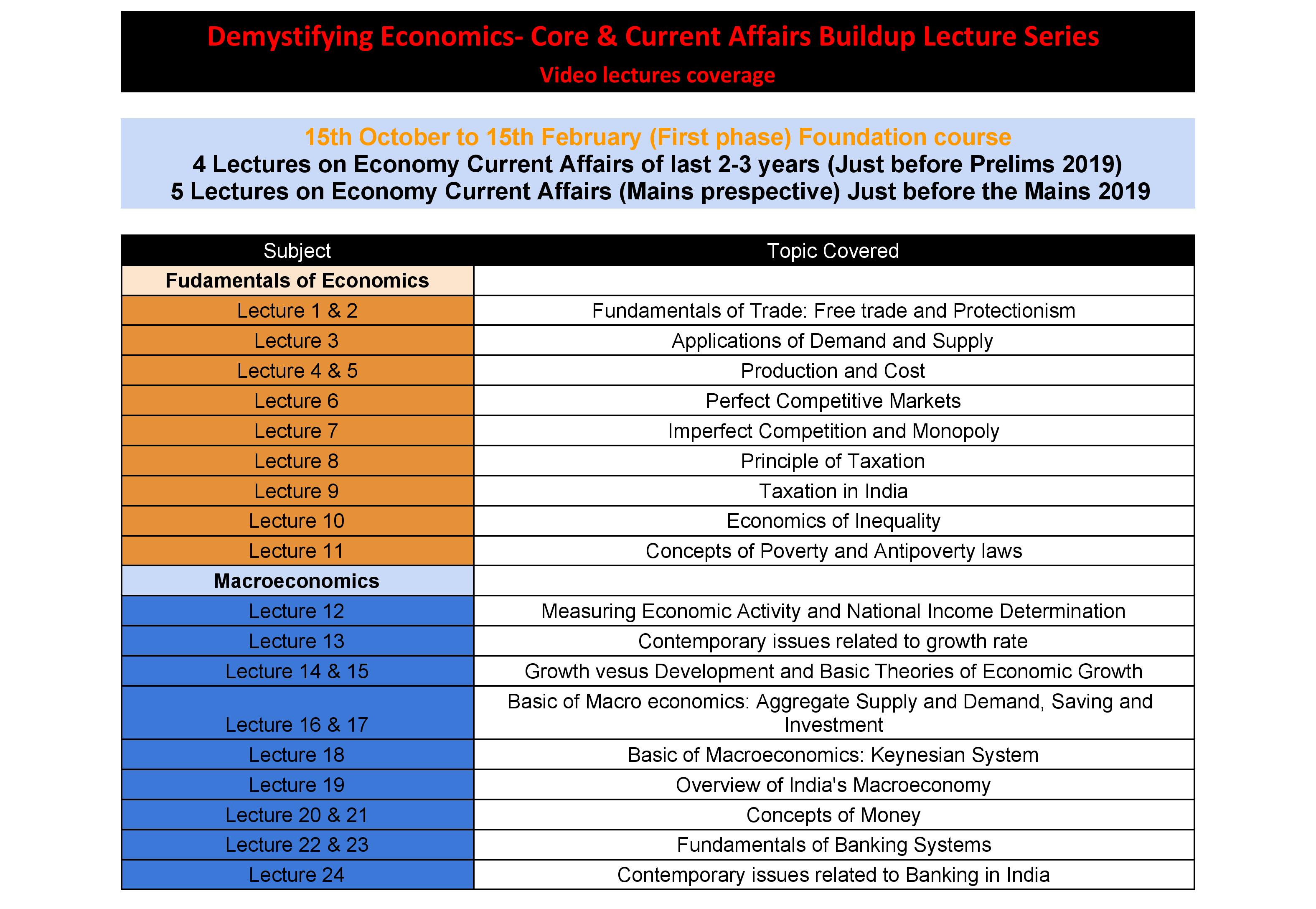
  • Demystifying Economics- Core & Current Affairs Buildup Lecture Series

    View the schedule of lectures here: Click2View

    Importance of Economics for UPSC

    Prelims exam

    Year   Questions asked

    2016   29

    2017   29

    2018   25

    Thus on an average 1/4th of the prelims paper can be solved easily if you have good command in economics.

    Mains exam

    GS paper 3

    Year    Total Marks

    2017    125 Marks

    2016    112.5 Marks

    2015    125 Marks

    In Essay Paper

    1 topic Every year

    Total Weightage in mains: 375 Marks

    Objectives of this course

    Economics is not only the most important subject in all 3 tiers of the exam (Prelims, Mains and interview) but also the most feared subject

    Rather than understanding the concepts, many aspirants indulge in rot learning and mugging up the concepts but since Economics is not a theoretical subject like History this method does not actually work in the actual exam. The objective of this course is to make Economics as a subject interesting, lucid, layman and enjoyable.

    After the end of the course, economics will be on your fingertips and you will be able to apply that knowledge not just in UPSC exam but also in other subsidiary exams like State PSC, RBI Grade B, CAPF, SSC, Bank PO etc.

    The other focus of this course is to strengthen the basics and conceptual clarity of the student so that he can apply that knowledge in understanding the contemporary economic issues.

    Is it relevant only to UPSC students?

    This course is relevant for not just UPSC students but also for State PSC, RBI Grade B, SSC, Bank PO and other competitive exams

    What will this course offer?

    1. Static Lectures

    100 hours of static Lectures covering NCERT’s, All advanced UPSC books like Mishra and Puri, Dutt and Sundaram, Paul Krugman, Mankiw etc

    Watch sample videos of the course here:

    2. Lectures on contemporary issues both 2019 Mains specific and 2019 Prelims specific

    35 – 40 Hours of lectures on Contemporary issues (From 2012 to 2018)

    Sources: All important magazines and newspapers like Economist, EPW, Livemint, Business Standard, Economic times

    3. Notes

    Notes on both static and current part will be given

    4. Tests

    6 Prelims test of Economics (100 Questions each)

    6 Mains test (10 Questions each)

    5. Mentorship

    -Telegram group where students can ask any doubts with the faculty. Students can also call the faculty at a defined time every day.

    6. Unlimited access

    Unlimited access to videos during the validity of the course. Can access the course 24/7 as per your convenience.

    7. Special Coverage of Budget and Economic Survey 2019

    Get all the details of the course and join here: Click2Join


    About the Faculty

    Himanshu Arora

    MPhil Economics (JNU)

    Works at Prime Minister Economic Advisory Council

    -Writes regularly in various famous Indian and international weeklies like Millenium post and Huffington Post.

    -Worked as Assistant Professor in Delhi University

    Read some of his articles here:

    Looking beyond geopolitics

    Empowering citizens is better than entitlements

    China in Xi Era

    ‘We the People’

    Sajal Singh

    MSc Economics (Gokhale Institute of Politics and Economics)

    MS Financial Economics Carleton University Canada

    NET (JRF) Economics Qualified

    Core Faculty @ Civilsdaily.com

  • 29 September 2018 | Prelims Daily with Previous Year Questions

    Q.1) The Loo Review campaign under the Swachh Bharat Mission is partnered with the Ministry of Housing and Urban Affairs by-

    a) Microsoft

    b) Google

    c) Facebook

    d) Whatsapp

    Inspired by: [pib] MoHUA partners with Google to launch #LooReview Campaign

    https://www.civilsdaily.com/news/pib-mohua-partners-with-google-to-launch-looreview-campaign/

    Q.2) With reference to the Sustainable Alternative Towards Affordable Transportation (SATAT) initiative, Which of the following statements is/are correct?

    1. SATAT is an initiative of MoEFCC.
    2. It is aimed to set up Compressed Bio-Gas (CBG) production plants and make available CBG in the market for use in automotive fuels.

    Select the correct codes:

    a) Both 1 and 2

    b) Only 1

    c) Only 2

    d) All are incorrect

    Inspired by: [pib] SATAT Initiative

    https://www.civilsdaily.com/news/pib-satat-initiative/

    Q.3) With reference to the State Disaster Response Fund (SDRF), which of the following statements is/are  incorrect?

    1. A State Government may use complete corpus of the funds available under the SDRF for providing immediate relief against local disasters.
    2. Local Disasters are such which are not included in the notified list of disasters of the Ministry of Home Affairs.

    Select the correct codes:

    a) Only 1

    b) Only 2

    c) Both 1 and 2

    d) None of the above.

    Inspired by: Centre to hike grant for SDRF

    https://www.civilsdaily.com/news/centre-to-hike-grant-for-sdrf/

    Q.4) Which of the following phenomena are not included in the notified list of disasters of the MHA covered under State Disaster Relief Funds?

    1. Pest Attack
    2. Cold Waves
    3. Hailstorms
    4. Frost

    Select the correct options:

    a) 1, 3, 4

    b) 3 and 4

    c) Only 2

    d) None of the above.

    Inspired by: Centre to hike grant for SDRF

    https://www.civilsdaily.com/news/centre-to-hike-grant-for-sdrf/

    Q.5) ” Her music opened a vibrant dialogue between the north and the south and the west and the east. She was invited to render a concert before the UN General Assembly, where she performed masterfully before a spellbound audience. The bhava and rasa which her music inspired, overwhelmed the Rasikas and often left them in tears. A ‘Bhajagovindam’ or a ‘Bhavayami’ elevated the listener to a higher plane of emotion or bhakti.”

    Which of the following eminent personality is addressed in the above paragraph?

    a) L. Vasanthakumari

    b) Vedavalli

    c) Muktha

    d) S. Subbulakshmi

    Inspired by:  Press Information Bureau


    For Solutions – Click Here

    Prelims Daily Archive – Click here


  • 28 September 2018 | Prelims Daily with Previous Year Questions

    Q.1) Which of the following bodies/ministries is the national counterpart of the India-United Nations Sustainable Development Framework (UNSDF) for 2018-2022?

    a) NITI Aayog

    b) Ministry of HRD

    c) Ministry of Home Affairs

    d) Ministry of Environment, Forest and Climate Change

    Inspired by: [pib] India and the UN to sign a Five-Year Sustainable Development Framework (2018-2022)

    https://www.civilsdaily.com/news/pib-india-and-the-un-to-sign-a-five-year-sustainable-development-framework-2018-2022/

    Q.2) The Centre of Excellence for Data Analytics (CEDA) is an initiative of-

    a) Ministry of HRD

    b) National Informatics Centre

    c) CERT-In

    d) Ministry of Skill Development and Entrepreneurship

    Inspired by: [pib] Centre of Excellence for Data Analytics (CEDA)

    https://www.civilsdaily.com/news/pib-centre-of-excellence-for-data-analytics-ceda/

    Q.3) The Doctrine of Coverture is related to-

    a) Legal Rights of women after Marriage

    b) Immunity against arbitrary Divorce

    c) Alimony to women post Divorce

    d) None of the above.

    Inspired by: Adultery no longer a criminal offence as SC scraps Section 497 of IPC

    https://www.civilsdaily.com/news/adultery-no-longer-a-criminal-offence-as-sc-scraps-section-497-of-ipc/

    Q.4) Consider the following statements related to the provisions for reservations of backward classes in promotions:

    1. The reservation in promotions is explicitly mentioned in the article 16 (4-A) of the Constitution of India.
    2. It is originally mentioned in the art. 16 as enshrined by the constitution.

    Which of the above statements is/are correct?

    a) Both 1 and 2

    b) Only 1

    c) Only 2

    d) None of the above.

    Inspired by: [op-ed snap] Removing biases

    https://www.civilsdaily.com/news/op-ed-snap-removing-biases/

    Q.5) Which of the following statements best describes “carbon fertilization”?

    a) Increased plant growth due to increased concentration of carbon dioxide in the atmosphere

    b) Increased temperature of Earth due to increased concentration of carbon dioxide in the atmosphere

    c) Increased acidity of oceans as a result of increased concentration of carbon dioxide in the atmosphere

    d) Adaptation of all living beings on Earth to the climate change brought about by the increased concentration of carbon dioxide in the atmosphere.

    Inspired by: CSP-2108


    For Solutions – Click Here

    Prelims Daily Archive – Click here

  • 29 September 2018 | High Relevance vs Low Relevance News

    Reading News for UPSC is utmost important and rising number of questions year on year in UPSC Prelims is a testimony of this

    We are starting a daily series where we will analyze news covered in The Hindu, Indian Express and other newspapers which are important from exam perspective and which are not

    Important news would have been covered in our daily news coverage in form of newscards.

    Unimportant ones will be mentioned here and a short description regarding why it is not relevant for the exam

    Click on news headlines to read the full news

    High Relevance News

    Supreme Court opens Sabarimala temple to women of all ages

    https://www.civilsdaily.com/news/supreme-court-opens-sabarimala-temple-to-women-of-all-ages/

    Read the views of SC judges and articles of constitution quoted during this judgment. Can be used in Mains paper 1, 2 as well as Essay on women’s rights, religious freedom and related topics.

    NITI Aayog, Oracle to fight fake drugs through blockchain

    https://www.civilsdaily.com/news/niti-aayog-oracle-to-fight-fake-drugs-through-blockchain/

    Blockchain is emerging as the most promising technology for solving various problems being faced by India. Read about the technology and its potential in India. Can be asked in Mains.

    [op-ed snap] A UN for the People

    https://www.civilsdaily.com/news/op-ed-snap-a-un-for-the-people/

    The era of multilateralism started by UN and carried forward by WTO seems to be fading. Read the oped to know the reasons as well as solutions to this problem of isolationism. Important for Mains.

    Low Relevance News

    It’s Bengal calling for the ‘greatest festival on earth’

    West Bengal, a State where the industry is often perceived to be in decline, plans to tap into tourism by hard-selling its festivals, starting with Durga Puja

    No important points in the news although the headline makes it look so from UPSC perspective

  • GS Paper 2 – UPSC Civil Services Mains Examination – 2018

    1. In the light of recent controversy regarding the use of Electronic Voting Machines (EVM), what are the challenges before the Election Commission of India to ensure the trustworthiness of elections in India? (10 marks, 150 words)
    2. Whether National Commission for Scheduled Castes (NCSC) can enforce the implementation of constitutional reservation for the Scheduled Castes in the religious minority institutions? Examine. (10 marks, 150 words)
    3. Under what circumstances can the Financial Emergency be proclaimed by the President of India? What consequences follow when such a declaration remains in force? (10 marks, 150 words)
    4. Why do you think the committees are considered to be useful for parliamentary work? Discuss, in this context, the role of the Estimates Committee. (10 marks, 150 words)
    5. “The Comptroller and Auditor General (CAG) has a very vital role to play.” Explain how this is reflected in the method and terms of his appointment as well as the range of powers he can exercise. (10 marks, 150 words)
    6. “Policy contradictions among various competing sectors and stakeholders have resulted in inadequate ‘protection and prevention of degradation to environment.” Comment with relevant illustrations. (10 marks, 150 words)
    7. Appropriate local community level healthcare intervention is a prerequisite to achieve ‘Health for All’ in India. Explain. (10 marks, 150 words)
    8. E-governance is not only about utilization of the power of new technology, but also much about critical importance of the ‘use value’ of information. Explain. (10 marks, 150 words)
    9. “India’s relations with Israel have, of late, acquired a depth and diversity, which cannot be rolled back.” Discuss.  (10 marks, 150 words)
    10. A number of outside powers have entrenched themselves in Central Asia, which is a zone of interest to India. Discuss the implications, in this context, of India’s joining the Ashgabat Agreement, 2018.  (10 marks, 150 words)
    11. Whether the Supreme Court Judgement (July 2018) can settle the political tussle between the Lt. Governor and elected government of Delhi? Examine. (15 marks, 250 words)
    12. How far do you agree with the view that tribunals curtail the jurisdiction of ordinary courts? In view of the above, discuss the constitutional validity and competency of the tribunals in India. (15 marks, 250 words)
    13. Indian and USA are two large democracies. Examine the basic tenets on which the two political systems are based. (15 marks, 250 words)
    14. How is the Finance Commission of India constituted? What do you know about the terms of reference of the recently constituted Finance Commission? Discuss.  (15 marks, 250 words)
    15. Assess the importance of the Panchayat system in India as a part of local government. Apart from government grants, what sources the Panchayats can look out for financing developmental projects? (15 marks, 250 words)
    16. Multiplicity of various commissions for the vulnerable sections of the society leads to problems of overlapping jurisdiction and duplication of functions. Is it better to merge all commissions into an umbrella Human Rights Commission? Argue your case.  (15 marks, 250 words)
    17. How far do you agree with the view that the focus on lack of availability of food as the main cause of hunger takes the attention away from ineffective human development policies in India?  (15 marks, 250 words)
    18. The Citizen’s Charter is an ideal instrument of organisational transparency and accountability, but it has its own limitations. Identify the limitations and suggest measures for greater effectiveness of the Citizen’s Charters.  (15 marks, 250 words)
    19. What are the key areas of reform if the WTO has to survive in the present context of ‘Trade War’, especially keeping in mind the interest of India?  (15 marks, 250 words)
    20. In what ways would the ongoing US-Iran Nuclear Pact Controversy affect the national interest of India? How should India respond to its situation?  (15 marks, 250 words)