National Income Accounting
National Income Accounting refers to the practice of calculating the output of an economy. It helps in assessing how the economy is doing. Some of the most standard identities used are GDP, GNP, National Income, etc. We will be studying those in detail once we cover the basics.
Since GDP is the most important identity and all other identities are derived from it, we will cover it first.
Gross Domestic Product (GDP)
Gross Domestic Product (GDP) is the monetary value of all the finished goods and services produced within a ‘domestic territory’ in a specific time period. As evident, it is tied to a specific territory – a country’s border irrespective of the person producing it. That person could be a citizen or a foreign national.
Let’s take a hypothetical economy that produces 10 cars. The manufacturer purchases all components like tyres, glass, etc for Rs. 40, pays rent for Rs. 30 and pays labor for Rs. 10. Finally, sells the car for Rs. 100.
The GDP for this economy will be 10X100 = 1000. We didn’t include the cost of components like tyres, glass, etc because they were not final goods in themselves. They were consumed in the manufacturing of cars.
The domestic (economic) territory includes 4:
(i) Territory lying within the political frontiers, including territorial waters of the country.
(ii) Ships and aircrafts operated by the residents of the country between two or more countries.
(iii) Fishing vessels, oil and natural gas rigs and floating platforms operated by the residents of a country in the international waters or engaged in extraction in areas where the country has exclusive rights of operation. For example, fishing boats operated by Indian fishermen in the international waters of the Indian Ocean.
(iv) Embassies, consulates and military establishments of the country located abroad.
Value Added Method: The sum of the value of all final goods and services produced.
Let’s suppose there are only kind of production process taking place in the economy. they are the farmers growing grapes and wine producer. The farmer need only human labour to grow grapes. The farmers sell a part of the produced grapes to the wine manufacturers. The manufacturer uses grapes as inputs to produce wine.
Let’s further assume that in a given year farmer grows grape worth of Rs 1000. Out of this, he sells Rs 500 worth of grapes to the wine manufacturer. The wine manufacturer using grapes as input produces wine worth of Rs 1500.
What will be the total value added in this entire process?
The farmer grows grapes of Rs 1000 which will be added to total value added since that’s the final output produced by the farmers.
The baker used grapes worth Rs 500 as an input to produce wine worth of Rs 1500. The input used by the baker must be subtracted from the final output of wine produced by him (1500-500=1000). The reason for the deduction is that, we have already included the value of grapes produced by the farmer in the value added. If we now again include this in calculating value added we commit the mistake of Double counting- counting a product twice while calculating final output.
Hence the net value added for the economy will be contribution of the farmer (1000) + net contribution of the wine manufacturer (1000) = Rs 2000.
The raw materials that a firm buys from another firm which are completely used up in the process of production are called ‘intermediate goods’. Therefore,
The value added of a firm = Value of production of the firm – Value of intermediate goods used by the firm.
The value added of a firm is distributed among its four factors of production, namely, labour, capital, entrepreneurship and land. Therefore wages, interest, profits and rents paid out by the firm must add up to the value added of the firm.
Income Method: The sum of all incomes accruing to factors of production, i.e., Rent, Interest, Profit and Wages.
The sum of final expenditures in the economy must be equal to the incomes received by all the factors of production taken together (final expenditure is the spending on final goods, it does not include spending on intermediate goods). This follows from the simple idea that the revenues earned by all the firms put together must be distributed among the factors of production as salaries, wages, profits, interest earnings and rents.
Expenditure Method: The sum of consumer’s expenditure, net investment, and government expenditure on goods and services.
The expenditure method looks at the demand side of the GDP. In this method we add the final expenditures incurred by all the firms in the economy. in the farmer wine grower example, the value of output in the economy by expenditure method will be calculated in the following way.
Final expenditure is that part of the expenditure which does not count intermediate inputs. In our example, the Rs 500 worth of grapes that the wine manufacturer buys from the farmer will not be included in final expenditure. The aggregate value of output of the economy is Rs 1500 (final expenditure received by the wine manufacturer) + Rs 500 (final expenditure received by the farmer) = Rs 2000.
Firms make final expenditure on the following accounts:
C, consumption expenditure incurred by the firms
I, Investment expenditure incurred by firms on capital goods
G, expenditure incurred by government on the purchase of final goods and services produced by the firms
X, Exports revenues earned by firms by selling its goods and services abroad
Sum total of final consumption, investment, government and exports expenditures received by the firms ≡ C + I + G + X
Circular Flow of Money and Methods of Calculating National Income
We will discuss a simple economic model depicting how money flows through the economy.

Money changes hand from one sector to another.
Companies/Firms use 4 kinds of inputs that are used in the production of goods and services in order to make an economic profit. These 4 inputs are land, labor, capital, and entrepreneurship and are known as factors of productions.
In the first stage, the Household sector provides the factors of production to the Business firms.
In the second stage, the Business firms pay back in monetary terms to the Household sector in the form of Wages, Rent, Interest and Profits.
In the third stage, the money received by household is spent on the goods and services produced by the firms in the form of consumption expenditure (C).
Thus, we see, that money flows from business firms to households and then it flows from Household to firms. This money flow is called circular flow of income.
Saving and Investment in the Circular Flow
Along with consumption, the households also save(S) part of their money.
When Households save, their expenditure on purchase of goods and services decline. The decline in the purchase will result in a decline in money received by firms. This will result in less money flow to the household as the firms will reduce hiring and production operations. Thus, saving act as a leakage from the economic system.
But the important question to ask is, where will savings go in the economy?
The savings in the economy does not lead to any reduction in aggregate spending and income as the savings flows back into the economic system through Financial Markets (Banks, Stock markets, insurance etc.)
From Financial Markets, the savings flows back to the Business firms who borrow them and invest it into new forms of investments.
Thus, the saving which is a leakage in the system also flows back into the system through investment by a firm which acts as injections.
Government Sector in the Circular Flow
Government affects the economy in a number of ways. The main components of government intervention are in the form of taxes(T), spending and borrowings(G).
The money flow from Households and firms to the government is in the form of taxes.
The other form of money flow from Households and firms to government is in the form of Borrowings through financial markets.
The Government pays back to households and firms in the form of provision of public goods like health, education, Policing, National Defence etc.
Because the money circulates, it leads to the following methods of GDP calculations.
- Expenditure Method
Households/firms can make the expenditure on final goods and services. We shall denote this by C. Final investment expenditure, I , incurred by firms on the capital goods produced. The expenditure that the government makes on the final goods and services produced by firms is G. We may point out that the final expenditure incurred by the government includes both the consumption and investment expenditure. The export revenues that firm earns by selling its goods and services abroad is denoted by X
GDP ≡ X+Ι+G+(X–M)
2. Income Method
The sum of income received by all the factors of production taken together is same as the value of final goods produced.
Either they consume it, or they save it, or pay taxes with it. This leads to the formulae.
GDP ≡ C + S + T
The Product or Value Added Method
Going back to the car example, we see the inputs were Rs. 40 and the value added was Rs. 60(finally the car was sold at 100). One way to calculte GDP would be to sum up all the value added at each step. In the first step it was Rs. 40 and in the 2nd step it was Rs. 60. That gives the total of Rs.100. Thus GDP can also be defined as
GDP ≡ Summation of GVA
When we consider an actual economy, the Value Added Method is used but things get more complicated.
First, the concept of factor cost, basic prices, and market prices is introduced.
Factor cost refers to the sum of the factor costs incurred during the process of production of final goods and services by the producer.
Basic prices refer to the price after accounting for production taxes and subsidies. When we add Net Production Taxes(Production taxes – Production subsidies), we get basic prices.
Market prices refer to the amount receivable by the producer from the purchaser for a unit of a good or service produced as output minus any tax payable. We get this price by adding Net Product Taxes(Product taxes – Product subsidies)
This is how it translates –
Gross Value Added (GVA) at basic prices = GVA at factor cost + Production taxes – Production subsidies
Gross Domestic Product (GDP) at market = GVA at market prices = GVA at basic prices + Product taxes – Product subsidies
Second, we come to the concept of constant prices and current prices.
We need to measure GDP by discounting the effect of inflation in the economy to arrive at real numbers of how the growth has been. When our reference year is a base year, we call it GPD at constant prices while this year’s GDP is referred to as GDP at current prices. Recently, the base year was updated to 2011-12.
Change in methodology of calculating GDP
India’s Central Statistical Office (CSO) introduced the new series of National Accounts Statistics (NAS) with the base year 2011-12, replacing the earlier series with 2004-05 as the base year. This is a routine matter for the CSO – as with statistical offices of most countries – to change the base year of the NAS periodically to account for structural changes in the economy, relative prices, and to replace older survey data with newer ones to better capture the economic activities. This time around the revision also had another objective, that is, to update the underlying methodology of NAS to the most recent international guidelines, namely, the UN System of National Accounts, 2008 (SNA 2008).
The following changes were made by the CSO while calculating GDP:
Replacing GDP at factor cost and GDP at market price with gross value added at basic prices and GDP respectively.
Estimating GDP of private corporate sector directly from the audited balance sheets, following an enterprise approach replacing the earlier used establishment approach.
Using private corporate sector for estimating the manufacturing sector GVA, by discarding the earlier usage of Index of Industrial Production (IIP) and Annual Survey of Industries (ASI).
Further, the GDP structure is also different now. While the public sector share in GDP remains unchanged, the share of private sector corporates is higher in new series by some 11 percent and the share of unorganised sector declined from 56 to 44 percent.

The Controversy
Historically, the private corporate sector was small. However, since the last three decades there is a phenomenon growth in the number of registered companies ranging from services to financial sector. But their contribution to the Indian economy is mostly unknown as they mostly don not files their returns and audited balance sheets with Registrar of Companies. Similarly, unorganised sector is vastly underestimated in the new series.
The new series, in a first, has estimated PCS’s GDP directly using company balance sheets obtained from Ministry of Corporate Affair’s (MCA) new database of about 500,000 companies for just two years (2011-12 and 2012-13).
MCA database has two sets of problem.
- Aggregate revenue estimates from company balance sheets are significantly different from those obtained from disaggregated revenue data, affecting the level as well as the growth rates of GVA in PCS.
- Since the number of companies in the MCA database plummeted to 300,000 – or, by 40 per cent – in 2013-14 and beyond, applying the blowing-up factor prepared with the smaller number of companies and blowing it up to the universe of over 900,000 companies, could have, one suspects, potentially over-estimated the GVA in the subsequent years, affecting the growth rates. Therefore, critics wonder if the remedy of using the huge MCA database has unwittingly proved to be worse than the disease.
The new methodology seems to have particularly affected the manufacturing sector estimates. The sector’s share in GDP has risen to 17-18 per cent, from 14-15 per cent earlier; its growth rate is systematically diverging from that based on both IIP and ASI
References in Government Reports
The Central Statistics Office brings a document on QUARTERLY ESTIMATES OF
GROSS DOMESTIC PRODUCT. Though such level of detail is not required from an exam perspective, its good for conceptual clarity.
A sample can be seen here.
http://mospi.nic.in/sites/default/files/press_release/nad_pr_2eni_28feb18_0.pdf
Advanced Estimates are predictions based on past trend. Revised Estimates are a review of Advanced Estimates taking into account the actual trend of expenditure, not past trend.
Statement 1 is as follows –

Notice the terms, PFCE, GFCE, GFCF.
These correspond to Private Final Consumption Expenditure, Government Final Consumption Expenditure and Gross Fixed Capital Formation respectively.
In the following chart, you can see sectors growth.

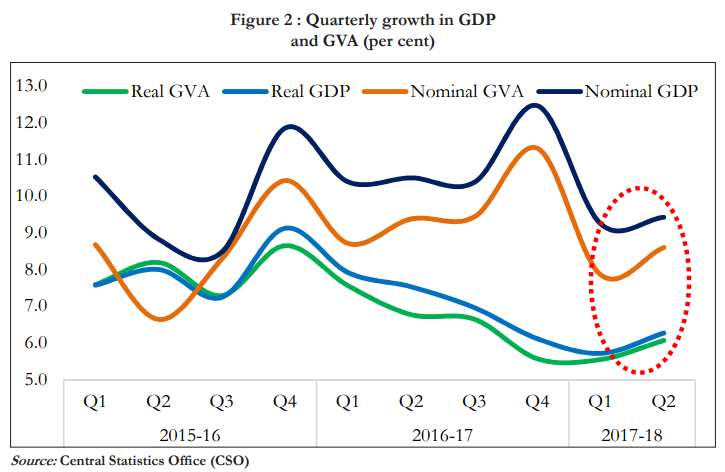
CSO also releases various graphs for trend analysis.

The Economic Survey also comes out with interesting trends on GDP.