[WpProQuiz 1557]
[WpProQuiz_toplist 1557]
UPSC 2024 countdown has begun! Get your personal guidance plan now! (Click here)
[WpProQuiz 1557]
[WpProQuiz_toplist 1557]
UPSC 2024 countdown has begun! Get your personal guidance plan now! (Click here)

Central idea
Key Highlights:
Key Challenges:
Key Terms and Phrases:
Key Quotes:
Key Examples and References:
Key Facts and Data:
Critical Analysis:
Way Forward:
Central idea
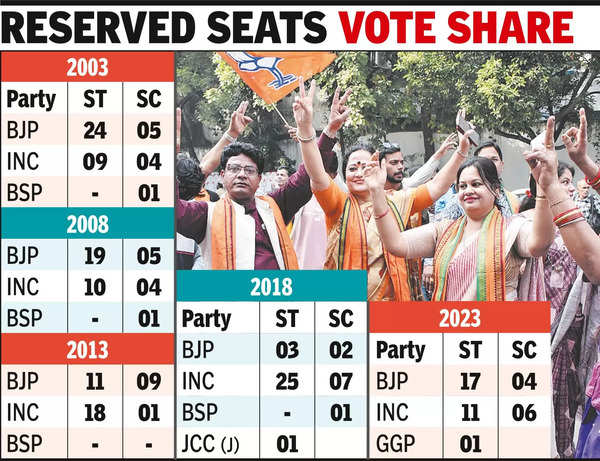
The BJP’s success in recent Assembly elections, marked by significant support from marginalized social groups, challenges its previous image as a party of social elites. Under the umbrella of “Subaltern Hindutva,” the party employs strategies that include general welfare measures and addressing grievances of non-dominant OBC castes. However, the gap between mobilization tactics and substantive issues like economic empowerment and political representation for Dalit-Bahujan groups requires attention.
Key Highlights:
Key Challenges:
Key Terms and Phrases:
Key Quotes:
Critical Analysis:
Way Forward:
Central idea
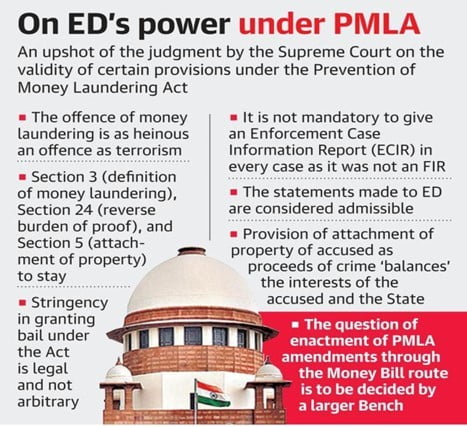
The Supreme Court’s interpretation of the Prevention of Money Laundering Act (PMLA) emphasizes a strict application tied to scheduled offences and the definition of “proceeds of crime.” Criticism of the Enforcement Directorate’s actions highlights the need for probity and fairness, urging consistency in procedures. The issue raises concerns about potential abuse of authority and its impact on federalism, necessitating clear jurisdictional delineation.
Key Highlights:
Key Challenges:
Key Terms and Phrases:
Key Quotes and Statements:
Key Examples:
Critical Analysis: The Court’s focus on the stringent application of PMLA provisions, especially tying them to scheduled offences and the definition of “proceeds of crime,” reflects a commitment to precision and legal rigor. The criticism of ED practices underscores the significance of maintaining ethical standards in enforcement agencies.
Way Forward:

| Details | |
| Meaning | “To see things as they really are” |
| Origin | Rooted in Buddhism, attributed to Gautama Buddha, rediscovered and refined by him over 2,500 years ago. |
| Historical Roots | Preserved in Theravada Buddhism, especially in Myanmar; based on teachings in the “Satipatthana Sutta.” |
| Technique | Mindfulness or insight meditation focusing on the interconnection between mind and body through physical sensations. |
| Practice | Observing natural breath and bodily sensations, understanding their impermanent nature, typically taught in 10-day retreats. |
| Goal | Self-transformation through self-observation, leading to improved mental clarity and insight. |
| Non-Sectarian | Taught as a universal practice, suitable for all backgrounds. |
| Global Spread | Popularized globally by S.N. Goenka and others in the 20th century. |
| Retreats | Offered worldwide, often free of charge, funded by donations. |
| Scientific Research | Studies show benefits in stress reduction, mental health, and treatment of substance abuse. |
| Code of Discipline | Includes abstaining from killing, stealing, sexual activity, false speech, and intoxicants during courses. |

| Details | |
| Full Name | Surface to Air Missile for Assured Retaliation (SAMAR) |
| Type | Short-range air-defence system |
| Developed By | A unit under the IAF’s Maintenance Command |
| Range | 10–12 km |
| Target | Low-flying aerial targets |
| Speed | Missiles operating at a speed range of 2 to 2.5 Mach |
| Key Features | – Uses existing inventory of Vympel R-73E missiles
– Twin-turret launch platform – Capable of single and salvo modes |
| Role in Defence | Supplementing IAF’s Akash and SPYDER systems, replacing older systems like Pechora and OSA-AK |
| Deployment | Not specified |
https://www.hindustantimes.com/videos/world-news/indian-missile-shield-against-potential-threats-from-pak-china-iaf-samar-system-in-action-101702815648038.html


Do you know?
The Mullaperiyar dam is located in Kerala on the river Periyar but is operated and maintained by the neighbouring state of Tamil Nadu.
John Pennycuick (the architect of this dam) sold his family property in England to mobilize money to fund the project! People of the region fondly name their children under his name a remark of reverence.
| Details | |
| Ratification Date | July 9, 1868 |
| Primary Purpose | To address civil rights issues following the Civil War, particularly regarding former slaves. |
| Key Clauses | – Citizenship Clause: Citizenship for all persons born or naturalized in the U.S.
– Due Process Clause: Fair legal process required for all citizens. – Equal Protection Clause: Equal legal protection for all citizens. |
| Historical Context | Response to post-Civil War issues, including the Black Codes in Southern states. |
| Major Significance | – Extended Bill of Rights protections to state actions.
– Foundation for numerous civil rights advancements and Supreme Court decisions. |
| Notable Cases | – Brown v. Board of Education (1954) for desegregation
– Roe v. Wade (1973) for abortion rights |
| Why in news? | Section 3 disqualifies anyone who, having taken an oath to support the Constitution, engages in insurrection or rebellion against the same, or aids its enemies, from holding any office, civil or military, in the United States.
Applied to Donald Trump |
| Impact on Federalism | Altered the balance of power between the federal government and states, especially in civil rights and liberties. |
| Details | |
| Equal Protection Clause | Article 14: Indian Constitution guarantees “equality before the law” and “equal protection of the laws” within the territory of India. |
| Citizenship Clause | Articles 5 to 11: Deal with aspects of citizenship in India, including citizenship by birth, descent, registration, naturalization, and incorporation of territory. |
| Due Process Clause | Article 21: Provides protection of life and personal liberty, stating “No person shall be deprived of his life or personal liberty except according to a procedure established by law.” |
| Protection of Civil Liberties | Article 19: Ensures the protection of certain rights regarding freedom of speech, assembly, etc. |
| Prohibition of Discrimination | Article 15: Prohibits discrimination on grounds of religion, race, caste, sex, or place of birth. |
| Disqualification for Public Office | Representation of the People Act, 1951 (Sections 8, 9, 10, 11): Lays out disqualifications for membership of Parliament and State Legislatures due to criminal convictions, corrupt practices, and certain office-of-profit positions. |
| Details | |
| Establishment | July 1944, during the United Nations Monetary and Financial Conference at Bretton Woods, New Hampshire, USA. |
| Initial Purpose | To help rebuild European nations devastated by World War II;
Later expanded to include global development and poverty reduction. |
| Components | – International Bank for Reconstruction and Development (IBRD)
– International Development Association (IDA) – International Finance Corporation (IFC) – Multilateral Investment Guarantee Agency (MIGA) – International Centre for Settlement of Investment Disputes (ICSID) |
| Membership | 189 member countries as of 2021. |
| Headquarters | Washington, D.C., United States. |
| Main Functions | Provides loans, credits, and grants; offers technical expertise and policy advice; researches development issues. |
| Funding | Through issuance of bonds in the international financial markets and earnings from its investments. |
| Governance | Led by a President, with a Board of Governors and a Board of Executive Directors. |
| India’s Involvement | – Founding member since 1944.
– First loan approved in 1949 for Indian Railways. |
| Details | |
| Establishment | May 1, 1956
Initially set up as an ‘Enforcement Unit’ |
| Mandate | Enforces economic and financial regulations |
| Jurisdiction | Nationwide |
| Legal Authority | – Prevention of Money Laundering Act, 2002
– Foreign Exchange Management Act, 1999 |
| Functional Focus | Economic and financial offenses including money laundering, foreign exchange irregularities |
| Investigative Powers | – Attachment, confiscation, and arrest
– Conduct raids and searches – Summon and question individuals |
| Collaboration | Coordinates with various agencies (CBI, local police) and banks |
| Reporting Authority | Department of Revenue, Ministry of Finance |
| Corruption Investigations | Has a separate Economic Offenses Division |
| Notable Cases | – Vijay Mallya extradition
– PNB fraud case – Augusta Westland VVIP chopper scam |
| International Cooperation | Works with international law enforcement for cross-border investigations (Interpol, FATF) |
| Public Interface | Accepts complaints and information regarding economic offenses |
| Transparency and Accountability | Regular reports to the Ministry of Finance; subject to oversight by judiciary and government bodies |
[WpProQuiz 1556]
[WpProQuiz_toplist 1556]
UPSC 2024 countdown has begun! Get your personal guidance plan now! (Click here)

Central idea
The article discusses the impact of shifting baseline syndrome on our perception of environmental changes, particularly in the context of unprecedented rainfall in south Tamil Nadu. It emphasizes the importance of officialese, or official vocabulary, in effectively communicating climate scenarios, addressing challenges in aligning definitions with lived experiences. The article also explores the global implications of terminological precision in climate negotiations and highlights the need for updated language to navigate evolving climate realities.
Key Highlights:
Key Challenges:
Key Terms and Phrases:
Key Quotes and Statements:
Key Examples and References:
Key Facts and Data:
Critical Analysis:
Way Forward:

First 100 will get access to Gaurav sir’s CSAT Telegram group
In the last 3 years, a lot of things have changed about UPSC-CSE
Especially the ‘CSAT’ paper in the prelims
The mysterious, unpredictable, and devious nature of CSAT paper spares no one, not even the IIT-IIM grads.
It’s time to look at CSAT from a different perspective
No more is it about just practicing and solving math problems
It is about crafting a ranker’s process and following right strategy
Civilsdaily Masterclasses allow you to access the real work from those who have done it before
All rankers built their own preparation system. What’s stopping you?
Never start from scratch on your UPSC preparation
Start like a Topper.
“Hey UPSC aspirants, this is Gaurav Mishra from Civilsdaily. I want to address a crucial aspect of your UPSC journey – the CSAT paper.
It’s increasingly becoming a major decider, and I’ve noticed that many aspirants, irrespective of their educational background, find it challenging.
Whether you’re from an IIT, a local college, a science or arts background, rural or urban areas, it doesn’t matter. What matters is your strategy and preparation approach.
Anyone can score above 90 in the CSAT with the right mindset and smart preparation.
In my upcoming webinar this Friday, I’ll be discussing how to tackle maths and logical reasoning questions, select high-scoring topics, and employ smart elimination techniques in CSAT, regardless of your academic background.
Join me LIVE on Zoom and transform your approach to CSAT. See you there!“
First 100 will get access to Gaurav sir’s CSAT Telegram group
By the end, you’ll have razor-sharp clarity and a clear roadmap for approaching and qualifying UPSC CSAT paper with ease.
Gaurav Mishra sir

These masterclasses are packed with value. They are conducted in private with a closed community. We rarely open these webinars for everyone for free. This time we are keeping it for 300 seats only.
We recommend you register here. It takes less than 10 seconds to register.
[WpProQuiz 1555]
[WpProQuiz_toplist 1555]
UPSC 2024 countdown has begun! Get your personal guidance plan now! (Click here)