💥UPSC 2026, 2027, 2028 UAP Mentorship (March Batch) + Access XFactor Notes & Microthemes PDF

Search results for: “”

  • [Burning Issue] Radicalization in India

    UPSC 2023 countdown has begun! Get your personal guidance plan now! (Click here)

    Context: Radicalization in India

    • Recently, India witnessed a series of extremist acts by some radicalized youth from different cities like Udaipur which later got extended to the “sar tan se juda” sloganeering and related controversy.
    • Last year also, The NIA made multiple arrests in a suspected ISI module that was playing role in the radicalization of Indian youth and performing extremist acts in India.
    • The above incidences highlight the issue of radicalization of Indian youth which could pose a serious challenge to India’s internal security. Thus, in this edition of the Burning issue, we will study radicalization in India, its causes, consequences and some way forward.

    What is Radicalization?

    • Radicalization is the process by which an individual or a group comes to adopt increasingly radical views in opposition to a political, social, or religious status quo. It is when someone starts to believe or support extreme views and then participates in extremist groups or acts.
    • It can be motivated by a range of factors, including ideologies, religious beliefs, political beliefs and prejudices against particular groups of people.

    Type of Radicalization

    Right-Wing Extremism

    • It is mostly associated with supremacist ideas promoting the supremacy of the social identity of one class or religion over the other. The fascist, racist, and ultranationalist are types of it.

    Left-Wing Extremism

    • They believe in the violent overthrow of the politically established governments and aim to control the state. This type includes Maoists, anarchists (one who believes in absence of the state) and Marxist–Leninists who believe in Marx’s revolutionary theory. Example- India’s Naxal violence in Chattishgarh, Jharkhand.

    Politico-Religious Extremism

    • This form of radicalization generally involves a political interpretation of religion and may defend their identity and customs through violent means that they perceive to be under attack.
    • It is the broader aspect of communal extremism where religion is used to politically mobilize people and in the process may turn to violent acts leading to religious extremism.

    Single-Issue Extremism

    • This type of radicalization uses a single issue to mobilize the masses. These can be issues of hatred against outsiders (xenophobia), feminist rights, and environmental issues. The recent post-Agniveer Scheme launch caused radicalization of youth for the job and following violence can be put under this category.

    Causes of radicalization in India

    • Political– Lack of civil rights or marginalization of a section of society from the political power may lead to the generation of radical ideas or dissent leading to communal mobilization by certain political groups.
    • Economic– Lack or deprivation of equal economic opportunity can be a cause of radicalization. Generally, poverty and unemployment are considered a cause of it. For example, violent Pro-Reservation protests by different communities at different times.
    • Cultural– It is generally seen with the communities who feel some threat to their cultural norms and practices due to the presence of outside people in their areas and attack these minorities out of fear of losing their culture.
    • Social identification– People identify themselves with different groups such as caste, religion, and ethnicity and when some threat occurs to these identifications, it causes them to rise in violence.   
    • Internet radicalization- uses the internet as a medium to propagate extremist views, thus provoking individuals, mainly youth, to rise against so-called injustice thus radicalizing them. Recently, the Union government asked several social media platforms to block accounts and youtube channels promoting hatred against the nation.
    • Individual factors– This includes a person’s natural tendency of violent behavior, aggressive attitude and causing harm to others. It may also include a feeling of revenge, a desire to cause harm to the wrongdoer etc also.
    • Faulty government policies- such as a land acquisition by the government without due compensation could lead to the generation of feelings of injustice and anger against the state, which often lead to moving towards radicalization.

    Consequences of radicalization

    • Ruptures the social fabric– as it promotes hatred among communities in the society and thus generation of enmity.
    • Causes trust deficit– among different sections of society in the country’s social and political system.
    • Breeding ground– for extremist or terrorist forces to train and recruit individuals for their motives.
    • Hamper’s economic investments– in a nation as frequent radical acts generate negative sentiments in investors about the future stability of the country and thus  reduce investment.
    • Threat to national security- as above all consequences finally reaches extreme levels leading to internal security challenges for the police and intelligence agencies. As Acharya Chanakya has said that “Internal threats are much more dangerous than threats outside”

    Current state of radicalization in India

    • India currently witnessing radicalization in form of Naxalism in central India, Ethnic insurgency in North East India and the recent new types being mob lynching (eg. Cow vigilantism) and even lone wolf attacks (Udaipur and Amravati killing).
    • A number of individuals, though minuscule in number, from India, have joined terrorist organizations such ISIS, Al-Queda etc.
    • Increasing threat of “Virtual Radicalisation” as evident from The Indian government recently blocking more than 100 YouTube channels as they were spreading fake information and communal hatred in India.
    • There is a growing threat of hate speech, and the demonization of certain communities as anti-nationals, which further promotes radicalization and extremism.

    Steps taken to counter radicalization

    • Approval of study– The Ministry of Home Affairs has ordered a study on ‘the status of radicalization in India’ which will be conducted under G.S. Bajpai. It will try to legally define ‘radicalization’ and suggest amendments to the UAPA Act,1967.
    • Enactment of laws- Various laws such as the UAPA act, 1967; NIA act, 2008 have to be strengthened to give more power to security agencies to tackle radicalism.
    • Institutions created– Counter-Terrorism and Counter Radicalization (CTCR) divisions of the Ministry of Home Affairs are the key wings of the Government of India to coordinate with various law-enforcement agencies in the country.
    • Cyberworld and technology mechanisms– IB launched Operation Chukravyuh in late 2014 to counter the challenges posed by online radicalization.
    • Several deradicalization programs– Certain deradicalization and anti-radicalization programs are coordinated by the Union Government such as Civic Action Programs implemented by the Seema Shastra Bal (SSB) along the Indo-Nepal and Indo-Bhutan Borders.
    • State-level de-radicalization programs– such as that of the Maharashtra Anti-Terrorism Squad (ATS) which has been quite successful in their attempts of deradicalizing numerous individuals.
    • Other programs- Coverage of the government’s various welfare schemes without discrimination, special schemes for communities and areas, promotion of composite culture and coexistence among various communities and constitutional safeguards for minorities, are some of the steps the government has been taking to keep people away from radicalization

    Way Forward

    • Launching de-radicalization programs– which focus on states with higher intensity of radicalization and also Development of counseling and rehabilitation centers for radicalized youths under police custody.
    • Adopting the holistic approach– of deradicalization, counter-radicalization and anti-radicalization at all necessary levels.
    • Promoting research in the field of radicalization– concerning the different regions of India for a deeper understanding of the issue and developing a better solution.
    • Ensuring adequate funds– for these programs, capability development of intelligence forces and creation of modern infrastructure to tackle radicalization, especially the virtual one.
    • Capacity development of state police- as they are the first line of defense. State police forces need to work in good cooperation with central security agencies to better counter the growing radicalization.
    • Increase involvement of family and religious leaders– in not only the process of rehabilitation of radicalized youths but also in preventing youth to move towards radicalized ideologies.
    • Increasing awareness– in society about these threats through school and college education or through social media accounts of security agencies to prevent people from falling into trap of extremists.
    • Need to de-glamourize terrorism- and also a coordinated South Asian effort in countering radicalization can go a long way for the region as all countries of the region is facing the heat of radicalization.

    Conclusion

    • Radicalization is an ongoing and dynamic process that needs a multifaceted approach that involves various policies and measures. Structural factors, in addition to psychological and ideological factors, go a long way in the explanation of radicalization.
    • Various counter-radicalization steps such as the correct diagnosis, building a counter-narrative, having the right communication strategy, education, having a counter-radicalization law, effective oversight and accountability, regulating the media, academia and public intellectuals and learning from other countries can be deliberated upon.
    • We all must work together in the ongoing “Amrit Kaal” to create a radicalization and extremism-free India by 2047, the 100th year of Indian Independence.

    UPSC 2023 countdown has begun! Get your personal guidance plan now! (Click here)

  • Untangling Kerala’s Lokayukta Amendment Controversy

    The Kerala Legislative Assembly passed the Kerala Lok Ayukta (Amendment) Bill on August 30, amid a boycott.

    Who are Lokpal-Lokayuktas?

    • The Lokpal-Lokayukta issue has always generated intense debate in the country.
    • In fact, this term was first used in a report of the Administrative Reforms Commission headed by Morarji Desai as far back as in 1966.
    • Political corruption had become rampant by then and it was thought that a credible system of an ombudsman should be established to redress public grievances against the leaders and public officials.
    • The first Bill on Lokpal was introduced in the Lok Sabha in 1968 which lapsed with the dissolution of the House.
    • Anna Hazare’s movement and the active involvement of civil society generated a lot of moral pressure on the Government which ultimately led to the passing of the Bill in 2013.

    Composition of Lokpal

    • The Lokpal is no ordinary investigative body.
    • It is headed by the incumbent Chief Justice of India or a retired judge.
    • It has eight members, four of whom are judicial members.
    • Thus the whole system is studded with judges or judicial men.
    • The Lokpal has an inquiry wing and a prosecution wing to deal with investigation and prosecution, respectively.
    • The director of prosecution files the case in the special court based on the findings of the Lokpal.

    Who falls under the ambit of Lokpal?

    • The Lokpal has jurisdiction to inquire into allegations of corruption against the Prime Minister, Ministers, Members of Parliament, Group A, B, C and D officers and officials of the central government.
    • After the conclusion of the investigation, the Lokpal may file a case in the special court in case the findings disclose the commission of offence under the Prevention of Corruption Act by the PM, Ministers or MPs.
    • However, the Lokpal does not have the power to ask the President to remove the Prime Minister or a Minister from office.

    What about the states?

    • The Lokpal and Lokayukta Act delegates the power to States to establish by law the Lokayukta to deal with complaints relating to corruption against public functionaries.
    • Some States already have established Lokayuktas. For example, Maharashtra in 1971, and Kerala in 1999.

    What is the Keralan controversy?

    • In order to get a clearer perspective on the Kerala Lokayukta controversy, it is necessary to understand the scheme of the Lokpal and Lokayuktas Act enacted by Parliament.
    • The long title of the Act says: “An Act to provide for the establishment of a body of Lokpal for the Union and Lokayukta for States to inquire into allegations of corruption against certain public functionaries….”
    • Thus, the Lokpal is conceived of as a body which will inquire into allegations of corruption.
    • It is basically an investigative body whose task is to conduct prompt and fair investigation and the prosecution of cases of corruption.

    Issues with the Amendment

    • The amendments were related to the competent authority to consider Lok Ayukta recommendations.
    • In the case of any unfavourable decision from the Lok Ayukta against the CM, the competent authority will now be the Legislative Assembly instead of the Governor as is prescribed in the existing Act.
    • The amendment tries to take away at the powers of the Governor.
    • The Lokayukta has indirectly expressed its resentment over the attempt to take away some of its powers.

    Arguments by Kerala Government

    • The Government, on the other hand, claims that through the amendment, a provision in the original Act which is unconstitutional has been excised.
    • Earlier it gave power to the Lokayukta to give directions to the Governor to remove a CM or a Minister on being found guilty of corruption.
    • This meant that the Lokayukta was to be over and above the office of Governor.

    Legal and constitutional implications

    Two important points need to be made here:

    (A) Overpowering the Lokpal

    • One, an investigative body does not have the legal authority to direct the public servant to resign his post on the basis of its findings.
    • It can only submit its findings to the competent authority or, as is provided in the Lokpal Act, file a case in the special court.
    • The Lokayukta is basically an investigative body with certain powers to carry out an investigation into cases relating to the Prevention of Corruption Act.
    • The only special feature of this body is that it is headed by a retired judge of the Supreme Court or a retired Chief Justice of a High Court.
    • But that does not alter the basic character of the Lokayukta as an investigative body.

    (B) Compulsion on Governor

    • The Chief Minister or a Minister holds office during the pleasure of the Governor (Article 164).
    • The Constitution of India does not contemplate any external pressure on the Governor to withdraw his pleasure.
    • The Sarkaria Commission had suggested that the Governor can dismiss a Chief Minister only when he loses his majority in the Assembly and refuses to step down.
    • The Supreme Court has accepted this recommendation of the Sarkaria Commission.
    • Another occasion when the Governor could withdraw his pleasure is on account of CM having been convicted in a criminal case and sentenced to not less than two years of imprisonment.
    • In other words, a Chief Minister cannot be asked to resign when he enjoys a majority in the House.
    • The Governor, being a high constitutional authority, cannot be compelled by a law to act in a particular manner so far as his constitutional duties and functions are concerned.

    Other contentious provisions

    (1) Undue burden on Political Parties

    • There are some other provisions as well which may not stand legal scrutiny.
    • For example, this law includes the office bearers of political parties within its definition of ‘public servant’.
    • Basically, the Prevention of Corruption Act deals with corruption in the government and allied agencies, statutory bodies, elected bodies, etc.
    • The functionaries of political parties do not come within the mischief of this law. So, it is difficult to understand how they can be brought within the sweep of the Lokayukta Act.

    (2) Reports of Lokayukta

    • Another problematic provision in this law is the one which deals with the reports of Lokayukta (Section 12).
    • It says that the Lokayukta shall, on the allegation of corruption being substantiated, send the findings along with recommendation of action to the competent authority who is required to take action as recommended by the Lokayukta.
    • It further says that if the Lokayukta is satisfied by the action taken by the competent authority, he shall close the case.
    • The question is how the Lokayukta can close a corruption case which is a criminal case and which invites imprisonment for three to seven years.
    • The Lokpal files the case in the court after the investigation. There is no provision in the central law under which the Lokpal can close the case before it reaches the court.
    • The Lokayukta not being a court does not have the legal capacity to close the corruption case under any circumstances.

    Way forward

    • The Kerala Lokayukta Act should be re-examined by a committee of the Assembly and should be brought on a par with the Lokpal Act.
    • Legislation that seeks to punish corrupt functionaries should be placed above controversies.

    Back2Basics: Lokpal Movement

    • The Lokpal, the apex body to inquire and investigate graft complaints against public functionaries, came into being with the appointment of its chairperson and members in March 2019.
    • In March 2019, former SC judge Justice Pinaki Chandra Ghose was selected as the first head of the Lokpal.

    Lokpal and Lokayuktas Act, 2013

    • The Lokpal Act 2013 is anti-corruption legislation that seeks to provide for the establishment of the institution of Lokpal.
    • It seeks to inquire into allegations of corruption against certain important public functionaries including the PM, cabinet ministers, MPs, Group A officials of the Central Government, etc.
    • The Bill was introduced in the parliament following massive public protests led by anti-corruption crusader Anna Hazare and his associates.
    • The Bill is one of the most widely discussed and debated Bills in India in recent times.

    Its history

    • The term Lokpal was coined in 1963 by Laxmi Mall Singhvi, a member of parliament during a parliamentary debate about grievance mechanisms.
    • The Administrative Reforms Commission (ARC) headed by Morarji Desai submitted an interim report on “Problems of Redressal of Citizen’s Grievances” in 1966.
    • In this report, ARC recommended the creation of two special authorities designated as ‘Lokpal’ and ‘Lokayukta’ for a redress of citizens’ grievances.
    • Maharashtra was the first state to introduce Lokayukta through The Maharashtra Lokayukta and Upa-Lokayuktas Act in 1971.


    UPSC 2023 countdown has begun! Get your personal guidance plan now! (Click here)

  • ISRO tests system recoverable rocket ‘Inflatable Aerodynamic Decelerator (IAD)’

    The Indian Space Research Organisation (ISRO) has successfully tested a technology that could aid the cost-effective recovery of spent rocket stages and safely land payloads on other planets.

    What is IAD?

    • IAD is a technique used for an atmospheric entry payload.
    • An inflatable envelope and an inflatant (anything that inflates the envelope, like air or helium) make up the inflatable aerodynamic decelerator.
    • While entering the atmosphere, it inflates like a balloon and decelerates the lander.
    • The inflatant is designed to fill the inflatable envelope to a condition such that it surrounds the payload meant to enter the atmosphere of a planet or satellite and causes aerodynamic forces to slow it down.
    • In simpler words, IAD is designed to increase drag upon entering the atmosphere of any planetary body, like Earth, Mars, or even Moon.
    • Its shape is maintained by a closed, gas-pressured body and the inflatant gas is also generated internally. Some versions also use ram air or both.

    How significant is this IAD?

    • Some space agencies, including NASA, have already successfully tested advanced versions of the technology, including the supersonic and hypersonic variants.
    • However, for near future missions of ISRO, the current version that it tested is perfect.
    • Its use was first proposed by NASA more than 50 years ago for planetary entries.

    Minuscule of ISRO’s IAD

    • The IAD tested by ISRO was inflated at an altitude of around 84 km and the sounding rocket’s cargo dropped through the atmosphere on it.
    • It is fitted with a booster motor. It also has a spin rocket that is ejectable.
    • The inflatable structure is made out of Kevlar fabric, which is a very strong synthetic fibre and also heat resistant to withstand atmospheric pressure and temperature changes.
    • On top of it, it’s coated with polychloroprene, an oil and wax resistant rubber, to withstand extreme temperatures.
    • In the inflation system, it uses compressed nitrogen stored in a bottle.
    • It has consistently decreased the payload’s velocity through aerodynamic drag while maintaining the expected trajectory during the test flight.

    Where does ISRO intend to use it?

    • The IAD will help ISRO in performing many space tasks effectively including recovery of spent stages of rockets, for landing payloads on missions to other planetary bodies.
    • This is the first instance where an IAD has been specially created for spent stage recovery.
    • So inter-planetary missions are certainly one aspect that ISRO wishes to explore.


    UPSC 2023 countdown has begun! Get your personal guidance plan now! (Click here)

  • India’s first Dark Sky Reserve to come up in Ladakh

    In a first-of-its-kind initiative, the Department of Science & Technology (DST) has announced the setting up of India’s first dark sky reserve at Hanle in Ladakh in the next three months.

    What is a Dark Sky Reserve?

    • A dark-sky reserve is an area, usually surrounding a park or observatory that is kept free of artificial light pollution.
    • The purpose of a dark sky preserve is generally to promote astronomy.
    • Because different national organizations have worked independently to create their programs, different terms have been used to describe the areas.

    How is it designated?

    • A dark sky reserve is a designation given to a place that has policies in place to ensure that a tract of land or region has minimal artificial light interference.
    • The International Dark Sky Association is a US-based non-profit that designates sites as international dark sky places, parks, sanctuaries and reserves, depending on the criteria they meet.
    • Several such reserves exist around the world but none so far in India.

    Dark Sky Reserve at Hanle

    • Hanle, which is about 4,500 metres above sea level, hosts telescopes and is regarded as one of the world’s most optimal sites for astronomical observations.
    • However, ensuring that the site remains well-suited for astronomy implies keeping the night sky pristine, or ensuring minimal interference to the telescopes from artificial light sources such as electric lights and vehicular lights from the ground.
    • The site will have activities to help in boosting local tourism and economy through interventions of science and technology.

    The Himalayan Chandra Telescope, High Energy Gamma Ray Telescope, Major Atmospheric Cherenkov Experiment Telescope and GROWTH-India are the prominent telescopes located at the Hanle observatory.

    Ideal conditions in India

    • The Indian Astronomical Observatory, the high-altitude station of the IIA, is situated to the north of Western Himalayas, at an altitude of 4,500 metres above mean sea level.
    • Located atop Mt. Saraswati in the Nilamkhul Plain in the Hanle Valley of Changthang, it is a dry, cold desert with sparse human population.
    • The cloudless skies and low atmospheric water vapour make it one of the best sites in the world for optical, infrared, sub-millimetre, and millimetre wavelengths.


    UPSC 2023 countdown has begun! Get your personal guidance plan now! (Click here)

  • Regional Benches of Supreme Court

    TN Chief Minister yet again reiterated the State’s request for establishing a Regional Bench of the Supreme Court in Chennai and allowing Tamil to be used in the Madras High Court as one of its official languages.

    Why in news?

    • Outgoing Vice President, M Venkaiah Naidu suggested bifurcation of the Supreme Court into four regional benches for speedy disposal of cases.
    • However, the Supreme Court has maintained on previous occasions that there is no need for such benches outside Delhi.

    Why the Supreme Court is located in New Delhi?

    • Article 130 of the Constitution of India reads- The Supreme Court shall sit in Delhi or in such other place or places, as the Chief Justice of India may, with the approval of the President, from time to time, appoint.
    • The law thus provides scope for setting up the Supreme Court in multiple places, subject to the concurrence of the CJI and the President.

    Who can establish the SC benches outside New Delhi?

    • The Supreme Court in Union of India v. S.P. Anand Verdict (2009), held that the Article vests exclusive discretionary powers on the matter with the Chief Justice of India.
    • It is an enabling provision and if the Chief Justice (after taking relevant factors into account) feels that the Court should sit elsewhere, s/he can seek the President’s approval for it.
    • No authority can compel the Chief Justice of India to act in a particular way under the Article.

    Voices for circuit benches

    • The Law Commission in its 229th Report had suggested setting up a Constitution Bench of the Court in New Delhi and four other benches in different regions i.e., Northern region in Delhi, Southern region in Chennai/Hyderabad, Easter region in Kolkata and Western region in Mumbai.
    • However, this idea did not find favour with the Judges of the Supreme Court.

    Reasons for having Regional/Circuit Benches

    • Access to Justice: Many litigants are discouraged to travel to Delhi from far away locations like south or northeast India.
    • Geographical Constraints: A disproportionately high number of cases filed in the Supreme Court originated in High Courts closer to Delhi. Hence coming up with regional benches will remove this constraint.
    • Huge pendency of cases: Increased workload on the Supreme Court and at present more than 65,000 cases are pending in the Supreme Court, and disposal of appeals takes many years.
    • Reducing Cost of Justice: It is observed that besides travelling to New Delhi, engaging expensive Supreme Court counsel to pursue a case is beyond the means of most litigants.

    Advantages of having circuit courts

    • Promotes Article 39A: It has been pointed out that Article 39A says that the state shall secure that the operation of the legal system promotes justice, on a basis of equal opportunity.
    • Remove Geographical Constraints: It is high time we had more benches because in a country as vast as India the litigants have to travel long distances and spend a huge amount of money and energy.
    • Upholding the spirit of the constitution: Setting up Benches outside Delhi would neither impair unity and integrity nor undermine the importance of the Supreme Court.


    UPSC 2023 countdown has begun! Get your personal guidance plan now! (Click here)

  • History and debates about ‘socialist’ and ‘secular’ in the Preamble

    The Supreme Court will hear a petition filed by former MP Dr Subramanian Swamy, seeking the removal of the words “Socialist” and “Secular” from the preamble of the Indian Constitution.

    Why in news?

    • The petitioners in two similar cases have argued that these words were never intended to be in the Constitution and that such insertion is beyond the amending power of the Parliament under Article 368.
    • Similar petitions have been filed earlier too and given rise to debates around the preamble and the role it plays in the Constitution.

    How did these words come?

    • The two terms were inserted into the preamble as part of the 42nd Amendment of the Constitution in 1976 during the Emergency imposed by then PM Indira Gandhi.

    What is the purpose of the Preamble?

    • A preamble serves as an introduction to a document and contains its basic principles and goals.
    • When the Indian Constitution was being drafted, the ideals behind the preamble were first laid down in the Objectives Resolution, adopted by the Constituent Assembly in 1947.
    • These ideals emerged out of the numerous debates that took place during the drafting of the Constitution.

    Initially, the Preamble said:

    “WE, THE PEOPLE OF INDIA, having solemnly resolved to constitute India into a SOVEREIGN DEMOCRATIC REPUBLIC and to secure to all its citizens:

    JUSTICE, social, economic and political;

    LIBERTY of thought, expression, belief, faith and worship;

    EQUALITY of status and of opportunity;

    And to promote among them all

    FRATERNITY assuring the dignity of the individual and the unity of the Nation;

    IN OUR CONSTITUENT ASSEMBLY this twenty-sixth day of November, 1949, do HEREBY ADOPT, ENACT AND GIVE TO OURSELVES THIS CONSTITUTION.”

    Nature of the preamble

    • The Constitution was the product of democratic deliberations and decided upon by the people of India themselves in the wake of freedom from colonial rule.
    • The ideals mentioned here were at the core of the newly democratic nation.
    • During the Constituent Assembly debates, many suggestions were put forth — including that God should be invoked in the preamble as in the Irish constitution, that Mahatma Gandhi’s name should be included, etc.

    Is it a part of the Constitution?

    • The question of whether the preamble is a part of the Constitution or simply an introduction has been deliberated upon by the highest court.
    • This is because the meaning and weight of the objectives mentioned in it, such as equality of status and opportunity, remained unclear from the perspective of law.
    • However, in its judgment in the famous LIC case of 1995, the Supreme Court said and the Preamble of the Constitution which is an integral part and scheme of the Constitution, affirming its position as part of the Constitution.
    • Additionally, the violation of any principle mentioned in the preamble cannot be a reason to go to court, meaning the preamble is “non-justiciable”.
    • However, judgments of courts can cite it as an additional factor in their reasoning, given that it constitutes the spirit of the Constitution.

    How else has the preamble been debated earlier?

    • In 2020 a ruling MP has moved a resolution in Rajya Sabha seeking to remove the word socialism from the preamble.
    • It said, that the earlier party which ruled the country for seven decades has changed its direction from being socialist to welfare to neo-liberalism.
    • Its new liberal policies adopted in the 1990s have negated its own earlier positions.
    • Earlier in 2015, the Ministry of Information and Broadcasting used an image of the preamble of the Indian Constitution without the words “socialist” and “secular”, leading to some criticism.

    What is the right-wing narrative?

    • These words were added during the Emergency. Now what is the harm if there is a debate on it?
    • In 2008, the Supreme Court rejected a plea demanding the removal of ‘socialist’.
    • The apex court asked-Why do you take socialism in a narrow sense defined by Communists?
    • In a broader sense, it means welfare measures for the citizens. It is a facet of democracy, said the Court.
    • It hasn’t got any definite meaning. It gets different meanings in different times.

    Under what circumstances was the preamble amended?

    • Over her years in government, Indira Gandhi had attempted to cement her approval among the masses on the basis of a socialist and pro-poor image with slogans such as “garibi hatao” (Eradicate poverty).
    • The 42nd Amendment to the Constitution, passed in 1976 when the Emergency was in place, replaced the words “sovereign democratic republic” with “sovereign socialist secular democratic republic”.
    • It also changed “unity of the nation” to “unity and integrity of the nation”.

    Were ‘Secular’ and ‘Socialist’ debated before Independence?

    • During the debates in the Constituent Assembly, members such as K T Shah and Brajeshwar Prasad had raised the demand to add these words to the preamble.
    • However, Dr B R Ambedkar argued: What should be the policy of the State, how the Society should be organised in its social and economic side are matters which must be decided by the people themselves according to time and circumstances.
    • It cannot be laid down in the Constitution itself because that is destroying democracy altogether.

    Is it inclusive of the Constitution?

    • Indeed, many principles affirming secularism and socialism were contained in the Constitution originally, such as in the Directive Principles of State Policy that is meant to guide the government in its actions.
    • Some examples are provisions related to the “equitable distribution of material resources of the community for the common good”, and protecting the rights of workers.
    • Similarly, in the fundamental rights that allow the freedom to profess and propagate one’s religion, as well as in the government policies that recognize religious occasions across communities, an Indian version of secularism is followed.
    • Unlike western secularism which strictly separates the state and religion, the Indian state has over the years acknowledged and involved itself in matters related to all religions.


    UPSC 2023 countdown has begun! Get your personal guidance plan now! (Click here)

  • Martand Temple in Kashmir

    In May this year, some pilgrims offered prayers inside the Martand Temple, an Archaeological Survey of India-protected (ASI) monument

    About Martand Sun Temple

    • The Martand Sun Temple is a Hindu temple located near the city of Anantnag in the Kashmir Valley.
    • It dates back to the eighth century AD and was dedicated to Surya, the chief solar deity.
    • The temple was destroyed by Sikandar Shah Miri in a bid to undertake mass conversion and execution of Hindus in the valley.
    • According to Kalhana, the Temple was commissioned by Lalitaditya Muktapida in the eighth century AD.
    • The temple is built on top of a plateau from where one can view whole of the Kashmir Valley.
    • From the ruins the visible architecture seems to be blended with the Gandharan, Gupta and Chinese forms of architecture.

    Why in news now?

    • According to ASI, prayers are allowed at its protected sites only if they were “functioning places of worship” at the time it took charge of them.
    • No religious rituals can be conducted at non-living monuments where there has been no continuity of worship when it became an ASI-protected site.

    What are the living/non-living monument?

    • If some activity, like any kind of worship, has been going on for years in the structure, then it is taken over as a living monument.
    • But where no activity has taken place, say an abandoned building, then it is declared a dead monument.
    • The latter is difficult to restore because it is generally covered by a lot of overgrowth.
    • The best-known example of a living ASI monument is the Taj Mahal in Agra, where namaz is held every Friday.


    UPSC 2023 countdown has begun! Get your personal guidance plan now! (Click here)

  • What is Kurki, and why is it a big issue in Punjab?

    A farmer in Punjab has committed suicide outside the office of the Muktsar DC against kurki orders for his land based on a court case filed against him by the local moneylender for defaulting on loan payment.

    What is Kurki?

    • Kurki means attachment of a farmer’s land, already pledged to the money lending institution or individual, in case of a loan default.
    • Apart from banks, private moneylenders, commission agents also get these decrees against farmers from time to time.

    How is kurki executed?

    • Kurki orders are executed under Section 60 of Civil Procedure Code, 1908.
    • The land which is pledged by the farmer to the bank or money lender gets registered in their name. In some cases, the land is auctioned as well.
    • The process begins after the money lender moves court to get kurki orders in case the farmer is unable to pay back his loan.
    • In kurki, attachment of farmer’s land as well as his tractor can be done as per the Section 60.

    Was kurki not banned in Punjab?

    • Both Akali Dal and Congress governments of the past have claimed to have banned kurki.
    • Congress fought the 2017 Assembly polls on the slogan ‘karza kurki khatam, fasal di poori rakam’.
    • Soon after winning polls in 2017, the then government abolished Section 67-A of Punjab Cooperative Societies Act that enabled cooperatives to recover unpaid loans through auctioning of land mortgaged by farmers.
    • However, Section 63-B, 63-C of the Act were not dropped to prevent attachment of land.
    • Former Punjab CM has also claimed that kurki was abolished by his government. Activists accuses governments of issuing vague orders on the matter.

    Why has a total ban on the century-old kurki law not been achieved?

    • A plea filed in the Punjab and Haryana High Court in 2018 sought complete ban on kurki.
    • However, the Punjab government in its affidavit stated that there was no need to ban kurki as relief was being given to farmers in terms of loan waiver, compensation etc.
    • Moreover, it stated that Section 60 of Civil Procedure Code, 1908 – under which kurki takes place — was over 110 years old and needed complete revision.

    What is the ground reality?

    • Farmers point out that they are made to give post-dated cheques for loan, which are then used to get arrest orders issued in cheque bounce cases.
    • They have also accused money lenders of using pronotes signed by them to get kurki orders.
    • “Pro-notes” (promissory notes) are written documents taken from farmers, and signed by them at the time of giving the loan.
    • In April 2022, over 2,000 arrest warrants were issued against farmers for non-payment of loans to cooperative societies and Punjab agriculture development banks.


    UPSC 2023 countdown has begun! Get your personal guidance plan now! (Click here)

  • Exercise Vostok-22

    Russia is holding Vostok exercises. However, India has only sent its army contingent of the 7/8 Gorkha Rifles, and will not take part in the maritime section of the two-part event.

    Vostok-2022

    • It is an annual, multilateral, strategic and command exercise hosted by Russia.
    • This year it will see the participation of more than 50,000 troops from 13 countries such as India, China, Algeria, India, Laos, Mongolia, Nicaragua, Syria and many more.
    • While the exercises in Vostok-2022 are routine, they are the first such multilateral exercises to be held since the Russian war in Ukraine began.

    Why in news now?

    • India has only sent its army contingent and will not take part in the maritime section of the two-part event.
    • This is because the maritime part of the exercises would be held in the Sea of Okhotsk and the Sea of Japan.
    • These are near the disputed South Kuril Islands.
    • India’s decision not to take part in the naval exercises is believed to be in deference to Tokyo’s sensitivities.

    What does India’s participation mean?

    By sending an army contingent to join Russian and Chinese troops in the exercises at this time, New Delhi is aiming to send a four-pronged message:

    1. Continuing relationship with Russia despite the Ukraine war: The Modi government has decided not to join the Western sanctions regime, or to curb oil imports and other economic engagement with Moscow.
    2. Signal balance and non-alignment in the current crisis: India has mostly abstained from votes at the United Nations seeking to criticise Russia.
    3. India also takes part in routine Indo-Pacific exercises: This is with its Western partners including the Quad, as well as in bilateral exercises, like the India-US Ex. Yudh Abhyas.
    4. Willingness to conditional engagement with China: The message the government continues to give is that it is willing to engage with China on a number of fronts, even as military talks at LAC (Line of Actual Control) remain stuck.

    Conclusion

    • There might be some discomfort for Indian soldiers in dealing with their counterparts at a time when they are facing each other off along the LAC.
    • But that’s a small price to pay if it means keeping India-Russia ties on an even keel.
    • India needs to start communicating its intent better.
    • Strategic communication is an art. It’s time to master it.


    UPSC 2023 countdown has begun! Get your personal guidance plan now! (Click here)

  • 5th September 2022| Daily Answer Writing Enhancement(AWE)

    Topics for Today’s questions:

    GS-1        Important Geophysical phenomena such as earthquakes, Tsunami, Volcanic activity, cyclone. etc., geographical features and their location-changes in critical geographical features (including water-bodies and ice-caps) and in flora and fauna and the effects of such changes. 

    GS-2        India and its neighbourhood- relations.

    GS-3        Infrastructure: Energy, Ports, Roads, Airports, Railways etc.

    GS-4        Strengthening of ethical and moral values in governance; ethical issues in international relations and funding; corporate governance.

    Question 1)


    Q.1 What is a bomb cyclone? Discussing the mechanism of their formation and highlight their impact on the weather pattern of the affected region. (10 Marks)


    Question 2)

    Q.2 Relations between India and Bangladesh have seen a steady progress over the years. Do you agree? Also, mention some of the challenges in the relationship. (15 Marks)

    Question 3)

    Q.3 How can India achieve “Energy Atmanirbharta” by 2040- an ambitious target stated by the PM? What are the challenges in achieving this goal? (10 Marks)

    Question 4)  

    Q.4 The recent Covid 19 pandemic has reinvigorated the debate about ‘compassionate capitalism’. Define the concept and explain its importance in the present times. (10 Marks)


    HOW TO ATTEMPT ANSWERS IN DAILY ANSWER WRITING ENHANCEMENT(AWE)?

    1. Daily 4 questions from General studies 1, 2, 3, and 4 will be provided to you.

    2. A Mentor’s Comment will be available for all answers. This can be used as a guidance tool but we encourage you to write original answers.

    3. You can write your answer on an A4 sheet and scan/click pictures of the same.

    4.  Upload the scanned answer in the comment section of the same question.

    5. Along with the scanned answer, please share your Razor payment ID, so that paid members are given priority.

    6. If you upload the answer on the same day like the answer of 11th  February is uploaded on 11th February then your answer will be checked within 72 hours. Also, reviews will be in the order of submission- First come first serve basis

    7. If you are writing answers late, for example, 11th February is uploaded on 13th February , then these answers will be evaluated as per the mentor’s schedule.

    8. We encourage you to write answers on the same day. However, if you are uploading an answer late then tag the mentor like @Staff so that the mentor is notified about your answer.

    *In case your answer is not reviewed, reply to your answer saying *NOT CHECKED*. 

    1. For the philosophy of AWE and payment: 

  • Q.3 How can India achieve “Energy Atmanirbharta” by 2040- an ambitious target stated by the PM? What are the challenges in achieving this goal? (10 Marks)

    Mentor’s comment-
  • Q.2 Relations between India and Bangladesh have seen a steady progress over the years. Do you agree? Also, mention some of the challenges in the relationship. (15 Marks)

    Mentor’s Comments-

  • Q.4 The recent Covid 19 pandemic has reinvigorated the debate about ‘compassionate capitalism’. Define the concept and explain its importance in the present times. (10 Marks)

    Mentor’s Comments-

    • In the introduction, define what is compassionate capitalism.
    • In the main body, elaborate upon the concept and explain why it is important in present times. Give examples of how corporates helped during the pandemic.
    • Conclude by summarizing the concept.
  • Q.1 What is a bomb cyclone? Discussing the mechanism of their formation and highlight their impact on the weather pattern of the affected region. (10 Marks)

    Mentor’s Comments-

    • Introduce by defining bomb cyclone. List out its important characteristics.
    • In the body, separately discuss the mechanism of formation of bomb cyclones and their impact on weather pattern of the affected region.
    • Conclude by mentioning increasing frequency and intensity of bomb cyclones due to climate change and need for climate action.
  • [MASTERCLASS] How do UPSC toppers write ‘Impactful Intoductions’ in UPSC Essay and score 150+ marks? | Register for the recorded *VIDEO* & Get Best Introduction PDF and Essay Test (FREE)

    [MASTERCLASS] How do UPSC toppers write ‘Impactful Intoductions’ in UPSC Essay and score 150+ marks? | Register for the recorded *VIDEO* & Get Best Introduction PDF and Essay Test (FREE)

    MASTERCLASS on how do Toppers write ‘Impactful Intro’ in UPSC Essay & score 150+ concluded |Register and get FREE mentorship and Samachar Manthan current week’s module


    Whether it’s Philosophical or topical or any other UPSC essay topic,  ideally, the introduction should not only introduce mere the topic/issue/concept to the examiner but also (very) briefly describe the central premise of the answer. Zeeshan sir says that a good essay doesn’t require very advanced English.

    But the introduction should be such that the examiner knows in advance that you know the answer and you’re not going to beat around the bush or weave a boring net of ornamental words looking for the right answer.

    Feedback on Zeeshan sir’s mentorship by AIR 65, Pranav (from Quora: https://qr.ae/pvH4yA)

    Acknowledging the need to ensure removing difficulties, the students face, we are conducting an on-demand MASTERCLASS on How to write an impactful introduction in UPSC Essay to make a great first impression on the examiner.

    You don’t want to miss out on this great chance to learn the subtleties of the Essay introduction and discuss your queries in a 1-1 session with a senior IAS expert. 


    An advanced technique for writing successfully is to create an impactful introduction for different types of UPSC essays that you can recall at short notice.

    UPSC Essay favorite topics

    • Philosophical Essay: You shouldn’t ignore them as UPSC is focused on them. In 2021, most of the questions were philosophical. So, how to write that intro? Should you start with a quote/story/anecdote/or self-written poem? Will be thoroughly discussed.
    • Topical essay: You should not ignore them completely and prepare a few important topics which are repeated often like IR, Women, Health and Education, Environment, Agriculture, etc. A fitting mark-leaving intro will be different from that of a ‘Philosophical essay’. All these super important points are going to be discussed in this masterclass.

    Whichever essay topic you choose – It should be based on the topic you like or you are comfortable with. You have to write impactful introductions that leave a great first impression on the examiner.

    AIR 117, Nisha was Zeeshan sir’s student

    Apart from the above, some more extra crucial points will be discussed in the Masterclass👇


    UPSC Essay Masterclass Concluded:

    Some more extra crucial points will be discussed in the Masterclass

    1. Common misconceptions in the framing introductions are to be addressed.

    2. Understanding the proper use of creative elements like Quotes, Anecdotes, Case studies, Newspaper Headlines, Fictional stories, etc.

    3. Learning Simple yet Effective framing of introductions.


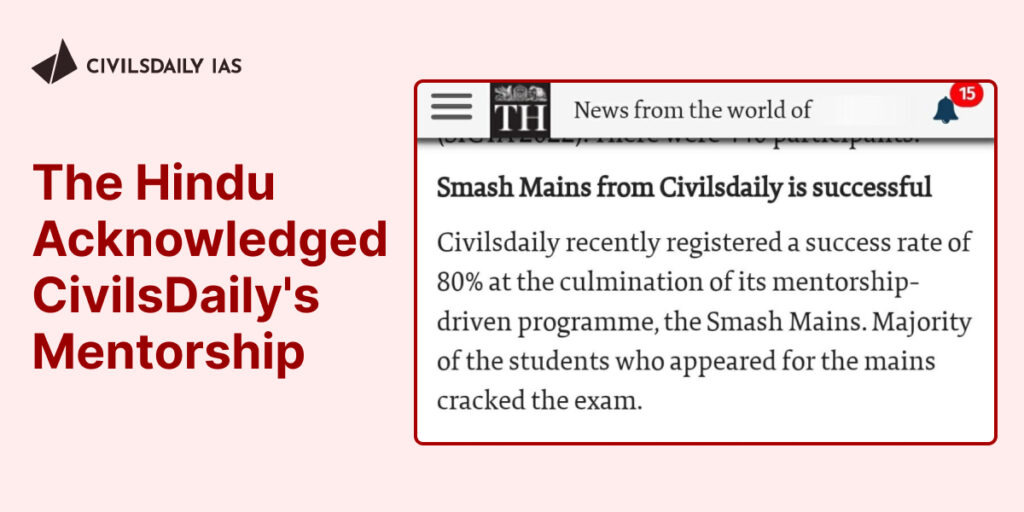
    What The Hindu mentioned about Civilsdaily Mentorship

  • How to become an IAS Officer in First Attempt After Graduation? | Roadmap to Prepare for UPSC in the next 2-3 years | Samanvaya released: Book Your First  Free Counselling Session with us Now!

    How to become an IAS Officer in First Attempt After Graduation? | Roadmap to Prepare for UPSC in the next 2-3 years | Samanvaya released: Book Your First Free Counselling Session with us Now!

    Though you can prepare for UPSC and give your attempts anytime till 32 years, the optimal time to begin your preparation is during your college days. A graduation degree is for 3 years and almost all toppers have prepared for the same amount of time to get the success they now enjoy.

    One of the biggest advantages for a college student is that they can easily switch to study mode as there are no other additional family responsibilities or expectations. Plus, an IAS officer who clears the exam within 23 years is more likely to hold the highest position of cabinet secretary than someone who cleared it in their late twenties. Youthful enthusiasm is the biggest internal motivation that college students possess which can help them in clearing this exhausting exam.

    So, now that you have broken the news to your parents about wanting to write the UPSC-CSE exam, you might be now wondering — what is UPSC-CSE? How to prepare for it? Should I attend a coaching institute? What is the syllabus? How many hours to study… the list is endless and daunting.

    However, you would have missed the obvious question— What kind of questions come in the paper and what kind of answers UPSC expects from an aspirant?

    Is UPSC CSE really about reading Unlimited Sources?

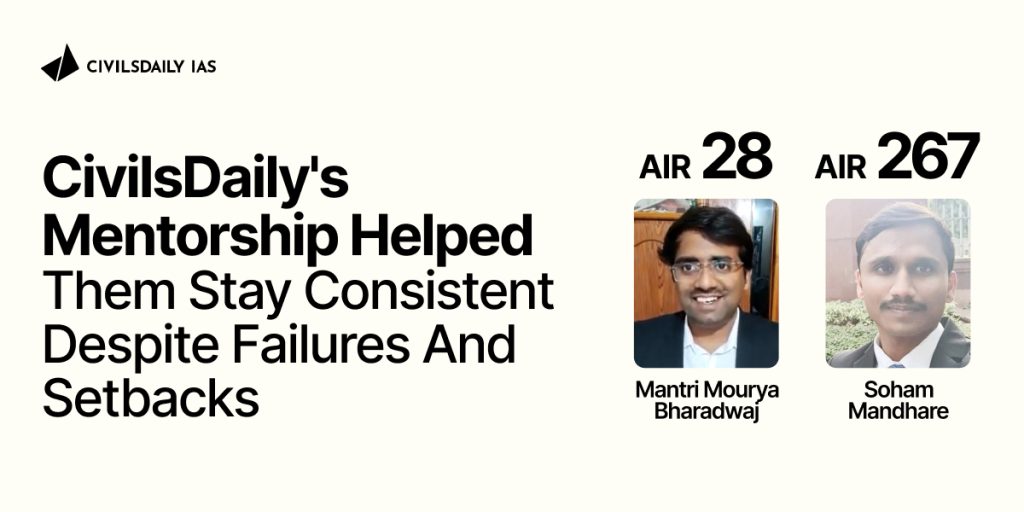
    Some of us will ask advices from all our friends and family on how to prepare for the exam, resulting in confusion in following through the UPSC syllabus. Don’t let these questions play the devil and make you postpone your UPSC preparation by a few more years. Having the right direction and guidance can help you save 2-3 critical attempts in UPSC. Listen to our Civilsdaily student and AIR 32 2021 UPSC topper Anay on how he improved his performance after 2 attempts with the guidance of Civilsdaily mentor, Sajal sir.

    Without much ado, register yourself for our free 1-on-1 counselling session at Civilsdaily known as Samanvaya. Your counsellors are trained mentors who have given the Mains exam six times and have attended UPSC interview multiple times. Experienced mentors like Sajal sir and his team have nearly mentored 500+ students.


    How Sajal sir and CivilsDaily helped these toppers?

    List goes on and on.


    What are the other mistakes in UPSC preparation first-time aspirants are likely to make?

    About 60% of the UPSC toppers have mostly prepared the wrong way in their first attempt. This could range from books, notes to time and consistency. If you want to start in the right direction, then it’s about time you booked a slot with your Samanvaya mentor.

    First-time aspirants often make the mistake of reading many sources for a single subject. If there is a new book in the market, they will not hesitate to buy it. UPSC preparation is not about reading multiple books, but one book multiple times.

    Few others, answer the essay paper in a very academic and technical manner.

    Most of the first-time aspirants skip studying for the language and CSAT paper.

    In the first few months of preparation, all of us read the entire 24 pages of the newspaper and waste 3-4 hrs of time. Some of us are over-confident of clearing the exam with our own preparation or by our institute’s coaching. We might be making notes but we will not be updating them or revising them.

    First-time aspirants struggle to understand what to skip in a book or what to cover. They take atleast 2-3 months to finish books like Laxmikanth and yet don’t have conceptual clarity.

    You can go through this video over here to get a basic understanding of the UPSC preparation.

    Toppers were once Beginners. And they began with Samanvaya.

    We, at Civilsdaily, are extremely proud to announce the incredible success of our students who have made their dreams come true. Today, we celebrate the hard work, commitment, and dedication with which they prepared for this exam, and succeeded! They are the heroes of today and leaders of tomorrow, and we are extremely glad to have been a part of their journey.

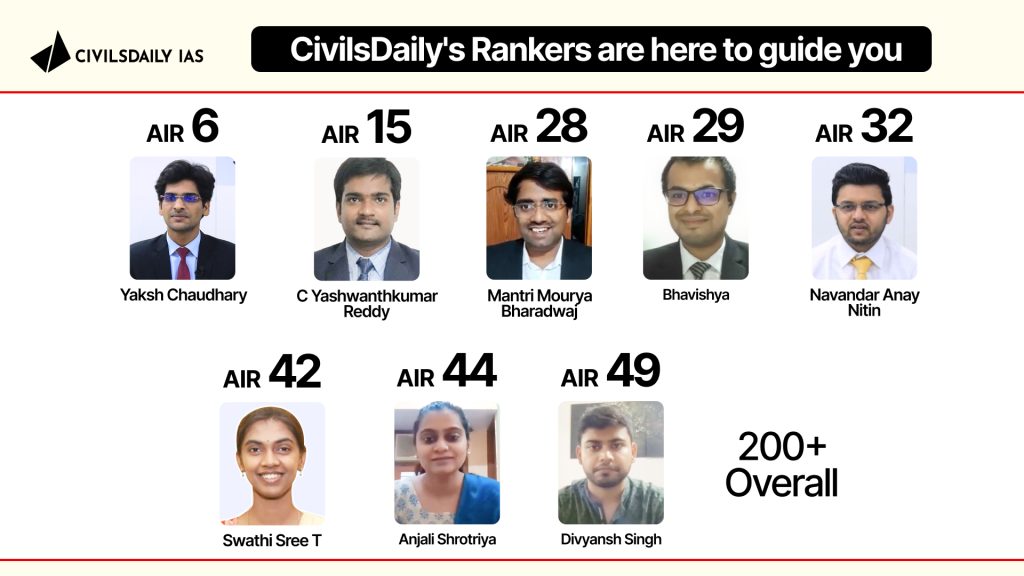
    We are also happy to announce that 78 Civilsdaily students (and counting) are now rank holders in UPSC. Our success rate has increased by 77% from last year in terms of rank holders. Civilsdaily is proud to say that 20 of our students are in the top 100 ranks. And this is a phenomenal 25% increase in our success rate for the top 100 positions since last year.

    And finally, we are extremely proud of our mentors whose tireless efforts helped our students become officers today. Their daily guidance, skilled mentorship, round-the-clock support, and dedication to work with the students day-in and day-out has led to this wonderful occasion where we celebrate the success of our students together!

    How is Samanvaya, UPSC Counselling Session Planned?

    At Civilsdaily, your assigned mentors interact with you on a daily basis. They are not just teachers, but coaches, philosophers, and guides. And this is how they will help you succeed:

    • Motivating you for one whole year and pushing you to complete the modules on time.
    • Helping you restart preparation despite low scores in test series.
    • Helping you study for 6 hours every day if you are working.
    • Guiding you on how to revise the whole syllabus 3 months before prelims and mains.
    • Providing you topic-wise notes.
    • Teaching you elimination techniques, tikdams and helpful strategies like 4-2-4 model of preparation.
    • Keeping you updated on what to study and from where to study.

    Three stages of Samanvaya FREE mentorship

    1. 30-minute counseling session: Once you fill the form, our senior mentors get on a 30-40 minute call with you to understand your preparation level, study constraints, your strategy for the last 6 months, and create measurable targets for next week, next month and so on. You will hear back from us within 24 hours. The first counseling session is absolutely free for all, however, there are limited slots available. So please register now.

    2. Access to our invite-only chat platform, Habitat:  This is where you can post your daily doubts, discuss your test questions and have real-time, live discussions on news and op-eds, and connect with other aspirants in your optional groups.

    3. 1 on 1 mentor allotment: The mentor will be available on scheduled calls with you throughout all the stages of your UPSC preparation and will daily assess, evaluate, and plan the next module according to the available time. We will help you pick the right books, make you practice answers daily, evaluate them and design practical & personal strategies that you can follow everyday

  • India Bangladesh Relations

    bangladeshContext

    • Bangladesh PM Sheikh Hasina’s four-day visit to India to boost bilateral ties.

    India-Bangladesh ties background

    • India’s links with Bangladesh are civilization, cultural, social and economic.
    • There is much that unites the two countries – a shared history and common heritage, linguistic and cultural ties, passion for music, literature and the arts.
    • India was one of the first countries, along with Bhutan, to recognise Bangladesh as a sovereign state on 6 December 1971.
    • It is also worth recalling that India shares its longest border of 4,096.7 kilometres with Bangladesh, which is also the fifth-longest border in the contemporary world.

    bangladeshTrade between two

    • CEPA: Trade will be a focal point during Ms. Hasina’s visit as the two countries gear up to sign a Comprehensive Economic Partnership Agreement.
    • Bangladesh dependency: Bangladesh imports critical industrial raw material from India on which its exports are reliant.
    • Leveraging Indian support: Bangladesh also could improve several manufacturing industries by leveraging Indian expertise in service sectors.

    bangladeshConnectivity

    • IMT highway: Bangladesh has expressed its interest in joining the India-Myanmar-Thailand highway project.
    • Waterway: India-Bangladesh bilateral waterway trade will get boosted as India can now use the Mongla and Chittagong ports.
    • Logistics: India’s Northeast and Bangladesh is important for bilateral cooperation. Currently, three express trains and international bus services operate between Indian and Bangladesh.

    Key data to remember

    Bangladesh is India’s sixth largest trade partner with bilateral trade rising from $2.4 billion in 2009 to $10.8 billion in 2020-21.

    Regional geopolitics

    • Chinese influence: Chinese inroads into the neighbourhood have been a cause of worry for India. China has been actively pursuing bilateral ties with Bangladesh. Bangladesh had successfully approached China for a mega project to enhance Teesta river water flow.
    • Strategic location: From the perspective of India’s Northeast, Bangladesh is India’s most strategic neighbour, whom New Delhi cannot ever afford to ignore.
    • Cooperation needed: India’s dream of ‘Act East Policy’ can only be materialized with the helping hands of Dhaka.
    • Gateway to northeast: The bridge ‘Maitri Setu’ has been built over the Feni River which flows between the Indian boundary in Tripura State and Bangladesh. It is set to become the ‘Gateway of North East’ with access to Chittagong Port of Bangladesh, which is just 80 kms from Sabroom.

    Way forward

    • The future will present itself with an abundance of opportunities to help the two countries to reach a new plane of bilateral relations higher than ever before.
    • Both nations should play their diplomatic cards with more maturity and pragmatism, keeping the regional aspirations and nuances of both countries in mind.
    • A judicious aggregation of regional expectations on both sides of the border will help in achieving their mutual national objectives.
    • To make the recent gains irreversible, both countries need to continue working on the three Cs — cooperation, collaboration, and consolidation.

    Conclusion

    • For India it will take more than cosy relations with one particular government to have long-term stable relations with its most trusted friend in the neighbourhood.

    Mains question

    Q. Do you think Bangladesh is most trusted friend in the neighbourhood? Discuss bilateral relations between two in terms of trade, connectivity and geopolitics.

    UPSC 2023 countdown has begun! Get your personal guidance plan now! (Click here)

  • Issues faced by Teachers in India

    teacher Context

    • 5 September is teacher’s day. Teachers’ Day or Shikshak Divas marks the birthday of the country’s first Vice President (1952–1962) who went on to become the second President of India (1962-1967), a scholar, philosopher, Bharat Ratna awardee, a highly-respected teacher and prolific statesman – Dr Sarvapalli Radhakrishnan.

    teacher What are the issue with teachers?

    • Less attractive career: It seems that teaching the young is no longer an attractive profession because systemic conditions are so discouraging. It points towards the reforms that education now requires.
    • Diversion from teaching: Teaching children is not regarded as a serious profession. Non-teaching duties are routinely assigned, and now the digital regime has washed away the few traces of professional autonomy even in the best of private schools.
    • Bureaucratic over vigilance: So deep is official suspicion of their integrity that many states have installed CCTV cameras in classrooms. That is not the only form of insult teacher’s face. They have little power to assert their professional dignity in the face of bureaucratic or managerial authority.
    • Marginalisation by coaching institutes: The Indian school teacher now faces new social and economic forces. Coaching institutions have marginalised the secondary-level science teacher. All over the country, children are allowed to bunk school to attend NEET and JEE coaching classes. Science and math teachers were, in any case, aware that their pedagogic effectiveness would be measured by an unreformed examination system.
    • Reliability issue due to internet overuse: Social Science teachers are coping with a different kind of challenge to justify their knowledge and interpretation. Children’s access to the internet exposes them to a wilderness of socio-political ideas and information. It is not easy for social science teachers to convince children that they are more reliable than a YouTube video or a WhatsApp message.

    Catchy line in this context for value addition

    Jinke jiwan me guru nahi, unka jiwan abhi shuru nahi.

    How to address these challenges

    • Supporting teacher control over curriculum and instruction: Classical top-down school leadership needs to be re-examined, and teachers must be recognized as professionals who have expertise to make good learning decisions for their students.
    • Establish adequate pay scales and financial incentives: Compensation systems signal what skills and attributes are valued and what kinds of contributions are rewarded.
    • Establish and conduct personnel evaluation systems: Teachers need regular feedback and accurate information on job expectations.
    • Provide adequate planning time for teachers: While all teachers work under tremendous time constraints, experienced teachers generally are able to complete their planning more quickly. For new teachers, adequate planning time can allay feelings of being overwhelmed.
    • Provide a structure for team planning and teaching: Teachers often report feeling isolated in their classrooms. Team planning and teaching can be an important step in retaining a high quality teaching force.

    teacher Conclusion

    • Since the teacher is the pivot of the entire educational system and is the main catalytic agent for introducing desirable changes in the teaching learning process, all attempts need be made for motivating teachers to become innovative and creative. It goes without saying that a self-motivated and really industrious teacher can utilise his own resources to keep themselves abreast of new knowledge and skills.

    Mains question

    Q. It seems that teaching the young is no longer an attractive profession because systemic conditions are so discouraging. Critically analyse.

    UPSC 2023 countdown has begun! Get your personal guidance plan now! (Click here)

More posts