💥UPSC 2027,2028 Mentorship (April Batch) + Access XFactor Notes & Microthemes PDF

Search results for: “”

  • New UGC regulations sharpen provisions against caste bias

    Why in the News

    The University Grants Commission has notified the UGC (Promotion of Equity in Higher Education Institutions) Regulations, 2026, introducing enforceable mechanisms to address caste-based discrimination in universities. This marks the first time “equity regulations” have been formally issued under UGC’s regulatory powers, rather than as advisory guidelines. The move follows a series of student suicides, including Rohith Vemula (2016) and Payal Tadvi (2019), which exposed systemic failures in grievance redressal. The regulations represent a clear departure from earlier, weakly enforced guidelines by mandating institutional structures, timelines, and penalties.

    What Are the New UGC Equity Regulations?

    1. Legal Framework: Issued under UGC Act powers, replacing advisory norms.
    2. Coverage: Applies to all higher education institutions without exception.
    3. Protected Grounds: Caste, birth, disability, religion, language, gender, and region.
    4. Target Groups: Scheduled Castes, Scheduled Tribes, OBCs, minorities, women, persons with disabilities, and economically weaker sections.

    How Do the Regulations Define Discrimination?

    1. Conceptual Clarity: Defines discrimination as exclusion, restriction, or differential treatment.
    2. Scope Expansion: Covers social, academic, and institutional spaces.
    3. Operational Reach: Includes both direct actions and systemic practices.
    4. Institutional Accountability: Fixes responsibility on authorities, not just individuals.

    What Institutional Mechanisms Are Mandated?

    Equity Officer (EO)

    1. Appointment: Mandatory in every institution.
    2. Role: Coordinates equity policies and grievance handling.
    3. Support: Liaison with administration, police, and district authorities.
    4. Faculty Involvement: Faculty members serve as institutional representatives.

    Equal Opportunity Centre (EOC)

    1. Structure: Statutory body within each institution.
    2. Functions: Receives complaints, monitors discrimination, provides legal aid.
    3. Continuity: Reinforces EOCs mandated since 2012 with enforcement powers.
    4. Compliance: Failure attracts regulatory consequences.

    Equity Committee

    1. Leadership: Headed by the institutional head.
    2. Composition: Reserved category members mandatory.
    3. Jurisdiction: Reviews complaints, directs corrective action.
    4. Timeline: Complaint reports submitted within 15 days.

    How Is Grievance Redressal Strengthened?

    1. Time-Bound Action: Institutional head must act within seven days.
    2. Escalation Mechanism: Non-compliance escalated to UGC.
    3. Monitoring: National-level oversight committee introduced.
    4. Sanctions: Non-compliant institutions barred from UGC schemes and funding.

    How Are These Regulations Different from 2012 Guidelines?

    1. From Advisory to Mandatory: Converts soft guidelines into enforceable rules.
    2. Punitive Powers: Introduces institutional penalties.
    3. Monitoring Framework: Adds national-level compliance review.
    4. Operational Precision: Specifies timelines, responsibilities, and reporting formats.

    What Provisions Address Campus Culture and Reporting?

    1. Equity Helpline: 24×7 helpline for discrimination complaints.
    2. Equity Ambassadors: Student and faculty representatives.
    3. Role Definition: Act as “torchbearers of equity”.
    4. Preventive Approach: Focus on awareness, not only punishment.

    What Are the Draft and Final Regulation Changes?

    1. Removed Provision: Penalty for “false complaints” dropped.
    2. Rationale: Avoids chilling effect on marginalised complainants.
    3. Institutional Penalties: Retained against institutions, not individuals.
    4. Clarity Added: Detailed complaint disposal procedures introduced.

    What Is the Controversy Over the Regulations?

    1. Student Opposition: Concerns raised by OBC and student groups.
    2. Core Demand: Inclusion of OBCs explicitly in Scheduled Caste/Tribe protections.
    3. Fear of Misuse: Allegations of incentivising false complaints.
    4. Political Dimension: Hashtags and protests indicate social mobilisation.

    Conclusion

    The UGC (Promotion of Equity in Higher Education Institutions) Regulations, 2026 institutionalise social justice within university governance by converting constitutional principles of equality and non-discrimination into enforceable administrative duties. By mandating equity officers, statutory committees, time-bound grievance redressal, and regulatory sanctions, the framework addresses long-standing gaps between policy intent and campus reality. The regulations signal a shift from symbolic inclusion to rule-based accountability, while their effectiveness will ultimately depend on consistent enforcement, institutional capacity, and sustained oversight by the UGC.

    PYQ Relevance

    [UPSC 2022] “The Rights of Persons with Disabilities Act, 2016 remains only a legal document without intense sensitisation of government functionaries and citizens.” Comment.

    Linkage: Highlights the recurring UPSC theme of law, implementation gap, similar to how earlier UGC guidelines failed due to lack of enforcement, now addressed through binding equity regulations.

  • Wings India 2026: Asia’s Largest Civil Aviation Event

    Why in the News?

    India’s rapidly expanding civil aviation sector will be showcased at Wings India 2026, Asia’s largest civil aviation event, scheduled from 28 to 31 January 2026 at Begumpet Airport, Hyderabad.

    About Wings India 2026

    • Asia’s largest civil aviation event
    • Organised as a global platform for Connectivity, Manufacturing, Services, Innovation and Sustainability
    • Inaugurated by Rammohan Naidu Kinjarapu, Union Minister of Civil Aviation

    Theme
    “Indian Aviation: Paving the Future from Design to Deployment, Manufacturing to Maintenance, Inclusivity to Innovation and Safety to Sustainability”

    India’s Aviation Growth Story

    • India among the fastest growing aviation markets globally
    • Passenger traffic has grown multi fold in the last decade
    • Record aircraft orders place India among the largest future aircraft markets
    • Rapid expansion of airport infrastructure Greenfield airports, Modernised terminals and Regional connectivity under UDAN

    Prelims Pointers

    • Wings India is a civil aviation industry event, not a treaty or summit
    • Held at Begumpet Airport, Hyderabad
    • Focus areas include MRO, SAF, drones and advanced air mobility
    • Reflects India’s transition from aviation growth to aviation leadership
    [2024] Consider the following airports: 

    1. Donyi Polo Airport 

    2. Kushinagar International Airport 

    3. Vijayawada International Airport 

    In the recent past, which of the above have been constructed as Greenfield projects? 

    (a) 1 and 2 only (b) 2 and 3 only (c) 1 and 3 only (d) 1, 2 and 3

  • Prime Minister at India Energy Week 2026

    Why in the News?

    Prime Minister Narendra Modi addressed the inauguration of India Energy Week 2026 via video conferencing, highlighting India’s growing role in the global energy sector, major investment opportunities.

    India Energy Week 2026

    • Representatives from nearly 125 countries participated
    • Emerged as a global platform for energy dialogue and action
    • Focus on energy security, sustainability, and global partnerships
    • Venue: Goa

    Key Highlights from the Prime Minister’s Address

    India’s Energy Potential

    • India is the world’s fastest growing major economy
    • Rising domestic energy demand and strong export capacity
    • Among the top five exporters of petroleum products, supplying over 150 countries
    • Large opportunities across the entire energy value chain

    Oil and Gas Exploration Sector

    • India has opened up its exploration sector significantly
    • Linked to Samudra Manthan Mission for deep sea exploration
    • Targets by end of decade
      • 100 billion dollars investment in oil and gas
      • Exploration area expanded to 1 million sq km
    • Over 170 blocks already awarded
    • Andaman and Nicobar Basin emerging as a new hydrocarbon zone
    • Reduction of No Go areas and regulatory reforms undertaken

    Refining and Petrochemicals

    • India ranks second globally in refining capacity
    • Current capacity: around 260 MMT per annum
    • Target: exceed 300 MMT per annum and become number one globally
    • Rising demand for petrochemical products due to population and economic growth

    Liquefied Natural Gas (LNG) Focus

    • Target to meet 15 percent of total energy demand through LNG
    • Investment opportunities across LNG transportation, LNG terminals and Regasification infrastructure
    • Domestic shipbuilding supported by ₹70,000 crore shipbuilding programme
    • Expansion of National gas pipeline network and City gas distribution systems

    Energy Reforms and Vision

    • India moving from energy security to energy independence
    • Focus on Transparent, Investor friendly and Reform driven ecosystem
    • Estimated 500 billion dollars investment opportunity in India’s energy sector
    [2019] Consider the following statements: 

    1. Petroleum and Natural Gas Regulatory Board (PNGRB) is the first regulatory body set up by the Government of India

    2. One of the tasks of PNGRB is to ensure competitive markets for gas

    3. Appeals against the decisions of PNGRB go before the Appellate Tribunals for Electricity. Which of the statements given above are correct? 

    (a) 1 and 2 only (b) 2 and 3 only (c) 1 and 3 only (d) Neither 1 nor 2

  • Pygmy Hog

    Why in the News?

    India’s Pygmy hog is rapidly declining due to loss and degradation of tall grassland habitats, even though it plays a critical role in maintaining grassland ecosystem health.

    About Pygmy Hog

    • Smallest and rarest wild pig species in the world
    • One of the few mammals that builds its own nest with a roof
    • Functions as an indicator species, reflecting grassland health

    Habitat

    • Prefers undisturbed tall grasslands with early succession riverine vegetation
    • Habitat includes dense tall grasses mixed with herbs, shrubs and young trees
    • Present distribution restricted to
      • Manas National Park
      • Orang National Park

    Ecological Role

    • Forages by digging soil using its snout
    • Feeds on roots, tubers, fruits, termites, earthworms and eggs
    • Improves soil aeration and fertility
    • Aids seed dispersal, supporting grassland regeneration

    Conservation Status

    • IUCN Red List: Critically Endangered
    • Listed under Schedule I of the Wildlife Protection Act, 1972
    • Estimated wild population is very small, confined to Assam
    [2013] Consider the following: 

    1. Star tortoise 

    2. Monitor lizard 

    3. Pygmy hog 

    4. Spider monkey 

    Which of the above are naturally found in India? 

    (a) 1, 2 and 3 only (b) 2 and 3 only (c) 1 and 4 only (d) 1, 2, 3 and 4

  • Army’s animals wing

    Why in the News?

    At the Republic Day Parade 2026, the Remount and Veterinary Corps of the Indian Army will, for the first time, showcase a curated animal contingent including Bactrian camels, Zanskar ponies, Army dogs and raptors, highlighting the operational role of animals in military logistics and combat support.

    About the Remount and Veterinary Corps (RVC)

    • A specialised corps of the Indian Army
    • Responsible for
      • Breeding, rearing and training of Army animals
      • Veterinary care and animal health services
    • Supports operations in high altitude, desert and difficult terrains

    Historical Background

    • Origin traced to the Stud Department established in Bengal in 1779
    • Reorganised as
      • Army Veterinary Corps in 1920
      • Indian Remount and Veterinary Corps in 1950
    • Formally designated as Remount and Veterinary Corps in 1960
    • Motto: Pashu Seva Asmakam Dharma
    • Awarded the President’s Flag in 1989
    • Headquarters at Meerut

    Role and Functions of RVC

    • Ensures operational readiness of animals for
      • Logistics
      • Reconnaissance
      • Counter terrorism
      • Disaster response
    • Mules and ponies used for supply transport where vehicles and aircraft cannot operate
    • Army dogs trained for
      • Explosive and mine detection
      • Tracking and guarding
      • Avalanche and disaster rescue
      • Combat roles
    • Supports UN peacekeeping missions, Military diplomacy and NCC horse riding training
    [2024] Operations undertaken by the Army towards upliftment of the local population in remote areas to include addressing of their basic needs is called: 

    (a) Operation Sankalp 

    (b) Operation Maitri 

    (c) Operation Sadbhavana 

    (d) Operation Madad

  • Kerala declares Bacillus subtilis ‘State microbe’

    Why in the News?

    Kerala has declared Bacillus subtilis as its State Microbe, becoming the first State in India to officially notify a state microbe during the inauguration of the Centre of Excellence in Microbiome (CoEM).

    About Bacillus subtilis

    • A probiotic or beneficial bacterium
    • Widely found in soil, environment, human gut and fermented foods
    • Known for disease control, soil health improvement and boosting agricultural productivity
    • Has potential for development of commercial microbial products

    Centre of Excellence in Microbiome (CoEM)

    • Established by the Kerala government to study the role of microorganisms in health, environment and sustainability
    • Focuses on translational research for societal benefit
    • Works under Kerala State Council for Science, Technology and Environment in collaboration with Kerala Development and Innovation Strategic Council

    Prelims Takeaway

    • Kerala is the first State to declare a State Microbe
    • Bacillus subtilis is a probiotic bacterium with health and agriculture applications
    • CoEM is India’s first integrated microbiome translational research platform
    [2022] Consider the following statements in respect of probiotics: 

    1. Probiotics are made of both bacteria and yeast

    2. The organisms in probiotics are found in foods we ingest but they do not naturally occur in our gut

    3. Probiotics help in the digestion of milk sugars

    Which of the statements given above is/are correct? 

    (a) 1 only (b) 2 only (c) 1 and 3 (d) 2 and 3

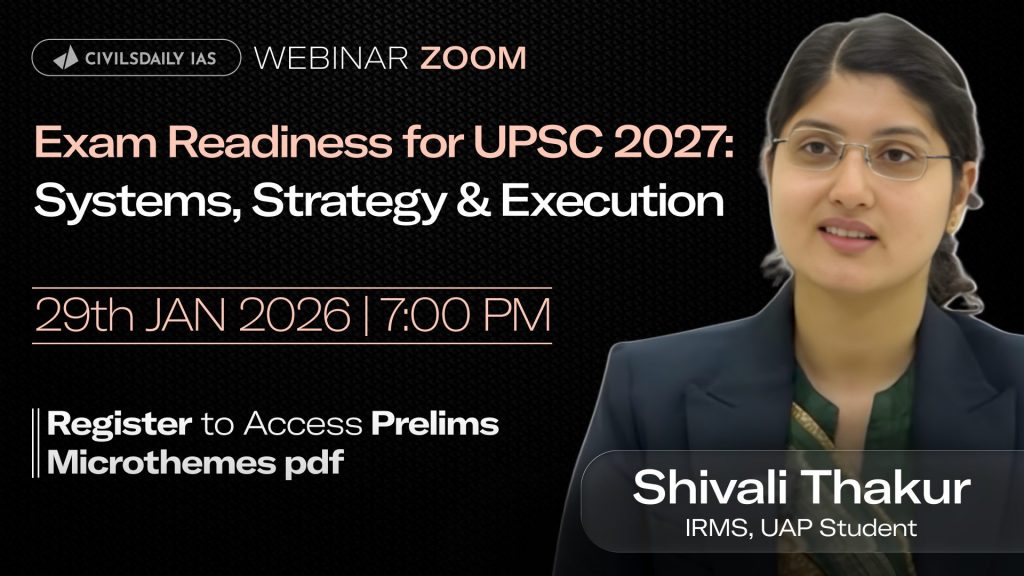
  • 🔴[UPSC Webinar for 2027] By Shivali Thakur, IRMS,UPSC CSE 2024 | Exam Readiness for UPSC 2027: Systems, Strategy & Execution | Join on 29th Jan at 7PM

    🔴[UPSC Webinar for 2027] By Shivali Thakur, IRMS,UPSC CSE 2024 | Exam Readiness for UPSC 2027: Systems, Strategy & Execution | Join on 29th Jan at 7PM

    Register for the session


    Read about Webinar

    “Preparation” and “exam readiness” are not the same thing.
    Many aspirants study hard for years , yet freeze, fumble, or underperform when it matters most.

    In this live webinar, I break down what it actually means to be exam ready for UPSC 2027, beyond schedules, motivation, and to do lists.

    This session is about building systems that work under pressure, not just plans that look good on paper.

    Shivali Thakur , IRMS, UPSC CSE 2024

    What I’ll do in this live session:

    1. What exam-readiness really means for UPSC
    Why completing the syllabus doesn’t automatically translate into performance in Prelims or Mains.

    2. Systems over motivation
    How to design daily, weekly, and monthly systems that keep working even when motivation drops.

    3. Strategy vs execution gap
    Where most aspirants lose marks, and how to close the gap between knowing what to do and actually doing it.

    4. Using Microthemes to stay exam focused
    How microtheme-based preparation improves recall, integration, and decision-making during the exam.

    5. Self-check framework for UPSC 2027 aspirants
    Clear indicators to assess whether your preparation is moving in the right direction, or needs correction now, not later.


    Who should attend:

    • UPSC 2027 aspirants feeling unsure about their current prep
    • Students studying regularly but lacking confidence
    • Aspirants who want clarity, structure, and direction early in the cycle
    • Anyone tired of random preparation and seeking a stable system

    Join us, for a 45 minute live Zoom session on 29th Jan at 7PM.

    See you in masterclass.


    It will be a 45 minute session, post which we will open up the floor for all kinds of queries which a beginner must have. No questions are taboo and Shivali Ma’am is known to be patiently solving all your doubts.

    Join us for a Zoom session on 29th Jan at 7 PM. This session is a must attend for you If you are attempting UPSC for the first time or have attempted earlier and now preparing for 2026/2027, then it is going to be a valuable session for you too.

    See you in the session”

    Register for the session for a complete in-depth UPSC Prep


    In this Civilsdaily masterclass, you will get:

    1. A 45-minute deep dive on how to plan your UPSC strategy from the start to the end.
    2. How do first-attempt IAS Rankers get the most out of their one year prep?
    3. Insider tips that only the top IAS and IPS rankers know and apply to get rank.

    By the end, you’ll have razor-sharp clarity and a clear path to crack UPSC with confidence and near-perfect certainty. 

    Join UPSC session on 29th Jan, at 7 PM

    (Don’t wait—the next webinar/session won’t be until Mid Feb’26)


    These masterclasses are packed with value. They are conducted in private with a closed community. We rarely open these webinars for everyone for free. This time we are keeping it for 300 seats only.

    Ready to attend the UPSC Webinar?


    Not sure yet?

    We recommend you register here. It takes less than 10 seconds to register.

    • No spam! Once in a while, we’ll only send you high-quality exam-related content. 
    • We will inform you about the upcoming Masterclasses that might benefit you.
    • You can demand one free mentorship call from verified Civilsdaily mentors. 
    • You can always choose to unsubscribe. 
  • [27th January 2026] The Hindu OpED: Mind the time: On the financial burden of India’s ageing population

    PYQ Relevance

    [UPSC 2024] What is the concept of a ‘demographic winter’? Is the world moving towards such a situation?

    Linkage: It falls under GS Paper I: Population and Associated Issues, with direct links to ageing, fertility decline, and socio-economic sustainability. The article reflects an emerging sub-national demographic winter in India, where States like Kerala and Tamil Nadu face rapid ageing, mirroring the global trend of falling fertility and rising old-age dependency.

    Mentor’s Comment

    This article is important because India’s population change is no longer a future issue, it is already happening unevenly across States. It is in the news as it questions the RBI’s advice that ageing States should cut subsidies to manage rising pension and healthcare costs, while younger States should focus on education, skills, and labour-intensive growth. The article highlights a key gap: without public, State-funded geriatric care, demographic advantage may turn into a serious social and fiscal burden.

    Why in the News

    India faces its first clear inter-State demographic divergence where ageing and youth coexist simultaneously at scale. Kerala and Tamil Nadu will become “ageing States” by 2036, with elderly populations exceeding 22% and 20%, respectively. This marks a sharp shift from earlier decades when demographic transition was gradual and nationally uniform.

    Why is India’s demographic transition uneven across States?

    1. Demographic divergence: Southern States experience rapid ageing due to sustained fertility decline, while Bihar, Uttar Pradesh, and Jharkhand retain expanding working-age populations beyond 2031.
    2. Middle-ground States: Karnataka and Maharashtra face simultaneous growth and ageing pressures, complicating fiscal planning.
    3. Policy implication: Uniform demographic assumptions no longer apply to inter-State fiscal transfers or social sector planning.

    How does the RBI propose managing ageing-related fiscal stress?

    1. Subsidy rationalisation: Advises ageing States to reduce subsidies to manage rising pension and healthcare expenditure.
    2. Human capital investment: Urges youthful States to invest heavily in education and skills to exploit a “window of opportunity.”
    3. Labour-intensive growth: Recommends expansion of labour-intensive sectors to absorb the growing workforce.

    Why is the RBI’s fiscal advice politically and structurally constrained?

    1. Fiscal federalism imbalance: Population-weighted Finance Commission formulas reduce tax devolution to ageing southern States despite higher welfare burdens.
    2. Delimitation impact: Upcoming delimitation reduces parliamentary representation of States that controlled population growth early.
    3. Double disadvantage: Successful population stabilisation results in lower fiscal transfers and reduced political voice.

    Are youthful States adequately positioned to harness demographic advantage?

    1. Education spending stagnation: Share of State expenditure on education has stagnated or declined despite workforce expansion.
    2. Employability gap: Persistent mismatch between education outcomes and job readiness.
    3. Technological disruption: Workforce entry coincides with rising automation and AI-driven manufacturing, reducing labour absorption capacity.
    4. Premature ageing risk: Possibility of “ageing before getting rich” due to weak industrial absorption.

    How does ageing disproportionately affect women

    1. Longevity-finance gap: Elderly women live longer but possess fewer financial assets.
    2. Workforce exclusion: Majority of elderly women were never part of the formal workforce and lack pension coverage.
    3. Policy blind spot: Workforce-centric ageing strategies exclude unpaid care workers and homemakers.
    4. Social dependency: Absence of income security deepens dependence on family or State transfers.

    Why can family-based elderly support no longer be assumed?

    1. Migration patterns: Youth migration weakens intergenerational co-residence.
    2. Nuclear families: Decline of joint family structures erodes informal care networks.
    3. Safety net collapse: Assumptions of familial support no longer hold as a universal fallback.

    What structural solutions does the article propose beyond fiscal adjustments?

    1. Industrial policy shift: Job creation in new sectors such as green energy and the care economy.
    2. Early institution-building: Youthful States must build healthcare and pension systems before fertility decline accelerates.
    3. Social pension expansion: Large-scale expansion of non-contributory social pensions despite fiscal consolidation pressures.
    4. Public geriatric care: Absence of State-funded geriatric infrastructure risks limiting “graceful ageing” to the wealthy.

    Conclusion

    India’s demographic transition demands a shift from narrow fiscal management to long-term social planning. Without early investment in public geriatric care, social pensions, and health systems, ageing will deepen inequality and strain federal finances. A balanced approach that links demographic responsibility with fiscal equity is essential to ensure that population change strengthens, rather than destabilises, India’s development trajectory.

  • How will U.S. exit affect solar alliance

    Why in the News?

    In January 2025, the United States withdrew from 66 international organisations, including the International Solar Alliance (ISA), signalling a clear retreat from multilateral climate cooperation. This is important because the U.S. had joined ISA only in late 2021, and its exit goes against the growing need for global climate finance and technology sharing. Although the U.S. contributed only about 1% of ISA’s total funds, its withdrawal raises concerns about global confidence, leadership, and funding for solar projects, especially in Africa and poorer developing countries.

    What is the International Solar Alliance (ISA)?

    1. Institutional Mandate: Facilitates affordable solar power deployment by reducing project risk, mobilising finance, and accelerating technology adoption.
    2. Establishment: Founded in 2015 and headquartered in India as a joint India-France initiative.
    3. Membership Base: Covers over 120 countries across Africa, Asia, and island states.
    4. Operational Role: Enables access to finance, training, and investor confidence rather than directly building solar plants.

    How significant was the U.S. role within the ISA?

    1. Limited Financial Contribution: Accounts for only about 1% of ISA’s total funding, limiting direct fiscal impact.
    2. Late Entry: Joined the Alliance only in late 2021, indicating limited institutional integration.
    3. Ongoing Continuity: Indian officials indicate existing programmes will continue without disruption.

    Will India’s solar manufacturing sector be affected?

    1. Domestic Manufacturing Strength: India’s solar module manufacturing capacity is projected to reach 144 GW by 2026, up from 25 GW earlier.
    2. Import Dependence Decline: India has reduced reliance on imported solar components, particularly from China.
    3. Market Share Indicator: Indian manufacturers already supply over 70% of domestic solar module demand.
    4. Cost Stability: The U.S. exit does not affect electricity tariffs or domestic solar affordability.

    Will investments in India’s solar projects slow down?

    1. Domestic Demand Driven: Most solar projects are backed by Indian power demand rather than foreign aid.
    2. Contract Stability: Projects operate under long-term contracts with state and central agencies.
    3. Investor Confidence: Strong policy continuity and power sector reforms sustain investor interest.
    4. Employment Trends: Solar job growth remains strong across manufacturing, installation, and operations.

    Where does the real economic risk lie?

    1. Regional Impact Concentration: Africa and poorer developing countries face higher vulnerability.
    2. Finance Dependence: These regions rely heavily on concessional lending and multilateral climate engagement.
    3. Lender Behaviour: Reduced U.S. climate engagement may slow approvals and increase lender caution.
    4. Export Exposure: Indian firms executing overseas solar projects may face indirect slowdown.

    Does the U.S. exit weaken India’s climate diplomacy?

    1. Leadership Continuity: India remains the central driver of ISA’s agenda and operations.
    2. Diplomatic Influence: ISA continues to function as a strategic diplomatic tool in the Global South.
    3. Responsibility Shift: India now bears greater responsibility for financing mobilisation and leadership.

    What lies ahead for solar energy in India?

    1. Grid Integration Challenge: Storage, grid stability, and transmission infrastructure remain key bottlenecks.
    2. Capital Mobilisation: Attracting affordable finance remains critical amid global fragmentation.
    3. Preparedness Indicator: India appears better positioned today than a decade ago to absorb such shocks.

    Conclusion

    The U.S. withdrawal from the International Solar Alliance does not materially weaken India’s domestic solar sector, which is now driven by strong manufacturing capacity and internal demand. However, it exposes the vulnerability of global climate cooperation, particularly for developing countries dependent on multilateral finance. Going forward, India’s leadership within ISA becomes more critical to sustain solar deployment, mobilise climate finance, and uphold collective action in an increasingly fragmented global climate order.

    International Solar Alliance (ISA)

    1. Launch and Leadership: Launched in 2015 by India and France to promote solar energy deployment among tropical countries.
    2. Legal Status: Became a treaty-based intergovernmental organisation in 2017, giving it formal international legitimacy.
    3. Headquarters: Located in Gurugram, India, reinforcing India’s role in global climate governance.
    4. Membership: Comprises 120+ member countries, primarily from Africa, Asia, and Small Island Developing States.
    5. Core Objective: Enables affordable, reliable, and scalable solar energy by reducing project risk and mobilising finance.
    6. Operational Focus: Works through capacity building, technical assistance, and investment facilitation, rather than direct project execution.
    7. Strategic Significance for India: Strengthens South-South cooperation, enhances climate diplomacy, and supports India’s leadership in the Global South.

    PYQ Relevance

    [UPSC 2021] Explain the purpose of the Green Grid Initiative launched at the World Leader Summit of the COP26 UN Climate change conference in Glasgow in November, 2021. When was this idea first floated in the International Solar Alliance [ISA]?

    Linkage: The Green Grid Initiative advances the ISA goal of cross-border renewable energy integration. The U.S. exit highlights India’s continued leadership in sustaining climate multilateralism.

  • Cybercrime and a global governance crisis

    Why in the news?

    The UN adopted the Convention against Cybercrime (December 2024), the first global cybercrime treaty in over two decades. However, India, the U.S., Japan, and Canada have not signed it, exposing deep divisions in global cyber governance. The Convention highlights a growing principles-practice gap, geopolitical mistrust, and a shift towards polycentric global governance.

    Why is the UN Cybercrime Convention considered a milestone?

    1. Institutional First: Establishes the first UN-led multilateral criminal justice instrument on cybercrime in two decades.
    2. Negotiation Scale: Reflects extensive multilateral engagement involving UN member states, civil society, and private sector actors.
    3. Global Scope: Seeks universal applicability beyond regional instruments like the Budapest Convention.
    4. Symbolic Consensus: Secured General Assembly adoption in December 2024 with support from 72 states.

    How does the Convention expose fractures in global cyber governance?

    1. Non-Participation by Major Democracies: India, the U.S., Japan, and Canada declined to sign, signalling legitimacy concerns.
    2. Governance Divide: Highlights divergence between European cyber norms and alternative governance visions advanced by Russia and China.
    3. Legal Uncertainty: Reveals gaps between international legal principles and domestic implementation capacity.
    4. Polycentrism Risk: Signals movement away from universal frameworks towards fragmented governance centres.

    What are the concerns regarding criminal definitions and civil liberties?

    1. Broad Crime Definitions: Expands criminalisation in ways that allow discretionary interpretation.
    2. Rights Implications: Raises risk of misuse against journalists, activists, and political opponents.
    3. Procedural Safeguards: Anchors protections like judicial review to domestic frameworks rather than uniform standards.
    4. Principles-Practice Rift: Consensus on principles masks divergence in enforcement practices.

    Why does India’s reluctance carry strategic significance?

    1. Institutional Autonomy: India resists surrendering control over data governance and lawmaking.
    2. Negotiation Disengagement: Unlike the Budapest Convention, India did not actively shape the UN Convention’s final contours.
    3. Regulatory Trade-offs: Proposals retained greater state control over citizen data, limiting flexibility.
    4. Eroded Influence: Reflects diminished agenda-setting power in global lawmaking over two decades.

    How does AI governance illustrate implementation challenges?

    1. Watermarking Example: India’s push to watermark AI-generated content highlights regulatory innovation.
    2. Platform Mandates: Draft rules require social media platforms to label AI content beyond body-corporate thresholds.
    3. Prescriptive Risk: Over-specification may constrain innovation and compliance feasibility.
    4. Governance Gap: Demonstrates difficulty in operationalising agreed principles.

    What does the Convention reveal about the global order?

    1. Weakened Multilateralism: Declining U.S. financial support to the UN undermines institutional effectiveness.
    2. Security Council Paralysis: Inability to act decisively in Ukraine and Gaza reflects governance fatigue.
    3. WTO Breakdown: Dispute settlement mechanism non-functional since 2019.
    4. Shift to Minilaterals: Reliance on smaller groupings such as Quad and Five Eyes for functional coordination.

    Why is cybercrime governance central to future global cooperation?

    1. Cross-Border Data Flows: Cybercrime enforcement depends on interoperable data-sharing mechanisms.
    2. Trust Deficit: Near-universal recognition of trusted data corridors without operational consensus.
    3. Capacity Constraints: States lack technical and regulatory infrastructure for implementation.
    4. Autonomy Trade-off: Global cooperation increasingly challenges domestic sovereignty.

    Conclusion

    The UN Convention against Cybercrime underscores the limits of consensus-based global governance in a fragmented geopolitical environment. While it symbolises multilateral intent, its effectiveness will depend on bridging institutional capacity gaps, reconciling sovereignty concerns, and aligning legal principles with enforceable safeguards. The future of cyber governance will be shaped less by universal treaties and more by adaptive, trust-based cooperation frameworks.

    Convention against Cybercrime

    1. The UN General Assembly adopted the Convention against Cybercrime in December 2024, marking the first legally binding UN instrument to combat cybercrime through international cooperation. 
    2. Designed to address issues like ransomware, child sexual abuse material, and online scams, it allows for cross-border evidence sharing and capacity building.
    3. The treaty, which opened for signature in 2025, requires 40 ratifications to enter into force. The treaty is scheduled to remain open for signature until December 31, 2026, and will come into effect 90 days after the 40th nation ratifies it.
    4. Adoption & Scope: The treaty was finalized in 2024 to create a global framework for investigating and prosecuting digital crimes, offering a universal approach rather than just regional (like the Budapest Convention).
    5. Controversies: The treaty has faced criticism regarding:
      1. potential misuse of surveillance powers 
      2. insufficient human rights safeguards
      3. could be used by governments to suppress online freedom.

    PYQ Relevance

    [UPSC 2024] Terrorism has become a significant threat to global peace and security. Evaluate the effectiveness of the United Nations Security Council’s Counter-Terrorism Committee (CTC).

    Linkage: It is highly important for GS-II (UN, global governance) and GS-III (cyber security, internal security) due to rising non-traditional security challenges. Just as UPSC asked about the UN Security Council’s Counter-Terrorism Committee (CTC), it can similarly ask about the UN Convention against Cybercrime, since both deal with transnational security threats and weak UN enforcement mechanisms.

More posts