Why in the News
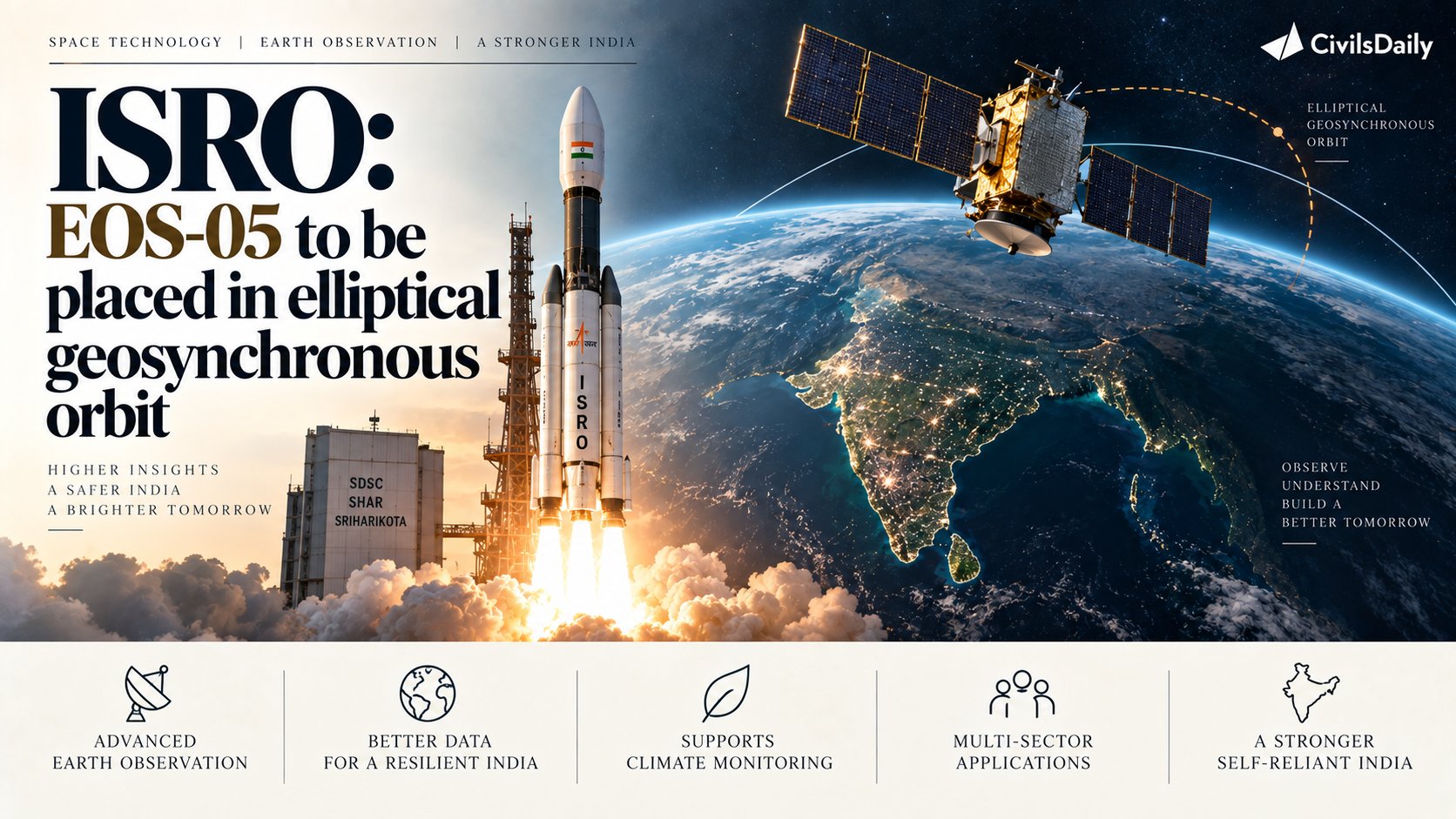
Nine employee associations of the Indian Space Research Organisation (ISRO) have written to the chairman seeking clarity on staff strength, recruitment and the outsourcing of core functions. The letter was sent on the day the agency recorded its largest success of the year, the launch of its first geosynchronous imaging satellite, EOS-05, on the Geosynchronous Satellite Launch Vehicle (GSLV). The grievance follows from the Indian Space Policy of April 2023, which signalled that ISRO would eventually stop building commercial satellites and launch vehicles and would concentrate on exploratory missions. ISRO has stated that it will not be privatised or reduced, and the Indian National Space Promotion and Authorisation Centre (IN-SPACe), the body set up to enable private participation, has stated that the agency will not be diminished and that only industry’s role must grow. Neither institution has addressed the concern the letter actually raises, which is the loss of jobs. The underlying question is whether the sector’s direction still matches its founding principle, that space technology is an instrument of social development rather than a contest for prestige.
What does the Indian Space Policy, 2023 set out?
- A division of roles: The policy separates the space sector into ISRO, IN-SPACe and NewSpace India Limited, and assigns each a distinct function instead of leaving all of them with ISRO.
- ISRO’s redefined remit: ISRO is to move out of routine operational and commercial production of satellites and launch vehicles, and towards research and development in advanced technologies and exploratory missions.
- IN-SPACe as the single window: IN-SPACe authorises and supervises the space activities of private entities, so a company deals with one authorising body rather than with the operator of the launch infrastructure.
- NewSpace India Limited as the commercial arm: The public sector company under the Department of Space is responsible for commercialising space technologies and platforms developed with public money.
What are the employee associations asking for?
- Staff strength and recruitment: The associations want stated numbers on sanctioned strength and future recruitment, since a shrinking mandate implies a shrinking establishment.
- Outsourcing of core functions: The letter distinguishes contracting out manufacturing from contracting out functions the agency treats as core, and seeks clarity on where that line now falls.
- The institutional replies avoid the question: Both the agency and the authorisation body have answered on the agency’s continued existence, which was not what was asked.
- The timing is the point: The grievance surfaced on a day of technical success, which indicates that the concern is about the institution’s trajectory and not about its capability.
Which vision of the space programme is the sector following?
- The founding principle: The programme was built on a refusal to be drawn into space races and on the use of space technology as a tool for social development, meaning communication, weather and resource mapping for domestic needs.
- The competing image: The alternative is space as an emblem of national power, membership of a small club of space faring countries, and a proliferation of startups as evidence of arrival.
- The 2035 test the sector is being set: If the sector is to be a source of export earnings and a nucleus of value added services that absorbs skilled labour and creates jobs, hard choices taken now may be justified.
- Where the line falls: Joining a bandwagon driven by billionaire ambition and notions of conquest is a different objective from either, and the case for restructuring collapses if that is what it delivers.
What does the comparison with NASA show?
- The budget gap: The National Aeronautics and Space Administration (NASA) operates on $24.4 billion against the Department of Space’s Rs 13,705 crore, roughly 16 times larger.
- NASA also contracted: NASA’s budget fell from 0.7% of American gross domestic product in 1966 to 0.1% now, so its own shift to contracting out followed a sustained loss of fiscal share.
- Its establishment shrank with it: NASA’s civil service headcount fell from about 36,000 at the peak of the Apollo programme to about 14,000 today, which is the trajectory ISRO’s employees are reading against.
- The unaddressed comparator: China’s space programme has not been seriously reckoned with in India’s planning, and it is the one operating at a scale and cadence that directly bears on India’s position.
Is the new private base the same as the old one?
- ISRO never made everything itself: Unlike NASA in its early years, which designed and made every component, ISRO has always had a manufacturing relationship with private industry, including Walchandnagar Industries and Larsen and Toubro.
- The entrants are of a different type: The current activity is not established companies building on decades of manufacturing experience but new entrants funded by foreign capital that may not stay.
- The business model has shifted: Most new entrants are interested in satellite data as a service rather than in building hardware, which is a different industrial base from the one that supplied the agency.
- The transferable capability is therefore narrower: A vendor base built on data services cannot absorb the manufacturing functions ISRO is being asked to shed.
Challenges to ISRO’s restructuring
- In house capability is easy to lose and slow to rebuild: Skills that live in the hands of a small number of engineers disappear once the work is contracted out and the staff are not replaced. Eg. Cryogenic engine development took India close to two decades to master after external supply was cut off.
The Fix: Ring fence a defined set of critical technologies as retained in house capability, with recruitment sanctioned against them irrespective of outsourcing elsewhere.
- The private demand base is thin: A domestic space economy built on data services has few anchor customers other than government departments, so private capacity depends on public orders it is meant to replace. Eg. Earth observation demand in India is dominated by central and State government users.
The Fix: Commit an anchor procurement volume for satellite data and launch services over a fixed multi year period, so private capacity is built against contracted demand.
- Foreign capital in the entrant base is mobile: Startups funded by capital that can exit quickly cannot be relied on to hold strategic capability through a downturn. Eg. Global space venture funding has moved sharply between years, tightening after periods of expansion.
The Fix: Condition the transfer of any strategic technology on domestic ownership thresholds and on a minimum period of operation in India.
- Transferring a launch vehicle is harder than transferring a design: Handing production of a vehicle to industry moves drawings but not the accumulated process knowledge that makes a launch repeatable. Eg. The Small Satellite Launch Vehicle technology transfer to industry involved an extended period of hand holding rather than a clean handover.
The Fix: Structure every technology transfer with a defined number of jointly executed missions before the agency withdraws.
- The regulatory body is also the promoter: IN-SPACe both promotes private participation and authorises it, so the function that grants approvals is the function measured on how many approvals it grants. Eg. Authorisation and promotion sit within one body rather than in separate agencies.
The Fix: Separate the authorisation function into a statutory regulator with its own appointment process, leaving promotion with the existing body.
Conclusion
The agency’s technical record is not what is in question, and a successful launch is precisely why the staffing letter is difficult to dismiss. What is unresolved is that two institutions have given assurances about the agency’s survival while declining to state what happens to the people inside it, and an assurance that avoids the question asked is not an answer. The concrete thing to watch is whether the Department of Space publishes a transparent policy stating sanctioned staff strength, the recruitment pipeline and the specific functions that will remain in house.
Back2Basics: Geosynchronous Satellite Launch Vehicle
- What it is: A three stage Indian launch vehicle designed mainly to place communication and other heavier satellites into geosynchronous transfer orbit.
- Its stages: It uses a solid first stage with liquid strap on boosters, a liquid second stage, and an indigenous cryogenic upper stage.
- Why the cryogenic stage matters: Cryogenic propulsion burns liquid hydrogen with liquid oxygen at very low temperatures, giving the high efficiency needed for the final push to a high orbit, and India developed it after external supply was withheld.
- Its record: The vehicle has a higher failure rate than India’s Polar Satellite Launch Vehicle, which is why each successful GSLV flight is treated as a significant outcome.
[2026] Consider the following statements about involvement of private entities in India’s space programme:
1. IN-SPACe is an autonomous agency formed to facilitate participation of private entities.
2. Agnikul Cosmos launched the world’s first flight using 3D-printed rocket engine.
3. Skyroot Aerospace has developed liquid fuel for GSLV.
(a) 1 only
(b) 2 and 3 only
(c) 1 and 2 only
(d) 1, 2 and 3