💥UPSC 2026, 2027, 2028 UAP Mentorship (March Batch) + Access XFactor Notes & Microthemes PDF

Search results for: “”

  • IAS officer salary after 7th Pay Commission | IAS Promotion Chart | Vs. IPS, IFS

    “When it comes to taking ownership for developing your career in IAS, knowing all about the service is vitally important. After mentoring 5000+ students, we, the Civilsdaily team, noticed almost every candidate became a staunch IAS aspirant after they learn about lucrative sides of UPSC-CSE. Explore now’


    Table of Content


    Salary of IAS officer during training

    Approx. Between 33,000 and 35,000, varies as per deduction.


    Maximum Salary of IAS Officer

    The maximum salary level is the Cabinet Secretary of India with a pay scale of 2,50,000 (fixed) and years of service vary.


    IAS Salary Per Month

    As per the latest 7th Pay Commission, the starting and entry-level salary of an IAS officer is ₹56100 which leads to ₹56100 – 132000 per month. 

    After years of service and with each promotion, IAS salary increases every month in India. 

    The highest post of Cabinet Secretary in India translates to around ₹2,50,000 per month. This is after 37+ years of service as an IAS officer. 

    IAS salary per month also includes DA which is 9% which is Rs 2.5 lakh per month + 9% or about Rs 32.7 lakh per annum.


    IAS officer salary after 7th Pay Commission

    Earlier, IAS officer pay was decided with the “Pay Grade for Civil Services” system, but now the ‘Consolidated Pay Scale’ has been introduced in the 7th Central Pay Commission. So, now IAS salary and pay scale in India will be decided only on ‘Basic Pay’ including DA, TA, and HRA. That’s why the salary of an IAS officer even at the entry-level will be excellent.

    IAS salary per month in India is divided into 8 grades with different pay scales and grade pay. Each level is also associated with required years of service.

    • Junior Scale – Pay Scale is 50,000 – 1,50,000 with a Grade Pay of 16,500. It is entry-level with no years of service required
    • Senior Time Scale – Pay Scale with Grade Pay Rs.50,000 – 1,50,001. 20,000 5 years of employment is expected.
    • Junior Administrative Grade – Pay Scale Rs. 23,000 Grade Pay with Rs.50,000 – 1,50,002. Years of service required is 9 years.
    •  

    The most increased grade is Cabinet Secretary of India Grade with a 2,50,000 (Fixed) pay scale…


    Perks of IAS Officer

    The powers and privileges of an IAS officer are unmatched by any other profession. Apart from the handsome IAS salary every month in hand, below is a list of benefits enjoyed by an IAS officer:

    SecurityDue to high and very very important profile and dangerous nature of the service, an IAS officer is provided with security guards for himself/herself and for family. Sometimes they are also given STF commandos
    ResidenceAn IAS officer is allotted residence at a meagre or no rent. They are also made available the service of cooks, maids, butlers, gardeners, etc.
    TransportAn IAS officer is allotted vehicles with drivers for official use.
    Subsidized billIAS officers usually get highly subsidized water, electricity, phone connection, cooking gas, etc.
    TripsIAS officers enjoy subsidized accommodation in Govt. guest house while visiting Delhi.
    Job SecurityAn IAS officer enjoy job security as it is not easy to rusticate or fire an officer. The process requires extensive investigation and inquiry as mandated by the Indian Constitution.
    Study LeaveAnother amazing benefit enjoyed by an IAS officer is that they’re allowed an official leave between 2 and 4 years. He can pursue courses at the reputed foreign university. The Govt. of India in that case bear the cost.
    Post Retirement benefitsAn IAS officer can also be appointed to different commissions and tribunals. They enjoy lifetime pension and other benefits prescribed by service record

    IAS Promotion Chart with a salary & Years of IAS officer

    GradeIAS postsYears/
    Services
    Grade PayBasic Salary
    Junior
    Scale
    SDM, Undersecretary, Assistant Secretary1-4 5400Rs. 56, 100
    Senior
    Time
    Scale
    ADM, Deputy Secretary, Under Secretary5-8 6600Rs. 67,700
    Junior Admin:DM, joint secretary, deputy secretary9-12 7600Rs. 78, 800
    Selection DM, Special Secretary cum commissioner. Director 13-16 8700Rs. 1, 18, 500
    Super
    Time
    Scale
    Divisional Commissioner, Secretary cum Commissioner, Joint Secretary16 to 24 8700Rs. 1, 44, 200
    Above
    ST
    scale
    Divisional Commissioner, Principal Secretary, additional Secretary24 to 30 12000Rs. 1, 82, 200
    Apex
    Scale
    Chief secretary, Additional Chief Secretary30 to 33 NARs. 2, 05, 400
    Cabinet Secretary GradeCabinet Secretary and Secretary34 to 36 NARs. 2, 25, 000
    Cabinet SecretaryCabinet Secretary of India37+NARs. 2, 50, 00

    IAS vs IPS Salary

    The amount salary of an IAS or an IPS is mostly the same. 

    Salary for both IAS and IPS officers starts from INR 56,100 excluding TA, DA, and HRA The maximum monthly salary of an IAS officer can reach INR 2,50,000 for a Cabinet Secretary. 

    Similarly, the maximum salary of an IPS salary can reach INR 2,50,00 for a DGP. As you can see the salary is the same, but the salaries depend on seniority and position.


    IAS vs IFS Salary

    The salary of an IAS officer is higher than that of an IFS officer.

    The salary of an IAS ranges from 56,100 to 2,50,000 depending on seniority. And the highest salary of an IAS officer in India can reach INR 90,000 for a Cabinet Secretary. 

    The pay band of an IFS officer starts from 15,600-39,100. The salary of IFS officers depends on the country in which they are posted. IFS officers who are posted outside India get a foreign allowance which makes a big difference in the overall pay structure.


    IAS salary, promotion, online workshop on IAS Prep

    IAS
    Salary

    Details
    During trainingApprox: 33, 000 – 36, 000. Deduction applicable
    IAS SalaryRs. 56,100 to 2.5 Lakh
    IAS salary pay commission7th Pay commission
    IAS Salary + AllowancesDA, TA, HRA, Medical, Etc.
    IAS vs IPS SalaryIAS (56, 100-2.5 Lakh), IPS (Same as IAS)
    IAS vs IFA SalaryIAS (56, 100-2.5 Lakh), IFS (90, 000+)
    Highest PromotionCabinet Secretary of India

    Guys, though we have provided above the most comprehensive details for your IAS preparation, we would like to recommend you to have a personalized mentor. Because UPSC IAS is a hard nut to crack.

    Guys, successful and unsuccessful people do not vary greatly in their abilities. They vary in their desires to reach their goal.

    Getting confused? connect with us. We will help you to make out more.

  • Russia, Ukraine seal grain exports deal

    Kyiv and Moscow penned a landmark agreement with Turkey and the UN to unblock Ukraine’s Black Sea grain exports after a Russian blockade raised fears of a global food crisis.

    What is the deal about?

    • The deal was agreed through UN and Turkish mediation.
    • It establishes safe corridors along which Ukrainian ships can come in and out of three designated Black Sea ports in and around Odessa.
    • Both sides also pledged not to attack ships on the way in or out.

    Why such move?

    • It will bring relief for developing countries on the edge of bankruptcy and the most vulnerable people on the edge of famine.
    • The five-month war has already displaced millions and left thousands dead.
    • It is being fought across one of Europe’s most fertile regions by two of the world’s biggest grain producers.
    • Up to 25 million tonnes of wheat and other grain have been blocked in Ukrainian ports by Russian warships and landmines Kyiv has laid to avert a feared amphibious assault.

    Why was the grain export deal signed?

    • Ukraine is one of the world’s largest exporters of wheat, corn and sunflower oil, but Russia’s invasion of the country and naval blockade of its ports have halted shipments.
    • Some grain is being transported through Europe by rail, road and river, but the prices of vital commodities like wheat and barley have soared during the nearly five-month war.
    • Ukrainian and Russian military delegations reached a tentative agreement last week on a UN plan that would also allow Russia to export its grain and fertilizers.
    • Ukraine is expected to export 22 million tons of grain and other agricultural products that have been stuck in Black Sea ports due to the war.

    What is the grain export deal?

    • The deal makes provisions for the safe passage of ships.
    • It foresees the establishment of a control center in Istanbul, to be staffed by UN, Turkish, Russian and Ukrainian officials, to run and coordinate the process.
    • Ships would undergo inspections to ensure they are not carrying weapons.
    • Ukraine has insisted that no Russian ship would escort vessels and that there would be no Russian representative present at Ukrainian ports.
    • Ukraine also plans an immediate military response in case of provocations.


    UPSC 2023 countdown has begun! Get your personal guidance plan now! (Click here)

  • What is a Private Member’s Bill?

    Opposition members protested against the introduction of a private member’s Bill on the repeal of The Places of Worship (Special Provisions) Act, 1991, in the Rajya Sabha.

    Private Member’s Bill

    • A private member’s Bill is different from a government Bill and is piloted by an MP who is not a minister. An MP who is not a minister is a private member.
    • Individual MPs may introduce private member’s Bill to draw the government’s attention to what they might see as issues requiring legislative intervention.

    Difference between private and government Bills

    • While both private members and ministers take part in the lawmaking process, Bills introduced by private members are referred to as private member’s Bills and those introduced by ministers are called government Bills.
    • Government Bills are backed by the government and also reflect its legislative agenda.
    • The admissibility of a Private Bill is decided by the Chairman in the case of the Rajya Sabha and the Speaker in the case of the Lok Sabha.
    • Before the Bill can be listed for introduction, the Member must give at least a month’s notice, for the House Secretariat to examine it for compliance with constitutional provisions and rules on legislation.
    • While a government Bill can be introduced and discussed on any day, a private member’s bill can only be introduced and discussed on Fridays.

    Has a private member’s bill ever become a law?

    • No private member’s Bill has been passed by Parliament since 1970.
    • To date, Parliament has passed 14 such Bills, six of them in 1956.
    • In the 14th Lok Sabha, of the over 300 private member’s Bills introduced, roughly four per cent were discussed, the remaining 96 per cent lapsed without a single dialogue.
    • The selection of Bills for discussion is done through a ballot.

    Back2Basics: Places of Worship Act, 1991

    • It was passed in 1991 by the P V Narasimha Rao-led government.
    • The law seeks to maintain the “religious character” of places of worship as it was in 1947 — except in the case of the Ram Janmabhoomi-Babri Masjid dispute, which was already in court.
    • The law was brought in at the peak of the Ram Mandir movement, exactly a year before the demolition of the Babri Masjid.
    • Introducing the law, then Home Minister S B Chavan said in Parliament that it was adopted to curb communal tension.

    What are its provisions?

    The objective of the law describes it as an Act to prohibit conversion of any place of worship.

    • It aims to provide for the maintenance of the religious character of any place of worship as it existed on the 15th day of August 1947, and for matters connected therewith or incidental thereto”.
    • Sections 3 and 4 of the Act declared that the religious character of a place of worship shall continue to be the same as it was on August 15, 1947.
    • No person shall convert any place of worship of any religious denomination into one of a different denomination or section.
    • Section 4(2) says that all suits, appeals or others regarding converting the character of a place of worship, that was pending on August 15, 1947, will stand abated when the Act commences and no fresh proceedings can be filed.
    • However, legal proceedings can be initiated after the commencement of the Act if the change of status took place after the cut-off date of August 15, 1947.

    What does it say about Ayodhya, and what else is exempted?

    • Act does not to apply to Ram Janma Bhumi Babri Masjid.

    Besides the Ayodhya dispute, the Act also exempted:

    • any place of worship that is an ancient and historical monument or an archaeological site, or is covered by the Ancient Monuments and Archaeological Sites and Remains Act, 1958;
    • a suit that has been finally settled or disposed of;
    • any dispute that has been settled by the parties or conversion of any place that took place by acquiescence before the Act commenced.

    What has the Supreme Court said about the Act?

    • In the 2019 Ayodhya verdict, the Constitution Bench led by former CJI Ranjan Gogoi referred to the law and said it manifests the secular values of the Constitution and strictly prohibits retrogression.
    • In providing a guarantee for the preservation of the religious character of places, Parliament determined that independence from colonial rule furnishes a constitutional basis for healing the injustices of the past.
    • The law addresses itself to the State as much as to every citizen of the nation. Its norms bind those who govern the affairs of the nation at every level.
    • Those norms implement the Fundamental Duties under Article 51A and are hence positive mandates to every citizen as well.

    Why is the law under challenge?

    • A politician has challenged the law on the ground that violates secularism.
    • He has also argued that the cut-off date of August 15, 1947, is “arbitrary, irrational and retrospective” and prohibits Hindus, Jains, Buddhists, and Sikhs from approaching courts to “reclaim” their places of worship.
    • Such places, he argued, were “invaded” and “encroached” upon by “fundamentalist barbaric invaders”.
    • The right-wing politicians have opposed the law even when it was introduced, arguing that the Centre has no power to legislate on “pilgrimages” or “burial grounds” which is under the state list.
    • Another criticism against the law is that the cut-off is the date of Independence, which means that the status quo determined by a colonial power is considered final.


    UPSC 2023 countdown has begun! Get your personal guidance plan now! (Click here)

  • What is Transition Tax Credit?

    Taxpayers who had missed out on getting the benefit of transitional tax credits during India’s switchover to the Goods and Services Tax (GST) regime five years ago, will now get a fresh window to avail them.

    What is Transitional Tax Credit?

    • A tax credit is a component of a company’s tax payment that can be applied to offset a subsequent tax obligation.
    • When India moved to the GST regime in 2017, companies had to transition the credit sitting on their books.
    • So, the closing balance in the old tax regime would become the opening credit balance under GST.
    • When India moved from the old indirect tax regime to GST, a one-time transition of credit was allowed.
    • That is, companies could set off part of the taxes paid during the old tax regime against future GST liabilities.
    • Many companies claimed that they had simply forgotten to claim the transitional credit.

    Why in news?

    • The Supreme Court has directed the revenue authorities to facilitate such credits.
    • The move is likely to benefit hundreds of GST assessees who had hitherto not been able to avail such credits.
    • They will be given two-month window to claim during September and October.


    UPSC 2023 countdown has begun! Get your personal guidance plan now! (Click here)

  • Who were Raja Serfoji and Sivaji?

    A 19th-century painting of Raja Serfoji and his son Sivaji, which was stolen from Saraswathi Mahal, Thanjavur, a few years ago has been traced to the Peabody Essex Museum, Massachusetts, in the US.

    Who was Raja Serfoji?

    • For long, the rulers of Thanjavur had been devoid of absolute power.
    • Serfoji, placed by the British on the throne over his stepbrother Amar Singh, died in 1832.
    • His only son Sivaji ruled until 1855.
    • However, he had no male successor.
    • Thanjavur became a casualty of Lord Dalhousie’s infamous ‘Doctrine of Lapse’, and it got absorbed into British-ruled Indian provinces.
    • The painting, which has Raja Serfoji and his young son, according to some historians, was probably painted between 1822 and 1827 and kept in the Saraswathi Mahal.

    Back2Basics: Doctrine of Lapse

    • Between 1848 and 1856, Lord Dalhousie, the Governor-General of India, devised the Doctrine of Lapse as an annexation policy.
    • It was an idea to annex those states which have no heir.
    • They lose the right of ruling, and it will not be reverted by the adoption of a child.
    • It was one of the key components that added to the 1857 revolt.

    Features of the doctrine

    • Any princely state or any territory under the direct influence of the British, as a vassal state under the British Subsidiary System, would inevitably be annexed if the ruler was either “manifestly incompetent or died without a direct heir”.
    • It ousted the age-old right of an Indian ruler without an heir to select a successor.
    • Additionally, the British decided whether potential rulers were competent enough or not.

    Annexations made under this policy

    Annexation           Year

    Satara                1848

    Jaitpur                1849

    Sambalpur            1849

    Baghat               1850

    Udaipur              1852

    Jhansi                 1853

    Nagpur               1854


    UPSC 2023 countdown has begun! Get your personal guidance plan now! (Click here)

  • [Burning Issue] Intra Party Democracy / Democratization of Political Parties

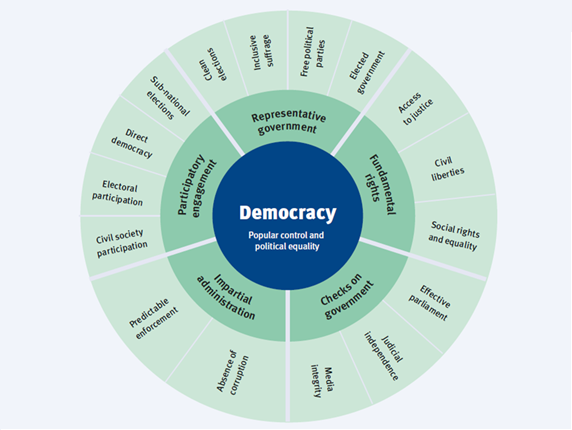
    https://www.idea.int/sites/default/files/2018-9-14-taking-stock-of-the-global-state-of-democracy-IDEA.PNG

    UPSC 2023 countdown has begun! Get your personal guidance plan now! (Click here)

    One should not be surprised that the democratic system of administration was not new to India. Ever since ancient times, India had it and she lost it. We all have read about “Kingdoms, Kings and Early Republic” through NCERT since our preparation began.

    Context

    • In Maharashtra, recently splits in the ruling party led to the fall of a tripartite government which had acclaimed dynast and popular leaders.
    • Most political parties in India were no doubt dynastic, i.e. the future leader is almost always a family member of the present party leader (no doubt they are anyhow ousted with the present regime in India).
    • This however highlights huge vacuum in intra-party discipline and coherence of ideologies.
    • Thus the character of any India’s political institution or party system is a result of its political culture.

    Today’s debate is – Is India being held back due to a lack of democracy in its political parties? Or does the freedom to start a new political party compensate for this defect?

    Point of discussion

    • In India, there is no real movement toward the democratization of parties.
    • The selection of candidates, Chief Ministers and office-bearers of party units is usually left to the discretion of a handful of leaders who take decisions behind closed doors.

    “It is not that India did not know what is Democracy,” Dr.B.R.Ambedkar, the Chairman of the Drafting Committee told the Constituent Assembly while presenting the final draft of the Constitution, “There was a time when India was studded with republics, and even where there were Mahajanpada monarchies, they were either elected or limited. They were never absolute. It is not that India did not know Parliaments or Parliamentary procedures. A study of the Buddhist Bhikshu Sanghas discloses that not only there were Parliaments- for the Sanghas were nothing but Parliaments- but the Sanghas knew and observed all the rules of Parliamentary Procedure known to modern times.”

    Constituent Assembly Debates

    Political Parties in India: A Backgrounder

    • A party system is a concept in comparative political science concerning the system of government by political parties in a democratic country.
    • In India, there is a multi-party system in place, with the number of parties at the national level fluctuating.
    • Furthermore, India has a diverse range of political parties, including left, centrist, and right-wing parties, as well as communal and non-communal parties.

    Features of Political Parties in India

    The key features of the Indian Party system are:

    1. Ideology base
    2. Multi-Party System
    3. Pre-poll Alliances
    4. Coalition System
    5. Opposition’s Multi-Party Character

    Issues with Political Parties in India

    • Lack of proper organisation: Another feature of the Indian party system is its lack of structure. Political parties live and die by their organization.
    • Groupism inside India’s party structure: In India, groupism is a major problem for every political party. This shatters a party’s cohesiveness, causing it to split into several factions. Ex. INC, NCP, TMC.
    • Extra-constitutional ways of gaining power: Political parties do not hesitate to utilize uncertain measures to gain political power in addition to legitimate means. Ex. Resort Politics
    • Populist tendencies: In India, it is well noticed that political parties turn to populist politics in order to gain power. They take unfair advantage of people’s emotions and compulsions, promote populist slogans, and mislead the public. Ex. Temple reconstruction movements
    • Lack of discipline among party members:  It has been observed that members of various political parties are unconcerned about party discipline, preferring instead to sling dirt at one another. Ex. Undue political statements
    • Communal characteristics: The people of India are influenced by caste and religion, and they have a strong sense of allegiance to their caste and religion. Ex. Political party in Hyderabad.
    • Criminalization of politics: Leaders are valued for their capacity to attract crowds and raise funds as elections become more and more expensive.

    Why are tainted candidates inducted by political parties?

    • Innocent until proven guilty maxim: The other reason offered by political parties is summarised by the maxim of Indian law, which is that any accused is innocent until proven guilty.
    • Popularity: Such candidates with serious records seem to do well despite their public image, largely due to their ability to finance their own elections and bring substantive resources to their respective parties.
    • Prospected victory: The logic of a candidate with criminal charges doing better for the cause of people of is another flawed argument.
    • Destabilizing other electors: Others do not seek to punish these candidates in instances where they are in contest with other candidates with similar records.
    • Vested interests: Some voters tend to view such candidates through a narrow prism: of being able to represent their interests by hook or by crook.

    Why voice for democracy within?

    • Dynastic politics: Many political parties in India has charges of dynastic politics irrespective of the political insights of the person who inherits the legacy.
    • Opaque appointments:  Although election of the party president cannot be the sole criteria for judging intraparty democracy, political parties view the matter only through the procedure of electing the chiefs.
    • Dominants: The party head positions are mostly influenced by some external forces which have larger say in finance and caste (or) religion.
    • Personality cult: There is a tendency of hero worship in people and many times a leader takes over the party and builds his own coterie, ending all forms of intra-party democracy.
    • Centralised power: Most parties are subservient to one supreme leader or a charismatic personality.   Such leaders are valued for their capacity to attract crowds and raise funds as elections become more and more expensive.
    • Lack of institutionalization: Most of political parties still refuse to lay down settled and predictable procedures for almost everything they do, from the selection of candidates to the framing of a manifesto.

    How this impacted election has mandates?

    • Weaker opposition: In India, strong and well-organized opposition is required for parliamentary democracy to succeed, yet it does not exist.
    • Non-coherence: There are several national and regional political parties performing the role of opposition at the moment, both at the national and state levels, but they are not unified on many political topics and do not have a uniform agenda.
    • Electoral autocracy: India is often accused to be a flawed democracy on accounts of its alleged far-right-wing political government. There has been increased pressure on human rights groups, intimidation of journalists and activists, and a spate of attacks, especially against Muslims.
    • Against public aspirations: People vote for fulfilling their demands and put much effort with aspirations that a stable government would be at their behest to resolve their issues.
    • Unstable government: This point needs no explanation. We have largely seen the perils of poor decision-making of politicians due to a lack of consensus among the allies.

    Even Monarchies were either elected or limited but never absolute Bhakti or hero-worship sure road to dictatorship, says Dr.Ambedkar

    A critical evaluation

    • Political parties have become oligarchies: India’s success in consolidating a democratic system of government has paradoxically forestalled pressure for party reform.  .
    • One person diktat rules the parties: Most parties are subservient to one supreme leader who can impose his/her offspring on the party, and even electoral defeat does not loosen their control or hold over the party.
    • Election manifesto is nowhere relevant post-election: Political parties with the exception of the Left parties still refuse to lay down settled and predictable procedures for almost everything they do, from the selection of candidates to the framing of a manifesto.
    • Party reform is a pressing one in India: While many argue that intraparty democracy is essential to sustain broader political democracy, this is not a panacea for the numerous problems facing parties.
    • Vague system is the status-quo:  The biggest weakness of parties is that they are leader-centric and most leaders are unwilling to institutionalize the procedures.
    • Diktat of the party high-command actually rules a govt.: As a rule, strong leaders rarely support institutionalization because it constrains their discretion and personal power.  
    • Partisan mobilization of the left-liberals: There is a major challenge facing the party system by party activity driven by partisan mobilisation lies at the root of much of the schism and disruption of Indian politics today. Ex. Leftists frequently meeting the Chinese.
    • Sake of electioneering and winning never ends: Another aspect is the reduction of party organisations into election-winning machines. This has become the only role a party envisages for itself.
    • Lack of political will persists: If party funds are raised and controlled centrally, this weakens the State units and rank and file vis-à-vis the central leadership on a range of issues including leadership selection and nominations for elections.

    Need for imbibing democracy

    • Ensuring equal opportunity: The absence of intra-party democracy adversely impacts the constitutional right of all citizens to equal political opportunity to participate in politics and contest elections.
    • Less factionalism: A leader with strong grassroot connection would not be side-lined. This will allow less factionalism and division of parties thereby ensuring a stable govt in power.
    • Popular representation: A transparent party structure with transparent processes will allow proper ticket distribution and candidate selection.  The selection would not be based on the whims of a few powerful leaders in the party but will represent the choice of the larger party.
    • Accountability of the legislators: A democratic party will be accountable to its party members, for they will lose elections in the next cycle for their shortcomings.
    • Decentralising power: Every political party has State and local body units, an election at each level will allow creation of power centres at different levels. This will allow decentralisation of power and the decision making will take place at the ground level.
    • Legal loopholes: Currently, there is no express provision for internal democratic regulation of political parties in India except political defection. The ECI’s power to require parties to hold regular internal elections for office bearers, and candidate selection is compromised in the absence of any penal provisions.

    How to attain internal democracy within parties?

    • Internal elections: It shall be the duty of the political party to take appropriate steps to ensure holding of elections at all levels. The political party shall hold elections in an unpartisan ways by their ‘karyakartas’.
    • Strengthening Anti-defection Law: The Anti-Defection Act of 1985 requires the party legislators to act according to the party whip which is decided by the diktats of the highest party leadership. One way to democratise political parties is to promote intra-party dissent.
    • Limited reservations: Seats can be reserved for women and members of the backward community including minorities.
    • Empowering ECI: The ECI shall be competent to inquire into allegations of non-compliance of any of the provisions requiring elections.
    • Social audit and penal provisions: ECI should have the penal power to deregister a party until free and fair elections in the party are conducted.
    • Encouraging new generation of leaders: For long, there is a widespread impression created that lot of good people shy away from politics. It is therefore necessary that this impression be changed and efficient people brought into political arena.

    Way forward

    • The 170th report of the Law Commission of India on reform of electoral laws, dedicated an entire chapter on the necessity of providing laws relating to internal democracy within parties.
    • It observed that a political party which does not respect democratic principles in its internal working cannot be expected to respect those principles in the governance of the country.
    • The National Commission for Review of Working of Constitution states that there should be comprehensive legislation regulating the registration and functioning of political parties or alliances of parties in India.
    • The Administrative Reforms Commission II (ARC), 2008 Ethics and Governance Report pointed out that corruption is caused by over-centralization.

    Conclusion

    • Politics is inseparable from political parties as they are the prime instruments for the execution of democracy in the country.
    • We must emphasize our PM’s call for a debate on internal democracy in political parties.
    • It is imperative that political parties open their eyes to growing calls for electoral political reforms and take steps towards bringing in intra-party democracy.

    UPSC 2023 countdown has begun! Get your personal guidance plan now! (Click here)

  • ‘Advantage New Delhi’ in Sri Lanka’s India lifeline

    Context

    Ranil Wickremesinghe’s election as the President of Sri Lanka in a crucial Parliament vote on July 20, 2022, gives India an opportunity to take the lead in the foreign aid game in its neighbourhood.

    Background of the crisis in Sri Lanka

    • Sri Lanka has been facing economic turbulence since its pre-emptive default on its foreign debt obligations in mid-April this year.
    • Following the debt default and a shortage of dollars, the Sri Lankan economy is experiencing stagflation.
    •  Inflation has spiralled to over 50%, translating into higher food and fuel prices.
    •  Sri Lanka’s worst economic crisis since its independence in 1948 is due to a tepid recovery from the COVID-19 pandemic, the Russia-Ukraine conflict shock and economic mismanagement under the administration of the Rajapaksas.
    • Sri Lanka is also facing challenges in getting foreign aid, as 60% of the world’s poorest countries are also experiencing debt distress.

    Opportunities for India

    •  In the first six months of 2022, Indian aid worth $3.8 billion has flowed to Sri Lanka through loans, swaps and grants.
    • This is India’s largest bilateral aid programme in recent times.
    •  Stabilising Sri Lanka’s economy could prove to be a major win for Indian’s ‘neighbourhood-first’ policy.
    • Moreover, once the Sri Lankan economy stabilises, India can deepen its trade and investment linkages with Sri Lanka, transcending the current humanitarian aid relationship.
    • On the other hand, an unstable Sri Lankan economy could pose security risks to India and lead to a flood of refugees across the Palk Strait.
    • This is an opportunity for India to strengthen bilateral and regional partnerships.
    • Countering Chinese influence: In recent years, China has emerged as a major partner for Sri Lanka, especially for infrastructure projects, many of which are under scrutiny now.
    • This provides an opportunity for India to upscale its aid and cement its first mover advantage over China by leading an aid consortium for Sri Lanka, working closely with other friendly countries such as the United States, Japan and the European Union as well as the International Monetary Fund (IMF).

    Why China is reluctant to help?

    • China worries that unilaterally restructuring Sri Lanka’s debt or giving it moratoria would set a new precedent in its lending practices, leading to a queue of similarly distressed countries seeking debt relief from Beijing.
    • Furthermore, China, which is a G2 economy, and wanting to challenge the U.S., does not want its reputation to be tarnished by bailing out a floundering economy.

    Steps Sri Lanka needs to take

    • Concluding the talks with Sri Lanka: The government must show that it is serious about stabilising the economy by concluding talks on an IMF programme which will increase taxes and utility prices to raise revenue and increase interest rates to control inflation.
    • Economic reforms: It has to implement structural reforms to make the economy more open to trade and investment and allow market forces to determine resource allocation.
    • National consensus on IMF program: It has to build national consensus on implementing the IMF programme and reforms by explaining that this is the only solution to the crisis.
    • Anti-corruption policies: It has to restore the rule of law and enforce strong anti-corruption policies (including asset declarations for all parliamentarians and a strong anti-corruption office supported by the United Nations).
    • Reset foreign policy: It has to reset foreign policy towards a more neutral direction.

    Conclusion

    With political will and the right set of policies, Sri Lanka stands a sporting chance of achieving some economic normalcy within the next three years. India stands to gain by supporting Sri Lanka in its hour of need. A friend in need is a friend indeed.

    UPSC 2023 countdown has begun! Get your personal guidance plan now! (Click here)

  • Need for a debate on freebies

    Context

    Many in India have been lamenting for quite some time the culture of political populism and “freebies”

    Fiscal stress due to subsidies

    • Technically, a subsidy is the unrecovered cost of any service (or good) provided by the government.
    • Freebies such as distribution of televisions, free cycles or laptops are the most highly visible and discussed freebies, but they are fiscally insignificant compared to the much larger subsidies on food, fertiliser and petroleum.
    • Though curbed in recent years, these “visible” subsidies in government budgets remain a major source of fiscal stress.
    • Then there is a range of “invisible” subsidies, especially in state government budgets, not always recognised as such, but which are also very large.
    • The deficit between the receipts and expenditure of a government department in providing a service is the unrecovered cost of providing that service, that is, a subsidy, even if not recognised as such in the budget.
    • Examples include the unrecovered cost of providing public education, healthcare, irrigation, power, water supply and sanitation.

    Some facts about the subsidies

    • Relation with per capita income: The volume of subsidies as a proportion of GDP comes down with rising per capita incomes, but very gradually.
    • The total volume of subsidies came down from 13 per cent of GDP way back in 1987-88 to a little over 10 per cent by 2015-16, almost 30 years later.
    • Contribution of central government: The central government accounts for less than 30 per cent of total subsidies, provided mainly for economic services including food.
    • Merit subsidies: From the total volume there is a very small number of “merit subsidies” which might be warranted in public interest.
    • All governments have provided a food subsidy for poor households by bi-partisan consensus for decades.
    • Then there is basic education and health services which have large benefits for society beyond the benefit accruing to the immediate recipient of the service, what economists call “externalities”.
    • Also in case of expenditure on water supply and sanitation, where again the benefit to society is much larger than that accruing to the immediate recipient of the service — for example, prevention of infectious diseases.
    • These four “merit” subsidies account for only a third of total subsidies.
    • Unwarranted freebies: Thus, two-thirds of total subsidies, about 6 per cent of GDP, are unwarranted freebies which should be eliminated.

    Way forward

    • Phasing out the unwarranted freebies: If central and state governments could step beyond their business as usual budgets and take bold measures to phase out these unwarranted freebies, along with much of the tax exemptions and concessions, which amount to about 5 per cent of GDP, that would free up huge fiscal space.
    • Universal basic income: There is a growing demand in many advanced countries, which already have large social security schemes, to provide a minimum “Universal Basic Income” for all.
    •  Providing a small safety net for the poor in countries like India, which have no social security system, is the least that any caring government can do.
    • MGNREGA is the largest and longest-standing income support programme in India for the unemployed in rural areas.
    • But it is often not regarded as such as it entails payment against performance of work.
    • The usual complaint against such schemes is that they artificially raise rural wages, reduce the incentive to search for work, and that the poor blow up these freebees on liquor etc.
    • Since MGNREGA and similar schemes in the states pay much less than the minimum wage, they obviously cannot raise rural wages beyond what is the legal minimum wage anyway.

    Conclusion

    Phasing out the unwarranted subsidies will enable a massive reduction in the combined fiscal deficit of the Centre and the states, while at the same time stepping up required expenditure on education, health and infrastructure.

    UPSC 2023 countdown has begun! Get your personal guidance plan now! (Click here)

  • 22nd July 2022| Daily Answer Writing Enhancement(AWE)

    Topics for Today’s questions:

    GS-1          Effects of globalisation on Indian society

    GS-2         Parliament & State Legislatures, Representation of People’s Act

    GS-3         Disaster Management

    GS-4         Case Studies

    Question 1)


    Q.1 Examine the multi-dimensional impact of globalisation on tribal development in India. (15 Marks)


    Question 2)

    Q.2 How does the lack of inner-party democracy affect Indian democracy? What are the factors responsible for it and suggest the way forward. (15 Marks)

    Question 3)

    Q.3 India is vulnerable to climate change-induced disasters. In context of this, suggest the approach India needs to adopt to deal with the challenges. (10 Marks)

    Question 4)  

    Q.4 An Indian company is active in the telecom sector and is the majority owner of a telecom company based in other geographies across the world. At one of its European headquarters, there emerged whistleblowing allegations that a local executive was bribing local government officials in order to obtain telecom cabling and construction contracts from the local government. The kickbacks were allegedly paid through a third-party consultant. More specifically, there were allegations that the executive, the third party, and a government official had some sort of business interest in common, possibly shareholdings in a limited company or the joint ownership of an undisclosed asset. The company is thought to be particularly close to the ruling dispensation in India and the news has now raised pressure to put its business operations in India under scanner as well. In this context, answer the following questions: (a) What are the ethical challenges in the given case? (b) Identify the different stakeholders and their interests. (c) As the CEO of the firm, how would you respond to the given situation? (20 Marks)


    HOW TO ATTEMPT ANSWERS IN DAILY ANSWER WRITING ENHANCEMENT(AWE)?

    1. Daily 4 questions from General studies 1, 2, 3, and 4 will be provided to you.

    2. A Mentor’s Comment will be available for all answers. This can be used as a guidance tool but we encourage you to write original answers.

    3. You can write your answer on an A4 sheet and scan/click pictures of the same.

    4.  Upload the scanned answer in the comment section of the same question.

    5. Along with the scanned answer, please share your Razor payment ID, so that paid members are given priority.

    6. If you upload the answer on the same day like the answer of 11th  February is uploaded on 11th February then your answer will be checked within 72 hours. Also, reviews will be in the order of submission- First come first serve basis

    7. If you are writing answers late, for example, 11th February is uploaded on 13th February , then these answers will be evaluated as per the mentor’s schedule.

    8. We encourage you to write answers on the same day. However, if you are uploading an answer late then tag the mentor like @Staff so that the mentor is notified about your answer.

    *In case your answer is not reviewed, reply to your answer saying *NOT CHECKED*. 

    1. For the philosophy of AWE and payment: 

  • Q.3 India is vulnerable to climate change-induced disasters. In context of this, suggest the approach India needs to adopt to deal with the challenges. (10 Marks)

    Mentor’s comment-
    • https://www.thehindu.com/opinion/op-ed/indias-climate-imperative/article65654280.ece
    • In the intro, mention the increasing frequencies of extreme weather events due to climate change in India such as heat waves and floods.
    • In the body, mention the need to adopt a two part approach in the form of adaptation and mitigation measures. In the measures mention resilience in agriculture, dealing with flood and storms by adopting design changes in building houses, expansion of forest cover, increasing the financing to disaster management etc.
    • Conclude by mentioning the need to focus on public awareness about climate change and the role played by man in it.
  • Q.2 How does the lack of inner-party democracy affect Indian democracy? What are the factors responsible for it and suggest the way forward. (15 Marks)

    Mentor’s comment-
    • https://www.thehindu.com/opinion/op-ed/no-inner-party-democracy/article65658107.ece
    • In the intro, mention the recent ouster of the UK Prime Minister and the role of party MP in it.
    • In the body mention the centralised nature of party functioning and decision making in Indian political parties with the exception of a few parties. In the next part, contrast it with the role played by individual MP in the UK. Next mention the harm such functioning can do in the form of decision making, policy making, priorities, and addressing the concerns of the people. In the way forward, mention the need for changes in the anti-defection law, consultation with the local party, making legal provisions for the inner-party elections, committee on the line of 1922 Committee in the UK.
    • Conclude by mentioning the need to strengthen the inner-party democracy to ensure the vibrancy in democracy.
  • Q.1 Examine the multi-dimensional impact of globalisation on tribal development in India. (15 Marks)

    Mentor’s Comments-

    • Introduce the answer with the meaning of globalization.
    • Substantiate upon the implications of this phenomenon- both negative and positive on tribal development in India.
    • Conclude accordingly.
  • Droupadi Murmu elected 15th President of India

    Former Jharkhand Governor Droupadi Murmu was elected the 15th President of India, the first (santhal) tribal woman to be appointed to the position and the youngest as well.

    Here’s a look at some interesting facts about the past Presidents of India:

    * Rajendra Prasad was the first President of India. He is also the only President to have served two consecutive terms.

    * Dr. Sarvepalli Radhakrishnan was the second President. He was the first to have served as Vice President before being elected to the top post.

    * Zakir Hussain was the third President of India, and the first Muslim President. He also was the first President to die in office. He was the shortest serving President of India (less than two years).

    * On his election, fourth President V.V. Giri became the first one to have also been an acting President.

    * Fakhruddin Ali Ahmed was the fifth President and the second Muslim to hold the post. The Emergency was declared during his tenure. He is the second President to have died in office.

    * Neelam Sanjiva Reddy was the sixth President. He became the youngest to take the post at the age of 64. He is also the only one to have been elected unopposed.

    * Giani Zail Singh was the seventh President of India and the first Sikh President.

    * Eighth President Ramaswamy Venkataraman was the first President to have worked with four Prime Ministers and appointed three: V. P. Singh, Chandra Shekhar and P. V. Narasimha Rao.

    * Shankar Dayal Sharma was the 9th President. He also worked with four PMs and appointed three of them in his last year: Atal Bihari Vajpayee, H. D. Deve Gowda, I. K. Gujral.

    * Kocheril Raman Narayanan was the 10th President of India and the first Dalit President. At 76 years and 271 days, he was the oldest President to be elected.

    * APJ Abdul Kalam was the 11th President and first Muslim President to serve an entire term.

    * Elected as the 12th President, Pratibha Patil was the first woman President of India.

    * Pranab Mukherjee, the 13th President, was the first Bengali to hold the post.

    * 14th President Ram Nath Kovind was the first BJP candidate to be elected to the post.

    * 11 Presidents have been members of a political party before being elected. 8 were from Congress, 2 from BJP, 1 from Janata Party, and the rest were Independents.

    The President of India

    • The President of India is recognized as the first citizen of the country and the head of the state.
    • The elected President of India is a part of the Union Executive along with several other members of the parliament including the Prime Minister, Attorney-General of India and the Vice – president.

    Electing the President

    • The provisions of the election of the President are laid down in Article 54 of the Constitution of India.
    • The Presidential and Vice-Presidential Election Act 1952 led to the establishment of this Constitutional provision.

    Qualifications to become the President of India

    The qualification of being the President of India are given below:

    • He/ She must be an Indian citizen
    • A person must have completed the age of 35.
    • A person must be qualified for election as a member of the House of the People.
    • Must not hold a government (central or state) office of profit
    • A person is eligible for election as President if he/she is holding the office of President or Vice-President.

    Actual course of election

    • The President of India is elected indirectly by an Electoral College following the system of proportional representation utilizing a single transferable vote system and secret ballots.
    • MPs and MLAs vote based on parity and uniformity values.

    Electoral College composition-

    (1) Legislative Assemblies of the States:

    • According to the provision of Article 333, every state’s Legislative Assembly must consist of not less than 60 members but not more than 500 members.

    (2) Council of States:

    • 12 members are nominated by the President of India based on skills or knowledge in literature, arts, science, and social service to act as the members of the Council of States.
    • In total, 238 represent act as representatives from both the States and Union Territories.

    (2) House of the People:

    • The composition of the House of People consists of 530 members (no exceeding) from the state territorial constituencies.
    • They are elected through direct election.
    • The President further elects 20 more members (no exceeding) from the Union Territories.

    Uniformity in the scale of representation of states

    To maintain the proportionality between the values of the votes, the following formula is used:

    Value of vote of an MLA= total no. of the population of the particular state/ number of elected MLAs of that state divided by 1000.

    Single vote system

    • During the presidential election, one voter can cast only one vote.
    • While the MLAs vote may vary state to state, the MPs vote always remain constant.

    MPs and MLAs vote balance

    • The number of the total value of the MPs votes must equal the total value of the MLAs to maintain the State and the Union balance.

    Quotas:

    • The candidate reaching the winning quota or exceeding it is the winner.
    • The formula sued is ‘Winning quota total number of poll/ no.of seats + 1’.

    Voters’ preference:

    • During the presidential election, the voter casts his vote in favor of his first preferred candidate.
    • However, in case the first preference candidate does not touch the winning quota, the vote automatically goes to the second preference.
    • The first preferred candidate with the lowest vote is eliminated and the votes in his/her favor are transferred to the remaining candidates.

    Why need Proportional representation?

    • The President of India is elected through proportional representation using the means of the single transferable vote (Article 55(3)).
    • It allows the independent candidates and minority parties to have the chance of representation.
    • It allows the practice of coalition with many voters under one government.
    • This system ensures that candidates who are elected don’t represent the majority of the electorate’s opinion.

    Why is President indirectly elected?

    If Presidents were to be elected directly, it would become very complicated.

    • It would, in fact, be a disaster because the public doesn’t have absolute clarity of how the president-ship runs or if the candidate fits the profile of a president.
    • Another reason why the direct election system isn’t favorable is that the candidate running for the president’s profile will have to campaign around the country with the aid of a political party.
    • And, this will result in massive political instability.
    • Moreover, it would be difficult and impossible for the government to hand out election machinery (given the vast population of India).
    • This will cost the government financially and may end up affecting the economy as well.
    • The indirect election system is a respectable system for the First Man of India (rightly deserving).
    • The system/method of indirect electing of the president also allows the states to maintain neutrality and minimize hostility.


    UPSC 2023 countdown has begun! Get your personal guidance plan now! (Click here)

  • Women have Right to Safe Abortion: SC

    Denying an unmarried woman the right to a safe abortion violates her personal autonomy and freedom, the Supreme Court held in an order.

    What did the SC say?

    • A woman’s right to reproductive choice is an inseparable part of her personal liberty under Article 21 of the Constitution.
    • She has a sacrosanct right to bodily integrity, the court quoted from precedents.
    • The court said forcing a woman to continue with her pregnancy would not only be a violation of her bodily integrity but also aggravate her mental trauma.

    Indispensable clause of safety

    • The court ordered a medical board to be formed by the AIIMS to check whether it was safe to conduct an abortion on the woman and submit a report in a week.

    What is the case?

    • A Bench led by Justice D.Y. Chandrachud was hearing the appeal of a woman who wanted to abort her 24-week pregnancy after her relationship failed and her partner left her.
    • The lower court had taken an “unduly restrictive view” that her plea for a safe abortion was not covered under the Medical Termination of Pregnancy Act.
    • This was since the pregnancy arose from a consensual relationship outside wedlock.

    What was the last amendment?

    • The court noted that an amendment to the Act in 2021 had substituted the term ‘husband’ with ‘partner’, a clear signal that the law covered unmarried women within its ambit.

    Reiterating the live-in recognition

    • Chastising the lower court, the Bench said live-in relationships had already been recognised by the Supreme Court.
    • There were a significant number of people in social mainstream who see no wrong in engaging in pre-marital sex.
    • The law could not be used to quench “notions of social morality” and unduly interfere in their personal autonomy and bodily integrity.

    Back2Basics: Medical Termination of Pregnancy (MTP) Act

    • Abortion in India has been a legal right under various circumstances for the last 50 years since the introduction of the Medical Termination of Pregnancy (MTP) Act in 1971.
    • The Act was amended in 2003 to enable women’s access to safe and legal abortion services.
    • Abortion is covered 100% by the government’s public national health insurance funds, Ayushman Bharat and Employees’ State Insurance with the package rate for surgical abortion.

    The idea of terminating your pregnancy cannot originate by choice and is purely circumstantial. There are four situations under which a legal abortion is performed:

    1. If continuation of the pregnancy poses any risks to the life of the mother or mental health
    2. If the foetus has any severe abnormalities
    3. If pregnancy occurred as a result of failure of contraception (but this is only applicable to married women)
    4. If pregnancy is a result of sexual assault or rape

    These are the key changes that the Medical Termination of Pregnancy (Amendment) Act, 2021, has brought in:

    1. The gestation limit for abortions has been raised from the earlier ceiling of 20 weeks to 24 weeks, but only for special categories of pregnant women such as rape or incest survivors. But this termination would need the approval of two registered doctors.
    2. All pregnancies up to 20 weeks require one doctor’s approval. The earlier law, the MTP Act 1971, required one doctor’s approval for pregnancies upto 12 weeks and two doctors’ for pregnancies between 12 and 20 weeks.
    3. Women can now terminate unwanted pregnancies caused by contraceptive failure, regardless of their marital status. Earlier the law specified that only a “married woman and her husband” could do this.
    4. There is also no upper gestation limit for abortion in case of foetal disability if so decided by a medical board of specialist doctors, which state governments and union territories’ administrations would set up.


    UPSC 2023 countdown has begun! Get your personal guidance plan now! (Click here)

  • Russia resumes gas supplies to Europe via Nord Stream Pipeline

    Russia restored critical gas supplies to Europe through Germany via the Nord Stream pipeline after 10 days of uncertainty in guise of maintenance.

    Nord Stream Pipeline

    • It is a system of offshore natural gas pipelines running under the Baltic Sea from Russia to Germany.
    • It includes two active pipelines running from Vyborg to Lubmin near Greifswald forming the original Nord Stream, and two further pipelines under construction running from Ust-Luga to Lubmin termed Nord Stream 2.
    • In Lubmin the lines connect to the OPAL line to Olbernhau on the Czech border and to the NEL line to Rehden near Bremen.
    • The first line Nord Stream-1 was laid and inaugurated in 2011 and the second line in 2012.
    • At 1,222 km in length, Nord Stream is the longest sub-sea pipeline in the world, surpassing the Langeled pipeline.

    Why in news?

    • Germany, which is heavily dependent on Russian gas, had feared that Moscow would not reopen the pipeline after the scheduled work and accused Moscow of using energy as a “weapon”.
    • The showdown came amid the worst tensions in several years over Russia’s invasion of Ukraine.
    • Germany believes Russia is squeezing supplies in retaliation for Western sanctions over the war.

    Why is Russian gas so important?

    (1) Major chunk of energy

    • Russia supplied some 40% of Europe’s natural gas before the war.
    • That has dropped to around 15%, sending prices through the roof and straining energy-intensive industries.

    (2) Everyday use

    • Gas is used across a range of processes that most people never see – to forge steel to make cars, make glass bottles and pasteurise milk and cheese.
    • Companies warn that they often can’t switch overnight to other energy sources such as fuel oil or electricity to produce heat.

    (3) Fuel inflation

    • High energy prices are already threatening to cause a recession in Europe through record inflation, with consumers having less to spend as costs rise for food, fuel and utilities.
    • A complete cutoff could deal an even heavier blow to an already troubled economy.

    What is visible in Russia’s game plan?

    • Since the invasion, Russia’s revenue from exporting oil and gas to Europe has doubled over the average from recent years, to $95 billion.
    • So Putin has cash in hand and could calculate that painful utility bills and an energy recession could undermine public support for Ukraine in Europe and increase sentiment for a negotiated settlement in his favour.
    • It would be unwise to exclude the possibility that Russia could decide to forgo the revenue it gets from exporting gas to Europe in order to gain political leverage.

    What alternatives does Europe have?

    • The EU has turned to more-expensive liquefied natural gas, or LNG, which comes by ship from places like the US and Qatar.
    • Germany is fast-tracking construction of LNG import terminals on its North Sea coast, but that will take years.
    • But LNG alone can’t make up the gap.
    • Conservation and other energy sources are key.

    Could people freeze this winter?

    • Its unlikely homes, schools and hospitals will lose heat because governments are required to impose rationing first on businesses.
    • The German government also could allow gas suppliers to immediately pass on increases to customers.
    • The choices could include torpedoing industry and/or socking consumers with even higher bills.
    • The IEA recommends that European countries step up campaigns for people to conserve at home and plan to share gas in an emergency.


    UPSC 2023 countdown has begun! Get your personal guidance plan now! (Click here)

  • Indian Antarctic Bill, 2022

    The Lok Sabha deferred the consideration and passing of the Indian Antarctic Bill, 2022 as the Opposition benches were empty due to the ongoing protests outside of Parliament.

    Indian Antarctic Bill, 2022

    Aims and objectives:

    • To provide for national measures to protect the Antarctic environment and associated ecosystems and to give effect to the Antarctic Treaty
    • To provide a harmonious policy framework for India’s Antarctic activities through a well-established legal mechanism
    • Facilitate activities of the Indian Antarctic programme, including management of Antarctic tourism and sustainable development of fisheries
    • To prohibit carrying of certain activities without a permit or the written authorisation of another party to the protocol
    • To provide for inspection in India by an officer designated by the Central government as an Inspector and to constitute an inspection team to carry out inspections in Antarctica
    • To prohibit drilling, dredging, excavation or collection of mineral resources or even doing anything to identify where such mineral deposits occur.

    Key feature: Committee on Antarctic governance

    • It will empower the government to establish a committee on Antarctic governance and environmental protection to monitor, implement and ensure compliance with the relevant international laws, emissions standards and rules of protection.
    • The panel is to be headed by the secretary of the Ministry of Earth Sciences, as ex officio chairperson.
    • Among other roles, he/she has also been the vice-president of the Scientific Committee on Antarctic Research of the International Science Council since 2018.
    • The committee will have ten members from various ministries, departments and organizations of the Union government, plus two experts on the Antarctic environment or other relevant areas.

    Prohibited activities

    The Bill prohibits certain activities in Antarctica including:

    • Nuclear explosion or disposal of radioactive wastes,
    • Introduction of non-sterile soil, and
    • Discharge of garbage, plastic or other substance into the sea which is harmful to the marine environment

    About Antarctica Treaty

    • Antarctica has a geographical area of 14 million sq. km and has had no indigenous population (i.e. “Antarcticans” don’t exist).
    • However, a few thousand people reside there, in some 40 research stations spread across the continent, throughout the year.
    • In 1959, 12 countries – Argentina, Australia, Belgium, Chile, France, Japan, New Zealand, Norway, South Africa, the USSR, the UK and the US signed the Antarctic Treaty.
    • Their aim was to prevent the continent from being militarised and to establish it as a center of peaceful activities.
    • Later, more countries, including India, have become party to the treaty, and today it counts more than 54 members.

    Significance of the treaty

    • The treaty requires each party to take appropriate measures within its competence, including the adoption of laws and regulations, administrative actions, and enforcement measures, to ensure compliance with the protocol.
    • Countries also signed the ‘Protocol on Environmental Protection to the Antarctic Treaty in 1991, which designates Antarctica as a “natural reserve, devoted to peace and science”.

    Need for the Antarctic Legislation

    • The growing presence of Indian scientists in Antarctica and the commitment to Antarctic research and protection prompted the government to adopt domestic legislation consistent with its obligations as a member of the Antarctic Treaty system.
    • These laws will enable India’s courts to deal with disputes or crimes committed in parts of Antarctica, and help build credibility vis-à-vis India’s participation.


    UPSC 2023 countdown has begun! Get your personal guidance plan now! (Click here)

  • Karnataka tops India Innovation Index List

    Karnataka has bagged the top rank in NITI Aayog’s India Innovation Index, 2022, which determines innovation capacities and ecosystems at the sub-national level.

    India Innovation Index (III)

    • The release of the second edition of the index—the first was launched in October 2019—demonstrates the Government’s continued commitment to transforming the country into an innovation-driven economy.
    • The index attempts to create an extensive framework for the continual evaluation of the innovation environment of all states and UTs in India.
    • It intends to perform the following three functions-
    1. Ranking of states and UTs based on their index scores
    2. Recognizing opportunities and challenges, and
    3. Assisting in tailoring governmental policies to foster innovation
    • The states have been bifurcated into three categories: major states, northeast and hill states, and union territories/city-states/small states.

    Significance

    • The study examines the innovation ecosystem of Indian states and union territories.
    • The aim is to create a holistic tool that can be used by policymakers across the country to identify the challenges to be addressed and strengths to build on when designing policies.

    Highlights of the 2022 index

    • Karnataka has held this position, under the Major States category, in all three editions of the Index so far.
    • It was followed by Telangana, Haryana, Maharashtra and Tamil Nadu. Chhattisgarh, Odisha, Bihar and Gujarat were at the bottom of the index.
    • In the Index, Manipur secured the lead in the Northeast and Hill States category, while Chandigarh was the top performer in the Union Territories and City States category.


    UPSC 2023 countdown has begun! Get your personal guidance plan now! (Click here)

More posts