💥UPSC 2026, 2027, 2028 UAP Mentorship (March Batch) + Access XFactor Notes & Microthemes PDF

Search results for: “”

  • Ravi Kumar Sihag AIR 18 UPSC 2021

    ‘If your task is once begun, never leave it till it’s done. Be the labor great or small, do it well or not at all’-Civilsdaily


    About Ravi Kumar Sihag– His UPSC journey and hobbies

    NameRavi Kumar Sihag
    Age30
    ResidentGanganagar, Rajasthan
    ExamUPSC 2021
    All India Rank18 
    Attempts4th
    Optional Subject Hindi Literature
    Hobbies

    2. Family and Education

    FatherRam Kumar Sihag. He is a farmer. 
    MotherHousewife
    Elder Brother
    Elder sisterMarried

    Ravi Kumar hails from Ganganagar in Rajasthan and has a family of five consisting of his parents, his elder brother, and elder sister.

    Ravi’s Educational Background:

    • Early schooling from New hope school, Shri Vijay Nagar. After that, he passed the 12th standard from the same school
    • He completed his graduation.
    • He was also selected in Indian Defence Accounts Services (Rajasthan)

    3. UPSC Strategy

    He started his preparation in 2016 and in 2018 he secured all India rank 337. In his 2nd attempt in 2019, he secured all India rank 317. In 2020, he couldn’t even clear prelims. 

    These 3 years’ experience and consistency helped him to formulate a better strategy.

    • For prelims he practiced 10 years of PYQs along with test series.
    • For mains he regularly gave some effort to make answer structure better.
    • He started UPSC preparation 4 years ago by studying NCERTs.
    • Since current affairs are possibly the most significant part of the IAS exam he backed his preparation with day-to-day newspaper readings to give sufficient focus to the happenings nationally and internationally.
    • he joined a few online mock test series for Prelims and mains.
    • He was meticulous about study materials. he consolidated his study materials and revised them as many times as he could.
    • Be patient and stay focused all the time.
    • Always tried to improve his performance.
    • made his notes.
    • From the very starting, he carried his preparation under senior teachers and mentors.

    He didn’t follow any super different strategy of planning. he executed the same strategy differently.


    4. Ravi’s Notes & Booklist

    Polity:

    • M. Laxmikant

    Indian Economy:

    • Nitin Singhania
    • Ramesh Singh

    Modern Indian History:

    • Indian struggles for Independence by Bipin Chandra
    • NCERTs class VI to XII (Old version)

    Art & Culture:

    • Indian Art and Culture by Nitin Singhania
    • NCERTs of class XI and XII

    Ancient India:

    • RS Sharma

    Ethics:

    • Ethics and integrity by Subba Rao and PN Rao Chaudhary

    Geography:

    • Certificate Physical and human geography by GC Leong
    • Indian Geography by Majid Hussain
    • NCERTs Class IX to Class XII
    • Challenges to Internal Security of India by Ashok Kumar
    • ETC.

    5. Motivation and inspiration

    Even being a part of a farmer family, Ravi proved what a dedicated and confident person can do in life. Ravi didn’t lose hope or give up in front of many challenges. Before starting UPSC preparation in 2016 he had to manage money for his elder sister’s marriage. Zeal for UPSC was in his blood, and that’s why even after getting posted in IDAS(P), he didn’t stop pursuing IAS. 

    His main aim to crack UPSC was to serve his society better he showed his gratitude to his teachers and mentors who were the real torch bearer all along the crooked path of UPSC.

  • Rankers from CivilsDaily IAS: Mantri Mourya Bhardwaj, AIR 28, UPSC 2021

    ‘It’s never about breaking records or beating someone but doing your best to improve yourself.’-Civilsdaily


    1. About Mantri Mourya Bhardwaj- His UPSC journey and hobbies

    NameMantri Mourya Bhardwaj
    Age28
    ResidentAnakapalle, Andhra Pradesh
    ExamUPSC 2021
    All India Rank28
    Attempts6th 
    Optional Subject Anthropology
    Hobbies

    He was an active student of CivilsDaily’s Mentorship program and took guidance in all stages of preparation. He thanked CD’s senior mentors and faculties for his top rank on UPSC 2021 merit list.


    2. Family and Education

    FatherSatya Prasad, a headmaster in a local government school.
    MotherRadha Kumar, a pharmacist in a government hospital.

    Mantri’s Educational Background:

    • He completed his graduation in Electrical and Communication Engineering from NIT Warangal in 2014
    • Later he joined MNC in Hyderabad as Electrical Engineer

    3. UPSC Strategy

    He resigned from his job and started preparing for the UPSC exam. But success did not come so easily. After failing to make it to the Civils in the first three attempts, he returned to his software profession for his livelihood. But, he did not give up, with the encouragement from my parents, he made it finally.

    He, in a candid conversation with his mentor Sukanya Ma’am, shared his thought.

    • For prelims he joined our Smash Prelims.
    • For mains he regularly gave some effort to make answer structure better.
    • He started UPSC preparation 4 years ago by studying NCERTs.
    • Since current affairs are possibly the most significant part of the IAS exam he backed his preparation with day-to-day newspaper readings to give sufficient focus to the happenings nationally and internationally.
    • he joined a few online mock test series for Prelims and mains.
    • He was meticulous about study materials. he consolidated his study materials and revised them as many times as he could.
    • Be patient and stay focused all the time.
    • Always tried to improve his performance.
    • made his own notes.
    • From the very starting, he carried his preparation under senior teachers and mentors.

    He didn’t follow any super different strategy of planning. he executed the same strategy differently.


    4. Mantri Mourya’s Notes & Booklist

    Polity:

    M. Laxmikant

    Indian Economy:

    Nitin Singhania

    Modern Indian History:

    • Indian struggles for Independence by Bipin Chandra
    • Spectrum
    • Etc.

    Art & Culture:

    Indian Art and Culture by Nitin Singhania

    Ancient India:

    RS Sharma

    Ethics:

    • Ethics and integrity by Subba Rao and PN Rao Chaudhary
    • Sukanya Rana’s notes

    Geography:

    Certificate Physical and human geography by GC Leong

    Indian Geography by Majid Hussain

    Challenges to Internal Security of India by Ashok Kumar


    5. Motivation and inspiration

    Maurya Bharadwaj said that patience and perseverance are very important to crack the UPSC Civil Services Exam. He said that his childhood dream has been fulfilled for the fifth time after failing in four exams. Maurya, who dreamed of becoming an IAS officer since childhood, expressed joy at making his family proud. He says that his aim now is to make the entire country proud by working as an IAS officer in health and education fields. His main aim to crack UPSC was to serve his society better he showed his gratitude to his teachers and mentors who were the real torch bearer all along the crooked path of UPSC.

    Civilsdaily heartily congratulated him on his grand success and wish the brightness of his determination will light up the path to his future.

  • A five-point plan to boost renewable energy

    Context

    As the fallout of Russia’s invasion of Ukraine ripples across the globe, the response of some nations to the growing energy crisis has been to double down on fossil fuels, pouring billions more dollars into the coal, oil and gas that are deepening the climate emergency.

    Need for transition to renewable energy

    • Fossil fuels are the cause of the climate crisis.
    • Renewable energy can limit climate disruption and boost energy security. Renewables are the peace plan of the 21st century.
    • But the battle for a rapid and just energy transition is not being fought on a level field.
    • Investors are still backing fossil fuels, and governments still hand out billions in subsidies for coal, oil and gas — about $11 million every minute.
    • The only true path to energy security, stable power prices, prosperity and a livable planet lies in abandoning polluting fossil fuels and accelerating the renewables-based energy transition.
    • We must reduce emissions by 45 per cent by 2030 and reach net-zero emissions by mid-century.
    • But current national commitments will lead to an increase of almost 14 per cent this decade.
    • Reducing cost:  The cost of solar energy and batteries has plummeted 85 per cent over the past decade.
    • The cost of wind power fell by 55 per cent. And investment in renewables creates three times more jobs than fossil fuels.
    • Nature-based solutions: Of course, renewables are not the only answer to the climate crisis.
    • Nature-based solutions, such as reversing deforestation and land degradation, are essential.
    • So too are efforts to promote energy efficiency.
    • But a rapid renewable energy transition must be our ambition.

    Five point plan to boost renewable

    • 1] Renewable energy technology as global good: We must make renewable energy technology a global public good, including removing intellectual property barriers to technology transfer.
    • 2] Improve global access: We must improve global access to supply chains for renewable energy technologies, components and raw materials.
    • In 2020, the world installed five gigawatts of battery storage.
    • We need 600 gigawatts of storage capacity by 2030.
    • Shipping bottlenecks and supply-chain constraints, as well as higher costs for lithium and other battery metals, are hurting the deployment of such technologies and materials.
    • 3] Fast-tracking : We must cut the red tape that holds up solar and wind projects.
    • We need fast-track approvals and more effort to modernise electricity grids.
    • 4] Shifting energy subsidies: The world must shift energy subsidies from fossil fuels to protect vulnerable people from energy shocks and invest in a just transition to a sustainable future.
    • Increase investment in renewables: We need to triple investments in renewables.
    • This includes multilateral development banks and development finance institutions, as well as commercial banks.

    Conclusion

    When energy prices rise, so do the costs of food and all the goods we rely on. So, let us all agree that a rapid renewables revolution is necessary and stop fiddling while our future burns.

    UPSC 2022 countdown has begun! Get your personal guidance plan now! (Click here)

  • No inner-party democracy

    Context

    The ousting of Boris Johnson as leader of the British Conservative Party is the latest in a series of coups periodically mounted by the party’s MPs. What is instructive about this whole process, however, is how much power ordinary MPs have over the Prime Minister.

    Lack of inner-party democracy in India

    • A Prime Minister in UK has to be able to maintain the confidence of his own backbencher MPs at all times or risk political oblivion.
    • If there is a sense that the leader is no longer acceptable to the country, then a well-oiled machine springs into action to protect the party’s electoral gains by providing fresh leadership.
    • In India, PM exercises absolute authority over party MPs, whose ability to even diverge slightly from the official government line on routine policy matters is almost non-existent.
    • Impact of anti-defection law: The Prime Minister’s power is strengthened by India’s unique anti-defection set-up, where recalcitrant MPs who do not manage to carry two-thirds of their colleagues with them can always be disqualified.
    • Lack of autonomy: In effect, MPs do not enjoy any autonomy at all to question and challenge their party leadership.
    • Prime Ministers or Chief Ministers at the State level are chosen by party high command, and then submitted to MPs/MLAs to be rubber stamped.

    Way forward

    • Strengthening local constituency party:  It is time for India to seriously consider empowering its elected representatives, to ensure accountability for party leadership.
    • MPs in the U.K. are able to act boldly because they do not owe their nomination to the party leader, but are selected by the local constituency party.
    • In India, however, it is the party leadership that decides candidates, with an informal consultation with the local party.
    • Amending anti-defection law: Neither do MPs in the U.K. stand a risk of disqualification if they speak out against the leader, a threat perpetuated in India through the anti-defection law.
    • These factors are the biggest stumbling blocks towards ensuring inner-party democracy in India.
    • System on the lines of 1922 Committee in UK: In U.K. where individual Conservative MPs write to the 1922 Committee (which comprises backbench MPs, and looks out for their interests) expressing that they have “no confidence” in their leader.
    • If a numerical or percentage threshold (15% of the party’s MPs in the U.K.) is breached, an automatic leadership vote is triggered, with the party leader forced to seek a fresh mandate from the parliamentary party.
    •  Of course, the only way such a model would work is if an exception is made to the anti-defection law.

    Conclusion

    Inner-party democracy is a essential for keeping the spirit of democracy alive. Westminster model dictates that control over candidates must shift from central party leaders to local party members.

    UPSC 2023 countdown has begun! Get your personal guidance plan now! (Click here)

  • Explained: Weapons of Mass Destruction and their Delivery Systems Amendment Bill, 2022

    External Affairs Minister S Jaishankar has introduced The Weapons of Mass Destruction (WMD) and their Delivery Systems (Prohibition of Unlawful Activities) Amendment Bill, 2022, which will amend the 2005 Act.

    What is the WMD Bill?

    • The Bill amends the WMD and their Delivery Systems (Prohibition of Unlawful Activities) Act, 2005 which prohibits the unlawful manufacture, transport, or transfer of WMD (chemical, biological and nuclear weapons) and their means of delivery.
    • It is popularly referred to as the WMD Act.
    • The recent amendment extends the scope of banned activities to include financing of already prohibited activities.
    • The WMD and their Delivery Systems (Prohibition of Unlawful Activities) Act came into being in July 2005.

    India’s 2005 WMD Act defines-

    1. Biological Weapons” as “microbial or other biological agents, or toxins…of types and in quantities that have no justification for prophylactic, protective or other peaceful purposes; and weapons, equipment or delivery systems specially designed to use such agents or toxins for hostile purposes or in armed conflict”; and
    2. Chemical Weapons” as “toxic chemicals and their precursors” except where used for peaceful, protective, and certain specified military and law enforcement purposes; “munitions and devices specifically designed to cause death or other harm through the toxic properties of those toxic chemicals”; and any equipment specifically designed for use in connection with the employment of these munitions and devices.

    What was the purpose of the original WMD Act?

    • Its primary objective was to provide integrated and overarching legislation on prohibiting unlawful activities in relation to all three types of WMD, their delivery systems, and related materials, equipment, and technologies.
    • It instituted penalties for contravention of these provisions such as imprisonment for a term not less than five years (extendable for life) as well as fines.
    • The Act was passed to meet an international obligation enforced by the UN Security Council Resolution (UNSCR) 1540 of 2004.

    What is the UNSCR 1540?

    • In April 2004 the UN Security Council adopted resolution 1540 to address the growing threat of non-state actors gaining access to WMD material, equipment or technology to undertake acts of terrorism.
    • In order to address this challenge to international peace and security, UNSCR 1540 established binding obligations on all UN member states under Chapter VII of the UN Charter.
    • Nations were mandated to take and enforce effective measures against proliferation of WMD, their means of delivery and related materials to non-state actors.
    • It was to punish the unlawful and unauthorised manufacture, acquisition, possession, development and transport of WMD became necessary.

    UNSCR 1540 enforced three primary obligations upon nation states —

    1. To not provide any form of support to non-state actors seeking to acquire WMD, related materials, or their means of delivery;
    2. To adopt and enforce laws criminalising the possession and acquisition of such items by non-state actors;

    3. To adopt and enforce domestic controls over relevant materials, in order to prevent their proliferation.

    What has the Amendment added to the existing Act?

    • The Amendment expands the scope to include prohibition of financing of any activity related to WMD and their delivery systems.
    • To prevent such financing, the Central government shall have the power to freeze, seize or attach funds, financial assets, or economic resources of suspected individuals (whether owned, held, or controlled directly or indirectly).
    • It also prohibits persons from making finances or related services available for other persons indulging in such activity.

    Why was this Amendment necessary?

    • India echoes these developments for having made the Amendment necessary.
    • Two specific gaps are being addressed-
    1. As the relevant organisations at the international level, such as the Financial Action Task Force have expanded the scope of targeted financial sanctions and India’s own legislation has been harmonised to align with international benchmarks.
    2. With advancements in technologies, new kinds of threats have emerged that were not sufficiently catered for in the existing legislation.
    • These notably include developments in the field of drones or unauthorised work in biomedical labs that could maliciously be used for terrorist activity.
    • Therefore, the Amendment keeps pace with evolving threats.

    What more should India do?

    • India’s responsible behaviour and actions on non-proliferation are well recognised.
    • It has a strong statutory national export control system and is committed to preventing proliferation of WMD.
    • This includes transit and trans-shipment controls, retransfer control, technology transfer controls, brokering controls and end-use based controls.
    • Every time India takes additional steps to fulfil new obligations, it must showcase its legislative, regulatory and enforcement frameworks to the international community.
    • It is also necessary that India keeps WMD security in international focus.

    Setting up a precedence

    • There is no room for complacency.
    • Even countries which do not have WMD technology have to be sensitised to their role in the control framework to prevent weak links in the global control system.
    • India can offer help to other countries on developing national legislation, institutions and regulatory framework through the IAEA (International Atomic Energy Agency) or on bilateral basis.

    Could the Amendment become troublesome to people on account of mistaken identity?

    • In the discussion on the Bill in Parliament, some members expressed concern on whether the new legislation could make existing business entities or people in the specific sector susceptible to a case of mistaken identity.
    • The External Affairs Minister, however, assured the House that such chances were minimal since identification of concerned individuals/entities would be based on a long list of specifics.

    What is the international significance of these legislation?

    • Preventing acts of terrorism that involve WMD or their delivery systems requires building a network of national and international measures in which all nation states are equally invested.
    • Such actions are necessary to strengthen global enforcement of standards relating to the export of sensitive items and to prohibit even the financing of such activities.

    Way forward

    • Sharing of best practices on legislations and their implementation can enable harmonization of global WMD controls.
    • India initially had reservations on enacting laws mandated by the UNSCR.
    • This is not seen by India as an appropriate body for making such a demand.
    • However, given the danger of WMD terrorism that India faces in view of the difficult neighbourhood that it inhabits, the country supported the Resolution and has fulfilled its requirements.

    Conclusion

    • It is in India’s interest to facilitate highest controls at the international level and adopt them at the domestic level.
    • Having now updated its own legislation, India can demand the same of others, especially from those in its neighbourhood that have a history of proliferation and of supporting terrorist organisations.

    Back2Basics:

    Nuclear Security Contact Group

    • The NSCG was established in 2016.
    • The NSCG or “Contact Group” has been established with the aim of facilitating cooperation and sustaining engagement on nuclear security after the conclusion of the Nuclear Security Summit process.
    • The Contact Group is tasked with:
    1. Convening annually on the margins of the General Conference of the International Atomic Energy Agency (IAEA), and, as may be useful, in connection with other related meetings
    2. Discussing a broad range of nuclear security-related issues, including identifying emerging trends that may require more focused attention

    Nuclear Suppliers Group

    • NSG is a group of nuclear supplier countries that seeks to contribute to the non-proliferation of nuclear weapons through the implementation of guidelines for nuclear exports and nuclear-related exports.
    • The NSG was set up as a response to India’s nuclear tests conducted in 1974.
    • The aim of the NSG is to ensure that nuclear trade for peaceful purposes does not contribute to the proliferation of nuclear weapons.

    Comprehensive Nuclear-Test-Ban Treaty

    • CTBT was negotiated at the Conference on Disarmament in Geneva and adopted by the United Nations General Assembly in 1996.
    • The Treaty intends to ban all nuclear explosions – everywhere, by everyone.
    • It was opened for signature in 1996 and since then 182 countries have signed the Treaty, most recently Ghana has ratified the treaty in 2011.

    Fissile material cut-off treaty

    • FMCT is a proposed international agreement that would prohibit the production of the two main components of nuclear weapons: highly-enriched uranium (HEU) and plutonium.
    • Discussions on this subject have taken place at the UN Conference on Disarmament (CD), a body of 65 member nations established as the sole multilateral negotiating forum on disarmament.
    • The CD operates by consensus and is often stagnant, impeding progress on an FMCT.
    • Those nations that joined the nuclear NPT as non-weapon states are already prohibited from producing or acquiring fissile material for weapons.
    • An FMCT would provide new restrictions for the five recognized nuclear weapon states (NWS—United States, Russia, United Kingdom, France, and China), and for the four nations that are not NPT members (Israel, India, Pakistan, and North Korea).


    UPSC 2023 countdown has begun! Get your personal guidance plan now! (Click here

  • [pib] NAMASTE scheme

    The Government has formulated a National Action Plan for Mechanized Sanitation Ecosystem- NAMASTE scheme for cleaning of sewers and septic tank.

    NAMASTE Scheme

    • The scheme is a joint venture of Department of Drinking Water and Sanitation, Ministry of Social Justice and Empowerment and the Ministry of Housing and Urban Affairs.
    • It aims to achieve outcomes like:
    1. Zero fatalities in sanitation work in India
    2. No sanitation workers come in direct contact with human faecal matter
    3. All Sewer and Septic tank sanitation workers have access to alternative livelihoods
    • The Ministry has shortlisted type of machineries and core equipments required for maintenance works, safety gear for Safai Mitras.

    Why such move?

    Ans. Prevalence of manual scavenging in India

    What is Manual Scavenging?

    • Manual scavenging is the practice of removing human excreta by hand from sewers or septic tanks.
    • India banned the practice under the Prohibition of Employment as Manual Scavengers and their Rehabilitation Act, 2013 (PEMSR).
    • The Act bans the use of any individual for manually cleaning, carrying, disposing of or otherwise handling in any manner, human excreta till its disposal.
    • In 2013, the definition of manual scavengers was also broadened to include people employed to clean septic tanks, ditches, or railway tracks.
    • The Act recognizes manual scavenging as a “dehumanizing practice,” and cites a need to “correct the historical injustice and indignity suffered by the manual scavengers.”

    Why is it still prevalent in India?

    • Low awareness: Manual scavenging is mostly done by the marginalized section of the society and they are generally not aware about their rights.
    • Enforcement issues: The lack of enforcement of the Act and exploitation of unskilled labourers are the reasons why the practice is still prevalent in India.
    • High cost of automated: The Mumbai civic body charges anywhere between Rs 20,000 and Rs 30,000 to clean septic tanks.
    • Cheaper availability: The unskilled labourers, meanwhile, are much cheaper to hire and contractors illegally employ them at a daily wage of Rs 300-500.
    • Caste dynamics: Caste hierarchy still exists and it reinforces the caste’s relation with occupation. Almost all the manual scavengers belong to lower castes.

    Various policy initiatives

    • Prohibition of Employment as Manual Scavengers and their Rehabilitation (Amendment) Bill, 2020: It proposes to completely mechanise sewer cleaning, introduce ways for ‘on-site’ protection and provide compensation to manual scavengers in case of sewer deaths.
    • Prohibition of Employment as Manual Scavengers and their Rehabilitation Act, 2013: Superseding the 1993 Act, the 2013 Act goes beyond prohibitions on dry latrines, and outlaws all manual excrement cleaning of insanitary latrines, open drains, or pits.
    • Rashtriya Garima Abhiyan: It started national wide march “Maila Mukti Yatra” for total eradication of manual scavenging from 30th November 2012 from Bhopal.
    • Prevention of Atrocities Act: In 1989, the Prevention of Atrocities Act became an integrated guard for sanitation workers since majority of the manual scavengers belonged to the Scheduled Caste.
    • Compensation: As per the Prohibition of Employment of Manual Scavengers and their Rehabilitation (PEMSR) Act, 2013 and the Supreme Court’s decision in the Safai Karamchari Andolan vs Union of India case, a compensation of Rs 10 lakh is awarded to the victims family.

    Way forward

    • Regular surveys and social audits must be conducted against the involvement of manual scavengers by public and local authorities.
    • There must be proper identification and capacity building of manual scavengers for alternate sources of livelihood.
    • Creating awareness about the legal protection of manual scavengers is necessary.


    UPSC 2023 countdown has begun! Get your personal guidance plan now! (Click here)

  • What Rs 80 to a dollar means

    The Indian rupee breached the psychologically significant exchange rate level of 80 to a US dollar in early trade.

    Free fall of Indian Rupee

    • Since the war in Ukraine began, and crude oil prices started going up, the rupee has steadily lost value against the dollar.
    • There are growing concerns about how a weaker rupee affects the broader economy.
    • Certainly it presents challenges to policymakers, especially since India is already grappling with high inflation and weak growth.

    What is the rupee exchange rate?

    • The rupee’s exchange rate vis-à-vis the dollar is essentially the number of rupees one needs to buy $1.
    • This is an important metric to buy not just US goods but also other goods and services (say crude oil) trade in which happens in US dollars.

    Benefits of Rupees fall

    • Broadly speaking, when the rupee depreciates, importing goods and service becomes costlier.
    • But if one is trying to export goods and services to other countries, especially to the US, India’s products become more competitive.
    • Depreciation makes these products cheaper for foreign buyers.

    How bad is it for the rupee?

    • If the rupee depreciates at a rate faster than the long-term average, it goes above the dotted line, and vice versa.
    • In the last couple of years, the rupee has been more resilient than the long-term trend.
    • The current fall has brought about a correction.

    Rupee’s exchange rate against the dollar

    • Another thing to note is that, at least as of now, the rupee is still more resilient (against the dollar) than it was in some of the previous crises such as the Global Financial Crisis of 2008 and the Taper Tantrum of 2013.
    • Moreover, the US dollar is just one of the currencies Indians need to trade.
    • If one looks at a whole basket of currencies, then data suggests the rupee has become stronger (or appreciated against that basket).
    • In other words, while the US dollar has become stronger against all other major currencies including the rupee, the rupee, in turn, has become stronger than many other currencies such as the euro.

    Is it a cause of worry?

    • It is important to remember that it is more of a story of the dollar strengthening than the rupee weakening.
    • This suggests that as things stand, India is still not facing an external crisis.
    • Take for instance the issue of external debt.
    • Long-term data shows that India is in a relatively comfortable position.

    Can we be comfortable with this free-fall?

    • While India is fine as of now, trends suggest things are getting worse.
    • For instance, forex reserves have fallen by over $50 billion between September 2021 and now.
    • In these 10 months, the rupee’s exchange rate with the dollar has fallen 8.7%, from 73.6 to 80. For context, historically the rupee depreciates by about 3% to 3.5% in a year.
    • What’s worse, many experts expect the rupee to weaken further in the coming 3-4 months and fall to as low as 82 to a dollar.

    Why are the rupee-dollar exchange rate and forex reserves falling?

    • To understand movements on these variables, one must understand India’s Balance of Payment (BoP)
    • The BoP is essentially a ledger of all monetary transactions between Indians and foreigners. Here it is shown in US dollar terms.
    • If a transaction leads to dollars coming into India, it is shown with a positive sign; if a transaction means dollars leaving India, it is shown with a minus sign.

    How did BoP come to the picture?

    • The BoP has two broad subheads (also called “accounts”) — current and capital — to slot different types of transactions.
    • The current account is further divided into the trade account (for export and import of goods) and the invisibles account (for export and import of services).
    • So if an Indian buys an American car, dollars will flow out of BoP, and it will be accounted for in the trade account within the current account.
    • If an American invests in Indian stock markets, dollars will come into the BoP table and it will be accounted for under FPI within the capital account.
    • The important thing about the BoP is that it always “balances”.

    India’s vulnerability on the external debt front

    • In 2021-22, India had a trade deficit of $189.5 billion.
    • That is, the country imported more goods (such as crude oil) than it exported, and the net effect was negative.
    • At the end of the year, the BoP was at a surplus of $47.5 billion — that is, the net effect of all transactions on current and capital accounts was that $47.5 billion came into India.

    What may happen ahead?

    Now, two things can happen from here:

    (1) Huge BoP surplus would lead to the rupee appreciating

    • This will bring about a change in people’s buying and investing preferences.
    • For instance, India’s exports will become costlier and import cheaper. Over time, the trade deficit will alter (will reduce or turn into a surplus) to “balance” the BoP.

    (2) RBI swoops in and removes all the surplus dollars

    • RBI purchases dollars to increase its forex reserves.
    • In 2021-22, for instance, India’s forex reserves went up by $47.5 billion.
    • The RBI keeps monitoring the BoP every week and keeps intervening in such a manner which ensures that the rupee’s exchange rate does not fluctuate too much.

    What will be the effect on the economy?

    • Since a large proportion of India’s imports are dollar-denominated, these imports will get costlier.
    • A good example is the crude oil import bill.
    • Costlier imports, in turn, will widen the trade deficit as well as the current account deficit, which, in turn, will put pressure on the exchange rate.
    • On the exports front, however, it is less straightforward.
    • For one, in bilateral trade, the rupee has become stronger than many currencies.

    Should policymakers prevent the fall?

    • It is neither wise nor possible for the RBI to prevent the rupee from falling indefinitely.
    • Defending the rupee will simply result in India exhausting its forex reserves over time because global investors have much bigger financial clout.
    • Most analysts believe that the better strategy is to let the rupee depreciate and act as a natural shock absorber to the adverse terms of trade.

    What should policymakers do?

    • The RBI (which is in charge of monetary policy) should focus on containing inflation, as it is legally mandated to do.
    • The government (which is in charge of the fiscal policy) should contain its borrowings.
    • Higher borrowings (fiscal deficit) by the government eat up domestic savings and force the rest of the economic agents to borrow from abroad.
    • Policymakers (both in the government and the RBI) have to choose what their priority is: containing inflation or being hung up on exchange rate and forex levels.
    • If they choose to contain inflation (that is, by raising interest rates) then it will require sacrificing economic growth. So be prepared for that.

    Conclusion

    • We can conclude that the rupee’s exchange rate and forex reserves levels are two sides of the same coin.

    Back2Basics: Taper Tantrum

    • After the 2007-2009 global financial crisis and recession, the US Federal Reserve started a bond-buying program (known as quantitative easing) to infuse liquidity.
    • With these funds, the investors started investing in global bonds and stocks. 
    • In 2013, the US Federal Reserve decided to reduce (taper) its quantum of a bond-buying program which led to a sudden sell-off in global bonds and stocks. 
    • As a result, many emerging market economies, that received large capital inflows, suffered currency depreciation and outflows of capital.
    • This was called globally a ‘taper tantrum‘.


    UPSC 2023 countdown has begun! Get your personal guidance plan now! (Click here)

  • Renouncement of Indian Citizenship

    Over 1.6 lakh Indians renounced their citizenship in 2021, highest in the past five years, according to information provided by the Ministry of Home Affairs (MHA).

    Destination US

    • Over 78,000 Indians acquired the US citizenship, the highest among all other countries.
    • India does not allow dual citizenship (Pakistan does allow).
    • As many as 362 Indians living in China also acquired Chinese citizenship.

    Citizenship in India

    • Citizenship is in the Union List under the Constitution and thus under the exclusive jurisdiction of Parliament.
    • The Constitution does not define the term ‘citizen’ but gives, in Articles 5 to 11, details of various categories of persons who are entitled to citizenship.
    • Unlike other provisions of the Constitution, which came into being on January 26, 1950, these articles were enforced on November 26, 1949 itself, when the Constitution was adopted.

    Various provisions for Indian Citizenship

    Article 5

    • It provided for citizenship on the commencement of the Constitution.
    • All those domiciled and born in India were given citizenship.
    • Even those who were domiciled but not born in India, but either of whose parents was born in India, were considered citizens.
    • Anyone who had been an ordinary resident for more than five years, too, was entitled to apply for citizenship.

    Article 6

    • Since Independence was preceded by Partition and migration, Article 6 laid down that anyone who migrated to India before July 19, 1949, would automatically become an Indian citizen if either of his parents or grandparents was born in India.
    • But those who entered India after this date needed to register themselves.

    Article 7

    • Even those who had migrated to Pakistan after March 1, 1947 but subsequently returned on resettlement permits were included within the citizenship net.
    • The law was more sympathetic to those who migrated from Pakistan and called them refugees than to those who, in a state of confusion, were stranded in Pakistan or went there but decided to return soon.

    Article 8

    • Any Person of Indian Origin residing outside India who, or either of whose parents or grandparents, was born in India could register himself or herself as an Indian citizen with Indian Diplomatic Mission.

    Various Amendments for Citizenships

    • According to Article 11, Parliament can go against the citizenship provisions of the Constitution.
    • The Citizenship Act, 1955 was passed and has been amended four times — in 1986, 2003, 2005, and 2015.
    • The Act empowers the government to determine the citizenship of persons in whose case it is in doubt.
    • However, over the decades, Parliament has narrowed down the wider and universal principles of citizenship based on the fact of birth.
    • Moreover, the Foreigners Act places a heavy burden on the individual to prove that he is not a foreigner.

    (1) 1986 amendment

    • The constitutional provision and the original Citizenship Act gave citizenship on the principle of jus soli to everyone born in India.
    • However, the 1986 amendment to Section 3 was less inclusive as it added the condition that those who were born in India on or after January 26, 1950 but before July 1, 1987, shall be an Indian citizen.
    • Those born after July 1, 1987 and before December 4, 2003, in addition to one’s own birth in India, can get citizenship only if either of his parents was an Indian citizen at the time of birth.

    (2) 2003 amendment

    • The then government made the above condition more stringent, keeping in view infiltration from Bangladesh.
    • Now the law requires that for those born on or after December 4, 2004, in addition to the fact of their own birth, both parents should be Indian citizens or one parent must be Indian citizen and other should not be an illegal migrant.
    • With these restrictive amendments, India has almost moved towards the narrow principle of jus sanguinis or blood relationship.
    • This lay down that an illegal migrant cannot claim citizenship by naturalization or registration even if he has been a resident of India for seven years.

    (3) Citizenship (Amendment) Act, 2019

    • The amendment proposes to permit members of six communities — Hindus, Sikhs, Buddhists, Jains, Parsis and Christians from Pakistan, Bangladesh and Afghanistan — to continue to live in India if they entered India before December 14, 2014.
    • It also reduces the requirement for citizenship from 11 years out of the preceding 14 years, to just 6 years.
    • Two notifications also exempted these migrants from the Passport Act and Foreigner Act.
    • A large number of organisations in Assam protested against this Bill as it may grant citizenship to Bangladeshi Hindu illegal migrants.

    Losing of Indian Citizenship

    • The Citizenship Act, 1955 also lays down the three modes by which an Indian citizen may lose his/her citizenship.
    • It may happen in any of the three ways: renunciation, termination and deprivation.

    (1) Renunciation

    • An Indian Citizen of full age and capacity can renounce his Indian citizenship by making a declaration to that effect and having it registered.
    • But if such a declaration is made during any war in which India is engaged, the registration shall be withheld until the Central Government otherwise directs.
    • When a male person renounces his citizenship, every minor child of him ceases to be an Indian citizen.
    • Such a child may, however, resume Indian citizenship if he makes a declaration to that effect within a year of his attaining full age, i.e. 18 years.

    (2) Termination

    • If a citizen of India voluntarily acquires the citizenship of another country, he shall cease to be a citizen of India.
    • During the war period, this provision does not apply to a citizen of India, who acquires the citizenship of another country in which India may be engaged voluntarily.

    (3) Deprivation

    • Deprivation is a compulsory termination of citizenship of India.
    • A citizen of India by naturalization, registration, domicile and residence, may be deprived of his citizenship by an order of the Central Government if it is satisfied that the Citizen has:
      1. Obtained the citizenship by means of fraud, false representation or concealment of any material fact
      2. Shown disloyalty to the Constitution of India
      3. Unlawfully traded or communicated with the enemy during a war
      4. Within five years after registration or neutralization, been imprisoned in any country for two years
      5. Ordinarily resident out of India for seven years continuously


    Try this PYQ:

    Q.With reference to India, consider the following statements:

    1. There is only ‘one citizenship and one domicile’.
    2. A citizen by birth only can become the Head of State.
    3. A foreigner once granted the citizenship cannot be deprived of it under any circumstances.

    Which of the statements given above is/are correct?

    (a) 1 only

    (b) 2 only

    (c) 1 and 3 only

    (d) 2 and 3 only


    Post your answers here.


    UPSC 2023 countdown has begun! Get your personal guidance plan now! (Click here

  • 20th July 2022| Daily Answer Writing Enhancement(AWE)

    Topics for Today’s questions:

    GS-1        History of the world will include events from 18th century such as industrial revolution, world wars, redrawal of national boundaries, colonization, decolonization, political philosophies like communism, capitalism, socialism etc.— their forms and effect on the society.

    GS-2         Parliament and state legislatures, Indian Constitution-Fundamental Rights

    GS-3         Infrastructure- Energy

    GS-4        Aptitude and foundational values of civil services

    Question 1)


    Q.1 Post World War I, the Treaty of Versailles sowed the seeds for another, even greater war. Discuss. (10 Marks)


    Question 2)

    Q.2 The Criminal Procedure (Identification) Bill 2022 aims to replace the Identification of Prisoners Act 1920. Examine the reasons for the introduction of the Bill and what are the concerns with the provision of the Bill? (15 Marks)

    Question 3)

    Q.3 What was the rationale of the deregulation of the fuel prices in India? Discuss the issues with the policy and suggest the way forward. (10 Marks)

    Question 4)  

    Q.4 It is argued that the Indian bureaucracy suffers from indecision and risk aversion. Do you agree? Justify with logical arguments. (10 Marks)


    HOW TO ATTEMPT ANSWERS IN DAILY ANSWER WRITING ENHANCEMENT(AWE)?

    1. Daily 4 questions from General studies 1, 2, 3, and 4 will be provided to you.

    2. A Mentor’s Comment will be available for all answers. This can be used as a guidance tool but we encourage you to write original answers.

    3. You can write your answer on an A4 sheet and scan/click pictures of the same.

    4.  Upload the scanned answer in the comment section of the same question.

    5. Along with the scanned answer, please share your Razor payment ID, so that paid members are given priority.

    6. If you upload the answer on the same day like the answer of 11th  February is uploaded on 11th February then your answer will be checked within 72 hours. Also, reviews will be in the order of submission- First come first serve basis

    7. If you are writing answers late, for example, 11th February is uploaded on 13th February , then these answers will be evaluated as per the mentor’s schedule.

    8. We encourage you to write answers on the same day. However, if you are uploading an answer late then tag the mentor like @Staff so that the mentor is notified about your answer.

    *In case your answer is not reviewed, reply to your answer saying *NOT CHECKED*. 

    1. For the philosophy of AWE and payment: 

  • Q.4 It is argued that the Indian bureaucracy suffers from indecision and risk aversion. Do you agree? Justify with logical arguments. (10 Marks)

    Mentor’s Comments-

    • Introduce by highlighting the issues faced by the Indian bureaucracy.
    • Give the reasons for risk aversion and indecision.
    • Conclude appropriately with a suitable way forward.
  • Q.3 What was the rationale of the deregulation of the fuel prices in India? Discuss the issues with the policy and suggest the way forward. (10 Marks)

    Mentor’s comment-
    • https://www.thehindu.com/opinion/op-ed/is-the-fuel-pricing-policy-problematic/article65278617.ece
    • In the intro, mention the rising fuel prices amid the Ukraine-Russia war.
    • In the body describe the rationale behind deregulation like reducing the subsidy burden and bringing the cost in line with the international prices. In the issues mention the issue of intervention for political economy reasons, the need for intervention for economic reasons, impact on the economy, growing dependence of the governments on fuel tax revenue etc. In the suggestion mention need for an independent body for determining fuel prices.
  • Q.2 The Criminal Procedure (Identification) Bill 2022 aims to replace the Identification of Prisoners Act 1920. Examine the reasons for the introduction of the Bill and what are the concerns with the provision of the Bill? (15 Marks)

    Mentor’s comment-
    • https://www.thehindu.com/opinion/lead/this-is-a-criminal-attack-on-privacy/article65278800.ece
    • In the intro, mention that the Prisoners Act 1920 suffered from the issue of the limited definition of the term ‘measurements’.
      In the body mention that in the 1980s, the Law Commission of India (in its 87th Report) and the Supreme Court of India in a judgment titled State of U.P. vs Ram Babu Misra had nearly simultaneously suggested the need to amend the statute owing to the limited scope of the term measurements. In the concerns mention that the definition of measurement in the Bill includes analysis of measurement in its ambit, the Bill removes limitations on persons whose measurements could be taken. The Bill also raises the issue of retention of the gathered data and its security.
    • Conclude by mentioning the need to address these issues with the Bill.
  • Q.1 Post World War I, the Treaty of Versailles sowed the seeds for another, even greater war. Discuss. (10 Marks)

    Mentor’s Comments-

    • Give a brief background of the Treaty of Versailles.
    • Write about provisions of the Treaty of Versailles, which led to World War II.
    • Conclude accordingly.
  • About Yaksh Chaudhury- AIR 6 | UPSC 2021

    Failure is nothing but an opportunity to revise your strategy.

    Dedication, Smart work, Confidence, Consistency and Personalized Mentors’ Guidance are the 5 pillars of UPSC-CSE success.


    1. About Yaksh Chaudhury- His UPSC journey and hobbies

    NameYaksh Chaudhary
    Age
    ResidentAmroha, Uttar Pradesh
    ExamUPSC 2021
    All India Rank6th 
    Attempts3rd 
    Optional Subject Sociology
    HobbiesAthletics, watching movies

    2. Family and Education

    FatherHe is a farmer. 
    MotherHousewife
    Elder Brotherworks with his father
    Elder sisterA school teacher

    Yaksha hails from Amroha in Uttar Pradesh and has a family of five consisting of his parents, his elder brother, and elder sister.

    Yaksh’s Educational Background:

    • Early schooling from Sarvodya Saraswati Academy. After that, he passed the 12th standard from the same school
    • Yaksh completed his graduation in civil engineering from IIT Guwahati.
    • He was also selected as Assistant Commandant in UPSC CAPF in 2019.

    3. UPSC Strategy

    He started his preparation in Delhi but had to return home due to Covid-19. After that, he continued his preparation from home. He was preparing full-time for the UPSC exam.

    At that time, he opted for online classes and subscribed to Unacademy which gave him access to quality learning materials with the flexibility to learn anywhere.

    • For prelims he practiced a lot.
    • For mains he regularly gave some effort to make answer structure better.
    • He started UPSC preparation 4 years ago by studying NCERTs.
    • Since current affairs are possibly the most significant part of the IAS exam he backed his preparation with day-to-day newspaper readings to give sufficient focus to the happenings nationally and internationally.
    • he joined a few online mock test series for Prelims and mains.
    • He was meticulous about study materials. he consolidated his study materials and revised them as many times as he could.
    • Be patient and stay focused all the time.
    • Always tried to improve his performance.
    • made his own notes.
    • From the very starting, he carried his preparation under senior teachers and mentors.

    He didn’t follow any super different strategy of planning. he executed the same strategy differently.


    4. Yaksh Chaudhary’s Notes & Booklist

    Polity:

    M. Laxmikant

    Indian Economy:

    Nitin Singhania

    Modern Indian History:

    Indian struggles for Independence by Bipin Chandra

    Art & Culture:

    Indian Art and Culture by Nitin Singhania

    Ancient India:

    RS Sharma

    Ethics:

    Ethics and integrity by Subba Rao and PN Rao Chaudhary

    Geography:

    Certificate Physical and human geography by GC Leong

    Indian Geography by Majid Hussain

    Challenges to Internal Security of India by Ashok Kumar


    5. Motivation and inspiration

    He interacted a lot with bureaucrats in his area administration department to understand how he can help people. His main aim to crack UPSC was to serve his society better he showed his gratitude to his teachers and mentors who were the real torch bearer all along the crooked path of UPSC.

  • EU’s Markets in Crypto-Assets (MiCA) Law

    The Markets in Crypto-Assets (MiCA) law of European Parliament is the first comprehensive regulation for cryptos, and some expect it to become a trendsetter for crypto regulation globally.

    What is MiCA Legislation?

    • The MiCA law seeks to address concerns like money-laundering, protection of consumers and investors, accountability of crypto firms, stablecoins and the environmental footprint of crypto mining.
    • It would regulate the “wild west” of crypto assets and provide legal certainty for those issuing crypto assets, while ensuring high standards for investors and consumers.
    • It also excludes non-fungible tokens, but the EU may make a horizontal legislation for NFTs in 18 months, after a separate assessment.

    How will MiCA regulate stablecoins?

    • The efficacy of stablecoins, which claim to be less volatile that other cryptos, came into question after the crash of some crypto-currencies.
    • The MiCA would mandate that stablecoin issuers maintain minimum liquidity to provide for sudden large withdrawals by users, and the reserves must also be protected from insolvency.
    • The European Banking Authority (EBA) has been brought in to supervise stablecoins, and the law asks stablecoin issuers to provide claims to investors free of charge.
    • In addition, large coins which are used as a means of payment will be capped at €200 million worth of transactions per day.

    How will the new law regulate money laundering?

    • MiCA requires the EBA to maintain a public register of non-compliant crypto asset service providers (CASPs).
    • Additional checks will be required, in line with the EU Anti-Money-Laundering (AML) framework.

    How does it address green concerns?

    • Under MiCA, crypto companies will be required to declare their environmental and climate footprint.
    • The European Securities and Markets Authority will develop regulatory technical standards on methodologies, content and presentation of such information.
    • The EC will also have to provide a report on the impact of crypto assets on environment.
    • It would introduce mandatory minimum sustainability standards for mining mechanisms, especially the proof-of-work system which raises overall computing power.

    Will it affect Indian regulations?

    • India’s crypto regulations seem to have taken a back seat at the moment.
    • Industry executives and experts say the government and industry are more concerned about taxation.
    • India levied a 30% tax on income from transfer of cryptos from April, and added a 1% tax deduction at source from 1 July.
    • This, along with the overall bear market, has depressed trading volumes, and revenues of crypto exchanges.
    • Indian regulators are also expected to consider rules being developed in the US before taking concrete decisions.

    Back2Basics: Stablecoins

    • Stablecoins are cryptocurrencies where the price is designed to be pegged to a cryptocurrency, fiat money, or to exchange-traded commodities (such as precious metals or industrial metals).
    • Advantages of asset-backed cryptocurrencies are that coins are stabilized by assets that fluctuate outside of the cryptocurrency space, that is, the underlying asset is not correlated, reducing financial risk.
    • Bitcoin and altcoins are highly correlated, so that cryptocurrency holders cannot escape widespread price falls without exiting the market or taking refuge in asset backed stablecoins.
    • Furthermore, such coins, assuming they are managed in good faith, and have a mechanism for redeeming the asset(s) backing them, are unlikely to drop below the value of the underlying physical asset, due to arbitrage.


    UPSC 2023 countdown has begun! Get your personal guidance plan now! (Click here)

  • Curtailing ‘unparliamentary’ expressions could stifle voice of MPs

    Context

    The Lok Sabha secretariat recently released a booklet of unparliamentary words that will henceforth be banned and if used, will be expunged, it created an uproar among the opposing parties.

    Historical Background

    • In the early days of parliamentary functioning in England, members would challenge one another to a duel if they felt dishonoured by another member’s speech.
    • It led to the Speaker of the House of Commons removing the offending words from the written proceedings.
    • In 1873, the constitutional theorist Erskine May started recording words and expressions that the Speaker considered unparliamentary in an eponymous guide to parliamentary procedure.
    •  Later editions of the book laid down the principle of parliamentary language.

    Who decides the nature of a word

    • MPs have freedom of speech in Parliament.
    • But the presiding officers of Parliament have the final authority on what gets recorded in the day’s proceedings.
    •  MPs can also draw attention to any unparliamentary words and urge the chair to delete them.
    • Any reporting of the parliamentary discussion that includes the deleted portion is a breach of parliamentary privilege and invites the ire of the House.
    • Deleted words are then added by the parliament secretariat to its compilation of unparliamentary expressions.
    • Why context is important? In any language, the context in which an individual uses a word is critical.
    • “Context” means how the word is said, the circumstances in which it is said and when it is said.

    Issues with addition of unparliamentary words

    • Effectiveness of measure: The first issues about the list is its effectiveness in maintaining decency in parliamentary debates.
    • Impact on the debate: The second that that needs to be considered is the effectiveness of such a list help in promoting or stifling discussion.
    • Role of technology: Technological advances have ensured that Parliament can no longer control how its proceedings are recorded and disseminated.
    • As a result, even if Parliament edits its record, the unparliamentary expression will be available online.
    • In such a scenario, a compilation of the words classified as unparliamentary will not deter an MP from using them.

    Conclusion

    Parliament is all about the cut and thrust of debate. And in a political discussion, a restriction of unparliamentary expression, without considering context, will unnecessarily stifle the voices of MPs.

    UPSC 2023 countdown has begun! Get your personal guidance plan now! (Click here)

  • Last Chance to Attempt EKLAVYA – All India FREE IAS Scholarship Test. No Issues, Give your Best in next test and get up to 60% Scholarship || TEST IS LIVE

    Last Chance to Attempt EKLAVYA – All India FREE IAS Scholarship Test. No Issues, Give your Best in next test and get up to 60% Scholarship || TEST IS LIVE

    Attend & score above the cut-off marks and get 60% on all the Civilsdaily courses under Smash Foundation Course.

    https://youtu.be/aANKfbU0cy4

    Dear Students!

    Civilsdaily is glad to announce that we are back with our pioneering initiative that has given our institute several top positions since its inception: the much-acclaimed Mentorship Programs!

    ATTEMPT THE TEST HERE

    Test is available under LEARN Section.

    But wait, we have another exciting news! We will repeat our entrance-cum-scholarship exam, Mission Eklavya 2023 on July 24, 2022.

    It can be the best kick-start opportunity to save your Time, Money and Energy up to 60%.


    Table of Content


    1. What is Mission Eklavya 2023 program?

    Guys, Mission Ekalavya is a National Scholarship Test Program for UPSC 2023. This is the perfect opporunity for a beginner who has no idea about UPSC, but want to check if he has the aptitude for the same. If you take the upcoming free UPSC national scholarship test and come out with flying colours, you will get about 60% scholarship on the Civilsdaily Flagship Foundation Course.

    Ultimate Assessment Program and Foundation Program includes – 

    • Mentorship (1:1, throughout the preparation till Interview stage)
    • Masterclasses (complete GS syllabus covered, Only provided in Foundation course)
    • Samachar Manthan (Current affairs Programme)
    • Decimate Prelims (Prelims Crash course)
    • Mains Answer Writing Initiative (On a weekly basis)
    • Smash Mains (upon Qualifying prelims 2023)
    • Essay Guidance Program (To score above 120+ in Essay Mains Paper)
    • Interview Guidance Program (more than 1 mock interview will be conducted with a panel)
    • Civilsdaily IAS Community for Peer to Peer Interaction
    Get all the Civilsdaily courses under Smash Foundation Course for 60% off after you attend our scholarship test and score above the cut-off marks!

    2. Details of the Civilsdaily Free National Scholarship Test

    Date – 24th July, 2022.

    CLICK: Register Here for ‘EKLAVYA’

    • Mode: Online
    • Registration Fee – Free
    • Language: English
    • Time: 2 Hours
    • Syllabus: GS Paper 1 (Preliminary exam)
    • No. of Questions: 100
    • Date: 24th July
    • Time: 10 AM
    • Result: 27/07/2022

    3. Mentorship: Our Every student is a batch.

    An average aspirant, pays for Prelims Course, Mains Program, Interview Guidance, Test Series & Study Materials all separately. The fees then comes up to 2-3 Lakhs for one attempt alone.

    Identifying this issue, Civilsdaily has designed the Flagship mentorship cum Foundation Course for 2023 aspirants. This course covers the entire 3-stage journey of a UPSC aspirant. From Prelims to Interview –

    • 1:1 Mentorship: Dedicated mentor to each student
    • Weekly, Monthly, Quarterly Study Plans
    • Weekly Test Series
    • Classes & Study Materials will be provided.

    Another benefit of the program is that it’s an umbrella course wherein an aspirant can access other paid courses of Civilsdaily for FREE.

    The main objective of the program is to identify and nurture serious aspirants to become future UPSC toppers. And that’s why we have designed a scholarship test.

    Our foundation course will be intensive yet personalised. You will be getting individual coaching on how to conquer the basics, develop analytical skills, inculcate conceptual clarity and acquire the necessary knowledge to face the unpredictable and dynamic UPSC.

    Apart from conducting subject-wise classes that covers all the Prelims-Mains syllabus from scratch, aspirants will follow a customised timetable and will complete their revision on a daily basis to attempt our weekly prelims and mains tests. Once the test is over, they will get a strategy call from a mentor, who will clear their doubts and tell them how to improve their performance from next test onwards.

    Simply put, like Ekalavya you will be getting a unique coaching experience that eludes other UPSC aspirants. Even aspects like Essay, Ethics and CSAT which is ignored in other normal coaching programs, will be covered over here with tests, mentorship, classes and notes.


    4. Toppers’ Talk


    5. Why should you take the CD’s Scholarship Test? 

    1. Test your preparation on UPSC-CSE grade questions, at national level.

    2. Chance to compete against the best. See where you stand.

    3. Identify your subjectwise strengths, weak points, and problem areas before you start preparation.

    4. Mentors will provide personalised counselling based on your performance in the scholarship test. 

    5. A detailed discussion will help you navigate through the challenges during the preparation.

    6. Achieve up to 60% scholarship in our exclusive umbrella foundation course.

    As the program is rigorous and involves individual attention, we can take only limited enrollments. Hence, we are conducting a Scholarship Exam to identify serious UPSC aspirants on 13th and 20th of March. Depending on your relative score, you can get up to a 60% scholarship.

    We are looking for

    1. Serious and hardworking aspirants.

    2. Ready to dedicate a minimum of 5-8 hours daily.

    3. Can complete assigned targets and tests without fail.

    4. Only 1 thought in mind and that is – to clear UPSC Civil Services 2023.

    5. Willing to take constructive feedback from mentors after each test.

    ATTEMPT THE TEST HERE

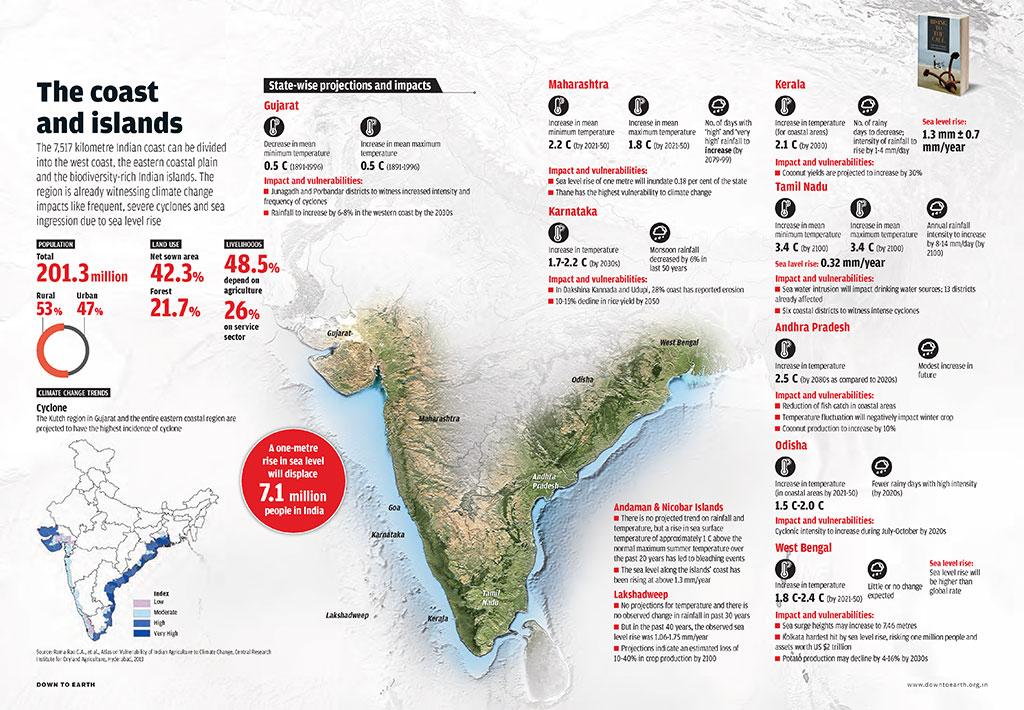
  • India’s climate Vulnerability

    Context

    In the absence of COVID-19, climate change-induced disasters would have been India’s biggest red alert in recent years.

    India’s vulnerabilities

    • Temperatures over the Indian Ocean have risen by over 1°C since the 1950s, increasing extreme weather events.
    • India is the fourth worst-hit in climate migration.
    • Heat waves in India have claimed an estimated 17,000 lives since the 1970s.
    • Labour losses from rising heat, by one estimate, could reach ₹1.6 lakh crore annually if global warming exceeds 2°C, with India among the hardest hit.
    • Extreme heat waves hit swathes of India. Heatwaves are aggravated by deforestation and land degradation, which also exacerbate fires.
    • Agriculture, being water-intensive, does not do well in heat wave-prone areas.

    Way forward

    • Two part approach: India needs a two-part approach:
    • Adaptation: one, to adapt to climate impacts by building resilience against weather extremes, and
    • Mitigation: to mitigate environmental destruction to prevent climate change from becoming more lethal.
    • Climate resistant agriculture: Agricultural practices which are not water-intensive and to support afforestation that has a salutary effect on warming.
    • Financial transfers can be targeted to help farmers plant trees and buy equipment — for example, for drip irrigation that reduces heavy water usage.
    • Crop diversification: Climate-resilient agriculture calls for diversification — for example, the cultivation of multiple crops on the same farm.
    • Climate-resilient agriculture calls for diversification — for example, the cultivation of multiple crops on the same farm
    • Managing vulnerable regions in coastal zones: Floods and storms are worsened by vast sea ingress and coastline erosion in the low-lying areas in the south.
    • It is vital to map flood-risk zones to manage vulnerable regions.
    • Environment Impact Assessments must be mandatory for commercial projects.
    • Design changes: Communities can build round-shaped houses, considering optimum aerodynamic orientation to reduce the strength of the winds.
    • Roofs with multiple slopes can stand well in strong winds, and central shafts reduce wind pressure on the roof by sucking in air from outside.
    • Moving away from fossil fuels: Adaptation alone will not slow climate damages if the warming of the sea level temperatures is not confronted.
    • Leading emitters, including India, must move away from fossil fuels.
    • Expanding and protecting forest cover: a big part of climate action lies in protecting and expanding forest coverage.
    • India gains from being part of the Glasgow declaration on forest protection that 141 countries signed in 2021.
    • Management of dams: Nearly 295 dams in India are more than 100 years old and need repairs.
    • In stemming landslides in Uttarakhand, regulations must stop the building of dams on steep slopes and eco-fragile areas, as well as the dynamiting of hills, sand mining, and quarrying.
    • Climate financing: India’s share in disaster management should be raised to 2.5% of GDP.
    • Climate finance is most suited for large-scale global funding from the World Bank, the International Monetary Fund, and the Asian Development Bank.
    • But smaller-scale financing can also be vital.

    Conclusion

    For public pressure to drive climate action, we need to consider climate catastrophes as largely man-made.


More posts