The Insurance Regulatory and Development Authority of India (IRDAI) has approved Indian Accounting Standards (Ind AS) framework for insurers, effective April 1, 2026.
What is Ind AS
Indian Accounting Standards (Ind AS):
Accounting rules for financial reporting
Based on International Financial Reporting Standards (IFRS)
Ensures:
Transparency
Comparability
Global alignment
Who Will Follow Ind AS
Applicable to all insurers: Life insurance companies, General insurance companies, Standalone health insurers, and Reinsurers
[2019] In India, which of the following review the independent regulators in sectors like telecommunications, insurance, electricity, etc.? 1 Ad Hoc Committees set up by the Parliament 2 Parliamentary Department Related Standing Committees 3 Finance Commission 4 Financial Sector Legislative 5 Reforms Commission NITI Aayog Select the correct answer using the code given below: (a) 1 and 2 (b) 1, 3 and 4 (c) 3, 4 and 5 (d) 2 and 5
The Reserve Bank of India (RBI) has tightened foreign exchange rules and banned non deliverable rupee derivative contracts to curb speculation and stabilize the Indian rupee, which recently weakened amid West Asia conflict.
Clients cannot hold opposite positions in non deliverable markets
3. Documentation Requirement
Authorised dealers can:
Ask for documents
Verify purpose of forex transactions
Ensure no speculative trading
4. Ban on Rebooking of Contracts
RBI also:
Prohibited rebooking of cancelled forex contracts
Applies to:
Deliverable contracts
Non deliverable contracts
Purpose: Prevent misuse and speculative loopholes
5. Restrictions on Related Party Transactions
Banks cannot undertake forex derivatives with related parties
Definition based on: Ind AS 24 and IAS 24
What is Ind AS 24
Ind AS 24 is Indian Accounting Standard 24 that deals with Related Party Disclosures in financial statements.
Issued by: Ministry of Corporate Affairs and Based on International Accounting Standards
What is IAS 24
IAS 24 is International Accounting Standard 24 issued by:
International Accounting Standards Board (IASB)
[2019] Which one of the following is not the most likely measure the Government/ RBI takes to stop the slide of Indian rupee? (a) Curbing imports of non-essential goods and promoting exports. (b) Encouraging Indian borrowers to issue rupee denominated Masala Bonds. (c) Easing conditions relating to external commercial borrowing. (d) Following an expansionary monetary policy.
The Samrat Samprati Museum was inaugurated in Koba, Gandhinagar on Mahavir Jayanti, highlighting the role of Samrat Samprati, grandson of Ashoka, in spreading Jainism.
Mauryan Dynasty and Religion
Ashoka and Buddhism
Ashoka ruled: 269–232 BCE
Adopted Buddhism after Kalinga War
Spread Buddhism:
Sri Lanka
Southeast Asia
Central Asia
Promoted ethical kingship and Dhamma
Jain Connections in Mauryan Dynasty
Chandragupta Maurya
Founder of Mauryan Empire
According to Jain tradition:
Converted to Jainism
Migrated to Shravanabelagola (Karnataka)
Practised Sallekhana (fast unto death)
Ashoka’s First Wife
Padmavati believed to be Jain
Who Was Samrat Samprati
Grandson of Ashoka
Son of Kunala
Ruled: c. 230–220 BCE
Associated with Shvetambara Jain tradition
Often called: “Ashoka of Jainism”
[2018] With reference to the religious practices in India, the “Sthanakvasi” sect belongs to: (a) Buddhism (b) Jainism (c) Vaishnavism (d) Shaivism
The Rajya Sabha passed the Central Armed Police Forces (General Administration) Bill, 2026, while the Opposition staged a walkout alleging that their concerns were not addressed.
What are Central Armed Police Forces (CAPFs)
CAPFs under Ministry of Home Affairs:
CRPF (Central Reserve Police Force)
BSF (Border Security Force)
CISF (Central Industrial Security Force)
ITBP (Indo Tibetan Border Police)
SSB (Sashastra Seema Bal)
Assam Rifles (operational control with Army)
Key Objective of the CAPF Bill
The Bill aims to:
Create umbrella administrative structure
Remove inconsistencies in service rules
Improve cadre management
Streamline appointments and promotions
Improve coordination with state police
Government stated:
It will strengthen national security
Boost efficiency and morale of forces
Why Government Introduced the Bill
Over time:
CAPFs developed different service rules
Lack of clarity in: Promotions, Appointments, Deputation, and Cadre management
The Bill aims to standardise administration.
Opposition’s Concerns
Deputation Issue
Institutionalising IPS officers’ deputation
May affect career progression of CAPF officers
[2023] With reference to Home Guards, consider the following statements: 1 Home Guards are raised under the Home Guards Act and Rules of the Central Government. 2 The role of the Home Guards is to serve as an auxiliary force to the police in maintenance of internal security. 3 To prevent infiltration on the international border/coastal areas, the Border Wing Home Guards Battalions have been raised in some States. How many of the above statements are correct? (a) Only one (b) Only two (c) All three (d) None
The Supreme Court of India ruled that voters excluded from electoral rolls during Special Intensive Revision (SIR) in West Bengaldo not lose their voting rights permanently.
Key Observations by Supreme Court
Voting rights cannot be “washed away forever”
Excluded voters must be given fair opportunity to appeal
Tribunal process must ensure fair adjudication
Electoral authorities must provide reasons for deletion
Case Background
Special Intensive Revision (SIR) conducted in West Bengal
Many voters removed from electoral rolls
19 tribunals constituted by Election Commission
Tribunals headed by:
Former High Court Chief Justices
Former High Court Judges
Purpose: Hear appeals of excluded voters
Supreme Court Directions
The Court directed:
Election Commission must provide:
Reasons for deletion
Remarks of adjudicating officers
Ensure transparent review process
Tribunal hearings to ensure justice for wrongly excluded voters
Supplementary Electoral Lists
Final voter list published: Feb 28, 2026
Supreme Court allowed:
Supplementary lists to include eligible voters
Fourth supplementary list already published
Constitutional Significance
Voting Rights linked to:
Article 326 — Adult Suffrage
Representation of the People Act, 1950
Key Principle: An eligible voter cannot be denied voting rights arbitrarily
[2017] Right to vote and to be elected in India is a (a) Fundamental Right (b) Natural Right (c) Constitutional Right (d) Legal Right
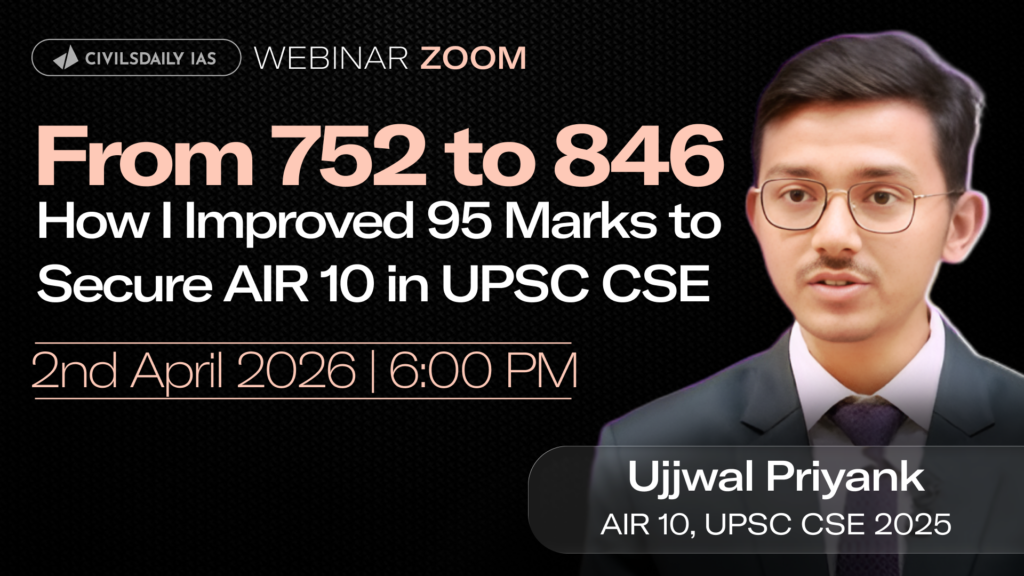
It will be a 45 minute session, post which we will open up the floor for all kinds of queries which a beginner must have. No questions are taboo and Ujjwal Sir is known to be patiently solving all your doubts.
Join us for a Zoom session on 02nd April at 6 PM. This session is a must attend for you If you are attempting UPSC for the first time or have attempted earlier and now preparing for 2026/2027, then it is going to be a valuable session for you too.
See you in the session”
Register for the session for a complete in-depth UPSC Prep
(Don’t wait—the next webinar/session won’t be until Mid April’26)
These masterclasses are packed with value. They are conducted in private with a closed community. We rarely open these webinars for everyone for free. This time we are keeping it for 300 seats only.
PYQ Relevance[UPSC 2019] Vulnerability is an essential element for defining disaster impacts and its threat to people. How and in what ways can vulnerability to disasters be characterized? Discuss different types of vulnerability with reference to disasters.Linkage: The PYQ tests core concepts of vulnerability, exposure, and disaster risk assessment, which form the foundation of GS-3 Disaster Management. The article directly critiques flawed vulnerability measurement (income-based proxy), reinforcing the need for multidimensional vulnerability assessment as demanded in the PYQ.
Mentor’s Comment
There is a critical flaw in India’s disaster financing architecture, the shift from risk-based assessment to population-based allocation. The issue is in the news due to concerns over the 16th Finance Commission’s disaster risk funding formula, which paradoxically allocates higher funds to States with larger populations rather than those with greater disaster exposure. This marks a sharp departure from earlier approaches and undermines decades of progress in disaster preparedness. The scale of the problem is significant, States like Odisha, with the highest hazard score (12), receive less effective consideration than States like Bihar (224.2) and Uttar Pradesh (413.2) due to population weighting.
What structural flaw exists in the disaster funding formula?
Multiplicative Risk Formula: Uses Disaster Risk Index (DRI = Hazard × Exposure × Vulnerability), but distorts outcomes due to flawed exposure metrics.
Population-Based Exposure: Defines exposure as total population (scaled 1-25), ignoring actual hazard-prone zones.
Bias Toward Larger States: Ensures States like Uttar Pradesh receive higher weight despite lower hazard intensity.
Departure from Previous Approach: Replaces additive model of 15th Finance Commission, which treated hazard and vulnerability separately.
Outcome Distortion: Rewards demographic size rather than disaster risk, contradicting risk-based allocation principles.
Why is ‘exposure’ measurement scientifically flawed?
Incorrect Definition: Uses total population instead of hazard-zone population.
IPCC Standard Ignored: Defines exposure as people in hazard-prone areas, not administrative boundaries.
Example: Odisha’s high-risk coastline equated with safer inland regions in other States.
Result: Artificial inflation of exposure scores for populous but less vulnerable States.
How does vulnerability measurement misrepresent actual risk?
Income-Based Proxy: Uses per capita NSDP, which measures fiscal capacity, not vulnerability.
Multidimensional Nature Ignored: Overlooks housing quality, health infrastructure, and early warning access.
Kerala Case Study: Despite ₹31,000 crore flood damages (2018), receives low vulnerability score (1.073).
Hidden Inequality: Average income masks intra-state disparities and disaster susceptibility.
Outcome: Underestimates real vulnerability in disaster-prone but relatively richer States.
Why does the formula penalize disaster-prone States?
Population Bias: Prioritizes demographic size over risk intensity.
Funding Paradox: Odisha (highest hazard score) loses out due to lower population score.
Disproportionate Allocation: Bihar (224.2) and UP (413.2) overshadow Odisha despite lower hazard exposure.
Kerala’s Loss: Loses 0.78 percentage points despite high vulnerability ranking.
Systemic Inequity: Smaller, disaster-prone States receive inadequate fiscal support.
What are the implications for disaster governance in India?
Misallocation of Resources: Funds diverted away from high-risk zones.
Reduced Preparedness: States with higher hazard exposure face fiscal constraints.
Climate Risk Escalation: Cyclones, floods, and droughts increasing in intensity and frequency.
Regional Inequality: Coastal and northeastern States disproportionately affected.
Policy Credibility Issue: Undermines objective of risk-based disaster financing.
What reforms are required in disaster risk assessment?
Hazard-Zone Mapping: Measures exposure based on population in disaster-prone areas.
Composite Vulnerability Index: Includes housing, health, agriculture, and infrastructure indicators.
Use of Data Systems: Integrates Building Materials and Technology Promotion Council (BMTPC) Vulnerability Atlas, National Family Health Survey-5 (NFHS-5), Pradhan Mantri Fasal Bima Yojana (PMFBY) database, National Health Mission (NHM) facility surveys, and India Meteorological Department (IMD) monitoring records.
Institutional Mechanism: Mandates NDMA to publish annual State Disaster Vulnerability Index.
Policy Continuity: Institutionalizes methodology across Finance Commissions.
Conclusion
A population-based approach to disaster funding undermines the principle of risk-sensitive governance. A shift toward hazard-specific exposure mapping and multidimensional vulnerability assessment is essential to ensure equitable and effective disaster resilience in India.
NASA is set to launch Artemis II, the first crewed lunar mission since the Apollo era (1972), carrying four astronauts on a flyby trajectory around the Moon. It represents the first human return to deep space in over 50 years and the first time the Space Launch System (SLS) and Orion spacecraft will carry astronauts together.
Why is Artemis II considered a historic milestone in space exploration?
First Crewed Lunar Mission Since Apollo: Re-establishes human presence beyond low Earth orbit after 1972, marking a generational shift in exploration capability.
Deep Space Human Travel: Ensures astronauts travel ~6,500 km beyond the Moon, the farthest distance humans have ever reached.
Technological Transition: Validates next-generation systems replacing Saturn V and Apollo modules.
Geopolitical Significance: Reinforces leadership in space amid rising competition (e.g., China’s lunar ambitions).
Programmatic Continuity: Bridges Artemis I (uncrewed) and Artemis III (lunar landing).
How does Artemis II’s trajectory and mission profile differ from earlier missions?
Lunar Flyby Trajectory: Ensures a non-landing mission with orbital path around the Moon and return to Earth.
Duration Optimization: Facilitates a ~10-day mission, shorter than robotic missions but efficient for human travel.
Distance Benchmark: Extends human reach beyond Apollo missions, which remained closer (~400 km lunar orbit).
Earth Orbit Phasing: Includes two Earth orbits before translunar injection, unlike direct Apollo launches.
Splashdown Recovery: Maintains ocean landing protocol for safe retrieval.
What technological advancements distinguish Artemis II from Apollo missions?
Space Launch System (SLS): Ensures higher thrust capacity, surpassing Saturn V in operational configuration.
Orion Spacecraft: Facilitates advanced life-support, navigation, and radiation shielding systems.
Extended Duration Capability: Supports ~25-day endurance, compared to shorter Apollo missions.
Modern Avionics: Integrates autonomous navigation and improved communication systems.
Reusability Elements: Promotes partial reusability, unlike fully expendable Apollo systems.
What challenges and risks are associated with Artemis II?
Weather Sensitivity: Launch delays due to unfavorable conditions (reported 80% favorable window).
Technological Validation Risks: First crewed use of SLS-Orion combination increases uncertainty.
Deep Space Radiation Exposure: Extends astronaut exposure beyond Earth’s magnetosphere.
Cost Constraints: High financial burden compared to earlier programs.
Mission Complexity: Multi-stage trajectory and long-duration spaceflight increase operational risk.
How does Artemis II contribute to future lunar and interplanetary missions?
System Validation: Ensures reliability of life-support, propulsion, and navigation systems.
Gateway Preparation: Supports future Lunar Gateway space station development.
Lunar Landing Readiness: Facilitates Artemis III mission planning and execution.
Mars Mission Foundation: Provides experience for long-duration deep space travel.
Commercial Integration: Encourages private sector participation in space logistics.
Conclusion
Artemis II represents a transitional mission that bridges past achievements with future ambitions. It validates technologies, extends human reach into deep space, and lays the foundation for sustained lunar exploration and eventual Mars missions.
PYQ Relevance
[UPSC 2023] What is the main task of India’s third moon mission which could not be achieved in its earlier mission? List the countries that have achieved this task. Introduce the subsystems in the spacecraft launched and explain the role of the Virtual Launch Control Centre at the Vikram Sarabhai Space Centre which contributed to the successful launch from Srihari Kota.
Linkage: The PYQ tests understanding of lunar mission objectives, spacecraft subsystems, and launch technologies, core to GS-III (Science & Tech) with emphasis on applied space capabilities. Artemis II similarly focuses on system validation (SLS-Orion) before lunar landing, paralleling Chandrayaan-3’s shift from failure to successful soft-landing capability.
Earth’s orbital space is transitioning from an open, sparsely used domain to a congested and commercially exploited environment. The issue has gained prominence due to the unprecedented surge in satellite launches, particularly large constellations like Starlink, enabled by reusable rocket technology. This marks a sharp shift from earlier state-controlled, low-density space activity to high-frequency, private-led deployments. The alarming rise in orbital debris, coupled with the absence of verifiable compliance mechanisms and enforceable global regulations, has exposed a major governance failure.
Why is Earth’s orbital environment becoming increasingly congested and fragile?
Commercial Expansion: Rapid increase in private satellite constellations has multiplied objects in orbit; Example: SpaceX’s Starlink deployment at scale.
Cumulative Congestion: Orbital space is finite; increasing density raises collision probability over time.
Tracking Limitations: Small debris (even coin-sized) cannot be consistently tracked but can destroy satellites.
What governance gaps are responsible for the current crisis?
Lack of Verification Mechanisms: No regular system to verify whether operators safely dispose of satellites post-mission.
Pre-launch Reliance: Regulators depend on company declarations rather than post-launch compliance checks.
Fragment Identification Limits: Authorities cannot reliably identify debris origin until damage occurs.
Weak Monitoring Infrastructure: Absence of global, transparent tracking systems accessible to all countries.
Non-binding Norms: Existing guidelines rely on voluntary compliance without enforcement or penalties.
UN Space Debris Mitigation Guidelines (2007): Adopted by the UN Committee on the Peaceful Uses of Outer Space (UNCOPUOS); provides best practices for limiting debris but has no legal enforcement.
IADC (Inter-Agency Space Debris Coordination Committee) Guidelines: Technical recommendations followed by major space agencies; purely voluntary and not legally binding.
Long-Term Sustainability (LTS) Guidelines (2019): Developed under UNCOPUOS to promote safe and sustainable space operations; depends on self-reporting and voluntary adoption.
National-level licensing norms (e.g., US FCC, others): Often incorporate mitigation principles but lack uniform global enforcement, leading to regulatory gaps.
Why are existing international space laws inadequate for present challenges?
Outdated Frameworks: Treaties were designed for a state-dominated, low-activity era.
Outer Space Treaty Limitations: Assigns responsibility to states but lacks provisions to regulate private actors effectively.
State-Centric Liability: Holds states responsible, not private companies directly.
No Uniform Regulation: Leaves licensing and supervision to national laws.
No Enforcement Mechanism: Lacks monitoring, verification, or penalties.
Reactive Liability: Applies only after damage, not for prevention.
Regulatory Fragmentation: Different national laws enable forum shopping.
Outdated Framework: Does not account for large private constellations.
Weak Dispute Resolution: Relies on slow state-to-state processes.
Absence of Liability Enforcement: No preventive liability mechanisms; action occurs only after damage.
Innovation-Regulation Gap: Rapid private innovation has outpaced slow-moving international law.
No Congestion Thresholds: Lack of defined limits for “acceptable” orbital crowding.
How does orbital debris pose systemic risks to space infrastructure?
High-Velocity Threat: Even small debris travels at orbital speeds, capable of disabling satellites.
Global Inequality: Developing countries face barriers in accessing already congested orbits.
What role can India play in shaping responsible orbital governance?
Policy Leadership: Opportunity to shape global norms through national legislation.
Balanced Approach: Combines cost-effective space missions with sustainability concerns.
Regulatory Framework Development: Licensing conditions can enforce debris mitigation.
Global Norm Advocacy: India can push for enforceable international agreements.
Technological Innovation: Investment in debris tracking and removal technologies.
Conclusion
Orbital congestion represents a governance failure in managing a global commons. Transition from voluntary norms to enforceable regulations is essential. Sustainable space use requires integrating technological capability with ethical responsibility and international cooperation.
PYQ Relevance
[UPSC 2019] What is India’s plan to have its own space station and how will it benefit our space programme?
Linkage: The PYQ tests understanding of India’s evolving space ambitions and long-term capabilities. The expansion of space infrastructure increases orbital activity, reinforcing concerns of congestion, debris, and the need for stronger global space governance.
The Indian Armed Forces concluded Exercise Dweep Shakti, a high intensity tri service exercise conducted in the Andaman and Nicobar Islands to strengthen India’s island defence and maritime security.
What is Exercise Dweep Shakti
Type: Tri Service Military Exercise
Forces involved:
Indian Army
Indian Navy
Indian Air Force
Focus: Island defence and amphibious warfare
Conducted under: Andaman and Nicobar Command (ANC)
About Andaman and Nicobar Command
India’s only Tri Service Theatre Command
Established in 2001
Headquarters: Port Blair
Strategic location near:
Malacca Strait
Indo Pacific sea routes
[2024] Which of the following statements about ‘Exercise Mitra Shakti-2023’ are correct? 1 This was a joint military exercise between India and Bangladesh. 2 It commenced in Aundh (Pune). Joint response during counter-terrorism operations was a goal of this operation. 3 Indian Air Force was a part of this exercise. Select the correct answer using the code given below: (a) 1, 2 and 3 (b) 1 and 4 (c) 1 and 4 (d) 2, 3 and 4
![🔴[UPSC Webinar for 2027] By Ujjwal Priyank, AIR 10, UPSC CSE 2025 | From 752 to 846: How I Improved 95 Marks to Secure AIR 10 in UPSC CSE | Join on 02nd April at 6 PM](https://d18x2uyjeekruj.cloudfront.net/wp-content/uploads/2026/04/Ujjwal-Priyank-thumb.png)