Government notified Startup India FoF 2.0 (April 13, 2026) with a ₹10,000 crore corpus to boost startup funding.
About FoF 2.0
What it is
A government-backed Fund of Funds
Invests in: Alternative Investment Funds
These AIFs then invest in startups
Indirect funding mechanism (not direct investment)
Institutional Framework
Nodal Department: Department for Promotion of Industry and Internal Trade
Implementation Agency: Small Industries Development Bank of India
Regulator for AIFs: Securities and Exchange Board of India
Background
FoF 1.0 (2016) under Startup India Action Plan
FoF 2.0 builds on it with:
More focus on advanced technologies
Stronger capital mobilization
[2025] With reference to investments, consider the following: I. Bonds II. Hedge Funds III. Stocks IV. Venture Capital How many of the above are treated as Alternative Investment Funds? (a) Only one (b) Only two (Hedge Funds and Venture Capital) (c) Only three (d) All the four
The Centre has proposed inter-State redistribution of Lok Sabha seats based on the 2011 Census, along with implementing 33% women’s reservation.
Key Proposals
1. Fresh Delimitation
Based on latest published Census (likely 2011)
Ends earlier freeze based on 1971 Census
Mandates readjustment of seats among States
2. Increase in Lok Sabha Strength
Current: 543 seats
Proposed:
Up to 850 seats
Around 815 for States
35 for Union Territories
3. Women’s Reservation
33% reservation in Lok Sabha & State Assemblies
Linked to:
Delimitation
Census-based seat allocation
Major Impact
Shift in Representation
Hindi heartland States
Share increases: 38.1% → 43.1%
Southern States
Share decreases: 24.3% → 20.7%
Examples of Seat Changes
Uttar Pradesh: +58 seats (80 → ~138)
Bihar: 40 → 72
Maharashtra: 48 → 78
Tamil Nadu: 39 → 50
Kerala: 20 → 23
Constitutional Background
Current System
Seat allocation based on:
1971 Census (inter-State)
2001 Census (intra-State)
Relevant Articles
Article 81 — Composition of Lok Sabha
Article 82 — Readjustment after Census
Freeze
Delimitation frozen till 2026
Reason: Promote population control policies
[2024] Consider the following statements regarding ‘Nari Shakti Vandan Adhiniyam’: 1 Provisions will come into effect from the 18th Lok Sabha. 2 This will be in force for 15 years after becoming an Act. 3 There are provisions for the reservation of seats for Scheduled Castes Women within the quota reserved for the Scheduled Castes. Which of the statements given above are correct? (a) 1, 2 and 3 (b) 1 and 2 only (c) 2 and 3 only (d) 1 and 3 only
Andhra Pradesh CM N. Chandrababu Naidu launched India’s first indigenous quantum computing testing facility at SRM University.
The initiative strengthens India’s push under the National Quantum Mission.
About Amaravati Quantum Facility
Name: Amaravati Quantum Reference Facility (AQRF)
Location: Amaravati, Andhra Pradesh
Type: Indigenous quantum testing infrastructure
Feature:
Open-access system
Sovereign quantum infrastructure
Key Highlights
First quantum computing testing facility in India
Includes:
Amaravati 1Q system (with cryogenic cooling processor)
Open demonstration system for research access
System housed at:
Medha Towers, Gannavaram
Amaravati Quantum Valley
Flagship initiative under National Quantum Mission
Aim: Develop Amaravati as a global quantum hub
Major Features
Hosting IBM 133-qubit quantum computer
80+ industry and academic partnerships
Focus areas:
Quantum computing
Quantum cloud
Skill development
Innovation ecosystem
What is Quantum Computing
Uses principles of Quantum Mechanics
Basic unit: Qubit (instead of classical bit)
[2022] Which one of the following is the context in which the term “qubit” is mentioned? (a) Cloud Services (b) Quantum Computing (c) Visible Light Communication Technologies (d) Wireless Communication Technologies
The Central Government has not revised wages under MGNREGS for FY 2026–27.
This is due to the upcoming rollout of a new scheme: Viksit Bharat–Guarantee for Rozgar and Ajeevika Mission (Gramin) (VB-GRAMG).
Key Highlights
Over 11 crore active workers under MGNREGS
Around 7.2 crore individuals (5.34 crore families) benefited in 2025–26
For the first time in over a decade, wage revision not announced in Feb–March
Existing wages of 2025–26 will continue temporarily
About MGNREGS
Full form: Mahatma Gandhi National Rural Employment Guarantee Scheme
Launched under:
MGNREGA Act, 2005
Objective:
Provide 100 days of guaranteed wage employment to rural households
Nature:
Demand-driven scheme
Legal right to work
Wage Fixation under MGNREGS
Wages notified under: Section 6(1) of MGNREGA, 2005
Revised annually based on: CPI-AL (Consumer Price Index for Agricultural Labourers)
Usually effective from: April 1 of each financial year
What is VB-GRAMG (New Scheme)
Full form: Viksit Bharat–Guarantee for Rozgar and Ajeevika Mission (Gramin)
Enacted through: VB-GRAMG Act, 2025
Aim:
Replace MGNREGA
Provide rural employment and livelihood support
[2011] Among the following who are eligible to benefit from the “Mahatma Gandhi National Rural Employment Guarantee Act”? (a) Adult members of only the scheduled caste and scheduled tribe households (b) Adult members of below poverty line (BPL) households (c) Adult members of households of all backward communities (d) Adult members of any household
Bengaluru is facing an acute groundwater crisis driven by over-extraction, weak recharge systems, and rising urban demand. The issue reflects a deeper structural imbalance between natural resource availability and urban growth patterns.
Urban Planning Integration: Aligns land-use with hydrological capacity.
Reduced Surface Sealing: Encourages permeable surfaces and green infrastructure.
Conclusion
Bengaluru’s crisis reflects a governance failure rather than a resource deficit. Sustainable urban water management requires integration of supply systems, strict regulation, and a shift towards nature-based solutions like the sponge city model.
PYQ Relevance
[UPSC 2024] The world is facing an acute shortage of clean and safe freshwater. What are the alternative technologies which can solve this crisis?
Linkage: Technologies addressing real-world crises like freshwater scarcity are frequently tested in Prelims (concepts) and Mains (application-based analysis). The Bengaluru water crisis exemplifies this trend, linking urban governance failure with the need for alternative technologies like wastewater recycling, desalination, and aquifer recharge.
Subhas Chandra Bose’s ideological framework has regained relevance amid contemporary debates on strong leadership, state-led development, and the balance between democracy and efficiency. His synthesis of Vedantic values with socialist policies and centralized governance offers an alternative model of nation-building, contrasting with the Gandhian approach.
How did Bose reconcile Indian spirituality with Western philosophical frameworks?
Vedantic Foundation: Rooted early thought in Advaita Vedanta; believed reality is spiritual and unified. Example: Influence of Swami Vivekananda
Doctrine of Maya: Viewed world as illusion but not escapist. This facilitated revolutionary engagement
Hegelian Dialectics: Adopted conflict as driver of progress. (Thesis-Antithesis-Synthesis framework)
Synthesis Approach: Combined Eastern spirituality with Western rationalism. This was a unique ideological blend
Moral Evolution: Considered conflict as moral and necessary and this shaped his revolutionary outlook.
Why did Bose shift from idealism to pragmatic socialism?
Rejection of Absolutism: Moved away from pure idealism and adopted pragmatic politics.
Historical Materialism Influence: Recognized role of material conditions in shaping society.
Critique of Gandhian Methods: Found non-violence inadequate for rapid transformation.
Industrial Imperative: Identified industrialization as key to poverty eradication
Global Influences: Inspired by Soviet planning and European models. Example: Exposure to Germany and USSR
What was Bose’s concept of ‘harmonious equality’?
Subhas Chandra Bose’s concept of “harmonious equality” was rooted in his ideology of Samyavada (Samya: concord/harmony; vada: doctrine), a doctrine of synthesis designed to blend the best elements of foreign ideologies with India’s spiritual traditions, rather than blindly copying them. It was a vision for a “thoroughly modern and Socialist State” that achieved total liberation from both colonial rule and internal socio-economic inequalities
Samyavada Doctrine: Advocated synthesis of socialism and nationalism
Rejection of Extremes: Opposed both capitalism and orthodox communism. Equality Principle: Emphasized social and economic equality
Dialectical Balance: Viewed ideologies as evolving through conflict and not static. He did not see Fascism or communism as finalities but as stages in the dialectical process. In the Indian Struggle (1934), he argued that India’s role was to work out a synthesis.
Indian Contextualization: Adapted socialism to Indian conditions and avoided blind imitation.
How did Bose envision political freedom beyond independence?
Comprehensive Freedom: Extended beyond colonial rule and it included social and economic justice.
Redistribution of Wealth: Ensured equitable distribution across classes.
Anti-Caste Measures: Focused on removal of caste inequalities
Gender Equality: Advocated equal rights for women
Communal Harmony: Emphasized elimination of religious divisions
Why did Bose advocate authoritarian governance during reconstruction?
Strong State Requirement: Supported centralized authority for nation-building
Temporary Authoritarianism: Suggested limited period of dictatorship
Administrative Efficiency: Ensured rapid decision-making and implementation
Planned Economy: Favored state control over production and distribution
Forward Bloc Vision: Proposed disciplined, centralized political organization.
What are the contradictions in Bose’s political philosophy?
Democracy vs Authority: Advocated freedom but supported authoritarianism
Spiritualism vs Materialism: Combined metaphysical beliefs with socialist economics
Nationalism vs Internationalism: Inspired by global ideologies but rooted in Indian nationalism.
Revolution vs Stability: Promoted radical change yet sought structured governance
Ethical Conflict: Justified conflict as moral necessity and raises ethical concerns.
Bose Vs Gandhi: Subhas Chandra Bose failed to win the confidence of Mahatma Gandhi mainly because of deep differences in ideology, methods, and political strategy within the Indian national movement.
Conclusion
Bose’s philosophy reflects a complex synthesis of spirituality, socialism, and authoritarian governance. It offers an alternative framework for nation-building but raises critical concerns regarding democratic values and ethical limits of power.
PYQ Relevance
[UPSC 2016] Highlight the differences in the approach of Subhas Chandra Bose and Mahatma Gandhi in the struggle for freedom.
Linkage: UPSC often frames questions on contrasting ideological approaches within the freedom struggle, making comparisons like Subhas Chandra Bose and Mahatma Gandhi highly relevant for Mains. This theme links to broader areas such as ideological diversity, methods of resistance, and models of nation-building, which are frequently tested directly or indirectly.
India has achieved a major milestone in reducing poverty, with the share of people below the World Bank’s lower-middle-income poverty line falling from ~50% a decade ago to ~30% today. India’s economic growth has reduced extreme deprivation but has not ensured broad-based upward mobility. The outcome is the emergence of a “vulnerable middle”, trapped between subsistence and prosperity, characterized by income instability, weak social protection, and limited access to opportunity.
For the first time, a major policy shift is being proposed: moving away from a binary classification of poor vs non-poor to a spectrum-based assessment of well-being, measuring how far individuals are from a dignified standard of living.
Why is the traditional poverty line inadequate to capture India’s development reality?
Binary Limitation: Classifies population as poor/non-poor, ignoring gradation of well-being (World Bank framework).
Mobility Blindness: Does not capture whether individuals are progressing or stagnating.
Threshold Problem: Crossing the poverty line does not imply economic security.
Data Evidence: Poverty reduced from ~50% to ~30% (World Bank Poverty & Equity Brief), yet vulnerability persists.
What is the alternate approach proposed for measuring welfare and development?
Spectrum-Based Measurement: Replaces binary poor/non-poor classification with a continuous assessment of well-being (World Bank Policy Framework).
Distance-to-Prosperity Metric: Measures how far households are from a reasonable standard of living, not just subsistence level.
Priority to the Poorest: Assigns greater weight to those furthest behind, ensuring targeted policy focus.
Mobility-Centric Evaluation: Tracks upward economic movement, not just poverty exit.
Outcome Sensitivity: Captures vulnerability, stagnation, and risk of falling back into poverty.
Example/Data Context: Despite poverty reduction to ~30% (World Bank), large populations remain clustered just above poverty line, validating need for this approach.
How does India’s growth model generate a “vulnerable middle class”?
Capital-Intensive Growth: Limits labour absorption in high-growth sectors (Economic Survey trend).
Weak Income Security: Large population remains above poverty without stable earnings.
Mobility Constraint: Limited transition to higher productivity sectors.
Consumption Fragility: Income volatility restricts sustained consumption.
Outcome Evidence: Rising population clustered just above poverty line (World Bank analysis).
Why is labour market structure central to economic vulnerability?
Low Formalization:<10% workforce in formal jobs with social security (PLFS).
Informal Dominance: Majority lack job contracts and benefits.
How do human development indicators signal constrained future mobility?
Child Wasting: ~18.7% (NFHS-5 data).
Child Stunting: ~35% under five (NFHS-5).
Health Deficit: Impacts cognitive and physical productivity.
Intergenerational Impact: Poverty and vulnerability transmitted across generations.
Outcome: Long-term constraints on economic mobility.
What does the shift from poverty reduction to mobility enhancement imply for policy?
Measurement Shift: Focus on distance from dignified living standards (World Bank).
Policy Reorientation: From poverty reduction to mobility generation.
Growth Quality Focus: Emphasis on inclusiveness.
Targeting Efficiency: Prioritizes most vulnerable segments.
Outcome: Addresses structural inequality and stagnation.
Conclusion
India’s development model has achieved poverty reduction without mobility expansion. The rise of a vulnerable middle class reflects structural distortions in labour markets, inequality, and human development, necessitating a shift towards mobility-centric policy design.
PYQ Relevance
[UPSC 2015] The nature of economic growth in India in recent times is often described as jobless growth. Do you agree with this view? Give arguments in favour of your answer.
Linkage: The PYQ directly links to the article’s core argument of growth without mobility, highlighting weak employment generation, informality, and wage stagnation. It supports analysis of vulnerable middle class formation, where poverty reduces but lack of quality jobs prevents upward economic movement.
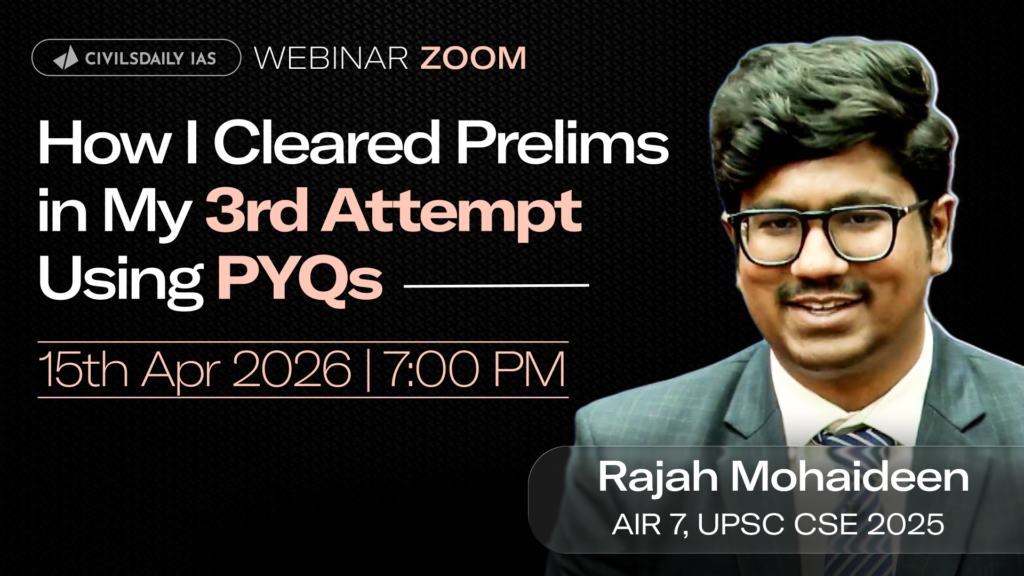
It will be a 45 minute session, post which we will open up the floor for all kinds of queries which a beginner must have. No questions are taboo and Arvind sir is known to be patiently solving all your doubts.
Join us for a Zoom session on 15th April at 7 PM. This session is a must attend for you If you are attempting UPSC for the first time or have attempted earlier and now preparing for 2027, then it is going to be a valuable session for you too.
See you in the session”
Register for the session for a complete in-depth UPSC Prep
(Don’t wait—the next webinar/session won’t be until End April’ 26)
These masterclasses are packed with value. They are conducted in private with a closed community. We rarely open these webinars for everyone for free. This time we are keeping it for 300 seats only.
The India Meteorological Department (IMD) has forecast below normal monsoon rainfall for 2026, mainly due to the developing El Niño conditions.
Key Highlights
Expected rainfall: 92% of Long Period Average (LPA)
Classification: Below Normal Monsoon
Error margin: ±5%
Monsoon period: June to September
India receives over 70% of annual rainfall during this period
What is Long Period Average (LPA)
LPA: Average rainfall during monsoon season
Current LPA period: 1971 to 2020
LPA rainfall: 87 cm
Monsoon Classification by IMD
Above normal: >104% of LPA
Normal: 96% to 104%
Below normal: 90% to 96%
Deficient: <90%
2026 Forecast: 92% → Below Normal
[2011] La Niña is suspected to have caused recent floods in Australia. How is La Niña different from El Niño? 1 La Niña is characterized by unusually cold ocean temperature in the equatorial Indian Ocean whereas El Niño is characterized by unusually warm ocean temperature in the equatorial Pacific Ocean. 2 El Niño has an adverse effect on the southwest monsoon of India, but La Niña has no effect on monsoon climate. Which of the statements given above is/are correct? (a) 1 only (b) 2 only (c) Both 1 and 2 (d) Neither 1 nor 2
Union Commerce Minister Piyush Goyal announced that India will soon get preferential market access to 38 developed countries through multiple Free Trade Agreements (FTAs).
These countries together account for:
Two thirds of global trade
Two thirds of global GDP
Key FTAs Mentioned
Already Operational
EFTA Countries (Effective October 2025): Switzerland, Norway, Liechtenstein, and Iceland
Upcoming FTAs
1. UK FTA: Expected to become operational: May 1, 2026
2. Oman FTA: Expected to become operational: June 1, 2026
3. New Zealand FTA
Signing expected soon
Likely operational: January 2027
4. European Union (EU) FTA: Expected operational timeline: Early next year
Around January–February
What is Preferential Access
Preferential access means:
Lower tariffs for Indian exports
Better market access compared to competitors
Boost to exports and manufacturing
Example:
If India’s tariff = lower than competitors
Indian goods become more competitive
[2017] ‘Broad-based Trade and Investment Agreement (BTIA)’ is sometimes seen in the news in the context of negotiations held between India and (a) European Union (b) Gulf Cooperation Council (c) Organization for Economic Cooperation and Development (d) Shanghai Cooperation Organization
![🔴[UPSC Webinar for 2027] By A R Rajah Mohaideen, AIR 7, UPSC CSE 25 | How I Cleared Prelims in My 3rd Attempt Using PYQs | Join on 15th April at 7PM](https://d18x2uyjeekruj.cloudfront.net/wp-content/uploads/2026/04/Rajah-thumb.png)