The WTO e commerce moratorium is set to expire at the 14th WTO Ministerial Conference in Yaounde, Cameroon, leading to debate between developed and developing countries including India.
What Is WTO E Commerce Moratorium?
• Global agreement among WTO members • Prohibits customs duties on electronic transmissions • Promotes digital trade growth
Coverage
Includes: Software downloads, E books, Music and video streaming, Video games, and Digital services
Background
• First adopted 1998 Geneva • Initially temporary • Renewed every two years • Last extended 2024 WTO Ministerial Conference
Debate Over Extension
Developed Countries Support
• United States, European Union, Japan, and Canada
Reasons
• Predictable digital trade environment • Support global digital economy • Protect Big Tech companies
India and Developing Countries Oppose
Concerns
• Loss of tariff revenue • Weak domestic digital industries • Big Tech dominance
Studies
• UNCTAD estimated $10 billion revenue loss • OECD says loss can be offset via GST or VAT
[2015] The terms ‘Agreement on Agriculture’, ‘Agreement on the application of Sanitary and Phytosanitary Measures’ and ‘Peace Clause’ appear in the news frequently in the context of the affairs of the (a) Food and Agricultural Organization (b) United Nations Framework Conference on Climate Change (c) World Trade Organization (d) United Nations Environment Programme
The Prime Minister of India paid homage to Shyamji Krishna Varma on his death anniversary, recalling his role in promoting Indian nationalism abroad.
About Shyamji Krishna Varma
• Born 4 October 1857 in Mandvi, Kachchh district, Gujarat • Freedom fighter, lawyer and journalist • First President of Bombay Arya Samaj • Strongly influenced by Swami Dayanand Saraswati • Played a key role in revolutionary nationalism outside India
Major Contributions
Indian Home Rule Society (1905)
• Founded in London • Supported by Bhikaji Cama, Dadabhai Naoroji, S.R. Rana • Aim: Promote self rule for India
India House
• Established in London in 1905 • Residence for Indian students in Britain • Became hub of revolutionary nationalism
Indian Sociologist
• Monthly journal started in London • Spread nationalist ideas • Criticised British colonial rule
Importance
• Promoted freedom struggle internationally • Inspired revolutionary leaders • Strengthened Indian independence movement abroad
[2018] Which among the following events happened earliest? (a) Swami Dayanand established Arya Samaj. (b) Dinabandhu Mitra wrote Neeldarpan. (c) Bankim Chandra Chattopadhyay wrote Anandmath. (d) Satyendranath Tagore became the first Indian to succeed in the ICS.
Researchers from the Indian Institute of Astrophysics IIA solved a long standing mystery of solar radio bursts, a breakthrough that could improve space weather forecasting and protect satellites, communication and navigation systems.
What Are Type II Solar Radio Bursts?
• Generated by Solar Flares and Coronal Mass Ejections CME • Produced by Shock waves in Sun’s Corona • Travel at Nearly 1000 km per second • Important for Space Weather Forecasting
What Was the Long Standing Mystery?
Scientists observed two radio emissions
• Fundamental Emission • Harmonic Emission
Earlier Expectation: Fundamental emission should be stronger
But Observations Showed
• Sometimes Harmonic emission stronger • This puzzled scientists for decades
What Did Indian Scientists Discover?
Researchers found
• Strength depends on Location of Solar Activity • Higher Solar Longitudes beyond 75 degree. Harmonic emission stronger
• Near centre of solar diskFundamental emission stronger
Why Does This Happen?
Scientists identified two main reasons
• Refraction in Solar Corona • Viewing Angle from Earth
How Was the Study Conducted?
• Analysed 58 Solar Events • Used Global CALLISTO Network • Used Gauribidanur Radio Observatory Karnataka • Published in Solar Physics Journal
What Is CALLISTO Network?
• Global solar radio monitoring network • Tracks Solar radio bursts • Used for Space weather prediction
[2022] If a major solar storm (solar flare) reaches the Earth, which of the following are the possible effects on the Earth? 1 GPS and navigation systems could fail. 2 Tsunamis could occur at equatorial regions. 3 Power grids could be damaged. 4 Intense auroras could occur over much of the Earth. 5 Forest fires could take place over much of the planet. 6 Orbits of the satellites could be disturbed. 7 Shortwave radio communication of the aircraft flying over polar regions could be interrupted. Select the correct answer using the code given below: (a) 1, 2, 4 and 5 only (b) 2, 3, 5, 6 and 7 only (c) 1, 3, 4, 6 and 7 only (d) 1, 2, 3, 4, 5, 6 and 7
The Karnataka Forest Department captured a female sloth bear near Shivamogga airport after it entered nearby villages and airport premises, raising concerns about human wildlife conflict.
What Is Sloth Bear?
• Scientific Name Melursus ursinus • Found in Indian Subcontinent • Habitat: Dry forests, Grasslands, Scrub forests • Known for Insect feeding, Strong claws, and Human conflict incidents
Conservation Status
• IUCN Status Vulnerable • Wildlife Protection Act 1972 • Listed under Schedule I protection
[2022] With reference to Indian laws about wildlife protection, consider the following statements: 1 Wild animals are the sole property of the government. 2 When a wild animal is declared protected, such animal is entitled for equal protection whether it is found in protected areas or outside. 3 Apprehension of a protected wild animal becoming a danger to human life is sufficient ground for its capture or killing. Which of the statements given above is/are correct? (a) 1 and 2 (b) 2 only (c) 1 and 3 (d) 3 only
India’s Index of Industrial Production IIP grew 5.2 percent in February 2026, driven mainly by manufacturing and capital goods sectors, indicating investment led industrial recovery.
What Is Index of Industrial Production IIP?
Index of Industrial Production
• Measures industrial activity in India • Released by Ministry of Statistics and Programme Implementation MOSPI • Covers three sectors: Manufacturing, Mining, and Electricity
What Are the Latest IIP Growth Numbers?
• February 2026 IIP Growth 5.2 percent • January 2026 Revised Growth 5.1 percent • January earlier estimate 4.8 percent
Which Sectors Drove Growth?
Manufacturing Sector
• Growth increased to 6 percent • Previous month 5.3 percent • February 2025 growth 2.8 percent • Key drivers: Basic metals, Automobiles, and Machinery
Capital Goods Sector
• Growth surged to 12.5 percent • Nine month high • Previous month 4.1 percent • Indicates Investment and Capex growth
[2012] In India, in the overall Index of Industrial Production, the Indices of Eight Core Industries have a combined weight of 37.90%. Which of the following are among those Eight Core Industries? 1 Cement 2 Fertilizers 3 Natural 4 Gas 5 Refinery products 6 Textiles Select the correct answer using the code given below: (a) 1 and 5 only (b) 2, 3 and 4 only (c) 1, 2, 3 and 4 only (d) 1, 2, 3, 4 and 5
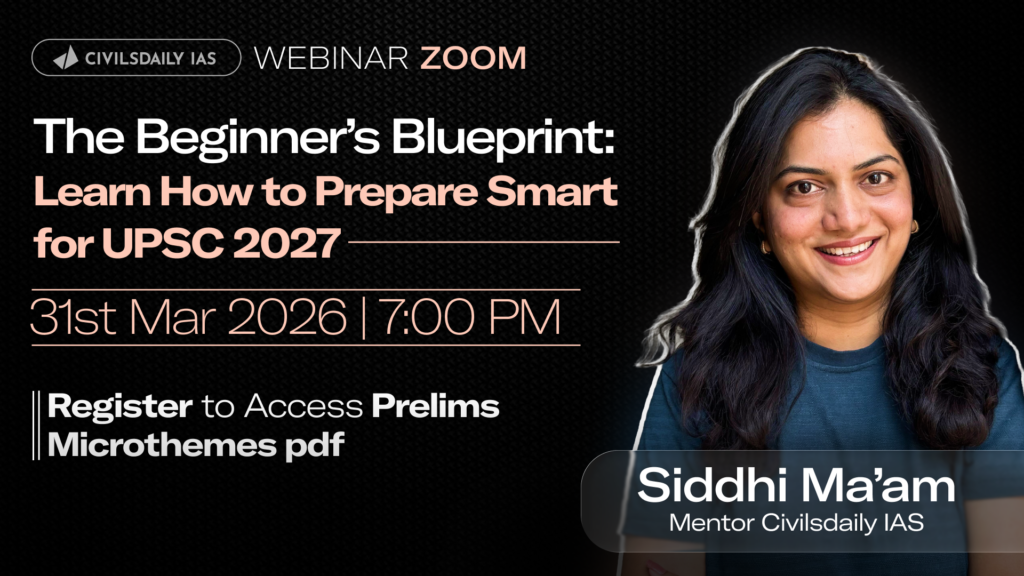
Most aspirants spend months figuring out what to study, what to avoid, and how to structure their preparation, often losing valuable time in confusion.
This session is designed to give you clarity from Day 1.
Join Me as I break down a beginner friendly blueprint to help you prepare smartly for UPSC 2027.
Siddhi Ma’am, Mentor, Civilsdaily IAS
What I’ll do in this live session:
1. How to Start Your UPSC Preparation
• What to study first, and what to avoid initially • Understanding the syllabus without feeling overwhelmed • Building a strong foundation from Day 1
Starting right saves months later.
2. Smart Study Strategy for Beginners
• How to choose the right sources (and avoid resource overload) • Static vs current affairs, how to balance both • Making a practical and sustainable study plan
Preparation is about clarity, not quantity.
3. The Role of Notes, Revision & PYQs
• How to make effective notes from the beginning • Why PYQs should guide your preparation • Building revision cycles early
Smart systems reduce last minute stress.
4. Common Mistakes Beginners Make
• Over planning without execution • Constantly changing sources • Delaying answer writing and revision
Avoiding mistakes is as important as doing things right.
5. Building Consistency for the Long Run
• How to stay consistent without burnout • Managing distractions and self-doubt • Developing discipline over motivation
UPSC is a marathon, not a sprint.
Who should attend: • Beginners starting UPSC 2027 preparation
• Aspirants feeling lost about where to begin
• Candidates looking to build a clear and structured approach
It will be a 45 minute session, post which we will open up the floor for all kinds of queries which a beginner must have. No questions are taboo and Siddhi Ma’am is known to be patiently solving all your doubts.
Join us for a Zoom session on 31st March at 7 PM. This session is a must attend for you If you are attempting UPSC for the first time or have attempted earlier and now preparing for 2027, then it is going to be a valuable session for you too.
See you in the session”
Register for the session for a complete in-depth UPSC Prep
(Don’t wait—the next webinar/session won’t be until April’26)
These masterclasses are packed with value. They are conducted in private with a closed community. We rarely open these webinars for everyone for free. This time we are keeping it for 300 seats only.
PYQ Relevance[UPSC 2024] Discuss the merits and demerits of the four ‘Labour Codes’ in the context of labour market reforms in India. What has been the progress so far in this regard?Linkage: The PYQ examines labour reforms and wage regulation, directly linking to issues of minimum wages, labour protection, and state role highlighted in MGNREGA wage suppression. It helps analyse how policy design and implementation gaps can weaken labour welfare outcomes.
Mentor’s Comment
The debate on how wages are fixed under MGNREGA has grown with the proposed VB-GRAM Act, which still keeps wage control with the Centre despite clear problems in the system. For the first time, MGNREGA wages are lower than the legal minimum wages in most states, going against its aim of providing basic livelihood security. Wages have remained almost stagnant in real terms since 2009, while gaps and leakages have increased, showing a serious policy failure affecting labour rights and the rural economy.
Why are wage rates central to employment guarantee schemes?
MGNREGA’s credibility as a rights-based welfare programme is weakening due to persistently low wages, delayed payments, and excessive central control. Without aligning wages to statutory minimum levels, restoring state autonomy, and ensuring timely and transparent payments, the scheme risks becoming ineffective. Strengthening its design is essential to uphold labour dignity, rural livelihoods, and inclusive growth.
India’s energy security concerns have changed due to tensions in West Asia. A surprising reality is that Liquefied Petroleum Gas (LPG) has become a bigger risk than Liquefied Natural Gas (LNG). Earlier, crude oil and LNG were seen as the main concerns. Now, India imports 60% of its LPG, and about 90% of it passes through the Strait of Hormuz, making it highly vulnerable to disruptions at this key route.
Why is LPG a greater energy security concern than LNG for India?
Import Dependence: LPG import dependence stands at 60%, compared to LNG at ~50%.
Chokepoint Risk: Nearly 90% of LPG imports pass through the Strait of Hormuz, compared to ~60% for LNG.
Effective Share: LPG contributes 54% to India’s total energy supply dependence, while LNG contributes ~30%.
Household Dependency: LPG is the primary cooking fuel, affecting millions of households directly.
Limited Substitutability: LNG has alternatives (PNG, industrial fuels), while LPG substitution is limited in rural areas.
How do LPG and LNG differ in terms of production, storage, and distribution?
Chemical Nature: LPG consists of propane and butane; LNG is methane-based natural gas.
Storage Mechanism: LPG is stored in cylinders under moderate pressure; LNG requires cryogenic storage at -160°C.
Transport Infrastructure: LPG is transported via cylinders and road networks, LNG requires pipelines and regasification terminals.
Distribution Reach: LPG reaches remote areas without pipelines; LNG requires pipeline connectivity.
Safety Concerns: LPG is heavier than air and prone to explosion risks; LNG disperses faster.
What structural vulnerabilities exist in India’s LPG ecosystem?
High Import Exposure: Domestic LPG production meets only 40% of demand.
Geographic Concentration: Heavy reliance on a single maritime route (Hormuz).
Household Dependence: LPG is used by crores of households, making disruptions socially sensitive.
Infrastructure Limitation: Lack of PNG penetration in rural and semi-urban regions
Storage Constraints: Limited buffer storage compared to crude oil reserves.
Why is LNG relatively less vulnerable despite similar import dependence?
Diversified Sources: LNG imports come from Qatar, USA, and others, reducing concentration risk.
Flexible Usage: LNG is used in power generation, industries, and transport, allowing demand adjustments.
Lower Household Dependence: LNG impacts industries more than households directly.
Strategic Buffering: LNG infrastructure allows storage in cryogenic tanks.
What is the government’s strategy to reduce LPG vulnerability?
Piped Natural Gas (PNG) Expansion: Promotes PNG to reduce LPG dependence.
PNG is a natural gas, primarily methane, transported through a network of underground pipelines directly to residential, commercial, and industrial consumers, providing a continuous, safe, and eco-friendly fuel alternative for cooking and heating.
It consists mainly of methane (CH4) and is considered a cleaner fuel.
PNG is lighter than air, meaning it disperses easily in the event of a leak, making it safer than LPG.
It is primarily used for domestic cooking, water heating, and in industrial settings like factories and restaurants.
Policy Push: Mandates PNG adoption in urban households.
Industrial Shift: Encourages industries to switch from LPG to LNG.
Supply Prioritization: Ensures LPG availability for households over commercial use.
Infrastructure Development: Expands pipeline networks and city gas distribution.
What are the broader implications of LPG vulnerability for India?
Energy Security Risk: High exposure to geopolitical disruptions.
Social Impact: Cooking fuel disruption affects welfare schemes like Ujjwala.
Strategic Weakness: Over-reliance on a single chokepoint reduces resilience.
Policy Urgency: Requires diversification and infrastructure expansion.
Conclusion
India’s energy security discourse must move beyond crude oil and LNG to address LPG vulnerabilities. Reducing import dependence, diversifying supply routes, and expanding PNG infrastructure are essential to ensure long-term resilience.
PYQ Relevance
[UPSC 2022] Do you think India will meet 50 percent of its energy needs from renewable energy by 2030? Justify.
Linkage: The PYQ tests India’s energy transition, sustainability goals, and long-term energy security strategy under GS3. LPG import vulnerability and dependence on the Strait of Hormuz highlight the urgency of reducing fossil fuel dependence and accelerating renewable energy adoption.
Artemis II is important because it will be the first crewed mission to the Moon since Apollo 17 in 1972, ending a gap of over 50 years. Unlike Apollo’s short visits, it aims to support long-term human presence through lunar bases and continuous missions. It also involves private companies and multiple countries, showing a shift toward a global space race. The mission is now planned for 2026, marking a major step toward future Moon and Mars exploration.
What is Artemis II?
Artemis II is NASA’s first crewed mission of the Artemis program, scheduled to launch on April 1, 2026.
It will send a crew of four on a 10-day journey around the Moon, marking the first time humans have ventured beyond low Earth orbit since the Apollo 17 mission in 1972.
Key Mission Details
Objective: To test the Space Launch System (SLS) rocket and the Orion spacecraft’s life-support systems with a crew on board.
Trajectory: The mission will follow a “free-return trajectory,” flying around the far side of the Moon and using lunar gravity to swing back toward Earth without entering lunar orbit.
The Crew:
Reid Wiseman (Commander): NASA.
Victor Glover (Pilot): NASA, the first person of colour on a lunar mission.
Christina Koch (Mission Specialist): NASA, the first woman on a lunar mission.
Jeremy Hansen (Mission Specialist): Canadian Space Agency (CSA), the first non-American on a lunar mission.
Launch Site: Launch Complex 39B at NASA Kennedy Space Center in Florida.
Splashdown: The mission is expected to conclude with a splashdown in the Pacific Ocean off the coast of San Diego.
How does Artemis II mark a shift from exploration to habitation?
Mission Objective Shift: Ensures transition from short-term lunar visits to sustained human presence; Apollo missions lasted 12 days, Artemis envisions prolonged stays.
Infrastructure Development: Facilitates creation of permanent bases like the Moon Gateway; supports long-term habitation and logistics.
Technological Evolution: Strengthens reusable systems and deep-space capabilities; contrasts Apollo’s one-time mission design.
Human Adaptation Focus: Promotes research on survival in extreme environments; essential for Mars missions.
Why is a permanent lunar base critical for deep space exploration?
Strategic Staging Ground: Enables Moon as a launchpad for Mars missions; reduces cost and energy requirements.
Resource Utilization: Supports extraction of lunar resources (e.g., water ice); enables in-situ fuel production.
Sustainability Models: Ensures closed-loop life support systems; reduces resource dependency.
Cost Dynamics: Highlights high cost (~$400,000/kg); necessitates innovation in reusable technologies.
What are the challenges and risks associated with Artemis missions?
High Costs: Limits scalability of missions; requires sustained funding.
Technological Uncertainty: Involves untested systems like nuclear propulsion; increases mission risk.
Geopolitical Tensions: Intensifies competition with China and others; risks fragmentation of space governance.
Human Survival Risks: Exposes astronauts to radiation and isolation; demands advanced life-support systems.
How does Artemis redefine the global space race?
Multi-Polar Competition: Expands participation beyond USA-Russia; includes China, India, Europe.
Strategic Dominance: Ensures control over lunar resources and routes; critical for future space economy.
Economic Opportunities: Promotes commercialization of space; example: mining and tourism prospects.
Policy Evolution: Necessitates new frameworks for space governance; updates Outer Space Treaty relevance.
Conclusion
Artemis II represents a structural shift in space exploration, from symbolic achievements to strategic permanence. It integrates technology, geopolitics, and economics, positioning the Moon as a gateway to Mars and beyond. The mission underscores the emergence of a new space order driven by sustainability, competition, and collaboration.
PYQ Relevance
[UPSC 2019] What is India’s plan to have its own space station and how will it benefit our space programme?
Linkage: The PYQ tests understanding of long-term space infrastructure and human spaceflight capabilities, a recurring UPSC theme in GS-3 (Science & Tech). Artemis II’s Moon Gateway and lunar base model provides a global reference to evaluate India’s space station ambitions and strategic positioning in deep-space exploration.
On March 29, 2026, reports highlighted the profound impact of Iran’s Shahed drones in the ongoing conflicts in West Asia. These “kamikaze” drones have challenged the supremacy of multi-million dollar air defense systems, signaling a paradigm shift where the economics of attrition are becoming as important as traditional firepower.
What Makes Drone Warfare a “Game Changer”?
The rise of Unmanned Aerial Vehicles (UAVs) like the Shahed-136 represents a shift toward Asymmetric Warfare.
Cost Imbalance: A Shahed drone costs between $20,000 and $50,000, while the missiles used to intercept them (like the Patriot) cost nearly $4 million each.
Swarm Tactics: Drones are often deployed in large numbers to overwhelm sophisticated radar and interceptor batteries.
Drone swarms are groups of autonomous drones that coordinate and operate together as a single intelligent system through communication networks, sensors, and AI algorithms.
Key Features
Autonomous Coordination
Each drone can: Share information with nearby drones
Adjust movement in real time
Collective Intelligence
Self-Healing Capability
If one drone fails, others reorganize automatically without collapsing the mission.
Sustainability: Maintaining an F-16 fighter jet costs roughly $25,000 per hour, nearly the total cost of the drone it is trying to shoot down.
Attrition: If a drone is lost, it is merely a financial loss; if a fighter jet is downed, the military loses a high-value asset and a highly trained pilot.
How Does the Shahed-136 “Kamikaze” Drone Operate?
The Shahed-136 (and its Russian variant, the Geran) is a “one-way” attack UAV with the following technical specifications:
Stealth: It flies at low altitudes (20–30 meters) to stay below traditional radar detection.
Navigation: Uses a push-propeller engine (noted for its “lawnmower” sound) and carries explosives in its nose.
Range: Capable of traveling up to 3,000 km.
Mechanism: It does not fire missiles; it is the missile, detonating upon impact with the target.
What are the Modern Counter-Drone Solutions?
To combat the high cost of traditional interceptors (Patriot, THAAD), militaries are moving toward Directed Energy Weapons (DEW) and low-cost interceptors:
Laser Weapons: Systems like the HELIOS Laser (used by the US Navy) destroy targets using concentrated heat. They are extremely cost-effective per shot but can be hindered by bad weather (fog/rain).
Acoustic Detection: Using technology to recognize the specific engine sounds of drones.
Low-Cost Interceptors: * Sting: A $2,000–$4,000 interceptor drone used by Ukraine.
Merops: A specialized American anti-drone system being rapidly deployed to West Asia.
LUCAS: The US-made “Low-cost Uncrewed Combat Attack System” ($35,000).
[2025] With reference to Unmanned Aerial Vehicles (UAVs), consider the following statements: 1 All types of UAVs can do vertical landing. 2 All types of UAVs can do automated hovering. 3 All types of UAVs can use battery only as a source of power supply. Which of the statements given above are correct? (a) Only one (b) Only two (c) All the three (d) None

![🔴[UPSC Webinar for 2027] By Siddhi Ma’am, Mentor, Civilsdaily IAS | The Beginner’s Blueprint: Learn How to Prepare Smart for UPSC 2027 | Join on 31st March at 7PM](https://d18x2uyjeekruj.cloudfront.net/wp-content/uploads/2026/03/Siddhi-thumb4.png)