Microplastics are now a serious environmental and health threat. A recent (Ministry of Earth Sciences) MoES–NCCR survey found alarming levels along India’s east and west coasts, highlighting the urgent need to embed microplastic control within India’s environmental governance framework.
Key Findings from NCCR Survey (2022–2025):
Major microplastic sources identified:
Riverine inputs (plastic waste transported by rivers)
Abandoned, Lost, and Discarded Fishing Gear (ALDFG), a persistent marine debris source globally
The presence of primary (e.g., microbeads in cosmetics) and secondary microplastics (from the breakdown of plastic waste) was confirmed.
Microplastics: Nature
Definition: Plastic particles ranging between 1 micrometre (µm) and 5 millimetres (mm).
Types:
Primary Microplastics: Manufactured in small sizes (e.g., microbeads in personal care products).
Secondary Microplastics: Result from degradation of larger plastic items due to sunlight, wave action and other environmental factors.
Environmental Impact of Microplastics:
Impact on Marine Environments:
Ingestion by Marine Life: Marine organisms, including fish, seabirds, ingest microplastics and can cause physical harm including gut blockages and tissue damage.
Bioaccumulation in Marine Food Webs: Bioaccumulation can lead to higher concentrations of toxins such as Polychlorinated Biphenyls (PCBs) and Polycyclic Aromatic Hydrocarbons (PAHs) in top predators, potentially impacting their health and reproductive success.
Habitat Disruption: Microplastics can accumulate in marine sediments and affect the structure and function of marine ecosystems.
Chemical Leaching: Microplastics can leach harmful chemicals into the surrounding seawater. These chemicals include Bisphenol A (BPA), which is known to cause reproductive defects in some fish species, along with phthalates and brominated flame retardants, all of which can interfere with the endocrine system.
Impact on Ecological Systems:
Soil Contamination: Microplastics can negatively impact soil structure, microbial activity, and nutrient cycling, affecting plant growth and overall ecosystem health. They can act as carriers for toxins like heavy metals (e.g., Lead (Pb) and Cadmium (Cd)).
Disruption of Food Webs: Microplastics can accumulate in the bodies of various organisms, potentially disrupting food chains and affecting higher trophic levels.
Impact on Soil Biota: Exposure to microplastics can negatively impact soil-dwelling organisms like earthworms and microorganisms, affecting their growth and reproduction. Leaching of plastic additives such as phthalates can disrupt cell membrane function in microbes.
Plant Toxicity: Microplastics can be absorbed by plants, potentially affecting their growth and development, and introducing toxins into the food chain.
India’s Initiatives on Microplastic Management
Plastic Waste Management Rules, 2016 (Amended 2021–22): Ban on single-use plastics and Emphasis on Extended Producer Responsibility (EPR) for collection and recycling.
Swachh Bharat Mission 2.0: Includes solid waste segregation, treatment, and scientific disposal.
Ecosensitive Coastal Zone Regulation (CRZ): CRZ rules govern development along coastlines and indirectly reduce marine plastic input.
FSSAI Project: Ongoing study to develop standard detection protocols for microplastics in food products.
International Conventions and Agreements
MARPOL (International Convention for the Prevention of Pollution from Ships) Annex V prohibits the discharge of plastics and synthetic fishing gear into the sea.
Basel Convention (1989, amended in 2019) regulates transboundary movement of plastic waste. India ratified the amendments concerning plastic waste in 2020.
The United Nations Environment Assembly (UNEA) adopted a historic resolution to negotiate a legally binding global treaty on plastic pollution by 2024 (still ongoing).
Sustainable Development Goal 14 talks about Preventing and significantly reducing marine pollution of all kinds, particularly from land-based activities.
Global Partnership on Marine Litter (GPML): A UN Environment initiative, India is a participating country.
Way Forward
National Microplastic Monitoring Programme: Expand surveys to include rivers, lakes, groundwater, and terrestrial ecosystems.
Ban on Microbeads: A clear legislative ban on the use of microbeads in personal care products (done in countries like the UK and USA).
Fishing Gear Recovery Programmes: Introduce buy-back schemes or incentives for collection of damaged fishing gear.
Invest in R&D: Support startups and research institutes working on biodegradable alternatives and plastic detection methods.
Public Awareness and Behavioural Change: Use platforms like Eco Clubs, MyGov, Swachh Bharat campaigns for mass education.
The presence of microplastics disrupts ecosystems by affecting organisms’ behavior and physiology, impacting soil fertility, and altering aquatic food webs. Addressing microplastic pollution requires a multi-faceted approach, including reducing plastic consumption, improving waste management, and developing innovative solutions like biodegradable alternatives and advanced filtration systems.
Practice UPSC Mains Questions:
What are microplastics and how do they impact human health and the environment? Evaluate India’s current policy response to the problem and suggest a comprehensive mitigation strategy.
Critically discuss the effectiveness of current national and global efforts to combat microplastic pollution, including initiatives like the Single-Use Plastic ban and the ongoing discussions around a legally binding international plastics treaty.
N4S: Article shows Northeast shifting from neglected hinterland to strategic green growth bridge. UPSC loves to turn this theme into GS‑3 questions that start with a concept like “carrying capacity” and then make you marry it to a real region, just as the 2019 PYQ asked you to first define the term and then apply it; expect verbs such as “explain” and “critically assess” followed by a demand for on‑ground examples. Many aspirants stumble because they either stop at textbook ecology without linking to development, or they gush about infrastructure but forget ecological limits, so their answers look lopsided. The piece fixes that blind spot: under “Balancing Infrastructure Development with Ecological Sensitivity in the North East” it walks you through precise trade‑offs, citing the 2021 Sikkim landslide and 160 Brahmaputra hydropower plans, while “NE: Zone of Untapped Potential” hands you a neat compare‑and‑contrast grid to frame the region’s carrying‑capacity stress points. “Strategic Integration of the Northeast” then shows how projects like the Sela Tunnel or the India–Myanmar–Thailand Highway can be justified only if they respect fragile ecosystems—exactly the synthesis UPSC rewards. The article’s superpower is its “Back2Basics: North East – Significance, Initiatives and Challenges” box, a one‑stop map of facts and schemes (₹38,856‑crore green‑energy MoUs, Champhai Solar Park, PM‑DevINE) that you can sprinkle across answers to prove both depth and currency.
PYQ ANCHORING
GS 3: Define the concept of carrying capacity of an ecosystem as relevant to an environment. Explain how understanding this concept is vital while planning for sustainable development of a region. [2019]
MICROTHEME: Ecosystem carrying capacity and SDG
Once seen as India’s remote hinterland, the Northeast is now rewriting its story — not as a periphery, but as a strategic, ecological, and digital frontier. With its eight vibrant states — the “Ashtalakshmi” — the region shares over 5,400 km of international borders, holds immense biodiversity, and boasts rich renewable resources. And the winds of change are real. From insurgency to infrastructure, from isolation to innovation — the Northeast is finding its place at the heart of India’s growth vision.
Backed by investments of over ₹1.5 lakh crore and empowered by the Act East Policy, the region is fast becoming a vital bridge to ASEAN. Yet, as NITI Aayog’s SDG Index (2021–22) shows, while progress is visible, development remains uneven. The Economic Survey 2024–25 puts it plainly: this is a zone of untapped potential — and the time to unlock it is now.
In such a scenario, some pertinent questions that come up are – Can India balance infrastructure development with ecological sensitivity in this fragile region?How can strategic integration of the Northeast redefine India’s foreign and economic policy in the Indo-Pacific era?
About ‘Rising Northeast’ Investor Summit
The ‘Rising Northeast’ Investor Summit, organized by the Ministry of DoNER, is India’s big push to rebrand the Northeast from a remote outpost to a high-potential investment and strategic hub. It’s not just about showcasing the region — it’s about inviting the nation (and the world) to be part of its transformation story.
Here’s what makes it big:
Massive Infrastructure Push: The Ministry of Road Transport and Highways is putting its money where its mouth is — 10% of its entire budget is going to the region. This translates to nearly 5,000 km of highways and over $5 billion in investment.
Green Growth with MoUs In a show of climate-smart development, ₹38,856 crore worth of MoUs have been signed for renewable energy projects — signalling a shift from insurgency zones to green energy hubs.
Digital First Northeast: A whopping ₹1.5 lakh crore has gone into digital and physical connectivity, including BharatNet and the Digital Northeast Vision. Today, 90% of the region has 4G access, and 80% of rural homes are fiber-connected.
Skilling for Tomorrow: Over 2,000 youth have been trained under skill schemes like Suryamitra and Jal Urjamitra, making sure local communities aren’t left behind as investment flows in.
Strategic Gateway to ASEAN: With 5,484 km of international borders, the Northeast isn’t just a frontier — it’s India’s bridge to Southeast Asia, aligning perfectly with the Act East Policy.
NE: Zone of Untapped Potential
India’s Northeast, once seen as distant and fragile, is now stepping into the spotlight as both a strategic bridge and a growth engine. With rich resources, cultural depth, and rising connectivity, the region is no longer a forgotten corner — it’s becoming central to India’s future. Yet, the promise remains only partially fulfilled. The following reasons hold it back:
Area of Potential
What Exists
What Holds It Back
1. Geography & Connectivity
Borders 5 countries; gateway to ASEAN; key to Act East Policy
Remoteness; dependency on Siliguri Corridor; challenging terrain
2. Natural Resources
Rich in hydropower, solar, forests, biodiversity, organic farming, tourism potential
Environmental concerns; lack of investment; poor logistics
3. Human Capital
Young population; high literacy; cultural diversity; emerging skill-training programs
Brain drain; lack of local jobs and industries; low industrial base
Last-mile gaps; patchy inter-state transport; slow logistics development
5. Security & Governance
Peace accords signed; insurgency reduced; investment summits like ‘Rising Northeast’
Lingering ethnic tensions; fragile inter-group trust; perception of instability
6. Strategic & Political Relevance
Central to India’s Indo-Pacific, BIMSTEC, and Act East Policy; shares 5,484 km international borders
Under-leveraged in foreign policy; weak economic diplomacy with neighbors
Balancing Infrastructure Development with Ecological Sensitivity in the North East
India’s North East is a region of immense ecological, cultural, and strategic significance. Home to more than 200 tribes, four global biodiversity hotspots, and vast hydrological resources, it is also one of the country’s least connected regions. In recent years, national priorities such as Act East Policy, border security, and economic integration have driven a surge in infrastructure development — roads, tunnels, railways, dams, and border trade corridors.
Yet, this progress comes with a warning: can we build without breaking what is already fragile?
Challenge
Explanation
Example
Ecological Disruption
Road and dam construction often leads to deforestation, loss of wildlife corridors, and increased vulnerability to disasters.
The 2021 landslide in Sikkim was partly attributed to road cutting for border infrastructure.
Lack of Cumulative Impact Assessment
Projects are cleared in isolation, ignoring the broader impact on connected ecosystems.
Over 160 hydropower projects are planned across the Brahmaputra basin, with little basin-level planning.
Neglect of Local Consent and Customary Rights
Many projects bypass community consultation, undermining tribal autonomy and causing unrest.
The protests in Dibang Valley (Arunachal) against large dams reflect tensions between state-led projects and indigenous rights.
Poor Regulatory Oversight
Environmental Impact Assessments are often poorly implemented, with limited local language access and tokenistic public hearings.
Reports show that many EIAs for Northeast road projects fail to account for landslide risk or wildlife movement.
Strategic vs. Sustainable Trade-Off
Border and defence infrastructure often bypass standard clearances under “strategic” exemption.
The Char Dham-style road expansion to Indo-China borders in Arunachal has raised ecological concerns.
Climate Change Vulnerability
Glacial retreat, extreme rainfall, and warmer winters are already stressing ecosystems, which are further strained by unregulated development.
Flash floods in Assam and glacial lake outbursts in Sikkim have increased in frequency and intensity.
Strategic Integration of the Northeast: A Gamechanger for India’s Indo-Pacific Policy
Lever in the Northeast
How It Recasts India’s Indo-Pacific Policy
Example / Project
Land Bridge to Southeast Asia
Turns Northeast into a logistics and trade corridor connecting India to ASEAN overland. Enhances connectivity under Act East.
India–Myanmar–Thailand Trilateral Highway (expected completion: 2025); Kaladan Multimodal Transit Project linking Mizoram to Sittwe port in Myanmar.
Gateway for Indo-Pacific Manufacturing
Offers a cost-effective manufacturing base for “China+1” supply chains; links landlocked NE to Bay of Bengal export markets.
Assam’s Bamboo Industrial Park, MSME electronics cluster near Guwahati; Japanese investment in Manipur’s logistics centres for Indo-Myanmar trade.
Energy Hub & Green Corridor
Exports clean energy to neighbouring countries; anchors India’s climate leadership in the region.
Strengthens eastern defence posture; dual-use infrastructure improves military mobility and maritime preparedness.
Sela Tunnel in Arunachal Pradesh (strategic all-weather access to Tawang); airstrip upgrades in Pasighat and Tezpur for drone ops.
Soft Power & Cultural Diplomacy Node
Uses shared culture and heritage to build people-to-people links in the Indo-Pacific; counters hard-power narratives.
India-ASEAN Youth Summit in Guwahati; Northeast Buddhist Circuit linking Sarnath–Tawang–Myanmar; Tai-Ahom and Naga textile exchanges with Thailand and Laos.
BBIN & BIMSTEC Integration Model
Makes NE a live demo for regional cooperation without Chinese footprint; shows India can deliver inclusive growth corridors.
Phulbari–Banglabandha ICP (India–Bangladesh) functional; BBIN motor vehicle agreement being piloted via Bhutan-bound trucks from Assam.
Way Forward
Way Forward: A Strategic Northeast for a Rising India
To unlock the full potential of the Northeast and align it with India’s Indo-Pacific aspirations, a multi-pronged, inclusive, and ecological development model is essential. The following six action pillars can shape the path ahead:
Connect to Compete Prioritise timely completion of strategic corridors and logistics infrastructure to integrate the Northeast with ASEAN and BIMSTEC trade routes. Projects like the Trans-Arunachal Highway and Kaladan Multimodal Transit must be accelerated with border market linkages.
Build and Back Local Industry Develop SEZs, agro-processing hubs, and bamboo-based value chains tailored to the region’s strength. Single-window investment facilitation and credit access for MSMEs should be expanded.
Secure Through Dialogue Institutionalise peace accords, continue inter-state border settlements, and enhance integrated border management to ensure stability and investor confidence.
Green the Growth Model Make climate resilience non-negotiable. Invest in renewable energy, disaster-proof infrastructure, and community-led conservation to balance development with ecology.
Empower Through Skills and Tech Align skilling with local industries—handloom, tourism, logistics—and scale digital infrastructure to enable telemedicine, smart governance, and e-commerce even in remote districts.
Brand the Northeast Globally Position the region as India’s cultural and eco-tourism frontier. Promote festivals, living traditions, and heritage circuits as instruments of soft power and sustainable livelihoods.
#BACK2BASICS: NORTH EAST -SIGNIFICANCE,INITIATIVES AND CHALLENGES
Significance of the North East for India
Geo-strategic Gateway With 5,400+ km of international borders, the region links India to ASEAN and BIMSTEC, boosting Act East and regional trade. (India–Myanmar–Thailand Highway; Sittwe Port, Myanmar)
Renewable Energy Powerhouse Home to 40% of India’s hydropower potential and vast solar-wind-biomass reserves, it’s key to green growth. (Champhai Solar Park & 20 MW Solar Project, Mizoram)
Cultural Capital Diverse ethnicities and rich traditions amplify India’s soft power and cultural diplomacy. (Hornbill Festival, Nagaland; Ziro Festival, Arunachal)
Biodiversity Hotspot One of India’s richest ecozones with endemic wildlife and fragile ecosystems. (Kaziranga National Park – one-horned rhino; Loktak Lake, Manipur)
Organic & Agri Hub Ideal for organic farming, horticulture, and food security through native crops. (Sikkim – fully organic state; Assam – tea plantations)
Human Capital Engine High literacy, English fluency, and tech-savvy youth position it for skilling and digital innovation. (IIT Guwahati alumni; 5G telemedicine in Arunachal)
Tourism & Wellness Zone Eco-tourism, Ayurveda, and indigenous culture attract global travellers. (Living Root Bridges, Meghalaya; Loktak Lake, Manipur)
Industrial & Connectivity Lift-Off Improved logistics, digital networks, and niche sectors like bamboo and semiconductors are emerging. (First semiconductor plant in Assam; Kaladan Multimodal Project)
Initiatives for the North East – Grouped by Key Focus Areas
1. Connectivity & Infrastructure
PM-DevINE (Prime Minister’s Development Initiative for North East Region) – ₹6,600 crore scheme launched in 2022 for infrastructure, health, agri-tech, and youth skilling.
North East Special Infrastructure Development Scheme (NESIDS) – For roads, power, water supply in backward areas.
Bharatmala & Sagarmala Projects – Enhancing highway and port-based connectivity in the Northeast.
India–Myanmar–Thailand Trilateral Highway – Key link under Act East Policy.
Kaladan Multimodal Transit Project – Connecting Mizoram to Sittwe Port in Myanmar.
Udan 5.0 (Regional Air Connectivity) – Inclusion of remote airstrips (e.g. Pasighat, Tezpur, Dibrugarh).
2. Economic Development & Industrial Growth
North East Industrial Development Scheme (NEIDS) 2017 – Incentives for setting up industries, logistics hubs, and MSMEs.
Swadesh Darshan – Northeast Circuit – Tourism infrastructure in destinations like Tawang, Kaziranga.
Hornbill Festival Support – Funding and promotion through Ministry of Culture and DoNER.
North East Film Festival – Promoting regional cinema and talent.
Act East Policy Cultural Wing – Building cross-border ethnic, linguistic and religious links.
7. Governance, Peace & Border Management
MHA’s Special Infrastructure Scheme – For policing, border posts, and intelligence in disturbed areas.
Reduction in AFSPA Coverage – Gradual withdrawal from parts of Assam, Manipur, and Nagaland (2022–24).
Bru Refugee Rehabilitation Agreement – Settlement of displaced communities in Tripura (2020).
Border Area Development Programme (BADP) – Targeted development in strategic villages near China, Myanmar, Bangladesh.
Challenges Faced by the North East
Infrastructure Gaps Roads, rail, health, and education infrastructure lag behind. (Low road density in Arunachal; poor rail access in Nagaland interiors)
Security & Insurgency Legacy Old conflicts and border tensions deter investment and stability. (ULFA remnants in Assam; Nagaland–Myanmar skirmishes)
Weak Industrial Base Lack of industries fuels unemployment and outmigration. (Youth exodus from Manipur due to job scarcity)
Connectivity Barriers Difficult terrain delays transport and market integration. (Highway delays in Arunachal interiors)
Climate & Environmental Risks Floods, quakes, and landslides damage infrastructure and ecosystems. (2022 Assam floods – major displacement and crop loss)
Governance & Coordination Deficits Overlapping jurisdictions slow project execution. (Kaladan Project – delays due to bureaucratic hurdles)
Resource Underuse Huge untapped hydro, solar, and minerals remain underexploited. (Only 7% of 129 GW hydro potential harnessed)
Financial & Skill Exclusion Low credit access and poor skilling limit local enterprise. (Low MSME loan coverage; high literacy, but skills mismatch)
SMASH MAINS MOCK DROP
With reference to India’s Northeast, analyse how the untapped potential be realised in ecologically fragile regions.
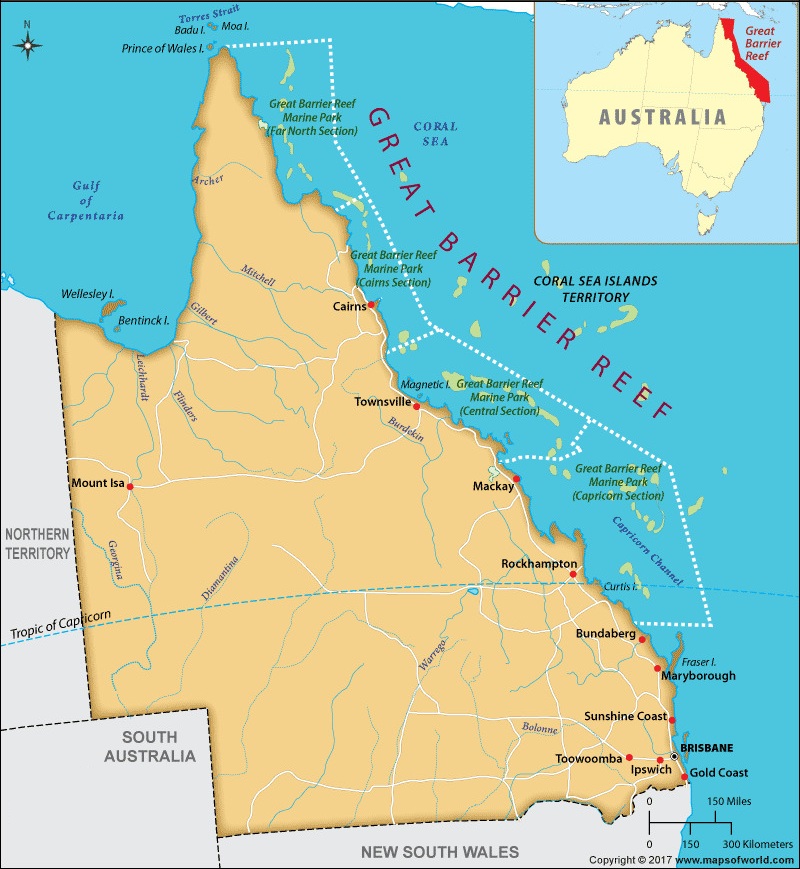
The Great Barrier Reef is facing its sharpest coral decline in 40 years, with the 2024 mass bleaching—driven by climate change, cyclones, and coral predators—severely damaging large reef areas.
About Great Barrier Reef:
Location: Coral Sea, off the northeast coast of Queensland, Australia.
Length & Area: Extends ~2,300 km; comprises ~3,000 reefs and 900 islands, covering ~350,000 square kilometers (about 10% of global coral reef ecosystems).
Biodiversity:
Hosts 400 coral species, 1,500 fish species, and 4,000 mollusk species.
Habitat for endangered species like the dugong and green turtle.
Reef Types: Includes platform reefs, wall reefs, and fringing reefs.
Protection Status:
Managed by the Great Barrier Reef Marine Park Authority.
Declared a United Nations Educational, Scientific and Cultural Organization (UNESCO) World Heritage Site in 1981.
Mass Bleaching Years: Notable events occurred in 1998, 2002, 2016, 2017, 2020, 2022, 2024, and 2025.
Coral Decline and Bleaching Events:
Main Cause: Heat stress due to climate change, particularly during marine heatwaves.
2024 Event: Fifth major bleaching since 2016; had the widest spatial impact recorded in the Australian Institute of Marine Science’s 39-year monitoring program.
Additional Damage: Cyclones (e.g., Cyclone Jasper) and flood plumes caused physical damage and freshwater stress.
Biological Threats: Crown-of-thorns starfish (COTS) outbreaks intensified coral predation, especially in the Swains sector.
2025 Survey Findings:
48% of 124 surveyed reefs showed coral decline.
Only 10% recorded an increase in coral cover.
Regional Impact: Southern Great Barrier Reef saw a 30.6% drop in hard coral cover—the sharpest annual decline ever recorded in that zone.
[UPSC 2014] The scientific view is that the increase in global temperature should not exceed 2 0 C above pre-industrial level. If the global temperature increases beyond 30 C above the pre-industrial level, what can be its possible impact/impacts on the world?
1. Terrestrial biosphere tends toward a net carbon source. 2. Widespread coral mortality will occur. 3. All the global wetlands will permanently disappear. 4. Cultivation of cereals will not be possible anywhere in the world. Select the correct answer using the code given below:
Options: (a) 1 only (b) 1 and 2 only* (c) 2, 3 and 4 only (d) 1, 2, 3 and 4 only
Since 2013, over 5 billion starfish have died along North America’s Pacific coast due to a wasting disease now linked to Vibrio pectenicida, a cholera-related bacterium.
About Starfish (Sea Stars):
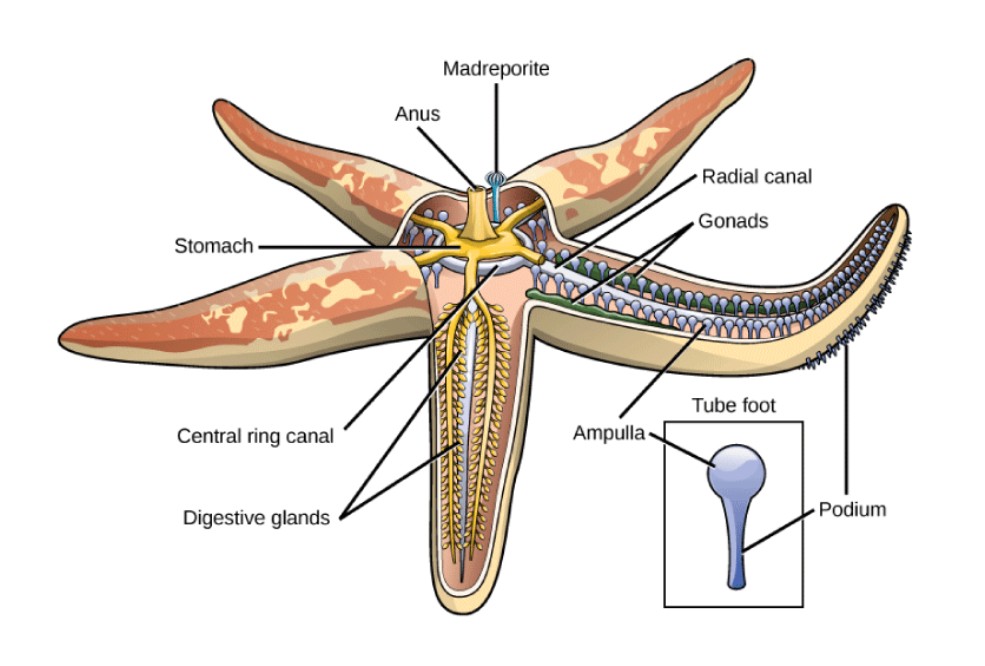
Taxonomy: Belong to phylum Echinodermata; exclusively marine organisms.
Water vascular system for respiration and circulation
Unique Features:
Regeneration: Can regrow lost limbs
No blood or brain: Seawater circulates nutrients
Eyespots: At arm tips, help sense light
Tough skin: Made of calcium carbonate
Feeding: Carnivorous, detritivorous, and scavengers
Reasons for Mass Deaths (2013–2025):
Causal Agent: Identified in 2025 as Vibrio pectenicida, a bacterium related to cholera-causing strains.
Symptoms: Limb detachment; Tissue disintegration; Melting into a pile of gunk.
Most Affected Species: Sunflower sea stars, which saw a 90% population decline.
Geographical Spread: Along the Pacific coast from Alaska to Mexico.
Ecological Consequences:
Starfish are keystone predators, especially of sea urchins.
Their decline led to urchin population explosions, which overgrazed kelp forests.
Resulted in biodiversity loss and reduced carbon sequestration.
[UPSC 2012] Vultures which used to be very common in Indian countryside some years ago are rarely seen nowadays. This is attributed to:
(a) the destruction of their nesting sites by new invasive species disease among them (b) a drug used by cattle owners for treating their diseased cattle persistent and fatal (c) scarcity of food available to them (d) a widespread, persistent and fatal disease among them
Russia officially announced its exit from the 1987 Intermediate-Range Nuclear Forces (INF) Treaty, marking a pivotal moment in the dismantling of Cold War-era nuclear arms control architecture.
What is the INF Treaty?
Signed In: 1987 by United States President Ronald Reagan and Soviet leader Mikhail Gorbachev.
Purpose: Banned ground-launched ballistic and cruise missiles with ranges between 500 and 5,500 kilometers.
Impact: Led to the elimination of 2,692 missiles by June 1, 1991.
Verification: Allowed on-site inspections, setting a benchmark for arms control agreements.
Scope: Covered both nuclear and conventional missile systems.
Significance: Became a key pillar of post-Cold War strategic stability.
Why did Russia exit the Treaty?
Cited US deployments of:
Tomahawk launchers (Philippines),
Dark Eagle hypersonic missiles (Australia).
Escalated by US nuclear submarine deployments in 2025 and rising NATO tensions.
Parliament has passed the Carriage of Goods by Sea Bill, 2025, replacing the nearly century-old Indian Carriage of Goods by Sea Act, 1925.
About Carriage of Goods by Sea Bill, 2025:
Replaces: The colonial-era Indian Carriage of Goods by Sea Act, 1925.
Purpose: Regulates the rights, duties, liabilities, and immunitiesof parties involved in shipping goods by sea from Indian ports to domestic or international destinations.
International Alignment: Retains consistency with the Hague Rules (1924), which also formed the basis of the 1925 Act.
Objective: Modernises maritime law in line with global standards and boosts India’s ease of doing business in the maritime sector.
Key Features:
Bills of Lading Defined: It outlines the details of the shipment, including the type and quantity of goods, the origin and destination, and the terms of the agreement between the shipper and the carrier.
Includes details on goods’ type, quantity, condition, and destination.
Serves as a legally bindingcontract between the shipper and carrier.
Central Government Powers:
May issue directions for implementation.
Can amend the Schedule of Rules related to bills of lading.
Part of Broader Maritime Reforms:
Supports port development and coastal trade.
Encourages creation of State Maritime Boards and a Maritime State Development Council.
Covers port safety, disaster response, pollution control, and dispute resolution.
Global Compliance: Aligns India’s shipping laws with evolving international conventions and practices.
[UPSC 2016] The term ‘import cover’, sometimes seen in the news, refers to
(a) It is the ratio of value of imports to the Gross Domestic Product of a country
(b) It is the total value of imports of a country in a year
(c) It is the ratio between the value of exports and that of imports between two countries
(d) It is the number of months of imports that could be paid for by a country’s international reserves*
The promise to deliver social welfare at scale, using data-driven algorithms, may be at the cost of ‘democratic norms’ and ‘political accountability’
India’s welfare model is undergoing a silent but radical transformation. What was once a deliberative system grounded in rights and citizen needs is now morphing into a technocratic model governed by data, code, and efficiency. This shift raises a key question: Can dignity and justice survive when welfare becomes measurable but impersonal?
From Entitlement to efficiency: The new welfare playbook
Over the past decade, India has moved from rights-based entitlements to an algorithm-led delivery model—what scholars call a technocratic calculus.
Aadhaar: Over 1 billion enrolled; enables biometric verification to curb duplicate beneficiaries.
DBT (Direct Benefit Transfers): 1,206 schemes unified under Aadhaar; ₹3.48 lakh crore saved via leakages plugged.
CPGRAMS and grievance portals: 36 digital platforms now streamline complaints.
That’s the infrastructure. But the implications run deeper. This marks a shift from deliberative welfare (based on rights and dialogue) to calculative welfare (based on metrics like coverage, leakage, speed).
Promises vs. Perils:
1. Efficiency vs. Empathy
Welfare delivery is now fast, traceable, and auditable. But it risks treating citizens as data profiles, not as individuals with needs. Algorithms can’t ask moral questions. Bureaucrats avoid hard choices by letting systems decide.
2. Political Accountability Diluted
Leaders now point to dashboards instead of taking responsibility. Decisions on who deserves support are increasingly delegated to code.
3. Institutions Under Strain
RTI backlog: Over 4 lakh pending cases (June 2024)
Vacant CIC posts: Weakens transparency
CPGRAMS: Acts more like a ticketing system, not a democratic grievance platform. Visibility is centralised, but not responsibility.
4. Shrinking Social Sector Investment
Welfare spending has dropped from 21% to 17% of GDP (2014–2025)
For vulnerable groups (SCs, minorities, labour, nutrition), allocations shrank from 11% pre-COVID to just 3%
The paradox: as delivery gets smarter, commitments get thinner.
The Deeper democratic concern:
When welfare turns technical, it becomes less political. Philosopher Habermas warned of this: expert-rule can silence democratic debate. In India’s case, welfare governance is increasingly auditable, but less answerable.
What Needs Fixing?
Embed human judgement in digital systems: Algorithms should aid, not override, political reasoning.
Revive deliberative spaces: Local bodies, gram sabhas, and social audits must regain teeth.
Reinvest in social sector spending: Efficiency must not justify austerity.
Reimagine grievance redressal: Make platforms citizen-centric, not just data-driven.
Way forward:
Federal Pluralism: Empower States to design context-sensitive welfare regimes, reinforcing federalism and pluralism.
Impact Audits: Institutionalise community-driven impact audits through Rashtriya Gram Swaraj Abhiyan and Gram Panchayat Development Plans.
Platform Cooperatives: Build platform cooperatives in all States with self-help groups as intermediaries, inspired by Kerala’s Kudumbashree.
Civic Engagement: Incentivise civil society to promote grassroots political education and establish legal aid clinics for stronger community accountability.
Resilience Mechanisms: Strengthen and codify offline fallback systems, human feedback safeguards, and statutory bias audits.
Digital Rights: Embed the “right to explanation and appeal” in digital governance frameworks, in line with UN Human Rights recommendations.
Digital welfare is not the problem. The problem is when it replaces, not supports, democracy. India must blend technology with trust, efficiency with empathy, and code with conscience. Only then can welfare remain a tool for justice—not just for savings.
Possible GS2 Mains Question:
India’s welfare governance has shifted from rights-based entitlement to algorithmic delivery. Critically examine the democratic and institutional implications of this shift. Suggest reforms to align technology with constitutional values.
The J&K Reorganisation Act was passed in Parliament on August 6, 2019. It gave the Centre, through the Lieutenant Governor, a heightened legislative role in J&K, and put the bureaucratic apparatus in the UT under the Union Home Minister.
Importance of the topic:
The demand for restoring J&K’s statehood is central to ongoing political discourse, federalism, and Centre–State relations. It involves constitutional questions about autonomy, democratic representation, and legislative authority. Understanding this issue is essential for both Indian Polity and Governance sections of GS Paper II and current affairs-based Mains questions. Six years after the abrogation of Article 370 and the passage of the Jammu and Kashmir Reorganisation Act, 2019, the question of restoring full statehood to J&K is back in political and judicial discourse. While the Supreme Court upheld the abrogation in December 2023, it also urged the Union Government to restore statehood at the earliest, ideally before the next Assembly elections.
Understanding the Jammu & Kashmir Reorganisation Act, 2019
The J&K Reorganisation Act, passed in August 2019, radically altered the political geography of India by:
Bifurcating the former state into two Union Territories (UTs): Jammu & Kashmir (with a legislative assembly) and Ladakh (without a legislative assembly)
Repealing Article 370, which had conferred special status to J&K.
Ending the state’s Constitution, flag, and autonomy in various matters.
How Was the Act Passed?
It was passed under Article 3 of the Constitution, which empowers Parliament to change the boundaries or status of any state. The Constitution (Application to J&K) Order, 2019 extended all provisions of the Indian Constitution to J&K. A Presidential Order, followed by resolutions in Parliament, enabled the effective nullification of Article 370.
This method has been legally contentious, with debates about: Whether Article 370 could be abrogated without the consent of the erstwhile State Assembly and Whether a UT can be created out of a full-fledged state without a constitutional amendment.
Why Restoration of Statehood is Important:
Democratic Legitimacy: A Union Territory is governed by the Centre, with limited powers to the local legislature (like Delhi). Statehood would return full legislative powers and autonomy to the elected J&K government.
Political Participation and Stability: Full statehood may encourage wider participation in elections and a return to mainstream politics in the Valley.
Judicial Recommendation: The Supreme Court (2023) noted that UT status must be temporary and urged a time-bound plan for restoration.
Rebuilding Trust: Statehood is seen as a step to win back the confidence of the local population, especially after internet shutdowns, detentions, and security clampdowns.
Challenges in Restoring Statehood
Security Concerns: Terror threats and infiltration risks persist. The government may delay full devolution until there is a more stable security environment.
Geopolitical Tensions: China and Pakistan continue to contest India’s sovereignty over J&K and Ladakh. Strategic concerns may shape decisions.
Administrative Realignment: The reorganisation involved restructuring administrative units, services, and legal frameworks. Reversing some of those may create bureaucratic hurdles.
Political Control by the Centre: The current arrangement allows the Centre direct control. Restoring statehood might reduce this control, especially if opposition parties dominate the future assembly.
Need for Election Readiness
Value Addition:
Article 3 of the Constitution of India:
Article 3 of the Indian Constitution grants the Parliament significant powers related to the internal reorganization of the states and union territories within the Union of India.
Under Article 3, Parliament can:
Form new states by combining or separating territory from existing states or union territories.
Increase or decrease the area of any state.
Alter the boundaries or change the name of any state
For Parliament to exercise these powers, a Bill must be introduced with the President’s prior recommendation. If the Bill impacts a state’s area, boundaries, or name, the President must seek the state legislature’s views within a specified timeframe. However, these views are not binding on Parliament. Bills under Article 3 are passed by a simple majority and are not considered constitutional amendments under Article 368.
With such a levy on high-end goods, spending on luxury will become a visible public act of support for the armed forces. In an era of evolving warfare, from stealth jets to AI-driven drones, India’s defence preparedness is no longer optional, it is existential. This article proposes a ‘Defence Cess’ on luxury goods and services, offering a creative, emotionally resonant, and fiscally sustainable mechanism to ring-fence funds for military modernisation. This issue links directly to GS Paper II (Governance), GS Paper III (Security and Economy), and GS IV (Ethics, especially public accountability and duty).
The Strategic Urgency: Why Modernisation Can’t Wait
India is increasingly surrounded by hostile neighbours with fast-upgrading military capacities:
Pakistan may soon induct stealth fighters like J-20 or J-35 from China.
China is testing sixth-generation aircraft and has strong cyber and drone warfare capabilities.
The Indian Air Force (IAF), by contrast, operates only 32 squadrons vs the sanctioned strength of 42 — leaving India strategically exposed in contested airspace.
Key Quote: “Capability alone is not enough. The country cannot afford to be vulnerable.”
Modernisation is Existential, Not Aspirational
India’s military modernisation roadmap is ambitious but underfunded. It includes:
Fifth-generation fighter aircraft development (AMCA)
Indigenous jet engine programmes
Strategic unmanned aerial vehicles (UAVs)
Electronic warfare (EW) and cyber-capacity enhancement
But while intent exists, execution suffers from fragmented schemes, budgetary limitations, and lack of dedicated long-term funding.
The Defence Cess Proposal: Key Features
A 5–10% surcharge on ultra-luxury goods and services like High-end cars, Private jets, Imported luxury watches, Premium liquor, etc.
Clearly itemised on invoices as “Raksha Cess”
Funds are non-lapsable, targeted, and traceable
Exclusively for capital expenditure in Procurement, R&D, Infrastructure for defence
Global Parallels and Precedents
Defence/Strategic Taxation Model
Italy
Luxury tax on yachts and helicopters during Eurozone crisis
These countries have used fiscal mechanisms not just to fund strategy but to shape public narratives, blending consumption with national responsibility.
Why a Defence Cess Works for India
Psychological and Symbolic Impact: The idea of contributing directly to the betterment of Indian defence through luxury spending has strong emotional appeal. It creates a moral linkage between indulgence and national duty converting private consumption into public solidarity. Naming it “Raksha Cess” makes it resonate with patriotism and responsibility.
Fiscal Innovation Without Burdening the Masses: India’s direct tax base is relatively narrow, and increasing defence funding through general taxation could hurt the middle class or poor. This cess targets only high-end consumers, ensuring that additional fiscal pressure is placed on those most capable of bearing it. Luxury spending has grown significantly with India’s rising affluent class, this captures a booming sector for national good.
Transparency and Traceability: Since the cess is itemised separately on invoices, it allows greater transparency. It increases trust in government utilisation and may lead to greater tax compliance if people know exactly where their money goes. With digitised billing and GST-era infrastructure, monitoring and reporting mechanisms already exist to track such surcharges.
Dedicated, Ring-Fenced Defence Fund: Current defence allocations are diluted across revenue expenses and pensions. It helps bypass routine bureaucratic delays and ensures directed capital spending. A defence cess would be non-lapsable and strictly for capital expenditure — such as: Acquiring new aircraft, R&D in defence tech and Indigenous manufacturing. This enables long-term strategic planning free from annual budget cycles.
Aligns India With Global Practices: Many countries (Italy, Sweden, China) have used luxury taxation or targeted levies to support strategic sectors or correct fiscal imbalances. India can draw from these models to introduce a fiscally sound and globally validated mechanism.
Boosts the Narrative of Nation-Building: In an era where narratives matter, this proposal encourages voluntary nation-building and elite participation in national security. It sends a message that “those who benefit most from India’s rise should contribute most to its protection.”
Challenges in Implementing a Defence Cess:
Legal and Fiscal Complexity: Introducing a cess outside the GST framework may face legal and administrative hurdles, requiring amendments or coordination with the GST Council. There may be opposition from States citing federal fiscal concerns
Risk of Misuse or Leakage: Any fund not managed with full transparency and oversight can fall prey to inefficiency or corruption. Strong audit systems and public reporting mechanisms must be built into the cess architecture from the outset.
Need for a Clear Governance Structure: A dedicated body or fund management unit should be created under the Ministry of Defence or PMO, preferably with civil society representation for accountability. Without such a structure, funds may be diverted or underutilised.
Revenue Predictability and Scale: Luxury consumption is inelastic but cyclical, it may dip during economic downturns. The fund should not be over-relied upon for core defence needs; rather, it must act as a complementary booster.
Perception Management and Political Pushback: Some may view this as a populist or performative move, or even as a “sin tax on success”. There must be consistent and transparent communication that this is about contribution, not punishment.
Moral Optics and Class Tensions: Care must be taken to avoid triggering class resentment or elite backlash, especially if the tax seems punitive. Framing it as “a privilege with purpose” is crucial — the messaging has to be inclusive, not divisive.
Conclusion: From Passive Consumers to Active Nation-Builders
India’s national security demands not just better weapons, but a sustainable model of public contribution and political imagination. A well-designed defence cess could convert elite indulgence into national insurance, creating a visible alignment between privilege and responsibility.
Value Addition
India’s Defence Modernisation:
What Has Been Done:
What is being planned
Tejas Mk-1A production initiated (HAL)
Strategic partnerships under DPP-2020 for indigenous manufacturing
Agni Prime, INS Vikrant, and SAM systems development
Defence exports crossed ₹21,000 crore in 2023-24
Emergency procurement powers given to armed forces post-Galwan
AMCA (Advanced Medium Combat Aircraft) — 5th Gen fighter
Twin-engine deck-based fighter (TEDBF) for Navy
India-US Jet Engine Deal (GE-HAL) under iCET
India-France agreement for submarine co-development
Cyber and AI warfare units under Theatre Command model
Important Agreements and Collaborations:
Country
Collaboration
USA
iCET, Jet Engine tech transfer (GE -F414)
France
Rafale aircraft, scorpene submarine
Israel
Missile defence (Barak-8)
Russia
S-400 Missile systems, AK-203 Rifles
Important Defence Policies:
Defence Acquisition Procedure (DAP) 2020:Goal: To streamline the procurement process for the Indian Armed Forces, promoting indigenization and efficiency. Prioritizes “Buy Indian” categories, Enhanced Indigenous Content (IC), Simplification of Trial and Testing Procedures and has Emphasis on Make and Innovation.
Innovations for Defence Excellence (iDEX):Goal: To foster an ecosystem for innovation and technology development in the defence and aerospace sectors, leveraging the potential of startups, MSMEs, academia, and individual innovators. It is managed by Defence Innovation Organization (DIO), a not-for-profit company founded by Hindustan Aeronautics Limited (HAL) & Bharat Electronics Limited (BEL).
DRDO’s 5-Year Roadmap (Vision 2025): Goal: To lead India towards self-reliance in defence technologies and become a global leader in defence research and development.