India met its 20% ethanol blending (E20) target in petrol by March 2025 — five years early. Talks are now on to raise the blending ratio further in the immediate future.
About Ethanol Blended Petrol (EBP) Programme:
Launched in 2003 by the Ministry of Petroleum and Natural Gas.
Objective: Promote use of renewable, domestically produced ethanol in petrol.
Nationwide rollout (except A&N and Lakshadweep) since April 2019.
Feedstock:
1G Ethanol: From sugarcane molasses, maize, rice.
2G Ethanol: From agricultural residues like rice straw, bamboo, bagasse.
Blending Progress:
1.6% in 2013–14
11.8% in 2022–23
20% achieved in March 2025 (E20)
Future Plans:
Discussions on E27 blending target by 2030.
Government exploring flex-fuel vehicles (e.g., E85-capable (dual-fuel) cars).
India’s Achievements:
Environmental Gains: 19.2 million tonnes of CO₂ emissions avoided (2014–2021).
Economic Impact: ₹26,000 crore saved in foreign exchange via reduced oil imports.
Industrial Growth:
Distillery capacity scaled up with interest subvention support.
Flex-fuel vehicles showcased by major automakers in 2025.
Farmer Benefit: Creates demand for sugarcane and grains, increasing farm income.
Limitations:
Technical Challenges
Lower mileage with E20 due to reduced energy content.
Older vehicles may face engine compatibility issues.
Flex-fuel technology adoption still limited.
Economic Concerns
No drop in fuel prices despite ethanol savings.
Consumer hesitation due to lack of visible benefits.
Environmental Trade-offs
High land and water use for ethanol crops (especially sugarcane).
Food security risks from diverting food crops for fuel.
Need for Diversification
Majority of ethanol still from sugarcane; limited 2G ethanol usage.
Need to promote biomass-based ethanol (wood chips, crop residue).
[UPSC 2025] Consider the following statements:
Statement I: Of the two major ethanol producers in the world, i.e., Brazil and the United States of America, the former produces more ethanol than the latter.
Statement II: Unlike in the United States of America where corn is the principal feedstock for ethanol production, sugarcane is the principal feedstock for ethanol production in Brazil.
Which one of the following is correct in respect of the above statements?
(a) Both Statement I and Statement II are correct and Statement II explains Statement I
(b) Both Statement I and Statement II are correct but Statement II does not explain Statement I
(c) Statement I is correct but Statement II is not correct
(d) Statement I is not correct but Statement II is correct *
In a move to combat rhino poaching, the University of the Witwatersrand in South Africa, supported by the International Atomic Energy Agency (IAEA), has launched the Rhisotope Project.
Initiation: Concept began in 2021; formally launched in July 2024.
Objective: Prevent rhino poaching by making horns traceable and unsuitable for illegal trade.
Pilot Site: Waterberg Biosphere Reserve, South Africa.
Pilot Implementation: 20 rhinos injected with radioisotopes (exact isotope remains undisclosed) for testing.
How the Isotope Tagging Works?
Isotope Basics: Uses radioactive isotopes that emit detectable radiation as they decay.
Injection Method: A small hole is drilled into the horn; a low dose of isotope is inserted safely.
Detection Mechanism: Radiation Portal Monitors at ports can detect tagged horns—even inside 40-foot containers, as proven using 3D-printed horn simulations.
Significance:
Safety Assurance: No damage to rhinos observed; cytological tests showed no cellular or physiological harm.
Impact on Illegal Trade: Horn becomes detectable, unusable, and toxic for illegal human consumption.
[UPSC 2019] Consider the following statements:
1. Asiatic lion is naturally found In India only. 2. Double-humped camel is naturally found in India only. 3. One-horned rhinoceros is naturally found in India only.
Which of the statements given above is / are correct?”
Options: (a) 1 only * (b) 2 only (c) 1 and 3 only (d) 1, 2 and 3
To align ancient Indian diets with modern nutrition, FSSAI and the Ministry of Ayush have released an official list of food items under the Ayurveda Aahara category.
About Ayurveda Aahara:
Definition: Refers to food products based on Ayurvedic dietary principles—focused on balance, seasonality, and natural, therapeutic ingredients.
Objective: Ensures standardisation, safety, and consumer trust in Ayurvedic dietary practices.
Legal Framework: Regulated under the Food Safety and Standards Authority of India’sAyurveda Aahara Regulations (2022).
Textual Basis: Product list notified under Note (1) of Schedule B, grounded in classical Ayurvedic texts listed in Schedule A.
Standards: Foods must follow authentic Ayurvedic recipes, ingredients, and preparation methods.
New Product Inclusion: Food Business Operators (FBOs) can propose additions by citing authoritative Ayurvedic sources.
Institutional Support: Endorsed by the National Institute of Ayurveda and the Ministry of Ayush; the Ayush Aahara Compendium offers scientifically validated formulations for industry use.
Significance:
Health Benefits: Supports preventive health, digestion, and immunity through time-tested dietary wisdom.
Cultural Revival: Reconnects with India’s ancient food traditions, including those from the Sangam era; recognised globally alongside Yoga and Millets.
Regulatory Clarity: Provides structured guidelines to manufacturers, enabling ease of business and consumer confidence in authenticity.
[UPSC 2017] Which of the following are the objectives of ‘National Nutrition Mission’?
1. To create awareness relating to malnutrition among pregnant women and lactating mothers.
2. To reduce the incidence of anaemia among young children, adolescent girls and women.
3. To promote the consumption of millets, coarse cereals and unpolished rice.
4. To promote the consumption of poultry eggs.
Select the correct answer using the code given below:
Options: (a) 1 and 2 only* (b) 1, 2 and 3 only (c) 1, 2 and 4 only (d) 3 and 4 only
India’s Mutual Fund (MF) industry has witnessed exponential growth, with Assets Under Management (AUM) reaching ₹74.40 lakh crore as of June 2025, a sevenfold increase over the past decade.
What are Assets Under Management (AUM)?
Definition: AUM refers to the total market value of financial assets (stocks, bonds, etc.) managed by an investment firm on behalf of clients.
Growth Drivers:
Net investor inflows and redemptions
Market performance
Dividend reinvestments
Importance:
Indicates fund size, investor confidence, and fund stability
Reflects fund manager performance and popularity
Higher AUM allows better liquidity and portfolio diversification
Impacts management fees and minimum investment limits
What is a Mutual Fund?
Definition: A mutual fund pools money from multiple investors to invest in a diversified portfolio.
Management: Handled by professional fund managers to balance risk and return.
Unit-Based Investment: Investors purchase fund units; each unit’s value is called the Net Asset Value (NAV), which changes with market movement.
Classification of Mutual Funds
a. Based on Asset Class:
Equity Funds: Invest in stocks; includes large-cap, mid-cap, and small-cap funds.
Debt Funds: Invest in bonds and other fixed-income instruments.
Hybrid Funds: Mix of equity and debt for balanced risk-return.
b. Based on Investment Objective:
Growth Funds: Focus on capital appreciation; suitable for long-term investors.
Income Funds: Aim for regular income via bonds/dividends.
Liquid Funds: Invest in short-term debt; low risk and high liquidity.
Pension Funds: Meant for retirement; long-term return-focused.
c. Based on Structure:
Open-ended Funds: Investors can enter or exit anytime; highly liquid.
Closed-ended Funds: Fixed maturity; investments only during the initial offer period.
Interval Funds: Allow purchase/redemption only at specific intervals.
[UPSC 2025] Consider the following statements:
I. India accounts for a very large portion of all equity option contracts traded globally, thus exhibiting a great boom. II. India’s stock market has grown rapidly in the recent past, even overtaking Hong Kong’s at some point in time. III. There is no regulatory body either to warn small investors about the risks of options trading or to act on unregistered financial advisors in this regard.
Which of the statements given above are correct?
Options: (a) I and II only * (b) II and III only (c) I and III only (d) I, II and III
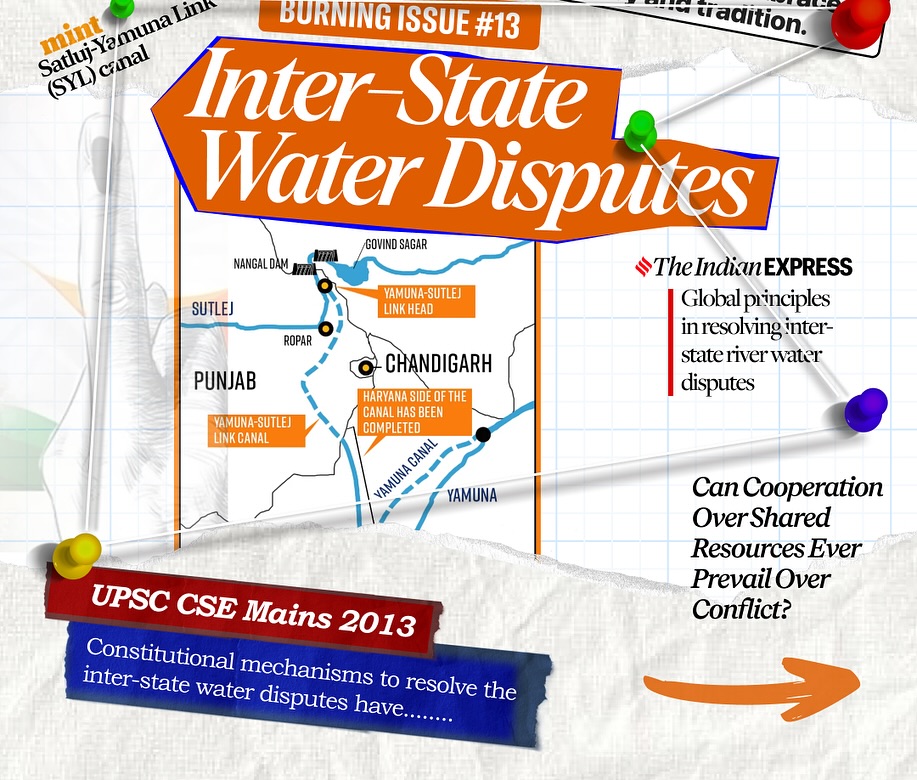
N4S: Rivers unite India, but politics keeps dividing them – and this article shows how. UPSC often frames water disputes as system-failure questions (like the 2013 mains on structural vs process flaws). Many just cite Cauvery or case laws, but miss deeper issues – no standing tribunal, murky data, Centre-state blame games – all unpacked under “Fundamental Structural Ambiguities” and “Challenges in Tribunal Functioning.” This piece fills that gap. It maps how tribunals crawl (“Process of Dispute Resolution”), why awards stall (Cauvery took 17 years), and how Article 262’s vagueness lets disputes return to the Supreme Court.
Bonus: it blends legal structure with lived realities-like Sutlej farmers in “Punjab-Haryana Water Dispute”-so you can fuse policy with people in your answers.
PYQ ANCHORING
GS 2: Constitutional mechanisms to resolve the inter-state water disputes have failed to address and solve the problems. Is the failure due to structural or process inadequacy or both? Discuss. [2013]
MICROTHEMES: Nature of Indian Federalism
“Dip your feet in the Sutlej, and feel the cool embrace of history and tradition.” – This belief draws people to the sacred rivers of Punjab and Haryana, rivers that have nourished these lands for centuries. But while these waters have sustained generations, they are now at the heart of one of India’s most contentious water disputes.
Tensions flared after Bhakra Beas Management Board’s decision to release 4,500 extra cusecs from Bhakra to Haryana, triggering strong political and legal pushback from Punjab. As the states clash, the rivers they rely on bear the brunt.
So, how did we reach this point? Can cooperation over shared resources ever outweigh the political tug-of-war? And most critically, can we find a solution that ensures fair access to water while preserving the future of these lifelines?
About the Punjab-Haryana Water Dispute
The Punjab-Haryana water sharing dispute is not new. It has deep historical roots that go back to the very formation of Haryana as a separate state, and revolves around the complex sharing of river waters, unfinished projects, and political sensitivities that have lasted for decades.
The dispute dates back to 1966 when Haryana was created from Punjab and was promised a share of river waters from the Ravi and Beas rivers.
The Satluj-Yamuna Link (SYL) canal was proposed to deliver Haryana’s share but remains incomplete due to Punjab’s resistance.
The current issue involves Punjab and Haryana over the release of additional water from the Bhakra dam, managed by the Bhakra Beas Management Board (BBMB).
On April 30, 2025, BBMB ordered the release of 8,500 cusecs of waterto Haryana for drinking needs, which Punjab opposed, claiming Haryana had already withdrawn 104% of its annual share.
Water levels in the Bhakra, Pong, and Ranjit Sagar dams are low due to poor snowfall in the Himalayas.
Punjab argues that BBMB’s decision is unilateral and has refused to open the Nangal dam sluice gates.
Process of Dispute Resolution
Steps
Details
Legal Basis
Disputes resolved under Inter-State River Water Disputes (IRWD) Act, 1956; supported by Article 262 of the Constitution.
Initial Step
A state government formally complains to the Centre, stating a dispute exists or may arise.
Central Government Role
Examines the matter and tries to resolve it via negotiation. If it fails, a tribunal is formed.
Tribunal Formation
Ad hoc tribunal is set up with a chairperson (Supreme Court judge), judicial members, and technical experts.
Tribunal Proceedings
States present technical and legal arguments. Tribunal studies rainfall, usage patterns, crop needs, etc.
Timelines
Originally, no time limit. Disputes often take decades. 2019 amendment proposes stricter timelines.
Legal Binding Nature
Award becomes binding once notified in the Gazette by the Centre. Awards can’t be challenged in ordinary courts.
Enforcement Mechanism
No strict enforcement mechanisms; states delay or defy compliance due to political reasons.
Judicial Oversight
Though barred under Article 262, states approach SC under Articles 131 or 136 in practice.
Reform Proposals
2019 Bill proposes permanent tribunal, Dispute Resolution Committee (DRC), and data agency.
Fundamental Structural Ambiguities in resolving disputes
1. Institutional and Procedural Gaps
Ad hoc nature of tribunals: Tribunals are formed only after disputes reach a crisis stage; there’s no permanent mechanism.
Absence of strict timelines: Until the 2019 amendment, tribunals had no binding deadlines, leading to long delays (e.g., Cauvery tribunal took 17 years).
No clear enforcement mechanism: Awards need central notification to become binding, and even then, enforcement remains weak.
Overlapping forums and lack of finality: Multiple forums (tribunals, SC, Centre) operate simultaneously, with unclear jurisdictional limits.
2. Federal and Political Tensions
Centre-state friction: States often allege the Centre’s decisions are politically influenced (e.g., Tamil Nadu vs. Karnataka).
Perceived partiality in dispute resolution: The Centre’s dual role as a neutral arbiter and political actor creates trust deficits.
3. Legal and Constitutional Ambiguity
Judicial overlap: Article 262 restricts SC’s role once a tribunal is set up, but states still approach courts via Articles 131 or 136, causing confusion.
Lack of clarity on legal hierarchy: It’s unclear how tribunal awards interact with constitutional rights and Supreme Court judgments.
4. Data and Technical Challenges
Opaque data-sharing: No standardized, independent authority to collect and verify hydrological data.
Technical weakness: Lack of scientific modelling or agreed methodologies for calculating water sharing, flows, and drought management.
5. Absence of Preventive and Cooperative Mechanisms
No early conflict resolution systems: There are limited platforms for dialogue or mediation before legal escalation.
Underutilised river boards and inter-state coordination bodies: Mechanisms like river boards (per River Boards Act, 1956) have rarely been established or made effective.
6. Normative and Equity Framework Gaps
Unclear role of equity and sustainability: No codified framework for factoring in historical use, equity among stakeholders, or ecological needs.
Inconsistent tribunal reasoning: Different tribunals apply varying standards of equity, population needs, and usage history, lacking uniformity.
Challenges in tribunal functioning
1. Delays and Lack of Time-Bound Resolution
Slow constitution of tribunals: The Centre often takes years to constitute a tribunal even after a dispute is formally raised by states.
Prolonged proceedings: Tribunals frequently take over a decade to deliver awards.
Example: The Cauvery Water Disputes Tribunal was constituted in 1990 and gave its final award only in 2007 — a gap of 17 years.
2. Non-Binding Nature and Delayed Notification of Awards
Tribunal awards do not become binding until notified by the central government, creating room for political delay.
Example: Cauvery award remained unimplemented for years due to notification delays and legal-political wrangling.
3. Enforcement Challenges
No institutional mechanism for enforcement: Even after notification, compliance depends on political will and Centre’s intervention.
States refuse compliance in politically sensitive times or if the award is seen as unfavorable.
Example: Karnataka’s reluctance to release Cauvery waters post-tribunal award led to recurring standoffs.
4. Jurisdictional Ambiguity and Judicial Overlap
Though Article 262 bars SC intervention once a tribunal is set up, states still approach courts under Article 131 or 136.
This leads to parallel litigation and confusion over final authority.
Example: Both Karnataka and Tamil Nadu moved the Supreme Court after the Cauvery award, despite an existing tribunal.
5. Lack of Uniform Standards and Precedents
Each tribunal applies different criteria — some focus on historical usage, others on economic needs or ecological flows.
This lack of standard methodology leads to inconsistency and perceived unfairness.
Example: The Krishna tribunal gave weightage to catchment area and utilization, while Cauvery focused more on crop water needs.
6. Political Interference and Erosion of Trust
Perception that tribunal processes are politically influenced, especially when the Centre delays action or notification.
States lose faith in tribunal neutrality if the ruling party at the Centre is seen favoring a particular state.
7. Absence of Permanent Institutional Framework
Each dispute leads to an ad hoc tribunal with fresh staffing, rules, and procedures.
No continuity or institutional memory is maintained.
8. Technical and Data Disputes
Lack of transparent, real-time, and credible hydrological data hampers tribunal assessment.
States often dispute each other’s data; no independent river basin authority exists to validate claims.
Example: In Mahanadi dispute, Odisha and Chhattisgarh had conflicting data on water usage and flow patterns.
Way Forward
Time-Bound Tribunal Process Amend the Inter-State River Water Disputes Act to set fixed timelines for tribunal awards and their publication in the Gazette.
Establish a Permanent Tribunal Create a standing tribunal with multiple expert benches to handle disputes continuously and reduce delays.
Set Up River Basin Authorities Form inter-state basin organizations for key rivers to manage planning, usage, and dispute prevention jointly.
Strengthen Centre-State Coordination Use platforms like the Inter-State Council and NITI Aayog for political dialogue and consensus building.
Adopt Global Norms Incorporate international principles like the Berlin Rules and Integrated Water Resources Management (IWRM) for fair and sustainable sharing.
Use Technology for Transparency Deploy real-time water monitoring and forecasting systems to promote data sharing and reduce mistrust.
#BACK2BASICS: Global principles in resolving inter-state river water disputes
Norm / Rule / Convention
Key Principle
Relevance to India
Helsinki Rules (1966)
Equitable and reasonable use of watercourses; Obligation not to cause appreciable harm to other states
Though non-binding, this principle supports fair sharing in Indian disputes like Krishna and Cauvery
UN Convention on the Law of the Non-Navigational Uses of International Watercourses (1997)
Reinforces principles of equitable use, prior notification, and cooperation between riparian states
Reflects the need for basin-level cooperation in India’s inter-state river basins (e.g., Mahanadi)
Berlin Rules (2004)
Expands Helsinki Rules to include environmental sustainability, public participation, and human rights
Calls for river management in India to consider ecological flows and inclusive planning (e.g., Western Ghats rivers)
Integrated Water Resources Management (IWRM)
Promotes coordinated development and management of water, land, and related resources across sectors
Emphasizes basin-level institutions like river basin authorities, which India lacks formally
Principle of Prior Notification and Consultation
States must inform and consult co-basin states before undertaking major projects
Could reduce friction as seen in Polavaram (Andhra–Odisha–Telangana) and Mahanadi (Chhattisgarh–Odisha) disputes
No Significant Harm Principle
A state should not cause significant harm to others through its water use
Applicable to disputes involving upstream usage impacting downstream states (e.g., Yamuna, Cauvery)
Obligation to Cooperate
Countries (or states) must cooperate in good faith to manage shared resources
This is lacking in many Indian disputes marked by political one-upmanship
Constitutional Provisions on Water Resources
The legal framework that governs water sharing and disputes in India is grounded in the Constitution.
Article 262 of the Indian Constitution: This article provides a specific mechanism for the resolution of inter-state river water disputes. It empowers Parliament to enact laws to adjudicate such disputes, barring the jurisdiction of the courts. It has been the basis for the creation of the Inter-State Water Disputes Act, 1956.
Water as a Union Subject (Article 246): Under the Constitution, water resources and their management primarily fall under the Union List (List I) of the Seventh Schedule. However, states are given jurisdiction over “water” under the Concurrent List, which leads to potential conflicts when inter-state water disputes arise.
Inter-State Water Disputes Act, 1956: The Act provides a detailed legal framework for resolving inter-state water disputes. It stipulates that if states cannot resolve a dispute by negotiation, a Water Disputes Tribunal is to be constituted. This process is critical in managing conflicts like the one between Punjab and Haryana.
Doctrine of Equitable Distribution: This principle, implied in Indian water law, suggests that water should be distributed fairly among states. However, the execution of this principle often faces challenges, particularly in the context of regional differences and political dynamics, as seen in the Punjab-Haryana dispute.
The Role of Parliament: Parliament holds the authority to resolve issues of inter-state water disputes by passing legislation. For example, the Cauvery Water Disputes Tribunal was created under a Parliamentary law, although delays in such decisions have often exacerbated tensions between states.
SMASH MAINS MOCK DROP
Despite constitutional provisions and legislative mechanisms, inter-state river water disputes in India remain unresolved for decades. Analyse the structural, political, and legal factors contributing to this failure. Suggest reforms to ensure time-bound, equitable, and enforceable resolution of such disputes.”
As questions emerge over the conduct of elections in India, restoring faith in the Election Commission is crucial to safeguarding democratic legitimacy.
Context and Relevance (GS2 – Polity and Governance, Constitutional Bodies):
The Election Commission of India (ECI), a constitutionally mandated body under Article 324, is once again in the spotlight. Following the 2024 general elections, allegations from political leaders, including Rahul Gandhi and Tejashwi Yadav, have cast a shadow over the Commission’s neutrality and transparency. These charges revive a critical debate: Can India’s democracy survive without full public trust in its electoral machinery? The answer lies in the integrity, independence, and accountability of the Election Commission, one of the bedrocks of India’s representative democracy.
Why Is Electoral Credibility So Vital?
Democratic legitimacy stems not just from elections being conducted, but from them being widely perceived as free, fair, and impartial.
If losers in elections feel the process was biased or manipulated, public trust erodes, similar to a rigged court trial or fixed sporting match.
Thus, electoral bodies must maintain absolute transparency to avoid a crisis of trust.
What are the Allegations?
Discrepancies in Voter Rolls: A Member of Parliament has hinted at large-scale discrepancies in the 2024 elections. Tejashwi Yadav alleged that his name was missing from the electoral rolls in Bihar due to a mismatch in his EPIC (voter ID) number.
Opacity in VVPAT Functioning: The Voter Verifiable Paper Audit Trail (VVPAT), a critical component of EVMs, has been flagged for lack of transparency. Unlike the Ballot Unit and Control Unit, the VVPAT contains software and is centrally programmed — raising questions about tamper-proofing and auditability.
Arbitrary VVPAT Tallying: The process of randomly tallying VVPAT slips with EVM counts has become highly discretionary, leading to low public confidence.
ECI’s Defensive Posture: Rather than addressing concerns head-on, the ECI has simply rejected tampering allegations and asked parties to raise objections “at the appropriate time”.
Wider Implications for Indian Democracy
Public Trust in Institutions: Without visible impartiality, even a fair process may be discredited by perception. This impacts citizen engagement, voter turnout, and social cohesion.
Level Playing Field in Elections: If major opposition leaders claim unfair treatment, it undermines the equality of contest fundamental to electoral democracy.
Rule of Law and Accountability: The ECI is not above public scrutiny. While insulated from political pressure, it must remain answerable to constitutional values and public confidence.
Judicial Oversight and Electoral Reforms: Calls may grow for stronger judicial or parliamentary oversight of ECI decisions — or reforms such as: Collegium system for appointing Election Commissioners, Mandatory disclosures of EVM-VVPAT audit protocols.
Way Forward
Ensure Real Transparency: ECI should publish standard operating procedures for VVPAT tallying and voter roll revision.
Independent Audit Mechanisms: Encourage third-party audits and real-time grievance tracking for electoral complaints.
Reform ECI Appointments: Move from Executive-dominated selection to a multi-member collegium including CJI, opposition leaders, and the President.
Digital Literacy and Voter Awareness: Boost public understanding of electoral tech like EVMs and VVPAT to counter misinformation and suspicion.
Conclusion:
India’s electoral democracy is only as strong as its citizens’ belief in its fairness. As a constitutional guardian of that belief, the Election Commission must go beyond legal compliance and strive to uphold both institutional credibility and democratic trust. A recalibration is urgently needed — not just for politicians or parties, but for the citizen-voter, who is the ultimate stakeholder in the democratic process.
“The credibility of democratic institutions lies not just in their constitutional design but in public perception of their impartiality.” In light of recent controversies, critically examine the functioning of the Election Commission of India. Suggest reforms to strengthen its autonomy and transparency.
Value Addition:
Constitutional Articles related to ECI
Article 324: Vests the superintendence, direction, and control of elections in the ECI.
Article 325: One general electoral roll for every territorial constituency.
Article 326: Elections to Lok Sabha and State Assemblies to be based on adult suffrage.
Article 327: Power of Parliament to make provisions with respect to elections.
Article 328: Power of State Legislature to make provisions relating to elections.
Article 329: Bar to interference by courts in electoral matters.
Voter Verified Paper Audit Trail (VVPAT)
VVPAT is an independent system attached to EVMs that allows voters to verify that their vote has been cast correctly.
It generates a printed slip with the candidate’s name and symbol, visible for 7 seconds before being dropped into a sealed box.
First used in India: 2013 in Nagam (Nagaland) by-election.
Nationwide use: Mandated by the Supreme Court in 2013; implemented in all 543 constituencies in 2019 General Elections.
SC 2019 ruling: 5 random VVPAT slips to be matched with EVMs per Assembly segment to increase transparency.
Electronic Voting Machines (EVMs) in India
Introduced on experimental basis in 1982 (Parur Assembly, Kerala).
Used in some constituencies in 1999 Lok Sabha elections.
Nationwide use: Since 2004 Lok Sabha elections.
EVMs have no internet connectivity, operate on standalone power, and are considered tamper-proof by EC.
Two parts: Control Unit & Balloting Unit, connected via cable.
Recent Issues in News Related to ECI
Demand for Collegium-style appointment of Election Commissioners:
The Supreme Court in 2023 ruled that CEC and ECs will be appointed by the President on recommendation of a committee comprising PM, LoP, and CJI.
Aims to reduce Executive influence and ensure independence of the ECI.
Delay in Disqualification under Anti-Defection Law:
ECI was criticized for delay in acting on defections in assemblies, e.g., Maharashtra political crisis.
Raises questions about the commission’s proactive powers under Tenth Schedule.
Electoral Roll Purification & Aadhaar-linkage:
Efforts to link voter ID with Aadhaar raised privacy concerns.
Opposition raised fears of disenfranchisement, especially of vulnerable communities.
The Growth is Now Coming Not from Insecticides or Fungicides, but Herbicides.
Understanding the Three Major Types of Pesticides:
Pesticides are chemical or biological substances used to protect crops by eliminating or controlling pests, diseases, or weeds. India’s pesticide market primarily consists of:
Insecticides: These control insects that damage crops by feeding on them or transmitting diseases.
Fungicides: These are used to prevent or eliminate fungal infections like mildew, blight, or rust that affect crop yield and quality.
Herbicides: These destroy or inhibit the growth of weeds that compete with crops for nutrients, water, and sunlight.
Herbicides – The New Growth Driver of India’s Pesticide Market:
India’s organised crop protection market is valued at approximately ₹24,500 crore. While insecticides (₹10,700 crore) remain the largest segment, herbicides (₹8,200 crore) have emerged as the fastest-growing category, with an annual growth rate exceeding 10%. This shift reflects a deeper transformation in India’s rural economy—one driven by labour scarcity, rising wage rates, and the need for mechanisation and efficiency in farm operations.
Why Herbicides Are Gaining Ground:
Labour Shortages in Agriculture: Manual weeding is time-consuming and labour-intensive. A labourer takes 8–10 hours to weed one acre, and the average daily wage has increased from ₹326 in 2019 to over ₹447 in 2024. Moreover, rural youth are increasingly moving away from agricultural work. This has led to a surge in herbicide use as a labour-saving input, similar to how tractors reduced the need for manual ploughing.
Time-Saving and Cost-Effective: Power weeders are limited in closely spaced or deep-rooted crops. Herbicides, on the other hand, can be sprayed easily and reduce both labour dependence and turnaround time between croppingcycles.
Strategic Use Patterns Emerging: Earlier, herbicides were used only after weed emergence (“post-emergent”). Now, farmers increasingly apply “pre-emergent” herbicides at or just after sowing to prevent weed growth from the beginning—reflecting a shift from reactive to preventive agriculture.
Role of Indian Companies Amidst MNC Dominance:
India’s crop protection sector remains largely dominated by multinationals like Bayer (Germany), Syngenta (Switzerland), Corteva (USA), and Sumitomo (Japan). However, Indian companies like Crystal Crop Protection Ltd (CCPL) and Dhanuka Agritech are rising players:
CCPL acquired rights for key herbicides like Ethoxysulfuron and Gramoxone from global majors.
It has also developed new products like ‘Sikosa’ in partnership with Battelle (USA) and Mitsui (Japan), showing how Indian firms are strategically expanding through innovation and collaboration.
Why This Matters for India’s Agricultural Future
Productivity Gains: Weeds reduce crop yield by competing for water and nutrients. Herbicides help ensure better resource absorption by crops.
Supports Mechanisation: Like other farm machinery, herbicides reduce dependence on human labour and enable faster, scalable farming.
Aligns with Climate-Resilient Agriculture: Timely and smart weed control reduces input waste and improves crop resilience.
Key Concerns
Ecological Impact: Excessive herbicide use can lead to soil degradation, water contamination, and loss of biodiversity.
Labour Displacement: As weeding becomes chemical-driven, demand for rural manual labour might further decline.
MNC Monopoly: Unlike seeds and fertilisers, pesticides remain MNC-dominated, raising questions on strategic autonomy in agri-inputs.
Conclusion:
The rise of herbicides in India’s pesticide market marks a significant transformation in agricultural input use. While they offer a timely solution to labour shortages and boost farm efficiency, a cautious, balanced, and indigenously empowered approach is necessary.
President Trump announces steep tariff hikes on Indian imports over continued Russian oil purchases; India calls it “unjustified and unreasonable”.
Context and Relevance (GS2 – International Relations, GS3 – Economy, Trade Policy):
In a move that has strained India–U.S. economic ties, U.S. President Donald Trump has announced plans to “substantially” increase tariffs on Indian goods. This decision comes days after a 25% tariff plus penalty was imposed, with Trump citing India’s oil imports from Russia as the trigger. India has hit back, defending its energy security needs and calling out the West’s own trade with Russia.
This development adds to the geopolitical-economic complexity facing India’s foreign policy and trade decisions in the wake of the Russia–Ukraine conflict.
What are Tariffs?
A tariff is a tax imposed by a government on imported goods.
Tariffs make foreign goods costlier, potentially protecting domestic industries but also risking retaliation and higher consumer prices.
Sectors Likely to Be Affected
Pharmaceuticals – India is a major exporter of generic drugs to the U.S.; tariffs could increase prices and affect competitiveness.
Metals and Engineering Goods – Steel, aluminum, and other value-added metals are vulnerable.
Textiles and Apparel – A major Indian export to the U.S. which operates on thin margins.
IT Services (Indirect Impact) – Not under direct tariff but can be impacted by broader deterioration in trade ties.
Petrochemicals and Refined Products – As India refines and re-exports Russian crude, this area could come under scrutiny.
Defence Procurement and Technology Sharing – Strategic relations could take a hit, affecting high-tech transfers.
Startups and Digital Trade – New tech collaborations may slow if the overall atmosphere deteriorates.
Why is the U.S. Taking This Step:
President Trump’s reasoning includes:
India allegedly buying “massive amounts of Russian oil” and re-exporting it for profits.
High Indian tariffs and non-tariff barriers that restrict U.S. goods.
India’s continued energy and defence cooperation with Russia.
Trump’s argument taps into U.S. domestic concerns around trade imbalances and perceived strategic neutrality by India on the Russia–Ukraine issue.
India’s Stand: Energy Security First:
India’s Ministry of External Affairs (MEA) issued a strong rebuttal:
India started buying from Russia when traditional suppliers diverted oil to Europe.
The U.S. itself had encouraged these imports to stabilise global markets.
Western nations continue trading with Russia in: LNG, uranium, palladium, fertilisers, and chemicals.
India argued that its trade was a “vital compulsion”, unlike the West’s “strategic choice”.
Economic and Strategic Implications for India:
Core Economic Concepts at Play
Trade Diversion & Substitution: U.S. importers may turn to other countries, diverting trade away from India.
Protectionism vs Globalisation: Rising protectionism threatens the rules-based global trade order.
Non-Tariff Barriers Debate: Focus returns to India’s complex regulatory environment that discourages FDI and foreign trade.
Elasticity of Demand for Indian Exports: Tariff hikes could reveal price sensitivity in sectors like pharma and textiles.
Foreign Policy and Strategic Autonomy
India’s multi-alignment strategy is being tested.
Strategic autonomy in energy choices now faces economic costs.
Impact on India’s Export Competitiveness
With countries like Vietnam, Mexico, and Indonesia unaffected by such tariffs, India faces a competitive disadvantage.
Investor Confidence
Heightened U.S.–India tensions could create policy uncertainty for foreign investors.
Way Forward for India:
Bilateral Negotiations: Urgent dialogue needed through trade channels to de-escalate.
Diversification: India must strengthen ties with other large markets (e.g., EU, ASEAN, Africa).
Strengthen Domestic Industry: Boost manufacturing competitiveness through PLI schemes, FTAs, and ease of doing business.
Energy Diplomacy: Deepen engagement with Gulf countries and renewables to reduce over-dependence on Russia.
Conclusion:
This episode is a litmus test for India’s balancing act between strategic autonomy and economic pragmatism. It also reflects the larger trend of global economic nationalism overshadowing multilateral cooperation. India will need to walk a tightrope between asserting its sovereign right to energy security and preserving its vital trade relationships.
Sample UPSC Mains Question (GS2/GS3 – 15 Marks)
In the wake of rising global protectionism and India’s continued energy trade with Russia, critically examine the impact of unilateral tariff impositions by developed nations on India’s strategic autonomy and export competitiveness. Suggest a multi-pronged approach to mitigate such risks.
To support India’s net-zero transport goal by 2070, NITI Aayog launched the India Electric Mobility Index (IEMI) to track and rank States/UTs on their shift to electric mobility.
About India Electric Mobility Index (IEMI):
Launched by: NITI Aayog in 2024.
Purpose: To evaluate and benchmark the progress of Indian States and Union Territories (UTs) in achieving their electric mobility and transport decarbonization goals.
Scoring: States and UTs are scored out of 100 using 16 indicators grouped under 3 core themes.
Core Themes:
Transport Electrification Progress – Measures EV adoption across segments (2W, 3W, 4W, buses, etc.)
Charging Infrastructure Readiness – Assesses public charging station density, coverage, and policy support.
EV Research & Innovation Status – Tracks EV startups, R&D activity, patents, and skilling efforts.
Significance:
Supports tailored policymaking and cross-learning.
Enables transparency and healthy competition among states.
Aligns with India’s net-zero emissions target by 2070.
Methodology: Based on VAHAN data, charging infrastructure maps, and stakeholder consultations.
Accessibility: Publicly available dashboard and report for rankings, scores, and methodology.
Key Highlights (2024 Edition):
Top Performers: Delhi, Maharashtra, and Chandigarh lead overall in EV readiness.

![[pib] India Electric Mobility Index (IEMI)](https://d18x2uyjeekruj.cloudfront.net/wp-content/uploads/2025/08/imei.jpg)