💥UPSC 2026, 2027, 2028 UAP Mentorship (March Batch) + Access XFactor Notes & Microthemes PDF

Search results for: “”

  • Nikaalo Prelims Spotlight || Inflation, Banking and Monetary Policy

    Dear Aspirants,

    This Spotlight is a part of our Mission Nikaalo Prelims-2023.

    You can check the broad timetable of Nikaalo Prelims here

    Session Details

    YouTube LIVE with Parth sir – 1 PM  – Prelims Spotlight Session

    Evening 04 PM  – Daily Mini Tests

    Telegram LIVE with Sukanya ma’am – 06 PM  – Current Affairs Session

    Join our Official telegram channel for Study material and Daily Sessions Here


    10th Mar 2023

    Inflation, Banking and Monetary Policy

    Inflation

    Understanding Inflation

    Inflation: Inflation is when the overall general price level of goods and services in an economy is increasing. As a consequence, the purchasing power of the people are falling. 

    Inflation Rate: Inflation Rate is the percentage change in the price level from the previous period. 

    Inflation Rate= {(Price in year 2 – Price in year 1)/ Price in year 1} *100

    Whole sale Price Index: WPI is used to monitor the cost of goods and services bought by producer and firms rather than final consumers. The WPI inflation captures price changes at the factory/wholesale level.

    GDP Deflator: GDP Deflator is the ratio of nominal GDP to real GDP. The nominal GDP is measured at the current prices whereas the real GDP is measured at the base year prices. 

    The Difference

    Consumer Price Index GDP Deflator
    CPI reflects the price of goods and services bought by the final consumers. GDP deflator reflects the price of all the goods and services produced domestically.
    Example: Suppose the price of a satellite to be launch by ISRO increases. Even though the satellite is part of the GDP of India, but it is not a part of normal CPI index, since we don’t consume satellite. The price rise of the ISRO satellite will be reflected in GDP deflator.
    Similarly, India produces some crude oil, but most of the oil/petroleum is imported from the West Asia, as a result, when the price of oil/petroleum product changes, it is reflected in CPI basket as petroleum products constitute a larger share in CPI. The price change of oil products is not reflected much in the GDP deflator since we do not produce much crude oil.
    The CPI compares the price of a fixed basket of goods and services to the price of the basket in the base year. The GDP deflator compares the price of currently produced goods and services to the price of the same goods and services in the base year. Thus, the group of goods and services used to compute the GDP deflator changes automatically over time.

    Producer Price Index

    PPI measures the average change in the sale price of goods and services either as they leave the place of production or as they enter the place of production. Moreover, PPI includes services also.

    The PPI measure the price changes from the perspective of the seller and differs from CPI which measures price changes from buyer perspective.

    Causes of Inflation

    Inflation is mainly caused either by demand Pull factors or Cost Push factors. Apart from demand and supply factors, Inflation sometimes is also caused by structural bottlenecks and policies of the government and the central banks. Therefore, the major causes of Inflation are:

    • Demand Pull Factors (when Aggregate Demand exceeds Aggregate Supply at Full employment level).
    • Cost Push Factors (when Aggregate supply increases due to increase in the cost of production while Aggregate demand remains the same).
    • Structural Bottlenecks (Agriculture Prices fluctuations, Weak Infrastructure etc.)
    • Monetary Policy Intervention by the Central Banks.
    • Expansionary Fiscal Policy by the Government.

    Demand and Supply factors can be further sub divided into the following:
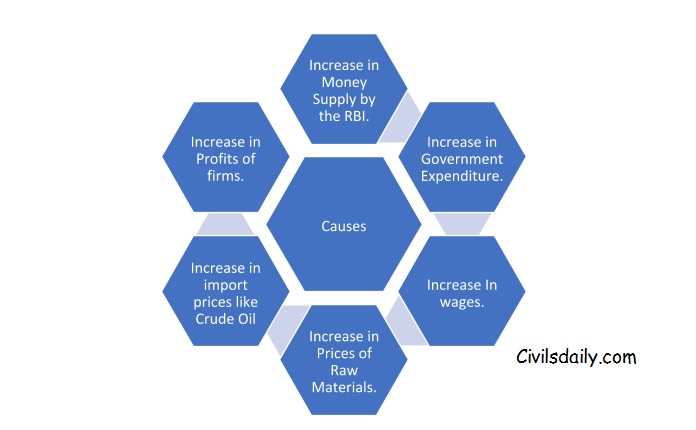
     

    Inflationary Gap: the Inflationary gap is a situation which arises when Aggregate demand in an economy exceeds the Aggregate supply at the full employment level.

    Deflationary Gap: Deflationary Gap is a situation which arises when Aggregate demand in the economy falls short of Aggregate Supply at the full employment level.


    Stagflation:  The falling growth along with rising prices makes cost push inflation more dangerous than the demand-pull inflation. The situation of rising prices along with falling growth and employment is called as stagflation.

    Hyperinflation: Hyperinflation is a situation when inflation rises at an extremely faster rate. The rate of inflation can increase from 50 times to 300 times. The major causes of the hyperinflation are; government issuing too much currency to finance its deficits; wars and political instabilities and unexpected increase in people’s anticipation of future inflation.

    Structural Inflation

    • Structuralist Inflation is another form of Inflation mostly prevalent in the Developing and Low-Income Countries.
    • The Structural school argues that inflation in the developing countries are mainly due to the weak structure of their economies.

    Deflation: Deflation is when the overall price level in the economy falls for a period of time.Deflation is when, for instance, the price of a basket of goods has fallen from Rs 100 to Rs 80. It’s the reduction in overall prices of goods.

    Disinflation: Disinflation is a situation in which the rate of inflation falls over a period of time. Remember the difference; disinflation is when the inflation rate is falling from say 5% to 3%.

    Headline versus Core Inflation

    The headline inflation measure demonstrates overall inflation in the economy. Conversely, the core inflation measures exclude the prices of highly volatile food and fuel components from the inflation index.

    Core inflation excludes the highly volatile food and fuel components and therefore represents the underlying trend inflation. 


    Banking and Monetary Policy

    What is monetary policy?

    As the name suggests it is policy formulated by monetary authority i.e. central bank which happens to be RBI in case of India.

    It deals with monetary i.e money matters i.e. affects money supply in the economy.

    Eg. CRR,SLR,OMO,REPO etc

    What is fiscal policy then?

    It is formulated by finance ministry i.e. government. It deals with fiscal matters i.e. matters related to government revenues and expenditure.

    Revenue matters- tax policies, non tax matters such as divestment, raising of loans, service charge etc

    Expenditure matters– subsidies, salaries, pensions, money spent on creation of capital assets such as roads, bridges etc.

    Monetary policy and fiscal policy together deal with inflation.


    Let us now understand how RBI formulates monetary policy to control inflation

    It’s clear from what we have learnt so far that to control inflation, RBI will have to decrease money supply or increase cost of fund so that people do not demand goods and services.

    Tools available with RBI


    1. Quantitative tools or general tools- they affect money supply in entire economy- housing, automobile, manufacturing, agriculture- everything.

    They are of two types

    1. Cash Reserve Ratio (CRR)– as the name suggests, banks have to keep this proportion as cash with the RBI. Bank cannot lend it to anyone. Bank earns no interest rate or profit on this.Bank cannot lend it to anyone. 
    2. Statutory Liquidity Ratio (SLR)-  As the name indicates banks have to set aside this much money into liquid assets such as gold or RBI approved securities mostly government securities. Banks earn interest on securities but as yield on govt securities is much lower banks earn that much less interest.

    RBI Tools for Controlling Credit/Money Supply

    Broadly speaking, there are two types of methods of controlling credit.


    Measure of Money Supply in India

    M1 M2 M3 M4
    It is also known as Narrow Money. It is a broader concept of the money supply. It is also known as Broad Money. M4 includes all items of M3 along with total deposits of post office saving accounts.
    M1= C+DD+OD


    C= Currency with Public.

    DD= Demand Deposit with the public in the Banks.

    OD= Other Deposits held by the public with RBI.

    M2= M1 + Saving deposits with the post office saving banks.


    M1 is distinguished from M2 because the post office saving deposits are not as liquid as Bank deposits.

    M3 = M1+ Time Deposits with the Bank.


    Time deposits serve as a store of wealth and represent a saving of the people and are not as liquid as they cannot be withdrawn through cheques or ATMs as compared to money deposited in Demand deposits.

    M4= M3+Total Deposits with Post Office Saving Organisations.


    M4 however, excludes National Saving Certificates of Post Offices.

    It is the most liquid form of the money supply.   M3 is the most popular and essential measure of the money supply. The monetary committee headed by late Prof Sukhamoy Chakravarty recommended its use for monetary planning in the economy. M3 is also called Aggregate Monetary Resource  


  • Gati Shakti: Transforming India’s Logistics

    Logistics

    Efficient logistics is the backbone of a successful economy, enabling businesses to access markets, reduce costs, and increase productivity, ultimately leading to sustainable economic growth.” – Nitin Gadkari, Minister of Road Transport and Highways.

    Central Idea

    • The Union Budget 2023 has increased the PM Gati Shakti National Master Plan’s budget from ₹5,000 crore to ₹10,000 crore and allocated ₹2.4 lakh crore to the Indian Railways. This plan aims to improve India’s logistics competitiveness by increasing the railways’ share in freight movement from 27% to 45% and addressing infrastructural challenges. However, several challenges such as operational and connectivity issues, infrastructural challenges, and lack of integration need to be addressed to achieve these targets.

    Logistics

    What is PM Gati Shakti National Master Plan?

    • Comprehensive development: It is a comprehensive infrastructure development plan announced by the Government of India in November 2021.
    • Aim: The plan aims to improve economic growth and sustainable development by focusing on infrastructure such as roads, railways, airports, ports, mass transport, waterways, and logistics.
    • Increased Budget: The Union Budget 2023 has increased the budget for the PM Gati Shakti National Master Plan
    • The plan includes the development of five main corridors:
    • East-West Corridor: It will connect the east and west coasts of India, stretching from Silchar in Assam to Porbandar in Gujarat.
    • North-South Corridor: It will connect the northern and southern parts of India, stretching from Srinagar in Jammu and Kashmir to Kanyakumari in Tamil Nadu.
    • North-East Corridor: It will connect the northeastern states to the rest of India, stretching from Imphal in Manipur to Kohima in Nagaland.
    • South-West Corridor: It will connect the southwestern states to the rest of India, stretching from Ratnagiri in Maharashtra to Kanyakumari in Tamil Nadu.
    • East Coast Corridor: It will connect the east coast states to the rest of India, stretching from Kolkata in West Bengal to Kanyakumari in Tamil Nadu.
    • The railways have a pan-India network and offer an efficient and economic mode of logistics movement, making them an essential component of the plan.

    Logistics

    The Freight Movement at Present

    • Freight movement Impact: Currently, 65% of freight movement is done by road transport, leading to congestion, pollution, and increased logistics costs.
    • convenience over cost: Although the cost of rail transportation is less than road transportation, convenience has taken precedence over cost, and the railways have lost their share in freight movement to more flexible modes.
    • For instance: In 2020-21, coal constituted 44% of the total freight movement of 1.2 billion tonnes, followed by iron ore (13%), cement (10%), food grains (5%), fertilizers (4%), iron and steel (4%), etc.
    • Non-bulk commodities: Transportation of non-bulk commodities accounts for a very small share in the rail freight movement
    • Rise in Container Traffic: The convenience of moving non-bulk commodities in containers has led to an increase in containerized traffic. Globally, railway systems are heavily investing in advanced rail infrastructure for quick and low-cost container movement.

    Infrastructural, Operational, and Connectivity Challenges

    • The national transporter faces several challenges, leading to a shift of freight traffic to roads.
    • Infrastructure: Increased transit time by rail, pre-movement and post-movement procedural delays, lack of necessary terminal infrastructure, maintenance of good sheds and warehouses, and uncertain supply of wagons are some of the infrastructural challenges that customers face.
    • Connectivity: The lack of integrated first and last-mile connectivity by rail increases the chances of damage due to multiple handling and also increases the inventory holding cost.

    Strategies to Improve Efficiency in Rail Cargo Movement in India

    • Overall improvement: The Indian Railways need to improve infrastructure and encourage private participation in the operation and management of terminals, containers, and warehouses to efficiently utilize resources.
    • Special Entity Needed: Establishing a special entity under the railways to handle intermodal logistics in partnership with the private sector could address the first and last-mile issue faced by the railways.
    • For instance: An integrated logistics infrastructure with first and last-mile connectivity is essential to make rail movement competitive with roads, and facilitate exports by rail to neighbouring countries such as Nepal and Bangladesh.
    • An Uber like model: An Uber-like model for one of the two cargo wagons, wherein the customer can book the wagon using an online application, could help in increasing the utilization rate of these wagons.

    Way ahead

    • The adoption of railways for cargo movement is crucial to improve India’s logistics competitiveness.
    • The Indian Railways are upgrading their infrastructure with PM Gati Shakti, but a continuous monitoring of existing projects and identification of new priority areas are required to achieve the targets of rail freight movement.

    Logistics

    Conclusion

    • The PM Gati Shakti National Master Plan has the potential to transform India’s logistics infrastructure and increase the railways’ share in freight movement. However, several challenges such as operational and connectivity issues, infrastructural challenges, and lack of integration need to be addressed. The upcoming Dedicated Freight Corridors, multimodal logistics parks, and establishment of a special entity under the railways could address these challenges.

    Mains Question

    Q. Explain the PM Gati Shakti National Master Plan and its significance in improving India’s logistics competitiveness.


    Are you an IAS Worthy Aspirant? Get a reality check with the All India Smash UPSC Scholarship Test

    Get upto 100% Scholarship | 900 Registration till now | Only 100 Slots Left


  • What is Digital India Act, 2023?

    india

    The Union government has formally outlined the Digital India Act, 2023 which is a broad overhaul of the decades-old Information Technology Act, 2000.

    Central idea: Reconsideration of Safe Harbour

    • The government is reconsidering a key aspect of cyberspace — ‘safe harbour’.
    • Safe harbour is the principle that so-called ‘intermediaries’ on the internet are not responsible for what third parties post on their website.
    • This is the principle that allows social media platforms to avoid liability for posts made by users.
    • Safe harbour has been reined in in recent years by regulations like the Information Technology (Intermediary Guidelines and Digital Media Ethics Code) Rules, 2021, which require platforms to take down posts when ordered to do so by the government, or when required by law.

    What is the Digital India Act, 2023?

    • The act is a new legislation that aims to overhaul the decades-old Information Technology Act, 2000.
    • The Act covers a range of topics such as Artificial Intelligence (AI), cybercrime, data protection, deepfakes, competition issues among internet platforms, and online safety.
    • The Act also aims to address “new complex forms of user harms” that have emerged in the years since the IT Act’s enactment, such as catfishing, doxxing, trolling, and phishing.

    Why was this act enacted?

    • Data privacy: The Digital India Act will be implemented alongside the Digital Personal Data Protection Bill, 2022, which focuses solely on processing personal data in India.
    • Lawful use of data: It seeks to address the processing of digital personal data in a manner that recognizes both the right of the individuals to protect their personal data and the need to process personal data for lawful purposes.
    • Comprehensive regulation: This Act and the Digital Personal Data Protection Bill will work in tandem with each other.

    Key features of the Digital India Act

    • Creating new regulations around newer technology, including 5G, IoT devices, cloud computing, metaverse, blockchain, and cryptocurrency.
    • Reclassifying online intermediaries to separate categories instead of one general intermediary label, each one with its own set of regulations.
    • Removing “safe harbour” immunity for online intermediaries for purposeful misinformation or other content violations from third parties.
    • Creating digital standards and laws regarding artificial intelligence (AI) and machine learning (ML) technology.
    • Criminalizing cyberbullying, identity theft, and unauthorized sharing of personal information without consent.

    Significance

    • The Digital India Act provides a legal framework for promoting the growth of the digital economy in India.
    • It aims to create a conducive environment for the development and deployment of digital technologies across different sectors.
    • The Act also addresses various challenges associated with cybersecurity and data privacy, which are critical issues in the digital age.

    Conclusion

    • The Digital India Act is expected to promote digital literacy and increase access to digital services for all citizens.
    • It will help in creating a digital infrastructure that is secure, reliable, and accessible to everyone.
    • The Act will also encourage the adoption of digital technologies in various sectors such as healthcare, education, and agriculture, leading to increased efficiency and productivityhow-to-start-upsc-preparation-from-zero-level


    Are you an IAS Worthy Aspirant? Get a reality check with the All India Smash UPSC Scholarship Test

    Get upto 100% Scholarship | 900 Registration till now | Only 100 Slots Left

  • [Sansad TV] Drones in Defence Sector

    [Sansad TV] Drones in Defence Sector

    In this edition of ‘The Defenders” experts discuss the importance of drones in the Indian defence sector, Indian drone policy and its implications.

    Context

    • As the role of unmanned aerial vehicles (UAVs) continues to grow in all sectors of society, new applications for drones in security and defence continue to emerge.
    • While the possibilities presented by drones in the theatre of war have already been explored, more research is now being undertaken into their potential for improving security.

    What are Drones?

    • Drones, also known as UAVs are aircraft that are flown without a human pilot on board.
    • They can be controlled remotely by a human operator or can be programmed to fly autonomously using onboard computers and sensors.
    • Drones come in a variety of shapes and sizes, ranging from small, hand-held models to larger, more complex aircraft capable of carrying payloads such as cameras, sensors, and weapons.
    • They can be powered by various sources, including electricity, gas, or other fuels, depending on their size and purpose.

    What are the types of Military Drones?

    drone

    There are a few different types of drones used in militaries around the world:

    1. Fixed-wing: They are the fastest military UAV currently deployed worldwide. These drones are designed to take off and land like aeroplanes, using wings instead of rotors for lift.
    2. Single-rotor: They look similar to helicopters and are more durable than other drones. While they can be more efficient than different types of drones, they require more maintenance.
    3. Multirotor: These drones are the most straightforward option that provides the best control over positioning and framing. Because of this, they are the best choice for surveillance and reconnaissance.

    How are Drones changing military warfare?

    Drones have improved military capabilities around the world in many ways. It will also continue to change military warfare through the following:

    • Better Reconnaissance, Surveillance, and Target Acquisition (RSTA): Drones provide real-time information on targets’ positions, terrain, and enemy movements to commanders on the ground.
    • Reduced Cost: Drones are cheaper than conventional aircraft in terms of both price and maintenance.
    • Crew safety: Because drones are unmanned, they also reduce the risk of pilots being injured mid-flight.
    • Faster deployment: Compared to conventional aircraft, drones are faster and easier to deploy. They are easier to operate and don’t need training as extensive as most aircraft. Many drones don’t need a runway, and other types can easily fit in a backpack.
    • Increased flexibility: While the military-industrial complex has developed technology that prioritizes this need, drones are the best example. On top of this, drones can even be fully automated.
    • Improved Situational Awareness: Drones can provide military commanders with real-time video and other intelligence data, giving them a better understanding of the battlefield and enemy movements.

    Combat importance of drones

    As a result, more military forces are looking to use drones to increase their combat and surveillance capacity. These are the most common roles UAVs fulfil:

    • Reconnaissance: Drones can conduct surveillance missions by hovering over an area for an extended period.
    • Command and Control: Drones can relay crucial information on enemy movements, locations, and positions of strategic targets. This information allows commanders to be more efficient and make better decisions when in the field.
    • Combat and Combat Support: Unmanned vehicles play a huge role in performing combat and combat support missions. Built-in targeting software allows operators to hit their targets with greater precision and accuracy.
    • Targeted strikes: UAVs can be used for target practice or for training exercises by operators to improve their accuracy. Drones’ built-in targeting software is customizable to detect and respond to targets automatically.
    • Logistics:  Drones can be used as military-industrial couriers and assist in delivering valuable supplies and equipment. They can also help evacuate injured personnel.
    • Search and Rescue: Drones can be equipped with thermal imaging cameras and other sensors to aid in search and rescue operations, helping to locate lost or injured personnel.
    • Drones as Target Decoys: There are times when a defense strategy may require using drones as target decoys to mislead its opponents and launch an attack from another direction.

    Drone regulation in India

    These rules are built on the premise of trust, self-certification, and non-intrusive monitoring. The policy is designed to usher in an era of super-normal growth while balancing safety and security considerations.

    drone

    Significant applications of Drone Technology

    Drones are a transformative technology. They have been and can be used in various areas such as:

    • Land mapping: The drone technology in the SVAMITVA scheme has helped about half a million village residents to get their property cards by mapping out the areas.
    • Emergency response: Drones are significant for the agencies such as the fire and emergency services wherever human intervention is not safe. It can perfectly save human efforts during disaster management.
    • Distant and remote delivery purposes: Recently, the Ministry of Civil Aviation has approved a project with the Telangana government for using drone technology to deliver vaccines in remote areas.
    • Agriculture: In the agriculture sector, micronutrients, and hazardous pesticides can be spread with the help of drones. It can also be used for performing surveys for identifying the challenges faced by the farmers.
    • E- Commerce: Drones offer a perfect and cost-effective solution for delivery of products by e-com facilitators.
    • Monitoring: The railways are using drones for track monitoring. Telecom companies are using drones for monitoring the tower.
    • Security and defence: Drone system can be used as a symmetric weapon against terrorist attacks. They can be integrated into the national airspace system.

    Threats posed by Drones

    drone

    The operation of drones without any adequate legal backing can pose several security threats.

    • Espionage: Drones can be stealthily used for spying purposes.
    • Terror sponsoring: Procurement of combat drones by non-state actors poses serious threats.
    • Stealth in warfare: Drones can easily escape security checks due to its compact size.
    • Easy available weapons: Given the easy availability of advanced technology to the common man at a reduced cost and the proliferation of information via the Internet, this threat will invariably grow.
    • Destruction of security apparatus: They can be put to destructive use, to slam into critical targets, destroy infrastructure and so on.
    • Smuggling of arms: Incidents of arms being dropped by drones are also there such as the recent Jammu drone attacks.

    Why are drones such stealthy?

    • Radar complicacies: Conventional air defense systems are less effective against drones and military radars are designed to track larger, fast-moving aircraft and cannot always pick up small, slow, low-flying drones.
    • Feasibility of securitization: It is not cost effective to use expensive anti-aircraft systems to shoot down these drones, which are typically cheap and can be easily devised.
    • Eyespoting not possible every time: Currently, border forces in India largely use eyesight to spot drones and then shoot them down. Drones can be easily disguised as bird or any other un-identified flying object.

    India’s vulnerability: Terror sponsoring neighborhood

    • India is always subjected to continuous threats of cross-border terrorism, drug trafficking and arms trafficking from Pakistan. 
    • Sighting of drones near the India-Pakistan border and the Line of Control has been frequent these days. 
    • We often get to hear news about Punjab Police seizing drones that dropped arms consignment, and narcotic drug supplies from Pakistan.
    • There were many drone-dropped arms consignments seized by the Indian police and security forces.

    Way forward

    • As technology advances, security architects and countries have taken cognizance of this fact and are working on the technological as well as policy fronts to counter it.
    • The Defence Research and Development Organisation (DRDO) has developed a detect-and-destroy technology for drones, but it is not yet into mass production.
    • GPS technology can be imbibed and be inbuilt in drones so that they cannot enter in non flying area.
    • For installations such as oil refineries, power stations or military station a ‘mid segment model’ that includes primary and passive detection and soft kill options can be adopted.

    Conclusion

    • Modern drones, in the hands of terrorists, could cause considerable panic and damage if not countered adequately.
    • Though drones pose a sub-tactical threat, it requires a strategic response. Entire threat perception has to be relooked.
    • It is essential to ensure that the security measures are set up in time so as to avoid any untoward occurrence or a major catastrophe.

    Are you an IAS Worthy Aspirant? Get a reality check with the All India Smash UPSC Scholarship Test

    Get upto 100% Scholarship | 900 Registration till now | Only 100 Slots Left

  • NASA’s IBEX spacecraft to study Edge of Solar System

    ibex

    NASA has announced that its Interstellar Boundary Explorer (IBEX) spacecraft is fully operational after the mission team successfully reset it.

    Edge of Solar System: Heliopause

    ibex

    The edge of the Solar System, also known as the heliopause, is the point where the solar wind from the Sun meets the interstellar medium. Here are some key points about the edge of the Solar System:

    • The heliopause is the boundary where the Sun’s solar wind is stopped by the interstellar medium.
    • The Voyager 1 spacecraft crossed the heliopause in 2012, becoming the first man-made object to leave the Solar System.
    • The exact location of the heliopause is not well defined and varies based on the strength of the solar wind and the density of the interstellar medium.
    • The interstellar medium beyond the heliopause is composed of plasma, magnetic fields, and cosmic rays from other stars in the Milky Way galaxy.
    • The edge of the Solar System is being studied by NASA’s Interstellar Boundary Explorer (IBEX) mission, which is mapping the boundary region where the solar wind meets the interstellar medium.

    Interstellar Boundary Explorer (IBEX)

    • IBEX is a small NASA spacecraft designed to map the boundary where winds from the Sun interact with winds from other stars.
    • The spacecraft is about the size of a bus tire and its instruments look towards the interstellar boundary while it is on its nine-day orbit around our planet.
    • It was launched in 2008 and has spent nearly 15 years in space already.

    Purpose

    • The purpose of IBEX is to study the interaction between the solar wind and the interstellar medium and to map the boundary of the solar system.

    Technology

    • IBEX uses two neutral atom imaging cameras to detect energetic neutral atoms that are created at the boundary of the heliosphere.
    • The cameras are mounted on a spinning spacecraft, allowing them to scan the sky and build up a map of the boundary.

    Discoveries

    Since its launch, IBEX has made several important discoveries, including:

    • The first direct measurements of the interstellar wind, which flows into the solar system from the direction of the constellation Scorpius.
    • The discovery of a “ribbon” of energetic neutral atoms that stretches across the sky, which may be caused by the interaction between the solar wind and the interstellar medium.

    Current Status

    • IBEX is still in operation and continues to gather data about the interstellar boundary.
    • Its mission has been extended several times, with the most recent extension running until 2023.

    Significance

    • IBEX’s findings have increased our understanding of the interaction between the solar wind and the interstellar medium.
    • It has helped to refine models of the heliosphere and the solar system’s place in the galaxy.

    Are you an IAS Worthy Aspirant? Get a reality check with the All India Smash UPSC Scholarship Test

    Get upto 100% Scholarship | 900 Registration till now | Only 100 Slots Left

  • Kodaikanal Solar Observatory

    Kodaikanal

    The Kodaikanal Solar Observatory (KoSO) has been observing the Sun for over a century.

    Why in news?

    • Kodaikanal Solar Observatory (KoSO) has been observing the Sun for over a century
    • KoSO has captured images of sunspots and recorded changes in the Sun’s behavior
    • Solar physicists at the Indian Institute of Astrophysics (IIA) and Aryabhatta Research Institute of Observational Sciences (ARIES) have digitized 1.48 lakh solar images captured since 1904

    A Brief History of Kodaikanal Solar Observatory

    • KoSO is one of the world’s oldest observatories studying the Sun.
    • Norman Pogson, astronomer and Government Astronomer of the Madras Observatory, proposed the idea of taking pictures of the Sun using a 20-inch telescope.
    • The Madras Observatory was set up as the private effort of an official of the British East India Company in 1786.
    • The decision to establish a solar observatory was taken in 1893, and Kodaikanal in present-day Tamil Nadu was chosen for its high altitude and dust-free environment.
    • The Solar Physics Observatory opened on April 1, 1899, and was later named KoSO.
    • The Bhavnagar Telescope, named after the Maharaja of Bhavnagar, was one of the more famous instruments at KoSO during the early decades of its operation.
    • A 15cm telescope was used to capture solar images onto a photographic film or plate.
    • Solar magnetic plages and prominences were recorded since 1911, taken on photographic films and plates.

    Solar Observations, One Every Day: How They Are Taken

    • White light images of the Sun have been captured every day since 1904 using a 6-inch telescope
    • Visible light images reveal sunspots on the surface of the Sun.
    • One image is taken daily around 8 am, which has been a fixed routine for over a century now
    • Each observation accompanies the corresponding date and time, which is key for calibration purposes later.
    • These plates or films are sent to the darkroom and developed either the same day or the next day
    • Once the film has been developed, the date and time of observation are written on the plate and entered in the logbook.
    • These plates or films are kept in an envelope with the handwritten date and time of observation and stored carefully in humidity-controlled rooms.

    Arrival of New Technology and the Process of Digitization

    • Between 1904 and 2017, all solar observations were traced onto photographic films and plates
    • A new telescope mounted with CCD cameras has taken over and, since 2017, continued to observe the Sun.
    • Digitization of the records was initiated in 1984 by Prof J C Bhattacharyya, and others continued the effort.
    • In 2018, digitized solar observations for the period 1921-2011 were made available to the scientific community.
    • Raw and calibrated data for the period of 1904 to 2017 were added, and the digitization process is nearly complete.
    • KoSO is now home to a digital repository of a whopping 1.48 lakh solar images adding up to 10 terabyte of data.
    • These include 33,500 white-light images (showing sunspots), 45,000 images of the Ca II K spectral line (which reveals plages), and 70,000 H-alpha photographic plates that show prominences.

    Are you an IAS Worthy Aspirant? Get a reality check with the All India Smash UPSC Scholarship Test

    Get upto 100% Scholarship | 900 Registration till now | Only 100 Slots Left

  • Yaoshang festival begins in Manipur

    yaoshang

    The Yaoshang festival, which is Manipur’s version of Holi, has begun.

    Yaoshang Festival

    • Yaoshang festival is celebrated every year on the full moon of Lamta (February-March) of the Meitei lunar calendar.
    • It begins just after sunset followed by Yaosang Mei thaba, also known as Burning of the Straw Hut.
    • Children visit neighbours to ask for monetary donations, called nakatheng.
    • Yaoshang, unlike Holi, is celebrated with a traditional twist in Manipur.
    • During these five days, Manipur comes alive with sporting events during the day and traditional “thabal chongba” dance in the night.

    Key feature: Thabal Chongba Dance

    • The thabal chongba is a traditional dance of the Meitei, where boys and girls gathered in an open ground and dance in a circle.
    • But these days thabal chongba is performed throughout the month of Lamta.


  • How to start answer writing FROM SCRATCH for UPSC Mains 2024? 10 Best practices our MEP program students followed | LIVE 1-1 Masterclass by Sukanya Ma’am | FREE Strategic Package on registration

    How to start answer writing FROM SCRATCH for UPSC Mains 2024? 10 Best practices our MEP program students followed | LIVE 1-1 Masterclass by Sukanya Ma’am | FREE Strategic Package on registration

    How to start answer writing FROM SCRATCH for UPSC & State PSC Mains 2024?

    According to Dr. Vishwa Shah, “Success does not lie in Results but Efforts, Being the best is not so important, Doing the best is all that matters..”

    When she notices a large number of aspirants around her who are anxious, nervous, or panicked, she joined Civilsdaily’s MEP Program and owned a compact experience and overall strategies which helped her to clear UPSC Mains twice (2020,2022) and cracked GPSC in her 1st attempt (2021) with a Rank of 98. Currently, she is a Probationary Deputy Superintendent of Police.

    Dr. Visha Shah

    According to her, starting answer writing early is the only reality and unavoidable truth behind sure success. However, focusing on small improvements, habits, and changes will eventually lead to bigger things.

    Even with numerous things pending, you can still pass the UPSC and State PSC exams if you prepare in an organized, measured, and progressive manner. Nobody goes into this exam fully prepared. It all depends on how you write it down.

    As a responsible Mentor cum teacher of many students like Dr. Vishwa Shah, Sukanya Ma’am (MEP Program Head) is conducting a FREE LIVE webinar to understand How to start answer writing FROM SCRATCH for UPSC/State PSC Mains 2024

    Date & Time: 11th March 2023 (Saturday), 8:30 P.M

    Ma’am will demonstrate LIVE How to start answer writing FROM SCRATCH for UPSC Mains 2024. She will also discuss, how to enjoy and learn answers writing for the UPSC Mains examination when it can be very confusing and stressful for other candidates.

    What you should expect in 1-1 LIVE with Sukanya Ma’am?

    • What are the 10 best practices my ranker students follow when they start from scratch?
    • Why it’s the very right time to start answer writing for UPSC mains 2024?
    • What are the benefits of attempting more mock tests for the UPSC Mains exam?
    • How state services also need more expertise in answer writing
    • How to connect current affairs and how to insert examples, and illustrations in your answers?
    • How to approach current affairs charged questions in UPSC Mains?
    • How frequently should you practice answer writing for UPSC Mains to become mains writing savvy in a very short time?
    • What are the 753 Rules for Mains answer writing that every topper follows in their preparation phase?

    The workshop will be an opportunity for UPSC & State PSC aspirants for 2023 exam and 2024, who want to clear the Mains exam in just one attempt, to learn from the best and gain a competitive edge in their preparation for the exam.

    The Practical LIVE session will focus on the importance of the Mains exam strategy, covering a wide range of topics such as time management, and effective Answer writing techniques to clear the UPSC Mains exam.


    CivilsDaily’s FREE Webinar package

    Post-webinar we will share important PDFs, timetable framework, and notes.

    Other than this a strategy package will be emailed to you.


    What The Hindu opined about Civilsdaily Mentorship

    best coaching for upsc in delhi

    Register FREE for a 1-1 LIVE UPSC Masterclass by Sukanya Rana Ma’am, CD Mains Program Head.

  • Space Debris: India’s Contribution and Efforts to Tackle the Problem

    Space Debris

    Central Idea

    • Space debris, particularly in Low Earth Orbit (LEO), is becoming an increasingly urgent problem due to the rising number of rocket launches and payloads, as well as anti-satellite missile tests and collisions. On March 7, 2023, ISRO successfully carried out a controlled re-entry for the decommissioned Megha-Tropiques-1 (MT1).

    Space Debris

    ISRO’s controlled re-entry of the decommission

    • Indian Space Research Organisation (ISRO) successfully carried out a controlled re-entry of the decommissioned Megha-Tropiques-1 (MT1) satellite.
    • MT1 was launched over a decade ago with the objective of studying clouds in the tropical regions of the world.
    • As the satellite had reached the end of its operational life, ISRO brought it down in a controlled manner to reduce space debris in the Low Earth Orbit (LEO) and limit the potential risks associated with it.

    Space debris

    • Space debris refers to any human-made object that is in orbit around the Earth but no longer serves any useful purpose. This can include pieces of spacecraft, rocket stages, and other materials that have been left in space after they have completed their missions or have been discarded.
    • Space debris can vary in size, from small paint flecks and bolts to larger objects like satellites and old rocket bodies.
    • There are currently more than 26,000 objects larger than 10 cm in orbit around the Earth, and many smaller objects that are too small to be tracked.

    Space Debris

    Surge in Space Debris

    • Increasing number of payloads: The surging number of rocket launches and the increasing number of payloads carried in recent years have made the space junk problem acute, especially after private companies such as SpaceX launched thousands of satellites to provide Internet access.
    • For instance: In 2022, over 2,160 objects were launched into space, about 300 more than 2021 and 900 more than 2020.
    • Data on fragmented debris: The number of satellites in space has crossed the 10,000 mark, including active and defunct ones still orbiting Earth, and the number of fragmentation debris is hurtling towards the 14,000-mark.
    • Smaller debris poses a bigger challenge: While satellite launches are the reason for the rise in rocket bodies orbiting Earth, fragmented debris are mostly a consequence of collisions and Anti-Satellite (ASAT) missile tests. The fragmented junk poses a bigger challenge as tracking debris smaller than 10 centimetres is tough.

    Countries responsible

    • Russia: Close to 35% originated from the Soviet Union/Russia,
    • US: 31% from the U.S.,
    • China: 29% from China, over 2,700 pieces of debris from a Chinese anti-satellite test in 2007, marked as the single worst contamination of space in history, are still in orbit.
    • India: India’s contribution is 0.5%.
    • India added to the problem in 2019 by testing an ASAT missile which targeted a live satellite in LEO which resulted in 400 pieces of orbital debris
    • While all the trackable debris from India’s test have re-entered Earth in subsequent years, over 50 pieces from a break-up event of the 4th stage of PSLV-C3 in 2001 are still in orbit.

    Space Debris

    The cost of avoiding collision

    • High cost: While debris has the potential to cause serious accidents, the cost of manoeuvres to avoid collisions is high.
    • For instance: In 2022, ISS had to conduct two such collision avoidance manoeuvres due to threats posted by debris from Russia’s ASAT test in 2021.
    • Challenges: Such manoeuvres are costly as they require hours of monitoring, fuel for movement, and also result in loss of data as instruments are turned off during such operations.
    • India’s honest efforts:
    • India conducted 21 such corrections for its satellites in 2022, the highest ever for the country.
    • Also, in 2021, ISRO monitored 4,382 events in LEO and 3,148 events in geostationary orbit (GEO) in which debris or other space objects came close to India’s space assets.

    Conclusion

    • Small debris orbiting Earth pose threats to space assets, the immediate need is that the countries must acknowledge the responsibility. India’s continues efforts towards controlled decommission set the bar high.

    Mains Question

    Q. Discuss the challenges posed by increasing space debris and the potential risks associated with it.


    Are you an IAS Worthy Aspirant? Get a reality check with the All India Smash UPSC Scholarship Test

    Get upto 100% Scholarship | 900 Registration till now | Only 100 Slots Left


More posts