💥Join UPSC 2027,2028 Mentorship (August Batch) + XFactor Notes & Microthemes PDF

Search results for: “”

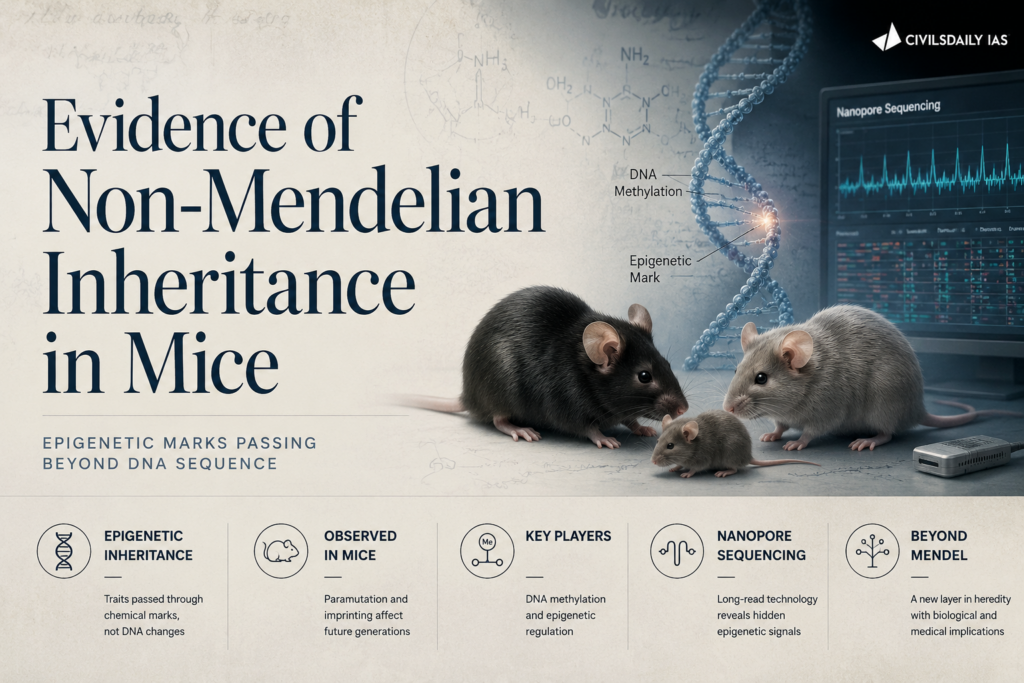
  • Evidence of non-Mendelian inheritance in mice

    Why in the News

    Researchers have reported evidence of non-Mendelian inheritance in mice, involving DNA methylation, genomic imprinting and paramutation. Nanopore sequencing helped detect these epigenetic marks.

    What is Epigenetic Inheritance?

    1. Definition: Transmission of heritable changes in gene activity without altering the underlying DNA sequence.
    2. Major mechanism: Chemical modifications such as DNA methylation can influence whether genes are switched on or off.
    3. Non-Mendelian: Unlike classical Mendelian inheritance, the inherited information is not limited to changes in the DNA sequence.
    4. Genomic imprinting: Expression of certain genes depends on whether they are inherited from the mother or father.
    5. Paramutation: One allele can induce a heritable change in the expression of another allele without changing its DNA sequence.
    6. Nanopore sequencing: Can detect certain DNA modifications, including methylation, while sequencing DNA.

    Why does it matter?

    • Expands inheritance theory: Heritable information can involve regulatory/epigenetic states in addition to DNA sequence.
    • Environment and inheritance: Some environmental factors can influence epigenetic states, though not every acquired epigenetic change is necessarily inherited.
    • Disease relevance: Abnormal epigenetic regulation is associated with cancers and other diseases.
    • Biotechnology: Advanced sequencing can help identify epigenetic modifications alongside DNA sequences.

    “[2021, GS3, 15 marks] What are the research and developmental achievements in applied biotechnology? How will these achievements help to uplift the poorer sections of society?

    [2021] In the context of hereditary diseases, consider the following statements:
    1. Passing on mitochondrial diseases from parent to child can be prevented by mitochondrial replacement therapy either before or after in vitro fertilization of egg.
    2. A child inherits mitochondrial diseases entirely from mother and not from father.
    Which of the statements given above is/are correct?

    [A] 1 only

    [B] 2 only

    [C] Both 1 and 2

    [D] Neither 1 nor 2
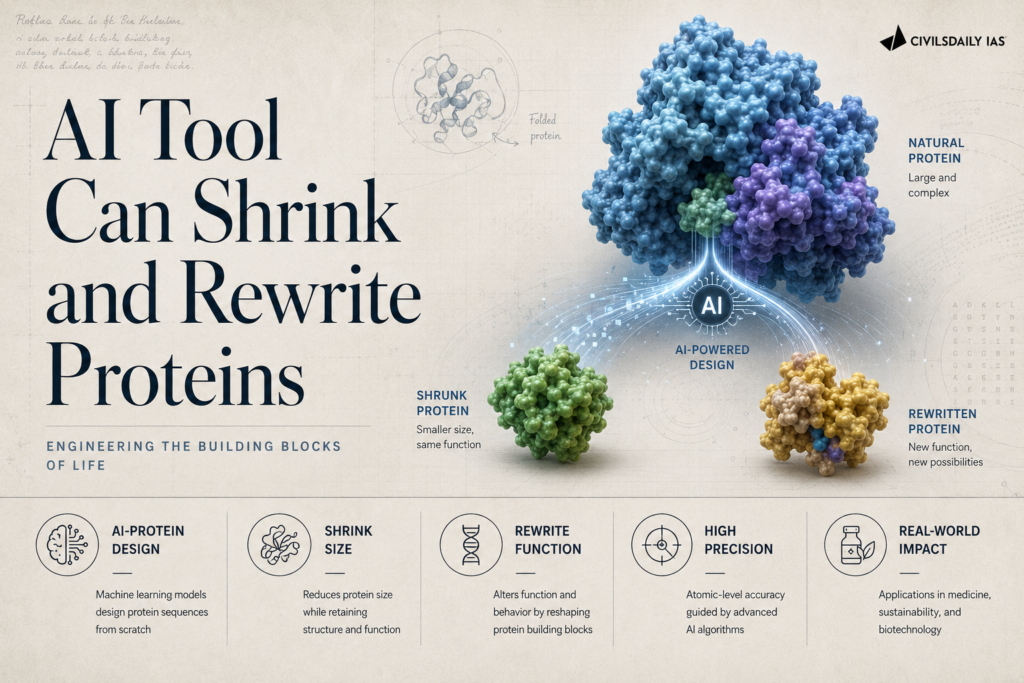
  • AI tool can shrink and rewrite proteins

    Why in the News

    A university team has developed Raygun, an AI tool that can redesign and miniaturise proteins while retaining their function. This could improve the delivery of protein-based therapies and accelerate drug development.

    What is AI-based Protein Engineering?

    1. Protein engineering: Designing or modifying proteins to obtain desired properties such as smaller size, stability or specific biological functions.
    2. AI-based design: AI models trained on protein sequences can predict and generate redesigned protein structures.
    3. Raygun: The tool can shrink proteins while attempting to preserve their function, potentially making them easier to deliver.

    Why does it matter?

    • Gene therapy: Delivery vectors have limited cargo capacity. Smaller functional proteins can make therapeutic delivery easier.
    • Drug development: AI can reduce dependence on lengthy trial-and-error approaches in protein design.
    • Precision medicine: Engineered proteins could potentially be tailored for specific therapeutic functions.
    • Biosafety: Powerful AI-enabled biological design raises concerns regarding misuse, unintended effects and governance.

    Protein engineering ≠ gene editing

    • Protein engineering: Modifies/designs the protein to alter its properties.
    • Gene editing: Directly modifies DNA sequences.
    • AI protein design: Uses computational models to predict or generate useful protein sequences/structures.
    • Gene therapy: Uses genetic material or biological mechanisms to treat disease.

    [2026] Which of the following statements with regard to genetic medicine is/are correct ?
    1. Genetic medicines correct/compensate for the faulty genes responsible for disease.
    2. Engineered viruses and lipid nanoparticles are used as carriers of the genetic medicine.
    3. Genetic medicines alter the entire DNA sequence.
    Select the answer using the code given below :

    [A] 1 only

    [B] 2 and 3 only

    [C] 1 and 2 only

    [D] 1, 2 and 3

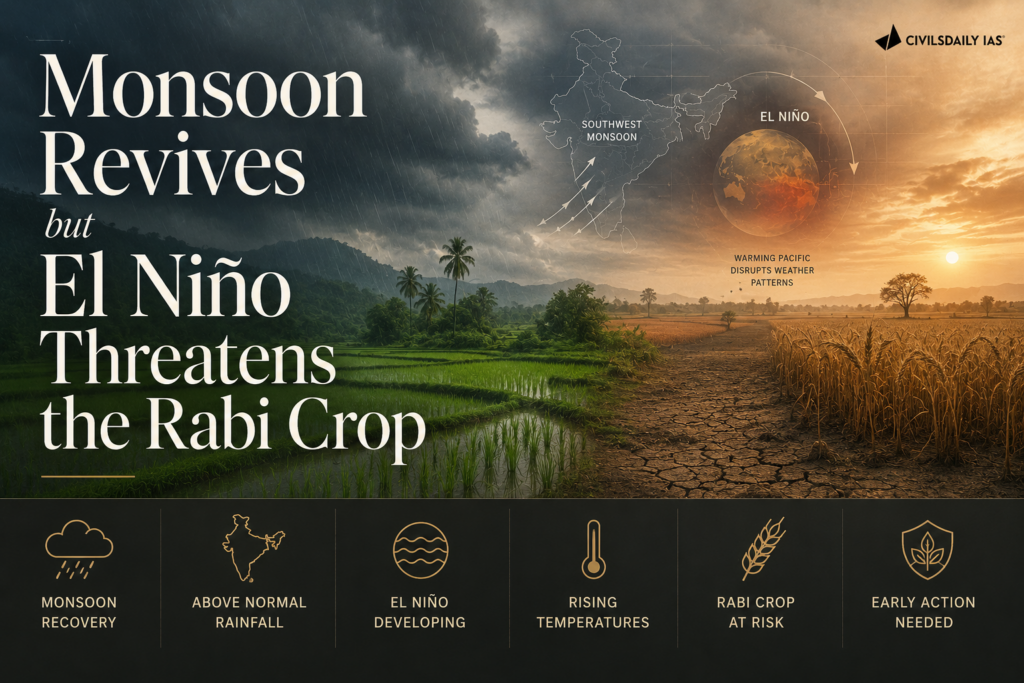
  • Monsoon revives but El Nino threatens the rabi crop

    Why in the News

    The southwest monsoon has revived, cutting the seasonal deficit to 11.5%, but warns that a possible El Nino threatens the rabi crop and keeps urea supply in focus.

    What is El Nino?

    1. Definition: El Nino is the abnormal warming of the central and eastern Pacific that weakens the Indian monsoon and disrupts rainfall.
    2. Crop link: A weak or erratic monsoon reduces soil moisture and reservoir storage needed for the winter rabi crop.

    Why does the rabi outlook matter?

    1. Food and prices: Wheat and other rabi crops shape food inflation and buffer stocks.
    2. Input dependence: Adequate urea and irrigation are needed to protect rabi output if rainfall falters.
    3. Recovery is partial: A narrowed deficit does not remove the risk that late-season El Nino conditions bring.

    Conclusion

    A recovering monsoon eases the kharif outlook but leaves rabi exposed to El Nino. The next milestone is confirmation of El Nino conditions before the rabi season.

    PYQ Relevance

    [UPSC 2015]How far do you agree that the behavior of the Indian monsoon has been changing due to humanizing landscapes? Discuss.

    Linkage: The PYQ explores changing monsoon behaviour and its impact on Indian agriculture. El Niño-induced rainfall variability shows how climatic and human factors can alter monsoon patterns and crop outcomes.

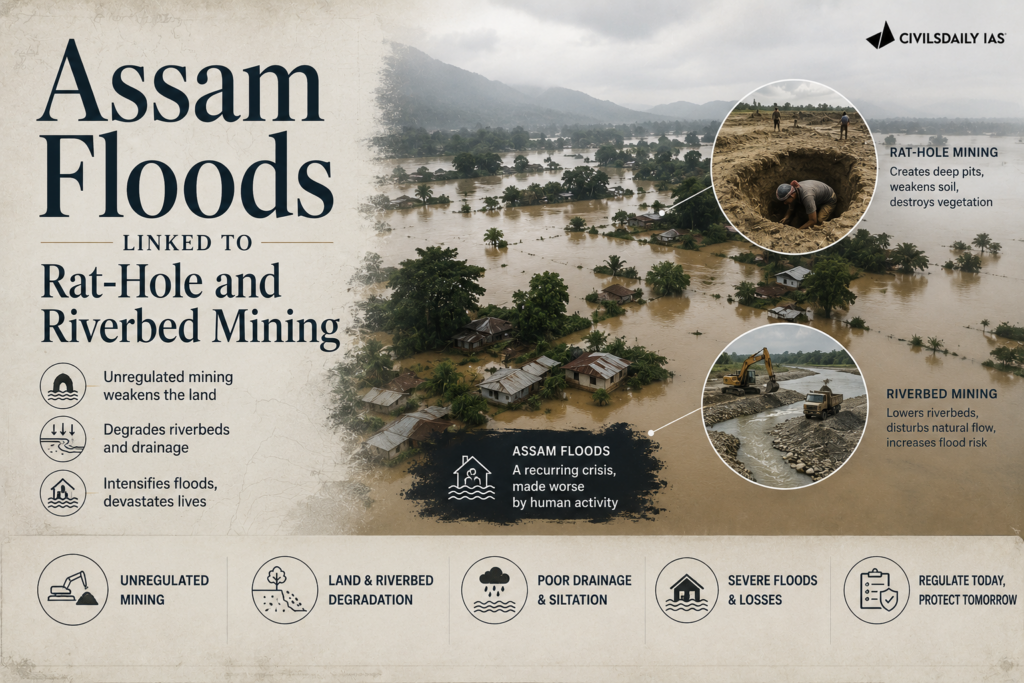
  • Assam floods linked to rat-hole and riverbed mining

    Why in the News

    Localised floods in Sivasagar, Charaideo and Jorhat districts of Assam have drawn attention to the role of rat-hole coal mining and riverbed mining in altering local drainage and aggravating flood impacts.

    What is Rat-Hole Mining?

    1. Method: A hazardous form of coal extraction through narrow horizontal tunnels, often too small for mechanised mining.
    2. Region: Historically prevalent in Meghalaya and other parts of Northeast India.
    3. NGT Ban: The National Green Tribunal (NGT) banned rat-hole coal mining in Meghalaya in 2014, citing environmental degradation and safety concerns.
    4. Environmental impact: Unregulated mining can disturb soil, drainage channels and river systems.

    How Can Mining Aggravate Floods?

    • Altered drainage: Mining and riverbed extraction can modify natural water-flow pathways.
    • Siltation: Mining activities can increase sediment entering waterways, reducing effective channel capacity.
    • Loss of natural buffers: Landscape disturbance can reduce the ability of terrain to absorb and retain water.
    • Compounded disaster: Heavy rainfall combined with degraded drainage can intensify flooding and displacement.

    Governance Issue

    • NGT ban → weak enforcement → continued illegal mining → environmental degradation → greater disaster vulnerability

    [2018] Which of the following is/are the possible consequence/s of heavy sand mining in riverbeds ?

    1. Decreased salinity in the river
    2.Pollution of groundwater
    3.Lowering of the water-table
    Select the correct answer using the code given below :

    (a) 1 only

    (b) 2 and 3 only

    (c) 1 and 3 only

    (d) 1, 2 and 3

  • India’s first open-access ecoacoustic biodiversity dataset

    Why in the News

    Researchers have released India’s first open-access, crowdsourced ecoacoustic biodiversity dataset, capturing 518 species across 5,815 minutes of recordings from 25 states and union territories.

    What is ecoacoustics?

    1. Ecoacoustics is the study of sounds produced by organisms and the surrounding environment to understand ecosystems, biodiversity and ecological change.
    2. Instead of relying only on visual surveys, passive acoustic recorders can continuously capture:
      • Bird calls, Insect sounds, Frog and bat calls, Reptile and mammal vocalisations, Marine animal sounds, Background environmental sounds such as rain, wind and human activity

    Why does it matter?

    1. Non-invasive monitoring: Sound-based surveys track biodiversity cheaply and continuously across large areas.
    2. Open science: An open-access, crowdsourced dataset lets any researcher reuse the data for conservation.
    3. Baseline data: It creates a reference against which future biodiversity loss can be measured.

    [2023] Which of the following organisms perform waggle dance for others of their kin to indicate the direction and the distance to a source of their food?

    [A] Butterflies

    [B] )Dragonflies

    [C] Honeybees

    [D] Wasps

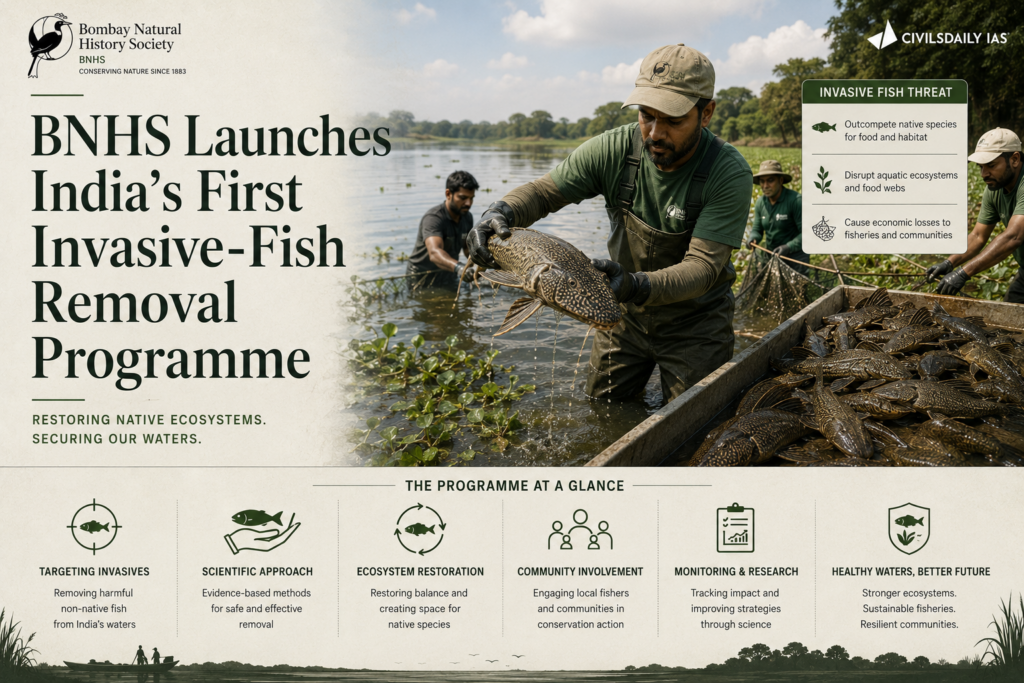
  • BNHS launches India’s first invasive-fish removal programme

    Why in the News

    The Bombay Natural History Society (BNHS) has launched India’s first community-driven removal programme for the invasive suckermouth catfish in Ujani Reservoir, Maharashtra.

    Suckermouth Catfish: Key Facts

    • Origin: Amazon River basin, South America.
    • Entry into India: Introduced through the aquarium trade and later released into natural waterways.
    • Local name: “Helicopter fish”.
    • Why invasive?
      • Feeds on fish eggs.
      • Competes with native bottom-feeding fish.
      • Burrows into riverbanks and can weaken earthen structures.
      • Adapts to adverse conditions.

    Scale of the Invasion

    • Around 97% of fish in Ujani are alien species including suckermouth catfish, Tilapia and African catfish.
    • Native fish account for only 3%.
    • Suckermouth catfish alone constitute around 30 to 40% of the total fish population.

    Impact on Fishermen

    • Around 20,000 people including fishermen, traders, transporters and labourers depend on the reservoir.
    • Invasive fish damage fishing nets and reduce the catch of economically valuable Rohu, Catla and Mrigal.
    • Fishermen may need to replace nets every 15 to 20 days, adding to costs.

    BNHS Removal Model

    • Collection centre established at Bhigwan fish market.
    • Fishermen receive financial incentives for collecting the invasive fish.
    • 36+ tonnes have already been removed.
    • Fish is processed into molasses used as fertiliser.
    • Creates a removal + livelihood + waste-utilisation model.

    “[2023] Invasive Species Specialist Group (that develops Global Invasive Species Database) belongs to which one of the following organizations?

    (a) The International Union for Conservation of Nature

    (b) The United Nations Environment Programme

    (c) The United Nations World Commission for Environment and Development

    (d) The World Wide Fund for Nature.

  • India-Israel defence ties under scrutiny

    Why in the News

    The India-Israel strategic partnership after an Amnesty International report alleged 2,596 Indian military shipments to Israel since the Gaza war.

    What anchors the partnership?

    1. Defence supply: Israel is a major source of drones, missiles and surveillance systems for India.
    2. Kargil legacy: Cooperation deepened after the 1999 Kargil War due to timely Israeli support.
    3. Strategic convergence: Both cooperate in counter-terrorism, cybersecurity, agriculture and emerging technologies.
    4. Defence co-production: Joint ventures support India’s Atmanirbhar Bharat and technology transfer.

    Why is it contested?

    1. Gaza: Defence links attract criticism due to India’s traditional support for Palestine.
    2. Gulf balance: India must balance Israel ties with energy, trade and diaspora interests in West Asia.
    3. Strategic autonomy: India must avoid being perceived as aligning completely with either side.
    4. Humanitarian concerns: Defence cooperation must remain consistent with international law and India’s foreign-policy principles.

    Conclusion

    India-Israel defence cooperation delivers capability but carries diplomatic cost in West Asia. The unresolved tension is balancing a strategic supplier against India’s wider regional interests.

    PYQ Relevance

    [UPSC 2018] India’s relations with Israel have, of late, acquired a depth and diversity, which cannot be rolled back.” Discuss.

    Linkage: The PYQ examines the growing depth and strategic importance of India-Israel relations. Defence cooperation, technology partnerships and the Gaza conflict highlight both the opportunities and diplomatic challenges in the relationship.

  • India invites Bangladesh to BRICS amid a Dhaka reset

    Why in the News

    India has invited Bangladesh’s Prime Minister to the BRICS summit as the current BIMSTEC chair, even as tension persists over the Sheikh Hasina extradition. A parallel opinion piece urges a Delhi-Dhaka reset.

    What is BIMSTEC?

    1. Definition: The Bay of Bengal Initiative for Multi-Sectoral Technical and Economic Cooperation (BIMSTEC) links South and Southeast Asian states around the Bay of Bengal.
    2. Members: India, Bangladesh, Myanmar, Sri Lanka, Thailand, Nepal, and Bhutan.

    Why is a reset needed?

    1. Political friction: The extradition dispute over the former Bangladesh premier strains ties.
    2. Connectivity stakes: The Maitree Super Thermal Power Plant and the India-Bangladesh Friendship Pipeline anchor an energy and trade partnership worth protecting.
    3. Neighbourhood First: Bangladesh is central to India’s Neighbourhood First and Act East bridge, so drift carries strategic cost.

    Conclusion

    India is using multilateral platforms to keep a strained bilateral relationship functional. The next milestone is whether the extradition dispute is contained.

    Matching Previous Year Question

    “[2022, GS2, 10 marks] Do you think that BIMSTEC is a parallel organisation like the SAARC? What are the similarities and dissimilarities between the two? How are Indian foreign policy objectives realized by forming this new organisation?”

  • Xi Jinping’s doctrine for a self-governing party

    Why in the News

    An opinion piece analyses the Communist Party of China’s doctrine of party self-governance, its anti-corruption drive, and the incoming 15th Five-Year Plan.

    What is China’s Five-Year Plan?

    1. Definition: A Five-Year Plan is China’s central blueprint setting economic and strategic priorities for a five-year cycle.
    2. 15th plan: The upcoming plan will set targets for technology self-reliance, growth, and security amid external pressure.

    Why does party self-governance matter?

    1. Centralised control: Tighter party discipline concentrates authority and reduces internal dissent.
    2. Anti-corruption as tool: The campaign doubles as a mechanism to enforce loyalty and remove rivals.
    3. Policy continuity: Party control over planning shapes China’s industrial and strategic trajectory that India must track.

    Conclusion

    China’s model fuses party discipline with long-range planning to sustain one-party control. The takeaway is that policy direction is set by the party, not the state.

  • The Makkah Joint Defence Agreement reshapes Gulf security

    Why in the News

    The Makkah Joint Defence Agreement, a Saudi Arabia-Pakistan-Turkey mutual-defence pact signed on 7 August 2026, is framed as a NATO-style collective-security bloc. It carries stakes for the Strait of Hormuz and Indian energy security.

    What is a collective defence pact?

    1. Definition: A collective defence pact treats an armed attack on one member as an attack on all, obliging mutual assistance.
    2. Model: The template is NATO’s Article 5, which the new pact echoes for the Gulf and West Asia.

    Why does it matter for India?

    1. Nuclear linkage: It ties a nuclear-armed neighbour, Pakistan, to a Gulf power and a NATO member, altering the regional balance.
    2. Energy chokepoint: Instability around the Strait of Hormuz threatens India’s crude and LNG imports.
    3. Strategic autonomy: India must balance ties with Gulf states, Israel, and Iran without being drawn into bloc politics.

    Conclusion

    A new security triangle in West Asia complicates India’s balancing act in an energy-critical region. The next milestone is whether it acquires an operational command structure.

    “[2023, GS2, 15 marks] The expansion and strengthening of NATO and a stronger US-Europe strategic partnership works well in India. What is your opinion about this statement? Give reasons and examples to support your answer.”