There seems to be considerable optimism about India’s near-term growth prospects now that the major global energy and commodity shocks have subsided. Even if these shocks have subsided, India still faces one big problem of its large current account deficit (CAD). How will this be managed? It turns out that the answer to both questions lies in one word exports.
A current account is a key component of balance of payments, which is the account of transactions or exchanges made between entities in a country and the rest of the world.
This includes a nation’s net trade in products and services, its net earnings on cross border investments including interest and dividends, and its net transfer payments such as remittances and foreign aid.
A CAD arises when the value of goods and services imported exceeds the value of exports, while the trade balance refers to the net balance of export and import of goods or merchandise trade.
CAD = Trade Deficit + Net Income from Abroad + Net transfers
Swelling CAD: Over the past year, the post-pandemic normalisation has caused the current account deficit to swell to exceptional proportions.
Decline in demand abroad: At home, normalisation has spurred a renewed demand for imported inputs. But abroad, it has had the opposite effect, leading to a decline in demand.
India’s import soared while exports fell: Foreign households are no longer demanding so many goods now that the lockdowns that kept them in their houses and the fiscal stimuli that gave them the money to spend have both ended. So, India’s imports have soared just at a time when its merchandise exports have started to fall.
Statistics for instance: The difference between the value of goods imported and exported fell to $54.48 million in Q4FY 2021-22 from $59.75 million in Q3 FY2021-22.
Service sector is saviour: However, based on robust performance by computer and business services, net service receipts rose both sequentially and, on a year, -on-year basis.
Future projections
Looking ahead, the situation seems set to worsen: Foreign demand will slow further as advanced countries slip into what now seem like inevitable recessions.
In the backdrop of recession India’s CAD could widen further: In that case, India’s CAD could widen even further, possibly to four per cent of GDP in 2022-23, double the level that the Reserve Bank of India (RBI) traditionally regards as “safe”.
Analysis: How should India respond?
Attracting foreign capital inflow: Attract foreign capital inflows worth at least four per cent of GDP.
Is this realistic in time of global uncertainty: The world is currently facing unprecedented levels of uncertainty. Two years of the pandemic, now a land war in Europe, inflation and energy crisis in Europe, interest rate hikes in the history of the US Federal Reserve, slowdown in china, etc. In such an uncertain environment, foreign investors prefer to invest in safe assets such as US government bonds rather than emerging markets like India. As a result, India has witnessed large outflows of foreign capital in 2022-23
Deploying RBI’s Forex to pay for imports: If India cannot attract the required amount of capital inflows, the RBI’s foreign exchange reserves could be deployed to pay for imports.
Is this strategy sustainable: The country’s reserves are meant to tide the country over short-term problems, such as commodity price spikes. India’s merchandise exports have been structurally weak, stagnating for the past decade, until the pandemic induced a short-lived boom.
How depreciating rupee could be helpful?
Price needs to be adjusted by depreciating rupee: This means that something fundamental needs to change. Ultimately, India’s CAD reflects a mismatch between the demand and supply of foreign exchange. To restore balance, first and foremost, the price needs to adjust, that is, the rupee needs to depreciate.
Exporting becomes more profitable: When this happens, exporting becomes more profitable, inducing more and more firms to explore foreign markets. Meanwhile, foreign demand improves, because the rupee depreciation makes India’s products more price-competitive. As a result, exports increase and the CAD falls.
Exchange rate depreciation is helpful in sustained growth: The recovery of the Indian economy from the pandemic was largely fuelled by exports. But with exports now declining, this crucial source of growth has now become uncertain for India. Strengthening the export sector is, therefore, critical for sustaining growth.
Way forward
Allow the rupee to depreciate,
Encourage foreign firms to produce in India by letting them access their supply chains,
Encourage domestic firms to step up to the competition, and
Create a level playing field for all players.
Conclusion
The large CAD, however, is not a short-term problem: It is a long-term problem requiring a long-term solution. By adopting the discussed strategy, India could potentially solve its two most important macroeconomic problems that are reducing the large CAD and securing rapid, sustained growth.
Mains question
Q. What is Current account deficit (CAD)? In a time of global uncertainty How India can reduce its large CAD and secure sustained growth. Analyze
The journey towards data protection legislation began in 2011 when the department of Personnel and Training initiated discussions on the Right to Privacy Bill, 2011.
The major fillip to the data protection case was given by the K. Puttuswamy judgment, 2017 where the supreme court held the “Right to privacy” as a fundamental right under Article 21- right to life and personal liberty.
After the Puttaswamy judgment, the government-appointed B.N Srikrishna committee the drafting of a law for data protection and privacy. This led to the Justice B.N. Srikrishna committee report which later on led to the Personal Data Protection Bill of 2019.
Two major stakeholders of the Legislation Data principles and data Fiduciary
Data Principle: Data principles refers to the subject whose data is being processed. While the Bill lists the “duties” of the Data Principals, these have no bearing on the realisation of the rights provided by the Bill.
Data Fiduciary: It is an entity that processes this data. The drafters of the Bill seem to be affirming that the Data Fiduciary is responsible for safeguarding the interests of Data Principals.
What is Data Fiduciary: The use of the term, “fiduciary” whilst referring to a data processor is significant. In different spheres of the law, when one party owes a “fiduciary” duty towards another a trustee, beneficiary, guardian or ward, the relationship between the two is guided by trust, assurance and good faith.
Obligations of data fiduciaries towards data principles: In line with this philosophy, the rest of the Bill describes the obligations of the Data Fiduciaries towards Data Principals, the rights and duties of the latter and the regulatory framework through which data will be processed.
Two noteworthy aspects of the Bill
Bill outlined the category of Data fiduciaries: In addition to the general obligations to prevent the misuse of the personal data of individuals, the Bill has outlined a category of Significant Data Fiduciaries, entities that are required to comply with additional measures to safeguard the personal data of individuals.
Why is this distinction being necessary: This distinction is essential as only companies that process vast amounts of data or have a potential impact on the country’s sovereignty and integrity need to take such stringent measures. Such measures reduce the compliance cost of companies that are at a nascent stage.
Relaxing Data localisation norms: Onerous provisions on “data localisation” in the previous versions of the Bill, which mandated companies to store user data only within India, have been omitted.
How this move will maintain balance: The reworked Bill permits the government to notify countries to which data transfers may be permitted. This is a major respite for several tech companies, who have long talked about the infeasibility of the data localisation provisions. A balance has now been struck between the legitimate concerns of businesses and the protection of personal data of individuals.
Where else does this bill need attention?
Focus remains only on the nature and gravity of the violation: While the Bill is, by and large, comprehensive. Section 25 and Schedule I, that deal with penalties, require elaboration. Section 25 refers to the quantum of financial penalty that must be imposed on a person guilty of non-compliance in matters related to detail. The focus remains only on the nature and gravity of the violation. The proposed legislation does not consider the financial ranking of a company before imposing penalties.
The bill must take financial ranking of the company in consideration: The Bill must ensure that the penalties imposed are proportionate to the size and operations of a company, to be effective, fines must not drive companies into economic loss.
For instance: A leaf can be taken from the European Union’s General Data Protection Regulation (GDPR), amongst other similar regulations, which levies penalties in accordance with the total turnover of companies.
What makes this bill distinct and comprehensive?
Promoting cooperation: The Bill safeguards individual data, whilst also promoting cooperation between data fiduciaries and the government.
As per the India’s requirements: While it draws upon the best practices of foreign jurisdictions, such as Europe and Australia, it has been drafted in a manner that is tailor-made to India’s requirements.
Exemptions are restrictive: Even the exemptions granted to the Centre are extremely restrictive and in sync with past judicial precedents and Article 19(2) of the Constitution.
Significant shift in drafting legislation: The Bill marks a significant shift in the manner of drafting legislation. Historically, comprehending a piece of legislation in India has usually been akin to the membership of an exclusive club only legal practitioners, policy professionals and a handful of politicians are able to understand and interpret laws.
Ensures simplification and accessibility to ordinary citizens: This Bill marks a transition from legalese to legal simplification, it realises that it is in our best interests to ensure that all laws especially legislation that have a significant impact on citizens are made accessible to all individuals irrespective of their professional or educational standing.
Conclusion
The Bill safeguards individual data, whilst also promoting cooperation between data fiduciaries and the government. While it draws upon the best practices of foreign jurisdictions, it has been drafted in a manner that is tailor-made to India’s requirements. Exemptions granted to the Centre are extremely restrictive.
Mains Question
Q. What are the salient aspects of the Digital Personal Data Protection Bill? Discuss what makes it unique and inclusive.
States are empowered to enact personal laws that decide issues such as succession, marriage and divorce, in their endeavor to secure a uniform civil code (UCC), Law Minister informed the Rajya Sabha.
What did Law Minister say?
Personal laws such as intestacy and succession; wills; joint family and partition; marriage and divorce, relate to Entry 5 of List-III-Concurrent List of the Seventh Schedule to the Constitution.
Hence, the States are also empowered to legislate upon them.
And many states are announcing the implementation of UCC in the election manifestos.
What is a Uniform Civil Code (UCC)?
A UCC is one that would provide for one personal civil law for the entire country.
This would be applicable to all religious communities in their personal matters such as marriage, divorce, inheritance, adoption etc.
Basis for UCC
Article 44, one of the Directive Principles of the Constitution lays down that the state shall endeavour to secure a UCC for the citizens throughout the territory of India.
These, as defined in Article 37, are not justiciable (not enforceable by any court) but the principles laid down therein are fundamental in governance.
UCC vs. Right to Freedom of Religion
Article 25 lays down an individual’s fundamental right to religion
Article 26(b) upholds the right of each religious denomination or any section thereof to “manage its own affairs in matters of religion”
Article 29 defines the right to conserve distinctive culture
Reasonable restrictions on the Freedom of Religion
An individual’s freedom of religion under Article 25 issubject to “public order, health, morality” and other provisions relating to FRs, but a group’s freedom under Article 26 has not been subjected to other FRs.
In the Constituent Assembly, there was division on the issue of putting UCC in the fundamental rights chapter. The matter was settled by a vote.
By a 5:4 majority, the fundamental rights sub-committee headed by Sardar Patel held that the provision was outside the scope of FRs and therefore the UCC was made less important.
Enacting and Enforcing UCC
Fundamental rights are enforceable in a court of law.
While Article 44 uses the words “state shall endeavour”, other Articles in the ‘Directive Principles’ chapter use words such as “in particular strive”; “shall in particular direct its policy”; “shall be obligation of the state” etc.
Article 43 mentions “state shall endeavour by suitable legislation” while the phrase “by suitable legislation” is absent in Article 44.
All this implies that the duty of the state is greater in other directive principles than in Article 44.
What are more important — fundamental rights or directive principles?
There is no doubt that fundamental rights are more important.
The Supreme Court held in Minerva Mills (1980): Indian Constitution is founded on the bed-rock of the balance between Parts III (Fundamental Rights) and IV (Directive Principles).
To give absolute primacy to one over the other is to disturb the harmony of the Constitution.
Article 31C inserted by the 42nd Amendment in 1976, however, lays down that if a law is made to implement any directive principle, it cannot be challenged on the ground of being violative of the FRs under Articles 14 and 19.
What about Personal Laws?
Citizens belonging to different religions and denominations follow different property and matrimonial laws which are an affront to the nation’s unity.
If the framers of the Constitution had intended to have a UCC, they would have given exclusive jurisdiction to Parliament in respect of personal laws, by including this subject in the Union List.
“Personal Laws” are mentioned in the Concurrent List.
Various customary laws
All Hindus of the country are not governed by one law, nor are all Muslims or all Christians.
Muslims of Kashmir were governed by a customary law, which in many ways was at variance with Muslim Personal Law in the rest of the country and was, in fact, closer to Hindu law.
Even on registration of marriage among Muslims, laws differ from place to place.
In the Northeast, there are more than 200 tribes with their own varied customary laws.
The Constitution itself protects local customs in Nagaland. Similar protections are enjoyed by Meghalaya and Mizoram.
Even reformed Hindu law, in spite of codification, protects customary practices.
Why need UCC?
UCC would provide equal status to all citizens
It would promote gender parity in Indian society.
UCC would accommodate the aspirations of the young population who imbibe liberal ideology.
Its implementation would thus support the national integration.
Hurdles to UCC implementation
There are practical difficulties due to religious and cultural diversity in India.
The UCC is often perceived by the minorities as an encroachment of religious freedom.
It is often regarded as interference of the state in personal matters of the minorities.
Experts often argue that the time is not ripe for Indian society to embrace such UCC.
These questions need to be addressed which are being completely ignored in the present din around UCC.
Firstly, how can uniformity in personal laws are brought without disturbing the distinct essence of each and every component of the society.
Secondly, what makes us believe that practices of one community are backward and unjust?
Thirdly, has other uniformities been able to eradicate inequalities which diminish the status of our society as a whole?
Way forward
It should be the duty of the religious intelligentia to educate the community about its rights and obligations based on modern liberal interpretations.
A good environment for the UCC must be prepared by the government by explaining the contents and significance of Article 44 taking all into confidence.
Social reforms are not overnight but gradual phenomenon. They are often vulnerable to media evils such as fake news and disinformation.
Social harmony and cultural fabric of our nation must be the priority.
Economic Advisory Council to Prime Minister (EAC-PM) will release the Social Progress Index (SPI) for states and districts of India on December 20, 2022.
Social Progress Index (SPI) Report
SPI is a comprehensive tool intended to be a holistic measure of the Social Progress made by the country at the national and sub-national levels.
The report has been prepared by Institute for Competitiveness, headed by Dr Amit Kapoor and the Social Progress Imperative, headed by Michael Green.
It was mandated by Economic Advisory Council to the Prime Minister of India.
Objectives of the report
With state and district-wise rankings and scorecards, the report aims to provide a systematic account of the social progress made at all levels in the country.
The report also sheds light on the achievements of the districts that have performed well on the index and the role of the states in achieving social progress.
A special section of the report provides an analysis of the Aspirational Districts of India, leading to a broader understanding of the social progress at the grassroots level.
The report will act as a critical enabler and tool for policymakers in the coming years for achieving sustained socio-economic growth.
Components of SPI
SPI assesses the performance of states and districts on three dimensions of social progress:
Basic Human Needs: It assesses the performance of states and districts in terms of Nutrition and Basic Medical Care, Water and Sanitation, Personal Safety and Shelter.
Foundations of Wellbeing: It evaluates the progress made by the country across the components of Access to Basic Knowledge, Access to Information and Communication, Health and Wellness, and Environmental Quality.
Opportunity: It focuses on aspects of Personal Rights, Personal Freedom and Choice, Inclusiveness, and Access to Advanced Education.
(This newscard will be updated once the report is published.)
Need for SPI
GDP is not a holistic measure of a nation’s development: It would be incorrect to state that the economic progress is completely divorced from progress made in areas mentioned above.
Social outcomes of developmental economics: The primary goal of the SPI is to provide a rigorous tool to benchmark progress and stimulate progress within countries.
No single holistic parameter available: Several indicators, like GHI and HDI, go beyond GDP, but none captures social progress as finely as SPI.
Doing away with biased reports: India does not display a respectable position in the index, as even the small neighbours like Nepal have a better rank. India is also the lowest rank holder in BRICS.
The number of journalists jailed around the world for practicing their profession has touched a record high, with 363 reporters deprived of their freedom as of December 1, 2022, according to the 2022 prison census released by the Committee to Protect Journalists (CPJ).
About Committee to Protect Journalists (CPJ)
The CPJ is an American independent non-profit, non-governmental organization, based in New York City, New York, with correspondents around the world.
CPJ promotes press freedom and defends the rights of journalists.
It is often called as the “Journalism’s Red Cross.”
Since late 1980s, the organization has been publishing an annual census of journalists killed or imprisoned in relation to their work.
Key highlights of CPJ report
This year’s top five jailers of journalists were Iran, China, Myanmar, Turkey, and Belarus, respectively.
New ‘fake news’ laws, criminal defamation, and abuse of judiciary are also tactics used to clamp down on press freedom.
This year’s top five jailers of journalists were Iran, China, Myanmar, Turkey, and Belarus, respectively.
These govt aimed to keep the lid on broiling discontent in a world disrupted by COVID-19 and the economic fallout from Russia’s war on Ukraine.
In China, too, another ‘worst offender’, many imprisoned journalists were Uighurs from Xinjiang.
What did it say about India?
India continues to draw criticism over its treatment of the media, in particular its use of-
Jammu and Kashmir Public Safety Act,
Preventive detention law- to keep journalists behind bars after they were granted court-ordered bail in separate cases,
Terrorism-related Unlawful Activities (Prevention) Act to investigate and charge the journalists.
Why does this report matter?
Earlier this year, India has reached 150th position in the World Press Freedom Index, dropping further from its last year’s 142nd rank out of 180 countries.
The safety of journalists is a grave concern in the Indian media landscape.
Conclusion
The right occasion to deliberate about the much-needed reforms in the media ecosystem in the country is due.
Establishing plurality in ownership, better legal frameworks to protect journalists, and steps to reduce the influence of vested interest groups in Media operations are the immediate steps required.
Back2Basics: Freedom of Press and Constitutional Provisions
The Supreme Court in Romesh Thappar v. the State of Madras, 1950 observed that freedom of the press lay at the foundation of all democratic organisations.
It is guaranteed under the freedom of speech and expression under Article 19, which deals with ‘Protection of certain rights regarding freedom of speech, etc.
Freedom of the press is not expressly protected by the Indian legal system but it is impliedly protected under article 19(1) (a) of the constitution.
The freedom of the press is also not absolute.
Reasonable restrictions
A law could impose only those restrictions on the exercise of this right, it faces certain restrictions under article 19(2), which is as follows:
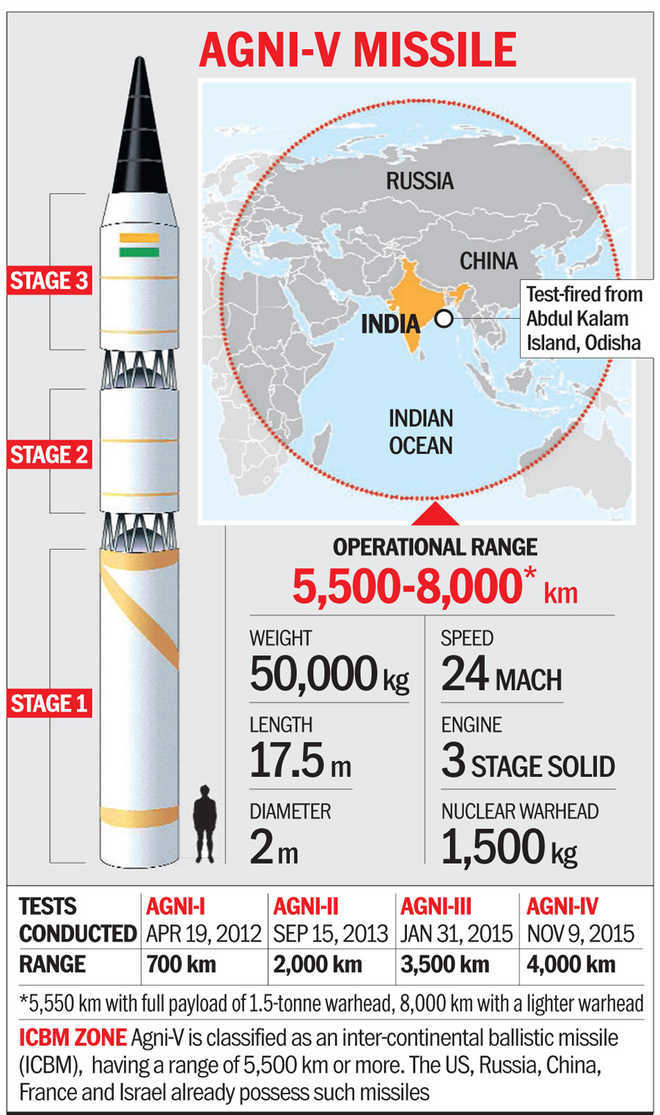
India successfully carried out the night trials of the Agni V nuclear-capable ballistic missile days after Indian and Chinese troops clashed in Tawang district of Arunachal Pradesh.
Why in news?
It was a midnight test fire.
And there are rumours about the increased range and stealth capabilities of Agni-V missile.
Agni Missiles
Agni missiles are long range, nuclear weapons capable surface to surface ballistic missile.
The first missile of the series, Agni-I was developed under the Integrated Guided Missile Development Program (IGMDP) and tested in 1989.
After its success, Agni missile program was separated from the IGMDP upon realizing its strategic importance.
It was designated as a special program in India’s defence budget and provided adequate funds for subsequent development.
Variants of Agni missiles
Agni I: It is a Medium Range Ballistic Missile with a Range of 700-800 km.
Agni II: It is also a Medium Range Ballistic Missile with a Range more than 2000 km.
Agni III: It is also an Inter-Medium Range Ballistic Missile with Range of more than 2,500 Km
Agni IV: It is also an Inter-Medium Range Ballistic Missile with Range is more than 3,500 km and can fire from a road mobile launcher.
Agni-V: Currently it is the longest of Agni series, an Inter-Continental Ballistic Missile (ICBM) with a range of over 5,000 km.
Agni- VI: The longest of the Agni series, an Inter-Continental Ballistic Missile (ICBM) with a range of ICBM 11,000–12,000 km.
Strategic significance of Agni Missiles
The success of AGNI missiles is in line with India’s stated policy to have ‘credible minimum deterrence’ that underpins the commitment to ‘No First Use’.
What makes Agni 5 agile is that it is a “canisterised” missile. It means that the missile can be launched from road and rail platforms, making it easier for it to be deployed and launched at a quicker pace.
The canisterisation also gives the missile a longer shelf life, protecting it from the harsher climatic conditions.
While India is among the handful of nations with ICBM capability.
The next generation of the missile, Agni VI, under development, is expected to have a range of around 8,000 km.
How to collect-analyse-organize-utilize-revise current affairs? Circle 16th (Friday) on the Calendar for Important Webinar for UPSC 2023-24.
Everybody tells you Current Affairs is crucial for UPSC CSE Prelims and Mains.
But no one tells you how to cover current affairs, what are the best sources, and how to collect-analyse-organize-utilize-revise current affairs.
Dimple Chouhan ma’am, senior IAS faculty for Samachar Manthan program will take the most important webinar for you on How to cover current affairs most effectively for UPSC CSE?
Current Affairs provide the basis for almost 70-80% of the questions asked in UPSC Prelims and Mains. As per recent exam trends, even the questions on various hardcore GS subjects, including History, Culture, Geography, and politics, have been critically connected with and influenced by current events.
Post webinar get PERSONALIZED Current Affairs Strategy + MENTORSHIP CALL for UPSC 2023-24.
What are you going to learn in this Webinar?
Basically, exam-oriented current affairs preparation depends on 4 aspects;
Staying informed about the most relevant current topics.
Understanding the context (It is not enough to simply know what has happened
Organizing & updating your notes for MCQs & Answer writing.
Practicing MCQs and forming Mains GS answers
In this webinar Dimple ma’am will discuss following points
1. How to cover daily current affairs in just 1.5 hrs along with notes and answer writing? Especially for working professionals.
2. How to Link current affairs to GS in Answer Writing?
3. How Current Affairs can help beat the unpredictability of UPSC paper, especially Prelims. Changing trends, eg: Prelims 2022- many questions from IR.
4. Issues in Current Affairs coverage-
What to read?
What are the sources?
How much time should be devoted to Current Affairs?
Can newspapers be a substitute for monthly magazines?
How to make notes
How to integrate CA into Mains answers
Daily, weekly coverage vs monthly coverage
5. Subjects, directly and indirectly, dependent on CA
Post webinar get PERSONALIZED Current Affairs Strategy + MENTORSHIP CALL for UPSC 2023-24.
Materials You Will Receive Post Webinar (Webinar FREE Package)
1-1 discussion on Most Probable current affairs topics for UPSC 2023
Smash Prelims notes PDF,
24 weeks’ Micro-Macro masterplan,
and MCQ tests.
About Dimple Ma’am
Dimple Chouhan is a senior IAS faculty at CivilsDaily. She has been mentoring UPSC aspirants for 4 years now and has mentored 150+ aspirants to Prelims success.
What The Hindu mentioned about Civilsdaily Mentorship
On the occasion of the 75th year of India’s independence, the Prime Minister articulated a bold vision that in the coming 25 years, “Nari Shakti” would play a vital role in India’s socio-economic developmental journey.
Elevated status in ancient texts and thoughts: Culturally and mythologically, women have enjoyed an elevated status in India. For example, it is mentioned in the Kena Upanishad that it was the goddess Uma who enlightened the three powerful but ignorant gods, Indra, Vayu, and Agni, to the profound mystery of Brahman.
Experience of women in modern era is far from ideal: Women have faced discrimination in the household and at jobs, and for a long time, they were victims of political indifference and neglect.
Recognizing the Nari Shakti: In recent decades, “Nari Shakti” has been reasserted through micro and silent revolutions. There are some silent women-led changes transforming our society politically and economically But there is need to highlight the challenges that remain in women fulfilling their true potential as modern nation-builders of India.
Gender gap in voter turnout is diminishing rapidly as women often exceeds male voter turnout: Research on women voters using historical data has revealed that since 2010, the gender gap in voter turnout has diminished significantly and the recent trends show women voter turnout often exceeds male voter turnout. This massive increase is a nationwide phenomenon and is also observed in less developed regions of the country where traditionally, the status of women has been significantly lower.
Dramatic increase in women contesting election particularly in panchayat level: Since 2010, many more women have been contesting elections. To put this in perspective, in the 1950s, in the state assembly elections, women contested elections in approximately 7 per cent of the constituencies, but by the 2010s, women were competing in 54 per cent of the constituencies. This is particularly remarkable at the grass roots panchayat level where 50 per cent seats have been reserved for women for over a decade now.
Results of this positive change
Women voters can no longer be neglected or marginalized: A key implication of this is that women voters can no longer be marginalised or neglected; they demand respect and command attention.
Political entrepreneurs compelled to address women issues: This silent revolution has compelled political entrepreneurs and grounded leaders to design policies addressing issues that women care about. It is not surprising that some of the most dramatic policy changes concerning poverty reduction since 2015-16 have been in the form of networking of households across the nation through amenities such as cooking fuel, sanitation, water, and electricity. These are also the key drivers of long-term economic growth.
Rising women voters compelled political parties to make law and order a critical issue: In less developed regions where women and children have been the biggest victims of lawlessness, the silent revolution of rising women voters has compelled political parties to make law and order a critical political issue.
Positive response by political parties: Political parties and leaders are now responding to this by improving access and affordability to basic needs of ordinary people like amenities and infrastructure rather than focusing on the rhetoric of caste and communalism. This is in sharp contrast to the “democratic recession” that is being experienced in the rest of the world.
Challenges ahead
Women employment a biggest challenge: According to World Bank data, the female labour force participation rate has declined from 32 per cent in 2005 to 19 per cent in 2022. Labour force participation does not consider unpaid domestic services, which include household services such as taking care of the children and the elderly.
More hours spent is in unpaid domestic services: Our research based on data from the time use surveys in India in 2018–19 reveals that women in the age group of 25 to 59 years spend approximately seven hours daily in unpaid domestic services.
Double burden of working is one of the reasons behind decline of women labour participation: Double burden of working women perhaps is one of the critical reasons for the decline in the women’s labour force participation rate. In sharp contrast, working or non-working men in the same age group spend less than 45 minutes on unpaid domestic or caregiving services.
Declined fertility rate: Fertility rates have declined dramatically below the replacement rate, the share of the ageing population has increased, and there is an alarming increase in the percentage of kinless elderly.
Did you know Baumol Cost Disease?
The care industry is labour-intensive and, therefore, subject to Baumol Cost Disease, implying that the cost of providing care would keep rising over time.
Way ahead
On labour force participation: It is essential to look at the experience of advanced countries, where increased participation of women in the labour force has come at the expense of family structure.
On dynamics of household and elderly care, sharing burden by men is a necessity: If we want more women to participate in the labour force, and at the same time preserve the family structure, then men would have to share the burden of unpaid domestic services. This would require a break from tradition and the creation of new modern narratives and myths.
Conclusion
As India takes over the presidency of G20, it is an occasion to celebrate “Nari Shakti” and political empowerment a stupendous increase in women voter turnout in the decade has strengthened and made our democracy more progressive. Women’s political empowerment has been a bottom-up revolution in India and holds lessons for other countries.
Mains question
Q. Culturally and mythologically, women hold a high position in India. However, there are still challenges in women fulfilling their true potential as India’s modern nation-builders. Discuss.
The 2023-24 Union budget will be announced on February 1, followed by the states’ respective budgets. These budgets will set the policy tone for the rest of the year and, as such, are followed closely.
Situation of Capex and fiscal consolidation after pandemic
Rise in fiscal deficit: The overall fiscal deficit of the government has soared and we believe the next few years will be all about getting it back on track.
Rising interest payments: This is important because interest payments on past debt make up a whopping 50 per cent of net tax revenues for the central government, leaving very little room for other spending.
less room for social spending: Given the needs of the economy on various fronts like health, education and capex, it is important to lower the interest burden over time. That can only be achieved by fiscal consolidation.
Analysing the tax revenue and expenditure of central and state Government
Central government tax revenues have risen faster than state revenues: Both benefitted as small and informal firms struggled with the lockdowns and lost market share to large firms, which tend to pay more taxes.
Disparity in revenue collection: A large chunk of the tax revenues in the early part of the pandemic period came from the “special” duty and surcharge on oil, which went primarily to the central government. To be fair, the central government subsequently cut the duty on oil (in both 2021-22 and 2022-23) and the tax share that went to the states rose somewhat.
Capex of centre is more: The Centre has committed to more current expenditure than the states. While it increased across the board during the pandemic, current expenditure rose more for the central government.
Higher spending on social schemes: This was led by higher social welfare spending (for instance, on the free food distribution scheme) and, more recently, higher subsidies (for example, fertilisers) in the face of rising commodity prices.
States have a moderate capex: The common perception is that states have gone all out on unsustainable current expenditure. But the data shows that it’s just a few states which have spent heavily (for example, Telangana, Assam, West Bengal and Punjab).
The central government capex has risen but state capex has contracted: Making a commendable choice, the central government used both its tax bounty as well as its ability to borrow more at a time when banking sector liquidity was loose to raise capex spending, which rose by 1.2 per cent of GDP between 2019-20 and 2021-22.
Cut in state capex: On the other hand, the states cut back on capex, which has fallen as a percentage of GDP over the last few years, and continues to be on a weak footing in the current year. In fact, putting the central government’s capex alongside the state and public sector capex shows that the overall public sector thrust is not any stronger than it was back in 2018-19.
Centre has breached the fiscal deficit target: The central government’s fiscal deficit has overshot targets while the state deficit is relatively contained. At a budgeted 6.4 per cent of GDP in 2022-23, the central government’s fiscal deficit has risen above the pre-pandemic level of 3.4 per cent in 2018-19, and is well above the 3 per cent medium-term target.
Sharp fall in states fiscal deficit target: Even though the state fiscal deficit rose in the first year of the pandemic (from 2.5 per cent of GDP in 2018-19 to 3.8 per cent in 2020-21), it has fallen sharply since (to 2.7 per cent in 2021-22).
Low borrowing by states: In fact, state government borrowing is rather low in the current year so far. If this continues, the fiscal deficit could be even lower in 2022-23 (around 2.5 per cent of GDP), which is well under the 3 per cent medium-term target, and bang in line with pre-pandemic levels.
What are the challenges?
Less consolidation by states: The states have less fiscal consolidation to do than the central government.
High quality spending: Both have a common challenge to commit to more capex, which is considered high quality spending as it “crowds in” private investment if done responsibly. And we believe investment is the only sustainable way to increase the capacity of the economy to grow and create jobs.
Balancing the capex and fiscal consolidation: For the central government, the challenge is to hold on to its capex push at a time of fiscal consolidation. For the states, the challenge is to start doing more.
What should be the way forward?
Lowering the fiscal deficit: The central government’s aim is to lower the fiscal deficit by about 2 per cent of GDP over the next three years. About half of this consolidation can come from lowering current expenditure to pre-pandemic levels.
Raising the tax revenue through formalization: Continued formalisation of the economy that raises tax revenues (though “organic” formalisation will likely be more sustainable than “forced” formalisation).
Disinvestment of PSUs: A bigger push for disinvestment by selling stakes in public-owned companies, and further tax reforms (in terms of direct taxes and the GST).
Capex cut is the last option: If these don’t work, the default option will be to cut capex, which is a concern as it has implications for medium-term growth.
Conclusion
Fiscal consolidation and capital expenditure should go hand in hand. More government spending means more infrastructure building and more chances of growth and employment. However, this spending should be done with sound fiscal base.