💥UPSC 2026, 2027, 2028 UAP Mentorship (March Batch) + Access XFactor Notes & Microthemes PDF

Search results for: “”

  • (WATCH Live.) How to ensure 100+ in CSAT for UPSC Prelims 2023? | Making CSAT a cakewalk, even for non-engineering/science background aspirants| By Zeeshan sir

    (WATCH Live.) How to ensure 100+ in CSAT for UPSC Prelims 2023? | Making CSAT a cakewalk, even for non-engineering/science background aspirants| By Zeeshan sir

    Join Zoom Meeting

    https://us06web.zoom.us/j/85604790744?pwd=Z0h6QTQzQ2dHYlFRbGNBczJxU2FTUT09

    Meeting ID: 856 0479 0744
    Passcode: 882928


    Reserve 30th November, Wednesday for an important MASTERCLASS on How to ensure 100+ in CSAT for UPSC Prelims 2023 by Zeeshan Hashmi Sir


    Despite being qualifying in nature, CSAT is getting more and more critical in surpassing the first hurdle of the UPSC-CSE exam. The Prelims is the first phase of the CSE exam but not necessarily the simplest.


    Even a top-notch GS preparation might not be enough to sail you through prelims if you are not clearing CSAT.

    Gone are the days when only humanities or non-science and non-engineering background students used to worry about CSAT. Now many IITian aspirants and even Areeba, AIR 109 in UPSC 2021, was not able to clear CSAT despite her engineering background and amazing performance academically all through.

    Having said that let me make a claim: It is easy to score 100+ if certain rules are followed and practiced diligently. It is not about engineering or technical background or ability to do maths but rather smartly tackling selected questions and preparing accordingly.

    My CSAT students from 2021 batch

    Points to remember, the CSAT is a major stabilizing factor, at least for someone with a basic knowledge of 10th-standard maths and general aptitude.

    Acknowledging the need to ensure the removal of difficulties, the students face in clearing CSAT paper, I will be conducting an on-demand MASTERCLASS on How to ensure 100+ in CSAT for UPSC Prelims 2023?

    CSAT MASTERCLASS DETAILS

    Topic: How to ensure 100+ in CSAT for UPSC Prelims 2023.

    Date and Time: 30th November, 7 pm (Wednesday)

    Link: Zoom link will be shared on email post registration

    Important Takeaways:

    1. Trend analysis of the last 4 years of CSAT paper. How UPSC CSAT has been evolving, changing pattern and difficulty level?
    2. How to deal with maths and logical reasoning questions irrespective of your academic background?
    3. How to select topics and sections which are high scoring and having high return of investment wrt time spend during preparation?
    4. List of super easy topics for CSAT that you must not ignore.
    5. From where and how to start reading and practicing comprehension. How many comprehensions you should try to solve in the paper?
    6. How to approach CSAT paper for best time management and high score?
    7. How to use smart elimination techniques in CSAT paper? Most important part of this webinar masterclass.

    What my students have to say about my CSAT and Prelims sessions?


  • (WATCH Live Direct link inside) MPSC-UPSC Webinar: 20 Best Practices of Answer Writing to Score like Topper in UPSC Mains | 1-1 LIVE session by Pravin Garje sir

    (WATCH Live Direct link inside) MPSC-UPSC Webinar: 20 Best Practices of Answer Writing to Score like Topper in UPSC Mains | 1-1 LIVE session by Pravin Garje sir

    Webinar: 20 Best Practices of Answer Writing to Score like Topper in UPSC Mains | 1-1 LIVE session by Pravin Garje sir | Register and receive CD’s mains Notes and PDF post webinar session

    Broadly speaking, two types of skills are required for creating excellent, rule-of-thumb answers in UPSC mains- execution of facts and integration of an administrator-like opinion.

    And it’s true that almost 100 out of 100 toppers develop these 2 must-have skills. And these must-have skills completely depend on the 20 best practices of UPSC mains answer writing.

    Click to add a reminder

    Besides, an aspirant should understand the bare minimum requirements needed for effective answer writing. Because these 1750 marks of the Mains exam will decide your IAS destiny. 

    Though UPSC has given a very detailed and crisp syllabus, it can’t resist the urge of adding surprising elements in questions every year to keep candidates on their toes and to test their mettle. 

    To boost your Mains score by more than 100 marks. And that is enough to make the difference where a single mark can decide success and failure. 

    Acknowledging the need to ensure the removal of difficulties, the students face, we’re conducting an on-demand MASTERCLASS by Pravin Sir on What are the 20 Best Practices of Answer Writing to Score like Topper in Mains & How to boost your mains Score in 2023, sticking to the basic sources, and practicing answer writing in expert-prescribed ways, even after many things are pending.

    This is the right time to focus on the principles that Pravin sir discussed in the FREE MASTERCLASS.  (details below)

    20 Best Practices of Answer Writing in UPSC Mains Masterclass details: 28th November (Wednesday), 6 PM

    The main points to be discussed:

    “*The 20 best answer writing practices are divided into 3 sections:- 5 basics, 5 intermediate, and 10 advanced”

    1. Identifying and tackling directive words and tail words in the Mains Question. There are more than 30 directives and you must answer according to that only. We will discuss how to approach an answer wrt to these directives

    2. When, where, and how to use diagrams, flowcharts, tables, etc?

    It is a common notion that more diagrams = more marks, but this is not true. You must draw diagrams/flowcharts to address certain parts of the question only. 

    3. Understanding the core and non-core parts of the questions. 

    There is one part of the Mains question that is directly asked and is an obvious question. The non-core part at times might not be obvious but you must address that. 

    4. How to use anecdotes, facts, data, examples, and case studies? – even using the most common ones in the most impactful manner, in such a manner that it fetches you more marks

    5. How to answer a question with limited content or knowledge? Basically – Bouncer/googly questions. Keywords in question: Pravin sir will thoroughly explain what each keyword means. Analyzing critically is different from explaining or elaborating. So, how to read the question carefully and then start answering?

    6. How to complete the paper in 3hours? And what should be the correct sequence of answering sections in the Mains paper? 

    This is very essential to maintain your speed as well as consistency in your thinking process. 

    7. Make a trade-off between quality and quantity in your answers. You might now be able to recall every piece of info for all the answers.

    8. When to write answers in Paragraph form and when to write in heading, subheading, and points? What should be the ideal length of a sentence, paragraph, and number of points?

    9. What should be your strategy for the last week before Mains 2022?

    10. How to go about the Final Revision before Mains 2022? Focus on making more revisions: If you can’t remember any points, how to put things in your notes during the exam? What are the exact ways to revise at least 10 times before the exam? Things must be your tips.


    Pravin Sir: Pravin sir is a mentor with CivilsDaily for nearly 4+ years and is now Working as a Mentor Head in Civilsdaily Mains Guidance Program. He has done 6 attempts of UPSC CSE with, written multiple mains and two UPSC interviews, PSIR as an optional, CAPF Interview 2017.


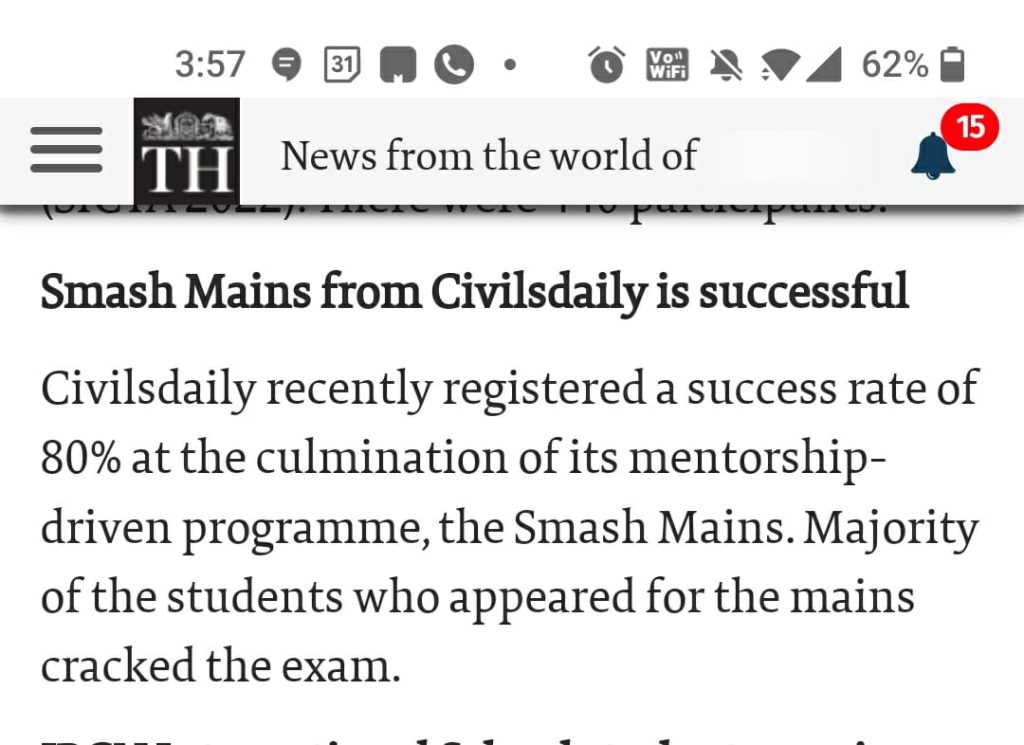
    What The Hindu opined about Civilsdaily Mentorship

  • Understanding the “China’s BRICS” game

    BRICS

    Context

    • At the 14thLeaders’ Meeting of the BRICS, held virtually in June 2022, China dwelt on the issue of expanding the group beyond its five existing members to include more emerging economies. At a time when China-India relations are at a low point, the proposal has raised concerns in New Delhi. As India deliberates its stance on this contentious issue, it is important to understand China’s approach towards BRICS.

    Click and get your FREE Copy of CURRENT AFFAIRS Micro Notes

    BRICS

    All you need to know about BRICS

    • BRICS is an acronym for the grouping of the world’s leading emerging economies, namely Brazil, Russia, India, China and South Africa.
    • Jim O’Neill, a British economist, coined the term ‘BRIC’ to describe the four emerging economies of Brazil, Russia, India, and China. He made a case for BRIC on the basis of econometric analyses projecting that the four economies would individually and collectively occupy far greater economic space and become among the world’s largest economies.
    • The importance of BRICS is self-evident: It represents 42% of the world’s population, 30% of the land area, 24% of global GDP and 16% of international trade.
    • The five BRICS countries are also members of G-20.

    BRICS for China

    • Strategy of multiple engagements: For China, it is the grand strategy that is the Belt and Road Initiative (BRI) that threads its many engagements: BRICS, the Shanghai Cooperation Organisation (SCO), the Association of South East Asian Nations (ASEAN) where it is not directly a member, the Eurasian Economic Union, and the Regional Comprehensive Economic Partnership (RCEP).
    • Projecting the connection between BRICS and BRI: BRICS as an entity, has not signed any memorandum of cooperation with the BRI, In Chinese strategic thinking, the BRI and BRICS are deeply connected.
    • Repeated assertion by Xi Jinping: President Xi Jinping himself has harped on this notion in his speeches on multiple occasions, such as the 9th BRICS Business Forum in September 2017 and the 11th BRICS Leaders’ Meeting in November 2019. In his speech he stated that China would cooperate with other multilateral development institutions such as the BRICS New Development Bank to support BRI and jointly formulate guidelines to finance development projects. 

    BRICS

    China’s Approach towards BRICS: The Link with BRI

    • Policy of Five connectivities: Chinese scholars are of the opinion that the “five connectivities” in policy, infrastructure, trade, finance, and people-to-people constitute the common way forward for both the BRI and BRICS.
    • Economic development strategy: China has been working towards strengthening the interconnection of economic development strategies of different states along the BRI, particularly the BRICS nations, aligning and integrating BRI and BRICS infrastructure projects, ensuring unimpeded trade, pursuing multiple forms of cooperation.
    • China’s Silk Road Economic Belt and EEU: The most significant progress made so far by China in this regard has been the official docking between China’s Silk Road Economic Belt (the land part of the BRI) and the EEU (where Russia is the dominant player) in May 2015.
    • Infrastructure models that China is emphasising: A high-speed railway project from Moscow to Kazan is being constructed under this strategic cooperation, funded by the BRICS New Development Bank. This is the model that China wants to replicate with other BRICS nations as well. In December 2015, South Africa and China signed a memorandum of understanding on jointly promoting the construction of the “Silk Road Economic Belt” and the “21st Century Maritime Silk Road.”

    Why China needs BRICS to promote the BRI?

    • To avoid direct conflicts: Chinese policymakers believe that although China is the main proponent of the BRI, it needs to avoid both strategic overdraft and direct conflicts with the pillars of the present international order while implementing the strategy.
    • To use resources effectively: To improve efficiency in the use of funds and other resources, China, it is argued, should shift from individually leading specific projects to constructing and leading various international institutions and exerting itself through institutional norms.
    • Strategic alignment and ambition to lead: President Xi emphasised this as well at the ‘Belt and Road’ International Cooperation Summit Forum in May 2017, saying that the BRI “is not about starting from scratch and reinventing the wheel, but realising strategic alignment and (reaping) complementary advantages (of various existing or new mechanisms).”
    • Dominating the financial mechanism through BRI partnership: Chinese scholars point out that all the BRICS countries have already been made part of the Asian Infrastructure Investment Bank (AIIB), one of China’s key financing mechanisms for the BRI. Further, given China’s clear dominance in the New Development Bank (NDB), Contingency Reserve Fund (CRA), the AIIB, as well as Silk Road Fund, it is only imperative for it to use these institutions to incentivise more BRICS countries to participate in the BRI, and to lay the foundation of a global financial system for the Chinese currency (RMB) trade settlement.
    • Creating an acceptable front: China is aware that the BRI has provoked extensive discussion around the world. It has been interpreted differently by different countries and has even drawn suspicion and caution in certain quarters. China is aware that to implement the BRI smoothly, it needs an additional front that is less controversial and more acceptable to the international community at large, and in particular, to developing countries.

    BRICS

    What are the concerns for India?

    • Promoting priorities in contrast: China prioritises the ‘BRICS + Asia’ cooperation mechanism – ‘BRICS + ASEAN’ on the one hand, and ‘BRICS + Bay of Bengal’ on the other, thereby integrating BRICS more closely with the Southeast Asian countries as well as with the Bangladesh-China-India-Myanmar Economic Corridor (BCIM-EC) and Bay of Bengal Initiative for Multi-Sectoral Technical and Economic Cooperation (BIMSTEC) nations.
    • Aligning with BIMSTEC to counter India’s resistance to BRI: The aligning with BIMSTEC is particularly aimed at countering India’s reticence to endorse the BRI, while seeking its cooperation through either coercion (i.e., using other member states of the said groupings as bargaining chips to pressure India to cooperate) or deception (i.e., temporarily ignoring the BRI banner).
    • Using BRICS at its advantage: China wants to use the BRICS platform to establish links and influence policies of these key regional organisations, including the African Union in Africa, the Arab League in West Asia, the SCO in Central Asia, the South Asian Association for Regional Cooperation (SAARC) in South Asia, and ASEAN in Southeast Asia.
    • Ambition to formulate the world order in its own way: It wants BRICS, especially the BRICS New Development Bank, to strengthen cooperation with the IMF, the World Bank, and the World Trade Organization. This will enable China, through BRICS, to strengthen its international leadership, play a bigger role in the formulation of international rules, and influence the overall global governance mechanism.

    Conclusion

    • As China-US rivalry intensifies and the BRI faces a plethora of challenges, BRICS is increasingly gaining significance for China. Within the grouping, China sees itself as the ‘core’ of BRICS, while India as its weakest link.
    • India needs to accurately grasp the geopolitical shifts taking place within BRICS and deftly navigate the complex dynamics between the member states to safeguard its own interests within the grouping and avoid being drawn passively into China’s Great Game.

    Mains Question

    Q. China has focused on expanding the BRICS group to achieve its own ambitions. Discuss the significance of BRICS for China and India’s concerns.

    (Click) FREE1-to-1 on-call Mentorship by IAS-IPS officers | Discuss doubts, strategy, sources, and more

  • Assessing The Impact of Falling Rupee

    Context

    • The Indian rupee has been quite the controversial newsmaker this year. Having fallen more than 11 percent against the US dollar so far in 2022, the rupee breached the much-feared 80-mark in July and went on to set record lows, touching 83 to a dollar late in October.

    Click and get your FREE Copy of CURRENT AFFAIRS Micro Notes

    Impact on trade

    • Widening trade deficit: The first phenomenon is one of the biggest worries caused by a falling rupee, a rise in import costs, threatening higher inflation and a widening trade deficit.
    • Advantage for export: However, there also exists a ray of hope, a depreciated currency implies cheaper, more competitive exports and therefore, a possible export-led boost to the domestic economy. The net effect of these opposing forces would determine the impact of a depreciating currency on an economy.
    • Robust Purchasing Manager’s Index (PMI): The import bill has risen not only on the back of a raging dollar and hardening crude prices but has also been spurred by strengthening domestic demand and manufacturing, as evidenced by a robust Purchasing Manager’s Index (PMI) of 55.3 in October.
    • Subdued merchandized export: Although service exports have done fairly well in FY 2022-23, merchandise exports have remained subdued and could soon worsen due to economic downturns in Europe and the US.

    Rupee

    Impact on foreign investment

    • Weak rupee low foreign portfolio investors (FPI): The rupee has a complicated relationship with the moody foreign portfolio investors (FPIs). A weaker rupee can discourage FPIs. In turn, FPI outflows can further push the rupee to depreciate.
    • Falling NRI deposits: With the rupee losing value against the dollar, and interest rates around the world rising, NRI deposit flows also fell in the five-month period from April to August 2022, down to US$1.4 billion from US$2.4 billion a year ago.
    • FDI is Rising: Net FDI flows have remained positive and are set to grow, with April-June 2022 seeing an inflow of US$13.6 billion, higher than the same period last year. Even Indian stock markets have remained resilient, particularly on the back of large net-purchases by domestic institutional and retail investors, offsetting the equity sell-off by foreign investors.
    • Negative foreign investment: Net foreign investment (FII) flows did turn negative for a few months in 2022, and while rebounding FPI and resilient FDI do point to a more optimistic opinion of India among foreign investors, foreign investment is absolutely crucial at this juncture in India’s growth story and must be watched closely.

    Rupee

    Efforts taken by RBI

    • Use of forex reserve: In an effort to defend the rupee, the RBI has intervened and sold off some of its foreign exchange reserves. The reserves stood at US$524.52 billion as of 21 October 2022, witnessing a fall of over US$115 billion since the beginning of the year.
    • according to RBI external situation is better: RBI has stated that most external indicators such as external debt to GDP ratio, net international investment position to GDP ratio and the ratio of short-term debt to reserves reflect India’s relatively comfortable position in meeting its external financing requirements–even in contrast to other emerging economies.
    • Careful intervention: Over-tightening of monetary policy and excessive intervention in the currency market can pose significant risks to the country’s growth prospects and the RBI must be careful to intervene just enough to quell volatility, without expending an inordinate amount of reserves.

    Rupee

    Opportunity in crisis

    • Leveraging the growth rate: India has the chance to leverage its relatively healthy growth rates and rising infrastructure and capital expenditure to attract foreign investment, spurring growth and strengthening the capital account.
    • High investor confidence: Investor confidence has been steady, with the country seeing a record high of annual FDI inflows of US$84.8 billion in FY2021-22 in spite of the pandemic and volatile geopolitical scenario.
    • Stability in growth: This confidence needs to be leveraged and by positioning India on the international stage as a thriving and stable haven for investments, both the country’s growth and forex needs can be met.
    • Sufficient policy support is needed: Although the falling rupee has caused worry for a few economic indicators, with sufficient policy support, the domestic economy could emerge as an outlier in a global downturn.

    Conclusion

    • With the United States (US) on a war path to curtail inflation and the supply side stifled by the conflict in Ukraine, even historically strong currencies like the euro and the British pound have plummeted against the raging dollar, more than the rupee. Government and RBI must stay on course of steady growth of economy.

    Mains Question

    Q. Discuss the impact of falling rupee on Trade and foreign investment in India? How India has unique opportunity for growth amidst the crisis around the world?

    (Click) FREE1-to-1 on-call Mentorship by IAS-IPS officers | Discuss doubts, strategy, sources, and more

  • Notable women in the making of Constitution of India

    women

    PM highlighted the contribution of women in the Constituent Assembly which drafted the Constitution was hardly discussed and efforts should be made to educate future generations about their work.

    These are the 15 invisible architects of the Indian republic cited by the PM-

    Note: This newscard has some invincible set of facts that no one can remember in one go. However, we advise you to take some notes and have it on your desk. Be it sticky notes or something. Revise them for some days.

    (1) Ammu Swaminathan

    • She was born into an upper-caste Nair family in the Palghat district of Kerala.
    • She was a social worker and politician who along with Annie Besant, Margaret Cousins, Malathi Patwardhan, Mrs. Dadabhoy, and Mrs. Ambujammal, formed the Women’s India Association in 1917 in Madras.
    • One of the first associations to demand adult franchise and constitutional rights for women.
    • She strongly opposed discriminatory caste practices although, she belonged to an upper-caste and strongly advocated equal status, adult franchise, and the removal of untouchability.
    • Ammu became a part of the Constituent Assembly in 1946 from the Madras constituency.
    • She felt that the Constitution was too long and that it had gone into unnecessary detail and wanted a constitution that could fit easily into a pocket or purse.

    (2) Annie Mascarene

    • Annie Mascarene was born into a Latin Catholic family belonging to Thiruvananthapuram, Kerala.
    • She was one of the first women to join the Travancore State Congress and became the first woman to be part of the Travancore State Congress Working Committee.
    • She was one of the leaders of the movements for independence and integration with the Indian nation in the Travancore State.
    • She was elected to the First Lok Sabha in the Indian general election, 1951.
    • She was the first woman MP from Kerala and one of only ten elected to Parliament in the elections.
    • Before her election to Parliament, she had served briefly as Minister in Charge of Health and Power during 1949-1950.

    (3) Begum Aizaz Rasul

    • She was born into the princely family of Malerkotla, Punjab.
    • She was the only Muslim woman in the Constituent Assembly.
    • She, together with her husband joined the Muslim League after the enactment of the GOI Act 1935.
    • In 1950, after the dissolution of the Muslim League in India, she joined Congress.
    • She was elected to the Constituent Assembly as a member of the Muslim League representing the United Provinces.
    • Although she was not a part of any committee in the Assembly, she advocated for National language, reservation and property rights, and minority rights.
    • She was against making ‘Sanskritised Hindi’ the National language, as only very few understood it and instead advocated for Hindustani.

    (4) Dakshayani Velayudhan

    • She was born into an agrestic slave caste, Pulayas, on a small island of Bolgatty on the coast of Cochin.
    • She was the only Dalit women member of the Constituent Assembly and also the youngest at 34 years.
    • She was the first Dalit woman to graduate in India, and was the only female student pursuing a course in the sciences.
    • She was inspired into politics through her family’s fight against discriminatory caste practices.
    • She was the first generation Kerala woman to be able to cover their upper-body.
    • She was nominated to the Assembly in 1945 from Madras.
    • In the Assembly, she advocated on issues of untouchability, forced labour, reservations, and against separate electorates for Dalits.
    • She believed that the best way to address untouchability was through sustained state propaganda and not through punishment.
    • In 1977 she set up a women’s rights organization Mahila Jagriti Parishad in Delhi.

    (5) Durgabai Deshmukh

    • Durgabai, from the ripe age of twelve, was a part of the Indian freedom movement.
    • She quit school to protest the imposition of English as a medium of education, part of the Non-Cooperation Movement.
    • She volunteered at a conference held by the Indian National Congress in Kakinada at the age of 14.
    • She participated in the Salt Satyagraha from Madras in May of 1930.
    • While she was in prison, she studied English and completed her master’s degree from Andhra University.
    • She then studied law at Madras University and practiced at the bar for a few years.
    • She established Andhra Mahila Sabha to coach young Telugu girls in Madras for their Matriculation examination conducted by the Banaras Hindu University in 1936.
    • She was elected to the Constituent Assembly from Madras and was part of the Committee on Rules and Procedure and the Steering Committee.
    • She also advocated for judicial-independence and human trafficking.
    • She also felt that Hindustani should be adopted as a national language instead of Sanskritised Hindi but, she later argued against adopting Hindi as the national language.

    (6) Hansa Jivraj Mehta

    • She was a writer, social reformer, social activist, and educator.
    • In 1937, she contested in the Bombay Legislative Council elections from the general category; she not only won but remained on the council till 1949.
    • She became President of the All India Women’s Conference in 1946.
    • During the presidency, she drafted the Indian Women’s Charter of Rights and Duties, which called for gender equality and civil rights for women.
    • She is 1946 also served as a member of the UN sub-committee on the status of women.
    • She along with Eleanor Roosevelt, vice-chaired the United Nations Universal Declaration of Human Rights Committee.
    • She was part of the Advisory Committee, Sub-Committee on Fundamental Rights, Provincial Constitution Committee.
    • She strongly advocated for a uniform civil code and believed that purdah was an evil practice. She also rejected quotas, reserved seats, and separate electorates for women.

    (7) Kamla Chaudhary

    • She was a feminist, fictional writer, and political activist.
    • Her political career began in 1930 when she joined the Indian National Congress and was an active participant in the Civil Disobedience Movement.
    • At the 54th session of the All India Congress Committee, she was the vice-president.
    • She was elected to the Constituent Assembly.

    (8) Leela Roy

    • She was a great social reformer, a staunch feminist and a social and political activist, and a close associate of Subash Chandra Bose.
    • In 1923 she received her M.A from Dhaka University and was the first woman to obtain it from the University.
    • She was an advocate for women’s education and established Dipali Sangh, an association for women, in 1923.
    • She founded a school named Dipali School and twelve other free primary schools with the help of the Dipali Sangha.
    • Subsequently, in 1928, she established two other schools known as Nari Shiksa Mandir (Temple of Women’s Education) and Shiksa Bhaban (House of Education).
    • Another important contribution was made b her to Muslim women’s education by setting up one of her schools as Qamrunnessa Girl’s School in Dhaka.
    • She was the only woman to be elected from Bengal to the Constituent Assembly on 9th December 1946.
    • However, she resigned from her post a few months later to protest against the partition of India.

    (9) Malati Choudhury

    • She hailed from East Bengal (now Bangladesh).
    • At the age of 16, in 1929, she was sent to Santiniketan where she got admitted to Viswa-Bharati.
    • Along with her husband, during the Salt Satyagrah joined the Indian National Congress.
    • In 1933, she formed Utkal Congress Samajvadi Karmi Sangh along with, her husband and later came to be known as the Orissa Provincial Branch of the All India Congress Socialist Party.
    • She joined Gandhiji in his famous padayatra in Orissa in 1934.
    • For the upliftment of vulnerable communities in Odisha, she set-up several organizations such as the Bajiraut Chhatravas.

    (10) Purnima Banerjee

    • She was a part of the individual Satyagraha and Quit India movement.
    • She was a member of the Congress Socialist Party and the Indian National Congress.
    • She held the post as the Secretary of the Allahabad City Congress Committee, working towards creating rural engagement.
    • She was appointed to the Constituent Assembly from United Provinces.
    • She argued that the preventative detention clause in Draft Article 15A (Article 22 of the Constitution of India) must prescribe time limits beyond which a person cannot be detained.
    • During the discussion of the Preamble, she expressly stated that ‘sovereignty’ is derived from the people of India.
    • During the discussion around the qualifications of Rajya Sabha members, Banerjee believed that the age limit should be reduced from 35 to 30 years.

    (11) Rajkumari Amrit Kaur

    • Inspired by Gandhi’s fight for Independence, she gave up her Sherborne and Oxford education to be his Secretary for 16 years.
    • In 1927 she along with Margaret cousins co-founded the All-India Women’s Conference.
    • She held the position of Secretary in 1930 and President in 1933.
    • She played a vital part in India’s establishment of constitutional equality of genders guaranteed under Articles 14, 15, and 16.
    • She was also played a pivotal part in the inclusion of the Uniform Civil Code as part of the Directive Principles of State Policy.
    • She was the first Health Minister of independent India and held office for ten years.
    • She was the first female and first Asian President of the world health Assembly.

    (12) Renuka Ray

    • Renuka Rai is a celebrated women’s rights and inheritance rights in parent a property activist.
    • She, like Kaur, was inspired by Gandhi’s call for the independence struggle, joined Gandhi’s Ashram accompanying him in protests.
    • In 1934 while working as a secretary of the AIWC, she authored ‘legal disability is Women in India; A Plea for A Commission of Inquiry’.
    • She worked for the prevention of women trafficking and the improvement of conditions of female labourers.
    • Ray contributed to numerous women’s rights issues, minority rights, and bicameral legislature provisions. She fought for Uniform Personal Law Code.
    • In 1949 represented India in the UN General assembly.

    (13) Sarojini Naidu

    • The first woman president of the Indian National Congress was popularly known as the Nightingale of India.
    • When in England, she had gained some experience in suffragist campaigns and was drawn to India’s Congress movement and Mahatma Gandhi’s Non-cooperation Movement.
    • Besides being a suffragette, she was also a women rights activist, and she advocated for reforms to improve the conditions of widows in the Indian National Social Conference in Madras, 1908.
    • In 1917 she headed the All-India Women’s Deputation and championed women’s suffrage before E. S. Montagu (Secretary of State for India).
    • In the same year, she together with Annie Besant, set up the Women’s India Association.
    • In 1931 she accompanied Gandhi to London for the inconclusive second session of the Round Table Conference.
    • She was appointed to the Constituent Assembly from Bihar as part of the ad-hoc committee on the national flag.

    (14) Sucheta Kriplani

    • The first elected female chief minister of an Indian state was born in Ambala.
    • A graduate from Indraprastha College for Women, Delhi University, taught Constitutional History at Banaras Hindu University until 1939.
    • She became a member of the Congress Party in 1938, served as the Secretary to the Foreign Department and Women’s Section for a year and a half.
    • Under her leadership, the women’s wing of the Congress Party was established in 1940.
    • She held an active role in India’s struggle for independence during the 1940s and was remembered especially for her role in the 1942 Quit India Movement for which she was arrested in 1944 and detained for a year.
    • She was elected to the Constituent Assembly from the United Provinces in 1946 as a member of the Flag Presentation Committee.
    • This committee presented the first Indian flag before the Constituent Assembly.
    • Kriplani served as a Secretary to the Relief and Rehabilitation Committee established by the Congress Party, playing a pivotal role in rehabilitating the Bengali refugees during the partition.
    • She had a colourful political career. She was also a part of various delegations to international organizations and countries.

    (15) Vijaya Lakshmi Pandit

    • Born, Swarup Kumari Nehru was a diplomat and politician. She changed her name after her marriage in 1921.
    • As an enthusiastic participant of the independence struggle, she was imprisoned on three different occasions.
    • After the Indian Independence, she became an eminent diplomat representing India in the United Nations between 1946- 48 and 1952-53.
    • She was an Ambassador to Moscow, Mexico, and Washington and later to England and Ireland concurrently.
    • She is the first woman to become President of the UN General Assembly.
    • She was appointed as the governor of Maharashtra after her return to India.


    Click and get your FREE Copy of CURRENT AFFAIRS Micro Notes

    (Click) FREE1-to-1 on-call Mentorship by IAS-IPS officers | Discuss doubts, strategy, sources, and more

  • Juvenile Delinquency in India

     Juvenile

    Click and get your FREE Copy of CURRENT AFFAIRS Micro Notes

    Context

    • The Supreme Court (SC) made an observation in its judgment of November 16 in the infamous Kathua rape-murder case that the rising rate of juvenile delinquency in India is a matter of concern and requires immediate attention.

    Present approach and implications towards Juvenile delinquency

    • The goal of reformation: There is a school of thought, that firmly believes that howsoever heinous the crime may be, be it single rape, gangrape, drug peddling or murder but if the accused is a juvenile, he should be dealt with keeping in mind only one thing i.e., the goal of reformation.
    • Continuance of crime: The school of thought, we are talking about, believes that the goal of reformation is ideal. The manner in which brutal and heinous crimes have been committed over a period of time by the juveniles and still continue to be committed, makes us wonder whether the [Juvenile Justice (Care and Protection of Children)] Act, 2015 has subserved its object.
    • No reformation but more crime: We have started gathering an impression that the leniency with which the juveniles are dealt with in the name of goal of reformation is making them more and more emboldened in indulging in such heinous crimes.

    Juvenile

    Provisions of Juvenile Justice (Care and Protection of Children)] Act, 2015

    • Criminal trials are not allowed: The law, contained in successive Juvenile Justice (Care and Protection of Children) Acts (JJ Acts), places a blanket ban on the power of the criminal court to try and punish a person below the specified age for committing any offence.
    • Lack of clarity on maturity of person: Should a person, who has sufficient maturity of understanding to judge the nature and consequences of his/her action, get blanket immunity from the criminal process without the fear of being prosecuted, tried and punished, merely because that person is below the specified age?
    • Child friendly inquiry: Under the existing law, such a person, at best, could be subjected to a child-friendly enquiry by a Juvenile Justice Board (JJ Board) and reformation for a maximum period of three years in a correctional home.

    Juvenile

    The issue of maturity of Juvenile offender

    • Help of experts to assess maturity: It is well settled that the assessment of whether or not an offender has attained sufficient maturity of understanding to judge the nature and consequences of his/her conduct is to be done by the court with the help of experts, and is a judicial function as exemplified by Section 83 of the Indian Penal Code, 1860 and Code of Civil Procedure, 1908.
    • Judicial discretion was not allowed in JJ Act 2000: The JJ Act 2000 to the extent it deprived the criminal court of the power to try and to punish a person below the age of 18 years for committing an offence, when such a person could be assessed to have attained sufficient maturity to judge the nature and consequences of his/her conduct ,encroached upon the judicial domain and was, therefore, unconstitutional.
    • No changes on maturity in JJ act 2015: The current JJ Act, 2015, suffers from the same defect, except that the age of criminal responsibility for heinous offences has been reduced to 16 years.
    • Immature send to correctional homes: It has been overlooked that the fundamental premise of juvenile justice law is that a juvenile offender who lacks such maturity should not be sent to a criminal court to be tried for the commission of an offence, and instead, should be sent to a correctional home for reform and rehabilitation.
    • Mature juvenile must be punished: Conversely, therefore, should the offender have such maturity, he/she must be prosecuted before the criminal court, tried and, if found guilty, punished. The age of the juvenile offender alone cannot, therefore, justify a blanket immunity from the criminal process rather, the question of such immunity must be assessed on a case-by-case basis depending on the maturity of such offender.

    Juvenile

    Trying the mature juvenile as adult

    • Mature juvenile and adults are not same: Indeed, Section 23 of the JJ Act, 2015 mandates that notwithstanding anything contained in Section 223 of the Code of Criminal Procedure of 1973 or in any other law for the time being in force, “there shall be no joint proceedings of a child alleged to be in conflict with the law, with a person who is not a child”.
    • Separate provision for mature juveniles: Provisions already exist in the JJ Act, 2015, as to how a child who has attained the age of 16 years could be tried and punished for a heinous offence.
    • Assessing the maturity of all juvenile irrespective of age: The same provisions could be extended to all juvenile offenders, regardless of age or nature of the crime, once it is found by the competent court that any such offender had sufficient maturity of understanding to judge the nature and consequences of his/her actions.

    Conclusion

    • Government should amend JJ Act 2015. Such an amendment would go a long way in providing the requisite balance between the rationales underlying the juvenile justice system and the criminal justice system and realizing the objectives professed by both.

    Mains Question

    Q. What are the flaws with existing Juvenile Justice Act 2015 vis-e-vis maturity of juveniles? How to address the issue mature juvenile and punishment to them?

    (Click) FREE1-to-1 on-call Mentorship by IAS-IPS officers | Discuss doubts, strategy, sources, and more

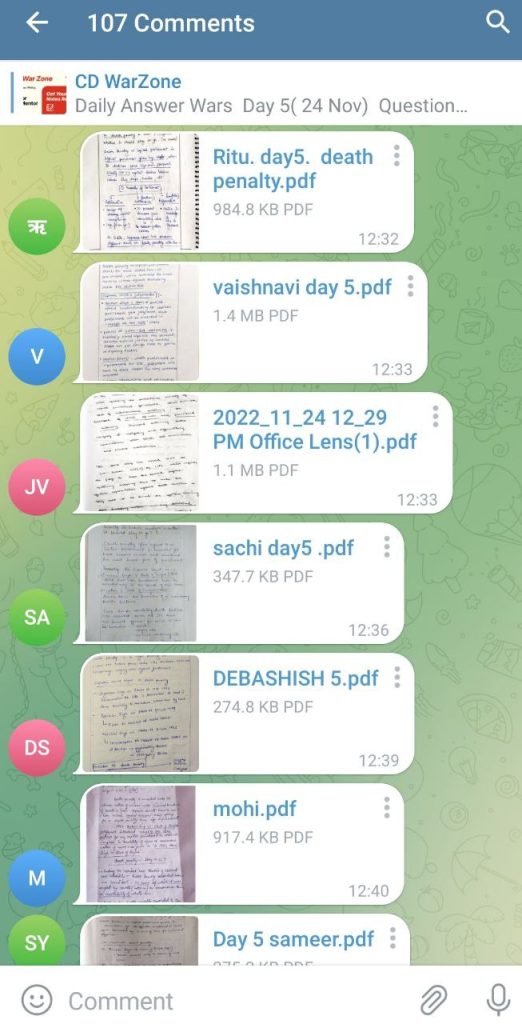
  • The essence of CD War Zone | Can you attempt the question of the day?| Get Feedback on the same day from Mentors of Civilsdaily| Join CD WAR ZONE (link inside)

    Question of the day: Panchayati Raj Institutions (PRIs) in India can become suitable agents for public service delivery. Discuss. (15 marks- 250 words) 

    Join this telegram group:

    We call this daily answer writing as Daily Answer Wars. Apart from this we also do Daily Check-ins making your daily Timetable and in Night owl discussions, we discuss important terms in news. 

    The essence of CD War Zone

    With Daily Answer Wars and Night Owl Discussions our aim is to ensure that you write and discuss themes/topics/terms that have a very high probability of appearing in the exam. 

    Writing is a whole different ball game. When you sit down to write, it’s an entirely different process. It’s about streamlining your thinking, and your ideas. You might be thorough with a concept but you might fail to pen it down. That’s worse than not having ideas at all. Moreover, when we all sit together and write an answer, we get access to various unexplored dimensions. By doing a Peer Review, you can add those dimensions to your War Notes. These War Notes will come handy when you would be revising your Mains notes. 

    When you discuss, you will almost always discover new concepts in the process. There is no substitute for this kind of discovery. Talking with others is a good way to develop a deeper understanding and ensure you retain better. Retention is everything. When you share with your fellow Aspirants regarding Academic and Non-Academic issues of the UPSC Exam, you get the best solutions to those problems. 

    So many aspirants just keep looking for content and hoard all kinds of PDFs. At Civilsdaily we don’t believe such PDFs are helpful at all. You need to be on a path of discovery and be actively involved. If you are a serious aspirant, you can’t afford to just consume information. That is why our emphasis is on the Notes(read War Notes) that you yourself prepare in this process. We Believe every Answer has the potential to become a Model Answer, rather than giving you a Model Answer, we help you make your Answers a Model answer

    Join the Civilsdaily Telegram Group to become a part of an extremely Positive and Vibrant UPSC Community.

    Here is how we start the day 

    Daily Check-in 

    Daily Answer Wars 

    Daily Answer Wars Result 

    Night owl discussions

    Join the telegram group here:

  • The depopulation alert

    depopulation

    Click and get your FREE Copy of CURRENT AFFAIRS Micro Notes

    Context

    • Recently, when the world population touched eight billion, several headlines focused on how India was the largest contributor to the last billion and is set to surpass China as the world’s most populous nation by 2023. But missing in this conversation is the real threat of depopulation that parts of India too face, and the country’s complete lack of preparedness to deal with it.

    Note: “The population and Population decline are continuously in the headlines which makes the population and associated topics important for the upcoming Mains Examinations.”

    India’s Population trend

    • The total population of India currently stands at 1.37 billion which is 17.5% of the world population.
    • Between 1992 and 2015, India’s Total fertility rate (TFR) had fallen by 35% from 3.4 to 2.2.
    • Young people (15-29 age years) form 27.2% of the population in 2021. This made India enter the Demographic dividend stage.
    • The percentage of the elderly population has been increasing from 6.8% in 1991 to 9.2% in 2016.

    What is depopulation?

    • The depopulation decline (also sometimes called population decline, underpopulation, or population collapse) in humans is a reduction in a human population size.
    • Over the long term, stretching from prehistory to the present, Earth’s total human population has continued to grow; however, current projections suggest that this long-term trend of steady population growth may be coming to an end.

    depopulation

    The depopulation discussion and the missing links

    • Falling fertility rate and discussing reversal: Demographers, policy experts and politicians in countries such as Japan, South Korea and Europe, which are experiencing falling fertility and nearing the inflection point of population declines, are beginning to talk about what the future holds and whether reversal is possible.
    • The missing key elements in the conversation: Talking about equitable sharing of housework; access to subsidized childcare that allows women to have families as well as a career; and lowered barriers to immigration to enable entry to working-age people from countries which aren’t yet in population decline is missing.

    Fertility in India

    • Falling fertility rate: It is now well-established that fertility in India is falling along expected lines as a direct result of rising incomes and greater female access to health and education. India’s total fertility rate is now below the replacement rate of fertility.
    • Many states are on the verge of population decline: Parts of India have not only achieved replacement fertility, but have been below the replacement rate for so long that they are at the cusp of real declines in population. Kerala, which achieved replacement fertility in 1998, and Tamil Nadu, which achieved this in 2000, are examples.
    • Decline in working age population: In the next four years, both Tamil Nadu and Kerala will see the first absolute declines in their working-age populations in their histories. With falling mortality (barring the pandemic), the total population of these States will continue to grow for the next few decades, which means that fewer working-age people must support more elderly people than ever before.

    What is Replacement Level Fertility (RLF)?

    • Replacement level fertility is the level of fertility at which a population exactly replaces itself from one generation to the next.
    • In simpler terms, it denotes the fertility number required to maintain the same population number of a country over a given period of time.
    • In developed countries, replacement level fertility can be taken as requiring an average of 2.1 children per woman.
    • In countries with high infant and child mortality rates, however, the average number of births may need to be much higher.
    • RLF will lead to zero population growth only if mortality rates remain constant and migration has no effect.

    A depopulating future and the challenges

    • Invisible trend because infuse of migrants: Access to working-age persons notably different from the situation in other States with low fertility. For instance, Delhi and Karnataka which are both net recipients of migrants, and will not confront population decline in the near future.
    • A skewed sex ratio remains a danger: As the latest round of the NFHS showed, families with at least one son are less likely to want more children than families with just one daughter.
    • Difference in education: The stark differences between northern and southern States in terms of basic literacy as well as enrolment in higher education, including in technical fields, will mean that workers from the southern States are not automatically replaceable.

    Conclusion

    • With decades of focus on lowering fertility, the conversation in India is stuck in a rut. It is for the southern States to break away from this outmoded, data-free rhetoric and join the global conversation on depopulation. India’s cannot ignore the depopulation in the name of migration to meet its current labour needs.

    Mains question

    Q. What is depopulation, which has been a hot topic in recent times? Where do you see India in global population trends? Discuss.

    (Click) FREE1-to-1 on-call Mentorship by IAS-IPS officers | Discuss doubts, strategy, sources, and more

  • [Sansad TV] Perspective: Legalizing Same-Sex Marriage

    Context

    • The Supreme Court has issued notice to the Centre Govt on a plea by two gay couples seeking recognition of same-sex marriage under the Special Marriage Act, 1954.
    • The petition drew on earlier landmark rulings including one declaring privacy a fundamental right and another that decriminalized gay sex in 2018.
    • Centre has to now file its response on this matter before the Supreme Court in four weeks.

    What is Same-Sex Marriage?

    sex
    • Same-sex marriage is marriage between partners of the same sex and/or gender identity.
    • For example, a marriage between two men or two women.
    • In the west, it is considered a civil partnership as a legally registered relationship which offers same sex couples rights similar to those of married couples of the opposite sex.

    Judicial basis for same-sex marriage: Decriminalization of IPC section 377

    Ans. Navtej Singh Johar & Ors. V. Union of India (2018)

    • In this landmark verdict, the Supreme Court today scrapped the controversial Section 377– a 158-year-old colonial law on consensual gay sex.
    • Section 377, which is part of an IPC 1861, banned “carnal intercourse against the order of nature with any man, woman or animal” — which was interpreted to refer to homosexual sex.
    • The Supreme Court reversed its own decision and said Sectuion 377 is irrational and arbitrary.
    • The judgment was delivered by a Bench of Chief Justice of India Dipak Misra and Justices Rohinton Nariman, AM Khanwilkar, DY Chandrachud and Indu Malhotra.

    Centre’s earlier stance

    • Directly opposed: In 2021 central Government had opposed same sex marriage in Delhi High Court citing it against the provisions of the Special Marriage Act, 1954.
    • Considers biological gender: It stated that a marriage in India can be recognised only if it’s between a biological man and biological woman capable of producing progeny.
    • Societal morality clause: In its argument then Central govt had also said that considerations of “societal morality” are relevant in considering the validity of a law.
    • Claiming responsibility: It argued that, it is for the Legislature to enforce such societal morality and public acceptance based upon Indian ethos.

    Reasons behind centre’s opposition

    • Legal revamp required: The registration of marriage of same-sex persons also results in a violation of existing personal as well as codified law provisions — such as ‘degrees of prohibited relationship’; ‘conditions of marriage’; ‘ceremonial and ritual requirements’ under the personal laws governing the individuals”.
    • Definition of spouse: In a same-sex marriage, it is neither possible nor feasible to term one as ‘husband’ and the other as ‘wife’ in the context of the legislative scheme of various personal laws.
    • Against cultural norms:  The social order in our Country is religion based which views procreation as an obligation for the execution of various religious ceremonies.
    • Property and other civil rights: Property rights post marriage is a much contested issues in India. Same sex marriage will not create any immunity for the law but increase complex interpretations.

    Issues with such marriages

    The issue of homosexual conduct to this fore in recent legal and political debate for main reasons, which are as follows:

    • Morality: This has brought with it a change in social attitudes, so that the stigma attached to the homosexuality has to a greater extent disappeared.
    • Rising activism: Campaigns for lesbian and gay rights taken on an increasingly radical character, arguing for an end to all forms of discrimination against homosexuality.
    • Religious sanctions: Same sex acts are punishable by death in Arab countries. No religion openly embraces same sex marriage. More or less, they are considered un-natural everywhere.
    • Social stigma:  Apart from the harsh legal scenario, homosexuals face social stigma as well. Same sex marriages are still unimaginable as any instance of sexual relations between a couple of the same sex draws hatred and disgust.  
    • Patriarchy: It must not be forgotten that the Indian society is patriarchal in nature and the fact that certain women and men have different choices, which is not sanctioned by the ‘order’, frightens them in a way.
    • Burden of collectivity: Our society is very community oriented and individualism is not encouraged in the least, any expression of homosexuality is seen as an attempt to renounce tradition and promote individualism.

    Arguments in favor

    • Pursuit of happiness: Homosexuality is not an offence, it is just a way of pursuit of happiness, a way to achieve sexual happiness or desire.
    • Right to privacy: The fundamental right to liberty (under Article-21) prohibits the state from interfering with the private personal activities of the individual.
    • Arbitrariness: Infringement of, the right to equal protection before law requires the determination of whether there is a rational and objective basis to the classification introduced.
    • Issues with definition: Section-377 assumes that natural sexual act is that which is performed for procreation. Hence, it thereby labels all forms of non-procreative sexual act as unnatural.
    • Discrimination: Section-377 discriminates on the basis of sexual orientation which is forbidden under Article-15 of the Constitution. Article-15 prohibits discrimination on several grounds, which includes Sex.
    • Human rights: The universal law of Human Rights states that social norms, tradition, custom or culture cannot be used to curb a person from asserting his fundamental and constitutional rights.
    • Many countries recognizing: According to global think tank Council of Foreign Relations, same sex marriages are legal in at least 30 countries, including the United States, Australia, Canada and France.

    Way forward

    • Dissociating from religion: Such marriages are forbidden in almost every religion. Hence no single religion should be considered a hindrance in creating a legal sanction.
    • Doing away with discrimination: The same-sex community needs an anti-discrimination law that empowers them to build productive lives and relationships irrespective of gender identity.   
    • Letting the society evolve: The society has to imbibe the doctrine of progressive realization of rights and it cannot be forcibly convinced by law.
    • Creating awareness: Certainly this is not an overnight phenomenon. We are society where practice of Sati and Nikah halala was considered a religious order.

    Conclusion

    • What should be the right approach to deal with same sex marriages, the issues are quite vast and complex.
    • However, the desirability and feasibility of such an approach remain to be ascertained.

    Click and get your FREE Copy of CURRENT AFFAIRS Micro Notes

    (Click) FREE1-to-1 on-call Mentorship by IAS-IPS officers | Discuss doubts, strategy, sources, and more

More posts