💥Join UPSC 2027,2028 Mentorship (July Batch) + XFactor Notes & Microthemes PDF

Subject: Agriculture

  • Centre Discontinues Sale of Rice and Wheat under OMSS

    wheat omss

    Central Idea

    • The Centre has discontinued the sale of rice and wheat from the central pool to State governments under the Open Market Sale Scheme (OMSS).
    • This move is aimed at controlling price inflation and stabilizing food prices, but it may have an impact on states like Karnataka that offer free grains to the poor.

    What is Open Market Sale Scheme (OMSS)?

    • The OMSS refers to the government’s selling of food grains, such as rice and wheat, in the open market at predetermined prices.
    • The scheme aims to enhance grain supply during the lean season and moderate open market prices.
    • It consists of three components:
    1. Sale of wheat to bulk consumers/private traders through e-auction.
    2. Sale of wheat to bulk consumers/private traders through e-auction by dedicated movement.
    3. Sale of Raw Rice Grade ‘A’ to bulk consumers/private traders through e-auction.

    Working of OMSS

    • To ensure transparency, the Food Corporation of India (FCI) has adopted e-auction as the method for selling food grains under the OMSS (Domestic).
    • Weekly auctions are conducted on the NCDEX platform.
    • State governments and Union Territory Administrations can participate in the e-auction if they require wheat and rice outside TPDS & OWS (Targeted Public Distribution System & Other Welfare Schemes).

    Reasons for Discontinuation of OMSS:

    • Controlling price inflation: Discontinuing OMSS helps regulate the supply of rice and wheat to prevent price hikes.
    • Ensuring price stability: By limiting the availability of grains through OMSS, the government aims to maintain stable market prices.
    • Balancing stock levels: Discontinuation allows for better management of grain stock in the central pool.
    • Streamlining distribution channels: OMSS discontinuation enables a more focused and efficient distribution of grains through targeted welfare schemes.
    • Efficient utilization of resources: By discontinuing OMSS, resources can be allocated more effectively to optimize procurement and distribution efforts.
    • Flexibility in response to market conditions: The discontinuation provides flexibility to adjust grain supply based on market demands and conditions.
    • Promoting market competition: The absence of OMSS encourages the participation of private traders and bulk consumers, fostering a competitive market environment.

    Concerns and Production Challenges

    • Adverse weather conditions: Unseasonal rains, hailstorms, and higher temperatures have posed challenges to wheat production.
    • Lower production and higher prices: The adverse weather conditions may lead to reduced wheat production and subsequent price increases.
    • Rice price fluctuations: Rice prices have already increased by 10% at the mandi level in the last year.
    • Dependence on monsoon rains: Monsoon rains are crucial for rice production, as 80% of the country’s total rice production occurs during the kharif season.
    • Potential impact on food security: Lower production and price fluctuations can affect food security, particularly for vulnerable sections of society.
    • Procurement challenges: Slow wheat procurement and increased prices create difficulties in achieving procurement targets and maintaining stock levels.
    • Potential impact on overall agricultural output: Production challenges in wheat may have a ripple effect on the overall agricultural sector and farm incomes.
    • Need for stabilizing measures: Measures to stabilize supply, improve agricultural practices, and manage weather-related risks are crucial to address these concerns.

    Efforts to Stabilize Supply and Stock Levels

    • Food Corporation of India: FCI plays a vital role in ensuring the availability of food grains at reasonable prices to vulnerable sections of society through the Public Distribution System.
    • Increased Procurement: The government has set a procurement target of 341.5 lakh metric tonnes of wheat for the ongoing Rabi Marketing Season (RMS) 2023-24.

    Conclusion

    • The Centre’s decision to discontinue the sale of rice and wheat to states under the OMSS aims to control price inflation and stabilize food prices.
    • Exceptions have been made for regions facing specific challenges.
    • The imposition of stock limits and offloading through the OMSS demonstrates the government’s efforts to manage overall food security and prevent hoarding.
    • However, concerns remain regarding lower wheat production due to adverse weather conditions, highlighting the need for measures to stabilize supply and stock levels.
  • India’s Ambitious Grain Storage Plan

    grain storage

    Central Idea

    • India, with its massive population of 1.4 billion people, faces the challenge of ensuring food security for its citizens.
    • To address this issue, the Centre has approved the establishment of an Inter-Ministerial Committee (IMC) to facilitate the implementation of the “world’s largest grain storage plan in the cooperative sector.”
    • This article explores the key aspects of the plan and its potential impact on food security in India.

    Need for Grain Storage Network

    (1) Population vs. Arable Land

    • India constitutes 18% of the global population but has only 11% of the arable land.
    • The country’s vast population necessitates a robust network of food-grain storage facilities.

    (2) Current Storage Gap

    • India’s current foodgrain storage capacity is 145 million metric tonnes (MMT).
    • However, the total food production stands at 311 MMT, resulting in a storage gap of 166 MMT.
    • Insufficient storage facilities often lead to open storage, causing damage to food grains.

    (3) Global Storage Capacities

    • Countries like China, USA, Brazil, Russia, Argentina, Ukraine, France, and Canada have better storage capacities than their foodgrain production.
    • For instance, China, with a foodgrain production of 615 MMT, has a storage capacity of 660 MMT.

    (4) Regional Disparities in India

    • In India, the storage capacity varies across regions.
    • Some southern states have a storage capacity of 90% and above, while northern states like Uttar Pradesh and Bihar have capacities below 50%.

    Understanding the ‘World’s Largest Grain Storage Plan’

    (1) Role of Primary Agricultural Credit Societies (PACS)

    • The Ministry of Cooperation plans to establish a network of integrated grain storage facilities through PACS.
    • PACS are widely spread across India, with over 1,00,000 societies and more than 13 crore farmers as members.
    • Leveraging the existing PACS network is a crucial aspect of the plan.

    (2) IMC Composition

    • The IMC, constituted under the chairmanship of Minister of Cooperation , includes three other ministers and secretaries from relevant ministries.
    • The IMC will modify guidelines and implementation methodologies of schemes to facilitate the storage plan.

    (3) Budgetary Allocation

    • The plan will be implemented through the convergence of 8 existing schemes, eliminating the need for a separate allocation.
    • Schemes under the Ministry of Agriculture and Farmers Welfare, Ministry of Food Processing Industries, and Ministry of Consumer Affairs, Food and Public Distribution will be utilized.

    Benefits of the Grain Storage Plan

    (1) Multi-Purpose Benefits:

    The plan aims to establish godowns at the PACS level, enabling them to serve multiple functions:

    1. Procurement centres for state agencies and Food Corporation of India (FCI)
    2. Fair Price Shops (FPS)
    3. Custom hiring centres
    4. Common processing units for agricultural produce

    (2) Other benefits

    1. Reduction in post-harvest losses
    2. Decreased foodgrain handling and transportation costs
    3. Enhanced market flexibility for farmers, reducing distress sales

    Key issues addressed

    grain storage food

    • Infrastructure Address: The establishment of godowns at PACS level will address the shortage of agricultural storage infrastructure, increasing India’s foodgrain storage capacity by 700 lakh tonnes.
    • Diversification of PACS: PACS will be empowered to undertake various activities such as procurement centers, fair price shops, and setting up custom hiring centers, enhancing farmer incomes.
    • Reduced Food Grain Wastage: Decentralized storage at PACS level will minimize grain wastage, contributing to improved food security.
    • Prevention of Distress Sales: Farmers can store their produce in PACS facilities and access loans of up to 70%, preventing distress sales and enabling better prices.
    • Cost Reduction: Local storage facilities will significantly reduce transportation costs of food grains to procurement centers and fair-price shops.

    Design and Features of Integrated Storage Facilities

    food grain storage

    (1) Facility Layout

    • Spread over 1 acre of land, the integrated modular PACS will have various components.
    • These include a custom hiring center, a multi-purpose hall, primary processing units, storage sheds, and container storage and silos.

    (2) Financing and Capacity:

    • The cost of establishing the facility is estimated at Rs 2.25 crore.
    • A subsidy of Rs 51 lakh will be provided, with the remaining amount as margin money or a loan.
    • The PACS is projected to earn Rs 45 lakh per year.
    • The hub and spoke model will be implemented, with 55,767 PACS functioning as spokes and 7,233 PACS as hubs.
    • The combined storage capacity of all 63,000 PACS will be 70 million tonnes.

    (3) Technological Advancements:

    • The modern silos will be equipped with computerized real-time monitoring systems.
    • These facilities can be rented out to the FCI and other private agencies.

    Conclusion

    • India’s ambitious grain storage plan in the cooperative sector, facilitated by the IMC, aims to bridge the storage gap and ensure food security for its billion-plus population.
    • By leveraging the vast network of PACS and implementing an integrated storage model, the plan seeks to reduce losses, transportation costs, and distress sales.
    • With proper execution and allocation of resources, this transformative initiative can have a significant and positive impact on India’s food security landscape.

    Back2Basics: Primary Agricultural Credit Societies (PACS)

    • PACS are the lowest tier of the Short-Term Cooperative Credit (STCC) structure in India directly dealing with Farmers.
    • The first PACS was established in 1904.
    • They are headed by the State Cooperative Banks (SCB) at the state level.
    • Credit from the SCBs is transferred to the District Central Cooperative Banks (DCCBs) which operate at the district level.
    • PACS directly work with farmers and play a crucial role in providing short-term lending.
    • PACS provide credit to farmers at the beginning of the cropping cycle to meet their needs for seeds, fertilizers, and other requirements.
  • Lessons of Indo-US Cooperation in Agriculture

    Central Idea

    • Soviet Union’s role: The Soviet Union contributed to India’s industrialization through capital equipment and technology.
    • United States’ contribution: The United States, along with the Rockefeller and Ford Foundation, supported India’s agricultural development.

    Soviet Union’s Role in Industrialization

    • Collaborations with the Soviet Bloc: Collaborations with the Soviet Bloc led to the establishment of key industrial plants and institutions in India.
    • Examples: Bhilai and Bokaro steel plants (established in the 1950s), Barauni and Koyali refineries, Bharat Heavy Electricals, Heavy Engineering Corporation, Mining & Allied Machinery Corporation, Neyveli Thermal Power Station, Indian Drugs & Pharmaceuticals, and oil prospecting and drilling at Ankleshwar.

    US’s Contribution to Agricultural Development

    agriculture

    • Lesser-known involvement: The United States, along with the Rockefeller and Ford Foundation, played a crucial role in India’s agricultural development during the 1950s and 1960s.
    • Assistance provided: The US supported areas such as agricultural education, research, extension services, and technology transfer.

    US Land-Grant Model

    • Visit to US land-grant universities: In 1950, Major H.S. Sandhu and Chief Secretary A.N. Jha visited US land-grant universities for inspiration.
    • Proposal for integrated agricultural universities: The visit inspired the recommendation to establish integrated agricultural universities in India.
    • Establishment of UP Agricultural University: The UP Agricultural University was established in the Tarai region of Uttar Pradesh and inaugurated by PM Jawaharlal Nehru on November 17, 1960.

    Expansion of Agricultural Universities

    • Publication of blueprint by ICAR: The Indian Council of Agricultural Research (ICAR) published a blueprint titled “Blueprint for a Rural University in India” in the late 1950s.
    • Financial assistance: The United States, through the USAID, provided support for the establishment of agricultural universities in India, starting from the late 1950s.
    • Collaboration with US land-grant institutions: Agricultural universities in India established in the late 1950s and early 1960s were linked with US land-grant institutions for expertise and curriculum design.

    Green Revolution under M.S. Swaminathan

    • Characteristics of traditional varieties: Traditional wheat and rice varieties were tall and prone to lodging when the ear-heads were heavy with well-filled grains.
    • Introduction of semi-dwarf varieties: Semi-dwarf varieties with strong stems that tolerated high fertilizer application were developed in the 1960s.
    • Development and distribution of Norin-10 genes: The Norin-10 dwarfing genes played a significant role in the development of high-yielding wheat varieties in the 1960s.

    Introduction of Seeds to India

    • Correspondence with Vogel and Borlaug: M.S. Swaminathan contacted Orville Vogel and Norman Borlaug in the late 1950s.
    • Arrival of Mexican wheat varieties: Mexican wheat varieties, sent by Borlaug, were first sown in trial fields in the early 1960s and later adopted on a large scale in India.
    • Transition to self-sufficiency: India transitioned from being a wheat importer to achieving self-sufficiency in wheat production in the mid-1960s.

    Motivation for US Assistance

    • Cold War geopolitics and competition: Assistance in agricultural development was motivated by the Cold War geopolitics and the competition between superpowers.
    • Benefits of India’s non-aligned status: India’s non-aligned status allowed for assistance from both superpowers, benefiting agricultural development.

    Socioeconomic Benefits of the Green Revolution:

    • Increased grain yields and productivity: The Green Revolution significantly increased grain yields, ensuring a stable food supply starting from the mid-1960s.
    • Food security and self-sufficiency: Adoption of high-yielding varieties improved food security and reduced dependence on imports in the 1960s and 1970s.
    • Economic growth and poverty reduction: The Green Revolution contributed to economic growth and poverty reduction in rural areas in the 1960s and 1970s.
  • Centre hikes Kharif crop Minimum Support Price (MSPs)

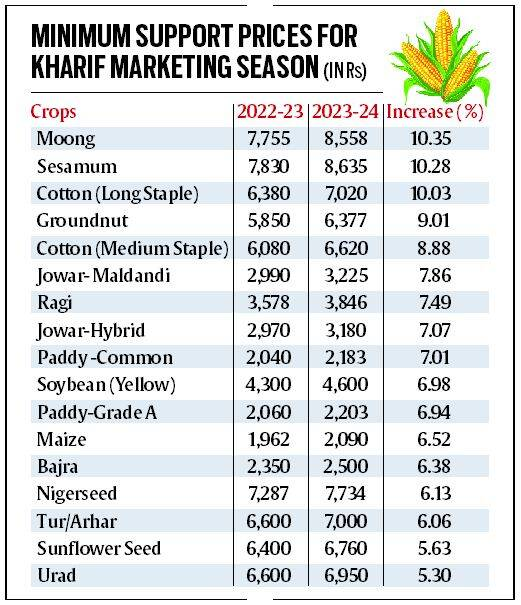
    The Centre has set the Minimum Support Price (MSP) for 17 kharif crops and variants.

    What is MSP?

    • The MSP assures the farmers of a fixed price for their crops, well above their production costs.
    • MSP, by contrast, is devoid of any legal backing. Access to it, unlike subsidized grains through the PDS, isn’t an entitlement for farmers.
    • They cannot demand it as a matter of right. It is only a government policy that is part of administrative decision-making.
    • The Centre currently fixes MSPs for 23 farm commodities based on the Commission for Agricultural Costs and Prices (CACP) recommendations.

    Fixing of MSPs

    • The CACP considered various factors while recommending the MSP for a commodity, including the cost of cultivation.
    • It also takes into account the supply and demand situation for the commodity; market price trends (domestic and global) and parity vis-à-vis other crops; and implications for consumers (inflation), environment (soil and water use) and terms of trade between agriculture and non-agriculture sectors.

    What changed with the 2018 budget?

    • The Budget for 2018-19 announced that MSPs would henceforth be fixed at 1.5 times of the production costs for crops as a “pre-determined principle”.
    • Simply put, the CACP’s job now was only to estimate production costs for a season and recommend the MSPs by applying the 1.5-times formula.

    How was this production cost arrived at?

    • The CACP projects three kinds of production cost for every crop, both at the state and all-India average levels.
    • ‘A2’ covers all paid-out costs directly incurred by the farmer — in cash and kind — on seeds, fertilizers, pesticides, hired labor, leased-in land, fuel, irrigation, etc.
    • ‘A2+FL’ includes A2 plus an imputed value of unpaid family labor.
    • ‘C2’ is a more comprehensive cost that factors in rentals and interest forgone on owned land and fixed capital assets, on top of A2+FL.

    How much produce can the government procure at MSP?

    • The MSP value of the total production of the 23 crops worked out to around Rs 10.78 lakh crore in 2019-20.
    • Not all this produce, however, is marketed. Farmers retain part of it for self-consumption, the seed for the next season’s sowing, and also for feeding their animals.
    • The marketed surplus ratio for different crops is estimated to range differently for various crops.
    • It ranges from below 50% for ragi and 65-70% for bajra (pearl millet) and jawar (sorghum) to 75% for wheat, 80% for paddy, 85% for sugarcane, 90% for most pulses, and 95%-plus for cotton, soybean, etc.
    • Taking an average of 75% would yield a number of just over Rs 8 lakh crore.
    • This is the MSP value of production that is the marketable surplus — which farmers actually sell.

    Nature of MSP

    • There is currently no statutory backing for these prices, nor any law mandating their enforcement.

    Farmers demand over legalization

    • Legal entitlement: There is a demand that MSP based on a C2+50% formula should be made a legal entitlement for all agricultural produce.
    • Private traders’ responsibility: Some says that most of the cost should be borne by private traders, noting that both middlemen and corporate giants are buying commodities at low rates from farmers.
    • Mandatory purchase at MSP: A left-affiliated farm union has suggested a law that simply stipulates that no one — neither the Government nor private players — will be allowed to buy at a rate lower than MSP.
    • Surplus payment by the govt.: Other unions have said that if private buyers fail to purchase their crops, the Government must be prepared to buy out the entire surplus at MSP rates.
    • Expansion of C2: Farm unions are demanding that C2 must also include capital assets and the rentals and interest forgone on owned land as recommended by the National Commission for Farmers.
  • [pib] Price Support Scheme (PSS)

    Central Idea

    • Procurement Ceilings for Pulses: The government has removed the procurement ceilings of 40% for tur, urad, and masur under the Price Support Scheme (PSS) operations for 2023-24.

    What is Price Support Scheme (PSS)?

    • Physical procurement: The Price Support Scheme (PSS) involves the physical procurement of pulses, oilseeds, and copra by Central Nodal Agencies.
    • Nodal Agencies: The National Agricultural Cooperative Marketing Federation of India (NAFED) and the Food Corporation of India (FCI) are the designated agencies responsible for procuring crops under the PSS.
    • Implementation: The scheme is implemented in collaboration with state governments, who exempt the procured commodities from mandi tax and provide logistical support, including gunny bags and working capital.

    Need for such scheme

    • Balancing farmer and consumer interests: The PSS strikes a balance between the welfare of farmers and consumers, ensuring fair returns for farmers and affordable prices for consumers.
    • Remunerative prices: The primary objectives of the PSS are to provide remunerative prices to farmers, encouraging increased investment and production, while ensuring affordable prices and availability for consumers.
    • Encouraging production: By offering a guaranteed price, the PSS incentivizes farmers to invest in agricultural production, leading to increased output and self-sufficiency.
    • Consumer welfare: The scheme aims to protect the interests of consumers by ensuring a stable supply of essential commodities at reasonable prices, reducing intermediation costs.
    • Market intervention: The PSS acts as a market intervention measure, stabilizing prices, and mitigating the risks faced by farmers due to market fluctuations and unforeseen circumstances.
    • Support for agricultural growth: The scheme is part of the government’s broader efforts to support agricultural growth, enhance farmer income, and promote food security in the country.

    Why in news?

    • Notified Essential commodities: On June 2, 2023, the government imposed stock limits on tur and urad by invoking the Essential Commodities Act, 1955.
    • Prevent hoarding: The imposition aims to prevent hoarding and unscrupulous speculation, as well as improve affordability for consumers.
    • Applicability and declaration: Stock limits are applicable to wholesalers, retailers, big chain retailers, millers, and importers, who are required to declare their stock position on the portal of the Department of Consumer Affairs.

    Enforcement of Stock Limits by State Governments:

    • Directives to state governments: The Department of Consumer Affairs has directed state governments to ensure strict enforcement of the stock limits in their respective states.
    • Monitoring and verification: States have been asked to monitor prices and verify the stock position by coordinating with various warehouse operators.
    • Cooperation from warehousing corporations: Central Warehousing Corporation (CWC) and State Warehousing Corporations (SWCs) have been requested to provide details of tur and urad stocks held in their warehouses.
  • Cabinet nod for ₹1.08 lakh crore kharif Fertilizer Subsidy

    Central Idea

    • The Union Cabinet has approved a fertilizer subsidy of ₹1.08 lakh crore for the ongoing kharif or monsoon season.
    • ₹38,000 crore will be allocated for Nitrogen, phosphatic and potassic (NPK) fertilizers, while ₹70,000 crore will go towards the urea subsidy.

    Fertilizer consumption and subsidies

    • The country’s total consumption of urea is approximately 325 to 350 lakh metric tonnes (LMT).
    • Other fertilizers sold in the country include 100 to 125 LMT of DAP, 100 to 125 LMT of NPK, and 50 to 60 LMT of Muriate of Potash (MoP).
    • The fertilizer subsidy per hectare of land is about ₹8,909, and each farmer receives a subsidy of ₹21,223.
    1. DAP: The actual price of a bag of DAP is ₹4,000, but farmers receive it at a subsidized rate of ₹1,350 per bag, with a subsidy of ₹2,461 per bag.
    2. NPK: This subsidy is ₹1,639 per bag, and the MoP subsidy amounts to ₹734 per bag.
    3. Urea: The Centre spends ₹2,196 per bag of urea.

    Fertilizer Subsidy in India

    • Subsidy as a concept originated during the Green Revolution of the 1970s-80s.
    • Fertiliser subsidy is purchasing by the farmer at a price below MRP (Maximum Retail Price), that is, below the usual demand-and-supply-rate, or regular production and import cost.
    • The rate of subsidy is based on the average price of imported fertilizer in the last six months.

    How is the subsidy paid and who gets it?

    • The subsidy goes to fertiliser companies, although its ultimate beneficiary is the farmer who pays MRPs less than the market-determined rates.
    • From March 2018, a new so-called direct benefit transfer (DBT) system was introduced, wherein subsidy payment to the companies would happen only after actual sales to farmers by retailers.
    • With the DBT system, each retailer — there is over 2.3 lakh of them across India — now has a point-of-sale (PoS) machine linked to the Department of Fertilizers’ e-Urvarak DBT portal.

    How does this system work?

    • A popular example of how this system works is that of the neem-coated urea fertiliser.
    • Its MRP is fixed by the government at Rs. 5922.22 per tonne.
    • The average cost of domestic production is at Rs 17,000 per tonne. The difference is footed by the centre in the form of subsidy.

    What about non-urea fertilizers?

    • The non-urea fertiliser is decontrolled or fixed by the companies.
    • The non- urea fertilizers are further divided into two parts, DAP (Diammonium Phosphate) and MOP (Muriate of Phosphate).
    • The government pays a flat per tonne subsidy to maintain the nutrition content of the soil, and ensure other fertilizers are economical to use.

    Issues with such subsidies

    • Low NUE: Indian soil has low Nitrogen use efficiency, which is the main constituent of Urea.
    • Groundwater pollution: Consequently, excess usage contaminates groundwater.
    • Overuse beyond prescription: The bulk of urea applied to the soil is lost as NH3 (Ammonia) and Nitrogen Oxides. The WHO has prescribed limits been breached by Punjab, Haryana and Rajasthan.
    • Health hazards: For human beings, “blue baby syndrome” is a common side ailment caused by Nitrate contaminated water.


    Get an IAS/IPS ranker as your personal mentor for UPSC 2024 | Schedule your FREE session and get the Prelims prep Toolkit!

  • Overuse of Urea in India and its Implications

    urea

    Central idea

    • Rising urea consumption: The use of urea has continued to increase, leading to a decline in crop yield response to fertiliser use, and an imbalance in the nutrient application.
    • Unbalanced fertilization: The nutrient-based subsidy regime is a failure in promoting balanced fertilization.
    • Several measures failed: The measures introduced by the Indian government to reduce urea consumption, such as neem-coating, smaller bags, and Nano Urea, have not been successful.

    Do You Know?

    The ideal NPK use ratio for the country is 4:2:1, whereas it was 6.5:2.8:1 in 2020-21 and 7.7:3.1:1 in 2021-22. In the recent 2022 kharif season, the ratio got further distorted to 12.8:5.1:1.

    What is Urea?

    • Urea is a commonly used nitrogen-containing fertiliser that provides crops with the necessary nutrients for growth and development.
    • It is a white, crystalline solid that is soluble in water and has a high nitrogen content, with around 46% nitrogen by weight.
    • Urea is made from ammonia and carbon dioxide and is used extensively in agriculture due to its high nitrogen content and affordability.
    • It is a major source of nitrogen for crops, and when applied in the right amounts, it can improve crop yields and increase overall agricultural productivity.

    Urea usage in India

    urea

    Policy moves related to Urea

    The introduction of these measures was aimed at reducing urea consumption in the country.

    • Neem-coated urea: In May 2015, the Indian government mandated the neem-coating of all urea manufactured in the country as well as imported urea to illegal diversion for non-agricultural use.
    • Reduced size: Later, in March 2018, the government replaced 50-kg urea bags with 45-kg bags.
    • Liquid Nano Urea: Recently, in June 2021, the Indian Farmers’ Fertiliser Cooperative (IFFCO) launched a liquid fertiliser called ‘Nano Urea’.

    Ineffectiveness of the above measures

    • Despite the introduction of these measures, urea consumption in the country has not decreased.
    • In fact, sales of urea crossed a record 35.7 million tonnes (mt) in the fiscal year ended March 31, 2023.
    • Although consumption dipped in the initial two years after neem-coating was fully enforced, it reversed from 2018-19.

    Failure of the nutrient-based subsidy (NBS) regime

    • The government introduced the nutrient-based subsidy (NBS) regime in April 2010.
    • The regime fixed a per-kg subsidy for each fertiliser nutrient – nitrogen (N), phosphorus (P), potash (K), and sulphur (S).
    • The aim was to promote balanced fertilisation and discourage farmers from applying too much urea, di-ammonium phosphate (DAP) and muriate of potash (MOP).
    • However, the data shows that nutrient imbalance has worsened, with urea consumption rising by over a third since 2009-10.
    • Nitrogen use efficiency (NUE) has declined from 48.2% in 1962-63 to 34.7% in 2018.

    Cost of overdose fertilization

    • Fertilisers are essential for plant growth and grain yield, but the overuse of urea and other fertilisers has led to an imbalance in nutrient application.
    • Crop yield response to fertiliser use has decreased, with the disproportionate application of nitrogen by farmers being a key reason.
    • Recent research has shown that nitrogen use efficiency has declined in India, making it necessary to promote the use of other fertilisers containing different nutrients.

    Way forward

    To address the issue of rising urea consumption, two approaches can be adopted.

    • Disincentivise: The first is to raise prices, but this is not politically feasible.
    • Improve nitrogen use efficiency (NUE): One way to achieve this is to make the incorporation of urease and nitrification inhibitors compulsory in urea.

    Some other potential solutions include:

    • Promoting the use of organic fertilisers: Such as compost and manure, can improve soil health and reduce the need for synthetic fertilisers. This can also reduce the risk of environmental pollution and improve the sustainability of agriculture.
    • Encouraging precision agriculture: Such as soil testing, can help farmers apply fertilisers in the right amounts and at the right time, reducing wastage and increasing nutrient use efficiency.
    • Promoting crop rotation and intercropping: Planting different crops in rotation or together can help maintain soil fertility and reduce the need for synthetic fertilisers.
    • Increasing public awareness and education: Educating farmers and the public on the importance of sustainable fertiliser use and the potential risks of overusing synthetic fertilisers can help promote more sustainable agricultural practices.


    Get an IAS/IPS ranker as your personal mentor for UPSC 2024 | Schedule your FREE session and get Prelims prep Toolkit!

  • What is the Open-Source Seeds Movement?

    seed

    Central idea

    • The article discusses the concept of open-source software and its parallels with open-source seeds.
    • Richard Stallman pioneered the Free Software Movement and developed the General Public License (GPL) to protect users’ rights and prevent code misappropriation.
    • Farmers have been innovating and sharing seeds without intellectual property rights (IPR) claims for centuries.

    Backgrounder: Plant Breeders’ Rights

    • Plant breeders’ rights (PBR) granted exclusive rights to breeders and developers of new varieties.
    • Farmers’ rights were limited under this regime.
    • The TRIPS agreement established a global IPR regime over plant varieties.
    • The consolidation of the seed sector raised concerns about the freedom to innovate.

    Forms of IPR Protection in Agriculture

    • There are now two forms of IPR protection in agriculture: PBR and patents.
    • Together, they restrict farmers’ rights and the freedom to develop new varieties.
    • The use of genetically modified seeds and IP claims triggered many problems, including State intervention on Bt cotton seeds in India.
    • The decline of public sector breeding and the dominance of the private sector in the seed sector increased the need for alternatives.

    What are Open Source Seeds?

    • The success of open-source software inspired a solution for seeds.
    • In 1999, a Canadian plant breeder named T.E. Michaels suggested an approach to seeds based on the principles of open-source software.
    • In 2012, Jack Kloppenburg launched the Open Source Seeds Initiative (OSSI) in Wisconsin.
    • Agrecol launched another initiative in Europe, and similar programs have come up worldwide.

    Open Source Seeds Initiatives in India

    • In India, the Hyderabad-based Centre for Sustainable Agriculture (CSA), part of the Apna Beej Network, developed a model incorporated into an agreement between CSA and the recipient of the seed/germplasm.
    • CSA’s Open Source Seeds Initiative uses a contracts approach similar to Agrecol’s strategy.
    • The number of seed firms using open-source models and the crop varieties and seeds made available thereunder is small but growing.
    • India is yet to test and adopt it widely.

    Potential Applications of Open-Source Seeds

    • Open-source principles can help promote farmer-led participatory plant-breeding exercises.
    • Traditional varieties often lack uniformity and aren’t of excellent quality, but open-source principles can facilitate testing, improvisation, and adoption.
    • Open-source principles can be used in farmer-led seed conservation and distribution systems.
    • The government and other stakeholders can consider adopting this approach to more widely adopt traditional varieties.

  • How India’s Sugar Exports to the world are surging?

    sugar

    Central idea:  India’s success story in sugar exports

    • India’s sugar exports have soared from $810.9 million in 2017-18 to $4.6 billion in 2021-22, and could cross $5.5 billion in the fiscal year ending March 31.
    • The increase is significant in quantity terms too, with India’s shipments increasing from a mere 0.46 lakh tonnes in 2016-17 to 110 lakh tonnes in 2021-22.
    • India has gone from being a marginal player in sugar exports five years ago to No. 2 in the world currently, behind only Brazil.

    Favourite destinations

    • The biggest importers of Indian raw sugar were Indonesia (16.73 lt), Bangladesh (12.10 lt), Saudi Arabia (6.83 lt), Iraq (4.78 lt) and Malaysia (4.15 lt).
    • The country also exported 53.71 lt of white/ refined sugar, the leading destinations for which included Afghanistan (7.54 lt), Somalia (5.17 lt), Djibouti (4.90 lt), Sri Lanka (4.27 lt), China (2.58 lt), and Sudan (1.08 lt).
    • The highest decline in exports has been registered by the European Union (which produces sugar from beet, unlike India and Brazil that only crush cane): from 39.74 lt in 2017-18 to 8.02 lt in 2021-22.

    Which grades of sugar does India export?

    • Raw sugar is what mills produce after the first crystallization of juice obtained from crushing of cane.
    • This sugar is rough and brownish in color, with an ICUMSA value of 600-1,200 or higher.
    • ICUMSA is a measure of the purity of sugar based on color.
    • This raw sugar is processed in refineries for removal of impurities and de-colorization.
    • The end product is refined white cane sugar having a standard ICUMSA value of 45.
    • Till 2017-18, India mainly shipped plantation white sugar with 100-150 ICUMSA value, also known as low-quality whites or LQW in international markets.

    Reasons behind India’s surge in sugar exports

    • Indian raw sugar is free of dextran, unlike Brazilian raws.
    • Indian mills can supply raws with a very high polarization of 98.5-99.5%, which is higher than the polarization of raws from Brazil, Thailand, and Australia.
    • Indian raws today fetch a 4% premium over the global benchmark (New York No. 11 futures contract) price, while LQW sells at a $40/tonne discount to the world price (London No. 5 futures) for 45 ICUMSA whites.
    • Indonesia agreed to tweak its norms in December 2019 to enable imports from India, which further boosted India’s efforts to push exports of raws.


    Are you an IAS Worthy Aspirant? Get a reality check with the All India Smash UPSC Scholarship Test

    Get upto 100% Scholarship | 900 Registration till now | Only 100 Slots Left

  • ‘HD 3226’ Wheat can beat the heat

    wheat

    Scientists at the Indian Council of Agricultural Research (ICAR) have developed a new variety of wheat ‘HD 3226’ that can withstand high temperatures.

    HD 3226 Wheat

    • The wheat, known as “HD 3226”, has been developed specifically for cultivation in the northwest region of India, where temperatures can reach up to 42 degrees Celsius.
    • It took 10 years for ICAR to develop this variety.
    • It has been specifically developed for cultivation in the northwest region of India.

    Features of HD 3226 Wheat

    • More resilient to heat stress: The HD 3226 wheat variety is reportedly more resilient to heat stress than other varieties of wheat.
    • Higher yields: The HD 3226 wheat variety can produce up to 12-15% higher yields in high-temperature conditions.

    Significance

    • The development of this new wheat variety is particularly important given the increasing frequency of heatwaves in the region due to climate change.
    • With rising temperatures, it is becoming more challenging for farmers to grow crops.

    Government approval and availability

    • The HD 3226 wheat variety has now been submitted to the Indian government for approval.
    • Once approved, it is expected to be available to farmers in the coming years.


    Attempt UPSC 2024 Smash Scholarship Test | FLAT* 100% OFF on UPSC Foundation & Mentorship programs

    Get your Rs 10,000 worth of UPSC Strategic Package for FREE | PDFs, Zoom session, Tests, & Mentorship