💥Mains Ready By December. Smash Mains & Smash PYQ Admissions Open

Subject: Basic Sciences

  • What is Sonoluminescence? 

    Why in the News?

    Recent studies have provided deeper insights into the mechanics of Sonoluminescence, particularly the conditions under which light is emitted from collapsing bubbles in liquids.

    What is Sonoluminescence?

    • Sonoluminescence is a phenomenon in which small gas bubbles in a liquid emit short bursts of light when exposed to intense sound waves.
    • The light is produced when the bubble undergoes rapid compression and expansion.
    • This is due to the alternating high- and low-pressure phases of the sound waves, causing the gas inside to heat up and emit light.
    • This phenomenon was discovered in 1934 by two German engineers while they were studying sonar technology, which uses sound waves to detect objects underwater.
    • They noticed that when a tiny bubble in a liquid was hit by strong sound waves, it emitted a brief flash of light.

    Mystery behind Sonoluminescence

    • Although the general mechanism is understood, the exact details of how the light is produced remain a mystery. 
    • Scientists are still exploring the precise processes that cause the gases inside the bubble to ionize and emit light at such high temperatures.

    Examples of Sonoluminescence

    • Controlled Experiments: In laboratory settings, scientists create sonoluminescence by trapping a bubble in a liquid and subjecting it to high-frequency sound waves.
    • Pistol Shrimp: When the shrimp (marine creature with a specialized claw) snaps its claw shut, it shoots out a jet of water that moves so fast it creates a low-pressure bubble. The bubble then collapses, producing a loud sound, intense heat, and sometimes a brief flash of light.
  • What is Quantum Non-Locality?

    Why in the News?

    A recent study published in Physical Review Letters by Indian researchers has revealed that a universal standard for measuring quantum non-locality is impossible.

    What is Quantum Nonlocality?

    • Quantum Nonlocality is a mysterious connection between distant objects that challenges the classical idea of local realism, where no faster-than-light communication is allowed.
    • It’s crucial for technologies like secure communication, random number generation, and cryptographic key creation.
    • Easy Explanation:
      • Imagine two particles that are created together and then move far apart, even to opposite ends of the universe.
      • In classical physics, any effect on one particle would need a signal to travel to the other, taking time.
      • But in quantum physics, Quantum Nonlocality means these particles are instantly connected, affecting each other no matter the distance, as if linked by an invisible thread that works faster than light.

    Historical Background: Bell’s Theorem (1964)

    • Physicist John Stewart Bell introduced a theorem that challenged the classical idea of ‘local realism’ in quantum systems.
      • Local Realism: In classical physics, objects are believed to have definite properties independent of observation and are only influenced by their immediate surroundings.
      • Quantum Challenge: Bell demonstrated that in quantum systems with multiple, distant parts, correlations appear that cannot be explained by local realism.
    • Bell’s theorem was confirmed through experiments, leading to the recognition of quantum nonlocality, which was honored with the 2022 Physics Nobel Prize.

    Recent Research and Findings

    • The research demonstrates that a universal standard for measuring and comparing quantum nonlocality is impossible.
      • It shows that the nature of nonlocality varies based on the type of correlation, with infinite unique points on the correlation boundary.
      • There is no single, universal resource in the realm of quantum nonlocality; instead, each nonlocal resource is unique, capable of performing specific tasks that others cannot.
    • This observation plays a key role in secure communication, random number certification, and cryptographic key generation.

    PYQ:

    [2022] Which one of the following is the context in which the term “qubit” is mentioned?

    (a) Cloud Services

    (b) Quantum Computing

    (c) Visible Light Communication Technologies

    (d) Wireless Communication Technologies

  • What are Deceptive Dark Patterns?

    Why in the News?

    The Advertising Standards Council of India (ASCI) has released a report highlighting the use of deceptive dark patterns in Indian apps.

    Key highlights of the ASCI Study:

    • The ASCI report aims to raise awareness among marketers and designers about the ethical implications of these deceptive patterns.
    • The study analyzed 12,000 screens across 53 leading Indian apps in 9 different industries.
    • The report identified the use of one or more of 12 deceptive patterns in most of these apps.

    What are Deceptive Dark Patterns?

    • These practices use elements of digital choice architecture, particularly in user interfaces.
    • The goal is to manipulate or impair consumer autonomy, decision-making, or choice.
    • These patterns are often subtle, directing users toward decisions that may not align with their true preferences.
    • As a result, they compromise the ability of users to make informed choices.

    Examples of Deceptive Patterns:

    Description Example
    Interface Interference Directs users to specific choices using visual tricks. Highlighting preferred options with bright colors.
    Confirm Shaming Uses guilt to push users toward certain actions. Options like “Upgrade now” vs. “I don’t want a smarter software.”
    Basket Sneaking Adds unwanted items to cart without consent. Automatically adding a donation to the shopping cart.
    Privacy Deception Tricks users into sharing more personal data. Requiring unnecessary personal info during signup.
    Drip Pricing Reveals extra fees late in the purchase process. Adding hidden charges at checkout.
    Subscription Trap Leads to unintended subscriptions without clear notice. “Free trial” that auto-renews to a paid plan.

    Importance of Ethical Design

    • Raising Awareness: Marketers are encouraged to study the guidelines issued by ASCI and the Department of Consumer Affairs to avoid unethical practices.
    • Conscious Patterns Website: Marketers can use resources like the Conscious Patterns website to test their apps and obtain a “conscious score” to ensure that their apps balance business needs with user interests.
    • Digital Responsibility: As the digital world evolves, ethical design practices are crucial for building and maintaining trust with customers.
    • Marketer and Designer Roles: Both marketers and app designers need to be vigilant about pursuing ethical design to create safe and trustworthy online environments.

    PYQ

    [2015] What are the impediments in marketing and supply chain management in developing the food processing industry in India? Can e-commerce help in overcoming this bottleneck?

  • Reshape the governance structures of AI companies      

    Why in the News?

    Recently, corporations adopting stakeholder capitalism are focusing on products like Generative AI, which require governance models that balance profit-making with broader social responsibilities, reflecting a shift in corporate priorities.

    Data Access Issues

    1. Dependence on Data for AI Development: The advancement of AI technologies necessitates access to vast amounts of data, including personal and sensitive information. This reliance raises significant privacy concerns, as improper handling of this data can lead to breaches of privacy rights.
    2. Regulatory Scrutiny: Companies like Meta have faced regulatory challenges regarding data usage for AI training. For example, Meta was asked to pause its plans to train large language models using public content from Facebook and Instagram due to privacy concerns raised by regulators, highlighting the tension between data access and compliance with privacy laws.
    3. Algorithmic Bias: AI systems can perpetuate existing biases present in the data they are trained on, leading to discriminatory outcomes. For instance, Amazon discontinued a recruiting algorithm that displayed gender bias.

    Purpose vs. Strategy

    1. Conflict Between Purpose and Profit: Many companies, including OpenAI, initially adopted governance structures aimed at public benefit but faced challenges when profit motives clashed with their social objectives. The dismissal of CEO Sam Altman over concerns about prioritizing commercialization over user safety exemplifies this conflict.
    2. Shareholder Primacy: Despite the adoption of alternative governance models, the underlying shareholder primacy often prevails. The pressure to generate profits can overshadow the intended social benefits, leading to a situation where public good becomes secondary to financial gains.
    3. Corporate Governance issue: The governance issues faced by OpenAI, particularly the internal conflict that led to Altman’s firing, raise questions about the effectiveness of public benefit corporate structures in balancing profit and purpose, especially in tech companies reliant on investor capital.
    4. Potential Shift to For-Profit Structures: Rumors about OpenAI considering a transition to a for-profit governance model indicate a trend where companies may abandon their social objectives in favour of profit maximization.

    Workable Strategy (Way forward)

    1. Framing Ethical Standards: Developing comprehensive ethical guidelines for AI product companies is crucial. These standards should address data privacy, algorithmic fairness, and accountability, ensuring that AI technologies are developed responsibly and equitably.
    2. Incentivizing Public Benefit Objectives: Corporations should be incentivized to adopt public benefit purposes that align with their business strategies. This could involve financial incentives for companies that demonstrate long-term profit gains from socially responsible practices.
    3. Reducing Compliance Costs: To encourage adherence to public benefit objectives, it is essential to lower the compliance costs associated with implementing ethical practices.

    Mains PYQ:

    Q The emergence of the Fourth Industrial Revolution (Digital Revolution) hasinitiated e-Governance as an integral part of government”. Discuss. (UPSC IAS/2020)

  • Extremophile bacteria have learnt to survive microwaves

    Why in the News?

    Researchers have isolated extremophile bacteria from harsh environments like volcanic vents, permafrost, acid mines, deep-sea hydrothermal vents, and lakes beneath polar ice caps.

    What are Extremophiles?

    • Extremophiles are microorganisms that thrive in extreme environmental conditions where other life forms typically cannot survive.
    • For example: Volcanic vents, Permafrost, Acid mines, Deep-sea hydrothermal vents, dark lakes buried beneath polar ice caps, on the exteriors of spacecraft, around nuclear waste storage sites.

    Adaptation and Evolution:

    • Extremophiles have developed unique biological and biochemical processes over millions of years to adapt to diverse habitats.
    • Unlike more complex life forms, which have one set of proteins, extremophiles have multiple sets of proteins, each adapted to specific environmental conditions.
    • These proteins are ‘activated’ based on the surrounding environment, enabling survival during extreme conditions like high temperatures, lack of water, or high acidity.
    • Significance: Some scientists believe that life on Earth may have begun as an extremophile in extreme environmental niches before spreading and adapting to more temperate ecosystems.

    About the ‘Earth Microbiome Project’

    • It is a global initiative aimed at mapping, organising, and understanding the diversity of microbial life across different environmental niches on Earth.
    • The project was founded in 2010.
    • Objective: 
      • To sequence 200,000 genetic samples from diverse environments.
      • To assemble 500,000 microbial genomes, creating a comprehensive map of microbial diversity on Earth.
    • Significance:
      • The project is part of broader efforts to understand the microbial world, which is still in its infancy.
      • It is related to other significant projects like the ‘Earth Biogenome Project,’ which aims to sequence the genomes of all eukaryotic organisms on the planet.
      • Understanding microbial diversity has numerous biological and industrial applications, such as developing new enzymes for molecular biology or finding new ways to adapt organisms to challenging environments.


    PYQ:

    [2017] With reference to agriculture in India, how can the technique of ‘genome sequencing’, often seen in the news, be used in the immediate future?

    1. Genome sequencing can be used to identify genetic markers for disease resistance and drought tolerance in various crop plants.

    2. This technique helps in reducing the time required to develop new varieties of crop plants.

    3. It can be used to decipher the host-pathogen relationships in crops.

    Select the correct answer using the code given below:

    (a) 1 only

    (b) 2 and 3 only

    (c) 1 and 3 only

    (d) 1, 2 and 3

  • Hints of the corporatization of science research in India 

    Why in the News?

    The establishment of the Anusandhan National Research Foundation and its funding structure clearly signals the government’s intended direction.

    Research Policy in India

    • Shift Towards Corporatisation: The Indian government’s approach encourages research institutions to generate revenue through external sources, moving away from reliance on public funding.
      • This trend aligns with the 2015 Dehradun Declaration, which advocated for marketing patents to self-finance research initiatives.
    • Focus on Market-Driven Research: The ANRF aims to align research outcomes with market needs, promoting the idea that scientific advancements should have immediate applications.
      • This is evident in the emphasis on prototype development, which assesses the marketability of research products, which was highlighted in the 2024 Budget speech.
    • Integration of Industry and Academia: The ANRF is designed to forge collaborations between research institutions and the private sector by earmarking a substantial portion of its funding (approximately 72%) from private sources, bridging the gap between scientific research and commercial application.
    Note: The Anusandhan National Research Foundation (ANRF) is a significant initiative in India’s research landscape, established under the Anusandhan National Research Foundation Act, 2023.

    Funding Mechanism of ANRF

    • Budget Allocation: The ANRF will be allocated ₹50,000 crore over five years, with a significant portion expected to come from non-government sources, including industry and philanthropic contributions.
    • Governance Structure: The ANRF will be governed by a board that includes industry representatives and experts, ensuring that funding decisions align with market demands and technological advancements.

    What are the signals despite the stated objective of ANRF? (challenges)

    • Potential Undermining of Curiosity-Driven Research:  The private sector does not want to fund basic research because it has no immediate commercial applications which ultimately leads to a decline in foundational scientific exploration.
    • Public Funding Concerns: The government’s expectation for private sector funding raises questions about the sustainability of public investment in research.
      • The current ratio of public funding for science research in India (0.6% to 0.7% of GDP) is significantly lower than that of countries like South Korea (around 4.8%  of GDP).

    India’s Achievements Despite a Low GDP Investment in R&D: 

    • High Production of PhDs:  Annually, India generates approximately 40,813 PhDs, ranking third globally after the United States and China. 
    • Robust Research Output: India’s research output remains substantial, with over 300,000 publications in 2022, making it the third-largest producer of scientific publications globally.
    • Growth in Patent Grants: India has shown remarkable progress in intellectual property creation, securing 30,490 patents in 2022, placing it sixth globally.  
    • Improvement in Global Rankings: India has made significant strides in global innovation rankings and research quality. It improved its position on the Global Innovation Index (GII) from 81st place in 2015 to 40th in 2023.  
        • India climbed to the 9th rank in the Nature Index 2023, surpassing countries like Australia and Switzerland.
    • Investment in Autonomous R&D Institutions: A considerable portion of India’s R&D funding is directed towards autonomous research laboratories. The total investment in R&D reached approximately $17.2 billion in 2020-21, with a significant allocation to key scientific agencies such as the Defence Research and Development Organisation (DRDO) and the Indian Council of Agricultural Research (ICAR).

    Comparison with Other Countries

    As of 2023, India’s gross expenditure on R&D stands at approximately 0.64% of its GDP.

    • United States: The U.S. invests about 3.46% of its GDP in R&D
    • South Korea: South Korea leads with an impressive 4.8% of GDP allocated to R&D.
    • Germany: Germany’s R&D spending is around 3.1% of GDP.
    • China: China’s investment in R&D is approximately 2.4% of GDP.
    • Taiwan: Taiwan also invests around 3.77% of its GDP in R&D.

    Way Forward: 

    • Strengthening Public Funding for Basic Research: To ensure a balanced research ecosystem, the government should increase public investment in foundational scientific research.
    • Enhancing Industry-Academia Collaboration: The government should facilitate stronger partnerships between research institutions and the private sector while maintaining a focus on both applied and basic research.

    Mains PYQ: 

    Q What are the research and developmental achievements in applied biotechnology? How will these achievements help to uplift the poorer sections of the society? (2021)

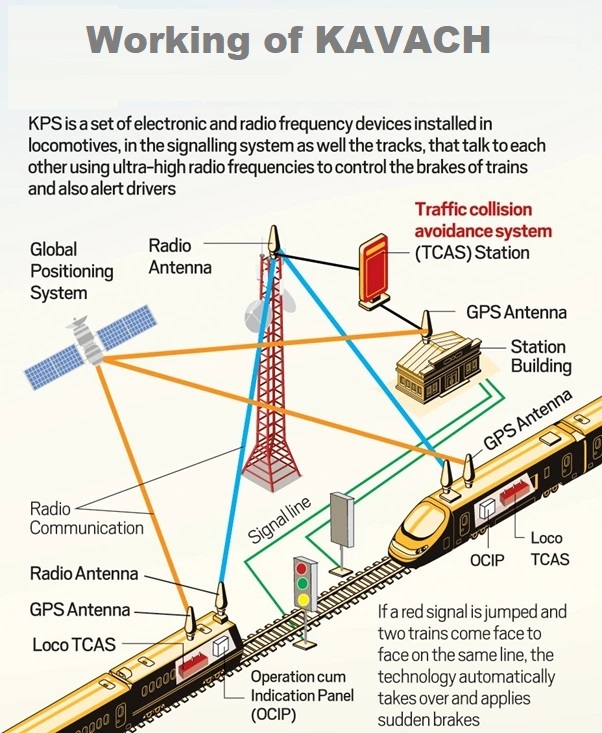
  • What is KAVACH Collision Avoidance System (CAS)?

    Why in the News?

    Indian Railways expects to launch Kavach CAS on Mumbai-Delhi-Kolkata routes by March 2025.

    About Kavach Train Collision Avoidance System (TCAS)

    Details
    Development
    • Development started in 2011 by Indian Railways and Research Designs & Standards Organisation (RDSO).
    • Key developer: B. Rajaram, known for the Skybus Metro system.
    • Field trials began in 2014, and final approval was granted in 2019.
    Safety Parameters Certified for Safety Integrity Level 4 (SIL-4) operations
    Working Mechanism
    • Components: Trackside RFID tags, onboard locomotive equipment, radio infrastructure.
    • Functionality: Real-time monitoring, driver alerts, and automatic braking to prevent collisions.
    • Data Inputs: Location, direction, time.
    • Event Recorders: Retain records for post-incident analysis.
    Collision Prevention
    • Alert Mechanism: Alerts the locomotive pilot if a ‘red signal’ is missed.
    • Automatic Braking: If speed exceeds 15 kmph after a red signal, Kavach applies brakes to halt the train.
    Issues
    • High Cost: ₹50 lakh per kilometer for deployment.
    • Low Coverage: Covers only 1,500 kilometers out of the total 68,000-kilometer rail network (as of November 2023).

    How does CAS work in ships and aircraft?

    Key Systems Functions
    Ships AIS (Automatic Identification System) Sends and receives data on location, speed, and direction between ships and land-based stations.
    LRIT (Long Range Identification and Tracking)
    • Requires ships to report location, time, and equipment every 6 hours to authorities.
    • Data shared with contracting governments and rescue operators via International LRIT Data Exchange.
    Aircraft Transponders Respond to radio-frequency pings to build a 3D view of surrounding air traffic.
    Alerts and Resolution Issues alert if another aircraft is within 48 seconds (traffic advisory) or 30 seconds (resolution) of a collision.
    Radar Altimeters and Obstacle Detection Monitors distance to the ground and alerts pilots about tall obstacles like towers.


    PYQ:

    [2015] With reference to bio-toilets used by the Indian Railways, consider the following statements:

    1. The decomposition of human waste in the biotoilets is initiated by a fungal inoculum.
    2. Ammonia and water vapour are the only end products in this decomposition which are released into the atmosphere.

    Which of the statements given above is/are correct?

    (a) 1 only
    (b) 2 only
    (c) Both 1 and 2
    (d) Neither 1 nor 2

  • The Physics of Pressure

    Why in the News?

    • Pressure is an indispensable part of life, often unnoticed but always present.
      • It’s the interaction of microscopic particles with the macroscopic world, creating phenomena like air pressure.

    What is Pressure?

    • Pressure is defined as the force exerted per unit area on a surface. 
    • For example, an apple weighing 100 g exerts a force of about 1 newton (N) on your hand and a pressure of approximately 500 Pa.
    • Atmospheric pressure is around 100,000 Pa, equivalent to the pressure exerted by about 200 apples on your hand.

    Everyday Examples of Pressure

    (1) Measuring Blood Pressure:

    • Blood pressure, measured in mm of mercury (mmHg), is an example of pressure in a different context.
    • Blood pressure is measured using a sphygmomanometer, which balances the pressure in an arm cuff with the pressure of the blood in the arteries.
    • The readings, such as 120/80 mmHg, represent the pressure during heartbeats (systolic) and between beats (diastolic).
    • Mercury, being 15 times heavier than water, allows for portable blood-pressure machines.

    (2) Pressure Cookers:

    • The whistle of a pressure cooker is a direct result of the increased pressure cooking the food efficiently.
    • The pressure cooker exemplifies the practical application of pressure in cooking, making it an indispensable kitchen tool.

    PYQ:

    [2021] In a pressure cooker, the temperature at which the food is cooked depends mainly upon which of the following?​

    1. Area of the hole in the lid​

    2. Temperature of the flame​

    3. Weight of the lid​

    Select the correct answer using the code given below.​

    (a) 1 and 2 only ​

    (b) 2 and 3 only​

    (c) 1 and 3 only ​

    (d) 1, 2 and 3​

  • AI needs cultural policies, not just regulation    

    Why in the news?

    Only by providing fair and broad access to data can we unlock AI’s full potential and ensure its benefits are shared equitably.

    Present Scenario of ‘Data Race vs. Ethics’

    • Data Demand vs. Quality: The race for data has intensified as AI systems, particularly Large Language Models (LLMs), require vast amounts of high-quality data for training. 
      • However, there is a growing concern that this demand may compromise ethical standards, leading to the use of pirated or low-quality datasets, such as the controversial ‘Books3’ collection of pirated texts.

    What are Large Language Models (LLMs)?

    Large Language Models (LLMs) are advanced AI systems that can understand and generate human-like text by learning from vast amounts of data, enabling a wide range of language-related applications.


    • Feedback Loops and Bias Amplification: The reliance on existing datasets can create feedback loops that exacerbate biases present in the data.
      • As AI models are trained on flawed datasets, they may perpetuate and amplify these biases, resulting in skewed outputs that reflect an unbalanced and often Anglophone-centric worldview.
    • Ethical Considerations: The urgency to acquire data can overshadow ethical considerations. This raises questions about the fairness and accountability of AI systems, as they may be built on datasets that do not represent the diversity of human knowledge and culture.

    Challenges towards the Sources

    • Lack of Primary Sources: Current LLMs are primarily trained on secondary sources, which often lack the depth and richness of primary cultural artefacts.
      • Important primary sources, such as archival documents and oral traditions, are frequently overlooked, limiting the diversity of data available for AI training.
    • Underutilization of Cultural Heritage: Many repositories of cultural heritage, such as state archives, remain untapped for AI training.
      • These archives contain vast amounts of linguistic and cultural data that could enhance AI’s understanding of humanity’s diverse history and knowledge.
    • Digital Divide: The digitization of cultural heritage is often deprioritized, leading to a lack of access to valuable data that could benefit AI development.
      • This gap in data availability disproportionately affects smaller companies and startups, hindering innovation and competition with larger tech firms.

    Case Studies from Italy and Canada

    • Italy’s Digital Library Initiative: Italy allocated €500 million from its ‘Next Generation EU’ package to develop a ‘Digital Library’ project aimed at making its rich cultural heritage accessible as open data. However, this initiative has faced setbacks and deprioritization, highlighting the challenges of sustaining investment in cultural digitization.
    • Canada’s Official Languages Act: This policy, once criticized for being wasteful, ultimately produced one of the most valuable datasets for training translation software.

    Conclusion: There is a need to implement robust ethical guidelines and standards for data collection and usage in AI training. These standards should ensure that datasets are sourced legally, represent diverse cultures and perspectives, and minimize biases. Encourage collaborations between tech companies, governments, and cultural institutions to develop and adhere to these guidelines.
  • What is FnCas9 Enzyme?

    Why in the News?

    • Scientists from the “CSIR-Institute of Genomics and Integrative Biology” have developed an enhanced genome-editing system using FnCas9 that can modify DNA more precisely and more efficiently than existing CRISPR-based technologies.
      • CRISPR occurs naturally in some bacteria, as a part of their immune system that limits infections by recognizing and destroying viral DNA.

    What is FnCas9?

    • FnCas9 is a variant of the Cas9 enzyme derived from the bacterium Francisella novicida.
    • It is used in genome editing technologies, particularly within the CRISPR (Clustered Regularly Interspaced Short Palindromic Repeats) system, to make precise modifications to DNA sequences.

    What is CRISPR-Cas9 System?

    • CRISPR-Cas9 is a revolutionary genome-editing tool adapted from a natural bacterial defense mechanism against viruses.
    • Bacteria use CRISPR sequences to store segments of viral DNA, which helps them recognize and combat viruses in subsequent infections.
    • The most commonly used Cas9 enzyme is derived from Streptococcus pyogenes.

    Mechanism:

    • Guide RNA (gRNA): A specifically designed RNA molecule that matches the target DNA sequence.
    • Cas9 Enzyme: Acts as molecular scissors that cut DNA at a location specified by the gRNA.
    • Proto-spacer Adjacent Motif (PAM): A short DNA sequence adjacent to the target site that Cas9 must recognize and bind to in order to cut the DNA.
    • DNA Repair: Once the DNA is cut, the cell’s natural repair mechanisms either repair the break or introduce desired genetic changes.

    Applications:

    • Agriculture: Enhancing crop yield and nutritional value.
    • Healthcare: Diagnosing and treating genetic disorders.
    • Research: Studying gene functions and interactions.

    Challenges with Traditional Cas9: SpCas9 can sometimes cut DNA at unintended sites, leading to potential unintended genetic modifications.

    How FnCas9 overpowers traditional Cas9 (SpCas9)?

    • FnCas9 is known for its higher specificity in targeting DNA sequences compared to SpCas9, resulting in fewer off-target effects.
    • More accurate targeting reduces unintended genetic modifications.
    • It ensures more reliable and safer genome editing.

    Achievements by Indian Scientists

    • Scientists at the CSIR-IGIB in New Delhi have modified FnCas9 to enhance its efficiency without compromising specificity.
    • Key Modifications include:
      • Amino Acid Tinkering: Researchers modified amino acids in FnCas9 that interact with the PAM sequence to increase binding affinity.
      • Improved Binding: Enhanced binding affinity allows FnCas9 to sit more securely on the DNA, improving gene-editing effectiveness.
      • Flexibility: The enhanced FnCas9 can access and edit hard-to-reach regions of the genome.

    Experimental Results:

    • Enhanced FnCas9 cuts target DNA at a higher rate than the unmodified version.
    • FnCas9 improved ability to detect single-nucleotide changes in the genome, broadening its diagnostic and therapeutic applications.
    PYQ:

    [2019] What is Cas9 protein that is often mentioned in news?

    (a) A molecular scissors used in targeted gene editing

    (b) A biosensor used in the accurate detection of pathogens in patients

    (c) A gene that makes plants pest-resistant

    (d) A herbicidal substance synthesized in genetically modified crops

    [2016] In the context of the developments in Bioinformatics, the term ‘transcriptome’, sometimes seen in the news, refers to:

    (a) a range of enzymes used in genome editing

    (b) the full range of mRNA molecules expressed by an organism

    (c) the description of the mechanism of gene expression

    (d) a mechanism of genetic mutations taking place in cells