💥Mains Ready By December. Smash Mains & Smash PYQ Admissions Open

Subject: Basic Sciences

  • Millimeter Spectrum

    The DoT plans to auction the 24.75 – 27.25 gigahertz (GHz) spectrum in the 5G band in March-April 2020.

    Millimeter Spectrum

    • The new spectrum under the 5G band called the ‘millimeter-wave bands’ is separate from the 8,300 megahertz (MHz).
    • The millimeter-wave band or extremely high-frequency frequency spectrum is mainly designed for usage in airport security scanners, closed-circuit television, scientific research, machine-to-machine communication, and military fire control.

    What’s so special with this MM spectrum?

    • As the wavelength becomes smaller, the cell size becomes less, which is the footprint of the relay station. This will be used more by the industry.
    • If we you already have fiber connection and want to reach houses, this will be through millimeter bands.
  • Nobel and other Prizes

    Cells’ Toolbox for DNA repair honoured with Nobel Prize in Chemistry


    The Nobel Prize in Chemistry 2015 is awarded to Tomas Lindahl (UK), Paul Modrich (USA) and Aziz Sancar (USA) for having mapped, at a molecular level, how cells repair damaged DNA and safeguard the genetic information.

    Their work has provided fundamental knowledge of how a living cell functions and is, for instance, used for the development of new cancer treatments.

    What’s the DNA repair toolbox ?

    Each day our DNA is damaged by UV radiation, free radicals and other carcinogenic substances, but even without such external attacks, a DNA molecule is inherently unstable.

    Thousands of spontaneous changes to a cell’s genome occur on a daily basis. Furthermore, defects can also arise when DNA is copied during cell division, a process that occurs several million times every day in the human body.

    The reason our genetic material does not disintegrate into complete chemical chaos is that a host of molecular systems continuously monitor and repair DNA.

    The Nobel laureate scientists, who have mapped how several of repair systems function at a detailed molecular level.


    Tomas Lindahl – Puts together the pieces of base excision repair

    In the early 1970s, scientists believed that DNA was an extremely stable molecule, but Tomas Lindahl demonstrated that DNA decays at a rate that ought to have made the development of life on Earth impossible. This insight led him to discover a molecular machinery, base excision repair, which constantly counteracts the collapse of our DNA.

    This was the start of 35 years of successful work, during which Tomas Lindahl has found and examined many of the proteins in the cell’s toolbox for DNA repair.

    Bit by bit, Lindahl pieced together a molecular image of how base excision repair functions, a process in which glycosylases, enzymes similar to the one he had found in 1974, are the first step in the DNA repair process.

    Base excision repair also occurs in human beings and, in 1996, Tomas Lindahl managed to recreate the human repair process in vitro.

    The decisive factor for Tomas Lindahl was the realisation that DNA inevitably undergoes change, even when the molecule is located in the cell’s protective environment. However, it had long been known that DNA can be damaged by environmental assaults such as UV radiation.

    The mechanism used by the majority of cells to repair UV damage, nucleotide excision repair, was mapped by Aziz Sancar, born in Savur, Turkey, and professionally active in the USA.
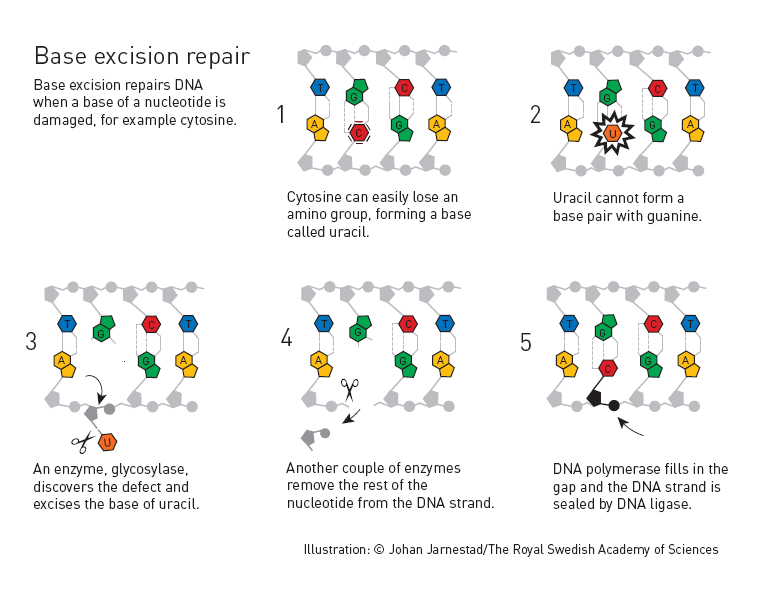
    Base Excision repair

    Aziz Sancar’s Nucleotide excision repair

    Aziz Sancar has mapped nucleotide excision repair, the mechanism that cells use to repair UV damage to DNA. People born with defects in this repair system will develop skin cancer if they are exposed to sunlight. The cell also utilises nucleotide excision repair to correct defects caused by mutagenic substances, among other things.

    Aziz Sancar’s ability to generate knowledge about the molecular details of the process changed the entire research field. He published his findings in 1983.

    He mapped the next stages of nucleotide excision repair. In parallel with other researchers, including Tomas Lindahl, Sancar investigated nucleotide excision repair in humans.

    The molecular machinery that excises UV damage from human DNA is more complex than its bacterial counterpart but, in chemical terms, nucleotide excision repair functions similarly in all organisms.
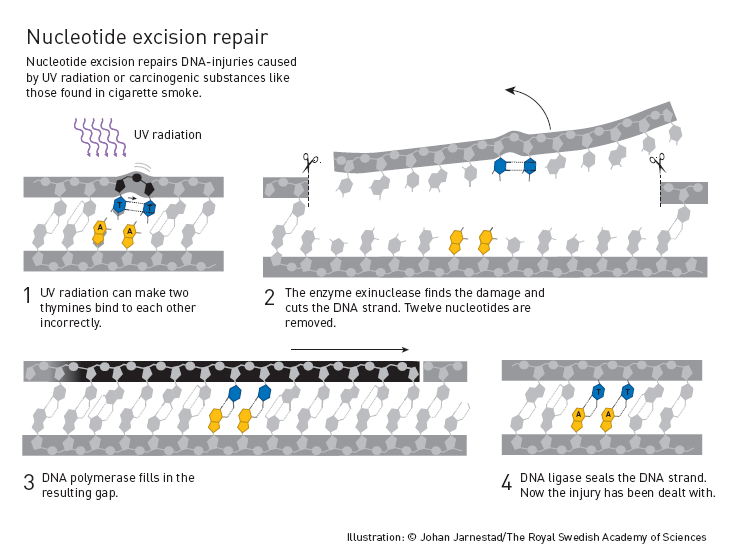
    nucleotide_excision_repair


    Paul Modrich – illustrating DNA mismatch repair

    Once his father, a biology teacher, said: “You should learn about this DNA stuff.” This was in 1963, the year after James Watson and Francis Crick had been awarded the Nobel Prize for discovering the structure of DNA.

    A few years later, that “DNA stuff” really became central to Paul Modrich’s life.

    Paul Modrich has demonstrated how the cell corrects errors that occur when DNA is replicated during cell division. This mechanism, mismatch repair, reduces the error frequency during DNA replication by about a thousandfold. Congenital defects in mismatch repair are known, for example, to cause a hereditary variant of colon cancer.

    In conclusion, the basic research carried out by the 2015 Nobel Laureates in Chemistry has not only deepened our knowledge of how we function, but could also lead to the development of lifesaving treatments.

    In the words of Paul Modrich: “That is why curiosity-based research is so important. You never know where it is going to lead… A little luck helps, too.”


    Irish-born William Campbell and Japan’s Satoshi Omura won half of the prize for discovering avermectin, a derivative of which has been used to treat hundreds of millions of people with river blindness and lymphatic filariasis, or elephantiasis.

    China’s Tu Youyou was awarded the other half of the prize for discovering artemisinin, a drug that has slashed malaria deaths and has become the mainstay of fighting the mosquito-borne disease. She is China’s first Nobel laureate in medicine.

    Lets’s talk about Satoshi Omura’s invention

    Satoshi Ōmura

    So, how did the journey start for Satoshi Omura?

    Satoshi Omura, a Japanese microbiologist and expert in isolating natural products, focused on a group of bacteria, Streptomyces, which lives in the soil and was known to produce a plethora of agents with antibacterial activities (including Streptomycin discovered by Selman Waksman, Nobel Prize 1952).

    Equipped with extraordinary skills in developing unique methods for large-scale culturing and characterization of these bacteria, Omura isolated new strains of Streptomyces from soil samples and successfully cultured them in the laboratory.

    From many thousand different cultures, he selected about 50 of the most promising, one of these cultures later turned out to be Streptomyces avermitilis, the source of Avermectin, a medicine that has nearly eradicated river blindness and radically reduced the incidence of filariasis, which can cause the disfiguring swelling of the lymph system in the legs and lower body known as elephantiasis.


    Bacteria.


    Puzzle about River Blindness?

    Also known as onchocerciasis or Robles’ Disease, is caused by transmission of the parasitic worm Onchocerca volvulus by black flies of the genus Simulium. Vector lives near rivers, thus the name.Inside the host, the worms create larvae that travel to the skin, and infect other flies that bite the victim.

    Symptoms include severe itching, eruptions under the skin, and blindness. About 17-25 million are infected; some 0.8 million have some degree of vision loss. Most infections in sub-Saharan Africa.

    Then, what about Lymphatic Filariasis or Commonly known as elephantiasis ?

    It is tropical disease caused by transmission of parasites classified as nematodes (roundworms) of the family Filariodideato, to humans by mosquitoes.

    Adult worms lodge in lymphatic system and disrupt immune system. Causes abnormal enlargement of body parts, pain, severe disability and social stigma.

    Over 120 million people are infected, about 40 million disfigured or incapacitated. About 1.23 billion in 58 countries are threatened, 80% of whom live in 10 countries, including India, Bangladesh and Nepal.


    Our next Pioneer William C. Campbell

    William C. Campbell

    An expert in parasite biology working in the USA, acquired Omura’s Streptomyces cultures and explored their efficacy.

    Campbell showed that a component from one of the cultures was remarkably efficient against parasites in domestic and farm animals.

    The bioactive agent was purified and named Avermectin, which was subsequently chemically modified to a more effective compound called Ivermectin. 

    Ivermectin was later tested in humans with parasitic infections and effectively killed parasite larvae (microfilaria) .

    Collectively, Omura and Campbell’s contributions led to the discovery of a new class of drugs with extraordinary efficacy against parasitic diseases.


    Scheme.


    What a breakthrough, China’s first Nobel laureate in medicine, Let’s talk about it?


    Youyou Tu

    Ms. Youyou Tu, won Nobel in Medicine for a therapy against malaria.

    Malaria was traditionally treated by chloroquine or quinine, but with declining success. By the late 1960s, efforts to eradicate Malaria had failed and the disease was on the rise.

    At that time, Youyou Tu in China turned to traditional herbal medicine to tackle the challenge of developing novel Malaria therapies.

    Tu revisited the ancient literature and discovered clues that guided her in her quest to successfully extract the active component from Artemisia annua. 

    Tu was the first to show that this component, later called Artemisinin, was highly effective against the Malaria parasite, both in infected animals and in humans.

    Artemisinin represents a new class of antimalarial agents that rapidly kill the Malaria parasites at an early stage of their development, which explains its unprecedented potency in the treatment of severe Malaria.


    Herbal medicine


    How do you think these inventions will change the world?

    The discoveries of Avermectin and Artemisinin have fundamentally changed the treatment of parasitic diseases.

    Ivermectin is highly effective against a range of parasites, has limited side effects and is freely available across the globe.

    The importance of Ivermectin for improving the health and wellbeing of millions of individuals with River Blindness and Lymphatic Filariasis, primarily in the poorest regions of the world, is immeasurable.

    Treatment is so successful that these diseases are on the verge of eradication, which would be a major feat in the medical history of humankind. Malaria infects close to 200 million individuals yearly.

    Artemisinin is used in all Malaria-ridden parts of the world. When used in combination therapy, it is estimated to reduce mortality from Malaria by more than 20% overall and by more than 30% in children. For Africa alone, this means that more than 100 000 lives are saved each year.

    The discoveries of Avermectin and Artemisinin have revolutionized therapy for patients suffering from devastating parasitic diseases.

    Campbell, Ōmura and Tu have transformed the treatment of parasitic diseases. The global impact of their discoveries and the resulting benefit to mankind are immeasurable.

    Published with inputs from Arun
  • Promoting Science and Technology – Missions,Policies & Schemes

    Technology Vision 2035 – Putting science to Use

    The Prime Minister unveiled the ‘Technology Vision Document 2035’ while inaugurating the 103rd Indian Science Congress on  January 3,  2016. Let’s take a glance at it

    <The document is dedicated to late Dr. A.P.J. Abdul Kalam, former President of India.>

    India2035header


    What is Technology Vision 2035?

    • The document foresees the technologies required for fulfilling the needs of India 2035
    • This is a vision of where India and its citizens should be in 2035 and how technology should help achieve this
    • Twelve Sectoral Technology roadmaps are being prepared by the Technology Information, Forecasting and Assessment Council, (TIFAC)

    Which are the 12 sectors?

    • Education
    • Medical Sciences & Healthcare
    • Food and Agriculture
    • Water
    • Energy
    • Environment
    • Habitat
    • Transportation
    • Infrastructure
    • Manufacturing
    • Materials
    • Information and Communication Technology

    The prime aim of the vision document

    • To ensure the security of every Indian, enhancing their prosperity and identity
    • This is stated in the document as “Our Aspiration” or “Vision Statement” in all languages of the 8th Schedule of the Constitution
    • The Vision document also identifies 12 prerogatives – (six for meeting individual needs and six for collective needs) that should be available to each and every Indian

    ISCPrerogatives


    How technologies could map to assure prerogatives?

    • Those are readily deployable
    • Those that needs to be moved from Lab to Field
    • Those that require targeted Research
    • Those that are still in Imagination

    What type of technologies are expected in future?

    • Technologies could come about as a result of curiosity driven or paradigm – shattering ‘Blue-sky’ Research like Internet of Things, Wearable Technology, Synthetic Biology, Brain computer Interface, Bioprinting and regenerative medicine
    • Precision agriculture and robotic farming, vertical farming, interactive foods, autonomous vehicles, Bioluminescence, 3D printing of buildings, earthquake prediction, weather modification technologies, green mining etc <Here, UPSC has great scope to ask questions, as we know 3D printing technology was asked in 2013 Mains >

    What is Bioluminescence?

    Bioluminescent creatures are found throughout marine habitats, from the ocean surface to the deep sea floor.
    Bioluminescent creatures are found throughout marine habitats, from the ocean surface to the deep sea floor.

    • Bioluminescence is the production and emission of light by a living organism
    • The light emitted by a bioluminescent organism is produced by energy released from chemical reactions occurring inside (or ejected by) the organism

    What are the challenges in the field of Technology?

    • Guaranteeing nutritional security and eliminating female and child anaemia
    • Ensuring universal eco-friendly waste management
    • Taking the railway to Leh and Tawang
    • Understanding national climate patterns and adapting to them
    • Ensuring location independent electoral and financial empowerment

    Then! Are there any ways to overcome these challenges?

    Technology Leadership – niche technologies in which we have core competencies, skilled manpower, infrastructure and a traditional knowledge base; eg. Nuclear Energy, Space Science.

    Technology Independence – strategic technologies that we would have to develop on our own as they may not be obtainable from elsewhere eg. Defence sector

    Technology Innovation – linking disparate technologies together or making a breakthrough in one technology and applying it to another. eg., solar cells patterned on chlorophyll based synthetic pathway are a potent future source of renewable energy

    Technology Adoption – obtain technologies from elsewhere, modify them according to local needs and reduce dependence on other sources eg., foreign collaboration in the sectors of rainwater harvesting, agri-biotech, desalination, energy efficient buildings.

    Technology Constraints – areas where technology is threatening and problematic i.e. having a negative social or environmental impact because of serious legal and ethical issues eg., Genetically Modified(GM) Crops.

    Which 3 key activities were identified as a part of the ‘Call to Action’?

    • Knowledge creation It says India cannot afford not to be in the forefront of the knowledge revolution, either applied or pure
    • Ecosystem design for innovation and development
    • Technology deployment by launching certain national missions involving specific targets, defined timelines requiring only a few carefully defined identified players


    Source - PIB Features | Pic - Vision 2035
  • Govt plans $2 bn incentive for Green Hydrogen Industry

    The govt is planning a $2 billion incentive program for the green hydrogen industry, in a bid to cut emissions and become a major export player in the field.

    What is Green Hydrogen?

    • Green hydrogen is hydrogen gas produced through the electrolysis of water.
    • It is an energy-intensive process for splitting water into hydrogen and oxygen— using renewable power to achieve this.
    • The current cost of green hydrogen in India is ₹300 to ₹400 per kg.

    Hydrogen Energy: A Backgrounder

    • Hydrogen is an important source of energy since it has zero carbon content and is a non-polluting source of energy in contrast to hydrocarbons that have net carbon content in the range of 75–85 per cent.
    • Hydrogen energy is expected to reduce carbon emissions that are set to jump by 1.5 billion tons in 2021.
    • It has the highest energy content by weight and lowest energy content by volume.
    • As per International Renewable Energy Agency (IRENA), Hydrogen shall make up 6 per cent of total energy consumption by 2050.
    • Hydrogen energy is currently at a nascent stage of development, but has considerable potential for aiding the process of energy transition from hydrocarbons to renewable.

    Why hydrogen?

    • Better properties: At standard temperature and pressure, hydrogen is a nontoxic, nonmetallic, odourless, tasteless, colourless, and highly combustible diatomic gas.
    • Clean fuel: Hydrogen fuel is a zero-emission fuel when burned with oxygen. It can be used in fuel cells or internal combustion engines. It is also used as a fuel for spacecraft propulsion.
    • Ample sources: Hydrogen can be sourced from natural gas, nuclear power, biomass, and renewable power like solar and wind.
    • Phasing out carbon: India remains committed to environmental and climate causes with a massive thrust on deploying renewable energy and energy efficiency measures.
    • Diversification of our energy basket: This would be the key lever enabling this transition. That’s why the emergence of hydrogen at the centre stage is a welcome development.

    How Hydrogen can be produced?

    Commercially viable Hydrogen can be produced from –

    1. Hydrocarbons including natural gas, oil and coal through processes like steam methane reforming, partial oxidation and coal gasification
    2. Renewables like water, sunlight and wind through electrolysis and photolysis and other thermo-chemical processes.

    How is Green Hydrogen produced?

    • For source material, green hydrogen today is typically generated from water through a process known as electrolysis, which uses an electric current to split water into its component molecules of hydrogen and oxygen.
    • This is done using a device called an electrolyzer, which utilizes a cathode and an anode (positively and negatively charged electrodes).
    • This process produces only oxygen – or steam – as a byproduct.
    • As for energy supply, to qualify as “green hydrogen,” the source of electricity used for electrolysis must derive from renewable power, such as wind or solar energy.
    • Currently the production of green hydrogen is two or three times more expensive than blue hydrogen.

    How can green hydrogen be used?

    Hydrogen can be used in broadly two ways. It can be burnt to produce heat or fed into a fuel cell to make electricity.

    • Fuel-cell  Mobility: Hydrogen electric cars and trucks
    • Container ships powered by liquid ammonia made from hydrogen
    • “Green steel” refineries burning hydrogen as a heat source rather than coal
    • Hydrogen-powered electricity turbines that can generate electricity at times of peak demand to help firm the electricity grid

    Challenges in producing Green Hydrogen

    India’s transition towards a green hydrogen economy (GHE) can only happen once certain key issues are addressed.

    • Supply-Chain Issues: GHE hinges upon the creation of a supply chain, starting from the manufacture of electrolysers to the production of green hydrogen, using electricity from a renewable energy source.
    • Technology: Green hydrogen needs electrolysers to be built on a scale larger than we’ve yet seen.
    • Storage: Either very high pressures or very high temperatures are required, both with their own technical difficulties.
    • Explosion Hazard: It is hazardous because of its low ignition energy and high combustion energy.
    • Risk to use: Automotive fuels are highly inflammable, but a vehicle laden with hydrogen is likely to be more vulnerable in case of a major accident.
    • High Cost of Production: To become competitive, the price per kilogram of green hydrogen has to reduce to a benchmark of $2/kg. At these prices, green hydrogen can compete with natural gas.
    • Energy intensivity: Creating green hydrogen needs a huge amount of electricity, which means an enormous increase in the amount of wind and solar power to meet global targets.
    • Lack of proper infrastructure, only 500 Hydrogen stations exist globally. Only countable manufacturers are involved as market players in this technology.
    • Others: Low user acceptance and social awareness. Developing after-sales service for hydrogen technology.

    Policy and Economic Challenges

    • Economic sustainability: One of the biggest challenges faced by the industry for using hydrogen commercially is the economic sustainability of extracting green or blue hydrogen.
    • Technological challenges: The technology used in production and use of hydrogen like Carbon Capture and Storage (CCS) and hydrogen fuel cell technology are at nascent stage.
    • Cost Factor: These technologies are expensive which in turn increases the cost of production of hydrogen and will require a lot of investment which in turn add fiscal pressure on government.
    • Higher Maintenance costs: Maintenance costs for fuel cells post-completion of a plant can be costly.
    • Need for legal and administrative adherence: Certification mechanisms, recommendations, and regulations for different components of the system.

    Way forward

    • Hydrogen energy is at a nascent stage of development but has significant potential for realizing the energy transition in India.
    • The new policy is a futuristic vision that can help the country not only cut down its carbon emissions but also diversify its energy basket and reduce external reliance.
    • India’s transition can be a testament to the world on the achievement of energy security, without compromising the goal of sustainable development.
    • The GoI must strongly pursue the objective of creating a GHE to make India a global manufacturing hub and place itself at the top of the green hydrogen export market.


    Click and get your FREE Copy of CURRENT AFFAIRS Micro Notes

    (Click) FREE 1-to-1 on-call Mentorship by IAS-IPS officers | Discuss doubts, strategy, sources, and more