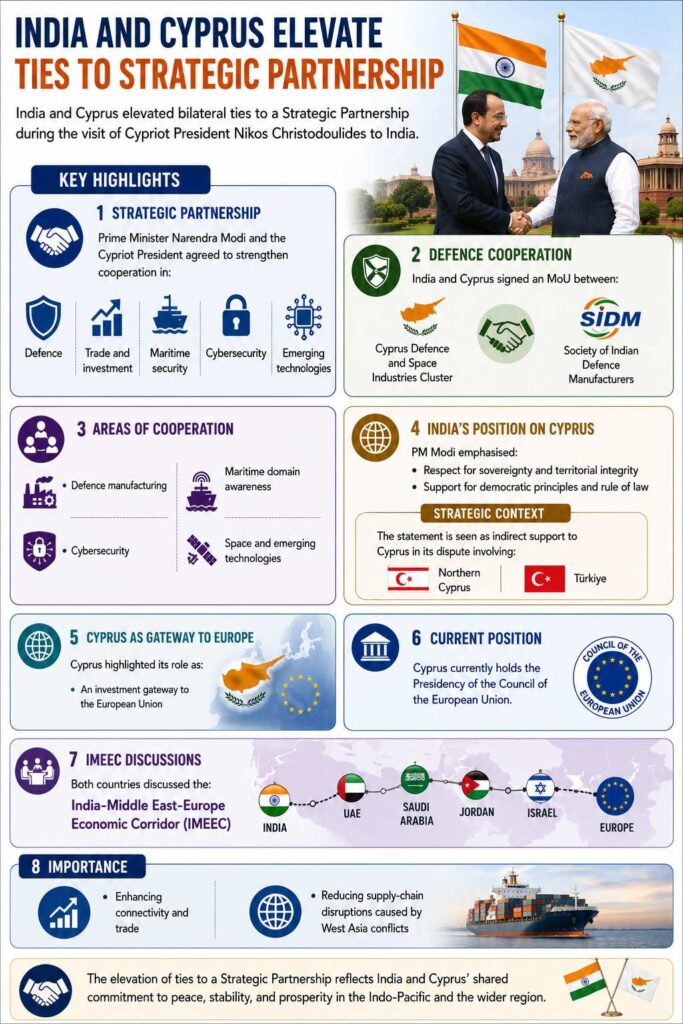
India and Cyprus elevated bilateral ties to a Strategic Partnership during the visit of Cypriot President Nikos Christodoulides to India.
Key Highlights
Strategic Partnership
Prime Minister Narendra Modi and the Cypriot President agreed to strengthen cooperation in:
Defence
Trade and investment
Maritime security
Cybersecurity
Emerging technologies
Defence Cooperation
India and Cyprus signed an MoU between:
Cyprus Defence and Space Industries Cluster
Society of Indian Defence Manufacturers
India’s Position on Cyprus
PM Modi emphasised:
Respect for sovereignty and territorial integrity
Support for democratic principles and rule of law
Strategic Context
The statement is seen as indirect support for Cyprus in its dispute involving Northern Cyprus and Türkiye.
Cyprus as a Gateway to Europe
Cyprus highlighted its role as an investment gateway to the European Union
Current Position: Cyprus currently holds the Presidency of the Council of the European Union.
[2024] Consider the following statements: Statement I: The Sumed pipeline is a strategic route for Persian Gulf oil and Natural gas shipments to Europe. Statement-II: Sumed pipeline connects the Red Sea with the Mediterranean Sea. Which one of the following is correct in respect of the above statements?
[A] Both Statement-I and Statement-II are correct and Statement-II explains Statement-I
[B] Both Statement-I and Statement-II are correct, but Statement-II does not explain Statement-I
[C] Statement-I is correct, but Statement-II is incorrect
[D] Statement-I is incorrect, but Statement-II is correct
Russian President Vladimir Putin visited China in May 2026 for his first foreign trip after re-election, showing China’s growing importance to Russia. The visit is significant because 32% of Russia’s trade in 2025 was with China, reflecting Moscow’s increasing dependence after Western sanctions. Russia-China ties have expanded from cautious cooperation to deeper links in energy, trade, technology, and defence. For India, this matters because Russia is a key defence partner, while China remains India’s biggest security challenge.
How Have Russia-China Relations Evolved Historically?
Imperial Legacy: Rivalry and Territorial Disputes (17th Century-1917): Russia and China experienced phases of rivalry during the imperial period, including territorial disputes and unequal treaties.
Expansionist Competition: Initial contacts between the Russian and Qing Empires in the 17th century involved competition over Siberia and the Amur River regions.
“Unequal Treaties”: In the 19th century, Russia exploited China’s weakness to annex large tracts of territory, including the regions surrounding the Amur and Ussuri Rivers, through treaties such as the Treaty of Aigun (1858) and the Treaty of Peking (1860).
Historical Distrust: This era established a legacy of mistrust, as these treaties are still viewed in China as part of a “Century of Humiliation”.
Communist Cooperation:
The “Honeymoon Decade”: Following the 1949 communist victory in China, the Soviet Union and China formed a tight ideological alliance, strengthened by the 1950 Sino-Soviet Treaty of Friendship.
Sino-Soviet Split:
Ideological Divergence: Disputes emerged in the late 1950s over interpretations of Marxism-Leninism, Soviet leader Nikita Khrushchev’s “peaceful coexistence” policy, and China’s desire for nuclear ambitions.
Border Conflicts: Relations broke down entirely in the 1960s, leading to border conflicts, notably the 1969 Ussuri River clashes.
“Confrontation Decade”: Through the 1970s and 1980s, the nations maintained a high-tension relationship, with China moving toward rapprochement with the US to counter Soviet power.
Strategic Reconciliation: Relations improved after the Soviet collapse in 1991, especially after Russian President Boris Yeltsin’s 1992 visit to China.
Putin-Xi Consolidation: A “No Limits” Partnership (2022-2026): Russia-China ties deepened significantly after 2022 following the Ukraine war and Western sanctions on Moscow.
Strategic Alignment: Relations deepened significantly following the February 2022 Russian invasion of Ukraine, as Beijing provided an economic lifeline to a sanctioned Moscow.
“No Limits” Friendship: Weeks before the 2022 Ukraine war, Presidents Vladimir Putin and Xi Jinping declared a partnership with “no limits,” uniting against the U.S.-led global hegemony.
Asymmetric Partnership (2026): By 2026, Russia has become increasingly dependent on China, which is now its largest trading partner, purchasing large amounts of oil and supplying high-tech components, despite Western sanctions.
The 2026 Configuration: Current relations (as of May 2026) are described as a “comprehensive strategic partnership of coordination for a new era,” with leaders meeting regularly to sign new cooperation agreements on trade, energy, and technology.
Why Are Russia and China Moving Closer Strategically?
Western Pressure: Shared resistance to US-led sanctions, military alliances, and perceived hegemonic interventions has encouraged coordination.
Economic Complementarity: China provides markets, finance, technology, and industrial capacity, while Russia supplies energy, defence systems, and natural resources.
Political Alignment: Both states support a “multipolar world order” and oppose unilateral dominance in global institutions.
Diplomatic Coordination: Cooperation has increased in multilateral forums such as BRICS, Shanghai Cooperation Organisation (SCO), and the United Nations Security Council (UNSC).
Strategic Necessity: Russia’s post-Ukraine isolation has accelerated dependence on China for trade, investment, and diplomatic legitimacy.
How Deep Is the Russia-China Economic Partnership?
Trade Expansion:China accounted for 32% of Russia’s total trade in 2025, highlighting growing economic dependence.
Energy Cooperation: Russia supplies oil and gas to China through major pipelines, reducing Moscow’s dependence on European markets.
Power of Siberia Pipeline: The 3,000-km pipeline transports natural gas from Eastern Siberia directly to northeastern China’s Heilongjiang province.
Power of Siberia-2 Project: The proposed 2,600-km pipeline through Mongolia could significantly expand Russian gas exports to China.
Technology and Finance: China increasingly supports Russia through alternative payment systems, industrial collaboration, and trade settlements outside the dollar system.
Sanctions Adaptation: Bilateral trade has become a mechanism for reducing Western economic pressure on Russia.
Are Russia and China Moving Towards a Military Alliance?
Strategic Coordination: Joint military exercises, defence consultations, and strategic patrols have expanded, indicating growing military cooperation.
Example:“Vostok” exercises, Joint Sea naval drills in the Sea of Japan, and joint bomber patrols over the East China Sea and Pacific region.
“Better Than Allies” Approach: Russia and China describe their relationship as “not allies, but better than allies”, enabling deep cooperation without a binding defence commitment. This preserves strategic flexibility and prevents subordination of national interests.
Strategic Convergence: Cooperation in missile warning systems, aerospace, cyber capabilities, artificial intelligence, and dual-use technologies reflects increasing security alignment.
Example: Russia assisted China in developing an early-warning missile defence system, while China increasingly supports Russia through microchips and drone components after Western sanctions.
Geopolitical Signalling: Joint military activities are often aimed at strategic messaging rather than interoperability, signalling resistance to Western influence.
Example:Russia-China-Iran trilateral naval exercises in the Gulf of Oman project coordination near critical maritime chokepoints.
Absence of Formal Treaty: Russia and China have avoided a NATO-style mutual defence alliance, indicating limits to military integration despite growing convergence.
Entrapment Concerns: Beijing may avoid direct involvement in Russia-NATO conflict over Ukraine. At the same time, Moscow remains cautious about being drawn into a Taiwan contingency, reducing prospects for a formal alliance.
Asymmetric Dependence: China’s larger economic weight makes it the senior partner, while Russia increasingly depends on Beijing for trade, technology, and diplomatic support, creating structural limits to equal alliance formation.
Assessment: Russia and China are moving toward a strategic or quasi-alliance characterised by deep coordination, but not a formal military alliance, due to fears of entrapment and differing regional priorities.
How Does a Stronger Russia-China Axis Affect India’s Security?
Strategic Dilemma:
The Continental Catch-22: India relies heavily on Russia to maintain its military readiness, yet its primary active threat is China along the 3,488-kilometer Line of Actual Control (LAC).
Continental Security Challenge: Closer Moscow-Beijing ties may weaken Russia’s ability to remain strategically neutral in India-China tensions.
Eroded Diplomatic Buffer: Historically, during India-China border crises (such as the 1962 war or the 2020 Galwan Valley clash), Moscow acted as a quiet mediator or accelerated emergency arms supplies to New Delhi.
The Tri-Continental Encirclement: A tight Russia-China axis, combined with Pakistan’s deep alignment with Beijing, effectively creates a coordinated security ring around India’s northern and western land borders.
Defence Dependence: India continues to depend heavily on Russian-origin defence platforms including missiles, submarines, and fighter systems.
Legacy Systems Lock-In: Over 60% of India’s current military inventory, including the S-400 Triumf air defense missile systems, Sukhoi Su-30MKI fighter jets, T-90 tanks, and INS Chakra nuclear submarine programs, is of Russian origin.
The Spare-Parts Crisis: India cannot instantly replace these platforms. It requires a decades-long supply of Russian spare parts, technical upgrades, and ammunition to maintain basic operational readiness against Pakistan and China.
Reduced Strategic Space: Enclosure in Eurasian Geopolitics
Multilateral Dilution: India uses groupings like BRICS and the Shanghai Cooperation Organisation (SCO) to project power in Eurasia. However, a dominant Russia-China axis turns these forums into anti-Western vehicles, alienating India’s interests.
Losing Central Asia: India views Central Asia as vital for energy security and counter-terrorism. A unified Russia-China front effectively locks India out of the region. This will allow China’s Belt and Road Initiative (BRI) to expand unchecked.
Technology Access: Russia’s increasing technological integration with China may influence defence transfers and strategic cooperation with India.
Joint Technology Leakage: As Russia and China merge their military-industrial complexes in areas like artificial intelligence, hypersonic missiles, and cyber warfare, India faces the acute risk of data spillover.
Diplomatic Balancing: The Aggressive Pivot to the West:
The Western Counterweight: To offset its continental vulnerabilities, India is rapidly intensifying its security architecture with the West, notably through the Quad (US, Japan, Australia) and bilateral defense pacts with France and the US.
Can India Preserve Strategic Autonomy Amid Emerging Geopolitical Blocs?
Multi-Alignment: India increasingly follows a strategy of engaging multiple power centres rather than exclusive alliances.
Strategic Autonomy: Maintains independent foreign policy choices despite closer engagement with Western powers.
Russia Engagement: Sustains defence and energy ties with Moscow despite Western pressure.
China Management: Combines military preparedness, diplomatic engagement, and economic caution.
Indo-Pacific Balancing: Strengthens partnerships through the Quad, maritime cooperation, and supply-chain diversification.
Domestic Capability: Expands defence indigenisation through Atmanirbhar Bharat in Defence to reduce long-term dependence.
Conclusion
The deepening Russia-China partnership reflects a shifting global order shaped by geopolitical rivalry, economic interdependence, and resistance to Western dominance. Although a formal military alliance remains unlikely, growing strategic convergence between Moscow and Beijing could narrow India’s diplomatic and security space. For India, the challenge lies in preserving strategic autonomy through calibrated multi-alignment. Maintaining strong ties with Russia, managing tensions with China, and strengthening partnerships in the Indo-Pacific while accelerating defence indigenisation and economic resilience is the need of the hour for India.
PYQ Relevance
[UPSC 2020] What is the significance of Indo-US defence deals over Indo-Russian defence deals? Discuss with reference to stability in the Indo-Pacific region.
Linkage: The PYQ directly relates to India’s strategic balancing between traditional defence dependence on Russia and emerging partnerships with the US amid geopolitical shifts. The deepening Russia-China partnership increases India’s security concerns, making defence diversification and Indo-Pacific strategy more relevant.
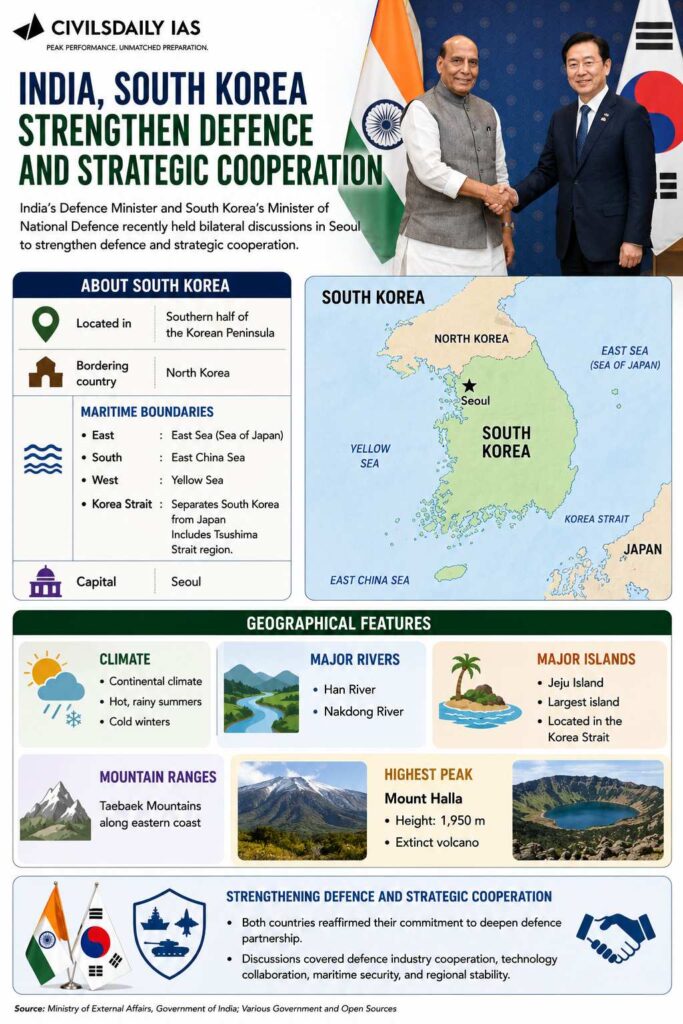
India’s Defence Minister and South Korea’s Minister of National Defence recently held bilateral discussions in Seoul to strengthen defence and strategic cooperation.
About South Korea
Located in the southern half of the Korean Peninsula
Bordering country North Korea
Maritime Boundaries
East: East Sea (Sea of Japan)
South: East China Sea
West: Yellow Sea
Korea Strait
Separates South Korea from Japan
Includes Tsushima Strait region.
Geographical Features
Climate
Continental climate
Hot, rainy summers
Cold winters
Major Rivers
Han River
Nakdong River
Major Islands
Jeju Island
Largest island
Located in the Korea Strait
Mountain Ranges
Taebaek Mountains along eastern coast
Highest Peak
Mount Halla
Height: 1,950 m
Extinct volcano
[2024] Consider the following countries: 1. Italy 2. Japan 3. Nigeria 4. South Korea 5. South Africa Which of the above countries are frequently mentioned in the media for their low birth rates, or ageing population or declining population?
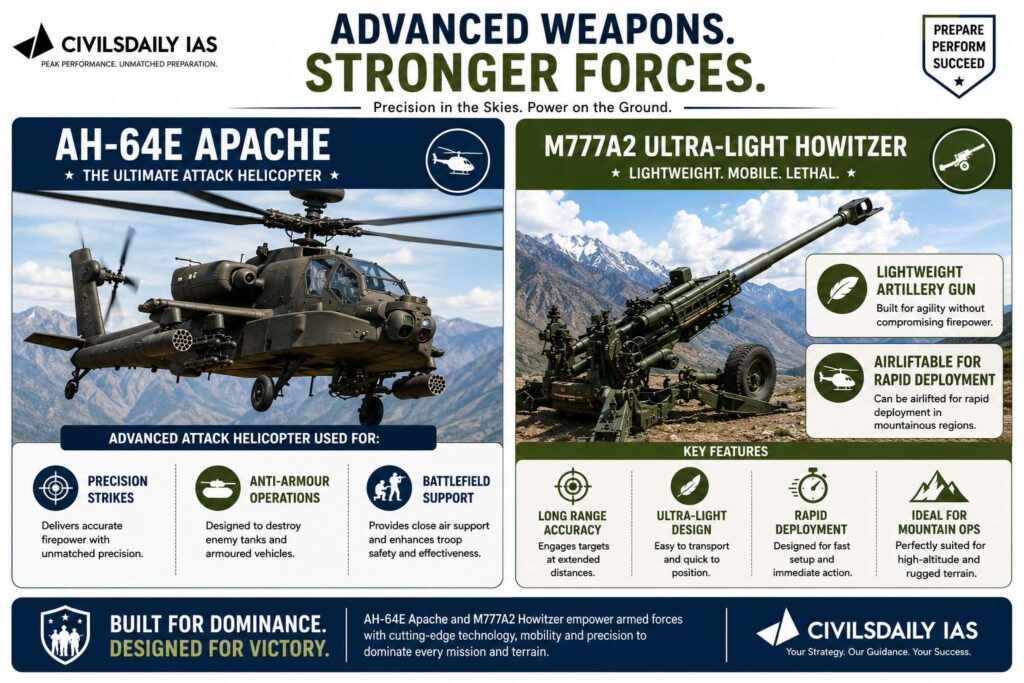
The United States approved support service deals for Apache helicopters and M777 howitzers for India, strengthening India-U.S. defence ties.
Key Highlights
Apache Helicopter Support Deal
Estimated value: $198.2 million
Includes:
Engineering and logistics support
Technical data and publications
Personnel training
Maintenance support
M777A2 Ultra-Light Howitzer Support
Estimated value: $230 million
Includes:
Spare parts
Repairs
Technical assistance
Field service support
About AH-64E Apache
Advanced attack helicopter used for:
Precision strikes
Anti-armour operations
Battlefield support
About M777A2 Ultra-Light Howitzer
Lightweight artillery gun.
Can be airlifted for rapid deployment in mountainous regions.
[2025] With reference to India’s defense, consider the following pairs: Aircraft type Description 1. Dornier-228: Maritime patrol aircraft 2. IL-76: Supersonic combat aircraft 3. C-17: Globe Master IIIMilitary transport aircraft How many of the pairs given above are correctly matched? [A] Only one [B] Only two [C] All the three [D] None
PYQ Relevance[UPSC 2023] The expansion and strengthening of NATO and a stronger US-Europe strategic partnership works well in India.” What is your opinion about this statement? Give reasons and examples to support your answer.Linkage: The PYQ tests understanding of how changing geopolitical alignments in Europe affect India’s strategic interests. Similar to the PYQ, the article examines how evolving European security architecture creates new strategic opportunities and challenges for India.
Mentor’s Comment
The Prime Minister of India visited Oslo, Norway on May 18 and 19 for the 3rd India-Nordic Summit. This visit was important as India’s ties with Nordic countries are entering a strategic phase. Earlier, relations focused on climate, innovation and digitalisation. However, the Ukraine war, NATO expansion, Arctic competition and critical mineral concerns have increased the region’s strategic importance for India. The Arctic is warming over three times faster than the global average, affecting India’s monsoon, Himalayan glaciers and maritime security, making closer Nordic engagement increasingly important.
How Has the Strategic Context of India-Nordic Relations Changed?
Shift in geopolitical environment
Ukraine War: Reshaped Europe’s security architecture and altered strategic calculations.
Trans-Atlantic Strains: Renewed uncertainty in European security has increased Nordic strategic importance.
NATO Expansion:Finland and Sweden joining NATO has transformed Nordic security architecture.
Russia-China Polar Partnership: Expands geopolitical competition into Arctic spaces through cooperation on shipping and energy.
Transition from functional to strategic cooperation
Earlier Focus: Climate cooperation, digitalisation, innovation and blue economy dominated engagement.
What Are the Challenges Before India’s Arctic Turn?
Insufficient Ice-Class Ships: Restricts India’s ability to utilise Arctic routes.
Great Power Rivalries: Russia-West tensions complicate Arctic engagement.
High Infrastructure Costs: Arctic operations require advanced technology and significant investments.
Governance Constraints/ Observer Status: India lacks formal decision-making power in the Arctic Council.
Conclusion
The Oslo Summit represents a strategic inflection point in India-Nordic relations. The Arctic’s growing geopolitical and economic relevance means that India can no longer treat Nordic engagement as peripheral or climate-centric. A calibrated “northward turn” through Arctic diplomacy, resilient supply chains, maritime cooperation and clean-energy partnerships can strengthen India’s strategic autonomy, climate resilience and economic competitiveness.
India’s Arctic Policy (2022): Key Pillars Science and Research: Expands polar research and climate studies. Climate and Environmental Protection: Supports sustainable Arctic governance. Economic and Human Development: Facilitates investment and connectivity. Transportation and Connectivity: Examines emerging shipping routes.Governance and International Cooperation: Strengthens multilateral engagement. National Capacity Building: Enhances polar expertise. Arctic CouncilEstablished: 1996 (Ottawa Declaration) Members: Canada, Denmark, Finland, Iceland, Norway, Russia, Sweden and USA. India’s Status: Observer since 2013. Function: Facilitates cooperation on environmental protection and sustainable development. Northern Sea RouteDefinition: Shipping corridor along Russia’s Arctic coast. Importance: Reduces travel distance between Europe and Asia.
Donald Trump visited China during May 13-15 and this visit assumes significance because it occurred amid an unusually volatile global environment. This is marked by the Iran crisis, disruption risks in the Strait of Hormuz, and escalating tensions around Taiwan. The visit came after nearly a decade of worsening U.S.-China relations driven by tariffs, technology restrictions, and strategic mistrust. Despite no formal agreements, the meeting marked a symbolic “thaw” after prolonged confrontation. Both sides acknowledge the need to restore stability in arguably the world’s most consequential bilateral relationship.
Why did Trump’s China visit acquire strategic significance amid global instability?
Iran Crisis: Escalating Iran-U.S. tensions threatened closure of the Strait of Hormuz, a critical global oil chokepoint. Stability between major powers became necessary to prevent wider economic disruption.
Taiwan Tensions: Taiwan’s pro-independence political developments intensified Chinese concerns regarding reunification and sovereignty claims.
Global Economic Stakes: U.S.-China relations affect global trade flows, supply chains, commodity prices, and financial stability.
Strategic Timing: The visit occurred after years of tariff escalation and deteriorating diplomatic relations, making even symbolic engagement politically important.
Domestic Political Context: U.S. mid-term electoral pressures incentivised Trump to seek economic gains and business opportunities.
How have U.S.-China relations evolved from cooperation to strategic rivalry?
Economic Interdependence: Four decades of trade integration initially produced deep commercial linkages and mutual dependence.
Trade War (2018): Trump initiated tariff measures against Chinese imports to reduce trade imbalances and strategic dependence.
Technology Competition: Restrictions emerged over semiconductors, AI, and advanced technologies, especially high-end graphics processing units (GPUs).
Strategic Distrust: Competition expanded beyond economics into military posturing, Indo-Pacific influence, and ideological rivalry.
Taiwan Factor: Beijing increasingly viewed American engagement with Taiwan as interference in its sovereignty concerns.
Why did both countries seek a “stability framework” despite persistent rivalry?
Economic Costs: Tariff escalation harmed both economies and disrupted global markets.
Energy Security Concerns: Strait of Hormuz disruptions created urgency for coordinated responses due to oil dependence.
Conflict Avoidance: Both sides recognised risks of unintended military escalation, especially regarding Taiwan.
Global Responsibility: As leading powers, instability between both states generates worldwide economic spillovers.
What were the major issues discussed during the Trump-Xi meeting?
Trade Expansion: China explored increased purchases of U.S. soybeans, beef, and energy products.
Technology Restrictions: Beijing sought relaxation of American restrictions on high-end GPU exports.
Civil Aviation Deals: China reportedly offered to purchase 200 Boeing aircraft and 450-500 American aircraft engines, although commercial arrangements remained unconfirmed.
Energy Cooperation: China expressed willingness to import more U.S. oil to reduce dependence on vulnerable maritime routes.
Taiwan Question: Xi Jinping strongly reiterated China’s position that U.S. handling of Taiwan remains the central obstacle in bilateral relations.
Iran Crisis: Discussions included coordination amid instability caused by the Iran-U.S. confrontation.
Why did the visit remain largely symbolic despite high expectations?
Absence of Agreements: No joint statement, treaty, or major agreement emerged from the meeting.
Unresolved Structural Issues: Tariffs, technology restrictions, military competition, and Taiwan disputes remained unresolved.
Trust Deficit: Strategic mistrust between both leaderships continues to limit institutional cooperation.
Domestic Political Constraints: Both leaders faced domestic constituencies discouraging major concessions.
Continuing Strategic Competition: Economic engagement coexists with long-term geopolitical rivalry.
Can U.S.-China competition be managed without confrontation?
Strategic Stability: Requires mechanisms to prevent escalation despite persistent rivalry.
Competitive Coexistence: Suggests coexistence through selective cooperation in trade, climate, and crisis management while competing strategically.
Crisis Communication: Diplomatic channels reduce risks of accidental escalation.
Mutual Restraint: Stable management of Taiwan remains critical to avoiding military conflict.
Institutional Engagement: Continued high-level summits preserve diplomatic communication even during disagreement.
Conclusion
The Trump-Xi meeting did not transform U.S.-China relations, yet it demonstrated recognition that unmanaged rivalry between major powers carries unacceptable global risks. The future trajectory will likely involve competitive coexistence rather than reconciliation, where limited cooperation coexists with enduring strategic distrust. Stability in this relationship will remain central to global economic and geopolitical order.
Value Addition Thucydides Trap Refers to conflict risk when a rising power challenges an established power.Coined from historical rivalry between Athens and Sparta.Frequently applied to U.S.-China strategic competition. G2 Concept Refers to U.S.-China cooperation as joint managers of global order.Suggests coordinated leadership in trade, climate, finance, and security.China informally invoked the idea during the visit.
PYQ Relevance
[UPSC 2022] The USA is facing an existential threat in the form of China, that is much more challenging than the erstwhile Soviet Union. Explain.
Linkage: The PYQ tests understanding of the U.S.-China strategic rivalry, great power competition, trade-tech conflict, and geopolitical implications. The article directly examines the attempt to stabilise worsening U.S.-China relations despite tensions.
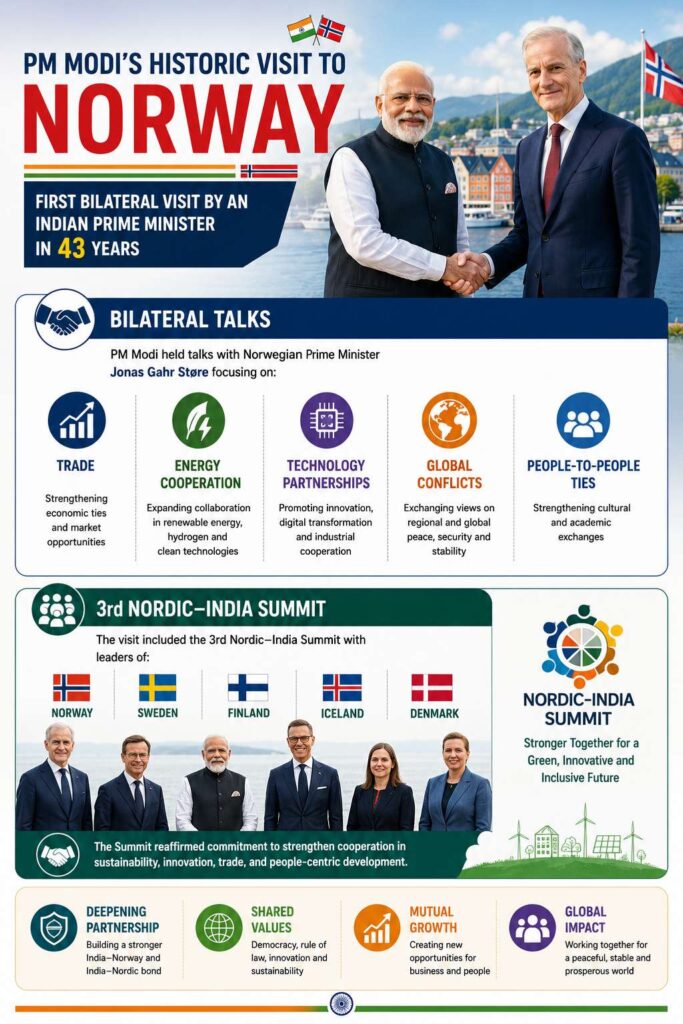
Prime Minister Narendra Modi visited Norway for the first bilateral visit by an Indian Prime Minister in 43 years.
Bilateral Talks
PM Modi held talks with Norwegian Prime Minister Jonas Gahr Støre focusing on:
Trade
Energy cooperation
Technology partnerships
Global conflicts
3rd Nordic-India Summit
The visit included the 3rd Nordic-India Summit with leaders of:
Norway
Sweden
Finland
Iceland
Denmark
Major Agenda Areas
Trade and investments
Energy security
Climate and green transition
Digital infrastructure
Space cooperation
Global conflicts:
Russia-Ukraine war
Gaza conflict
Iran crisis
Energy Cooperation
Norway is a major exporter of oil and natural gas.
Discussions included LNG supplies to India.
Norwegian company Equinor recently supplied LNG to India under a 15-year agreement.
Economic Relations
Over 700 Nordic firms operate in India.
Around 150 Indian firms operate in Nordic countries.
India’s trade with Nordic countries is about $19 billion.
[2024] Consider the following countries: 1. Finland 2. Germany 3. Norway 4. Russia How many of the above countries have a border with the North Sea? [A] Only one [B] Only two [C] Only three [D] All four
India’s agricultural exports recorded growth in 2025-26 despite higher tariff barriers imposed by the United States. This assumes importance because farm exports grew even when tariffs were raised sharply from 10% to 25% and then to 50% within months.
How has India’s agricultural trade performed amid U.S. tariff pressures?
Export Growth: Agricultural exports increased by 2.3% year-on-year, reaching $53.13 billion in 2025-26, marginally below the all-time high of $53.2 billion in 2022-23.
Trade Resilience: Overall exports rose 0.9% to $441.7 billion, despite aggressive tariff increases by the U.S. administration.
Tariff Escalation: The U.S. increased tariffs from 10% (February 10) to 25% (August 7) and later 50% (August 27), creating major trade uncertainty.
Comparative Contrast: Contrary to expectations of export contraction under higher tariffs, India sustained agricultural export growth through diversification.
Trade Balance: Agricultural trade surplus narrowed over time, despite remaining positive, due to increasing imports.
Why were Indian agricultural exports able to withstand U.S. tariff shocks?
Market Diversification: Exporters reduced excessive dependence on the U.S. market and expanded into Vietnam, UAE, Japan, Belgium, Saudi Arabia, Egypt and Bangladesh.
Commodity Diversification: Growth shifted toward high-performing sectors such as marine products, buffalo meat, coffee and basmati rice, reducing concentration risks.
Demand Expansion: Alternative markets compensated for reduced U.S. demand through higher shipments.
Competitive Pricing: India retained export competitiveness in labour-intensive and agro-processing sectors.
Supply Flexibility: Exporters redirected shipments geographically instead of relying on one dominant market.
Alternative Markets: Exports expanded to China ($1.2 billion), Vietnam ($881.8 million), Japan ($408.5 million) and Belgium ($225.3 million).
Frozen Shrimp Diversification: Exporters offset reduced U.S. demand through shipments to alternative destinations.
Why did buffalo meat exports rise significantly?
Export Surge: Buffalo meat exports increased 25.6%, touching a record $5.1 billion, surpassing the previous peak of $4.8 billion (2014-15).
Major Markets: Key destinations included Vietnam ($740.8 million), Egypt ($656.1 million), UAE ($300.4 million) and Saudi Arabia ($317.6 million).
Volume Growth: Exports rose from 1.2 lakh tonnes (2024-25) to 14.2 lakh tonnes (2025-26).
How has India emerged as a stronger coffee exporter?
Coffee Boom: Coffee exports crossed the $2 billion mark for the first time in 2025-26.
Structural Driver: High global coffee prices and supply disruptions in major producers such as Brazil and Vietnam increased India’s competitiveness.
Export Destinations: Major buyers included Italy, Germany, Russia, UAE and Belgium.
What explains growth in basmati rice and processed foods?
Basmati Exports: Basmati rice exports increased from $337.1 million to $285.9 million(decline in U.S. market but overall diversification sustained demand).
Processed Foods: Processed fruits and vegetables exports expanded due to rising international demand.
Fresh Produce: Exports of grapes, pomegranates, mangoes, bananas, onions and vegetables reached record levels.
Why do edible oil imports remain structurally high?
Import Dependence: Vegetable oil imports reached a record $19.56 billion, despite declining volumes.
Domestic Deficit: India imports nearly 40% of edible oil consumption, exposing vulnerability in oilseed production.
Top Imports: Major imports included palm oil, soybean oil and sunflower oil.
Why has cotton turned from an export to an import commodity?
Import Surge: Cotton imports rose due to domestic shortages and absence of new yield-enhancing technologies.
Export Decline: Cotton shifted from a traditional export commodity toward higher import dependence.
What trends are visible in fruit and pulse imports?
Fresh Fruits: Imports rose to $3.5 billion, including apples, kiwis, grapes, pears and dates.
Pulses: Imports increased because of domestic supply shortfalls and consumption demand.
Nutritional Demand: Rising incomes contributed to diversified food demand.
Does India’s agricultural trade surplus remain sustainable?
India’s agricultural trade surplus faces critical sustainability risks despite remaining positive at $12.7 billion in 2025-26.
Trade Surplus: India continues to remain a net agricultural exporter.
Aggressive Structural Erosion: Agricultural trade surplus declined from $27.7 billion (2013-14) to $12.7 billion (2025-26).
Import Growth: Faster growth in edible oil, cotton and fruit imports reduced net gains.
The Forex Drain: High-volume imports of edible oils ($19.5B) and pulses ($3.6B) create an structural annual drag of $23.1 billion.
Weak Import Substitution: Domestic policy interventions have failed to scale local oilseed and pulse production to displace international imports.
What are the broader economic and policy implications?
Export Diversification: Reduces overdependence on single-country markets and strengthens trade resilience.
Food Processing: Expands value-added exports and rural employment.
MSP and Competitiveness: Balances domestic food security with export competitiveness.
Oilseed Mission: Necessitates domestic edible oil production reforms.
Technology Adoption: Requires improved cotton productivity and climate-resilient farming.
Trade Diplomacy: Strengthens India’s negotiating position amid rising global protectionism.
Conclusion
India’s farm export resilience despite U.S. tariff escalation demonstrates the benefits of market diversification and commodity specialization. However, rising dependence on edible oils, cotton and select food imports highlights structural weaknesses in domestic agricultural productivity. A balanced strategy combining export competitiveness with import substitution and technological modernization remains essential for sustaining India’s agricultural trade surplus.
PYQ Relevance
[UPSC 2018] How would the recent phenomena of protectionism and currency manipulations in world trade affect macroeconomic stability of India?
Linkage: This article directly relates to global protectionism and tariff barriers, as India’s agricultural exports faced higher U.S. tariffs but remained resilient through diversification. It helps in understanding how trade shocks, export diversification and global market shifts affect India’s macroeconomic and agricultural stability.
PYQ Relevance[UPSC 2013] Discuss the political developments in Maldives in the last two years. Should they be of cause of concern to India?Linkage: The PYQ reflects UPSC’s emphasis on how regional geopolitical developments affect India’s foreign policy and strategic interests. Similarly, India-Vietnam relations must be examined through the lens of regional balancing, maritime security, and Indo-Pacific strategy.
Mentor’s Comment
The state visit of Vietnamese President Tô Lâm to India (May 5-7, 2026) marks an important step in India-Vietnam relations. It shows the growing strength of their Comprehensive Strategic Partnership, established a decade ago. The visit is significant because Vietnam, facing increasing Chinese pressure in the South China Sea, is expanding defence and economic ties with India. At the same time, India is looking for trusted partners in the region to strengthen its Act East Policy and Indo-Pacific strategy.
How has the India-Vietnam strategic partnership evolved into a comprehensive relationship?
India and Vietnam elevated their ties to an Enhanced Comprehensive Strategic Partnership in May 2026, marking 10 years of their previous 2016 partnership. This deepening of relations focuses on intensified defense cooperation, maritime security, trade, digital payments, and critical technology, with a goal of $25 billion in bilateral trade by 2030
Strategic Evolution: India-Vietnam ties have progressed from political goodwill to a Comprehensive Strategic Partnership (CSP) established in 2016, institutionalising defence and security cooperation.
Act East Convergence: Vietnam occupies a central position in India’s Act East Policy, reinforcing India’s diplomatic and economic outreach to Southeast Asia.
Historical Trust: Long-standing diplomatic engagement and political trust have strengthened cooperation in trade, defence, maritime affairs, and capacity-building.
Institutional Mechanisms: Regular high-level exchanges, defence dialogues, naval cooperation, and capacity-building initiatives have deepened bilateral engagement.
Regional Context: China’s increasing assertiveness in the South China Sea has accelerated strategic convergence between India and Vietnam.
Why has defence cooperation emerged as the backbone of India-Vietnam relations?
Defence cooperation constitutes the strongest pillar of bilateral engagement due to shared concerns over maritime security and regional stability.
Lines of Credit: India extended US $225 million in defence credit to Vietnam, facilitating military modernisation.
Naval Cooperation: Maritime engagement includes joint exercises, training assistance, port calls, and maritime cooperation mechanisms.
Cooperation has moved beyond exercises to include joint hydrographic surveys (first conducted in May 2025) and a Mutual Submarine Search and Rescue Agreement.
Defence Capacity Building: India supports training of Vietnamese armed personnel and defence institution-building.
Gifted Assets: India gifted the missile corvette INS Kirpan to Vietnam in 2023.
BrahMos Dimension: Discussions surrounding potential BrahMos supersonic cruise missile exports indicate growing defence trust and a shift in deterrence calculations in the South China Sea.
New Strategic Mechanisms: During the May 2026 visit, both nations agreed to establish a 2+2 Ministerial Dialogue (Foreign and Defence Ministers) to deepen policy coordination.
Strategic Signalling: Defence cooperation strengthens a rules-based maritime order and enhances balancing capacity against coercive regional behaviour.
Logistics & Training: Vietnam signed its first-ever Mutual Logistics Support MoU with India in 2022, facilitating reciprocal access to military bases for replenishment.
How do Indo-Pacific dynamics shape India-Vietnam cooperation?
Shared Strategic Concerns: Both countries support freedom of navigation, maritime security, and peaceful dispute resolution in the Indo-Pacific.
Vietnam formally joined India’s Indo-Pacific Oceans Initiative (IPOI) in 2026. This voluntary initiative focuses on maritime governance, sustainable development, and a rules-based order, directly countering unilateral actions in the South China Sea.
South China Sea Factor: Vietnam faces persistent Chinese assertiveness, creating convergence with India’s emphasis on a stable maritime order.
ASEAN Centrality: Vietnam supports India’s participation in an ASEAN-led regional architecture, ensuring inclusive regional cooperation.To further this, Prime Minister Modi declared 2026 as the ASEAN-India Year of Maritime Cooperation, a move supported by Vietnam to ensure inclusive regional engagement.
Supply Chain Resilience: To reduce dependence on single-country (Chinese) supply chains, the two nations have focused on:
Critical Minerals: An MoU between IREL (India) Ltd. and Vietnam’s ITRRE aims to secure the extraction and processing of rare earth elements essential for high-tech and defence sectors.
Economic Targets: A bilateral trade goal of USD 25 billion by 2030 was established to foster economic stability amid global geopolitical flux.
Minilateral Balancing: India and Vietnam increasingly participate in issue-based strategic partnerships without entering formal military alliances.
Indo-Pacific Oceans Initiative (IPOI)
The “2+2” Ministerial Dialogue (Instituted recently)
Both participate in ASEAN Defence Ministers’ Meeting Plus (ADMM-Plus) and the East Asia Summit (EAS)
Mekong-Ganga Cooperation (MGC): India uses the MGC framework to implement Quick Impact Projects (QIPs) in Vietnam.
Digital Connectivity Blocks: Agreements between NPCI International and NAPAS for cross-border QR code payments create a digital economic corridor
Rules-Based Order: Joint emphasis on international law and UNCLOS principles reflects commitment to legal mechanisms in maritime disputes.
Can economic cooperation become the next pillar of the partnership?
Trade Expansion: Bilateral trade has crossed US $15 billion, with ambitions to reach US $25 billion by 2030, indicating untapped economic potential.
Supply-Chain Diversification: Vietnam offers India an alternative manufacturing and supply-chain partner amid concerns over China-centric production networks.
Digital and Technology Cooperation: Cooperation is expanding in semiconductors, digital economy, artificial intelligence, and payment systems integration.
Manufacturing Synergies: Vietnam’s integration into global value chains complements India’s manufacturing ambitions.
Energy Cooperation: Collaboration in energy security strengthens broader economic engagement.
What role does Vietnam play in India’s Indo-Pacific strategy?
Vietnam is the central pillar of India’s Act East Policy and a critical strategic anchor in the Indo-Pacific region.
Strategic Geography: Vietnam occupies a vital position near the South China Sea, making it strategically important for India’s regional outreach.This is reinforced by India’s support for UNCLOS and freedom of navigation.
Reliable Regional Partner: Vietnam functions as a dependable partner for India in balancing regional uncertainties.
ASEAN Connectivity: Vietnam facilitates India’s engagement with Southeast Asia and broader Indo-Pacific institutions.
Gateway to ASEAN: As a key member of ASEAN, Vietnam serves as a bridge for India to deepen its engagement with the 11-nation bloc.
Vision MAHASAGAR: India officially recognizes Vietnam as a pillar in its Vision MAHASAGAR (Security and Growth for All in the Region).
Mekong-Ganga Cooperation: Vietnam facilitates India’s strategic reach into the Mekong sub-region, driving developmental and economic integration
Security Cooperation: Defence coordination with Vietnam enhances India’s maritime presence and strategic footprint.
Geopolitical Significance: Vietnam’s independent foreign policy and strategic hedging align with India’s preference for multi-alignment.
What structural challenges may constrain deeper India-Vietnam engagement?
Implementation Deficit: Strategic intent requires conversion into operational outcomes in trade, defence industrial cooperation, and connectivity.
Logistical Constraints: Limited transport and connectivity infrastructure impede faster trade integration.
Regulatory Barriers: Legal and procedural bottlenecks restrict rapid expansion of bilateral projects.
Defence Delivery Challenges: Potential transfer of advanced systems such as BrahMos may face diplomatic and logistical complexities.
Conclusion
India-Vietnam relations are transitioning from a conventional diplomatic partnership to a multidimensional strategic relationship. This is shaped by defence cooperation, economic resilience, and Indo-Pacific security concerns. Sustained institutional implementation, stronger trade integration, and deeper defence-industrial collaboration will determine if the partnership evolves into a durable pillar of regional stability and strategic balancing.
PYQ Relevance[UPSC 2020] What is the significance of Indo-US defence deals over Indo-Russian defence deals? Discuss with reference to stability in the Indo-Pacific region.Linkage: The PYQ examines India’s evolving strategic and defence partnerships in the Indo-Pacific and the shift toward technology-driven defence cooperation. KIND-X similarly reflects India’s move from traditional procurement to co-development, co-production, and defence innovation partnerships with South Korea.
Mentor’s Comment
India and South Korea launched the Korea-India Defence Accelerator (KIND-X) during the India-South Korea Summit on April 20, 2026. It marks a shift from conventional defence procurement to innovation-led cooperation. For the first time, both countries are institutionalising collaboration among start-ups, universities, investors, and defence firms for co-development and co-production of advanced technologies. The initiative also aligns India’s defence modernisation goals with South Korea’s Defence Innovation 4.0 strategy and may create an India-South Korea defence innovation corridor.
How has India-South Korea defence cooperation evolved over time?
Diplomatic Relations (1973): Established formal bilateral relations, creating the basis for defence and strategic engagement.
Defence Industry Agreement (2005): Signed a MoU on Defence Industry and Logistics, expanding cooperation in procurement, production, research, and development.
Research Collaboration (2010): Concluded separate memoranda on defence cooperation and defence R&D, strengthening institutional engagement.
Technology Partnerships: Expanded cooperation in maritime systems, electronics, and intelligent systems through links between India’s DRDO and South Korean defence firms.
Strategic Upgrade (2015): Elevated ties to a Special Strategic Partnership, widening defence and security cooperation.
Roadmap for Cooperation (2020): Introduced the 2020 Roadmap for Defence Industries Cooperation, covering land, naval, aero, and guided weapon systems, alongside investments and technology transfer.
Industrial Success: Enabled the K9 Vajra-T self-propelled artillery system, manufactured by L&T and Hanwha Aerospace, under the Make in India initiative, resulting in follow-on production contracts.
Why does KIND-X represent a major shift in bilateral defence relations?
Innovation Ecosystem: Connects businesses, innovators, investors, defence start-ups, and universities, shifting cooperation from procurement to joint innovation.
Institutionalisation: Creates a structured bilateral platform similar to INDUS-X (India-U.S.) and FRIND-X (France-India) defence innovation frameworks.
Co-development Model: Enables joint defence R&D, co-production, and technology development, rather than import-dependent defence relations.
Strategic Alignment: Aligns with India’s 2020 Defence Industries Roadmap and South Korea’s Defence Acquisition Program Administration (DAPA) and Defence Innovation 4.0 strategy.
Start-up Integration: Expands defence participation beyond large firms to include MSMEs, start-ups, incubators, and think tanks.
What opportunities can KIND-X unlock for both countries?
Joint Innovation Fund: Facilitates joint grants by India’s DIO/DAPA for start-ups developing defence technologies.
Testing Infrastructure: Ensures access to universities, laboratories, and testing facilities in both countries.
Standardisation: Supports joint certification and standardisation mechanisms, improving defence interoperability.
Technology Transfer: Facilitates licensing arrangements and intellectual property collaboration for co-production.
Investment Linkages: Connects innovators with venture capital and defence investors, strengthening defence start-up ecosystems.
Knowledge Exchange: Supports annual summits, accelerator programmes, incubators, and workshops to navigate export controls and defence funding mechanisms.
Track 1.5 Dialogue: Strengthens policy coordination among government, academia, industry, and think tanks.
How can KIND-X strengthen India’s defence industrial ecosystem?
Co-production: Supports joint manufacturing ventures, using successful templates such as K9 Vajra-T howitzers.
Industrial Corridors: Connects South Korean innovation clusters in Changwon, Daejeon, and Gumi with Indian defence corridors in Tamil Nadu and Uttar Pradesh, and aerospace hubs in Bengaluru, Chennai, and Hyderabad.
Private Sector Participation: Deepens engagement of firms such as Hyundai, L&T, Tata Advanced Systems Limited, Mahindra, Bharat Forge, Hanwha, LIG, and Kangnam.
Indigenisation: Strengthens India’s objective of reducing import dependence under Aatmanirbhar Bharat.
Export Capacity: Enhances defence exports through joint production and access to regional markets.
Which strategic sectors are likely to benefit from KIND-X?
Artificial Intelligence: Supports military AI platforms for decision-making and autonomous systems.
Autonomous Weapons: Facilitates development of robotics and unmanned defence systems.
Space-Based Intelligence: Expands collaboration in satellite surveillance, ISR (Intelligence, Surveillance and Reconnaissance), and Space Situational Awareness (SSA).
Critical Minerals: Enhances supply-chain security for strategic manufacturing.
Navigation and Communication: Supports advanced defence communication systems and secure navigation technologies.
What challenges may limit the success of KIND-X?
Funding Constraints: Requires sustained financing for start-ups and joint defence projects.
Technology Sensitivities: Faces barriers due to IP rights, export controls, and licensing restrictions.
Institutional Coordination: Requires effective coordination among ministries, private firms, universities, and regulators.
Execution Deficit: Success depends on tangible deliverables, measurable timelines, and project continuity.
Geopolitical Risks: Regional strategic tensions in the Indo-Pacific may affect technology-sharing priorities.
How does KIND-X fit into India’s broader strategic objectives?
Aatmanirbhar Bharat: Strengthens indigenous defence manufacturing and technology absorption.
Indo-Pacific Strategy: Diversifies strategic partnerships beyond traditional defence partners.
Defence Modernisation: Accelerates adoption of emerging military technologies.
Export Promotion: Supports India’s ambition of becoming a defence manufacturing and export hub.
Conclusion
KIND-X marks a new phase in India-South Korea defence ties by shifting focus from procurement to joint innovation and co-development. Effective implementation can strengthen defence indigenisation, technological capacity, and strategic resilience. Sustained funding, institutional coordination, and technology-sharing mechanisms will determine its long-term success.