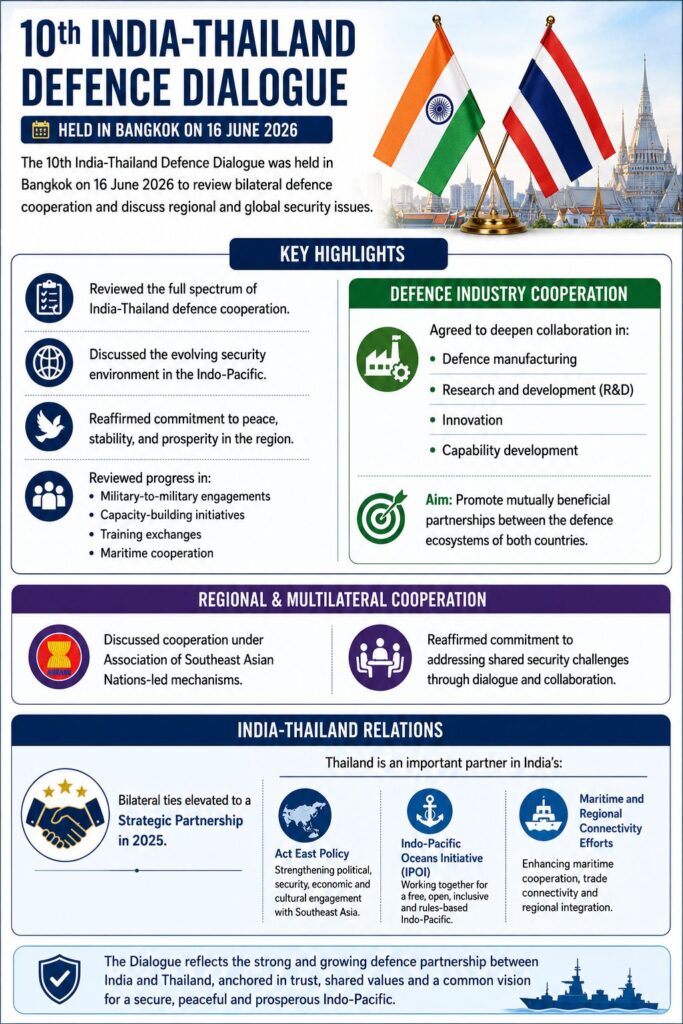
The 10th India-Thailand Defence Dialogue was held in Bangkok on 16 June 2026 to review bilateral defence cooperation and discuss regional and global security issues.
Key Highlights
Reviewed the full spectrum of India-Thailand defence cooperation.
Discussed the evolving security environment in the Indo-Pacific.
Reaffirmed commitment to peace, stability, and prosperity in the region.
Reviewed progress in:
Military-to-military engagements.
Capacity-building initiatives.
Training exchanges.
Maritime cooperation.
Defence Industry Cooperation
Agreed to deepen collaboration in:
Defence manufacturing.
Research and development (R&D).
Innovation.
Capability development.
Aim: Promote mutually beneficial partnerships between the defence ecosystems of both countries.
Regional & Multilateral Cooperation
Discussed cooperation under Association of Southeast Asian Nations-led mechanisms.
Reaffirmed commitment to addressing shared security challenges through dialogue and collaboration.
India-Thailand Relations
Bilateral ties elevated to a Strategic Partnership in 2025.
Thailand is an important partner in India’s:
Act East Policy.
Indo-Pacific Oceans Initiative (IPOI).
Maritime and regional connectivity efforts.
[2023] With reference to India’s projects on connectivity, consider the following statements:: 1. East-West Corridor under Golden Quadrilateral Project connects Dibrugarh and Surat. 2. Trilateral Highway connects Moreh in Manipur and Chiang Mai in Thailand via Myanmar. 3. Bangladesh- China- India- Myanmar Economic Corridor connects Varanasi in Uttar Pradesh with Kunming in China. How many of the above statements are correct?
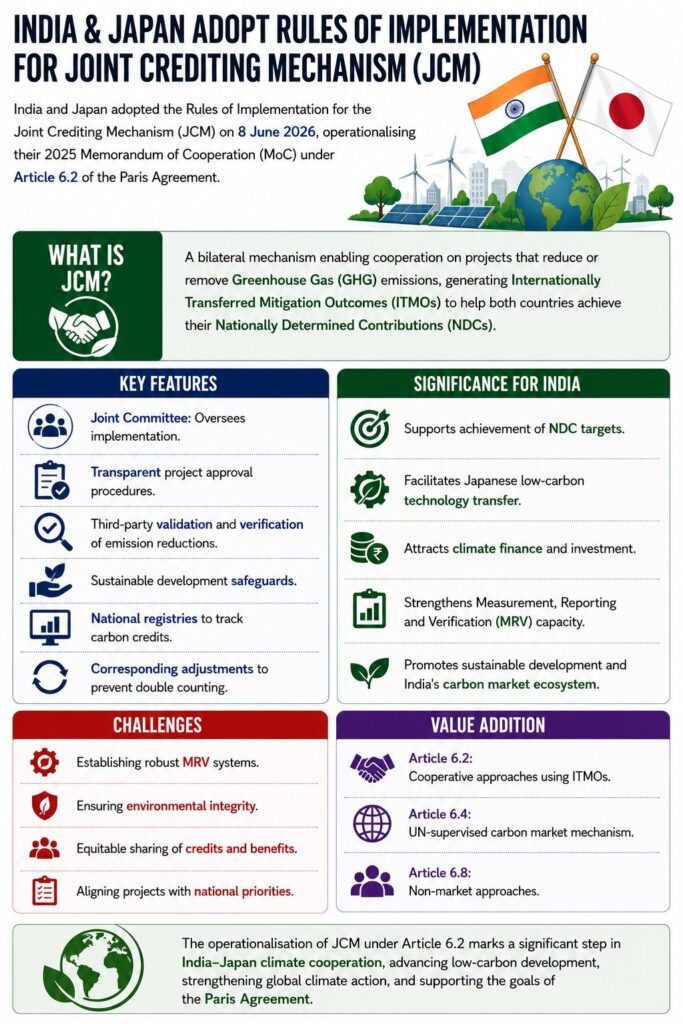
India and Japan adopted the Rules of Implementation for the Joint Crediting Mechanism (JCM) on 8 June 2026, operationalising their 2025 Memorandum of Cooperation (MoC) under Article 6.2 of the Paris Agreement.
What is JCM?
A bilateral mechanism enabling cooperation on projects that reduce or remove Greenhouse Gas (GHG) emissions, generating Internationally Transferred Mitigation Outcomes (ITMOs) to help both countries achieve their Nationally Determined Contributions (NDCs).
Key Features
Joint Committee: Oversees implementation.
Transparent project approval procedures.
Third-party validation and verification of emission reductions.
Sustainable development safeguards.
National registries to track carbon credits.
Corresponding adjustments to prevent double counting.
Significance for India
Supports achievement of NDC targets.
Facilitates Japanese low-carbon technology transfer.
Attracts climate finance and investment.
Strengthens Measurement, Reporting and Verification (MRV) capacity.
Promotes sustainable development and India’s carbon market ecosystem.
[2025] Consider the following statements: Statement I: Article 6 of the Paris Agreement on climate change is frequently discussed in global discussions on sustainable development and climate change. Statement II: Article 6 of the Paris Agreement on climate change sets out the principles of carbon markets. Statement III: Article 6 of the Paris Agreement on climate change intends to promote inter-country non-market strategies to reach their climate targets. Which one of the following is correct in respect of the above statements?
[A] Both Statement II and Statement III are correct and both of them explain Statement I
[B] Both Statement II and Statement III are correct but only one of them explains Statement I
[C] Only one of the Statements II and III is correct and that explains Statement I
[D] Neither Statement II nor Statement III is correct
India and Slovakia have elevated their bilateral relationship to a “Comprehensive Partnership”, marking a significant upgrade in ties during Prime Minister Narendra Modi’s visit to Bratislava. The development is important because it is the first visit by an Indian Prime Minister to Slovakia since its independence in 1993, ending a long period of limited high-level political engagement.
Why is the elevation of India-Slovakia ties to a Comprehensive Partnership significant?
Strategic Upgrade: Elevates bilateral relations beyond conventional diplomatic engagement to a broader framework encompassing political, economic, technological, security, and people-centric cooperation.
Historic Milestone: Marks the first visit by an Indian Prime Minister to Slovakia since the country’s independence in 1993.
Institutional Framework: Creates structured mechanisms for cooperation across multiple sectors through MoUs, joint working groups, academic exchanges, and industrial partnerships.
European Outreach: Strengthens India’s engagement with Central and Eastern Europe amid changing geopolitical dynamics in Europe.
Economic Diversification: Expands India’s economic partnerships within the European Union beyond major Western European economies.
How does the partnership seek to strengthen economic and trade cooperation?
Trade Expansion: Aims to take bilateral trade relations to a higher level through enhanced economic cooperation.
Industrial Complementarity: Leverages Slovakia’s developed industrial ecosystem and India’s scale, innovation capabilities, and technological strengths.
Advanced Manufacturing: Identifies advanced manufacturing as a priority area for collaboration.
Automotive Cooperation: Encourages cooperation in automotive manufacturing and supply chains.
Electronics Sector: Facilitates partnerships in electronics production and technological development.
Future Industries: Supports cooperation in advanced manufacturing sectors and emerging technologies.
India-EU FTA Support: Prime Minister highlighted the importance of early implementation of the India-EU Free Trade Agreement for maximizing benefits for industries, startups, and trade communities in both countries.
How does the partnership deepen defence and security cooperation?
Defence Letter of Intent: Establishes a formal framework for enhanced defence cooperation.
Joint Development: Facilitates collaborative defence research and development projects.
Joint Production: Supports co-production initiatives between defence industries.
Industrial Collaboration: Strengthens ties between Indian and Slovak defence manufacturers.
Counter-Terrorism Cooperation: Establishes a Joint Working Group on Counter-Terrorism.
Terrorism Condemnation: Reaffirms a zero-tolerance approach to terrorism in all forms and manifestations.
Pahalgam Attack Reference: Strongly condemns the terrorist attack in Pahalgam, Jammu & Kashmir, on April 22, 2025.
International Cooperation: Calls for coordinated global efforts to combat terrorism in a sustained manner.
Critical Infrastructure Security: Includes an MoU on communication and critical infrastructure protection.
What role do technology, innovation, education, and research play in the partnership?
Digital Technologies MoU: Strengthens cooperation in emerging digital sectors.
Quantum Communication: Includes cooperation in quantum communication technologies.
Higher Education Cooperation: Promotes academic collaboration and knowledge exchange.
Research Collaboration: Expands joint research initiatives between institutions.
Student Mobility: Facilitates student exchange programmes and scholarships.
Institutional Partnership: Establishes collaboration between IIT Delhi and the Slovak Technical University.
Scientific Cooperation: Enhances cooperation between ISRO and the Slovak Academy of Sciences.
Innovation Ecosystem: Integrates Slovak industrial expertise with India’s innovation and startup ecosystem.
Research Capacity Building: Supports joint expertise exchange and capacity-building initiatives.
How does labour mobility emerge as a major pillar of cooperation?
Labour Migration MoU: Creates a framework for cooperation in labour mobility.
Skilled Mobility: Supports safe, orderly, and legal migration of skilled professionals.
Information Exchange: Facilitates sharing of information related to labour migration.
Mobility Governance: Aligns migration pathways with workforce requirements.
India-EU Mobility Linkages: Takes note of the India-European Union Comprehensive Framework for Cooperation on Migration and Mobility signed in January 2026.
Social Security Discussions: Supports early conclusion of a Social Security Agreement.
Worker Protection: Ensures welfare and social protection of professionals working in both countries.
Why is energy security becoming an important area of India-Slovakia cooperation?
Energy Cooperation: Expands collaboration in the energy sector.
Energy Security: Addresses concerns arising from global energy disruptions.
Diversification: Encourages diversification of energy sources.
Nuclear Energy: Includes cooperation in nuclear energy.
Geothermal Energy: Supports exploration and utilization of geothermal energy resources.
Knowledge Exchange: Facilitates sharing of expertise and technical knowledge.
Resilience Building: Strengthens sustainability and resilience of energy systems.
Geopolitical Context: Responds to energy challenges intensified by the ongoing Russia-Ukraine conflict.
How does the partnership strengthen cultural and people-to-people relations?
Audio-Visual Cooperation: Facilitates collaboration in media and creative sectors.
ICCR Chair: Establishes the first-ever ICCR Chair at Al TechniCal University of Košice.
Academic Exchanges: Supports scholarships, student exchanges, and joint research.
Tourism Cooperation: Creates an association between tour operators of both countries.
Cultural Diplomacy: Expands people-to-people contacts and mutual understanding.
What geopolitical issues shaped the bilateral discussions?
Russia-Ukraine Conflict: Both sides emphasized peaceful resolution through dialogue and diplomacy.
Regional Stability: Recognized the impact of the conflict on Slovakia’s neighbourhood and broader Europe.
Multilateral Cooperation: Reaffirmed commitment to bilateral and multilateral engagement.
Shared Interests: Focused on stability, security, economic resilience, and sustainable development.
Major Agreements and Outcomes of the Visit
Labour Mobility and Migration
Labour Migration MoU: Facilitates structured mobility of skilled professionals.
Migration Governance: Supports legal and regulated migration channels.
Defence Cooperation
Letter of Intent: Establishes defence-sector collaboration.
Digital Technologies MoU: Expands cooperation in digital transformation.
Quantum Communication: Strengthens collaboration in frontier technologies.
Higher Education and Research
Higher Education MoU: Supports academic cooperation.IIT Delhi-Slovak Technical University Agreement: Enables exchanges, scholarships, and joint research.
ISRO-Slovak Academy of Sciences Cooperation: Expands scientific collaboration.
Health and Wellness
Naturopathy Cooperation: Agreement between National Institute of Naturopathy, Pune, Ministry of Ayush, and Slovak Health Spa Piestany.
Culture and Media
Audio-Visual Cooperation MoU: Supports cultural and creative industry engagement.
ICCR Chair: First ICCR Chair established at Al TechniCal University of Košice.
Tourism
Tour Operators Association: Enhances tourism linkages.
Security
Critical Infrastructure Protection MoU: Strengthens communication and infrastructure resilience.
Counter-Terrorism Working Group: Institutionalizes security cooperation.
Conclusion
The India-Slovakia Comprehensive Partnership marks a significant upgrade in bilateral relations, expanding cooperation from traditional diplomacy to strategic sectors such as defence, digital technologies, energy, education, and labour mobility. It strengthens India’s engagement with Central Europe, supports economic and technological collaboration, and contributes to resilient, mutually beneficial partnerships in an evolving global order.
PYQ Relevance
[UPSC 2024] Critically analyse India’s evolving diplomatic, economic and strategic relations with the Central Asian Republics (CARs), highlighting their increasing significance in regional and global geopolitics.
Linkage: This PYQ is of similar theme of India’s outreach to non-traditional Eurasian partners. India-Slovakia relations demonstrate India’s strategy of expanding engagement beyond major powers into Central and Eastern Europe.
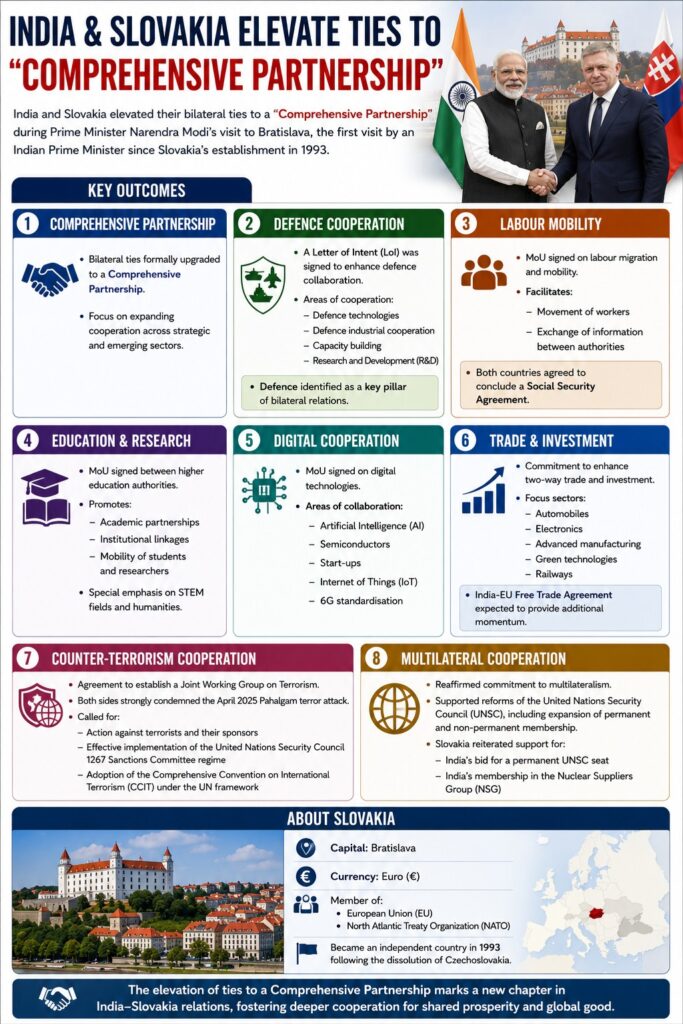
India and Slovakia elevated their bilateral ties to a “Comprehensive Partnership” during Prime Minister Narendra Modi’s visit to Bratislava, the first visit by an Indian Prime Minister since Slovakia’s establishment in 1993.
Key Outcomes
Comprehensive Partnership
Bilateral ties formally upgraded to a Comprehensive Partnership.
Focus on expanding cooperation across strategic and emerging sectors.
Defence Cooperation
A Letter of Intent (LoI) was signed to enhance defence collaboration.
Areas of cooperation Defence technologies, Defence industrial cooperation, Capacity building, and Research and Development (R&D).
Defence identified as a key pillar of bilateral relations.
Labour Mobility
MoU signed on labour migration and mobility.
Facilitates Movement of workers and Exchange of information between authorities.
Both countries agreed to conclude a Social Security Agreement.
Education and Research
MoU signed between higher education authorities.
Promotes Academic partnerships, Institutional linkages, Mobility of students and researchers.
Special emphasis on STEM fields and humanities.
Digital Cooperation
MoU signed on digital technologies.
Areas of collaboration Artificial Intelligence (AI), Semiconductors, Start-ups, Internet of Things (IoT), and 6G standardisation.
Trade and Investment
Commitment to enhance two-way trade and investment.
Focus sectors Automobiles, Electronics, Advanced manufacturing, Green technologies, and Railways.
India-EU Free Trade Agreement expected to provide additional momentum.
Counter-Terrorism Cooperation
Agreement to establish a Joint Working Group on Terrorism.
Both sides strongly condemned the April 2025 Pahalgam terror attack.
Called for: Action against terrorists and their sponsors, Effective implementation of the United Nations Security Council 1267 Sanctions Committee regime, and Adoption of the Comprehensive Convention on International Terrorism (CCIT) under the UN framework.
Multilateral Cooperation
Reaffirmed commitment to multilateralism.
Supported reforms of the United Nations Security Council (UNSC), including expansion of permanent and non-permanent membership.
Slovakia reiterated support for India’s bid for a permanent UNSC seat and India’s membership in the Nuclear Suppliers Group (NSG).
About Slovakia
Capital: Bratislava
Currency: Euro (€)
Member of European Union (EU) and North Atlantic Treaty Organization (NATO)
Became an independent country in 1993 following the dissolution of Czechoslovakia.
[2025] Consider the following countries: I. Austria II. Bulgaria III. Croatia IV. Serbia V. Sweden VI. North Macedonia How many of the above are members of the North Atlantic Treaty Organization?
June 15 marks the 84th anniversary of a historic meeting in Bangkok that laid the institutional foundation for the Indian National Army (INA). Thailand acted as a strategic, cultural, and organisational hub for Indian nationalists that ultimately contributed to the formation of the Indian National Army (INA).
How did cultural diplomacy lay the foundations of the Thai-Bharat connection?
Civilisational Linkages
Ancient Cultural Bonds: India and Thailand shared long-standing civilisational connections rooted in religion, philosophy, literature, and cultural traditions.
Ramayana Influence: The Thai epic Ramakien draws significant inspiration from the Indian Ramayana.
Shared Heritage: Cultural interaction preceded political cooperation and provided a foundation for later nationalist mobilisation.
Tagore’s Historic Visit (1927)
Rabindranath Tagore’s Engagement: Gurudev Rabindranath Tagore visited Siam (Thailand) and met King Prajadhipok (Rama VII).
Intellectual Exchange: Discussions centred on deep historical and cultural ties between India and Thailand.
Inspirational Legacy: The visit inspired efforts to institutionalise India-Thailand cultural cooperation.
Role of Swami Satyananda Puri
Arrival in Bangkok (1932): Bengali scholar Prafulla Kumar Sen, later known as Swami Satyananda Puri, settled in Bangkok.
Academic Contribution: Taught at Chulalongkorn University and mastered the Thai language within six months.
Cultural Institution Building: Established the Dharm Ashram in 1939 as a centre for spiritual and cultural exchange.
Why did the Thai-Bharat Cultural Lodge become crucial to the freedom movement?
Transformation into TBCL
Institutional Evolution: Dharm Ashram evolved into the Thai-Bharat Cultural Lodge (TBCL) in December 1940.
Diaspora Hub: Became a focal point for the growing Indian community in Bangkok.
Political Shift: Transitioned from cultural engagement to nationalist mobilisation during World War II.
Symbolic Assertion
Tricolour Hoisting: The Indian national flag was hoisted at the Lodge shortly after its formation.
Political Significance: Demonstrated support for Indian independence on foreign soil.
British Opposition: The act reportedly triggered strong protests from the British Ambassador.
Strategic Importance During WWII
Japanese Advance: As Japan expanded into Southeast Asia in 1941, Bangkok gained strategic importance.
Nationalist Convergence: TBCL emerged as a meeting point for Indian revolutionaries, activists, and diaspora leaders.
Political Infrastructure: Provided organisational support for the independence movement.
How did Indian revolutionaries and the diaspora organise resistance from Thailand?
Role of Sardar Pritam Singh
Revolutionary Leadership: Sikh missionary and former Ghadar Party activist.
Diaspora Mobilisation: Spread nationalist ideas among overseas Indians.
Intelligence Links: Worked closely with Major Iwaichi Fujiwara, head of Japanese intelligence unit F-Kikan.
Indian National Council (INC) Formation
Established in December 1941: Created at Silpakorn Theatre, Bangkok.
Leadership Structure: Swami Satyananda Puri served as President and Debnath Das as Secretary.
Political Coordination: Linked civilian nationalist efforts with military mobilisation initiatives.
Indian Independence League (IIL)
Institutional Bridge: Connected civilian aspirations with armed resistance.
Political Legitimacy: Became the representative organisation of Indians outside India.
Coordination Role: Facilitated cooperation among Indian communities across Southeast Asia.
Why was the Bangkok Conference of 1942 a turning point?
Historic Gathering
Dates: June 15-23, 1942.
Venue: Silpakorn Theatre, Bangkok.
Participation: More than 100 representatives from Burma, Malaya, Singapore, and other Southeast Asian regions.
Political Consolidation
Unified Leadership: Brought together multiple nationalist factions under a common framework.
Recognition of IIL: Established the Indian Independence League as the central organisation of overseas Indians.
Strategic Coordination: Strengthened political and military planning.
The 34-Point Resolution
Blueprint for INA: Served as the foundational framework for establishing the Indian National Army.
Volunteer-Based Force: Proposed recruitment from civilians and former prisoners of war.
Japanese Supervision: Military operations to be coordinated with Japanese support.
Political Safeguard: Sought formal recognition of India’s independence and legitimacy of the IIL.
How did leadership transitions shape the INA movement?
Loss of Early Leaders
March 1942 Air Crash: Swami Satyananda Puri and Sardar Pritam Singh died while travelling to Tokyo.
Strategic Setback: Movement lost key organisers and ideological leaders.
Mobilisation Impact: Their sacrifice strengthened resolve among remaining nationalists.
Arrival of Subhas Chandra Bose
Leadership Change (1943): Bose assumed leadership of the IIL and INA.
Centralised Command: Shifted the movement from dispersed regional leadership to unified military direction.
Charismatic Mobilisation: Expanded support through disciplined organisational structures.
Total Mobilisation Strategy
Mass Participation: Mobilised civilians, volunteers, and former prisoners of war.
Diplomatic Objective: Sought recognition of the Provisional Government of Free India.
Military Expansion: Increased scale and effectiveness of INA operations.
How did the TBCL sustain the independence movement beyond military mobilisation?
Civilian-Military Interface
Institutional Continuity: Continued operating even as INA activities became militarised.
Support Functions: Provided administrative, cultural, and social support.
Community Cohesion: Maintained links among Indian diaspora communities.
Asian Solidarity
Shared Liberation Vision: Promoted the idea that Indian independence was linked to broader Asian emancipation.
Regional Cooperation: Fostered connections across Southeast Asian nationalist networks.
Anti-Colonial Platform: Functioned as a centre of intellectual and political engagement.
Sanctuary Function
Safe Space: Offered refuge to independence supporters.
Ideological Preservation: Sustained the original vision articulated by Swami Satyananda Puri.
Movement Resilience: Helped maintain continuity despite wartime disruptions.
How was the legacy of the Thai-Bharat Cultural Lodge preserved after World War II?
Post-War Repression
Allied Action (1945): TBCL was banned and its leaders imprisoned.
INA Dissolution: Formal military structures were dismantled.
Leadership Vacuum: Nationalist networks faced severe disruption.
Revival in 1946
Restoration Efforts: Pandit Raghunath Sharma played a key role in reviving the institution.
Historical Continuity: Preserved memories of overseas contributions to India’s freedom struggle.
Living Archive
Unique Status: Remains the only surviving institution from that period.
Historical Collection: Houses rare texts, photographs, and archival documents.
Educational Value: Provides insights into the lives of Indian diaspora families involved in the freedom movement.
Conclusion
The Thai-Bharat connection reveals the global dimensions of India’s freedom struggle, where diaspora networks, cultural institutions, and revolutionary movements converged to advance the cause of independence. The legacy of the TBCL underscores the enduring role of cultural diplomacy, diaspora engagement, and Asian solidarity in shaping both India’s past and its contemporary foreign policy.
Prime Minister Narendra Modi visited France in June 2026 for a bilateral visit and participation in the G7 Summit, marking his seventh visit to France since 2014. The relationship has evolved from a traditional diplomatic partnership into a Special Global Strategic Partnership, spanning defence, nuclear energy, space cooperation, emerging technologies, and Indo-Pacific security.
Timeline of India-France Relations
Year
Development
1947
Establishment of diplomatic relations
1998
Strategic Partnership launched
1998
France refrains from sanctions after Pokhran-II
2018
International Solar Alliance deepened cooperation
2023
Special Global Strategic Partnership announced
2024
Macron attends Republic Day as Chief Guest
2026
PM Modi’s seventh visit to France
Why Is India-France Partnership Considered Unique in Contemporary Diplomacy?
Strategic Trust
Consistency: Maintains stable engagement irrespective of changes in domestic political leadership.
Reliability: Supports long-term cooperation without transactional conditions.
Strategic Autonomy: Respects each other’s independent foreign policy choices.
Political Continuity
Leadership Engagement: PM Modi’s June 2026 visit marks his seventh visit to France since 2014.
Reciprocity: French President Emmanuel Macron attended India’s Republic Day celebrations in January 2024.
How Are Innovation and Emerging Technologies Deepening Bilateral Ties?
India-France Year of Innovation: The India-France Year of Innovation is designated for 2026.
Core Goal: To accelerate cooperation across deep tech, artificial intelligence, cyberspace, sustainable development, and advanced research networks.
Flagship Event: The landmark event “Bharat Innovates 2026” is hosted in Nice, France, connecting prominent Indian deep tech startups with global investors.
Strategic Roadmap: The program aligns with the Horizon 2047 Roadmap, which outlines the future of the India-France strategic partnership.
AI Cooperation: The global AI Action Summit hosted in Paris took place in 2025
Co-Chairs: The high-level summit was jointly co-chaired by Indian Prime Minister Narendra Modi and French President Emmanuel Macron.
India-France Declaration on AI: The two nations signed a comprehensive India-France Declaration on Artificial Intelligence to advance sovereign computing capacity, open-source language models, and digital public infrastructure.
Responsible Governance: Ahead of the summit, India and France co-led an international working group on AI governance consisting of 29 states to establish frameworks for trustworthy and ethical AI deployment.
Official AI Country Partner: India serves as the official AI Country Partner under the theme “Tech for Humanity,” establishing one of the largest national pavilions in the event’s history to showcase over 80 Indian deep tech startups.
Entrepreneurship Networks: Facilitates startup investments and technology transfer. Active entrepreneurship pipelines include the ongoing Station F-HEC Paris International Launchpad programme, which regularly scales cohorts of Indian startups into the European market.
Bilateral Incubation hubs: The launch of dedicated platforms like the Indo-French Centre for AI in Health and the Indo-French Centre for Digital Science and Technology continues to facilitate technology transfers and research networks.
Digital Collaboration: Joint research partnerships include, Indo-French Centre for Digital Science and Technology, Indo-French Centre for AI in Health and Joint Ph.D. & Exchange Frameworks
Emerging Technologies: Cooperation in AI, quantum technologies, digital infrastructure and cybersecurity.
Research Partnerships: Encourages joint innovation projects.
How Do India and France Cooperate in the Indo-Pacific?
Maritime Security
Indian Ocean Presence: France’s territories give it a direct stake in the region, allowing India and France to act as mutual logistical hubs to monitor crucial sea lanes.
Naval Coordination: The two navies conduct highly complex joint maneuvers like the annual Varuna naval exercise to improve interoperability.
Logistics Sharing: A reciprocal logistics support agreement allows Indian warships to access French naval bases in Djibouti, Réunion, and the UAE, and vice versa.
Regional Stability
Rules-Based Order: Supports freedom of navigation and international law.
Strategic Balancing: Contributes to regional stability amid rising geopolitical competition.
Information Fusion: India’s Information Fusion Centre for the Indian Ocean Region (IFC-IOR) hosts a permanent French liaison officer to coordinate maritime domain awareness and counter piracy, smuggling, and illegal fishing.
Connectivity and Blue Economy
Infrastructure Cooperation: They partner through initiatives like the Indo-Pacific Triangular Development Cooperation Fund to bankroll sustainable, green infrastructure projects in Pacific and Indian Ocean island nations.
Blue Economy: The two countries work together under the Indo-French Roadmap on the Blue Economy and Ocean Governance to scientifically map marine biodiversity, manage fisheries, and prevent ocean pollution.
Resilient Networks: They cooperate under the International Solar Alliance (ISA) and the Coalition for Disaster Resilient Infrastructure (CDRI) to help vulnerable coastal states adapt to climate change and rising sea levels.
What Opportunities Exist for Future Expansion?
Defence Manufacturing
Co-Production: Supports Make in India objectives.
Supply Chains: Integrates Indian MSMEs and aerospace vendors into the global supply chains of French giants like Safran, Dassault, and Thales, strengthening domestic defence industrial ecosystems.
Green Transition
Renewable Energy: Expands the scope of the co-founded International Solar Alliance (ISA) to roll out large-scale grid storage solutions and cross-border solar networks.
Climate Technology: Facilitates clean technology deployment through joint ventures in carbon capture, smart grid management, and climate-resilient urban infrastructure.
Multilateral Coordination: Aligns positions on major international issues.
Strategic Dialogue: Deepens coordination in G20, UN and Indo-Pacific forums.
Energy Security Concerns: India seeks international cooperation to ensure stability of critical sea lanes such as the Strait of Hormuz.
Maritime Trade Protection: Disruptions affect India’s energy imports and trade flows.
Conclusion
India-France relations demonstrate how strategic partnerships endure when built on trust, strategic autonomy, and long-term convergence rather than short-term geopolitical calculations. From France’s support during the 1998 nuclear tests to cooperation in defence, space, nuclear energy, innovation, and the Indo-Pacific, the partnership has steadily expanded into a comprehensive and future-oriented relationship. As global uncertainties deepen, the India-France partnership is increasingly emerging as a model of reliable diplomacy, capable of advancing not only bilateral interests but also a stable, multipolar, and rules-based international order.
PYQ Relevance
[UPSC 2019] “The time has come for India and Japan to build a strong contemporary relationship, one involving global and strategic partnership that will have a great significance for Asia and the world as a whole.” Comment.
Linkage: The question examines the significance of strategic partnerships in advancing India’s geopolitical, economic, and security interests in an evolving global order. Similar to India-Japan relations, the India-France partnership has evolved into a comprehensive strategic partnership based on trust, strategic autonomy, defence cooperation, technology collaboration, and Indo-Pacific convergence.
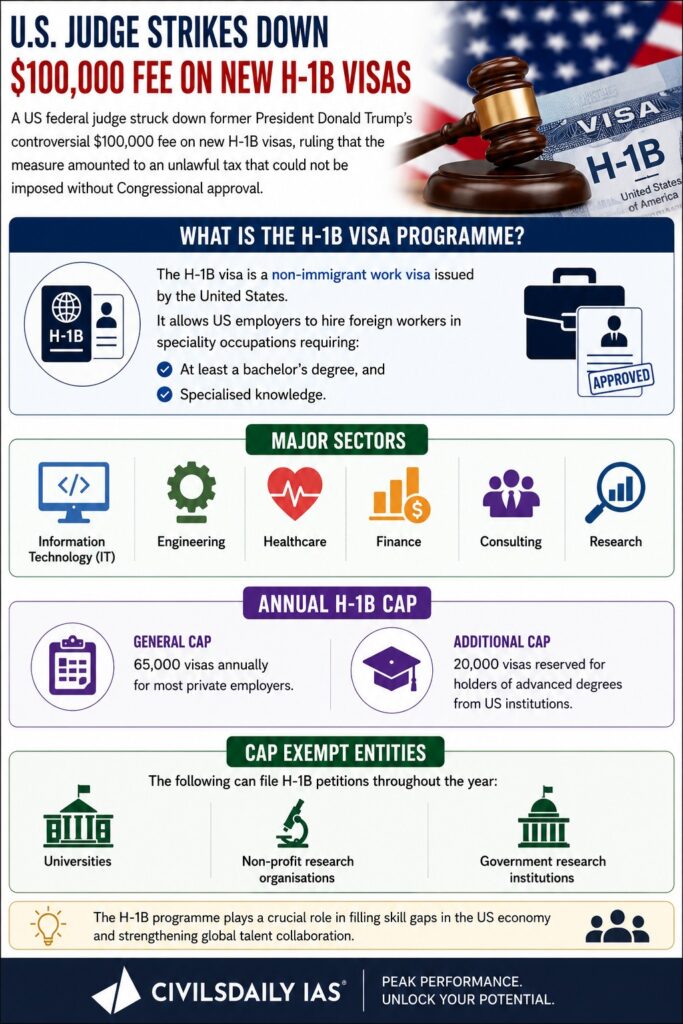
A US federal judge struck down former President Donald Trump’s controversial $100,000 fee on new H-1B visas, ruling that the measure amounted to an unlawful tax that could not be imposed without Congressional approval.
What is the H-1B Visa Programme?
The H-1B visa is a non-immigrant work visa issued by the United States.
It allows US employers to hire foreign workers in speciality occupations requiring at least a bachelor’s degree and Specialised knowledge.
Major Sectors
Information Technology (IT), Engineering, Healthcare, Finance, Consulting, and Research
Annual H-1B Cap
General Cap:65,000 visas annually for most private employers.
Additional Cap: 20,000 visas reserved for holders of advanced degrees from US institutions.
Cap Exempt Entities
The following can file H-1B petitions throughout the year: Universities, Non-profit research organisations, and government research institutions.
In the context of India, which of the following factors is/are contributor/contributors to reducing the risk of a currency crisis? (2019)
The foreign currency earnings of India’s IT sector
Increasing the government expenditure
Remittances from Indians abroad
Select the correct answer using the code given below.
PYQ Relevance[UPSC 2024] Critically analyse India’s evolving diplomatic, economic and strategic relations with the Central Asian Republics (CARs) highlighting their increasing significance in regional and global geopolitics. Linkage: The PYQ examines how strategic economic partnerships and connectivity initiatives enhance India’s regional influence and economic interests. The India-Oman CEPA similarly demonstrates how India leverages economic agreements with strategically located partners to strengthen trade connectivity, expand market access, and enhance its geopolitical footprint in the Gulf and adjoining regions.
Mentor’s Comment
The India-Oman Comprehensive Economic Partnership Agreement (CEPA) came into force on June 1, 2026. The agreement provides duty-free access to 99.38% of India’s exports by value, up from just 1.53% under the earlier MFN regime, making it one of India’s most comprehensive trade agreements with a Gulf partner.
How Does the CEPA Expand India’s Market Access in Oman?
Duty-Free Access: Provides tariff-free access on 98.08% of tariff lines covering 99.38% of India’s export value.
Previous Regime: Only 1.53% of Indian exports to Oman enjoyed duty-free treatment under the Most Favoured Nation (MFN) framework.
Competitiveness: Enhances price competitiveness of Indian products across multiple sectors.
Trade Growth: Bilateral trade expected to increase from $9.84 billion (FY2023-24) to $11.8 billion (FY2025-26).
Economic Complementarity: Reflects growing integration between India’s manufacturing strengths and Oman’s import requirements.
Why Is the CEPA Significant for India’s Diversification Strategy?
Trade Diversification: Supports India’s objective of reducing excessive dependence on limited export markets.
Regional Integration: Strengthens India’s economic presence in the Gulf region.
Recent Trade Agreements: Builds upon agreements with:
United Arab Emirates (UAE)
Australia
European Free Trade Association (EFTA)
United Kingdom (under negotiation)
New Zealand (under negotiation)
European Union (under negotiation)
Strategic Importance: Deepens engagement in a region critical for energy security, trade flows, and connectivity.
Which Export Sectors Stand to Gain the Most?
Textile and Apparel Sector
Market Share: India accounts for 43% of Oman’s apparel imports.
Knitted Apparel: India holds 31% of Oman’s knitted apparel imports.
Tariff Elimination: Removal of Oman’s 5% tariff improves competitiveness.
China Competition: Enhances India’s position against China, the dominant supplier.
Chemicals Sector
Market Presence: India supplies nearly 39% of Oman’s chemical imports.
Tariff-Free Access: Strengthens India’s leadership position in the market.
Export Expansion: Creates opportunities for higher value-added chemical exports.
Engineering Goods Sector
Automotive Market: Oman imports over $3.3 billion worth of automobiles annually.
Current Share: India’s market share is approximately 5%.
Expansion Opportunity: Preferential access can significantly improve penetration.
Infrastructure Demand: Supports exports linked to Oman’s construction and industrial sectors.
Pharmaceuticals Sector
Market Share: India accounts for around 10% of Oman’s pharmaceutical imports.
Regulatory Facilitation: Products approved by major international regulators receive faster approvals.
Compliance Benefits: Reduces regulatory costs and market-entry barriers.
Healthcare Demand: Expands opportunities for Indian pharmaceutical manufacturers.
Food Processing and Agriculture
Processed Foods: Expands opportunities for Indian processed food exports.
Sensitive Sectors: Dairy, cereals, edible oils, and certain agricultural products remain protected.
Tariff Concessions: Exclusions ensure protection of domestic producers.
How Does the CEPA Improve Trade Facilitation and Customs Procedures?
Electronic Certification: Mutual acceptance of certificates issued by India’s Export Inspection Council (EIC).
Paperless Trade: Reduces documentation burden.
Organic Product Recognition: Accepts India’s National Programme for Organic Production (NPOP) standards.
SPS Cooperation: Strengthens coordination on sanitary and phytosanitary measures.
TBT Cooperation: Improves transparency regarding technical barriers to trade.
Customs Modernisation: Enhances regulatory cooperation and customs clearance efficiency.
Perishable Goods: Facilitates faster movement of time-sensitive exports.
Cost Reduction: Lowers transaction costs and logistics delays.
How Does the Agreement Strengthen India’s Services Exports?
GCC Engagement: Creates a foundation for wider economic integration with Gulf economies.
Conclusion
The India-Oman CEPA represents a significant evolution in India’s economic engagement with the Gulf region. By combining tariff liberalisation with services access, investment facilitation, customs cooperation, and professional mobility, the agreement transforms Oman from a bilateral trading partner into a strategic gateway connecting India to GCC and East African markets. Its success will depend on effective utilisation by Indian exporters, deeper supply chain integration, and sustained competitiveness across key sectors.
The visit of Rabi Lamichhane, chief of Nepal’s ruling Rashtriya Swatantra Party (RSP), to India has emerged as the most significant political engagement between the two countries since Nepal’s new government assumed office. This comes at a time when Prime Minister Balen Shah has imposed restrictions on foreign travel and prioritized domestic governance, resulting in limited high-level diplomatic exchanges.
Why Does Lamichhane’s Visit Mark a Turning Point in India-Nepal Relations?
Political Transition
Emerging Leadership: Rabi Lamichhane represents a new generation of political actors challenging Nepal’s traditional political establishment.
Changing Political Landscape: Nepal’s political discourse is increasingly shaped by younger leaders and new political formations.
Generational Shift: Nepal’s median age is approximately 38 years, while decision-making is gradually moving towards younger leadership groups.
Diplomatic Significance
Highest-Level Engagement: Lamichhane’s visit constitutes the most significant political engagement since Nepal’s new government came to power.
Deadlock Resolution: The visit helps break a period of limited diplomatic interaction between the two countries.
Recognition of New Nepal: India acknowledges that future engagement cannot remain confined to traditional political actors.
Priority Signal from India
Strategic Importance: Prime Minister Narendra Modi conveyed that Nepal remains India’s “priority partner.”
Future Cooperation: India expressed willingness to elevate bilateral relations to “greater heights.”
Continuity in Engagement: New Delhi signalled that engagement will continue irrespective of changes in Nepal’s domestic political landscape.
How Is Nepal’s New Political Leadership Different from the Traditional Establishment?
Governance-First Approach
Domestic Prioritisation: Prime Minister Balen Shah has emphasized governance reforms over foreign policy activism.
Foreign Travel Restriction: Shah imposed a self-declared restriction on foreign travel during the initial phase of his tenure.
Administrative Focus: Greater emphasis on domestic accountability and service delivery.
Protocol Changes
Rank-Based Engagement: Shah declared that he would not meet officials below his own rank.
Departure from Convention: Represents a shift from established diplomatic practices.
Assertion of Sovereignty: Reflects increasing confidence among Nepal’s new political leadership.
Anti-Establishment Politics
Political Disruption: New political actors challenge long-established parties.
Youth Mobilisation: Younger voters increasingly favour alternatives to traditional elites.
Institutional Reconfiguration: Nepal’s political system is experiencing a broader transition.
Why Can India No Longer Depend Solely on Traditional Political Networks in Nepal?
Historical Pattern
Elite-Centric Engagement: India traditionally dealt with established political leaders and long-term political actors.
Political Continuity: Familiar actors often alternated in government, facilitating predictable diplomacy.
Institutional Comfort: New Delhi developed extensive networks with traditional parties.
Changing Political Reality
New Stakeholders: Emerging leaders possess different political priorities and constituencies.
Regional Competition: Nepal has become an important arena of India-China competition.
Why Is Connectivity Emerging as India’s Most Effective Diplomatic Tool?
Development Partnership: Strengthens economic integration, delivers infrastructure benefits, and reinforces India’s role as a trusted development partner.
Seamless Connectivity: Expands road, rail, air and digital links, facilitating trade, mobility and regional integration.
Civilisational Linkages: Leverages shared cultural and religious heritage to strengthen people-to-people ties and soft power.
Strategic Advantage: Generates goodwill, counters growing Chinese influence, and promotes long-term bilateral stability.
What Should Be India’s Approach Towards the New Nepal?
Respect for Sovereignty: Adopt a non-interference approach, engage all political stakeholders, and treat Nepal as an equal partner.
Broad-Based Engagement: Build ties beyond traditional elites through outreach to emerging leaders, youth groups and institutions.
Connectivity and Development: Expand infrastructure, digital integration and economic cooperation to deepen mutual interdependence.
Trust-Based Diplomacy: Strengthen public goodwill, address historical mistrust and replace “big brother” perceptions with a partnership model.
Conclusion
As Nepal’s political landscape evolves, India must move beyond historical ties and engage a new generation of leaders through respect, trust and development partnership. An approach based on sovereignty, connectivity and equal partnership will be key to sustaining strong India-Nepal relations in a changing geopolitical environment.
Value Addition
India-Nepal Border Facts
Border Length: 1,751 km open international border.
Indian States Sharing Border
Uttarakhand
Uttar Pradesh
Bihar
West Bengal
Sikkim
Major India-Nepal Connectivity and Infrastructure Projects
Jayanagar-Kurtha-Bijalpura Railway: Connects Jayanagar (Bihar, India) with Kurtha and Bijalpura (Madhesh Province, Nepal). It is Nepal’s first broad-gauge passenger railway and strengthens cross-border trade, mobility and regional integration.
Motihari-Amlekhgunj Petroleum Pipeline: Connects Motihari (Bihar, India) with Amlekhgunj (Nepal). It is South Asia’s first cross-border petroleum pipeline and ensures reliable fuel supply while reducing transportation costs and leakages.
Arun-III Hydropower Project: Located on the Arun River in Sankhuwasabha district of eastern Nepal. Developed by India’s SJVN Ltd, it strengthens bilateral energy cooperation and facilitates power exports to India.
Cross-Border Transmission Lines: Includes the Muzaffarpur (Bihar)-Dhalkebar (Nepal) transmission line and new high-capacity corridors. These facilitate electricity trade and support Nepal’s emergence as a power-exporting nation.
Integrated Check Posts (ICPs): Operational at Raxaul-Birgunj, Jogbani-Biratnagar, Sunauli-Bhairahawa and Nepalgunj Road-Nepalgunj. They streamline customs clearance, trade logistics and border management.
Terai Road Project: India-assisted road network across Nepal’s Terai region improves connectivity along the India-Nepal border and enhances economic integration.
These projects aim to connect Nepal’s major economic centres with Indian transport networks.
Important Border Areas Frequently in News
Kalapani: Strategic Himalayan region claimed by both India and Nepal; located near the India-Nepal-China tri-junction.
Lipulekh Pass: Important trade and pilgrimage route connecting India with Tibet; frequently features in territorial disputes.
Limpiyadhura: Claimed by Nepal as part of its territory and included in Nepal’s revised political map in 2020.
Susta: Border dispute area along the Gandak River due to changes in river course.
Important Border Crossing Points
Raxaul-Birgunj: Nepal’s busiest trade gateway; handles a major share of bilateral trade.
Sunauli-Bhairahawa: Key route for trade and Buddhist tourism.
Jogbani-Biratnagar: Major commercial corridor in eastern Nepal.
Banbasa-Mahendranagar: Important western border crossing.
Panitanki-Kakarbhitta: Connects eastern Nepal with West Bengal and the Siliguri Corridor.
PYQ Relevance
[UPSC 2022] “India is an age-old friend of Sri Lanka.” Discuss India’s role in the recent crisis in Sri Lanka in the light of the preceding statement.
Linkage: The PYQ tests India’s neighbourhood policy, management of bilateral relations, and balancing of strategic interests in South Asia. Similar to Sri Lanka, the article examines how India must adapt its diplomacy towards a changing Nepal while preserving influence amid growing Chinese presence and shifting domestic politics.
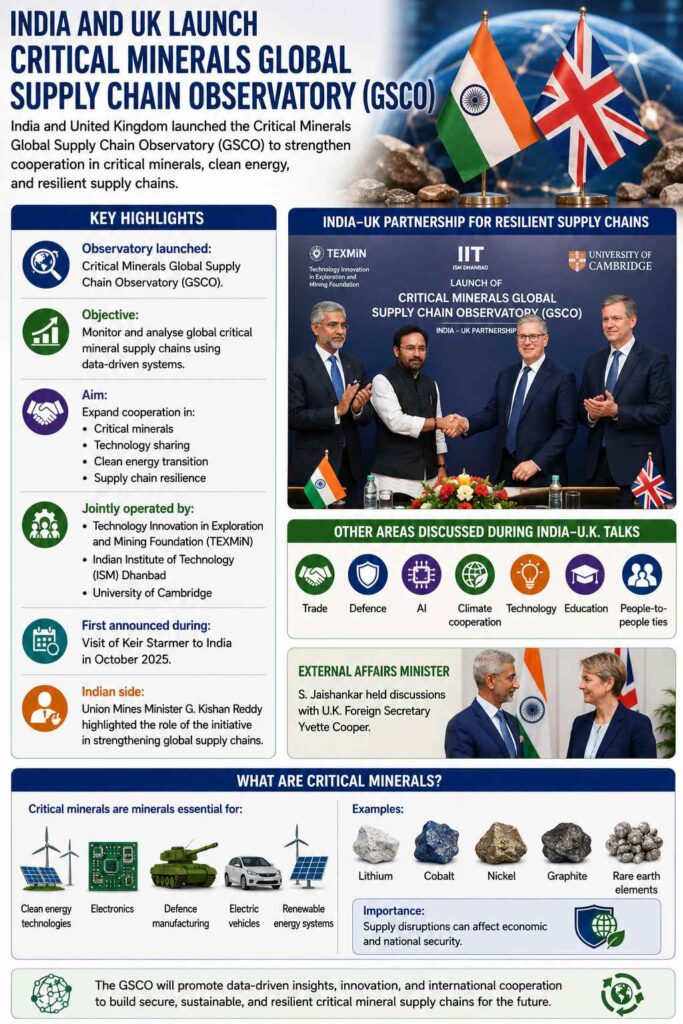
India and the United Kingdom launched the Critical Minerals Global Supply Chain Observatory (GSCO) to strengthen cooperation in critical minerals, clean energy, and resilient supply chains.
Key Highlights
Observatory launched: Critical Minerals Global Supply Chain Observatory (GSCO).
Objective: Monitor and analyse global critical mineral supply chains using data-driven systems.
Aim:
Expand cooperation in:
Critical minerals
Technology sharing
Clean energy transition
Supply chain resilience
Jointly operated by:
Technology Innovation in Exploration and Mining Foundation (TEXMiN)
Indian Institute of Technology (ISM) Dhanbad
University of Cambridge
First announced during:
Visit of Keir Starmer to India in October 2025.
Indian side:
Union Mines Minister G. Kishan Reddy highlighted the role of the initiative in strengthening global supply chains.
Other areas discussed during India-U.K. talks:
Trade
Defence
AI
Climate cooperation
Technology
Education
People-to-people ties
External Affairs Minister: S. Jaishankar held discussions with U.K. Foreign Secretary Yvette Cooper.
What are Critical Minerals?
Critical minerals are minerals essential for:
Clean energy technologies
Electronics
Defence manufacturing
Electric vehicles
Renewable energy systems
Examples: Lithium, Cobalt, Nickel, Graphite, and Rare Earth elements
Importance: Supply disruptions can affect economic and national security.
[2025] Consider the following statements: I. India has joined the Minerals Security Partnership as a member. II. India is a resource-rich country in all the 30 critical minerals that it has identified. III. The Parliament in 2023 has amended the Mines and Minerals (Development and Regulation) Act, 1957 empowering the Central Government to exclusively auction mining lease and composite license for certain critical minerals. Which of the statements given above are correct?