💥Mains Ready By December. Smash Mains & Smash PYQ Admissions Open

Subject: Bilateral Relations

1. Major World Events
2. India’s Interests in neighbourhood
3. Effects of our Policies

  • Sagarmatha Sambaad


    Nepal has invited the PMs of India and Pakistan along with several other heads of government and heads of state for the Sagarmatha Sambaad.

    Sagarmatha Sambaad

    • Sagarmatha Sambaad is a multi-stakeholder, permanent global dialogue forum initiated by the Government of Nepal.
    • It is scheduled to be held biennially in Nepal.
    • The Sambaad (dialogue) is named after the world’s tallest mountain Sagarmatha (Mount Everest).
    • The Everest is also a symbol of friendship and is meant to promote the notions of common good and collective well-being of humanity.
    • The first episode of the Sambaad is scheduled to be held from 2 to 4 April 2020 by the Ministry of Foreign Affairs (Nepal).
    • The theme of the first Sambaad is “Climate Change, Mountains and the Future of Humanity.”

    Significance

    • This is the first ever multi-stakeholder dialogue and a biggest diplomatic initiative in Nepal’s recent history.
    • India and Pakistan have been caught up in a cycle of hostility, which had prevented Islamabad from hosting the SAARC Summit in 2016.
    • The Kathmandu event aims to draw all the SAARC leaders and provide an opportunity to break the ice.
    • India had accused Pakistan of cross border terrorism while boycotting the Islamabad summit leading to its cancellation.
  • [op-ed snap] It’s not yet Howdy, Modi!

    Context

    Persistent in their efforts to remake their countries and their engagement with the world, Mr Modi and Mr Trump are shaking up the bilateral ties between the two countries, and the resultant flux could outlive their tenures.

    The emergence of both the leaders on similar promises

    • Improvements over the legacy of their predecessors: Both leaders continuously reiterate that their predecessors were incapable of protecting national interest.
      • The compulsion to reframe the national interest: Such premises commits them both to reframe the national interest, and both have articulated it with clarity and force.
      • For instance, Mr Modi, in Houston in September 2019 and Mr Trump in Davos this week, went great lengths to lay out figures that presented their respective regimes as the most effective guardians.
    • Both have cultural and economic agenda: Both dispensations believe that “the people” had been given a raw deal by earlier regimes.
      • Both have a cultural and economic agenda.
      • National awakening: They are now leading a national reawakening, and working hard for the hard-working people.
      • Both believe that cultural nationalism is a force for the good.
      • Securing borders and entry barriers: Both believe that national borders need to be strengthened by stricter monitoring and setting new bars for entry.
      • Renegotiating the treaties: Both leaders try to renegotiate the contract between the union and the States, and between citizens and the state within their respective countries.
      • The supremacy of executive: They assert the supremacy of the executive over the legislature and the judiciary.
      • Shared values: The notion of shared values of India and the U.S. has acquired a whole new meaning under Mr Trump and Mr Modi.

    Politics and governance

    • Hopes of status-quo in bilateral relations shattered: It was hoped that the stronger U.S.-India ties- that have autonomous drivers of convergence-would not be impacted by the nationalist politics of these two leaders.
      • But both leaders have been remarkably true to their politics in their governance.
      • Current tumult in the India-US ties: Shared values notwithstanding, national interests as perceived by these leaders have several points of divergence and therein lies in the current tumult in India-U.S. ties.
      • Opposition to the “world order”: Mr Trump has been outspokenly confrontational with the “world order” that he says has worked against American interests.
      • Dismantling the treaties: America under Mr Trump has wrecked treaties such as the Paris climate agreement and institutions such as the World Trade Organization and the United Nations, disrupting the “rule-based order”.
      • India’s relations with Bangladesh: India’s spirited outreach in the neighbourhood is still playing out. India’s historically warm ties with Bangladesh have been frayed after CAA.
    • India’s ambitions on the global level
    • The seat at the UNSC: India under continues to push for more space for itself in global affairs by seeking a permanent seat in the UN Security Council and membership.
    • NSG membership: India is also pushing for the membership of the Nuclear Suppliers Group.
    • The US actions at global levels
      • Expansion of the principle of the pre-emptive strike: America expanded the principle of pre-emptive strike to include the assassination of a senior official of Iran.
      • Renegotiating the treaties: After dismantling the North American Free Trade Agreement, Mr Trump forced Mexico and Canada to accede to his demands in a new trade deal.
    • The India-US relations and impact of U.S. relations with other countries
      • Impact on India-US ties: India’s ties with the U.S. are impacted by America’s ties with India’s adversaries and neighbours, China and Pakistan.
      • Hopes of alignment in the Indo-US ties: Mr Trump’s bluster against both had lit hope that there would finally be a near-complete alignment between India and the U.S. on strategy.
      • US-Iran conflict: Despite Mr Trump’s avowed opposition to America’s endless wars in West Asia, the US is going against Iran headlong, which is not in India’s interest.
      • Relations with Gulf Countries: Trump and Mr Modi share a strong bonding with the Gulf Cooperation Council kings, but their courses in the region are diverging.
      • US-Pakistan coming closer once again: The American President’s impatience to get out of Afghanistan has already pushed his administration closer to Pakistan, which is now further necessitated by his adventurist Iran policy.
      • The US disregard for China’s expansionist policies: Mr Trump has been singularly focused on one question-trade. He cares little about China’s expansionism and at any rate that is not a factor in his ties with other Asian countries.

    India-US ties- Points of fission

    • On the trade front: Mr Trump has bracketed India and China as two countries that have duped his predecessors to gain undue advantage. Which is far from seeing India as deserving special concessions to counterbalance China as old wisdom demanded.
      • Ending GSP: The US ended India’s status under the World Trade Organization’s Generalized System of Preferences and took other punitive measures.
      • India trying to decrease the trade surplus: By increasing hydrocarbon imports from the U.S., the government is trying to reduce India’s trade surplus.
    • Restrictions on H1-B visa: The US has tightened the restrictions on the H1-B visa which is used by the Indian companies.
    • Decreasing bipartisan support in the US: The mobilisation of Indian diaspora in America by the government has resulted in the inevitable blowback.
      • Diaspora divided and bipartisan support waning: The diaspora has been divided, and the bipartisan support for India is now squandered. Progressive sections on the Democratic side and religious libertarians and evangelicals on the Trump side are both concerned over India’s actions back home.

    Conclusion

    Partnership with America is critical to India. India must take the steps to align the interest but whenever it diverges India must take measures to minimise its impact on India while furthering its interests.

  • [op-ed snap] Same country, different script

    Context

    Pakistan is changing significantly, which is good for itself and its neighbour as well.

    Changing Pakistan

    • Major stakeholders in favour of peace: The civil society, the political parties, and even the military establishment of Pakistan have come to favour peaceful and cooperative relations with India.
    • Both the power-centre on the same page: Both Islamabad and Rawalpindi, Pakistan’s two centres of power, are now on the same page in seeking “honourable peace” with New Delhi on the basis of “sovereign equality”.
      • Heavy price paid by Pakistan: There is a broad consensus in Pakistani society and polity that their country has paid a very heavy price by supporting the forces of Islamist extremism and terrorism.
      • The futility of using terrorism as foreign policy: There is also consensus that using terrorism for achieving mistaken foreign policy ends in Afghanistan and India.

    Conducive conditions for dialogues

    • Four factors have influenced the welcome winds of change in Pakistan.
    • First-Realisation that Pakistan has suffered a lot:
      • Harm at home and to the global image: There is the across-the-board realisation that Pakistan has suffered a lot, both domestically and in terms of damage to its global image, by supporting religious extremism and terrorism.
      • A large number of casualties: Terrorists have killed a shockingly large number of civilians -certainly far many more than in India. Several thousand soldiers have lost their lives in the army’s “war on terror”-more than the number of casualties in all the wars with India.
      • The threat of FATF blacklisting: Furthermore, Islamabad is under relentless pressure from the Financial Action Task Force (FATF) to act decisively and irreversibly against terrorist organisations.
    • Second-Decrease in religious radicalisation in Pakistan
      • The decrease in the financial support to radicalism: What has contributed to the diminished importance of religious radicalism is also the shrinking inflow of petrodollars from Saudi Arabia and Gulf countries that promoted this agenda.
      • The ideological influence of religious radicalisation on Pakistan’s civil society is clearly declining.
      • Change in Saudi Government Policy: Export of Wahhabism is no longer a foreign policy priority of the Saudi Arabian government.
      • Changing policies in UAE: The United Arab Emirates has gone a step further, under the leadership of Abu Dhabi’s Crown Prince Mohammed bin Zayed Al Nahyan, it is pursuing inter-religious tolerance with a zeal that has surprised Muslims and non-Muslims alike.
    • Third-Interest of China
      • Rise of China as an economic and security partner: The third factor is China, which has emerged as Pakistan’s most important economic and security partner.
      • The China-Pakistan Economic Corridor (CPEC) and BRI: The flagship projects under Beijing’s BRI has begun to modernise Pakistan’s infrastructure spectacularly, but its security is which could be threatened by terrorism is also the concern for China.
      • Connection with China’s Xinjiang Province: China has urged Pakistan’s ruling establishment to take firm steps to curb the activities of Islamist groups because they can easily foment trouble in China’s Muslim-majority Xinjiang province.
      • India-China relation factor: Beijing is also engaged in a steady effort to improve relations with New Delhi, in recognition of India’s rising economic and geopolitical stature in Asia and globally.
      • Possibility of India-China-Pakistan cooperation: China’s President Xi Jinping even mooted cooperation among China, India and Pakistan at Mamallapuram summit.
    • Fourth-Military establishment in favour of peace.
      • The military establishment seems to be fully convinced of the need for normalisation of India-Pakistan
      • Opening of Kartarpur Sahib Corridor: The opening of the Kartarpur Sahib Corridor, perhaps the greatest confidence-building measure between the two countries since 1947, is almost entirely due to Gen. Bajwa’s personal commitment to the project.
      • The economic crisis in Pakistan: Bajwa’s is also said to be convinced of the need to open the doors for economic and trade cooperation between the two countries given a serious economic crisis Pakistan is going through.
      • Discussion on the Kashmir issue: The Pakistan Army may also be ready to discuss a solution to the Kashmir issue on the basis of a formula Gen. Pervez Musharraf had discussed with PMs Atal Bihari Vajpayee and Dr Manmohan Singh.

    Conclusion

    India needs to seize the opportunity to resume the talks with Pakistan on all the contentious issues and try to resolve the disputes so that the improved relations could help both the countries and the neighbouring countries.

  • India-Pakistan Trade

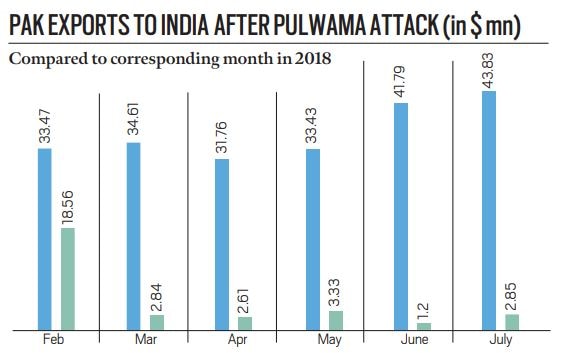
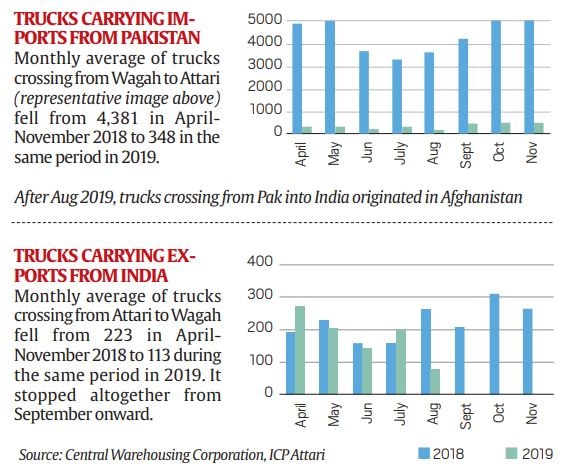
    Tensions between India and Pakistan in 2019 have reduced the already low volumes of trade between the two countries to near zero.

    India-Pakistan trade, in the beginning

    • In 1948-49, about 56% of Pakistan’s exports were to India, and 32% of its imports came from India.
    • From 1948-65, India and Pakistan used a number of land routes for bilateral trade; there were eight customs stations in Pakistan’s Punjab province and three customs checkpoints in Sindh.
    • India remained Pakistan’s largest trading partner until 1955-56. Between 1947 and 1965, the countries signed 14 bilateral agreements on trade, covering avoidance of double taxation, air services, and banking, etc.
    • In 1965, nine branches of six Indian banks were operating in Pakistan.

    Close to vanishing

    • Following the terrorist attack on the CRPF convoy in Pulwama in February, India withdrew Most Favoured Nation (MFN) status for Pakistan and raised customs duty on Pakistani imports to 200% .
    • In April, India suspended cross-LoC trade to stop the misuse of this route by Pakistan-based elements.
    • Pakistan on its part closed its airspace to India for a prolonged period.
    • The decisions by both countries, while targeted at hurting the neighbour, have severely impacted the livelihoods of individuals and families involved in cross-border trading activities.
  • [op-ed snap] Seize the summit

    Context

    India announced that it will invite all heads of government of Shanghai Co-operation Organisation member countries, including Pakistan.

    Significance of the invitation

    • First since 2014: The summit will assume significance should Pakistan Prime Minister accept the invitation.
      • As it will be the first by a head of government or state of that country to India since former Prime Minister Nawaz Sharif attended the swearing-in ceremony of Prime Minister in 2014.
    • Hopes belied: Nothing came from that meeting and hopes created by the invitation were belied.
    • Failed attempts to engage: Attempts to engage after that failed, including at a previous SCO summit at Ufa in 2015.

    Latest events that further reduced the engagement

    • Pulwama attack: First, there was the February 2019 Pulwama attack, India’s Balakot response, and Pakistan’s counter-response.
    • Article 370: After India did away with Jammu & Kashmir’s special status, India and Pakistan have downgraded even their diplomatic presence in each other’s countries.
    • Both the countries withdrew their high commissioners after the Article 370 issue.
    • Trade stopped completely: Bilateral trade, which had managed to survive earlier shocks to relations, has stopped completely.

    Opportunities presented by SCO summit

    • “Inputs of all stakeholders”: In deciding whether to accept the invitation, the Pakistan PM will have to take into consideration “inputs of all stakeholders”.
    • A polite way of saying that the final yes or no will rest with the Pakistan Army.
    • A chance for a high-level meeting: Even if Imran Khan stays away and sends a minister instead, it would still be a chance for a high-level bilateral meeting.
    • The world wants India and Pakistan to engage: The world wants India and Pakistan to engage, and this was evident in the way the UNSC refused to take up the Kashmir issue, saying it was not the forum for it.
    • Opportunity for India to make a start: India has declared several times recently that it wants to peel away from historical foreign policy baggage.
      • India should make a start with Pakistan by making it possible for such a meeting to take place.
    • Making acceptance of invitation easier: India can make it easier for the Pakistan Prime Minister to accept the invitation.
    • Resuming trade: A start could be made by resuming trade, which has ground to a dead halt
    • Sending High Commissioner back: India can start by sending India’s High Commissioner back to his office in Islamabad.

     Conclusion

    The SCO summit presents an opportunity for both the countries to end the long hiatus in the relations which is essential for both the countries to resolve the long-standing issues and progress of both the countries.


  • Indian Origin Tamils and Sri Lanka’s Citizenship Law

    Recently an MHA spokesperson wrote on Twitter that about 4.61 lakh Tamils of Indian origin were given Indian citizenship during 1964-2008. The reference was to the Indian Origin Tamils (IOTs) of Sri Lanka, and the Lal Bahadur Shastri-Sirimavo Bandaranaike Pact of 1964.

    The Indian Origin Tamils

    • Different from Sri Lankan Tamils who live predominantly in the North and East, the IoTs are descendants of indentured Tamil workers.
    • The British had shipped them to the island in the mid 19th century to work on tea estates in the five hill districts of the Central and Uva provinces.
    • These people now call themselves Malayaha (hill country) Tamils — because of the historical stigma attached to being “Indian” Tamils.
    • At the time of Sri Lanka’s independence, the IOTs numbered around 800,000.
    • They were the backbone of the tea industry, politically active, and keen to ensure their rights in independent Sri Lanka through strategic alliances with unions and left parties.
    • Determined to blunt their political rights, the ruling parties described IOTs as “birds of passage” with no loyalty to the country, as India’s fifth column in Sri Lanka, and as people who stole the locals’ jobs.

    SL’s 1948 Citizenship Act

    • Sri Lanka’s Nov. 1948 Citizenship Act was the first in a series of divisive moves by the Sinhala rulers to consolidate their political base in the majority Sinhalese (Buddhist and Christian) community.
    • It was aimed at excluding IOTs — then as now, the predominant workforce in the upcountry tea estates — whose numbers and growing association with leftist parties were proving to be politically inconvenient.
    • The IOTs that India accepted through the 1964 agreement were not “fleeing” Sri Lanka.
    • Most were, in fact, reluctant to leave the country in which they had lived for three generations or longer.
    • Those that remained, were stateless in Sri Lanka for decades until their status as citizens was settled ironically because the ruling party now wanted their votes.

    What did the Act provide?

    • Under the Act, citizenship could be only by patrilineal descent or registration.
    • For citizenship by registration, umarried persons had to show 10 years of uninterrupted stay in Sri Lanka from the date of application; married persons had to show 7 years.
    • Most IOTs were unlettered and poor, with no documents. Effectively an entire community was rendered stateless.
    • Soon afterward came the Indian & Pakistani Residents’ Act of 1949, which opened a window for those above a certain income level.
    • Only 1,40,000 had been granted citizenship under the Indian & Pakistani Residents’ Act, and 2,50,000 were accepted by India as its citizens.
    • Finally, the 1949 Ceylon (Parliamentary Elections) Amendment was passed, under which only citizens could vote.
    • The IOTs were stripped of voting rights, and the fallout was immediate: in 1947, there were 7 Indian Tamils in the legislature; in 1952, there were none.

    Issues with the Act

    • This Act sharply delineated ethnic differences, and distorted the political system to weight it in favour the Sinhalese majority.
    • This created an intractable dynamic of ethnic outbidding between the two major Sinhalese-dominated parties to attract Sinhalese voters at the expense of the Sri Lankan Tamil minority.
    • This directly contributed to the latter’s alienation, support for secessionism, and the outbreak of ethnic violence and civil war in the 1970s and 1980s.

    India’s response

    • The treatment of Indian Tamils had cast a shadow on India-Sri Lanka relations even before independence; post-independence, the citizenship laws became a major irritant.
    • They were denounced in India, and the Madras legislature passed a resolution against them.
    • In 1947, PM Nehru had tried unsuccessfully to persuade Senanayake to give citizenship to all Indian Tamils who had lived in the country for 7 years prior to January 1, 1948.
    • The two countries corresponded on this issue until Nehru’s death in 1964.
    • Nehru rejected the Sri Lankan position that the “stateless” IOTs were automatically Indian citizens, and would have to be shipped to India.

    Repatriation of IOTs

    • After the 1962 war with China, PM Shastri was eager to mend fences with Sri Lanka. He gave in to Bandaranaike’s demands, and it was agreed that Sri Lanka would accept 3,00,000 IOTs and their natural increase, while India would accept 5,25,000 IOTs and their natural increase.
    • The status of the balance 1,50,000 IOTs was to be decided later.
    • Some 4,00,000 reluctantly applied for citizenship of India; 6,30,000 applied for Sri Lanka’s.
    • By the time the window agreed upon in 1964 closed, only 1,62,000 IOTs had been given Sri Lankan citizenship. In the same period, India gave citizenship to over 3,50,000.
  • Ethnic Unity Law in Tibet

    The People’s Congress of Tibet passed a law that makes ethnic unity in the region mandatory, reflecting the significant role that the autonomous Himalayan region plays in its economic and social development.

    About the Law

    • The law makes it clear that Tibet has been an inalienable part of China since ancient times.
    • It states that it is the common responsibility of the people of all ethnic groups to safeguard national reunification and take a clear stand against separatism.

    Ethnic Unity in China

    • This is not the first time that the phrase ethnic unity has been mentioned by China.
    • In October 2019 the Communist Party of China published a guideline for enhancing ethnic unity.
    • It stressed on efforts to improve the governance of ethnic affairs, guaranteeing the legal rights and interests of citizens of ethnic groups.
    • It called for cracking down on “criminal acts” that sabotage ethnic unity or cause ethnic separation.
    • Before this, in 2016, China began a campaign in the autonomous territory of Xinjiang to promote ethnic unity and called for people to respect the cultures of the minorities who call the region home.

    Why such Law?

    • There are more than 40 ethnic minorities in the region, which account for 95 per cent of Tibet’s population of over three million.
    • Like Tibet, Xinjiang is another region of China that houses multiple ethnic minorities.
    • A similar legislation was passed there four years ago and in recent times, China has faced criticism for detaining at least a million Uighur and other Muslims, along with some ethnic Kazakhs and Uzbeks.
    • China has began “re-education camps” in Xinjiang, a region that has been claimed by China since 1949.
    • China has denied these allegations and maintains that the facilities where the detainees are housed are vocational training centers.
  • [op-ed snap] The world from Raisina.

    Context:

    As the world is moving from an era of predictability to an era of unpredictability led by the US and China, a new Middle Power coalition is the need of an hour.

    The “Rising India” narrative and challenges

    • The narrative was scripted over the two post-Cold War decades, 1991 to 2011.
    • Narrative of plural secular democracy: It was based on the improving performance of the economy and India’s political ability to deal with many longstanding diplomatic challenges within a paradigm of realism.
    • Three successive prime ministers – scripted the narrative of India rising as a plural, secular democracy, as opposed to China’s rise within an authoritarian system.
    • Opening of new vistas: India’s improving economic performance had opened up new vistas for cooperation with major powers and neighbours.
    • New challenges to the narrative: Now the economy’s subdued performance and domestic political issues have created new challenges for Indian foreign policy.
      • The new approach to relations with India adopted by both President Donald Trump and President Xi Jinping has created a more challenging external environment.

    Relations with the US

    • New demands from the US: Each time New Delhi has tried to meet a US demand, Washington DC has come up with new demands.
    • US-China dispute resolution and effects for India: Any resolution of US differences with China, can only reduce whatever little bargaining clout India has.
    • Complaint at WTO: The US has, in fact, actively lodged complaints against India at the World Trade Organisation.
    • Geopolitical effects for India:  On the geopolitical side, US intervention in West Asia has always imposed an additional economic burden on India.

    Relations with China

    • Consistent policy: There has been continuity and consistency in India-China policy over the past two decades, with some ups and downs.
    • Effects of power difference with China: As the bilateral power differential widens, China has little incentive or compulsion to be accommodative of Indian concerns, much less the interests. 
      • China never fails to remind India of the growing power differential between the two.
    • Building strength to deal with China: In dealing with China, India will have to, paraphrasing Deng Xiaoping, “build its strength and bide its time.

    Russia’s focus

    • It will remain focused on Eurasian geopolitics.
    • It will also be concerned with the geo-economics of energy.
    • Implications for India: Both these factors define Russia’s relations with China, and increasingly, with Pakistan, posing a challenge for India.


    Way forward in the relations with Pakistan

    • The government’s Pakistan policy has run its course.
      • It yielded some short-term results thanks to Pakistan’s efforts not to get “black-listed” by the Financial Action Task Force (FATF).
      • But the rest of the world is doing business with Pakistan, lending billions in aid.
    • The global community may increasingly accept future pleas from Pakistan that terror attacks in India are home-grown.
    • related to the situation in Kashmir or concerns about the welfare of Muslims, unless incontrovertible evidence to the contrary is offered.
    • The need for a new Pakistan policy: Backchannel talks should be resumed and visas should be given liberally to Pakistani intellectuals, media and entertainers to improve cross-border perceptions as a first step towards improving relations.

    The Middle Powers and opportunities for India

    • What are the middle powers?  It is a mix of developed and developing economies, some friends of the US and other friends of China.
      • It is an amorphous group but can emerge into a grouping of the like-minded in a world of uncertainty capable of taming both the US and China.
      • A new Middle Powers coalition may be the need of the year.
    • Which countries can be part of it?  Germany, France, Japan, Australia, Brazil, Indonesia, Vietnam and perhaps South Korea. One could include Russia, Nigeria and South Africa also in this group.
    • Stakes involved but no influence: Like India, these countries have a stake in what the US and China do, but little influence over either.
    • What India can do? These countries which constitute the part of the Middle Powers should engage the attention of India’s external affairs minister.

    Disruptive policies not an option

    • Adoption of disruptive approach: There is a view among some policy analysts that India too can adopt a “disruptive” approach as a clever tactic in foreign affairs.
      • Disruption is not an end in itself. It has to be a means to an end.
      • Powerful nations can afford disruption as tactics.
    • Unchanged strategic elements: The strategic elements defining Indian foreign policy in the post-Cold War era have not changed.
    • Not an option: India cannot risk such tactics without measuring the risk they pose to strategy.

    Conclusion

    With the changing geopolitical atmosphere particularly with respect to the US and Chiana, India needs to adopt a suitable approach to its foreign policy especially involving the Middle Powers.



  • [op-ed snap] A multilateral alternative, by Asia

    Context

    After the gap of 200 years, Asian economies are once again larger than the rest of the world combined.

    The Asian Century

    • Providing an alternative order: With the rise of India and China, Asia is providing a multilateral alternative to the world base on values.
    • Asian Century corresponds to the re-emergence of the two countries, leveraging the size and technological competence
    • Civilizational values: Both countries have civilisational values that are different from the west.
    • Peaceful existence: In the case of India and China balance of power is a western construct and both lived in peace across the ages.
    • The rise of China on the global landscape: In 2013, after attaining 15% of global wealth, announced the multilateral Belt and Road Initiative (BRI). In 2014, launched the Asian Infrastructure Investment Bank, challenging the global governance paradigm.
    • India in 2015, established the International Solar Alliance, laying out a distinct global sustainable development framework.
    • Current multilateralism and its problems: The U.S. has recognised the ‘Asian Century’ bypassing multilateralism and recognised Indo-Pacific construct.
    • The U.S. withdrawal from the Paris Agreement and the inclusion of intellectual property rights into the trade regime point to the colonial origin of the present order.


    New Framework- Country-specific to global value chain

    • Changing competition: Competition is moving from country-specific to fragmented competition based on global value chains.
    • Imposing the U.S. determined national security standards has led to only a handful of countries agreeing to ban Huawei for 5G technology.
    • The U.S. imposed sanctions on Iran that have affected India’s interests.
    • A different approach of China: It is based on “common interests” as different from the agreed goals of a negotiated treaty. BRI is an example of this.
    • It optimise not maximise the financial returns with countries remaining out of it.
    • The BRI offers the benefit of integration and connectivity with European markets to the member countries.

    Potential of BRI

    • It acts as a strategic framework: It provides a strategic framework for new global institution building.
    • Its scope is as wide as multilateral treaties.
    • Internationalizing the Renminbi: With state-owned enterprises in the infrastructure sector in the sector in BRI and backing from national banks is internationalising the Renminbi.
    • Developing blockchain bases infrastructure: As a leader in digital transactions, China is developing blockchain-based infrastructure in BRI countries. Thus reducing the dependence on the dollar.

    The shared interest of India and China

    • RCEP: China and the rest of the countries are eager that India joins the Regional Comprehensive Economic Partnership (RCEP), which is poised to become the largest trading block.
    • Security and border dispute: With the U.S. pivot to Asia, China is eager to resolve the dispute with India to avoid constraints.
    • Huawei: India has rejected American opposition to Huawei taking part in 5G trials, India allowed all applicants to participate.

        The emergence of new values

    • The emergence of the new order should not be seen through a western prism.
    • The triumvirate: India, the U.S., and China are intertwined with each other. China was the largest supplier of the goods to the U.S. in 2018 and it has been India’s major trading partner.
    • They take part in limited sectoral cooperation on a regional basis.
    • Both the U.S. and China have a regular high-level discussions on strategic issues with India.

        Area of future differences

    • In Asia, differences will center on overlapping priorities.
    • Security-The U.S.’s effort to maintain hegemony.
    • Economy-China’s emphasis on connectivity, markets, and growth.
    • An equitable and sustainable development-India-led framework of digital infrastructure designed as a public good.

       Conclusion

    With the rise of India and China in Asia and the presence of the U.S. with them is going to make the new order centered around Asia a new reality in the near future.

  • [op-ed snap] Amidst a tragedy, an opportunity

    Context

    The raging fire in Australia gives provides an opportunity for India and Australia to deepen their dialogue including on energy.

    Scope for the two countries

    • At this moment India and Australia have a rare opportunity to translate their converging interests into a partnership.
    • At Australia India Leadership Dialogue last month in Melbourne, the breadth and depth of the relationship was evident.
    • As a consequence of the bushfires, the debate on global warming, climate change and fossil fuels is going to intensify in the weeks ahead.
    • Environmental activism has gained ground throughout Australia.
    • Indian Ocean Dipole may have triggered the drought that is related to the fires.
    • The campaign against fossil fuels and the export of coal is sure to intensify.
    • India and Australia are two economies with a great stakeholding in fossil fuels.
    • It is critical for India and Australia to ensure that their dialogue on energy acquires momentum.
    • Both countries must simultaneously strengthen the International Solar Alliance and the search for other alternative green fuels.

    Common threat of China

    • Leadership Dialogue also recognised that we are living through a period of immense turbulence, disruption, and even subversion.
    • Presence of assertive China is the single biggest challenge to our two countries.
    • In India, there is a consensus that the Australia-India relationship is an idea whose time has well and truly come.

    Area of coordination

    • India and Australia can work on the area of water management to trauma research to skill and higher education.
    • Both the countries can also work in the area of maritime security, cybersecurity, counterterrorism,
    • In a survey, Indians ranked Australia in the top four nations towards which they feel most warmly.
    • Both have a strategic interest in ensuring a free, open, inclusive and rules-based Indo-Pacific region.
    • Indians are today the largest source of skilled migrants in Australia.
    • there is need for an early conclusion of a bilateral Free Trade Agreement.

     Conclusion

    There is a large scope for both countries to coordinate on wide issues like energy, research, security and work together for the benefit of both countries.