đŸ’„Join UPSC 2027,2028 Mentorship (July Batch) + XFactor Notes & Microthemes PDF

Subject: Biodiversity

1. Ecology & Ecosystems
2. Indian Biodiversity

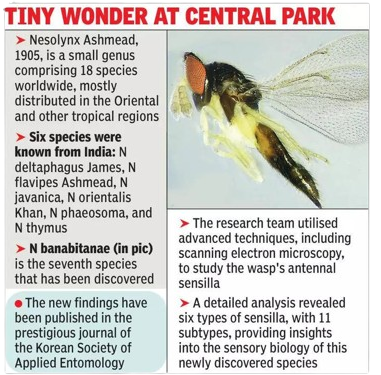
  • Nesolynx banabitanae new wasp discovered in West Bengal

    Why in the News?

    A new species of wasp, Nesolynx banabitanae, has been discovered in Central Park (Banabitan), Salt Lake, Kolkata.

    Nesolynx banabitanae new wasp discovered in West Bengal

    About ‘Nesolynx banabitanae’:

    • Taxonomic Family: Belongs to the Eulophidae family — known for parasitic and hyperparasitic wasps.
    • Type of Species: It is a hyperparasitoid, meaning it parasitises other parasitoid wasps rather than directly preying on host insects.
    • Host Interaction: Parasitises the ichneumonid parasitoid Charops aditya, which itself attacks caterpillars of the Common Palmfly (Elymnias hypermnestra) and Common Castor (Ariadne merione) butterflies.
    • Significance: Only the seventh known wasp species discovered in India, adding to the country’s limited record of Nesolynx genus.
    • Etymology: Named banabitanae after “Banabitan”, the local Bengali name for Central Park, where it was first identified.

    Significance:

    • Ecological Role: Contributes to multitrophic ecological interactions by adding a fourth trophic level influencing population dynamics of butterflies and their parasitoids.
    • Scientific Relevance: Enhances understanding of hyperparasitoid behaviour, urban insect ecology, and biodiversity conservation in anthropogenic landscapes.
    • Analytical Importance: The SEM-based structural mapping provides baseline data for future phylogenetic and taxonomic comparisons within Nesolynx.
    [UPSC 2024] Regarding Peacock tarantula (Gooty tarantula), consider the following statements:

    I. It is an omnivorous crustacean. II. Its natural habitat in India is only limited to some forest areas. III. In its natural habitat, it is an arboreal species.

    Which of the statements given above is/are correct?

    (a) I only (b) I and III (c) II only (d) II and III *


  • News specie “Chlorophytum vanapushpam” found

    Why in the News?

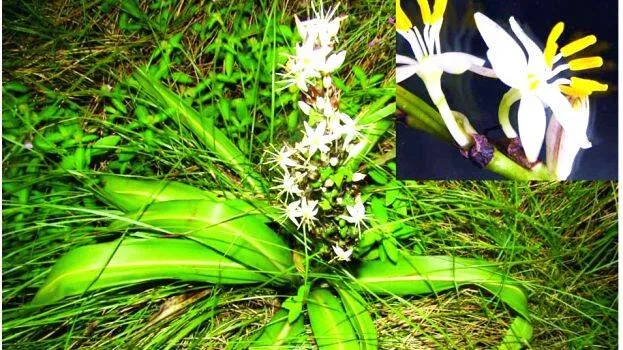
    Researchers have discovered a new species of perennial herb Chlorophytum vanapushpam from the Vagamon hills of Idukki district, Kerala.

    Chlorophytum vanapushpam

    About Chlorophytum vanapushpam:

    • Discovery & Location: Newly discovered perennial herb of the Asparagaceae family, identified in Vagamon and Neymakkad hills (Idukki, Kerala) within the Western Ghats biodiversity hotspot.
    • Name & Meaning: “Vanam” (forest) + “Pushpam” (flower) = forest flower.
    • Publication & Context: Reported in Phytotaxa, reaffirming the Western Ghats as the centre of origin for the Chlorophytum genus (18 Indian species).
    • Related Species: Closely allied to C. borivilianum (safed musli) but differs in form and lacks underground tubers.

    Key Features:

    • Growth Form: Herb up to 90 cm tall, clinging to rocky hill slopes.
    • Habitat & Range: Found between 700 m – 2,124 m elevation in moist, rocky terrains.
    • Leaves & Flowers: Slender, grass-like leaves; white clustered blossoms.
    • Reproduction: Seeds 4–5 mm; flowering and fruiting Sep–Dec.
    [UPSC 2016] Recently, our scientists have discovered a new and distinct species of banana plant which attains a height of about 11 metres and has orange-coloured fruit pulp.

    In which part of India has it been discovered?

    Options: (a) Andaman Islands * (b) Anaimalai Forests (c) Maikala Hills (d) Tropical rain forests of northeast


  • New species of finless Snake Eel named after Kanniyakumari

    Why in the News?

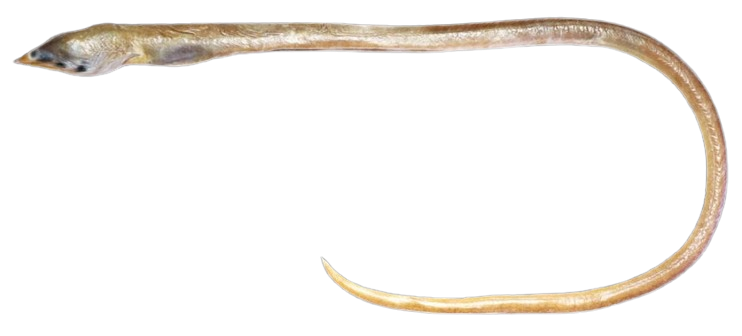
    ICAR- National Bureau of Fish Genetic Resources (NBFGR) researchers in Kochi have discovered a new finless snake eel species, Apterichtus kanniyakumari, named after Kanniyakumari district.

    New species of finless Snake Eel named after Kanniyakumari

    About Finless Snake Eel (Apterichtus kanniyakumari):

    • Location: Discovered off the Colachel coast, Kanniyakumari (Tamil Nadu), at ~100 m depth during deep-sea trawling.
    • Etymology: Named kanniyakumari in honour of the district’s cultural, linguistic, historical, and geographical heritage.
    • Taxonomy: Belongs to the genus Apterichtus, family Ophichthidae, commonly known as finless snake eels.
    • Morphological traits: Golden-yellow body, pale white ventral head with yellow jaw lines, three black blotches (behind eyes, at rictus, behind rictus origin), conical uniserial teeth, 3 preopercular & 9 supratemporal pores.
    • Molecular confirmation: Mitochondrial CO1 gene analysis shows it as a distinct clade, closely related to Apterichtus nanjilnaduensis.
    • Significance: Marks the 16th new species described from the Indian coast by NBFGR; adds to India’s marine biodiversity records.
    [UPSC 2016] Recently, our scientists have discovered a new and distinct species of banana plant which attains a height of about 11 meters and has orange coloured fruit pulp. In which part of India has it been discovered?

    (a) Andaman Islands *

    (b) Anaimalai Forests

    (c) Maikala Hills

    (d) Tropical rain forests of northeast


  • Ant Queens giving birth to different species

    Why in the News?

    A groundbreaking study published in Nature (2025) has revealed that Messor ibericus, a Mediterranean harvester ant species, can produce male offspring of a completely different species, Messor structor.

    Ant Queens giving birth to different species

    About the Specie Messor ibericus:

    • Overview: A Mediterranean harvester ant, widely distributed across Southern Europe, known for its grain-harvesting behaviour and large colonies.
    • Hybrid Workers: All workers are hybrids, carrying DNA from both Messor ibericus and Messor structor.
    • Cross-Species Male Production: About 10% of queen’s eggs develop into pure Messor structor males, even without nearby structor colonies.
    • Genetic Signature: These males retain Messor ibericus mitochondrial DNA, proving maternal origin.
    • Reproductive Strategy: As per the Nature study:
      • Ibericus sperm produces new queens.
      • Structor sperm produces hybrid workers and additional structor males.
    • Evolutionary Significance: First documented case of a species naturally producing offspring of another species, challenging classical species concepts.
    • Colony Advantage: By producing both hybrid workers and pure structor males, queens secure compatible mates for future generations, sustaining both lineages.
    [UPSC 2024] Which one of the following shows a unique relationship with an insect that has coevolved with it and that is the only insect that can pollinate this tree?

    Options:

    (a) Fig* (b) Mahua (c) Sandalwood (d) Silk cotton


  • Bengaluru gets its 2nd Biodiversity Heritage Site (BHS)

    Why in the News?

    The Karnataka government declared 8.6 acres of green cover at Cantonment Railway Colony in Bengaluru as a Biodiversity Heritage Site (BHS), the second such site in the city after Gandhi Krishi Vigyan Kendra (GKVK).

    About Biodiversity Heritage Sites (BHS):

    • Legal Basis: Recognized under Section 37(1) of the Biological Diversity Act, 2002 as ecologically sensitive areas of high biodiversity.
    • Notifying Authority: The State Government, in consultation with local bodies, can declare an area as a BHS.
    • Objective: Conserves wild and domesticated species, including rare, threatened, and keystone species, vital for ecological balance.
    • Significance: Marked as ecologically fragile zones, essential for sustaining local ecosystems and long-term sustainability.
    • Community Role: Local communities and institutions are actively involved in management and protection.
    • Restrictions Put: Declaration does NOT restrict customary uses; aims to enhance quality of life through conservation.
    • Institutional Support: State Biodiversity Boards (SBBs) and Biodiversity Management Committees (BMCs) assist in proposing, managing, and monitoring BHS.
    • First BHS in India: Nallur Tamarind Grove, Bengaluru, Karnataka, notified in 2007.
    [UPSC 2023] Consider the following statements:

    1. In India, the Biodiversity Management Committees are key to the realization of the objectives of the Nagoya Protocol.

    2. The Biodiversity Management Committees have important functions in determining access and benefit sharing, including the power to levy collection fees on the access of biological resources within its jurisdiction.

    Which of the statements given above is/are correct?

    Options: (a) 1 only (b) 2 only (c) Both 1 and 2* (d) Neither 1 nor 2


  • New Palm Species ‘Phoenix roxburghii’ discovered

    Why in the News?

    A palm specie ‘Phoenix roxburghii’ first described in the 17th-century botanical treatise Hortus Malabaricus has been recently confirmed.

    About Phoenix roxburghii:

    • Origin: Named after William Roxburgh, regarded as the father of Indian Botany.
    • Distribution: Found along India’s eastern coast, Bangladesh, Gujarat, Rajasthan, and Pakistan.
    • Height: Grows up to 12–16 metres, taller than Phoenix sylvestris.
    • Distinct Features:
      • Solitary trunk
      • Larger leaves and leaflets
      • Musty-scented staminate flowers
      • Large, obovoid orange-yellow fruits

    Back2Basics: India’s Oil Palm Scenario

    • National Mission on Edible Oils – Oil Palm (NMEO-OP) (2021): Centrally sponsored, aims to boost domestic crude palm oil (CPO) production and reduce import dependence.
    • Targets:
      • Expand area to 10 lakh ha by 2025–26.
      • Raise production from 0.27 lakh tonnes (2019–20) to 11.2 lakh tonnes (2025–26), further to 28 lakh tonnes (2029–30).
    • Support Mechanisms: Viability Price (VP), Direct Benefit Transfer (DBT), planting subsidy (â‚č29,000/ha), and special aid for NE & Andaman regions.
    • Cultivation States: Andhra Pradesh, Telangana, and Kerala (98% of output); others include Karnataka, Tamil Nadu, Odisha, Gujarat, and NE states.
    • Potential vs Current: 28 lakh ha potential; only 3.7 lakh ha cultivated.
    • Imports: India is the world’s largest palm oil importer (9.2 million tonnes in 2023–24). Palm oil forms 60% of edible oil imports, sourced mainly from Indonesia, Malaysia, and Thailand.
    • Unique Advantage: Palm oil yields are 5× higher than traditional oilseeds.
    [UPSC 2021] With reference to ‘palm oil,’ consider the following statements:

    1. The palm oil tree is native to Southeast Asia.

    2. Palm oil is a raw material for some industries producing lipstick and perfumes.

    3. Palm oil can be used to produce biodiesel.

    Which of the statements given above are correct?

    Options: (a) 1 and 2 only (b) 2 and 3 only* (c) 1 and 3 only (d) 1, 2, and 3


  • Specie in news: Indian flapshell turtle (Lissemys punctata)

    Why in the News?

    The Social Forestry Department of Vadodara rescued an Albino Indian flapshell turtle (Lissemys punctata) from a freshwater lake in Chikhodra, Gujarat.

    Specie in news: Indian flapshell turtle (Lissemys punctata)

    About Indian Flapshell Turtle (Lissemys punctata):

    • Type: Small, freshwater softshell turtle native to South Asia
    • Unique Feature: Named for femoral flaps on the plastron that cover the limbs when retracted
    • Geographic Range: Found in India, Pakistan, Nepal, Bangladesh, Sri Lanka, and Myanmar
    • River Systems: Occurs in the Indus, Ganges, Irrawaddy, and Salween basins
    • Habitat: Prefers shallow, quiet freshwater bodies like rivers, ponds, lakes, marshes, tanks, and canals with muddy or sandy bottoms for burrowing
    • Conservation Status:
      • IUCN Red List: Vulnerable
      • CITES Listing: Appendix II
      • Wildlife (Protection) Act, 1972: Schedule I (maximum protection)
    • Major Threats:
      • Poaching for meat, blood-based potions, aphrodisiacs, and traditional medicine
      • Illegal trade for fishing bait, livestock feed, leather, and exotic pets
      • Habitat loss due to pollution, encroachment, and waterbody destruction
      • Albino individuals especially targeted in the illegal pet market
    [UPSC 2013] Consider the following fauna of India:

    1. Gharial 2. Leatherback turtle 3. Swamp deer

    Which of the above is/are endangered?

    Options: (a) 1 and 2 only (b) 3 only (c) 1, 2 and 3* (d) None


  • Asian Giant Tortoise reintroduced in Nagaland

    Why in the News?

    The Asian giant tortoise (Manouria emys), the largest tortoise in mainland Asia, has been reintroduced into the Zeliang Community Reserve in Nagaland’s Peren district.

    Asian Giant Tortoise reintroduced in Nagaland

    About Asian Giant Tortoise (Manouria emys):

    • It is the largest tortoise in mainland Asia.
    • Two subspecies: Manouria emys emys and Manouria emys phayrei.
    • Uniquely, it lays eggs above ground in leaf-litter nests.
    • Behaviour: It is solitary and active mostly during dawn and dusk.
    • Found in evergreen and bamboo forests across India, Bangladesh, Myanmar, Thailand, Malaysia, and Indonesia.
    • Habitat in India: Nengpui WLS, Nongkhyllem WLS, and North Cachar Hills.
    • Conservation status: IUCN – Critically Endangered; CITES – Appendix II; Wildlife Protection Act – Schedule IV.
    • Major threats: Illegal hunting for meat, habitat degradation, forest fires, and bamboo removal.
    [UPSC 2017] In India, if a species of tortoise is declared protected under Schedule I of the Wildlife (Protection) Act, 1972, what does it imply?

    Options: (a) It enjoys the same level of protection as the tiger*

    (b) It no longer exists in the wild, a few individuals are under captive protection; and how it is impossible to prevent its extinction

    (c) It is endemic to a particular region of India

    (d) Both (b) and (c) stated above are correct in this context.


  • [pib] New Lichen Species reveals ancient Symbiosis

    Why in the News?

    A team of Indian scientists has discovered a new species of lichen, Allographa effusosoredica, in the Western Ghats, a global biodiversity hotspot.

    What are Lichens?

    lichen

    • Lichens are symbiotic organisms, composed of a fungus (mycobiont) and a photosynthetic partner (photobiont)—either a green alga or a cyanobacterium.
    • The fungus provides structure and protection, while the photobiont produces food through photosynthesis.
    • Lichens are key ecological contributors:
      • They build soil by breaking down rocks.
      • Serve as bioindicators of environmental and air quality.
      • Provide food for insects and small animals.
    • Despite being often overlooked, lichens are vital to ecosystem stability and resilience.

    About the Newly Discovered Lichen Species:

    • Discovery: Allographa effusosoredica was discovered in the Western Ghats by MACS-Agarkar Research Institute, Pune.
    • First of Its Kind: First Indian Allographa species confirmed using molecular data.
    • Biodiversity Addition: 53rd Allographa species in India; 22nd from the Western Ghats.
    • Funding Support: Research funded by Anusandhan National Research Foundation (ANRF) under a lichen symbiosis project.

    Key Features Revealed:

    • Morphology: Crustose body with effuse soredia; Contains norstictic acid—rare among related species.
    • Algal Partner: Photobiont identified as Trentepohlia, expanding understanding of tropical lichen symbiosis.
    • Molecular Markers: Analysis used fungal markers (mtSSU, LSU, RPB2) and algal marker (ITS).
    • Phylogenetic Placement: Closely related to Allographa xanthospora; visually similar to Graphis glaucescens.
    [UPSC 2014] Lichens, which are capable of initiating ecological succession even on a bare rock, are actually a symbiotic association of:

    Options: (a) algae and bacteria (b) algae and fungi* (c) bacteria and fungi (d) fungi and mosses


  • New butterfly species Zographetus mathewi found in Western Ghats

    Why in the News?

    A team of Indian conservationists has identified a new butterfly species, Zographetus mathewi, in the biologically rich Western Ghats.

    About Zographetus mathewi

    • Overview: Zographetus mathewi is a newly identified species of skipper butterfly.
    • Taxonomic Classification: It belongs to the family Hesperiidae and the genus Zographetus Watson, 1893.
    • Distribution: This species is endemic to the low-elevation forests of Kerala, Western Ghats.
    • Genus: It is the 15th species in the Zographetus genus and the 5th recorded in India.
    • Publication and Naming: Published in the journal Entomon, the butterfly was named in honour of George Mathew, a noted Indian entomologist.

    Key Features of Zographetus mathewi

    • Similarity with Other Species: It closely resembles Zographetus ogygia but differs in wing venation patterns and genitalia structure in both male and female butterflies.
    • Species Group Traits: It belongs to the Zographetus satwa species-group, which is known for swollen forewing veins in males as a secondary sexual trait, a distinct basal hair tuft on the underside of the forewing, and yellow-ochre scaling on the hindwing underside.
    [UPSC 2025] Regarding Peacock tarantula (Gooty tarantula), consider the following statements :

    I. It is an omnivorous crustacean.

    II. Its natural habitat in India is only limited to some forest areas.

    III. In its natural habitat, it is an arboreal species.

    Which of the statements given above is/are correct?

    Options: (a) I only   (b) I and III   (c) II only  (d) II and III*