đŸ’„Join UPSC 2027,2028 Mentorship (July Batch) + XFactor Notes & Microthemes PDF

Subject: Climate Change

1. Global Warming and Issues
2. All about Pollution

  • Nord Stream Pipeline Leakage: A climate Catastrophe

    Nord StreamContext

    • Four leakages were reported at different points in the Nord Stream pipelines, linking Russia and Europe, since September 26. Two of the leaks were in Swedish waters while the other two were reported from Danish waters. The European Union said they suspected “sabotage” behind the leaks.

    What is Nord Stream Pipeline?

    • Nord Stream 1:
    • Nord Stream 1 is the biggest pipeline transporting natural gas between Russia and Europe via Germany.It is a system of offshore natural gas pipelines running under the Baltic Sea from Russia to Germany.
    • Nord Stream 1 is a 1,224 km underwater gas pipeline that runs from Vyborg in northwest Russia to Lubmin in northeastern Germany via the Baltic Sea.
    • Nord Stream 2:
    • Russian threats to choke this gas supply to Europe present an economic threat to Germany.
    • To expand options and double the supply from Russia, Germany decided to build Nord Stream 2.
    • The construction of the $11 billion-worth Nord Stream 2 was completed in 2021 but never began commercial operations.

    Nord StreamWhy the Nord Stream pipeline is so important?

    • For Germany: Energy prices in Germany, Europe’s largest economy, are among the lowest in the continent because of the cheap gas supplies via Nord Stream 1. This also makes German manufactured goods more competitive in the international market.
    • For European Union: In 2021, Russia supplied nearly 40 per cent of the EU’s natural gas needs through this pipeline. The flows through Nord Stream play a vital role in filling up the national storage tanks of EU. It is crucial to provide the required heating in the upcoming winter.
    • For Russia: Russia is using the supplies via the crucial pipeline as a bargain to navigate its economy through sanctions from the western countries.

    What is the current status of Nord Stream Pipeline?

    • Nord stream pipeline is the largest single supply route for Russian gas to Europe. The Russian state owned gas company Gazprom has a majority ownership in the pipeline.
    • While it was running at just 20% of its capacity since the Russia-Ukraine conflict began, the company, in early September fully cut gas flows from the pipeline on the pretext of maintenance.
    • According to Bloomberg, while 40% of Europe’s pipeline gas came from Russia before Russia Ukraine the war, the number now stands at just 9%.
    • Even though both pipelines were not running commercially, they had millions of cubic metres of gas stored in them.

    The recent leakage in the pipeline

    • Commercial Methane: Measuring satellite firm GHGSat says, that a conservative estimate based on available data suggested that the leaks together were releasing ‘more than500 metric tonnes of methane per hour’ when first breached, with the flow decreasing over time.
    • Biggest methane leakage ever: According to UNEP The leakage from the Nord Stream natural gas pipeline system under the Baltic Sea have led to perhaps the single biggest release of methane ever recorded.
    • Amount of leakage: The rate of leakage at one of the four points of rupture in the pipeline was 22,920 kg per hour. That is equal to burning about 286,000 kg of coal every hour, according to scientists.

    Nord StreamWhat will be the Impact of methane leakage?

    • Possibility of more leakage: With the timeframe for repairs being uncertain, the pipelines were unlikely to provide any gas to Europe in the forthcoming winter months, even if the political will to resume supply was found.
    • Commercial damage: European gas prices spiked after reports of the leaks emerged; European Benchmark prices rose 12% on Tuesday, while Dutch and British Prices continued to rise.
    • Ozone formation: Methane is the primary contributor to the formation of ground-level ozone, a hazardous air pollutant and greenhouse gas, exposure to which causes 1 million premature deaths every year.
    • Green House gas: Methane is also a powerful greenhouse gas. Over a 20-year period, it is 80 times more potent at warming than carbon dioxide.
    • Global warming: Methane has accounted for roughly 30 per cent of global warming since pre-industrial times and is proliferating faster than at any other time since record keeping began in the 1980s.
    • Emission have already increased during the lockdown: According to data from the United States National Oceanic and Atmospheric Administration, even as carbon dioxide emissions decelerated during the pandemic-related lockdowns of 2020, atmospheric methane shot up.

    Nord Stream

    Why is it important to reduce methane emission?

    • Short lifespan: Carbon dioxide remains in the atmosphere for hundreds to thousands of years. But it takes only about a decade for methane to break down. So, reducing methane emissions now would have an impact in the near term and is critical for helping keep the world on a path to 1.5°C.
    • Human caused methane emissions: Human-caused methane emissions could be reduced by as much as 45 per cent within the decade. This would avert nearly 0.3°C of global warming by 2045, helping to limit global temperature rise to 1.5˚C and putting the planet on track to achieve the Paris Agreement targets.
    • Prevent premature deaths: Every year, the subsequent reduction in ground-level ozone would also prevent 260,000 premature deaths, 775,000 asthma-related hospital visits, 73 billion hours of lost labour from extreme heat and 25 million tonnes of crop losses.
    • Reducing the Agriculture emission: Agriculture and allied activities remains the biggest contributor of methane emission. The UN’s Koronivia Joint Work on Agriculture initiative is supporting the transformation of agricultural and food systems, focusing on how to maintain productivity amid a changing climate. Representatives are also working to mainstream agriculture into the UN Framework Convention on Climate Change.

    Conclusion

    • Nord stream pipeline leakages will further exacerbate the ozone formation, Green House Gas emissions global warming and thereby climate change. In the spirit of Paris climate change agreement nations must act together to rein in the menace of GHG emissions.

    Mains Questions

    Q.Methane emission into atmosphere is done more by human activities than natural causes. In the spirit of Paris climate change agreement nations must act together to rein in the menace of GHG emissions. Explain


    UPSC 2023 countdown has begun! Get your personal guidance plan now! (Click here)


  • Stressed ecology of Bay of Bengal

    Bay of BengalContext

    • At the fourth BIMSTEC summit, Prime Minister Narendra Modi announced the opening of the Centre for Bay of Bengal Studies (CBS) at Nalanda University. The launch of the CBS has once again demonstrated India’s commitment to advancing constructive agendas by forging connections and setting up platforms for all those with an interest in the of Bay of Benagl.

    Bay of BengalWhy Bay of Bengal is so important?

    • Commerce hub: The Bay has long been a major commerce hub for the Indian Ocean. It created a conduit between the East and the West in terms for trade and culture.
    • Emerging arena of maritime warfare: An Indo-Pacific orientation and the realignment of global economic and military power towards Asia have had a considerable impact on the Bay region.
    • Communication and Energy: The key sea lanes of communication in this area are lifelines for global economic security and are crucial to the energy security that powers the economies of many countries in the region.Further, non-traditional dangers including terrorism and climate change have become more prevalent.
    • Under water resources: The Bay also provides an opportunity for greater regional cooperation in the environmentally friendly exploration of marine and energy resources. The Bay has a biodiverse marine environment.
    • Fresh water resources: It receives the water from some of the world’s largest rivers. It is a partially enclosed sea that has given rise to several geological characteristics.
    • Ecology: It is home to many rare and endangered marine species and mangroves, which are essential to the survival of the ecology and the fishing sector.

    Bay of BengalWhy ecology in the region is under threat?

    The region’s maritime environment has changed as are result of major powers expanding their economic and geopolitical influence.

    • Competition: Political and cultural engagement, together with economic competition, have taken on new dimensions. More crucially, the Bay’s ecosystem is going through an unprecedented crisis brought on by widespread environmental exploitation and geopolitical unrest.
    • Resource exploitation: Species extinction is a result of careless exploitation of the maritime environment, which has severe consequences on biodiversity. Problems such as population growth, altered land use, excessive resource exploitation, salinity, sea level rise, and climate change are exerting significant strain on the Bay’s environment.
    • Water pollution: Operational discharge from small and medium feeder ships, shipping collisions, unintentional oil spills, industrial waste, pollution, and the accumulation of non- biodegradable plastic litter are all contributing to the deterioration of the Bay.
    • Declining ecology: A dead-zone has formed, and the mangrove trees that protect the shore from the fury of nature are under more threat than ever.

    What could be the Solutions?

    For a better knowledge of challenges, and strategies to overcome them for the sustainable development of the region, more focused and inter-disciplinary study is required on these issues.

    • Centre for Bay of Bengal studies: By founding the CBS, Nalanda University has already started its journey and given the nation a unique interdisciplinary research centre devoted to Bay focused teaching, research, and capacity building. Additionally, scholars from many countries and academic streams are already participating in CBS’s first certificate programme on the Bay.
    • Inter-governmental cooperation: It is essential that nautical neighbours develop a partnership and cooperate because of the maritime domain’s interrelated and interdependent nature, transnational character, and cross-jurisdictional engagement of various governments and diverse organisations and enterprises.
    • Maritime connectivity: A few concerns that need immediate attention include expanding cooperation in maritime safety and security, enhancing cooperation on maritime connectivity and the ease of maritime transit, and boosting investment possibilities in the maritime connectivity sector.
    • Illegal activities: The latter subject involves addressing non-traditional threats and fostering group efforts to reduce illicit, unreported, and unregulated fishing.
    • Data sharing: Standardising and harmonising data reporting.
    • Balanced approach: Furthermore regional marine entities should strive to balance opportunities and goals on a national, regional, and international scale.
    • Investment in R&D: Littoral governments need to support and promote skill-building, research, and training.

    Conclusion

    • Countries in the Bay of Bengal need to mobilise investments, manage maritime affairs more effectively. Alternative lifestyle should be explored. The cooperation of all member states, for information gathering, sharing and result oriented actions is crucial in protecting the ecology of Bay of Bengal.

    Mains Question

    Q.Countries in the Indian subcontinent are developing rapidly, putting serious stress on the environment of the Bay of Bengal.Mention the challenges and suggest solutions.

    UPSC 2022 countdown has begun! Get your personal guidance plan now! (Click here)

  • Backsliding on climate action

    Context

    Europe is staring at a recession and its appetite for climate action is waning.

    Developed countries moving away from commitment

    • Countries in Europe led by Germany, Austria and the Netherlands are cranking up their coal plants again.
    • Fossil fuels are making a comeback and countries are rejecting the European Union (EU)’s plan to reduce natural gas consumption by 15%. Dutch, Polish and other European farmers are protesting against emission cuts from agriculture.
    • In the U.S. too, the Senate and the Supreme Court have struck blows to climate action.
    • And in the U.S. too, prices of fuel started increasing last year, not just this year.
    • Fossil fuels are making a quiet comeback, since the strength of the U.S. is its oil and gas industry.
    • That is why we have just witnessed a ‘re-calibration’ of U.S. policy towards the Gulf.
    • Coal, oil and gas are not going anywhere in the developed world; they are, in fact, making a comeback.
    • The West had rushed to draw down on fossil fuels even before technology for renewables were in place.

    Global peaking issue

    • Article 4 of the Paris Agreement defines ‘Global Peaking’ thus: “In order to achieve the long-term temperature goal set out in Article 2, Parties aim to reach global peaking of greenhouse gas emissions as soon as possible, recognizing that peaking will take longer for developing country Parties.”
    • The developed countries, given their historical emissions, will have to peak first.
    • That’s why the reference is to ‘global peaking’ and not ‘individual peaking’.
    • From this, it logically follows that when developing country parties peak later than developed countries, they will also achieve net zero later than developed countries.
    • Consequently, it is the logical conclusion of the Article 4 of the Paris Agreement that when we consider net zero, we should only consider ‘global net zero’ and not ‘individual net zero’ for 2050.
    • The statement calls on developed countries to do a net negative on mitigation by 2050 rather than just “net zero”, if they are serious about fighting climate change.
    • In effect, the West needs to do a net minus and not just net zero.
    • Thanks to the efforts of India, the phrase used in the 2021 summit-level declarations at both G-20 and Quad is ‘global net zero’. We need to build on this understanding.
    • India stands as beacon of hope in renewables.
    • It is time for all developing countries, especially the small island developing states, to make sure that the developed world doesn’t backslide on its commitments on mitigation yet again.

    Way forward for developing countries

    • With countries of the developed world almost sure to renege on their 2030 Paris Agreement commitments, countries of the developing world must do everything to hold the countries of the developed world to their commitments.
    • The Western nations have already started reinterpreting the Paris Agreement and look to downgrade their commitments.
    • The concept of net zero is being cleverly misinterpreted.
    •  To bring this to the attention of the Global South, India, China and eight other countries from Africa, Asia and Latin America made a cross-regional statement on ‘global net zero’ on June 7 at the UN on World Environment Day.

    Conclusion

    COP 27 in Egypt gives us that opportunity to hold their feet to the fire. It is time for the developed world to make net minus pledges. If we don’t collectively push for it, we will be collectively pushed back.

    UPSC 2022 countdown has begun! Get your personal guidance plan now! (Click here)

  • What is International Argo Program?

    argo

    The International Argo Program system to observe carbon concentration in the world’s oceans is extremely inadequate to meet the growing and urgent need for information on oceanic carbon, says a report.

    What is Argo?

    • Argo is an international program that uses profiling floats to observe temperature, salinity, currents, and, recently, bio-optical properties in the Earth’s oceans; it has been operational since the early 2000s.
    • The real-time data it provides is used in climate and oceanographic research.
    • A special research interest is to quantify the ocean heat content (OHC).
    • Each instrument (float) spends almost all its life below the surface.
    • The name Argo was chosen because the array of floats works in partnership with the Jason earth observing satellites that measure the shape of the ocean surface.
    • In Greek mythology Jason sailed on his ship the Argo in search of the Golden Fleece.

    What are its aims?

    • The data that Argo collects describes the temperature and salinity of the water and some of the floats measure other properties that describe the biology/chemistry of the ocean.
    • The main reason for collecting these data is to help us understand the oceans’ role in earth’s climate.
    • For example, the changes in sea level (once the tides are averaged out) depend partly on the melting of icecaps and partly on the amount of heat stored in the oceans.
    • Argo’s temperature measurements allow us to calculate how much heat is stored and to monitor from year to year how the distribution of heat changes with depth and from area to area.
    • As ocean heat content increases, sea level rises, just like the mercury in a thermometer.

    How does it work?

    • Each Argo float (costing between $20,000 and $150,000 depending on the individual float’s technical specification) is launched from a ship.
    • The float’s weight is carefully adjusted so that, as it sinks, it eventually stabilizes at a pre-set level, usually 1 km.
    • Ten days later, an internal battery-driven pump transfers oil between a reservoir inside the float and an external bladder.
    • This makes the float first descend to 2km and then return to the surface measuring ocean properties as it rises.
    • The data and the float position are relayed to satellites and then on to receiving stations on shore.
    • The float then sinks again to repeat the 10 day cycle until its batteries are exhausted.


    UPSC 2023 countdown has begun! Get your personal guidance plan now! (Click here)

  • What is a Triple-Dip La Nina?

    nina

    Parts of the world are expected to experience severe weather for the rest of the year and into 2023, as part of a rare “triple dip La Nina” event, according to the World Meteorological Organization (WMO).

     What is the “Triple-Dip” La Nina?

    • A “triple-dip” La Nina is a multiyear cooling of the surface temperature of the equatorial Pacific Ocean, which can cause droughts, fierce winds and heavy rainfall.
    • According to WMO, the current La Nina is projected to span three consecutive northern hemisphere winters. It began in September 2020.
    • If it continues for the next six months, it will be the first “triple-dip” La Nina event of the 21st century, WMO says.

    How rare is this triple-dip?

    • It is exceptional to have three consecutive years with a la Nina event.
    • Its cooling influence is temporarily slowing the rise in global temperatures – but it will not halt or reverse the long-term warming trend.
    • La Nina’s are usually preceded by El Nino, a weather pattern that warms the surface of the eastern tropical Pacific Ocean.
    • However, an El Nino event did not occur before the current La Nina.

    Has it happened before? Will it happen again?

    • La Nina’s occurred several times between 1903 to 2010 and 2010 to 2012.
    • This would be the first “triple-dip” La Nina this century.
    • However, it is not unprecedented for the weather pattern to last more than nine months to a year, which is typical for a La Nina.

    Evaluating the likely impact

    • In the Indian context, La Nina is associated with good rainfall during the monsoon season.
    • This is the opposite of El Nino which is known to suppress monsoon rainfall.
    • Thus, a continued spell of La Nina could lead to expectation of another year of good, or normal, rainfall during the monsoon.
    • Until now, the monsoon season this year has produced 7% more rain compared to normal. Last year, the seasonal rainfall was almost 100%.
    • But, even though powerful, ENSO condition is only one of the several factors affecting monsoon rainfall in India.

    Impact on rainfall

    • There is no one-on-one correlation between the ENSO condition and the amount of rainfall.
    • Also, the influence of ENSO is at a macro level.
    • There are wide variations in rainfall at the local level, which are getting exacerbated by climate change.

    Differential impacts of this triple-dip event

    • The continuance of La Nina further into 2023 is not bad news from the Indian standpoint. But it is not the same for many other regions where La Nina has very different impacts.
    • In most parts of the United States, for example, La Nina is associated with very dry winters.
    • In Australia and Indonesia, and generally in the tropical region, La Nina is expected to bring more rainfall.
    • The excessive rainfall in Pakistan, which is experiencing its worst flooding disaster, can also be blamed in part on La Nina.
    • It said that the persistence of La Nina was most likely to result in a worsening of the drought in Africa.

    What is its climate change link?

    • Every unusual weather event these days is attributed to climate change, but science is not conclusive right now.
    • The occurrences of El Nino or La Nina are not very regular.
    • Sometimes they emerge every two years, at other times there has been a gap of even seven years.
    • Historical records do not go very far in the past.
    • As a result, the natural variability of ENSO is not understood very clearly.
    • And when the natural variability itself is not clear, the influence of global warming is difficult to quantify.
    • But there is clearer evidence of another kind of linkage with global warming.
    • During La Nina years, the colder surfaces allow the oceans to absorb more heat from the atmosphere.
    • Consequently, the air temperatures tend to go down, producing a cooling effect.


    UPSC 2023 countdown has begun! Get your personal guidance plan now! (Click here)

  • UNEP launches Green Fins Hub

    fins

    The United Nations Environmental Programme (UNEP) has launched the Green Fins Hub, a global digital platform to give sustainable marine tourism a ‘major boost’.

    Green Fins Hub

    • The Green Fins Global Hub will be a first-of-its-kind online support system to motivate scuba operators to improve their daily environmental practices at scale.
    • It aims to help diving and snorkeling operators worldwide to make simple, cost-efficient changes to their daily practices by utilizing tried and tested solutions.
    • It would also help them keep track of their annual improvements and communicate with their communities and customers.

    Membership of Green Fins Hub

    • It will host two types of membership. One would be digital membership available for diving, snorkelling and liveaboard operations globally.
    • Throughout every year of membership, operators will receive environmental scores based on a detailed online self-evaluation and progress made on their action plans.
    • The Certified Members will continue to be assessed annually and trained in person at their operation.
    • The platform will be for operators around the world to raise industry needs, discuss environmental issues and share lessons and ideas with like-minded industry leaders, non-profits and governments.


    UPSC 2023 countdown has begun! Get your personal guidance plan now! (Click here)

  • What is the idea of Climate Reparation?

    Facing the worst flooding disaster in its history, Pakistan has begun demanding reparations, or compensation, from the rich countries that are mainly responsible for causing climate change.

    Why in news?

    • On the face of it, Pakistan’s demand for reparations appears to be a long shot, but the principles being invoked are fairly well-established in environmental jurisprudence.
    • In fact, Pakistan is not alone in making this demand.
    • Almost the entire developing world has for years been insisting on setting up an international mechanism for financial reparation for loss and damage caused by climate disasters.
    • The issue has come up repeatedly at international negotiations for climate change, and on other platforms.

    What is Climate Reparation?

    • At its heart, the demand for compensation for loss and damage from climate disasters is an extension of the universally acknowledged “Polluter Pays” principle.
    • This makes the polluter liable for paying not just for the cost of remedial action, but also for compensating the victims of environmental damage caused by their actions.
    • Climate justice is based on the notion of not being punished for someone else’s bad behaviour, but it does not sanction additional bad behaviour.

    Who are responsible for climate change?

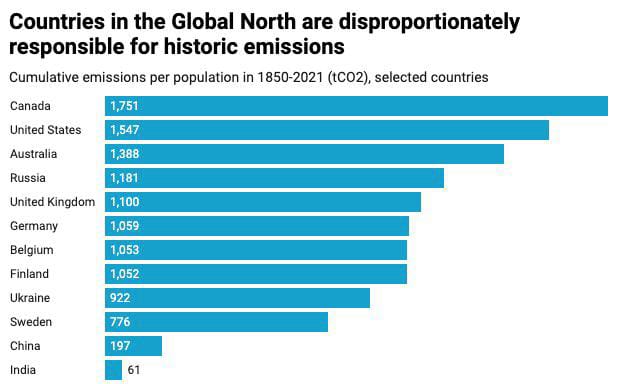
    • In the climate change framework, the burden of responsibility falls on those rich countries that have contributed most of the greenhouse gas emissions since 1850, generally considered to be the beginning of the industrial age.
    • The United States and the European Union, including the UK, account for over 50% of all emissions during this time.
    • If Russia, Canada, Japan, and Australia too are included, the combined contribution goes past 65%, or almost two-thirds of all emissions.
    • Historical responsibility is important because carbon dioxide remains in the atmosphere for hundreds of years, and it is the cumulative accumulation of carbon dioxide that causes global warming.

    What about developing countries?

    • A country like India, currently the third largest emitter, accounts for only 3% of historical emissions.
    • China, which is the world’s biggest emitter for over 15 years now, has contributed about 11% to total emissions since 1850.

    Why need climate reparations?

    • While the impact of climate change is global, it is much more severe on the poorer nations because of their geographical locations and weaker capacity to cope.
    • Countries that have had negligible contributions to historical emissions and have severe limitations of resources are the ones that face the most devastating impacts of climate change.

    Institutional mechanism for Climate Reparations

    (1) United Nations

    • The UN Framework Convention on Climate Change (UNFCCC), the 1994 international agreement that lays down the broad principles of the global effort to fight climate change.
    • It explicitly acknowledges this differentiated responsibility of nations.
    • It makes it very clear that rich countries must provide both the finance and the technology to the developing nations to help them tackle climate change.
    • It is this mandate that later evolved into the $100 billion amount that the rich countries agreed to provide every year to the developing world.
    • While this promise is yet to be met, this $100 billion per year amount is not meant for loss and damage.
    • Climate disasters were not a regular occurrence in 1994, and as such the UNFCCC does not make a mention of loss and damage.
    • This particular demand emerged much later, and faced stiff resistance from the developed nations.

    (2) Warsaw International Mechanism (WIM)

    • The WIM for Loss and Damages, set up in 2013, was the first formal acknowledgment of the need to compensate developing countries struck by climate disasters.
    • However, the progress on this front has been painfully slow.
    • No funding mechanism, or even a promise to provide funds, has come about.

    Pushback from Developed Countries

    • It is not hard to understand why the developed countries are dead against compensation claims.
    • They are struggling to put together even the $100 billion per year flow that they had reluctantly agreed to provide.
    • Further, loss and damage claims can easily spiral into billions of dollars, or even more.
    • The report said that the United States alone is estimated to have “inflicted more than $1.9 trillion in damages to other countries” due to its emissions.

    Issues with loss assessment

    • There are practical difficulties in estimating how much a country has actually suffered due to the actions of others.
    • To begin with, it has to be established that the disaster was caused by climate change.
    • Then there are non-economic losses as well, including loss of lives, displacement and migration, health impacts, and damage to cultural heritage.
    • Then there is this other step about assessing how much of the losses are due to the event itself, and what could be attributed to misgovernance.

    Conclusion

    • A lot of background work is going on to create the framework in which it would be possible to quantify the compensation due to an affected country.
    • What Pakistan has done, through its demands for reparations, is to call attention to this often neglected aspect.


    UPSC 2023 countdown has begun! Get your personal guidance plan now! (Click here)

  • Abnormal’ La Nina conditions impacting India’s monsoon

    In what may be termed as an uncommon ocean phenomenon, the prevailing La Nina conditions over the equatorial Pacific Ocean have entered the third consecutive year.

    What is the news?

    • The current La Nina phase has been prevailing since September 2020.
    • Since the 1950s, La Nina lasting for more than two years has been recorded only on six instances (see graph below), data by the India Meteorological Department (IMD) stated.
    • It confirmed that India’s La Nina conditions are here to stay till the end of 2022.

    What is El Nino and La Nina?

    • While El Nino (Spanish for ‘little boy’), the more common expression, is the abnormal surface warming observed along the eastern and central regions of the Pacific Ocean (the region between Peru and Papua New Guinea).
    • The La Nina (Spanish for ‘little girl’) is an abnormal cooling of these surface waters.
    • Together, the El Nino (Warm Phase) and La Nina (Cool Phase) phenomena are termed as El Nino Southern Oscillation (ENSO).
    • These are large-scale ocean phenomena that influence the global weather — winds, temperature and rainfall. They have the ability to trigger extreme weather events like droughts, floods, hot and cold conditions, globally.
    • Each cycle can last anywhere between 9 to 12 months, at times extendable to 18 months — and re-occur after every three to five years.
    • Meteorologists record the sea surface temperatures for four different regions, known as Nino regions, along this equatorial belt.
    • Depending on the temperatures, they forecast either as an El Nino, an ENSO neutral phase, or a La Nina.

    Why has La Nina conditions continued for 3 years?

    • It is surprising that it has continued for the last three years. It may be good for India but not for some other countries.
    • Under climate change conditions, one must expect more such instances. Climate change could be a factor driving such anomalous conditions.

    Issues with La Nina

    • La Nina years are infamous for frequent and intense hurricanes and cyclones in the Atlantic Ocean and the Bay of Bengal.
    • Chances of more cyclones are likely due to multiple aiding factors, including high relative moisture and relative low wind shear over the Bay of Bengal.


    Try this PYQ:

    Q. La Nina is suspected to have caused recent floods in Australia. How is La Nina different from El Nino?

    1. La Nina is characterized by unusually cold ocean temperature in equatorial Indian Ocean whereas El Nino is characterized by unusually warm ocean temperature in the equatorial Pacific Ocean.
    2. El Nino has an adverse effect on south-west monsoon of India, but La Nina has no effect on monsoon climate.

    Which of the statements given above is/are correct?

    (a) Only 1

    (b) Only 2

    (c) Both 1 and 2

    (d) Neither 1 nor 2


    [wpdiscuz-feedback id=”b6qp23xiv6″ question=”Please leave a feedback on this” opened=”1″]Post your answers here.[/wpdiscuz-feedback]


    UPSC 2023 countdown has begun! Get your personal guidance plan now! (Click here)

  • Recovery of Ozone Layer achieves significant milestone

    The concentration of ozone-depleting substances in the atmosphere has reduced to reach a significant milestone this year.

    What is Ozone and Ozone Layer?

    • An ozone molecule consists of three oxygen atoms instead of the usual two (the oxygen we breathe, O2, makes up 21% of the atmosphere).
    • It only exists in the atmosphere in trace quantities (less than 0.001%), but its effects are very important.
    • Ozone molecules are created by the interaction of ultra-violet (UV) radiation from the Sun with O2 molecules.
    • Because UV radiation is more intense at higher altitudes where the air is thinner, it is in the stratosphere where most of the ozone is produced, giving rise to what is called the ‘ozone layer’.
    • The ozone layer, containing over 90% of all atmospheric ozone, extends between about 10 and 40km altitude, peaking at about 25km in Stratosphere.

    Why need Ozone Layer?

    • The ozone layer is very important for life on Earth because it has the property of absorbing the most damaging form of UV radiation, UV-B radiation which has a wavelength of between 280 and 315 nanometres.
    • As UV radiation is absorbed by ozone in the stratosphere, it heats up the surrounding air to produce the stratospheric temperature inversion.

    What is Ozone Hole?

    • Each year for the past few decades during the Southern Hemisphere spring, chemical reactions involving chlorine and bromine cause ozone in the southern polar region to be destroyed rapidly and severely.
    • The Dobson Unit (DU) is the unit of measure for total ozone.
    • The chemicals involved ozone depletion are chlorofluorocarbons (CFCs for short), halons, and carbon tetrachloride.
    • They are used for a wide range of applications, including refrigeration, air conditioning, foam packaging, and making aerosol spray cans.
    • The ozone-depleted region is known as the “ozone hole”.

    Tropical Ozone Hole

    • According to the study, the ozone hole is located at altitudes of 10-25 km over the tropics.
    • This hole is about seven times larger than Antarctica, the study suggested.
    • It also appears across all seasons, unlike that of Antarctica, which is visible only in the spring.
    • The hole has become significant since the 1980s. But it was not discovered until this study.

    What caused an ozone hole in the tropics?

    • Studies suggested another mechanism of ozone depletion: Cosmic rays.
    • Chlorofluorocarbon’s (CFC) role in depleting the ozone layer is well-documented.
    • The tropical stratosphere recorded a low temperature of 190-200 Kelvin (K).
    • This can explain why the tropical ozone hole is constantly formed over the seasons.

    Significance of the finding

    • The tropical ozone hole, which makes up 50 percent of Earth’s surface, could cause a global concern due to the risks associated with it.
    • It is likely to cause skin cancer, cataracts and other negative effects on the health and ecosystems in tropical regions.

    Try this PYQ

    Q.Consider the following statements:

    Chlorofluorocarbons, known as ozone-depleting substances are used:

    1. In the production of plastic foams
    2. In the production of tubeless tyres
    3. In cleaning certain electronic components
    4. As pressurizing agents in aerosol cans

    Which of the statements given above is/are correct?

    (a) 1, 2 and 3 only

    (b) 4 only

    (c) 1, 3 and 4 only

    (d) 1, 2, 3 and 4


    [wpdiscuz-feedback id=”dl4j162prv” question=”Please leave a feedback on this” opened=”1″]Post your answers here[/wpdiscuz-feedback]


    UPSC 2023 countdown has begun! Get your personal guidance plan now! (Click here)

  • What are Cloudbursts? Why are they rising across India?

    Over 20 people have been killed in destruction caused by cloudbursts and flash floods in different parts of Himachal Pradesh and Uttarakhand over the last three days.

    What are Cloudbursts?

    • A cloudburst is a localised but intense rainfall activity.
    • Short spells of very heavy rainfall over a small geographical area can cause widespread destruction, especially in hilly regions where this phenomenon is the most common.
    • Not all instances of very heavy rainfall, however, are cloudbursts.
    • A cloudburst has a very specific definition: Rainfall of 10 cm or more in an hour over a roughly 10 km x 10-km area is classified as a cloudburst event.
    • By this definition, 5 cm of rainfall in a half-hour period over the same area would also be categorized as a cloudburst.

    How is it different from normal rainfall?

    • To put this in perspective, in a normal year, India, as a whole, receives about 116 cm of rainfall over the entire year.
    • This means if the entire rainfall everywhere in India during a year was spread evenly over its area, the total accumulated water would be 116 cm high.
    • There are, of course, huge geographical variations in rainfall within the country, and some areas receive over 10 times more than that amount in a year.
    • But on average, any place in India can be expected to receive about 116 cm of rain in a year.
    • During a cloudburst event, a place receives about 10% of this annual rainfall within an hour.

    How common are cloudbursts?

    • Cloudbursts are not uncommon events, particularly during the monsoon months.
    • Most of these happen in the Himalayan states where the local topology, wind systems, and temperature gradients between the lower and upper atmosphere facilitate the occurrence of such events.
    • However, not every event that is described as a cloudburst is actually, by definition, a cloudburst.
    • That is because these events are highly localized.
    • They take place in very small areas which are often devoid of rainfall measuring instruments.

    Why are they so destructive?

    • The consequences of these events, however, are not confined to small areas.
    • Because of the nature of terrain, the heavy rainfall events often trigger landslides and flash floods, causing extensive destruction downstream.
    • This is the reason why every sudden downpour that leads to destruction of life and property in the hilly areas gets described as a “cloudburst”, irrespective of whether the amount of rainfall meets the defining criteria.
    • At the same time, it is also possible that actual cloudburst events in remote locations aren’t recorded.

    Can cloudbursts be forecasted?

    • The India Meteorological Department forecasts rainfall events well in advance, but it does not predict the quantum of rainfall — in fact, no meteorological agency does.
    • The forecasts can be about light, heavy, or very heavy rainfall, but weather scientists do not have the capability to predict exactly how much rain is likely to fall at any given place.
    • Additionally, the forecasts are for a relatively large geographical area, usually a region, a state, a meteorological sub-division, or at best a district.
    • As they zoom in over smaller areas, the forecasts get more and more uncertain.
    • Theoretically, it is not impossible to forecast rainfall over a very small area as well, but it requires a very dense network of weather instruments and computing capabilities that seem unfeasible with current technologies.
    • As a result, specific cloudburst events cannot be forecast. No forecast ever mentions a possibility of a cloudburst.
    • But there are warnings for heavy to very heavy rainfall events, and these are routinely forecast four to five days in advance.
    • Possibility of extremely heavy rainfall, which could result in cloudburst kind of situations, are forecast six to 12 hours in advance.

    Are cloudburst incidents increasing?

    • There is no long-term trend that suggests that cloudbursts, as defined by the IMD, are rising.
    • What is well established, however, is that incidents of extreme rainfall, as also other extreme weather events, are increasing — not just in India but across the world.
    • While the overall amount of rainfall in India has not changed substantially, an increasing proportion of rainfall is happening in a short span of time.
    • That means that the wet spells are very wet, and are interspersed with prolonged dry spells even in the rainy season.
    • This kind of pattern, attributed to climate change, does suggest that cloudburst events might also be on the rise.


    UPSC 2023 countdown has begun! Get your personal guidance plan now! (Click here)