💥Join UPSC 2027,2028 Mentorship (July Batch) + XFactor Notes & Microthemes PDF

Subject: e-Governance

  • Understanding India’s internet censorship regime

    Why in the News?

    A recent study testing 294 million domains across six major Internet Service Providers (ISPs) in 2025 reveals significant inconsistencies in website blocking. Despite receiving identical blocking orders, ISPs do not block the same domains. Out of 43,083 blocked domains, only 1,414 were uniformly blocked, highlighting a fragmented censorship regime. This is a major concern because it demonstrates that internet censorship in India is not centrally uniform but ISP-dependent, marking a shift from the assumption of standardised enforcement.

    How does India’s legal framework enable internet censorship?

    India’s legal framework enables internet censorship primarily through broad executive powers granted by the Information Technology Act of 2000 (IT Act), supported by constitutional, penal, and procedural regulations that prioritize national security and public order.

    1. Information Technology Act, 2000 (ITA): The IT Act is the primary legislation used for digital censorship.
      1. Section 69A: Empowered by the 2008 amendment, this section allows the central government to issue directives to block public access to any information online. Grounds include the interest of sovereignty, integrity, defense of India, security of the state, or public order.
      2. IT Blocking Rules, 2009: These govern the process of Section 69A, allowing for confidential takedown orders, which often lack transparency, limiting the ability of content creators to challenge them.
      3. Section 79 (3)(b): This section dictates that “intermediaries” (like ISPs, search engines, and social media sites) must remove content upon receiving “actual knowledge” or being notified by the government that their platform is being used for unlawful acts. Failure to comply can lead to a loss of “safe harbor” protection, making them liable for user content.
    2. IT (Intermediary Guidelines and Digital Media Ethics Code) Rules, 2021: These rules significantly tightened control over online content.
      1. Content Takedown Timelines: Intermediaries must remove “unlawful” content within set timeframes (often within 36 hours, but tighter for specific content) after receiving a complaint or government notice.
      2. Mandatory Grievance Redressal: Platforms must establish an internal mechanism to handle complaints, strengthening the government’s ability to demand removal.
      3. Expedited Removal for Specific Content: Recent amendments (as of 2026) have proposed removing content within as little as three hours.
      4. Traceability Requirement: The rules require messaging platforms to be able to identify the “first originator” of a message, raising privacy concerns.
    3. Licensing Conditions under Telecom Regulatory Framework:
      1. Binding Obligations: Requires ISPs to comply with directions issued by the Department of Telecommunications (DoT) and other competent authorities
      2. Enforcement Mechanism: Non-compliance can lead to penalties, suspension, or cancellation of licenses
      3. Operational Impact: Ensures that censorship orders are effectively implemented at the network level.
      4. Example: ISPs blocking specific domains or services following government directives during security situations.
    4. Confidentiality Clause in Blocking Rules (2009):
      1. Secrecy of Orders: Mandates strict confidentiality regarding blocking requests and directions.
      2. Transparency Deficit: Prevents public disclosure of reasons, scope, and number of blocked websites.
      3. Accountability Constraint: Limits scope for judicial review, public scrutiny, and informed debate.
      4. Example: Users are often unaware why a particular website is inaccessible, as blocking orders are not publicly available. 

    Why does censorship vary across ISPs despite identical orders?

    1. Non-uniform Implementation: ISPs interpret and execute government blocking orders differently based on internal protocols, leading to variation in outcomes.
    2. Technical Discretion: ISPs choose different blocking techniques such as DNS, HTTP, or TLS filtering depending on their technical setup and preferences.
    3. Operational Constraints: Variations in infrastructure capacity, technical expertise, and financial resources influence how effectively orders are implemented.
    4. Compliance Prioritisation: ISPs differ in urgency and strictness while implementing orders, causing delays or partial enforcement.
    5. Lack of Standardisation: Absence of uniform technical guidelines results in fragmented enforcement across networks.

    What technical mechanisms are used for website blocking?

    1. DNS Blocking: Redirects domain queries to false or incorrect IP addresses through DNS poisoning, preventing access at the resolution stage. Example: Access request to example.com gets redirected to an incorrect or null IP address.
    2. HTTP Blocking: Restricts access at the application layer by intercepting HTTP requests and returning error or denial responses.
    3. TLS Blocking: Interferes with encrypted HTTPS connections by blocking or disrupting secure handshakes.
    4. IP Blocking: Blocks specific IP addresses hosting content, restricting access at the network layer.
    5. Key Insight: Most Indian ISPs rely primarily on DNS blocking due to its low cost, ease of deployment, and minimal infrastructure requirements.

    What does the empirical data reveal about the scale of censorship?

    1. 294 Million Domains Tested: Large-scale testing conducted across six major ISPs in 2025 to assess censorship patterns.
    2. 43,083 Domains Blocked: Indicates significant extent of content restriction across networks.
    3. Only 1,414 Commonly Blocked: Demonstrates that very few domains are uniformly blocked across all ISPs.
    4. Inter-ISP Variation: Same blocking orders result in different lists of blocked websites across providers.
    5. Inference: Internet censorship in India operates in a fragmented, inconsistent, and decentralised manner rather than a uniform system.

    What are the implications for users and digital rights?

    1. Unequal Access: Same website may be accessible on one ISP but blocked on another, leading to inconsistent user experience.
    2. Opacity: Users remain unaware of blocking reasons due to confidentiality of government orders and lack of disclosures.
    3. Freedom of Expression: Arbitrary and inconsistent restrictions weaken the protection under Article 19(1)(a).
    4. Accountability Gap: Limited transparency reduces scope for judicial review and public oversight.
    5. Chilling Effect: Uncertainty about access may discourage users from engaging with certain online content.

    Why is DNS blocking problematic as a primary tool?

    DNS (Domain Name System) is the “phonebook of the internet,” translating human-friendly domain names (like example.com) into machine-readable IP addresses (like 192.0.2.1). This system allows users to access websites using memorable names instead of complex numerical addresses, acting as a crucial intermediary for web browsers to find and connect to servers.

    1. Low Precision: Blocks entire domains instead of targeting specific unlawful content, leading to overblocking.
    2. Circumvention Risk: Easily bypassed using VPNs, proxy servers, or alternative DNS services.
    3. Security Risks: DNS poisoning may redirect users to malicious or unintended websites, compromising safety.
    4. Lack of Effectiveness: Ineffective against dynamic or mirror websites that frequently change domains.
    5. Over-Reliance: Excessive dependence on DNS blocking reflects technological limitations in implementing more precise methods. 

    Conclusion

    India’s internet censorship regime reflects legal backing but weak procedural uniformity and transparency. Addressing these gaps requires standardised implementation, greater accountability, and judicial oversight to balance state interests with fundamental rights.

    PYQ Relevance

    [UPSC 2013] Discuss Section 66A of IT Act, with reference to its alleged violation of Article 19 of the Constitution.

    Linkage: The PYQ Examines limits of state power over online speech under Article 19(1)(a) and safeguards against arbitrary censorship. Similar to Section 66A concerns, the current internet censorship regime (Section 69A, ISP blocking) raises issues of overreach, opacity, and disproportionate restrictions on digital expression.

  • Digital Push in Rural India: eGramSwaraj & SabhaSaar Milestones

    Why in the News?

    The Ministry of Panchayati Raj announced major milestones:

    • ₹3 lakh crore digital payments via eGramSwaraj
    • SabhaSaar AI tool expanded to 23 Indian languages

    These developments strengthen digital governance and transparency in rural India.

    What is eGramSwaraj?

    • Digital platform for Gram Panchayat governance
    • Part of e Panchayat Mission Mode Project
    • Integrated with Public Financial Management System (PFMS)

    What is SabhaSaar? 

    • AI powered voice to text meeting summarisation tool
    • Launched: 14 August 2025
    • Used for Gram Sabha meetings
    [2017] Local self-government can be best explained as an exercise in: (a) Federalism (b) Democratic decentralization (c) Administrative delegation (d) Direct democracy
  • Home Ministry Sends 290 Takedown Notices Daily

    Why in News

    Union Home Ministry issued average 290 online content takedown notices per day under Information Technology Act 2000, indicating rise in online regulation and cybersecurity threats.

    Key Highlights

    1,11,185 suspicious online content blocked in 2024 to 25
    290 takedown notices per day issued by Home Ministry
    • Social media platforms must remove content within 3 hours
    • Sharp rise in cybersecurity incidents reported

    Legal Provision

    Section 79 of Information Technology Act 2000

    Section 79(1)

    • Provides Safe Harbour Protection
    • Platforms not liable for user generated content

    Section 79(3)(b)

    • Safe harbour removed if
    • Platform fails to remove flagged unlawful content
    • Government can issue takedown notices

    Nodal Agency

    Indian Cyber Crime Coordination Centre I4C

    • Designated on March 13, 2024
    • Empowered to issue takedown notices
    • Functions under Ministry of Home Affairs

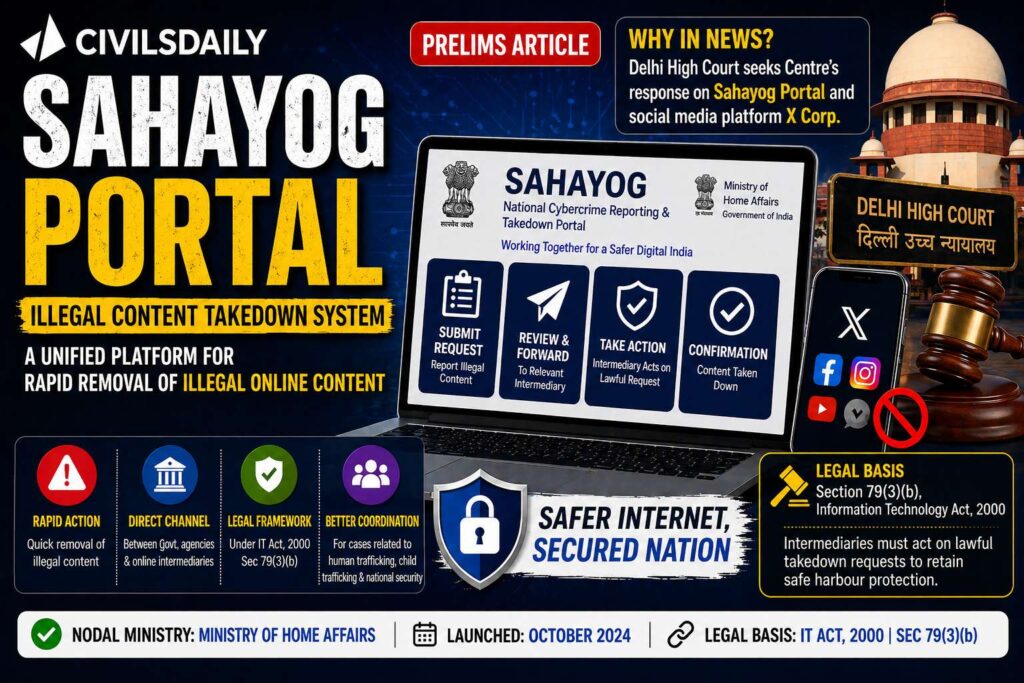
    Sahyog Portal

    • Centralised portal for sending takedown notices
    • Police agencies across India can issue requests
    • Used to coordinate with social media platforms

    3 Hour Rule

    Social media platforms must Remove unlawful content Within 3 hours of receiving order. Order may come from Court, Government agency, and Law enforcement

    Rise in Cybersecurity Incidents

    • According to CERT In
      • 2021: 14.02 lakh incidents
      • 2022: 13.91 lakh incidents
      • 2023: 15.92 lakh incidents
      • 2024: 20.41 lakh incidents
      • 2025: 29.44 lakh incidents
    • Highest incidents reported from National Capital Territory of Delhi

    What is CERT In

    Indian Computer Emergency Response Team

    • National cybersecurity agency
    • Established under Section 70B of IT Act 2000
    • Functions under Ministry of Electronics and IT

    Functions
    • Track cyber threats
    • Issue alerts
    • Incident response
    • Cybersecurity coordination

    [2017] In India, it is legally mandatory for which of the following to report on cyber security incidents?
    1 Service providers 
    2 Data Centres 
    3 Body corporate 
    Select the correct answer using the code given below: 
    (a) 1 only (b) 1 and 2 only (c) 3 only (d) 1, 2 and 3
  • [20th March 2026] The Hindu OpED: AI-powered tax governance in India and its challenges

    PYQ Relevance[UPSC 2023] Introduce the concept of Artificial Intelligence (AI). How does AI help clinical diagnosis? Do you perceive any threat to privacy of the individual in the use of AI in healthcare?Linkage: The question examines the use of Artificial Intelligence in healthcare and the associated concerns of data privacy and ethics. Similar privacy and ethical issues arise in AI-based tax governance, where sensitive financial data is processed.

    Mentor’s Comment

    The growing application of Artificial Intelligence in tax administration has significant implications for revenue mobilisation and governance in India. The Income Tax Department’s Project Insight (PI) represents a major shift towards data-driven tax administration. It leverages Artificial Intelligence and data analytics to enhance compliance, detect evasion, and improve revenue outcomes. 

    What is Project Insight (PI) and how does it function?

    1. Project Insight (PI): Establishes a data-driven tax intelligence system to strengthen compliance and enforcement.
    2. Income Tax Transaction Analysis Centre (INTRAC): Processes financial data from banks, GST, property, and securities to generate taxpayer insights
    3. 360-degree Profiling: Integrates multi-source financial data to build comprehensive taxpayer profiles
    4. Non-intrusive Usage of Data to Guide and Enable (NUDGE) Strategy: Uses behavioural nudges such as SMS and emails to prompt voluntary compliance
    5. Compliance Management Centralised Processing Centre: Ensures behavioural monitoring and correction of inaccurate filings

    How does AI improve tax compliance and administrative efficiency?

    1. Voluntary Compliance: Enables self-correction; over one crore revised returns filed since 2021
    2. Targeted Enforcement: Identifies high-risk taxpayers; 19,501 individuals contacted under NUDGE campaign
    3. Automation of Processes: Reduces routine workload; allows focus on complex assessments
    4. Service Delivery: Assists taxpayers in filing returns and resolving queries through automated systems
    5. Efficiency Gains: Reduces refund processing time from 93 days to 17 days

    What are the measurable outcomes of AI-driven tax governance?

    1. Revenue Augmentation: Generates ₹11,000 crore additional tax collection
    2. Foreign Asset Disclosure: ₹1,089 crore declared under foreign income reporting
    3. Digital Asset Tracking: ₹29,208 crore in overseas assets including cryptocurrencies identified
    4. False Claim Correction: ₹963 crore corrected under NUDGE campaign
    5. Additional Tax Payments: ₹410 crore realised from compliance actions
    6. Evasion Detection: ₹70,000 crore suppressed turnover identified since 2019-20
    7. Fraud Techniques Identified: Fake invoices, sales data manipulation, post-billing modifications

    What are the challenges related to data quality and accuracy?

    1. Data Dependence: Ensures outcomes depend on quality and completeness of input data
    2. False Positives: Flags legitimate transactions (e.g., joint family structures, clerical errors) as suspicious
    3. Error Propagation: Inaccurate data leads to flawed enforcement actions
    4. Administrative Burden: Increases grievance redressal workload

    How does algorithmic bias affect fairness in tax enforcement?

    1. Historical Bias Replication: Uses past enforcement data, reinforcing socio-economic disparities
    2. Geographical Skew: Targets specific regions or taxpayer categories disproportionately
    3. International Example: Dutch childcare benefits scandal demonstrates risks of biased AI systems
    4. Equity Concerns: Undermines fairness and trust in taxation

    Why is explainability critical in AI-based tax systems?

    1. Transparency Requirement: Ensures taxpayers understand reasons for scrutiny
    2. Right to Appeal: Facilitates challenge to algorithmic decisions
    3. Human Oversight: Maintains human-in-the-loop for high-impact decisions
    4. Legal Validity: Supports principles of natural justice and due process

    What are the concerns related to data privacy and security?

    1. Sensitive Data Handling: Involves financial and personal taxpayer information
    2. Cybersecurity Risks: Expands attack surface for data breaches
    3. Surveillance Concerns: Enables potential misuse of taxpayer data
    4. Regulatory Gaps: Highlights need for AI-specific safeguards

    Why is institutional oversight necessary in AI governance?

    1. AI Ombudsman Requirement: Establishes independent grievance redressal
    2. Algorithm Audits: Ensures external verification of AI systems
    3. Public Disclosure: Reports false positives and system accuracy
    4. Trust Building: Enhances legitimacy of tax administration

    Conclusion

    AI-based tax governance improves compliance and revenue outcomes. However, risks related to bias, privacy, and accountability require institutional safeguards. A balance between efficiency and fairness remains essential.

  • Jal Jeevan Mission & Sujal Gaon ID

    Why in the News

    The government has launched Sujal Gaon ID for digital mapping of rural water schemes.

    • Approved Jal Jeevan Mission (JJM) 2.0 extension till Dec 2028.
    • Increased total outlay to ₹8.69 lakh crore.

    What is Sujal Gaon ID?

    • A unique digital ID for every rural piped water supply scheme
    • Enables end-to-end mapping (source → infrastructure → service area)
    • Integrated under “Sujalam Bharat” digital platform

    Key Facts

    • 1.64 lakh Sujal Gaon IDs created
    • Linked to 67,000 Sujalam Bharat IDs
    • Covers 31 States/UTs
    • Aim: Real-time monitoring, transparency, and accountability
    [2024] With reference to the Digital India Land Records Modernisation Programme, consider the following statements: To implement the scheme, the Central Government provides 100% funding. Under the Scheme, Cadastral Maps are digitised. An initiative has been undertaken to transliterate the Records of Rights from local language to any of the languages recognized by the Constitution of India. Which of the statements given above are correct? (a) 1 and 2 only (b) 2 and 3 only (c) 1 and 3 only (d) 1, 2 and 3

  • IT Rules 2026 Amendment on AI Content

    Why in the News?

    The Union Government has amended the IT Rules to mandate prominent labelling of AI generated photorealistic content and sharply reduce takedown timelines for unlawful material. The rules take effect from February 20, 2026.

    Key Highlights

    • Definition of Synthetic Content: AI generated audio, visual or audiovisual content that appears real and indistinguishable from natural persons or real events.
    • Mandatory Labelling: Platforms must seek disclosure if content is AI generated. 
      • If no disclosure, platforms must label it prominently. 
      • Non consensual deepfakes must be removed.
    • Reduced Takedown Timeline: Court or government declared illegal content: within 3 hours. 
      • Non consensual nudity and deepfakes: within 2 hours. Earlier limit was 24 to 36 hours
    • Safe Harbour Impact: Under the Information Technology Act, 2000, intermediaries enjoy safe harbour under Section 79. 
      • Failure to exercise due diligence may lead to loss of immunity.
    • States’ Power: States can now notify more than one officer to issue takedown orders.
    [2020] With the present state of development, Artificial Intelligence can effectively do which of the following? 1. Bring down electricity consumption in industrial units 

    2. Create meaningful short stories and songs 

    3. Disease diagnosis 

    4. Text-to-Speech Conversion 

    5. Wireless transmission of electrical energy 

    Select the correct answer using the code given below: 

    (a) 1, 2, 3 and 5 only (b) 1, 3 and 4 only (c) 2, 4 and 5 only (d) 1, 2, 3, 4 and 5

  • [9th February 2026] The Hindu OpED: A social media ban will not save our children

    PYQ Relevance

    [UPSC 2023] Child cuddling is now being replaced by mobile phones. Discuss its impact on the socialization of children.

    Linkage: This GS-I (Society) question examines the impact of digital technology on family structures, early childhood development, and patterns of socialization.

    Mentor’s Comment

    The debate on banning social media for minors has intensified following policy moves globally and in India. The article argues that prohibition is a simplistic response to a complex structural problem. It cautions against moral panic-driven regulation and instead calls for building a healthy digital media ecosystem grounded in accountability, research, and child protection safeguards.

    Why in the News?

    The issue gains prominence due to a growing global shift toward restricting adolescent access to social media platforms. In 2024, Australia passed a law prohibiting anyone under 16 from holding accounts on major platforms such as Instagram, TikTok, YouTube, Snapchat, and X. It mandates age verification and imposes fines up to $50 million for non-compliance. In February 2026, Spain announced similar restrictions. These measures represent one of the first large-scale legislative attempts to exclude minors from digital platforms entirely. In India, policymakers are considering comparable measures amid rising concern over screen addiction and adolescent mental health.

    Why is a Social Media Ban Being Considered?

    1. Adolescent Mental Health Concerns: Links heavy social media use with anxiety, depressive symptoms, self-harm, and body image dissatisfaction. Evidence remains associational, not causal.
    2. Screen Addiction Narrative: Frames excessive digital engagement as primary cause of adolescent distress.
    3. Policy Response Shift: Australia’s 2024 legislation bans under-16 accounts on major platforms. Imposes mandatory age verification and fines up to $50 million.
    4. International Replication: Spain (February 2026) announced similar prohibition for minors under 16.
    5. Moral Panic Dynamics: Political responses seek visible control measures during public tragedies, producing symbolic crackdowns.

    Does Evidence Justify Blanket Prohibition?

    1. Systematic Reviews: Identify small but consistent associations between heavy usage and mental health challenges.
    2. Gendered Impact: Greater vulnerability among adolescent girls.
    3. Absence of Causality: Studies do not establish direct cause-effect relationship.
    4. Indian Context Gap: Limited domestic studies, but global findings signal caution in usage effects.

    Why May Bans Fail in the Indian Context?

    1. Enforcement Constraints: Adolescents evade age restrictions easily.
    2. VPN Circumvention: Strict age-gating pushes minors toward unregulated platforms or dark web spaces.
    3. Encrypted Migration: Movement to platforms like Instagram or encrypted environments reduces oversight.
    4. Mass Surveillance Risk: Identity verification frameworks risk linking minors’ online activity to government databases.
    5. Gender Inequality Reinforcement: 33.3% of women in India use internet versus 57.1% of men. Bans may disproportionately restrict girls’ mobility and digital access.
    6. Community Loss: For queer and differently-abled teens in small towns, social media provides safe communities otherwise unavailable offline.
    7. Democratic Deficit: Policy decisions occur without consulting adolescents directly.

    What Structural Problems Are Being Ignored?

    1. Platform Design Incentives: Engagement-maximizing algorithms encourage addictive use.
    2. Profit Model Dependence: Revenue tied to user attention and data extraction.
    3. Content Moderation Gaps: Inconsistent enforcement and opaque governance structures.
    4. Digital Protection Weakness: India’s Digital Personal Data Protection Act, 2023 relies on parental consent gating, which may result in exclusion or false declarations.
    5. Under-Regulated AI Integration: Generative AI chatbots integrated into platforms increase exposure to unverified health advice and harmful interactions.
    6. Emerging Risks: AI-related cases include sexualised interactions with minors and alleged self-harm inducement.

    What are the Policy Alternatives Available?

    1. Platform Accountability: Legally enforceable “duty of care” obligations.
    2. Independent Regulation: Oversight by expert regulators, not solely by the Ministry of Electronics and IT.
    3. Research Infrastructure: Longitudinal studies on children’s digital well-being across class, caste, gender, and region.
    4. Notice-and-Repair Model: Move beyond takedown mechanisms to systemic platform design reform.
    5. Healthy Media Ecology: Balance innovation with child safety and democratic transparency.
    6. Avoid Illusion of Control: Recognize that bans offer symbolic reassurance without systemic resolution.

    Conclusion

    Blanket prohibition simplifies a complex structural issue. It risks deepening inequalities, encouraging circumvention, and expanding surveillance frameworks. Sustainable reform requires platform accountability, independent oversight, evidence-based research, and systemic redesign of digital environments.

  • PAIMANA Portal

    Why in the News?

    The Ministry of Statistics and Programme Implementation has operationalised the PAIMANA portal for mandatory monitoring of Central Sector Infrastructure Projects worth ₹150 crore and above.

    About PAIMANA Portal

    • PAIMANA stands for Project Assessment, Infrastructure Monitoring and Analytics for Nation-building.
    • It is a flagship digital initiative of MoSPI aimed at strengthening monitoring, transparency and data driven governance in infrastructure development.

    Objectives

    • Create a centralised national repository of major infrastructure projects
    • Enable evidence based decision making using analytics
    • Improve data accuracy, operational efficiency and project oversight

    Key Features

    • Centralised Project Monitoring: Single window system for ministries, departments and implementing agencies to upload, track and review project data
    • Real Time Dashboards: Interactive dashboards with drill down options to monitor progress across sectors, states and timelines
    • Advanced Data Analytics: Includes reporting tools, query modules, review cases and identification of data gaps
    • Role Based Access: Different user roles for data entry, validation and monitoring to ensure accountability
    • Integration: Integrated with Department for Promotion of Industry and Internal Trade’s Integrated Project Monitoring Portal (IPMP or IIG PMG) through APIs
    • Coverage: Mandatory monitoring of Central Sector Infrastructure Projects worth ₹150 crore and above
    [2022] In India, what is the role of the Coal Controller’s Organization (CCO)? 

    1. CCO is the major source of Coal Statistics in Government of India

    2. It monitors progress of development of Captive Coal/Lignite blocks

    3. It hears any objection to the Government’s notification relating to acquisition of coal-bearing areas

    4. It ensures that coal mining companies deliver the coal to end users in the prescribed time. 

    Select the correct answer using the code given below: 

    (a) 1, 2 and 3 (b) 3 and 4 only (c) 1 and 2 only (d) 1, 2 and 4

  • Internet Governance Capacity Building Programme

    Why in the News

    India marked one year of the Internet Governance Internship and Capacity Building Scheme (IGICBS), highlighting its role in preparing young professionals to engage effectively in national and global internet governance forums and represent India’s interests.

    Key Institutions Involved

    • National Internet Exchange of India
    • Ministry of Electronics and Information Technology

    About IGICBS

    • A first of its kind capacity building initiative launched in 2024
    • Aims to build human capital in internet governance
    • Targets students and young professionals from Technology, Law, and Public policy.
    • Combines expert led learning, mentorship and internships
    • Bridges policy, technology and academia

    Key Achievements in One Year

    • 10,000 plus participants trained and engaged
    • Creation of a national pipeline of internet governance professionals
    • Strengthened India’s presence in global standards and technical forums
    • Increased youth participation in multi stakeholder internet governance processes

    Strategic Significance

    • Enhances India’s role in global internet governance
    • Supports a secure, inclusive and resilient digital ecosystem
    • Aligns with India’s vision of knowledge led digital governance
    • Builds capacity for engagement in forums such as global internet governance discussions and technical standard bodies

    Prelims Pointers

    • IGICBS is a capacity building and internship programme, not a regulatory body
    • Implemented by NIXI under MeitY
    • Focuses on internet governance, not just coding or IT skills
    • Emphasises youth participation and global engagement
    • Example of soft power through digital leadership
    [2017] In India, it is legally mandatory for which of the following to report on cyber security incidents? 

    1. Service providers 

    2. Data Centres 

    3. Body corporate 

    Select the correct answer using the code given below: 

    (a) 1 only (b) 1 and 2 only (c) 3 only (d) 1, 2 and 3

  • PANKHUDI Portal  

    Why in the News?

    The Union Minister launched PANKHUDI, an integrated digital portal to improve ease of living for women and children by streamlining CSR and voluntary partnerships.

    About PANKHUDI Portal

    • A single window integrated digital platform
    • Facilitates CSR and voluntary contributions for women and child development
    • Enables transparent funding, proposal tracking, and outcome monitoring
    • Nodal Ministry: Ministry of Women and Child Development

    Objectives

    • Strengthen coordination among government, citizens, NRIs, NGOs, and corporates
    • Improve transparency and accountability in social investments
    • Enhance service delivery and outcomes for women and children nationwide

    Key Features

    Unified CSR Interface

    • Single platform for individuals, NRIs, NGOs, corporates, and government agencies
    • Simplifies collaboration with government programmes
    • Priority Focus Areas: Nutrition, Health, Early Childhood Care and Education,Child welfare and protection, Women’s safety and empowerment

    Support to Flagship Missions

    • Digitally strengthens
      • Mission Saksham Anganwadi and Poshan 2.0
      • Mission Vatsalya
      • Mission Shakti

    End-to-End Transparency

    • Online registration and proposal submission
    • Digital approvals and real time monitoring
    • Non cash contributions only to ensure traceability

    Scale of Impact

    • Covers more than 14 lakh Anganwadi Centres
    • Around 5,000 Child Care Institutions
    • Nearly 800 One Stop Centres
    • About 500 Shakhi Niwas
    • Around 400 Shakti Sadan

    Significance

    • Reduces procedural friction in government partnerships
    • Enhances monitoring and convergence of welfare schemes
    • Improves measurable impact of CSR and voluntary funding
    • Strengthens digital governance in social sector delivery

    Prelims Pointers

    • PANKHUDI is a CSR facilitation portal
    • Focused on women and child development
    • Operates through non cash contributions
    • Linked with major flagship missions
    [2024] With reference to Corporate Social Responsibility (CSR) rules in India, consider the following statements: 

    1. CSR rules specify that expenditures that benefit the company directly or its employees will not be considered as CSR activities. 

    2. CSR rules do not specify minimum spending on CSR activities. 

    Which of the statements given above is/are correct? 

    (a) 1 only (b) 2 only (c) Both 1 and 2 (d) Neither 1 nor 2