The Arun River, which flows across Nepal and Tibet, is eroding rock and soil in its basin, leading to the rise of Mount Everest by up to 2 mm a year.
How is Arun River making the Everest taller?
The Arun River is contributing to the rise of Mount Everest through a process called isostatic rebound. Here’s how it works:
1. River Incision:
The Arun River, which flows about 75 km from Mount Everest, is eroding large amounts of rock and soil from the surrounding landscape.
This process of erosion reduces the weight on the Earth’s crust in the Arun River basin.
A study by UCL suggests that the Arun River’s ability to carve out large amounts of rock and other materials may be due to it capturing another river or water system in Tibet.
This process is known as River Incision, where the river cuts downward into its bed, deepening its channel.
The erosion began to accelerate around 89,000 years ago when the Arun River merged with the Kosi River, removing large amounts of landmass and further reducing the weight on the region’s crust.
2. Isostatic Rebound:
When the weight of the land (due to rocks, soil, or even ice) decreases, the Earth’s crust rises to balance the change.
This is similar to how a boat rises in water when heavy cargo is removed.
The removal of landmass in the Arun River basin allows the crust underneath Mount Everest to rise.
AboutArun River
The Arun River originates in the Tibet Autonomous Region of China, where it is known as Phung Chu or Bum-chu in Tibetan.
It flows into Nepal and confluences with the Sun Koshi and Tamur River at Tribenighat, forming the Sapta Koshi River.
Tributaries:
Left tributaries: Yeru Tsanpo, Trakar-chu.
Right tributary: Barun River.
At the Nepal border, the Arun River is approximately 3,500 meters (11,500 ft) above sea level.
The river drains into the Koshi River, significantly contributing to the Sapta Koshi River system in Nepal.
It is the largest trans-Himalayan river in Nepal, playing a crucial role in supporting the region’s hydrology and ecosystems.
It provides around 37% of the total water in the Sapta Koshi system, following the Sun Koshi which contributes 44%.
Recently, the Arun-III Hydro Power Project (900 MW), which constructed with $6.95b Indian assistance, achieved a milestone with a tunnel breakthrough.
PYQ:
[2017] With reference to river Teesta, consider the following statements:
1. The source of river Teesta is the same as that of Brahmaputra but it flows through Sikkim.
2. River Rangeet originates in Sikkim and it is a tributary of river Teesta.
3. River Teesta falls into Bay of Bengal at the border of India and Bangladesh.
Which of the statements given above is/are correct?
A recent study has found that the overexploitation of medicinal plants, is threatening the survival of swallowtail butterflies in the forest habitats of Assam’s Bodoland Territorial Region.
AboutSwallowtail Butterfly
Details
Family and Species
Family: Papilionidae
Global species: 573
Indian species: 77
Characteristics
Large size, brightly colored wings, tail-like extensions on hindwings
Strong fliers, diurnal, territorial behavior, feed on nectar
Distribution
Found in tropical and temperate regions of Asia, Africa, Americas
Habitat in India
Found in rainforests, woodlands, cultivated lands, and protected areas like the Western Ghats and Northeast India
Host Plants
Depend on specific plants like Rutaceae, Aristolochiaceae, Lauraceae, and Magnoliaceae families for larval development
Threats
Host plants, especially medicinal plants, are being overexploited in areas like the Bodoland Territorial Region
Deforestation, illegal cattle farming, agriculture, tree felling, and pesticide use
Swallowtail Conservation Action Plan (SCAP)
Purpose
To protect and conserve endangered swallowtail species and prevent their extinction
Focus Area
Focuses on habitat protection, host plant conservation, and population restoration
Swallowtail-Rich Zones
Northeastern India designated as a key zone for swallowtail conservation under SCAP
Legal Protection
12 swallowtail species in India are under federal protection;
Some species are listed under Schedule I of the Wildlife Protection Act.
Community Role
SCAP involves local communities in protecting host plants and preventing activities like illegal cattle grazing
PYQ:
[2016] Recently, for the first time in our country, which of the following States has declared a particular butterfly as ‘State Butterfly’?
The delayed onset of La Niña and the late retreat of the monsoon have diminished hopes that Delhi’s residents might enjoy improved air quality this winter compared to previous years.
What is Triple-dipLa- Nina?
Triple-dip La Niña refers to the rare occurrence of La Niña persisting for three consecutive years, causing prolonged cooler ocean temperatures in the Pacific and influencing global weather patterns, including stronger monsoons.
How has the triple-dip La Niña phenomenon influenced air quality in North India?
No dispersion of pollutants: The delayed onset of La Niña has led to stagnant air and calm winds, preventing the dispersion of pollutants. In previous winters, La Niña helped improve air quality with stronger winds and atmospheric circulation.
Trapped air pollutants: The slower monsoon retreat resulted in extended periods of high humidity, reduced atmospheric mixing, and trapped pollutants near the surface, contributing to deteriorated air quality.
What meteorological factors contributed to the observed anomalies in air quality?
Monsoon Retreat and Humidity: The delayed retreat of the monsoon contributes to prolonged periods of high humidity and calm winds. These conditions reduce atmospheric mixing, trapping pollutants near the surface and leading to elevated levels of PM2.5 and PM10.
Stagnant Winds: The absence of La Niña conditions results in stagnant surface winds, which hinder the dispersion of pollutants. This stagnation is particularly problematic given the regional emissions from stubble burning and other sources.
Stubble Burning: With prevailing north-north-westerly winds, stubble burning in Punjab and Haryana could significantly worsen Delhi’s air quality if it occurs at even half the intensity seen in previous years.
What implications does this have for future climate and air quality management strategies?
Need for Broader Focus: There is a growing recognition that air quality management must shift from a localized emission-centric approach to one that considers larger meteorological patterns and regional airsheds.
Policy Recommendations: Policymakers should prioritize mitigating PM2.5 emissions over PM10, as PM2.5 poses greater health risks.
Integration of Climate Factors: Future air quality strategies should integrate climate change considerations, recognizing that local emissions are only part of the equation.
Way forward:
Adopt Regional Airshed Management: Shift from a localized approach to a broader airshed strategy, accounting for meteorological patterns and regional pollution sources to improve air quality management.
Prioritize PM2.5 Mitigation and Climate Integration: Focus on reducing PM2.5 emissions, which pose higher health risks, and incorporate climate change factors into long-term air quality policies for comprehensive solutions.
An annular solar eclipse will be visible in parts of South America on October 2, 2023. It, however, will not be visible from India.
What is a Solar Eclipse?
A solar eclipse occurs when the Moon moves between the Earth and the Sun, blocking the Sun’s light either fully or partially, casting a shadow on certain parts of the Earth.
There are four types of solar eclipses:
Total Solar Eclipse: When the Moon completely blocks the Sun, turning the sky dark. People in the path of a total solar eclipse can witness the Sun’s corona (its outer atmosphere), which is normally hidden by the bright sunlight.
Annular Solar Eclipse: Occurs when the Moon is at or near its farthest point from Earth. The Moon does not fully cover the Sun, leaving a visible ring of fire around the Moon. This is what people in parts of South America will witness on October 2, 2023.
Partial Solar Eclipse: Happens when the Moon blocks only a part of the Sun, giving it a crescent shape. During both partial and annular eclipses, areas outside the Moon’s umbra (the darkest part of its shadow) experience a partial eclipse. It is the most common type of solar eclipse.
Hybrid Solar Eclipse: The rarest type, where the eclipse shifts between total and annular as the Moon’s shadow moves across the Earth. Some places see a total solar eclipse, while others see an annular one.
Frequency of Solar Eclipses
A solar eclipse can only occur during the new moon, when the Moon and Sun are aligned on the same side of the Earth.
A new moon happens approximately every 29.5 days because that is the time it takes for the Moon to orbit the Earth.
However, solar eclipses don’t happen every month. They occur two to five times annually, but not every new moon results in an eclipse.
Why don’t they occur every month:
The Moon’s orbit around the Earth is tilted by about 5 degrees compared to the Earth’s orbit around the Sun.
This means the Moon’s shadow usually misses the Earth.
A solar eclipse only occur when the Moon crosses specific points in its orbit, called nodes, where the Moon’s orbit intersects the plane of Earth’s orbit around the Sun.
When a new moon occurs at one of these nodes, a solar eclipse is possible.
PYQ:
[2019] On 21st June, the Sun
(a) does not set below the horizon at the Arctic Circle
(b) does not set below the horizon at Antarctic Circle
(c) shines vertically overhead at noon on the Equator
(d) shines vertically overhead at the Tropic of Capricorn
A study conducted at Moorea, French Polynesia, has revealed that the network of dead coral skeletons left behind by bleaching events prevents reefs from regenerating.
About Corals
Corals are marine invertebrates made up of genetically identical organisms called polyps.
Polyps have a mutualistic relationship with microscopic algae called zooxanthellae that live within their tissues.
Zooxanthellae perform photosynthesis, providing the corals with carbohydrates, while the corals offer compounds needed for photosynthesis.
Corals have calcium carbonate skeletons, which help in building the reef structure.
Thousands of polyps combine to form coral colonies, which multiply and grow over time.
Coral reefs are underwater ecosystems formed by the accumulation of calcium carbonate skeletons from corals.
Known as the “rainforests of the seas”, they provide habitat and protection for a wide variety of marine life.
Coral reefs are built by both hard and soft corals and grow over time as more corals attach to the reef structure.
They are the largest living structures on the planet, vital for marine biodiversity.
Challenges due to Dead Corals
Shelter for Seaweed: Dead coral skeletons create a complex structure that offers protection to macroalgae (seaweed) from herbivores. This allows seaweed to colonize the reef quickly, outcompeting young coral.
Impeded Herbivory: The complex landscape of dead corals prevents herbivores, which normally graze on algae, from accessing the macroalgae effectively. This leads to unchecked algae growth.
Increased Competition: Macroalgae grow faster and reproduce more frequently than coral, leading to increased competition for space, light, and nutrients, which further inhibits young coral from settling and growing.
Annual Coral Reproduction: Coral typically spawns only once a year, while algae reproduce continuously. This gives algae a competitive advantage in newly available spaces left by dead coral skeletons.
Altered Ecosystem Balance: The presence of dead coral shifts the balance between herbivores, algae, and coral, making it difficult for the reef to regenerate naturally.
Conditions for Reef Regeneration
Flat Substrate: After events like cyclones, which remove coral but leave behind a flat surface, reefs tend to recover more easily, as young coral can settle and regrow without much competition from macroalgae.
Herbivore Activity: Active herbivory is crucial for reef recovery, as herbivores control the growth of macroalgae, allowing space for coral recruits to settle and thrive.
Clear Space for Coral Recruits: To regenerate effectively, coral needs open space free from excessive algae. Removing dead coral skeletons might help create these conditions.
Frequent Disturbances: Coral reefs are better adapted to recover from frequent but non-lethal disturbances like storms, which scrape off coral and allow for fresh regrowth, compared to bleaching events, which leave the dead coral structure intact.
Water Quality and Temperature: Coral recovery depends on optimal water conditions, including the absence of pollutants and suitable temperatures.
PYQ:
[2018] Consider the following statements
Most of the world’s coral reefs are in tropical waters.
More than one-third of the world’s coral reefs are located in the territories of Australia, Indonesia and Philippines.
Coral reefs host far more number of animal phyla than those hosted by tropical rainforests.
Which of the statements given above is/are correct?
Q). Should the pursuit of carbon credits and clean development mechanisms set up under UNFCCC be maintained even though there has been a massive slide in the value of a carbon credit? Discuss with respect to India’s energy needs for economic growth. (UPSC CSE 2014) Q). In the view of the declining average size of land holdings in India which has made agriculture non – viable for a majority of farmers should contract farming and land leasing be promoted in agriculture? critically evaluate the pros and cons. (UPSC CSE 2015) Q). Sikkim is the first ‘Organic State’ in India. What are the ecological and economical benefits of Organic State? (UPSC CSE 2018)
Prelims:
In the context of India, which of the following is/are considered to be practice(s) of eco-friendly agriculture? (UPSC CSE 2020) 1. Crop diversification 2. Legume intensification 3. Tensiometer use 4. Vertical farmingSelect the correct answer using the code given below: (a) 1, 2 and 3 only (b) 3 only (c) 4 only (d) 1, 2, 3, and 4
Mentor’s Comment: Agroforestry plays a crucial role in enhancing the resilience of Indian agriculture through various mechanisms. By integrating trees with crops and livestock, agroforestry provides farmers with multiple income streams, reducing dependence on single crops and mitigating the impact of market fluctuations. The integration of trees provides shade and wind protection, making agricultural systems more resilient to extreme weather events such as droughts and floods. This adaptability is vital for farmers facing unpredictable climate patterns. In today’s editorial, we will focus on Indian-centric issues.
_
Let’s learn!
Why in the News?
Recent studies indicate that with the right policies and financial support, India could sequester an additional 2.5 billion tons of CO2 equivalent by 2030 in the agroforestry sector.
Currently, agro-forestry represents 8.65% of India’s land and contributes 19.3% of its carbon stocks, playing a vital role in both environmental sustainability and economic growth.
India is poised to increase agroforestry area from 28.4 million hectares to 53 million hectares by 2050.
CASE STUDY of UP:
• In Uttar Pradesh, a new agroforestry project aims to connect local farming with the global carbon credit market, potentially generating 4.5 million carbon credits valued at around Rs 230 crore. • This initiative is part of a broader strategy to enhance rural incomes while increasing the state’s green cover from 9.23% to 15% by 2027. • The success of these projects hinges on adapting carbon finance standards to better suit India’s unique agricultural landscape, which could unlock further opportunities for smallholder farmers.
How does the ‘Polluter Pays Principle’apply to carbon credits in agro-forestry?
The Polluter Pays Principle (PPP) is a fundamental concept in environmental economics that holds polluters responsible for the costs associated with their environmental impact.
Responsibility for Emissions: Industries that emit greenhouse gases are required to compensate for their emissions by purchasing carbon credits.
Each credit represents one ton of CO2 or its equivalent that has been sequestered or reduced, which creates a financial incentive for these industries to invest in carbon offset projects like agroforestry.
Market Dynamics: The carbon credit market operates on the principle that companies must buy credits to offset their emissions, thus internalizing the external costs of pollution.
What are the present issues for the Indian Market?
In carbon finance, “common practice” assesses the projects that have additional regional activities (larger areas), meaning they are disqualified from earning carbon credits if they don’t provide additional environmental benefits.
For example, standards like Verra’s VCS and Gold’s current definitions reflect large-scale agricultural practices in regions like Latin America and the U.S., overlooking India’s context of small, fragmented landholdings.
However, in India, approximately 86.1% of farmers have less than two hectares, often practicing agroforestry in a non-systematic manner, which may not meet the additionality criteria. Many Indian farmers are excluded from ARR carbon finance projects due to this.
Why is there a need for an India-centric approach?
Revising standards to fit India’s fragmented small-holder model could allow more farmers to participate in carbon finance projects.
Enhanced Income Streams: Integrating agroforestry with Afforestation, Reforestation, and Revegetation (ARR) initiatives provides farmers with additional income through carbon credits, diversifying their revenue sources.
This integration helps tackle issues such as low productivity, small land holdings, dependence on monsoons, and environmental degradation by promoting sustainable land management practices.
Soil and Ecosystem Health: Agro-forestry practices improve soil quality, enhance water retention, and mitigate erosion, contributing to overall ecosystem health and agricultural productivity.
Biodiversity Conservation: The integration encourages greater biodiversity by incorporating various tree species alongside crops, promoting ecological balance within agricultural landscapes.
Alignment with National Goals: The integration supports India’s climate goals and commitments under international agreements by increasing carbon sequestration potential and enhancing green cover.
Long-Term Sustainability: By establishing a systematic approach to agroforestry through ARR initiatives, farmers can achieve sustainable agricultural practices that ensure long-term productivity and environmental health.
Way Forward:
TheEnergy and Resources Institute (TERI)has launched 19 ARR projects across seven states in India, benefiting over 56,600 farmers.
To scale these initiatives, international carbon finance platforms must revise their standards to align with the realities of Indian agriculture.
A systematic approach to agro-forestry supported by carbon finance can help farmers diversify their income, making them more resilient to climate variability.
The Supreme Court has criticized the Commission for Air Quality Management (CAQM) for its lack of concrete action to curb stubble burning in states neighboring Delhi.
Key issues as per SC:
Non-Compliance and Ineffectiveness: The Supreme Court criticized the CAQM for failing to enforce the CAQM Act, highlighting a lack of concrete measures against stubble burning in Punjab and Haryana.
Lack of Accountability: The Court questioned the CAQM’s accountability, emphasizing the need for concrete actions and consequences for officials who fail to enforce anti-pollution laws.
Staffing and Representation Issues: The Court expressed concerns over staffing shortages in pollution control boards and inadequate representation in CAQM sub-committees, hindering effective operation.
Scepticism on Pollution Reduction Claims: Despite claims of improved air quality and reduced stubble burning, the Court remained doubtful, citing ongoing instances of stubble burning and demanding detailed explanations from the CAQM.
AbouttheCommission for Air Quality Management (CAQM):
Details
Formation
Established in 2021;
Statutory body under the Commission for Air Quality Management in NCR and Adjoining Areas Act, 2021
Objective
To manage air quality in the NCR and adjoining areas comprehensively
Composition
Headed by a full-time chairperson, with members from various states, ministries, and sectors like agriculture, industry, transport, and construction
Powers
Authority to issue directions, inspect industries, entertain complaints, restrict industries, and shut down non-compliant units
Jurisdiction
National Capital Region (NCR) and adjoining areas in Punjab, Haryana, Uttar Pradesh, and Rajasthan
Functions
Coordinates and monitors air quality, sets pollution control parameters, identifies violators, monitors industries, and can overrule state directives
PYQ:
[2018] How is the National Green Tribunal (NGT) different from the Central Pollution Control Board (CPCB)?
1. The NGT has been established by an Act whereas the CPCB has been created by an executive order of the Government.
2. The NGT provides environmental justice and helps reduce the burden of litigation in the higher courts whereas the CPCB promotes cleanliness of streams and wells and aims to improve the quality of air in the country.
Which of the statements given above is/are correct?
(a) 1 only
(b) 2 only
(c) Both 1 and 2
(d) Neither 1 nor 2
[2022]The most significant achievement of modern law in India is the constitutionalization of environmental problems by the Supreme Court.” Discuss this statement with the help of relevant case laws.
[2015] Mumbai, Delhi and Kolkata are the three Mega cities of the country but the air pollution is much more serious problem in Delhi as compared to the other two. Why is this so?
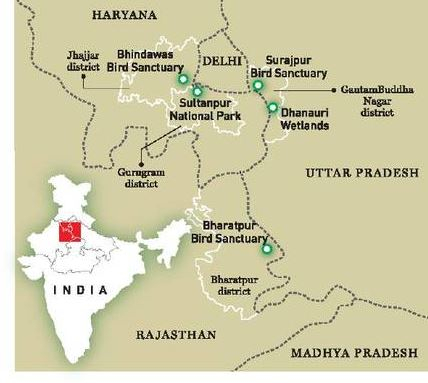
The NGT has ordered the UP government to remove water hyacinth from “Dhanauri wetlands” and questioned its failure to designate the wetland as a Ramsar site.
AboutDhanauri Wetland
Details
Location
Dhanauri village near Dankaur, Uttar Pradesh;
Floodplains of Yamuna.
Key Species
Home to over 120 Sarus Cranes (state bird of Uttar Pradesh) and 217 bird species
Ecological Significance
Important birding and nesting site; recognized as an Important Bird Area by Bird Life International
Bird Population
Hosts over 50,000 waterfowls during migratory seasons (November to March)
Ramsar Criteria
Fulfills 2 Ramsar criteria:
1. Hosts over 1% of biogeographic Sarus Crane population
2. Congregation site for 20,000+ waterfowls
Conservation Status
Documented by BNHS (Bombay Natural History Society); crucial for supporting endangered species
Ramsar Wetlands
The Ramsar Convention, also known as the ‘Convention on Wetlands,’ is an intergovernmental environmental treaty founded by UNESCO in 1971.
It derives its name from the city of Ramsar in Iran, where it was initially signed.
Ramsar sites are wetlands of global significance recognized under this treaty.
The Montreux Record is a register of wetland sites on the brink of ecological changes and in need of close monitoring under the Ramsar Convention.
Ramsar Site Designation Criteria:
Ramsar site designation hinges on several factors:
Representing rare or unique natural wetland types.
Supporting endangered species or threatened ecological communities.
Maintaining biodiversity in specific biogeographic regions.
Offering refuge during adverse conditions.
Regularly accommodating 20,000 or more waterbirds.
Sustaining 1% of a population of a single water-bird species.
Serving as a critical source of food, spawning grounds, nurseries, and migration paths for fish.
Regularly supporting 1% of a population of non-avian wetland-dependent animal species.
The record warming of 2023-2024 is offering a clearer view of the impacts of global warming. The range of extreme events experienced globally has spanned from deadly heatwaves to devastating cyclones and floods, as well as droughts and wildfires.
Impact of Warming on Predictability:
Increased Variability: The record warming of 2023-2024 highlights the unpredictability of climate systems under global warming, complicating forecasts for natural phenomena like El Niño, monsoons, and hurricanes.
Natural Variability: Warming may extend the timescale of natural decadal variability, making it harder to distinguish between short-term fluctuations and long-term trends in climate behaviour.
Model Limitations: Despite advances, climate models are imperfect in capturing changes in dominant climate modes due to warming, leading to inconsistencies in predicting events like monsoon trends.
Types of Climate Models to forecast the weather:
General Circulation Models (GCMs): These models simulate the physics of the climate system by representing the interactions between the atmosphere, oceans, land, and ice. They divide the Earth into a three-dimensional grid and calculate climate variables like temperature and humidity in each grid cell.
Earth System Models (ESMs): An advanced subset of GCMs that includes biogeochemical cycles, allowing them to simulate interactions between climate and ecological processes, such as carbon and nitrogen cycles.
Regional Climate Models (RCMs): These focus on smaller geographic areas to provide more detailed climate projections by using outputs from GCMs as inputs for localized simulations.
Integrated Assessment Models (IAMs): These combine climate science with socioeconomic factors to analyze how human activities influence climate change and to project future emissions scenarios.
Challenges in Forecasting Extreme Weather:
Inconsistent Predictions: Predictions for extreme weather events in 2023, such as the monsoon and hurricane seasons, were less accurate, revealing the limitations of current models and observational networks.
Unforeseen Factors: Unanticipated contributions, like the impact of the Hunga Tonga volcano or wildfire-induced CO2 emissions, exacerbated warming in ways models failed to predict, illustrating the unpredictability of new factors.
Censorship Concerns: The rapid response required from social media platforms to act on content flagged as misleading within 36 hours created concerns about censorship and freedom of expression.
Future of Weather Prediction Models:
Need for Model Improvements: There is ongoing work to refine models and incorporate the latest technologies, including AI and machine learning, to improve weather prediction accuracy at hyperlocal scales.
Natural Modes and Uncertainty: The predictability of natural modes (El Niño, La Niña, IOD) may decrease with relentless warming, making future climate forecasts increasingly uncertain.
Short-Term Focus: A shift toward short-term predictions (up to a decade or two) may offer more reliable projections due to the inherent difficulty in predicting long-term scenarios under continuous global warming.
Way forward:
Enhanced Climate Models: Invest in improving climate models with cutting-edge technologies like AI, machine learning, and advanced sensors to increase the accuracy of short-term forecasts and better capture the impact of natural variability under warming.
Localized Early Warning Systems: Develop robust, hyperlocal early warning systems to better prepare for extreme weather events, focusing on disaster management and reducing vulnerabilities in high-risk communities.
In September 2023, seismic stations across the world detected an unusual signal which persisted for 9 days.
It was caused by a massive landslide in Greenland’s Dickson Fjord (i.e narrow sea inlet with steep sides or cliffs, created by a glacier).
About the Massive Greenland Landslide
The landslide involved a colossal volume of 25 million cubic metres of rock and ice, equivalent to filling 10,000 Olympic-sized swimming pools.
The landslide involved 25 million cubic meters of rock and ice, which is enough to fill 10,000 Olympic-sized swimming pools.
This event caused a mega-tsunami with waves as high as 200 meters, which significantly impacted the area.
The seismic waves created by the landslide lasted for 9 consecutive days.
The loss of such a large amount of glacier ice highlights how global warming is speeding up damage to these fragile environments.
Causes of the Greenland Landslide
The main reason for the landslide was global warming, which caused the glaciers in Greenland to melt and shrink over recent decades.
The Hvide Stovhorn peak glacier had been holding up the mountain slopes, but as it thinned, the rock above it became unstable and eventually collapsed.
The permafrost (frozen ground) on the mountain’s steep slopes started melting because of rising temperatures, making the slopes unstable.
When the rocks and ice fell into the fjord, it triggered a submarine landslide (a landslide under water), which made the event even bigger and caused a mega-tsunami.