💥Join UPSC 2027,2028 Mentorship (July Batch) + XFactor Notes & Microthemes PDF

Subject: Environment

  • Twin balance sheet problem

    Note4Students/Syllabus Mapping: GS3

    The Economic Survey 2015-16 for the first time highlighted the weakening balance sheets of public sector banks and that of some large corporate houses as one of the most critical short-term challenges for the Indian economy and an impediment to economic recovery. Terming it as ‘Twin balance sheet challenge’, it is clear that the TBS problem is the major impediment to private investment, and thereby to a full-fledged economic recovery. Undoubtedly, this makes it a hot topic for 2017 CSE Mains in the context of Indian economic challenges that need immediate attention.


    What is this Twin Balance Sheet Problem?

    The twin balance sheet problem refers to the ballooning of debt on the books of corporate entities and the estimated Rs10 trillion of stressed assets that have piled up at banks because of the inability of borrowers to repay.

    Thus, TBS is two-fold problems for Indian economy which deals with:

    1. Overleveraged companies – Debt accumulation on companies is very high and thus they are unable to pay interest payments on loans. Note: 40% of corporate debt is owed by companies who are not earning enough to pay back their interest payments. In technical terms, this means that they have an interest coverage ratio less than 1.
    2. Bad-loan-encumbered-banks – Non Performing Assets (NPA) of the banks is 9% for the total banking system of India. It is as high as 12.1% for Public Sector Banks contributing to four-fifths of the total NPAs. As companies fail to pay back principal or interest, banks are also in trouble.


    Concerns  around this TBS issue

    Corporate Sector Banking Sector
    • Gross capital formation by the private sector has come down sharply over the past three years. The Gross Fixed Capital Formation has declined from 34% in 2011-12 to 27% in 2016-17 which indicates stalled investments in the economy.
    • More than four-fifths of the non-performing assets are in the public sector banks, where the NPA ratio had reached almost 12 percent.
     The corporate investment is in the doldrums right now. New data from the Centre for Monitoring Indian Economy shows that new project proposals in the June quarter were at their lowest level in three years.
    • At its current level, India’s NPA ratio is higher than any other major emerging market (with the exception of Russia), higher even than the peak levels seen in Korea during the East Asian crisis.
    • New data from the Centre for Monitoring Indian Economy shows that new project proposals in the June quarter were at their lowest level in three years.


    • 40 percent of the corporate debt it monitored did not earn enough to pay the interest obligations on their loans.
     The capital adequacy ratio of six banks is likely to fall below 9% in a severe macro stress scenario, dragging the system-level ratio down to 11.2% by March 2018 from 13.3% as of March 2017.
     While corporate debts are rising, the economic survey noted that their profits are low and the situation is forcing the firms to cut investment and preserve their cash flow.  The latest edition of the regulator’s Financial Stability Report (FSR), released on Friday, said a severe credit shock is likely to impact capital adequacy and profitability of a significant number of banks.
    • At least 13 of these banks accounting for approximately 40 per cent of total loans are severely stressed


    What are the reasons for this issue?

    1. The origins of the NPA problem dates back to the decision taken during the mid-2000s.
    2. During this period for the first time in the country’s history, everything was going right: corporate profitability was amongst the highest in the world, encouraging firms to hire labor aggressively, which in turn sent wages soaring.
    3. Firms made plans accordingly. They launched new projects worth lakhs of crores, particularly in infrastructure-related areas such as power generation, steel, and telecoms, setting off the biggest investment boom in the country’s history.
    4. Within the span of four short years, the investment-GDP ratio had soared by 11 percentage points, reaching over 38 percent by 2007-08.
    5. This time saw extraordinary increase in the debt of non-financial corporations.

    Work in Progress- yet visible shortcomings!!

    RBI has deployed several mechanisms to deal with the stressed asset problems, of these mechanisms that are particularly notable. Success of schemes, however, has been limited. There are several reasons why progress has been so limited:

    Poor Loss recognition: – The Asset Quality Review (AQR) was meant to force banks to recognize the true state of their balance sheets but banks kept on ever greening loans.

    Coordination Issues: – The RBI has encouraged creditors to come together in Joint Lenders Forums, where decisions can be taken by 75 percent of creditors by value and 60 percent by number. But reaching agreement in these Forums has proved difficult, because different banks have different degrees of credit exposure, capital cushions, and incentives.

    Lack of Proper incentives: – The S4A scheme recognizes that large debt reductions will be needed to restore viability in many cases. But public sector bankers are reluctant to grant write-downs, because there are no rewards for doing so. To address this problem, the Bank Board Bureau (BBB) has created an Oversight Committee which can vet and certify write-down proposals.

    Massive Capital Constraints: –The government has promised under the Indradhanush scheme to infuse Rs 70,000 crores of capital into the public sector banks by 2018-19. But this is far from sufficient.

    IBC in nascent stage: The new bankruptcy system is not yet fully in place, and even when it is, the new procedures (and participants) will need to be tested first on smaller cases.

    Severe viability issues: – At this point, large write-offs will be required to restore viability to the large IC1 companies (those companies whose earnings do not even cover their interest obligations).

    Lack of teeth in private Asset Reconstruction Companies (ARCs)

    Many ARCs have been created, but they have solved only a small portion of the problem, buying up only about 5 percent of total NPAs. The problem is that ARCs have found it difficult to recover much from the debtors. Thus they have only been able to offer low prices to banks, prices which banks have found it difficult to accept.

    Strategic Debt Restructuring (SDR) scheme

    Under this creditors could take over firms that were unable to pay and sell them to new owners. Only those projects that have started commercial production can take advantage of this scheme

    Sustainable Structuring of Stressed Assets (S4A)

    Under this, creditors could provide firms with debt reductions up to 50 percent in order to restore their financial viability. Unlike CDR, S4A does not allow the banks to offer any moratorium on debt repayment; they are also not allowed to extend the repayment schedule or reduce the interest rate.

    Way forward:

    1. TBS problem can be resolved by taking a four step path that involves – recognition, recapitalization, resolution and reform.
    2. First, there needs to be a readiness to confront the losses that have already occurred in the banking system, and accept the political consequences of dealing with the problem.
    3. Second, the PARA needs to follow commercial rather than political principles. To achieve this, it would need to be an independent agency, staffed by banking professionals. It would also need a clear mandate of maximizing recoveries within a specified, reasonably short time period.
    4. The third issue is pricing. If loans are transferred at inflated prices, banks would be transferring losses to the Rehabilitation Agency. As a result, private sector banks could not be allowed to participate – and then co-ordination issues would remain – while private capital would not want to invest in the Agency, since PARA would make losses.
    5. A rekindled optimism on structural reforms in the Indian economy, along with implementation of GST and diligent implementation of Bankruptcy Code will play supporting pillars.

    Conclusion:

    The twin balance sheet problem is a serious drag on credit growth. The setting up of a centrally-assisted rehabilitation agency will help in taking difficult decisions which the public sector banks are unable to take. The past mechanisms of resolving this problem in the form of decentralized approach have failed. There is no point of delaying this problem because the delay is very costly for the economy as impaired banks are scaling back their credit while the stressed companies are cutting their investments. Time is opportune to create a centralized agency called Public Sector Asset Rehabilitation Agency (PARA) akin to that of East Asia adopted during their crises period. The centralized agency in the form of PARA would allow debt problems to be worked out quickly as highlighted in this year’s Economic Survey.


  • VVPAT debate

    Note4Students/Syllabus Mapping: GS2

    Amid allegations of EVM tampering in the recently concluded state polls and by-polls in 5 states of Punjab, Manipur, UP, Goa, and Uttarakhand have reignited the controversies and raised questions on the fairness of elections in our democracy. Some have demanded revert to ballot paper system and others for wide scale investment in VVPATs. In this article we discuss the various aspects around this issue and how VVPATs can be a solution to a transparent electoral process. Electoral reforms have always been a favourite topic of UPSC and undoubtedly VVPAT analysis in this context makes it a potential question in this year CSE Mains 2017.


    What are the ensuing issues?

    1. In the recent episode of state assembly elections many political parties have raised questions on vulnerability of EVMs and allege result fixing and whether EVMs are tamper-proof?
    2. In the back drop of the media reports that a VVPAT machine showed discrepancies during a demonstration exercise in Madhya Pradesh’s Bhind, concerns are rife about whether EVMs are a reliable medium for fair and transparent elections in the country. Further questions are being raised if people are casting their votes or machines itself deciding it?
    3. Most of the advanced democracies like USA, Germany and Japan continue to rely on paper ballots.
    4. Cross checking and auditing is not feasible, unless equipped with VVPATs.


    Introduction:

    In the wake of the above controversy the Election Commission intends to use voter-verified paper audit trail (VVPAT) in all coming elections to bring in more transparency and boosting the confidence of people in the electoral process. ECI has sent multiple reminders to the Central government to release adequate funds for manufacture of VVPATs.


    Image result C:\Windows\system32\config\systemprofile\Desktop\EVM.jpg

    What is VVPAT?

    1. VVPAT is a slip generated in a printer-like a machine attached to EVM and flashes voter’s choice of candidate and party. Generated slip is shown for a few seconds to the voter to cross check before it falls into a sealed drop box which can be opened during counting.
    2. VVPATs are a second line of verification and are particularly useful in the time when allegations around Electronic Voting Machines’ tampering crop up.
    3. After voting, the VVPAT machine dispenses a paper slip with the name, serial number and symbol of the candidate voted for.


    Advantage VVPAT:

    1. The Voter Verified Paper Audit Trail is a method that provides feedback to voters.
    2. It is an independent verification printer machine and is attached to electronic voting machines.
    3. It allows voters to verify if their vote has gone to the intended candidate.
    4. Under VVPATs, initially, election results are announced based on the recording of votes given by EVMs. If the election results are disputed, then the votes recorded under Paper Trail System shall be counted and announced.
    5. If there is any discrepancy between the two results, then the result given by VVPAT will prevail over the EVMs.

    Working procedure of EVM’s equipped with Voter-verified paper audit trail

    1. VVPAT device functions like a printer to be attached to the ballot unit.
    2. Once the vote is cast it dispenses a paper slip showing the symbol on which it is cast.
    3. The voter can only see this slip through a screened window.
    4. After seven seconds, the slip automatically gets cut and falls into a sealed drop box.
    5. The machines can be accessed, though, by the polling officials and not by the voter.
    6. The printout is deposited in a box and can be used to resolve any dispute regarding the election.


    Flipside Arguments: Election Commission’s response to allegations

    1. ECI said that EVMs can neither be reprogrammed nor controlled by the external device. The source
      code is so designed that it allows the voter to cast the vote only once. The next vote can be
      recorded only after the Presiding Officer enables the ballot on the Control Unit. In between, the
      machine becomes dead to any signal from outside.
    2. The Election Commission said that the comparison between EVMs in India and abroad, where they have
      failed, are both misplaced and misguided. This is because most of the systems used in other
      countries are PC based and running on the operating system. Hence they are vulnerable to hacking.
    3. But EVMs in India are the standalone machine without being part of any input. The software in the
      chip is one time programmable and is burnt into the chip at the time of manufacture. Nothing
      can be written on the chip after manufacture. Thus there is a fundamental difference between
      EVMs in India and abroad.

    Way forward:

    1. The Supreme Court has supported the ECI’s endeavor to use VVPATs in a phased manner to usher in more transparency in voting.
    2. The recent cabinet decision to release funds of Rs 3173 crores for 1.6 million Voter verifiable paper audit trail (VVPAT) units attached electronic voting machines (EVMs), is a positive step in line with ECI’s strategy for the 2019 next general election.
    3. Two public sector units —Electronic Corp. of India Ltd (ECIL) and Bharat Electronics Ltd (BEL) have been approached for manufacture of those VVPATs.

    Conclusion:

    A free and fair election is the key requirement for sustaining the faith in the democratic ethos and thus, all such allegations on the integrity of EVMs shall be put to test by the ECI with active involvement of political parties. The increased usage of VVPATs attached EVMs are a major step in strengthening democracy as directed by the Supreme Court. It should be followed up with other electoral reforms like Right to rejection, transparency in political parties and their election finances, disqualifying criminals from contesting elections on filing of charge sheets etc as recommended by various law commissions. Political parties should come together irrespective of their positions and decide upon these electoral issues in order to further strengthen the largest democracy in world.

  • Compensatory Afforestation Fund Bill: Significance & Challenges


    “The environment and the economy are really both two sides of the same coin if we cannot sustain the environment we cannot sustain ourselves”-Wangari Mathai

    Why in News

    Recently Rajya Sabha passed The Compensatory Afforestation Fund Bill, 2016.   The Bill had earlier been passed by Lok Sabha in May 2016.

    Context

    1. India is one of the ten most forest-rich countries of the world along with the Russian Federation, Brazil, Canada, United States of America, China, Democratic Republic of the Congo, Australia, Indonesia and Sudan.
    2. The 2013 Forest Survey of India states its forest cover increased to 69.8 million hectares or more than 21% of the country’s area.
    3. For the past two decades concern for climate change and sustainable development is the talk over all major international platform but on the other side there is increasing deforestation, forest fires, encroachments etc.
    4. For sustainable development ecological balance should also be given due importance along with the economic development.
    5. In 2002, the Supreme Court of India observed that collected funds for afforestation were underutilized by the states and it ordered for centrally pooling of funds under Compensatory Afforestation Fund.
    6. The court had set up the National Compensatory Afforestation Fund Management and Planning Authority (National CAMPA) to manage the Fund.
    7. In 2009, states also had set up State CAMPAs that receive 10% of funds form National CAMPA to use for afforestation and forest conservation.
    8. However, in 2013, a CAG report identified that the funds continued to be underutilized.

    C:\Users\ASHWIN\Desktop\environmenta.gif


     What is Compensatory Afforestation?

    1. The simple principle at work here is that since forests are an important natural resource and render a variety of ecological services, they must not be destroyed.
    2. However, because of developmental or industrial requirements, forests are routinely cut, or, as it is said in official language, “diverted for non-forest purposes”.
    3. In such cases, the Forest (Conservation) Act of 1980 requires that non-forest land, equal to the size of the forest being “diverted”, is afforested.
    4. But since afforested land does not become a forest overnight, there is still a loss of the goods and services that the diverted forest would have provided in the interim period.
    5. These goods and services include timber, bamboo, fuel wood, carbon sequestration, soil conservation, water recharge, and seed dispersal.
    6. Afforested land is expected to take no less than 50 years to start delivering comparable goods and services.
    7. To compensate for the loss in the interim, the law requires that the Net Present Value (NPV) of the diverted forest is calculated for a period of 50 years, and recovered from the “user agency” that is “diverting” the forests.
    8. So in short, Compensatory afforestation is defined as afforestation done in lieu of the diversion of forest land for non-forest use.

    Working of CAMPA

    1. An expert committee calculates the NPV for every patch of forest. Currently, the NPV ranges from Rs 4.38 lakh per hectare in case of poor quality forests to Rs 10.43 lakh/ha for very dense forests. An expert committee has recently recommended that this be revised to Rs 5.65 lakh and Rs 55.55 lakh respectively.
    2. “User agencies”, which are often private parties, are not expected to undertake afforestation work themselves.
    3. This work has to be done by the state government. But the entire expenditure to be incurred on creating this new ‘forest’, including purchase of land for the purpose, has to be borne by the user.
    4. The state government eventually has to transfer this land to the forest department for maintenance and management.
    5. Thus, if any user agency wants to divert forest land for non-forest purposes, it has to deposit money for compensatory afforestation as well as pay the NPV, besides a few other charges.
    6. Since forests are being diverted routinely (at the rate of about 20,000-25,000 ha per year according to the Ministry of Environment and Forests) a large sum of money is accruing to the government. Currently, more than Rs 40,000 crore has accumulated from these sources, and the fund is increasing at the rate of about Rs 6,000 crore every year.

    Need of Compensatory Afforestation fund Management and Planning Authority (CAMPA)

    It is to manage this money, and to use it for the designated purposes that CAMPA is proposed to be set up.

    The compensatory afforestation money and NPV are supposed to be collected from the user agency by the government of the state in which the project is located, and deposited with the central government.

    The money will eventually flow back to the state to be used for afforestation or related works

    Key Features of Legislation

    1. The Bill establishes the National Compensatory Afforestation Fund under the Public Account of India, and a State Compensatory Afforestation Fund under the Public Account of each state.
    2. These Funds will receive payments for: (i) compensatory afforestation, (ii) net present value of forest (NPV), and (iii) other project specific payments.  The National Fund will receive 10% of these funds, and the State Funds will receive the remaining 90%.
    3. These Funds will be primarily spent on afforestation to compensate for loss of forest cover, regeneration of forest ecosystem, wildlife protection and infrastructure development.
    4. The Bill also establishes the National and State Compensatory Afforestation Fund Management and Planning Authorities to manage the National and State Funds.

    Merits of Legislation

    1. The passing of the Bill has ended the long era of ad-hocism and will help the Centre and State Governments to utilise these amounts in a planned manner.
    2. It will facilitate make available more than Rs. 6,000 crores per annum to the States/UTs for conservation, protection, improvement and expansion of forest and wildlife resources of the country.
    3. Availability of these amounts will not only help the States/UTs and local communities to ensure better management of their forest resources but will also result in creation of more than 15 crores man-days of direct employment.
    4. A major part of these amounts will be used to restock and improve quality of degraded forests, which constitutes more than 40 % of the total forest cover of the country.
    5. Rules to be framed by the Central Government in consultation with the States/ UTs will provide for use of native species in afforestation activities to be undertaken from these funds.
    6. Majority of the employment will be generated in tribal dominated and backward areas of the country.
    7. Apart from creation of direct employment, utilisation of these amounts will result in increased availability of timber and various other non-timber forest products, and will thus help in improvement of the overall living standards of the forest dependent communities.

    Key Issues

    1. The Bill establishes the Funds for compensatory afforestation and forest conservation. However, there are several factors (other than administration of funds) which affect compensatory afforestation and forest conservation. These factors are mentioned below.
    2. A 2013 CAG report noted that state forest departments lack the planning and implementation capacity to carry out compensatory afforestation and forest conservation. With the share of funds transferred to states increasing from 10% to 90%, effective utilisation of these funds will depend on the capacity of state forest departments.
    3. Procuring land for compensatory afforestation is difficult as land is a limited resource, and is required for multiple purposes, such as agriculture, industry, etc. This is compounded by unclear land titles, and difficulties in complying with procedures for land use.
    4. A High Level Committee on Environment Laws observed that quality of forest cover has declined between 1951 and 2014, with poor quality of compensatory afforestation plantations being one of the reasons behind the decline.
    5. The Bill delegates the determination of NPV (value of loss of forest ecosystem) to an expert committee constituted by the central government. As NPV constitutes about half of the total funds collected, its computation methodology would be important.
    6. Loss of biodiversity: – Since it leads to diversion of original forests, the result is fragmentation, that is, the breaking up of large forest blocks into smaller and more vulnerable patches. Fragmentation in turn leads to biodiversity loss. Moreover, non-native species planted in the name of artificial plantation often have served as a threat to even the existing ecosystem.
    7. .Artificial vs original: –Natural ecosystems take thousands of years to develop over a place. Raising artificial plantations elsewhere such as those along the flanks of railway lines, highways, and so on can’t be supposed to have the same biodiversity value as the original ones. Often, they have a poor survival rate.
    8. .Unavailability of land for planting new forests: –which has often led to use of CAMPA funds for purchasing forest department vehicles or repairing buildings defeating the original purpose.

    Conclusion/Way forward

    What is required is actually an ecosystems approach with focus on climate justice and the rights and role of local communities. It should also address biodiversity and poverty effectively and challenge the underlying causes of deforestation directly, resolving governance, poverty and land tenure issues.

    Question

    What do you understand by Compensatory Afforestation? Critically comment on the provisions of Compensatory Afforestation Fund Bill.

    Source

    http://indianexpress.com/article/explained/campa-afforestation-bill-rajya-sabha-green-india-mission-narendra-modi-2817475/

    http://www.thehindu.com/news/national/Compensatory-Afforestation-Fund-bill-passed-to-create-special-funds/article14300557.ece

    http://pib.nic.in/newsite/mbErel.aspx?relid=147937

    http://fsi.nic.in/details.php?pgID=qu_4

    http://www.moef.nic.in/division/research-development

  • 8 August 2017 | Prelims Daily with Previous Year Questions & Tikdams

    Q.1) Which of the following countries are members of both ASEAN and RCEP:
    1. Indonesia
    2. Malaysia
    3. Philippines
    4. Singapore
    5. Thailand
    Select the correct answer using the codes given below.
    a) 1, 2, 3, 4 and 5
    b) 2, 3 and 4 only
    c) 1, 3 and 4 only
    d) 3, 4 and 5 only

    Q.2) Consider the following statements regarding the ‘Right of Children to Free and Compulsory Education Act , 2009’:
    1. Right to Education is a legal right under the Indian Constitution.
    2. 86th amendment is related to Right to Education act.
    Which of the statements given above is/are correct?
    a) 1 only
    b) 2 only
    c) Neither 1 nor 2
    d) Both are correct

    Q.3) Which of the following statements regarding the ‘International Labour Organization’ is/are correct?
    1. It is an agency under the United Nations.
    2. In 1969, the organization received the Nobel Peace Prize for improving peace.
    Select the correct answer using the codes given below.
    a) 1 only
    b) Neither 1 nor 2
    c) Both are correct
    d) 2 only

    Q.4) “Capital at Charge” which is often seen in news, is related to
    a) Ministry of Commerce
    b) Ministry of Health and Family Welfare
    c) Ministry of Railways
    d) Ministry of Human Resource Development

    Q.5) Consider the following pairs
    1. Dampa Tiger Reserve : Mizoram
    2. Gumti Wildlife Sanctuary : Sikkim
    3. Saramati Peak : Nagaland
    Which of the above pairs is /are correctly matched?
    a) 1 only
    b) 2 and 3 only
    c) 1 and 3 only
    d) 1, 2 and 3

    Q.6) With reference to a conservation organization called ‘Wetlands International’, which of the following statements is/are correct? (CSE: 2014)
    1. It is an intergovernmental organization formed by the countries which are signatories to Ramsar Convention.
    2. It works at the field level to develop and mobilize knowledge, and use the practical experience to advocate for better policies.
    Select the correct answer using the code given below.
    a) 1 only
    b) 2 only
    c) Both 1 and 2
    d) Neither 1 nor 2

    Q.7) With reference to a grouping of countries known as BRICS, consider the following statements: (CSE: 2014)
    1. The First Summit of BRICS was held in Rio de Janeiro in 2009.
    2. South Africa was the last to join the BRICS grouping.
    Which of the statements given above is / are correct?
    a) 1 only
    b) 2 only
    c) Both 1 and 2
    d) Neither 1 nor 2

    Q.8) Consider the following diseases (CSE: 2014)
    1. Diphtheria
    2. Chickenpox
    3. Smallpox
    Which of the above diseases has/have been eradicated in India?
    a) 1 and 2 only
    b) 3 only
    c) 1, 2 and 3
    d) None


    IMPORTANT STUFF: 

    1. Daily newscards have been enriched with back2basics and note2students – Make notes daily

    2. Join Full Year Prelims TS – prelims.civilsdaily.com

    3. Solutions will be uploaded at 11.30 p.m. Click here for Solutions

    4. For attempting previous Prelims Daily Questions – Click here

  • PM Modi’s 10-point agenda for renewing efforts towards disaster risk reduction

    source

    Dear Mitron,

    I welcome you all to New Delhi for this landmark conference, the first after the adoption of the Sendai Framework for Disaster Risk Reduction.

    First boley to maximum important for UPSC guys giving Prelims in 2017! Also research about Sendai Network and its predecessor. Kuch bhi pooch saktey hain.

    2015 was a momentous year! Apart from the Sendai Framework, the international community adopted two other major frameworks to shape the future of humanity:

    • – the Sustainable Development Goals,
    • – and the Paris Agreement on Climate Change

    For my UPSC Mitrons, make sure you have your notes made on both of them!

    Disaster Risk Reduction has a pivotal role in supporting adaptation to climate change as well as sustainable development.

    Use this line to flaunt your breadth of inter-connecting issues in your mains and essay papers!

    Seven of the top ten countries in the world in terms of number of deaths due to disasters are in the Asia-Pacific. That’s a heck of a statistic to have!

    A quarter century ago, only a handful of Asian nations had national disaster management institutions. Today, over thirty Asian countries have dedicated institutions leading disaster risk management efforts. After the Indian Ocean Tsunami of 2004, the five worst affected countries brought in new laws for disaster risk management.

    What has India done for Tsunami relief and preparedness?

    Hint: We now have a fully functional Indian Ocean Tsunami Warning System. Along with its Australian and Indonesian counterparts, the Indian National Centre for Ocean Information Services is mandated to issue regional tsunami bulletins.


    10 point agenda for renewing our efforts towards disaster risk reduction

    First, all development sectors must imbibe the principles of disaster risk management. This will ensure that all development projects – airports, roads, canals, hospitals, schools, bridges – are built to appropriate standards and contribute to the resilience of communities they seek to serve.

    In India, the ‘housing for all’ programme and ‘smart cities’ initiative represent such opportunities.

    Second, work towards risk coverage for all – starting from poor households to small and medium enterprises to multi-national corporations to nation states.

    In India, we have taken bold steps to ensure financial inclusion and risk insurance for the poorest. The Jan Dhan Yojana has brought millions of people into the banking system. The Suraksha Bima Yojana provides risk insurance to millions who need it the most. We have launched the Fasal Bima Yojana, which will provide risk cover to millions of farmers.

    Third, encourage greater involvement and leadership of women in disaster risk management. Women are disproportionately affected by disasters. They also have unique strengths and insights.

    Fourth, invest in risk mapping globally. For mapping risks related to hazards such as earthquakes we have widely accepted standards and parameters. Based on these, in India, we have mapped seismic zones, with five as highest seismic risk and two as low risk.

    Fifth, leverage technology to enhance the efficiency of our disaster risk management efforts

    What are the technological efforts/ inventions from India’s side on Disaster Reduction Plan?

    Sixth, develop a network of universities to work on disaster issues. After all, universities have social responsibilities too. Over the first five years of the Sendai Framework, we should develop a global network of universities working together on problems of disaster risk management.

    Seventh, utilize the opportunities provided by social media and mobile technologies. Social media is transforming disaster response. How so?

    Eighth, build on local capacity and initiative. The task of disaster risk management, particularly in rapidly growing economies, is so huge that formal institutions of the state can at best be instrumental in creating the enabling conditions.

    Can you give instances of local involvement in India’s case?

    Ninth, ensure that the opportunity to learn from a disaster is not wasted. After every disaster there are papers and reports on lessons learnt that are rarely applied.

    And finally, bring about greater cohesion in international response to disasters.


    In India, we are committed to walk the talk on the implementation of Sendai Framework. In June this year, India’s National Disaster Management Plan was released which is aligned with the priorities set out in the Sendai Framework.

    To read through related news on Disaster Management – Read this Newstrail

    To read more by Confused Billi – click here

  • 6 Types of Lakes and Their Charactersitics

    Lakes are classified depending on how they formed and on the quality of the water (freshwater or saltwater). Only in the saltiest lakes there is no life. Lakes contain 4 times more freshwater than the rivers, but, if they are not continuously supplied with freshwater, they can disappear through desiccation or accumulation of sediments.

    A lake helps in preventing flood by regulating the flow of river. During dry seasons, a lake helps to maintain an even flow of the river. Lakes can also be used for generating hydel power.

    #1.Tectonic lakes

    source
    • The movements of the Earth’s crust formed the largest lake, the Caspian Sea, and the deepest, Lake Baikal.
    • Caspian Sea is located in a depression between the Caucasus Mountains and Central Asia and its surface is still varying, millions of years after its emergence.
    • Before the formation of the Caucasus chain, it was connected to the Black Sea.
    • Wular lake (Jammu & Kashmir) is the largest freshwater lake in India. It was formed by tectonic activity.

    The Great Rift Valley in Africa harbors, from north to south, a chain of lakes like Albert, Edward, Tanganyika and Malawi. The rift penetrates to southwestern Asia, comprising the lake located at the lowest altitude: the Dead Sea, 399 m (1,330 ft) under the sea level.

    #2. Volcanic lakes

    The most common form is the one filling the caldera of a shut-off volcano. One of the largest lakes of this kind is the Crater Lake, from the crater of Mazama Mountain, Oregon, US. It formed 6,600 years ago, having 10 km (6.2 mi) in diameter, and a depth of 589 m (1.963 ft).

    source

    #3. Ox­bow Lake:

    source

    #4. Glacial Lake

    source

    A lake formed by melting of glacier is called a glacial lake. Most of the lakes in the Himalayan region are glacial lakes.

    #5. Lagoon

    When the lake is formed by spits and bars in coastal areas, it is called a lagoon. Chilika lake, Pulicat lake, Kolleru lake, etc. are examples of lagoon.

    #6. Artificial Lake


  • Understand Everything About a River Drainage & Drainage Patterns

    The river system of an area is called drainage. The area drained by a single river system is called the drainage basin.

    The word watershed is sometimes used interchangeably with drainage basin or catchment. Ridges and hills that separate two watersheds are called the drainage divide.

    source

    Terminology for the study of rivers

    • Drainage basin – the area of land drained by a river.
    • Catchment area – the area within the drainage basin.
    • Watershed – the edge of highland surrounding a drainage basin. It marks the boundary between two drainage basins.
    • Source – The beginning or start of a river.
    • Confluence – the point at which two rivers or streams join.
    • Tributary – a stream or smaller river which joins a larger stream or river.
    • Mouth – the point where the river comes to the end, usually when entering a sea.

    Drainage Patterns:

    source

    Depending on the slope of land, underlying rock structure and climate of an area, the streams in a drainage basin form certain patterns. Different types of drainage pattern are as follows:

    #1. Dendritic Drainage Pattern:

    When the river channel follows the slope of the terrain, it develops dendritic pattern. The stream and its tributaries resemble the branches of a tree. Hence, it is called dendritic pattern.

    source

    #2. Trellis Drainage Pattern:

    When a river is joined by its tributaries at almost right angles, it develops a trellis pattern. Trellis pattern develops where hard and soft rocks exist parallel to each other.

    source

    #3. Rectangular Drainage Pattern:

    When rocks are strongly joined, rectangular pattern develops.

    source

    #4. Radial Drainage Pattern:

    • When the streams flow in different directions from a central peak or dome like structure, a radial pattern is developed.
    • It is important to note that a combination of different patterns may develop in the same drainage basin.

    source

    A Quick Recap

    source


  • The 5 Types of Natural Vegetation in India and Their Charactersitics

    source
    CLICK:-REGISTER & DISCUSS ETHICS CASE STUDIES & YOUR UPSC PREPARATION WITH CD MENTORS FOR FREE

    What is natural vegetation?

    It refers to a plant community which has grown naturally without human aid and has been left undisturbed by humans for a long time (also called as virgin vegetation).

    • Cultivated crops and fruits, orchards form part of vegetation but not natural vegetation
    • The virgin vegetation, which are purely Indian are known as endemic or indigenous species but those which have come from outside India are termed as exotic plants.
    • The term flora is used to denote plants of a particular region or period. The species of animals are referred to as fauna.

    Types of Natural Vegetation in India

    source

    The following are the principal types of natural vegetation of India:

    (1) Tropical Evergreen Rain Forests,

    (2) Deciduous or Monsoon Type of Forests,

    (3) Dry Deciduous Forests and Scrubs,

    (4) Semi Desert and Desert Vegetation,

    (5) Tidal or Mangrove Forests and


    #1. Tropical Evergreen Forests

    source
    • The tropical evergreen forests usually occur in areas receiving more than 200 cm of rainfall and having a temperature of 15 to 30 degrees Celsius.
    • They occupy about seven per cent of the earth’s land surface and harbours more than half of the world’s plants and animals.
    • They are found mostly near the equator. Region is warm and wet throughout the year.
    • Trees reach great heights up to 60 metres or even above.
    • It has a luxuriant vegetation of all kinds – trees, shrubs, and creepers giving it a multilayered structure.

    In India, evergreen forests are found in the western slopes of the Western Ghats in States such as Kerala and Karnataka. They are also found in hills of Jaintia and Khasi. Some of the trees found in Indian Tropical Forests are rosewood, mahogany and ebony. Bamboos and reeds are also common.

    Common animals found in these forests are elephants, monkey, lemur and deer. The one horned rhinoceros are found in the jungles of Assam and West Bengal.

    #2. Tropical Deciduous Forests:

    • They are the most widespread forests of India.
    • Also called the monsoon forests and spread over the region receiving rainfall between 200 cm and 70 cm.
    • Trees of this forest ­type shed their leaves for about six to eight weeks in dry summer.
    • On the basis of the availability of water, these forests are further divided into moist and dry deciduous.

    Moist deciduous forests:

    source
    • It found in areas receiving rainfall between 200 and 100 cm.
    • Exist mostly in the eastern part of the country – northeastern states, along the foothills of the Himalayas, Jharkhand, West Orissa and Chhattisgarh, and on the eastern slopes of the Western Ghats.
    • Teak is the most dominant species of this forest.
    • Bamboos, sal, shisham, sandalwood, khair , kusum, arjun, mulberry are other commercially important species.

    Dry Deciduous Forests:

    source
    • The dry deciduous forests are found in areas having rainfall between 100 cm and 70cm.
    • These forests are found in the rainier parts of the peninsular plateau and the plains of Bihar and Uttar Pradesh.
    • There are open stretches in which Teak, Sal, Peepal, and Neem grow.
    • A large part of this region has been cleared for cultivation and some parts are used for grazing.
    • Common animals found are lion, tiger , pig, deer and elephant. Variety of birds, lizards, snakes, and tortoises are also found here.

    Difference between Dry & Moist Deciduous Forests

    source

    Difference between Evergreen and Deciduous Forests

    source

    #3. The Thorn Forests and Scrubs:

    • In regions with less than 70 cm of rainfall, the natural vegetation consists of thorny trees and bushes.
    • Found in the north­western part of the country including semi­arid areas of Gujarat, Rajasthan, Madhya Pradesh, Chhattisgarh, Uttar Pradesh and Haryana.
    • Acacias, palms, euphorbias and cacti are the main plant species.
    • Trees are scattered and have long roots penetrating deep into the soil in order to get moisture.
    • The stems are succulent to conserve water.
    • Leaves are mostly thick and small to minimize evaporation

    source

    source

    #4. Montane Forests:

    • In mountainous areas, the decrease in temperature with increasing altitude leads to the corresponding change in natural vegetation.
    • As such, there is a succession of natural vegetation belts in the same order as we see from the tropical to the tundra region.
    • The wet temperate type of forests are found between a height of1000 and 2000 metres.
    • Evergreen broad­leaf trees such as oaks and chestnuts predominate.
    • Between 1500 and 3000 metres, temperate forests containing coniferous trees like pine, deodar, silver fir, spruce and cedar, are found. and they cover mostly the southern slopes of the Himalayas, places having high altitude in southern and north­east India.
    • At higher elevations, temperate grasslands are common.
    • At high altitudes, generally more than 3,600 metres above sea­ level, temperate forests and grasslands give way to the Alpine vegetation.
    • Silver fir, junipers, pines and birches are the common trees of these forests.
    • They get progressively stunted as they approach the snow­line and are used extensively for grazing by nomadic tribes like the Gujjars and the Bakarwals.
    • At higher altitudes, mosses and lichens form part of tundra vegetation.
    • Common animals found in these forests are Kashmir stag, spotted dear , wild sheep, jack rabbit, Tibetan antelope, yak, snow leopard, squirrels, Shaggy horn wild ibex, bear and rare red panda, sheep and goats with thick hair.

    source

    source

    #5. Mangrove Forests:

    • Found in the areas of coasts influenced by tides.
    • Mud and silt get accumulated on such coasts.
    • Dense mangroves are the common varieties with roots of the plants submerged under water.
    • The deltas of the Ganga, the Mahanadi, the Krishna, the Godavari and the Kaveri are covered by such vegetation.
    • In the Ganga Brahmaputra delta, sundari trees are found, which provide durable hard timber.
    • Palm, coconut, keora, agar, also grow in some parts of the delta.
    • Royal Bengal Tiger is the famous animal in these forests.
    • Turtles, crocodiles, gharials and snakes are also found in these forests.

    source
    CLICK:-REGISTER & DISCUSS ETHICS CASE STUDIES & YOUR UPSC PREPARATION WITH CD MENTORS FOR FREE
  • The 4 Types of Mountains and their Detailed Charactersitics

    Landform is a natural feature of the earth’s surface. The surface of the earth varies from one place to another. The main landforms are; mountains, plateau and plains. There are two processes which lead to formation of different landforms. These processes are; internal process and external process.

    source

    Internal Process: The earth beneath your feet is continuously moving. The movement of earth’s surface results in internal process. The internal process results in a portion of the earth’s surface getting elevated or getting sunk.

    External Process: Continuous wearing down and rebuilding of the earth’s surface is the result of external process.

    Mountains:

    • A mountain is the natural elevation of the earth’s surface.
    • A mountain may be narrow at top and broad at the base.
    • The elevation of mountain is considerably more than that of surrounding area.
    • We know that temperature reduces with increase in altitude.
    • Due to this, very high mountains are usually covered with snow.

    Mountain Range: When mountains are arranged in a line, then it is called a mountain range. Some of the mountain systems contain ranges spread over hundreds of kilometers.

    source

    Types of Mountains:

    There are 4 types of mountains, viz. fold mountains, block mountains and volcanic mountains.

    #1. Fold Mountains:

    The formation of fold mountains

    source
    1. Where an area of sea separates two plates, sediments settle on the sea floor in depressions called geosynclines. These sediments gradually become compressed into sedimentary rock.
    2. When the two plates move towards each other again, the layers of sedimentary rock on the sea floor become crumpled and folded.
    3. Eventually the sedimentary rock appears above sea level as a range of fold mountains.

    Where the rocks are folded upwards, they are called anticlines. Where the rocks are folded downwards, they are called synclines. Severely folded and faulted rocks are called nappes.

    source

    Fold mountains are created through a process called orogeny. An orogenic event takes millions of years to create a fold mountain. When a tectonic plate gets pressure from two sides, it gets folded. Some of its portion becomes elevated and forms the mountains.

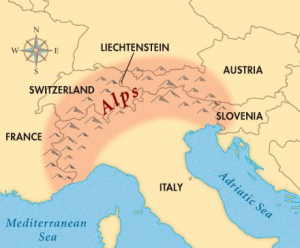
    The depressions form the valleys. The Himalayas, The Andes and the Alps are examples of Fold Mountain. They are the young mountains of the world and hence they have some of the highest peaks of the world.

    #2. Block Mountains:

    When large areas are broken and displaced vertically, Block Mountains are formed. In this case, the uplifted blocks are called horsts. On the other hand, the lowered blocks are called graben.

    Examples of Block Mountains are; the Rhine Valley and the Vosges mountain in Europe.

    source

    source

    source

    #3. Volcanic Mountains:

    A mountain formed due to volcanic activity is called Volcanic Mountain. Examples of Volcanic Mountains are; Mt. Kilimanjaro and Mt. Fujiyama.

    Andaman and Nicobar islands in India are the tip of the volcanic mountains which rise from the ocean floor.

    source

    #4. Dome Mountains:

    source

    source

    Dome mountains form when large globs of magma float up from beneath the crust and push up surface rocks, creating a rounded swelling in the crust. Once the magma cools, it creates a large dome of harder rock under the surface, which erosion sometimes reveals.