💥Join UPSC 2027,2028 Mentorship (July Batch) + XFactor Notes & Microthemes PDF

Subject: Fundamental Rights and Duties

  • Right to privacy is intrinsic to life and personal liberty and is inherently protected under Article 21 of the Constitution. Explain. In this reference discuss the law relating to D.N.A. testing of a child in the womb to establish its paternity.

    “Privacy is the constitutional core of human dignity.” – Justice D.Y. Chandrachud

    The Supreme Court in Justice K.S. Puttaswamy v. Union of India (2017) declared that Right to Privacy is intrinsic to Right to Life and Personal Liberty under Article 21.

    Scope of Right to Privacy (post-Puttaswamy)

    Informational Privacy – Protection of personal data, Aadhaar details, medical records, online footprints.

    Decisional Autonomy – Eg- Navtej Singh Johar (2018) decriminalised same-sex relations.

    Bodily Integrity – Eg- Suchita Srivastava v. Chandigarh Administration (2009) recognised reproductive choice.

    Family, Marriage & Relationships – Eg- Shafin Jahan v. Asokan (2018, Hadiya case) upheld interfaith marriage choice.

    Reproductive Rights – Eg- in X v. Principal Secretary, Health case (2022), SC allowed abortion for unmarried women under MTP Act.

    Digital Privacy – Protection against surveillance, right to internet access, and data protection in cyberspace. Eg- Aadhar Judgment

    However, Privacy is not absolute and subject to Reasonable Restrictions

    Test of Proportionality – Puttaswamy (2017) –

    Legalitysanctioned by law, with a just, fair, and reasonable procedure.

    Legitimate Aim – e.g., national security, public health.

    Proportionality – The nature, method, and extent of interference must be proportionate to the purpose sought.

    Arguments in Favour of DNA Testing

    Truth and Justice – Ensures scientific accuracy in resolving paternity disputes. Eg – Goutam Kundu v. State of West Bengal (1993) allowed DNA in exceptional cases.

    Child’s Right to Identity – Establishing paternity secures child’s dignity and identity under Article 21.

    Preventing Fraud – Avoids false claims in inheritance, custody, or maintenance disputes.

    Criminal Justice Support – DNA helps in rape and assault cases, strengthening convictions.

    International Standards – Aligns with UNCRC’s recognition of a child’s right to know parents.

    Arguments Against DNA Testing

    Privacy of Parents – Supreme Court in 2025 held that DNA cannot be used for “roving inquiries into paternity.”

    Right to Dignity – Privacy includes the right to be left alone; forceful DNA tests intrude into intimate decisions

    Genetic information = core privacy – DNA reveals “a person’s very essence” and is part of the fundamental right to privacy under Article 21.

    Potential Misuse – DNA demands in marital disputes may be used to harass women and allege infidelity.

    Mother’s dignity – Forced DNA tests also harm the reputation and dignity of mothers, by casting aspersions on fidelity.

    Presumption of LegitimacySection 112, Indian Evidence Act presumes legitimacy of child born in wedlock.

    Child’s dignity – Children cannot be treated as material objects in divorce battles; they have a right not to have their legitimacy frivolously questioned.

    UN Convention on Rights of the Child – Recognises privacy, autonomy and identity as core entitlements of children.

    Thus, the doctrine of ‘Eminent Need’ and ‘Last resort’ (Family courts should order DNA tests only in rare, expedient cases) is essential to balance a child’s right to identity with parents’ dignity and privacy.
  • Consider the following statements

    Consider the following statements:
    1. According to the Constitution of India, the Central Government has a duty to protect States from internal disturbances.
    2. The Constitution of India exempts the States from providing legal counsel to person being held for preventive detention
    3. According to the Prevention of Terrorism Act, 2002, confession of the accused before the police cannot be used as evidence.
    How many of the above statements are correct?

  • Consider the following statements

    Consider the following statements :
    Statement-I:
    The Supreme Court of India has held in some judgements that the reservation policies made under Article 16(4) of the Constitution of India would be limited by Article 335 for maintenance of efficiency of administration.
    Statement-II :
    Article 335 of the Constitution of India defines the term ‘efficiency of administration’.
    Which one of the following is correct in respect of the above statements?

  • Consider the following pairs

    Consider the following pairs:
    Provision in the Constitution of India: Stated under
    I. Separation of Judiciary from the Executive in the public services of the State The Directive Principles of the State Policy
    II. Valuing and preserving of the rich heritage of our composite culture The Fundamental Duties
    III. Prohibition of employment of children below the age of 14 years in factories The Fundamental Rights
    How many of the above pairs are correctly matched?

  • Right of way

    Why in the News?

    The Supreme Court has reaffirmed that the right to walk safely on demarcated footpaths is part of Article 21 and therefore a fundamental right. The judgment highlights the gap between constitutional recognition of pedestrian rights and the absence of adequate pedestrian infrastructure.

    What has the Supreme Court held on the right to walk?

    1. Article 21 Protection: The Court held that safe access to footpaths forms part of the right to life and personal liberty.
    2. Pedestrian Dignity: Walking is not merely a mode of transport. It is a constitutional entitlement linked to safety and dignity.
    3. State Responsibility: Governments must ensure safe pedestrian infrastructure and cannot treat pedestrians as secondary road users.
    4. Compensation Jurisprudence: The ruling emerged from a case involving the death of a five-year-old child who was hit by a tanker lorry in Karnataka.

    Why Does India Lack Functional Pedestrian Infrastructure?

    1. No central law: No national law governs pedestrian rights or safety.
    2. Vehicle-Centric Planning: Urban transport systems prioritise road expansion and vehicle movement.
    3. Fragmented responsibility: Responsibility for pedestrian safety is split across municipal laws, town-planning statutes, and street design guidelines, with no single accountable authority.
    4. Minimal safety standard: Current practice treats pedestrians as safe if they face no immediate physical harm, not if they have usable, continuous infrastructure.
    5. Physical encroachment: Existing footpaths are frequently encroached by parking, vendors, utilities, and construction debris.
    6. Competing infrastructure priorities: Road-widening projects compete with footpath space, with roads typically winning.

    Why is recognition of a right insufficient by itself?

    1. Rights Need Infrastructure: A right becomes ineffective when the supporting public infrastructure is absent.
    2. Implementation Deficit: India often struggles with execution rather than legal recognition.
    3. Administrative Neglect: Urban local bodies frequently delay or abandon pedestrian projects.
    4. Funding Priorities: Public expenditure remains concentrated on road widening and motorised transport.
    5. Behavioural Norms: Motorists often view pedestrians as obstacles rather than legitimate road users.

    What Tension Does the Ruling Expose Between Rights Recognition and State Capacity?

    1. Right without infrastructure is hollow: If the state does not build footpaths, the citizen’s right to walk on them carries no practical content.
    2. Compensation is not prevention: A right enforced only through post-tragedy compensation does not change the conditions that caused the harm.
    3. Conflict with the Street Vendors Act: The new judgment is likely to generate disputes with the 2014 Act, since reclaiming footpaths for pedestrians can mean removing vendors the 2014 Act protects.
    4. Risk of gentrification: A state acting on this ruling could use it to clear footpaths of informal commercial activity, criminalising the survival strategies of the urban poor under the cover of a pedestrian-rights judgment.

    Does India’s Experience with Rights-Based Legislation Suggest that Legal Recognition Alone Is Insufficient?

    1. Street Vendors Act, 2014: The Act protects vendors’ right to trade under Article 19(1)(g). Implementation has lagged because surveys, Town Vending Committees, and vending zones remain incomplete. Municipalities continue eviction drives despite legal protection.
    2. Cigarettes and Other Tobacco Products Act 2003: Public smoking declined through sustained enforcement, social messaging, and small immediate penalties. Behaviour changed because legal recognition was backed by continuous implementation.
    3. Swachh Bharat and Waste Segregation Laws: Citizens are required to segregate waste. Municipal systems often fail to collect segregated waste. The absence of supporting infrastructure weakens compliance.
    4. Implementation Gap: Rights and duties succeed only when governments create the institutions, incentives, and enforcement mechanisms needed to support them.
    5. Lesson for the Right to Walk: Pedestrian rights will remain symbolic unless cities build continuous, unobstructed footpaths and protect them from encroachment.

    What Precondition Determines Whether the Right Produces Real Change?

    1. Pedestrian Infrastructure as the Missing Link: Constitutional recognition cannot improve pedestrian safety unless cities build continuous and unobstructed footpaths.
    2. Funding Redirection as the Binding Constraint: The ruling’s success depends on shifting public expenditure towards pedestrian infrastructure rather than treating the judgment as a compensation mechanism.
    3. Risk of Legal Tokenism: If the right remains usable only for post-tragedy compensation claims, it produces no change in pedestrian mobility or safety.
    4. Cultural Internalisation of Right of Way: Pavements must be socially recognised as pedestrian space. Judicial declaration alone cannot alter road-use behaviour.

    What must change for the right to walk to become meaningful?

    1. Dedicated Pedestrian Infrastructure: Cities must invest in continuous and obstruction-free footpaths.
    2. Pedestrian-First Urban Design: Walking must become the foundation of street planning.
    3. Clear Space Allocation: Urban authorities must balance pedestrian access and vendor livelihoods.
    4. Municipal Accountability: Local bodies must be assessed on pedestrian safety outcomes.
    5. Stable Funding: Budget allocations must shift towards non-motorised transport infrastructure.

    Conclusion

    The Supreme Court has expanded constitutional protection for pedestrians, but rights alone cannot create safe streets. India’s challenge is not recognising the right to walk but building the footpaths, governance mechanisms and urban priorities that make that right real. The success of the judgment depends on shifting public investment and administrative attention towards pedestrian infrastructure rather than merely providing legal remedies after accidents.

  • Right to Walk on Footpaths Declared a Fundamental Right

    Why in the news?

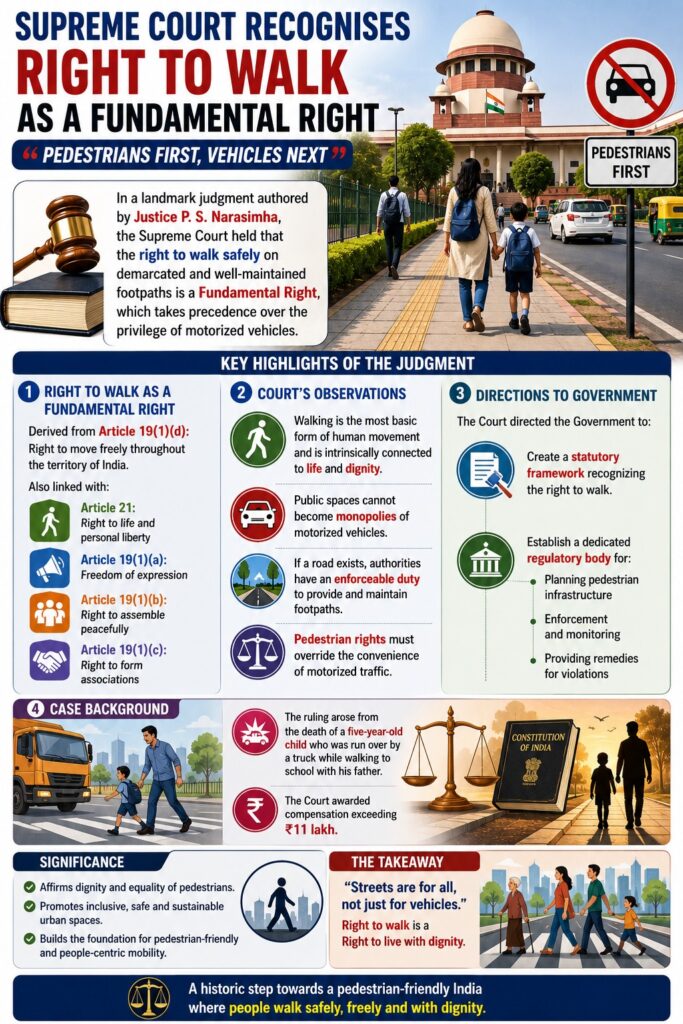
    The Supreme Court, in a landmark judgment authored by Justice P. S. Narasimha, held that the right to walk safely on demarcated and well-maintained footpaths is a Fundamental Right, which takes precedence over the privilege of motorized vehicles.

    Right to Walk as a Fundamental Right

    • Derived from Article 19(1)(d): Right to move freely throughout the territory of India.
    • Also linked with:
      • Article 21: Right to life and personal liberty.
      • Article 19(1)(a): Freedom of expression.
      • Article 19(1)(b): Right to assemble peacefully.
      • Article 19(1)(c): Right to form associations.

    Court’s Observations

    • Walking is the most basic form of human movement and is intrinsically connected to life and dignity.
    • Public spaces cannot become monopolies of motorized vehicles.
    • If a road exists, authorities have an enforceable duty to provide and maintain footpaths.
    • Pedestrian rights must override the convenience of motorized traffic.

    Directions to Government

    • Create a statutory framework recognizing the right to walk.
    • Establish a dedicated regulatory body for:
      • Planning pedestrian infrastructure.
      • Enforcement and monitoring.
      • Providing remedies for violations.
    • Judgment sent to Ministries of:
      • Housing & Urban Affairs
      • Rural Development
      • Road Transport & Highways

    Case Background

    • The ruling arose from the death of a five-year-old child who was run over by a truck while walking to school with his father.
    • The Court awarded compensation exceeding ₹11 lakh.

    [2018] Right to Privacy is protected as an intrinsic part of Right to Life and Personal Liberty. Which of the following in the Constitution of India correctly and appropriately imply the above statement?

    (a) Article 14 and the provisions under the 42nd Amendment to the Constitution.

    (b) Article 17 and the Directive Principles of State Policy in Part IV.

    (c) Article 21 and the freedoms guaranteed in Part III.

    (d) Article 24 and the provisions under the 44th Amendment to the Constitution.

  • In India, if a religious sect/community is given “the status of a national minority, what special advantages is it entitled to

    In India, if a religious sect/community is given “the status of a national minority, what special advantages is it entitled to?
    1. It can establish and administer exclusive educational institutions.
    2. The President of India automatically nominates a representative of the community to Lok Sabha.
    3. It can derive benefits from the Prime Minister’s 15-Point Programme. Which of the statements given above is/are correct?

  • Consider the following: 1. Right to education 2. Right to equal access to public service 3. Right to food Which of the above is/are Human Right/Human Rights under “Universal Declaration of Human Rights”

    Consider the following: 1. Right to education 2. Right to equal access to public service 3. Right to food Which of the above is/are Human Right/Human Rights under “Universal Declaration of Human Rights”?

  • Under the Constitution of India, which one of the following is not a Fundamental Duty

    Under the Constitution of India, which one of the following is not a Fundamental Duty?

  • Which of the following is/are among the Fundamental Duties of citizens laid down in the Indian Constitution

    Which of the following is/are among the Fundamental Duties of citizens laid down in the Indian Constitution?
    1. To preserve the rich heritage of our composite culture
    2. To protect the weaker sections from social injustice
    3. To develop the scientific temper and spirit of inquiry
    4. To strive towards excellence in all spheres of individual and collective activity
    Select the correct answer using the code given below: